Rorate Caeli

Hearts Aflame


A Pontifical Mass at the Faldstool was celebrated at the Hearts Aflame conference at Saint Bede's College in Christchurch, New Zealand, on Wednesday 14th January (Feast of St Hilary). The celebrant was the Most Rev'd Basil Meeking, Bishop Emeritus of Christchurch and an "old boy" of Saint Bede's College. This is believed to be the first Pontifical Mass in the Extraordinary form in the South Island of New Zealand since at least the 1960's. The Mass (and two chant workshops) were organized by Latin Mass Melbourne who travelled to NZ at the kind invitation of the Hearts Aflame team. Bishop Meeking also gave an excellent talk on the Extraordinary form and Summorum Pontificum. Hearts Aflame is a 10 day summer school for young Catholics between the ages of 18 and 35. It comprises daily Mass and singing of the Office (Lauds, Vespers and Compline), lectures, and workshops.

The photograph above shews the Bishop giving the Blessing at the Pontifical Mass; Father William Define FSSP as assistant priest, Father Clement Mary FSSR (formerly the Transalpine Redemptorists) as deacon, and Father Nicholas Dillon (present on loan to the Archdiocese of Melbourne) as subdeacon.

A surprise?


[2002 GMT:] Could there be a surprise during the Chair of Unity Octave?

Rumors have been intense in the past few days.
________________

UPDATE (2100 GMT):
DICI (SSPX News Agency)

Message of H. E. Bishop Bernard Fellay, Superior General of the Fraternity of Saint Pius X

Dear faithful,

The Rosary Crusade, to which we invited you in Lourdes, during our memorable pilgrimage of Christ-the-King, at the end of last October, has by far exceeded our expectations. In less than two months, one million seven hundred and three thousand rosaries were recited throughout the world to obtain from Our Lady the withdrawal of the decree of excommunication of 1988.

We would like to thank you all wholeheartedly. Considering such a generosity, we dare to ask you to continue your efforts in praying that this Crusade may bear its fruits for the good of the whole Church.

+Bernard Fellay
Menzingen, 20 January 2009
________________

UPDATE 2 (2250 GMT):

Rome. January 19. Own sources. In well-informed circles, it is said that Bishop Bernard Fellay, Superior-General of the FSSPX, would have already delivered, in a discreet visit to Rome, the "bouquet" of 1.000.000 rosaries offered to the Most Holy Virgin, asking for the grace that the Holy See remove the excommunications which weigh on the four Bishops consecrated in 1988. [Source: Argentinian online Catholic website Panorama Católico Mundial.]

The "Hermeneutic of Continuity" and the Joint Declaration on Justification

The Vatican website reports the address of the Holy Father to a Lutheran delegation from Finland this morning, during which he remarked: “The Lutheran-Catholic Dialogue Commission in Finland and Sweden continues to consider the Joint Declaration on Justification. This year we celebrate the tenth anniversary of this significant statement, and the Commission is now studying its implications and the possibility of its reception.”

When the Joint Declaration was first presented at a press conference in 1998 by Cardinal Cassidy, then president of the Pontifical Council for Promoting Christian Unity, it was accompanied by the official Response of the Catholic Church to the Joint Declaration, a document which the Congregation for the Doctrine of the Faith had collaborated on and which pointed out Lutheran passages in the Joint Declaration which appeared to contradict the Council of Trent. The whole purpose of the Joint Declaration was for Lutherans to say things on justification which would not contradict the teachings of the Catholic Church, and for Catholics to say things which would not contradict the Lutheran confessional documents. So when Cardinal Cassidy said the Joint Declaration was ready to be signed, the Lutheran World Federation demurred, saying it was impossible to sign as long as the Catholic Church found some parts of the declaration incompatible with the Catholic faith. Further discussions ensued, and the result was a joint Annex published in 1999 which offered clarification and interpretation in response to the Response of the Catholic Church. Cardinal Cassidy signed in Augsburg, Germany together with a Lutheran bishop on October 31, 1999. And still the disputes and interpretations were not over. There soon appeared an article signed *** (indicating a source within the Curia, probably the CDF) in Osservatore Romano commenting on the Annex which had noted that the Lutherans use the concept of “concupiscence” in a sense different from that of Catholics.

Not stated by the unsigned article was an obvious consequence: the only way to reconcile the Lutheran and Catholic statements on “concupiscence” in the JD—concupiscence is sin (Lutheran), concupiscence is not sin in the proper sense (Trent)--is to use distinct meanings for the subject term when the Lutheran and Catholic propositions are compared. And in the following years, various Catholic theologians would find the Joint Declaration simply indigestible for the Catholic mind. (As an aside, the present writer once spoke with an American archbishop who decided not to hold a joint observance in his diocese when both Catholic priests and Lutheran pastors told him they didn’t understand the Joint Declaration.) Some questioned the authority of the Joint Declaration (is the Christian Unity council president’s signature and a pope’s praise enough to make it an act of authority imposing assent on all the baptized?) as well as some of its content, finding various Lutheran passages to be contrary to the Catholic faith despite the document’s claim that they are compatible. Most notable among these theologians was the late Cardinal Avery Dulles whose 2002 article in the Josephinum Journal of Theology declared flatly that some Lutheran points made in the JD contradicted the Council of Trent and that no theology professor would be allowed to teach those points in a Catholic seminary. Professor Christopher Malloy of the University of Dallas published Engrafted Into Christ: A Critique of the Joint Declaration, a book which Fr. Augustine J. DiNoia, OP of the Congregation for the Doctrine of the Faith said needed to be read by all theologians who would treat of the topic (according to the publisher’s brochure).

Pope Benedict XVI has continued to mention the Joint Declaration in his addresses to Protestant groups. In some of his Wednesday catecheses on faith, love and the Law according to St. Paul he has stated Catholic doctrine on justification, although not always using the language and patterns of Trent and even reading the Lutheran slogan “by faith alone” in a Catholic sense. Clearly the famous hermeneutic of continuity with Tradition and the authentic magisterium has to be applied to ecumenical dialogue as well as to the Second Vatican Council. But this means that to the extent the Joint Declaration is “received” by Catholics coherent with the Faith, its key words will signify one thing to Catholics and something else to Lutherans. Better therefore to abandon the ecumenical model of “reconciled diversity” behind the Joint Declaration and return to argument from Scripture and Tradition, so that with God’s grace many Lutherans as individuals and communities may seek full communion and valid apostolic succession, thus restoring unity and enriching us with some good things God has given to baptized souls trapped in Lutheran error, but in good faith, over the centuries.

Fifty years ago:
The Pope sets the whirlwind in motion

Just three months into his pontificate, Pope John XXIII makes his plans known to his close advisor and Secretary of State, Cardinal Tardini.
An important audience. 
Yesterday afternoon [January 19, 1959], His Holiness reflected on and specified the programme of his papacy. He planned three things: a Roman Synod, an ecumenical Council, a revision of the Code of Canon Law. 
He wants to announce these three points next Sunday [January 25, 1959] to the Cardinals, after the ceremony in St. Paul's. 
I said to the Holy Father (who asked me): "I like beautiful new things. Now, these three points are very beautiful, and the way of making the first announcement to the cardinals is new (but linked to ancient papal traditions), and it is very appropriate."
Cardinal Domenico Tardini
Personal diary
January 20, 1959

The joint Liberal Jewish-Liberal Catholic taskforce
against Benedict XVI


Giorgio Israel, an Italian Jewish commentator (and Math professor at the University of Rome - La Sapienza), writes today in Il Foglio about the violent attacks of the Italian rabbinate against Pope Benedict XVI. Liberal Judaism acts together with the leaders of the "Progressive" Italian Church (led by the luminaries of the Archdiocese of Milan) to undermine the reputation of Pope Benedict XVI. What matters to them (and Liberal Jews do not even mind being used by the powerful Milanese Catholics for this) is to ridicule the Pope as a "neocon" and as a spent force.

Let us pray for our Holy Father, Pope Benedict XVI: that he may not be afraid of the wolves, from Milan or elsewhere.

Excerpts:

Ambrosian [Milanese] Catholicism and left wing Judaism march together to better attack Ratzingerism

by Giorgio Israel

It is significant that the violent attack in which Chief-Rabbi of Venice Richetti accused Benedict XVI of having demolished 50 years of Jewish-Christian dialogue would have appeared in the monthly of the Jesuits, Popoli

On the other hand, it is enough to stick to facts, without any recourse to the mediocre practice of hindsight, to realize that in this diatribe there are motives which have little to do with the merits [of the debate]. It should be noticed that none of the arguments proposed in opposition to the harsh attacks of the Italian rabbinate have ever been taken into consideration.

On the contrary, after the Chief-Rabbi of Rome, Riccardo Di Segni, praised the affirmation of the Pope according to whom, in a strict sense, interreligious dialogue is impossible - because, Di Segni says, it is better to avoid the theological dialogue - behold that Richetti then indicates it, on the other hand, as an evidence that there is no wish to dialogue!

The fact is that, while Di Segni, being cautious and wary, follows a line of rationality -"Dialogue is a process which should go on despite the difficulties. Pope Benedict XVI keeps rendering an original and decisive contribution, even though it is not always possible to share his positions"- there are those who have decided that it is necessary to battle the Pope at all costs, even at the cost of rekindling anti-Jewish sentiments which were never extinguished. 

Here we are in the presence of an internal struggle within the Catholic world in which a part of the Italian Jewish world is playing the role of the 7th Cavalry Regiment.
...

Afterwards, there were the polemics related to the Good Friday prayer which have led to the current suspension of the dialogue, decreed also in the words of a prohibition of [members of] the Community of meeting ecclesiastics.

Guido Guastalla and I dissented from such a suspension in a letter to Corriere della Sera (26 November 2008), with mild tone and with no shadow of polemics. 

In response, we received a violent answer signed by Rabbi Laras (President of the Italian Rabbis), by the President of the Union of Young Jews, and (a significant fact), not by the President, but by the former President of the Union of Jewish Communities, in the person of Amos Luzzatto. In this letter - in which it was urged [of us] not to bother with the dialogue, of exclusive competence of the rabbis (only "interlocutors" and "officials responsible for the religious representation") - the "capital" of the Jewish-Christian dialogue was indicated as Milan and in the persons of Cardinals Martini and Tettamanzi, on one side, and Laras and others [on the Jewish side]; and it was noticed that we were missing from this list... [sic]

In every circumstance, we always returned there, to Milan, around the Ambrosian Catholicism and a certain Leftist Judaism.
...
It is the ideological identity between a certain Catholicism of the Ambrosian [Milanese] style - the same [Catholicism] which watches the Islamic marches passively - and a Leftist Judaism, indifferent to being called a "degraded religious tradition" [Rorate note: words used by Martini]: what matters is to attack together the common enemy, the hated Ratzingerian neoconservatism... [sic]

Our dear Patron Saints - II


_______________________________

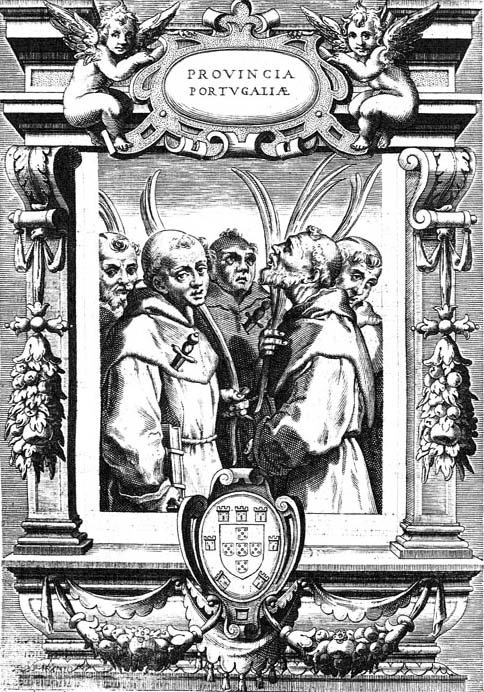
Today is the glorious feast of the Franciscan Protomartyrs, the main patrons of this page.

Collect

Deus, qui sanctorum Martyrum tuorum Berardi, Petri, Accursii, Adiuti atque Othonis glorioso certamine ordinis Minorum initia consecrasti: concede nobis famulis tuis; ut quorum lætamur triumphis, eorum virtutes imitemur. Per Dominum... (God, who has consecrated the beginnings of the Order of Friars Minor with the glorious struggle of your holy Martyrs Berard, Peter, Accursius, Adjutus, and Otho; make us, your servants, imitate the virtues of those in whose triumph we rejoice. Through Our Lord...)

Secret

Pro pretiosa, Domine, tuorum morte Sanctorum sacrificium istud offerimus: quo opem tuam nostris temporibus clementer impendas, et gratiam nobis veræ devotionis exhibeas. Per Dominum... (We offer this Sacrifice, o Lord, for the precious death of your Saints: that you may mercifully give your aid to our time, and that you may show us the grace of true devotion. Through Our Lord...)

Postcommunion

Cælestia, Domine, dona quæ sumpsimus, vitam nobis tribuant sempiternam; quam cum beatorum Martyrum tuorum Berardi, Petri, Accursii, Adiuti atque Othonis gloriosis meritis imploramus. Per Dominum... (Lord, may the heavenly gifts which we have consumed bring us everlasting life; this we implore by the glorious merits of your blessed Martyrs Berard, Peter, Accursius, Adjutus, and Otho. Through Our Lord...)

_______________________________

Holy Franciscan Protomartyrs,
Pray for us!

Our dear Patron Saints - I

From the January 16 entry of the Martyrologium Romanum, recited today:
Marrochii, in Africa, passio sanctorum quinque Protomartyrum Ordinis Minorum, scilicet Berardi, Petri atque Othonis Sacerdotum, Accursii et Adiuti Laicorum; qui, ob Christianæ fidei prædicationem ac Mahumeticæ reprobationem legis, post varia tormenta et ludibria, a Saracenorum Rege, scissis gladio capitibus, enecati sunt.

(from the Roman Martyrology, Jan. 16: "[A.D. 1220:] In Morocco, Africa, the martyrdom of the five Protomartyrs of the Order of Friars Minor, Berard, Peter, and Otho, priests, and Accursius and Adjutus, lay brothers; who, for preaching the Catholic Faith and for their condemnation of the Mohammedan Law, after various torments and mockeries by the Saracen king, and with their heads opened by the scimitar, were executed.")

In Jesuit magazine, Chief-Rabbi of Venice:
Pope has cancelled 50 years of Church History

The Jesuit (!) monthly Popoli (January 2009 issue) opened its pages for Elia Enrico Richetti, Chief-Rabbi of Venice, who severely criticizes the Holy Father and blames him (especially his liberalization of the Latin Mass and his reformed Prayer for the Jews on Good Friday) for the suspension of dialogue between Italian rabbis and the Church. The suspension was unilaterally declared by the rabbis.

The Assembly of Rabbis of Italy has made known that, at least for this year, there will be no collaboration between the Jewish Communities of Italy and the Catholic institutions for the celebration of the Day of Judaism (January 17). It is the logical consequence of a particular moment which the inter-Confessional dialogue is living today, a moment in which the signs began to appear when the Pope, by liberalizing the Latin Mass, indicated in the Tridentine Mass the norm to follow. In that formulation, in the prayers of Good Friday, there is a prayer which asks for the conversion of the Jews to the "truth" of the Church and to faith in the salvific role of Jesus. In truth, that prayer, which, in its first wording defined the Jews as "perfidious", that is "outside the faith" and blind, had already been "changed" (but never abolished) by John XXIII. Benedict XVI expunged from it the most offensive terms, and reintroduced it.

...
It is not, therefore, a matter of hypersensitivity: it is in the most banal sense about the respect owed to the other as a creature of God. If to that we add the most recent positions taken by the Pope regarding the worthiness of dialogue, defined as useless because in every case the superiority of the Christian faith is clear, it is evident that we march towards the cancellation of the past fifty years of the history of the Church. From this point of view, the interruption of the collaboration between Italian Jewry and the Church is the logical consequence of the ecclesiastical mindset expressed by its supreme authority.

The most underwhelming "news" of the year


Italian religious website Petrus repeats the "amazing" news "reported" by Italian weekly Panorama. In an article dedicated to several "finds" in the "Secret heart of the Vatican" (Nel cuore segreto del Vaticano, Panorama, n. 3/2009, p. 130-134), the newsweekly's reporters found the damning evidence that... Archbishop Marcel Lefebvre signed the documents of the Second Vatican Council.

No, really... Panorama's reporters found the top-secret signature (which it calls "The signature that unmasks Lefebvre") in some mysterious location, when they could have found the more "damning" document showing the Archbishop's signature of, among others, Gaudium et Spes (De Ecclesia in mundo huius temporis) or Dignitatis Humanae (De Libertate Religiosa) in our Rorate repository (see here).

The problem is: it is well known that Lefebvre placed his name upon the ceremonial lists of documents (for instance, both the list provided by Panorama and the one in our repository include a very diverse array of conciliar documents and, below them, signatures of bishops - the second list includes not only the above-mentioned documents, but also the only one which the Archbishop publicly praised, Presbyterorum Ordinis).

Irrespective of this, Bernard Tissier de Mallerais, Lefebvre's biographer and one of the Bishops consecrated by Lefebvre in 1988, had already written that the Archbishop had indeed placed his signature upon the Conciliar documents and among the Conciliar Fathers (Marcel Lefebvre: The Biography, published originally in French in 2002: cf. last pages of Chapter 13). This does not deny the fact that Lefebvre firmly voted against the final drafts both of Gaudium et Spes and Dignitatis Humanae.

Therefore, the only "new" information in the Panorama article is the attempt to create a false appearance of "scandal" in Italian-speaking Catholic circles in a very delicate moment. We will do our utmost to make clear that the shame is on Panorama, and on those who repeat false reports thoughtlessly.

______________________
Source of image: click here.

FSSPX Celebrates Mass at Amiens – in the Cathedral!

Having spent 63 Sundays celebrating Mass in the streets after being evicted from their chapel of 23 years in November of 2007, the FSSPX community of Amiens, France was invited into the Cathedral on Sunday to offer Mass at the altar of St. Joseph. The charitable gesture was made by the pastor of the Cathedral as the outdoor temperature dipped to 14ºF (-10ºC) creating a hazardous icy condition at the usual Mass site in front of church of St. Germain. The community thanked the pastor for his kindness.

Although the pastor’s motives are being debated in some quarters, let us pray that this is the start of a camaraderie between the local diocese and the FSSPX that will culminate in the finding of a permanent home for them in Amiens.


Amiens, des catholiques à la rue (photos)

* Update: Video montage of the Mass

You Report:
Traditional Masses around the world - XV
Brazil and Virginia


1. A reader from the State of Rio de Janeiro, Brazil, sends us this report and pictures of the regular Traditional Mass celebrated in Niteroi, across the bay from city of Rio de Janeiro:

As reported in the Catholic news website kreuz.net, the Holy Sacrifice of the Mass in the Extraordinary Form of the Roman Rite has been celebrated in the Cathedral of Niterói since December 2007. The Tridentine Mass, as it is commonly known, has been piously celebrated every Sunday afternoon by two young priests from the Archdiocese of Niterói, namely: Fr. Anderson Batista da Silva and Fr. Demétrio Gomes da Silva.

The faithful come from different parish churches and even from the adjacent municipalities where the Motu Proprio has not been implemented yet. In addition to a stable group of so-called Traditional Catholics, there are also newcomers who head to the Cathedral of Niterói to experience the sacredness and beauty of the Rite of Saint Pius V.

Fr. Anderson Batista wishes to have an improved Gregorian chant choral in place, while planning to provide his faithful with a deeper Catechetical formation during his sermons.

Curiously, traditional Catholics from the City of Rio de Janeiro, a neighbor metropolis with approximately 7,000,000 inhabitants, do not have the same privilege, since the Motu Proprio has found some hindrance among the local hierarchy.

Let us pray so that the grandeur and reverence of the Gregorian Mass may be known and loved by Catholics all over the world, in every parish church, as already announced by Cardinal Castrillón Hoyos. Let us ask for the intercession of Our Blessed Mother, so that the Walls of Jericho that are hindering the implementation of the Motu Proprio in Rio de Janeiro may fall soon.
Congratulations to the faithful of Niteroi and neighboring cities, to the priests who serve this community, as well as to all whose past labor generated so much love for the Traditional Mass in that city!


2. Reader L. Hertz sends us pictures from the celebration of the Solemn Mass celebrated for the Feast of the Epiphany in Gainesville, Virginia. The whole set is available at Flickr.

British journals publicize Traditional Calendar

Our friends at The Latin Mass Society of England and Wales remind us to post the following press release:

British Catholic Newspapers Recognise the Extraordinary Form (Traditional Latin Rite) Calendar 

After prompting from the Latin Mass Society of England and Wales, two leading British Catholic journals now publish weekly information on the Liturgical Calendar for the Extraordinary Form. 

The Catholic Herald, the main ‘conservative’ Catholic paper, publishes the full weekly calendar for the Extraordinary Form alongside that for the Ordinary Form. This is provided for them each week by Gordon Dimon, the LMS’s Senior MC, who also compiles the LMS’s annual Ordo which is used by priests worldwide. 

More surprisingly, The Tablet – the main British journal of ‘liberal’ Catholicism – also runs a weekly link to the Latin Mass Society’s website (www.latin-mass-society.org) where the full Ordo can be consulted (along with much else of interest to enquiring Catholics). 

John Medlin, LMS General Manager, said: “I was pleased at how responsive both The Catholic Herald and The Tablet were to my suggestion that they acknowledge the calendar for the Extraordinary Form. It shows that the Extraordinary Form is becoming accepted for what it is – a rite of equal standing with the Ordinary Form. The other two main British Catholic newspapers – The Universe and The Catholic Times – have yet to catch up with the Herald and Tablet. I will keep prodding them!”

Pell as new Prefect of the Congregation for Bishops?

French ultra-"Progressive" religious weekly Golias reports on possible replacements for some important heads of dicasteries who have reached the age limit or will reach it soon.

Cardinal Re, Prefect of Bishops, reaches the age limit next January 30. Other rumors are included in the article, but none so interesting as this one: Golias reports that it "should be known that one of the most mentioned names for the Congregation for Bishops is that of the ultra-Conservative [sic] Cardinal George Pell, of Sydney". 

_________________
Tip: Le Forum Catholique and Reader.

Nobody expects the Trappist Inquisition

A cryptic communiqué issued by the office of Dom Eamon Fitzgerald, Abbot General of the Cistercian Order of the Strict Observance (the Trappists), regarding Mariawald. Full text:
Mariawald

Some monasteries have learned through the media that the Abbot of Mariawald requested the Holy Father, Pope Benedict XVI, to grant to his community the privilege of “returning to the old liturgy as well as to the former usages of the Trappists (the ‘Usus’ di Monte Cistello – Rome 1964)”. This privilege was granted and communicated to Dom Josef Vollberg by the President of the Pontifical Commission “Ecclesia Dei”, Dario Cardinal Castrillón Hoyos. 

In a letter of November 20th the Cardinal informed the Abbot General of this decision. On December 20th , the Abbot General wrote to the Cardinal requesting some clarifications.

Korean Bishops denounce Charismatic excesses

Finally, a bishops' conference has the courage to take on a movement that, until very recently, has been practically above public criticism in the Catholic Church despite the numerous errors and dubious practices associated with it. The specific condemnation of the practice of "family tree healing" -- very common in charismatic circles -- is most necessary. CAP.
SEOUL (UCAN) -- Korean bishops, in a recent document, mentioned certain negative aspects of the charismatic movement in the Church here, while at the same time acknowledging its contributions to Church life.
The Committee for the Doctrine of the Faith of the Catholic Bishops' Conference of Korea (CBCK) says that although the movement has helped to renew the faith of Catholics, some aspects have been questionable.

Its 88-page document, Right Understanding of the Holy Spirit, cites certain misunderstandings of the faith and unethical behavior of some followers, the abuse of spiritual gifts, a fanatical atmosphere at some prayer meetings, and deviation from Church teaching by some laypeople, priests and Religious.

The document, which the committee issued on Dec. 24, attributes decades of growth in the spiritual renewal movement, which focuses on the power of the Holy Spirit to transform lives, to members' dedication. However, it pointed out that some followers have pursued fame, money and privilege, which it calls "a great obstacle" to the movement.

The bishops' committee says some of these people have sought money from people, claiming they possess the gift of healing or prophecy.

It also maintains that some followers have sought spiritual gifts for personal gain rather than for the common good, and that others have focused on prayers for healing physical illnesses rather than for inner renewal.

Committee secretary Father Benedict Son Hee-song told UCA News on Jan. 7 that the document aims to provide guidance for the movement's development.

It has reached a stage where one can see its strengths and weakness, explained Father Son, a professor at Seoul archdiocese's major seminary. "So we need to review the movement and direct its future development."

The Church official acknowledged the movement "has improved in many ways since its early stages, but needs to make greater effort to follow Church teaching."

Nonetheless, Father Thomas Oh Tae-soon, president of the National Catholic Charismatic Service Association (NCCSA), says he remains confident about the movement. It has been on the right track for a long time, he told UCA News, adding that the document does not perturb him.

Paul Chung Ok-dong, former president of the Seoul Catholic Charismatic Service Association, admits that in the 1970s and 1980s, when the movement was growing rapidly, quite a number of followers sought money and fame.

"These days few do so, though sometimes I hear some of them still do it in secret," said the 73-year-old layman, who got involved in the charismatic renewal in 1974. He added, "I think the document is timely but it sounds a little bit negative toward charismatics."

In addition to explaining the nature of the Holy Spirit and how to discern spiritual gifts, the document warns against "family-tree healing," practiced in some charismatic prayer meetings.
Proponents of this practice believe that the sins of ancestors are transmitted to descendents, who therefore cannot help but commit misdeeds and, as a result, suffer misfortunes such as illness, suicide and miscarriage.

The document urges "all Catholics not to accept such a false claim," pointing out that it runs counter to Church teaching on the grace received through the Sacrament of Baptism, which cleanses all sins including original sin.

The Korean bishops discussed the matter during their October 2007 plenary assembly and warned Catholics that "family-tree healing" goes against Church teaching on prayers for healing.

According to an NCCSA official, all 15 dioceses in the country have charismatic organizations that conduct regular prayer meetings at the parish and diocesan levels.
END

Reform at Ecclesia Dei?
Pontifical Commission downgraded?

Excerpt of a report in the current issue of French magazine Monde et Vie, on rumors regarding a reform of the Pontifical Commission Ecclesia Dei:

The pope wishes to use the nomination of his right-hand man [Cardinal Cañizares Llovera] at the helm of the Congregation for Divine Worship [as a means] to profoundly reorganize the Ecclesia Dei Commission, where Cardinal Cañizares is already a member. According to the rumor, which seems to be just backstage gossip, Cardinal Castrillón Hoyos, who has surpassed the age limit for a long time, would cede his place to his current second, Mgr. Camille Perl, a personal friend to Pope Ratzinger, who would be consecrated a bishop for the event.

And the Commission would then be attached to the Congregation for Divine Worship, bearing responsibility, within a dicastery, for the Traditional form of the Roman rite, under the patronage of Cardinal Cañizares. [...] This means, at any rate, that the Ecclesia Dei Commission is placed within the ecclesial landscape. [Rorate Note: And where is the commission now? Outside the Church?]

Besides, its supposed man in charge, Mgr. Perl, is certainly the one in Rome who knows the Traditionalist world best, its twists, its turns, or its detours. He has had the Pope's ears for a long time. In more than one occasion, his diplomacy has done wonders.
__________
Tip: Le Salon Beige.

"The Way" at the heart of the Church

The Pope will preside this Saturday an audience in Saint Peter's Basilica, celebrating the 40th anniversary of foundation of the Neocatechumenal Way. The audience will include a Te Deum and an Apostolic Blessing. (Several sources)

It is quite good that there will be no papal mass for them...

No desire for reform - in Russian Orthodoxy

Interfax reports on comments made by the current locum tenens of the Moscow Patriarchate:

There will be no reforms in the Russian Orthodox Church when a new Patriarch takes office, Patriarchal Locum Tenens Metropolitan Kirill told the media in Moscow on Monday.

"I strongly oppose any church reforms. Besides, I do not think that any of the 145 archbishops that may be nominated for Patriarch have reform aspirations," he said.

Russia has twice learned "the necessity of careful attitude to traditions, especially church traditions," the Metropolitan said.

"The first lesson we learned was the church split by Old Believers. Our second lesson was the notorious innovations of the 1920s. Both processes caused agitation and divided people but neither of them reached the goals set by the reformers," he told.

"Church reforms cannot attain their goals unless these goals are rooted in people's life," Metropolitan Kirill remarked.

"Our Church is strong with its ability to preserve the belief and the flawless moral paradigm and to pass them over from one generation to another," the Metropolitan said.

"The Church is conservative by nature, as it maintains the apostolic belief," he added.

"If we want to pass the belief from one generation to another for centuries, the belief must be intact. Any reform damaging the belief, traditions and values is called heresy," he said.

Tip: Reader "John"

No shadow dims the light of Christ


It is divine love, incarnate in Christ, that is the fundamental and universal law of Creation. This is to be understood not in a poetical sense, but in a real one. Thus understood also Dante himself when, in the sublime verse which ends the Paradiso and the entire Divine Comedy, he defines God [as] "the love which moves the sun and the other stars” (Paradiso, XXXIII, 145).

This means that the stars, the planets, the universe as a whole are not governed by a blind force; they do not obey the dynamics of matter alone. They are not therefore cosmic elements that must be deified; on the contrary, in all and above all there is a personal will, the Spirit of God, that was revealed in Christ as love. ...


The Son of man sums up in himself earth and sky, creation and Creator, flesh and Spirit. He is the centre of the cosmos and history because in Him Author and work are united without merging. ...


There is no shadow, however dark, that can dim the light of Christ. For this reason believers in Christ never lose hope for the great social and economic crisis troubling mankind today, the destructive hatred and violence that continue to shed blood in many regions of the world and man’s selfishness and pretensions to be his own god, which leads sometimes to dangerous distortions of God’s design about life and the human dignity in matter of the family and the harmony of Creation.
Benedict XVI
Homily - Feast of the Epiphany
January 6, 2009

In nomine Iesu

In nomine Iesu omne genu flectatur, cælestium, terrestrium, et infernorum. (From the Introit for the Feast of the Holy Name of Jesus: Philippians ii, 10)

The name of Jesus is the glory of preachers, because the shining splendor of that name causes his word to be proclaimed and heard. And how do you think such an immense, sudden and dazzling light of faith came into the world, if not because Jesus was preached? Was it not through the brilliance and sweet savor of this name that God called us into his marvelous light? ...

So this name must be proclaimed, that it may shine out and never be suppressed. But it must not be preached by someone with sullied mind or unclean lips, but stored up and poured out from a chosen vessel. That is why our Lord said of Saint Paul: "He is a chosen instrument of mine, the vessel of my choice, to carry my name before the Gentiles and kings and the sons of Israel." In this chosen vessel there was to be a drink more pleasing than earth ever knew, offered to all mankind for a price they could pay, so that they would be drawn to taste of it. Poured into other chosen vessels, it would grow and radiate splendor. For our Lord said: "He is to Carry my name."

When a fire is lit to clear a field, it burns off all the dry and useless weeds and thorns. When the sun rises and darkness is dispelled, robbers, night-prowlers and burglars hide away. So when Paul's voice was raised to preach the Gospel to the nations, like a great clap of thunder in the sky, his preaching was a blazing fire carrying all before it. It was the sun rising in full glory. Infidelity was consumed by it, false beliefs fled away, and the truth appeared like a great candle lighting the whole world with its brilliant flame.

By word of mouth, by letters, by miracles and by the example of his own life, Saint Paul bore the name of Jesus wherever he went. He praised the name of Jesus at all times, but never more than when bearing witness to his faith. Moreover, the Apostle did indeed carry this name before the Gentiles and kings and the sons of Israel as a light to enlighten all nations. And this was his cry wherever he journeyed: "The night is passing away, the day is at hand." Let us then cast off the works of darkness and put on the armor of light; let us conduct ourselves honorably as in the day. Paul himself showed forth the burning and shining light set upon a candlestick, everywhere proclaiming Jesus, and him crucified.

And so the Church, the bride of Christ strengthened by his testimony, rejoices with the psalmist, singing: "O God, from my youth you have taught me, and I still proclaim your wondrous deeds." The psalmist exhorts her to do this, as he says: "Sing to the Lord, and bless his name, proclaim his salvation day after day." And this salvation is Jesus, her savior.
Saint Bernardine of Siena
De glorioso Nomine Iesu Christi

______________
Recess for two days - Urgent news may be reported.

"Compromise is compromise. It cannot go on forever"


By "self-ordination" the Cardinal of Hong Kong is clearly referring to the continued consecration of Chinese "Patriotic Catholic" bishops appointed by the Communist government in Beijing, without any papal mandate. CAP.


January 2, 2009

HONG KONG (UCAN) -- Cardinal Joseph Zen Ze-kiun of Hong Kong has called for bishops in mainland China to courageously fulfill their responsibilities to the Church, saying compromise cannot last forever.


The cardinal made the call in his article in the Jan. 4 issue of Kung Kao Po, the diocese's Chinese-language weekly. On Dec. 24, he had announced to local media that Pope Benedict XVI had agreed to let him retire in the first half of 2009, although the date of retirement has yet to be announced, and that he would focus on China Church affairs.


In his article, “Inspiration from St. Stephen’s Martyrdom,” the cardinal reviewed developments since 2006 and made an appeal to his “brothers in mainland China.”


“Don’t be afraid. Bear the responsibilities that history has placed upon you! In this critical moment, your choice could revive the Church or it could let her languish for a long time,” he told mainland bishops.


“You are held accountable to history and you must be prepared to stand firm without blemish before God’s judgment,” he continued.


His call was prompted by anticipation that Vatican-approved bishops in the open Church might participate in the election of chairpersons of the government-recognized Chinese Catholic Patriotic Association (CCPA) and Bishops’ Conference of the Catholic Church in China (BCCCC) during the next National Congress of Catholic Representatives.


The national congress, the highest self-governing body of the CCPA and BCCCC, is supposed to be held every five years.


Bishops. The sixth congress elected Michael Fu Tieshan to head the CCPA in 1998, and the seventh elected Joseph Liu Yuanren of Nanjing to head the BCCCC in 2004. Neither prelate was recognized by the Vatican. Their posts have remained vacant since Bishop Liu died in 2005 and Bishop Fu in 2007.


No national congress has been announced, but the government-approved "open" Church celebrated in 2007 the golden jubilee of the founding of the CCPA, and in 2008 the jubilee of the “self-election and self-ordination” of bishops.


The China Church began illicit episcopal ordinations in 1958. Since then, there have been about 170 "self-elected, self-ordained" bishops in China.


The prelate also pointed out that some “learning sessions” appear to have taken place, seemingly in preparation for the congress.


“Must the meeting take place?” he asked. “Is it not an insult in response to the pope’s letter to Chinese Catholics - or perhaps you could call it a slap on his face – if (bishops are) joining such a meeting?”


More directly he asked mainland clergy, “Does your conscience allow you to do that? Would the people of God accept such behavior from you?”


Pope Benedict’s letter to Chinese Catholics, released on June 30, 2007, stated Catholic Church principles and gave pastoral guidelines.


Cardinal Zen encouraged the mainland bishops to follow the example of the first Christian martyr, Saint Stephen, assuring that being open about their stance would not result in “total loss.”


In his article, the cardinal quoted an unidentified person telling the "underground" clergy that compromise was wise, because “we are in communion with the pope and recognized by the government, and can take care of the Catholics.”


“Instead, you prefer staying in jail, sacrifice your lives, and so your faithful are abandoned without anyone to take care of them,” the unnamed person reportedly said.


However, “compromise is compromise,” the cardinal warned. “It cannot go on forever.”


“One should not give up the truth of faith forever for the sake of evangelization,” he stressed.


With regret, he said more than a dozen Vatican-approved bishops in the open Church had taken part in three ordinations conducted without Vatican approval in 2006.


On the contrary, 2007 contained “a ray of hope,” since the Vatican convened a meeting on the Church situation in China, and the pope wrote his letter to Chinese Catholics. The CCPA 50th anniversary celebration in July 2007 could be described as the “aftermath of the era before the papal letter,” Cardinal Zen remarked.


By now, however, all should have digested the content of the papal document, he wrote. That is why participating in “self-election and self-ordination” celebrations of bishops in December 2008 “made one feel perplexed.”


The Vatican sent another letter to encourage bishops to stand behind the pope’s teaching, Cardinal Zen added.


That letter, signed by Cardinal Tarcisio Bertone, Vatican secretary of state, on April 22, 2008, was addressed to all Vatican-approved bishops in mainland China.


Source: http://www.ucanews.com

Image of Cardinal Zen is from the Solemn Pontifical Mass (1962 Missal) he offered last year in Hong Kong. More can be found in this wonderful webpage.

Pilgrimages in Ireland in honor of St. Paul

Upon the request of our friends in the St. Conleth's Catholic Heritage Association, we are posting the following announcements:
The first pilgrimage will be to Dublin on Saturday, 24th January, 2009, where Mass will be celebrated in the Gregorian Rite at 11 a.m. in St. Paul's Church on Arran Quay on the banks of the River Liffey. Blessed Columba Marmion was baptised in this Church, which was home for many years to the Latin Mass in the Archdiocese of Dublin.
The second pilgrimage will be to Kilcock, Co. Kildare, on Saturday, 21st March, 2009, where Mass will be celebrated in the Gregorian Rite in St. Coca's Church. Kilcock, on the bank of the Royal Canal, stands upon the site of the foundation of St. Coca, another ourstanding lady Saint of Kildare, of whom more in June about the time of her feastday.
The third confirmed pilgrimage is to the village of Vicarstown, Co. Laois, on Saturday, 25th April, 2009, where Mass will be celebrated in the Gregorian Rite at 11 a.m. in the Church of the Assumption. Vicarstown lies on the banks of the Grand Canal, near the ancient monastic settlement of Clonenagh, home of St. Fintan, known as the Father of Irish Monks, and St. Aengus the Culdee, author of the Felire and co-author with Maelruain of the Martyrology of Tallaght.

You report:
A Parish transformed by Summorum Pontificum


The Rev. Father Anthony Robbie, Parish Priest of Saint Dominic's Parish (in Homebush West, a suburb of Sydney, Australia), sends us this heartwarming report from his post-Summorum experience.

My parish instituted an extraordinary form Mass on the day Summorum Pontificum came into effect. At first we kept the Mass for the First Friday of each month. After three months, the people having supported the development, I moved the EF celebration to every Saturday morning. I should stress that it was my intention that this not be a token extra Mass for the parish, but be the regular scheduled parish Mass. I picked that Mass because it had the lowest attendance of all the week’s Masses. 

The result? The attendance trebled. I should point out that we did not get an influx of outside people seeking the EF. The trebling of Mass attendance was of my own parishioners. The effect has been to bring the traditions of our faith into the ordinary spiritual life blood of the parish. There were no complaints, no one stopped coming to Mass and the servers took delight in learning the EF and never miss their Saturday morning. All round, a great success.

My parish is where the Fraternity of St Peter established their seminary (Ezechiel House) in the parish convent, and although they have now moved on to more spacious accommodation, we remember them with fondness and support their work in any way we can.

God will not abandon us if...

The birthday of Christ, which we are currently celebrating, is entirely suffused with the light of Mary and, even as we pause to contemplate the child in the manger, our gaze cannot but turn with recognitions toward his Mother, who with her 'yes' made the gift of Redemption possible. 

This is why Christmastide has profoundly Marian connotations. The birth of Jesus, the man-God, and Mary's divine maternity are indissoluble realities. The mystery of Mary and the mystery of the only-begotten Son of God, who becomes man, form a single mystery, in which one helps to better understand the other.

...

In such times as ours, marked by uncertainty and concern for the future, it is necessary to experience the living presence of Christ. It is Mary, the Star of Hope, who leads us to Him. It is [Mary], with maternal love, who can lead to Jesus, especially the young, who bear in their heart irrepressible questions about the meaning of human existence.
...

Even though quite a few dark clouds are gathering over our future, we must not be afraid. Our greatest hope as believers is in eternal life in the company of Christ and the entire family of God. This great hope gives us strength to face and overcome the difficulties of life in this world. The maternal presence of Mary ensures tonight that God shall never abandon us if we entrust ourselves to Him and follow his teachings.
Benedict XVI
December 31, 2008

En la Catedral Primada


Creer en Mexico, the best Mexican blog on Traditional matters, reports on the Solemn Latin Mass celebrated yesterday in the majestic Cathedral of Mexico City (Altar of the Kings), by Father Jonathan Romanoski, FSSP.

Announcements

1. Our reader L. Hertz sends us the following notice:

For the feast of the Epiphany (7 PM) , there will be a Solemn High Mass at Holy Trinity parish, in Bristow-Gainesville-Haymarket area of Virginia (8213 Linton Hall Rd, Bristow, VA 20136).

Several local seminarians from the Priestly Fraternity of St. Peter, the Institute of Christ the King, and St. Charles Borromeo, as well as diocesan priests, will be serving or singing at the Mass. The parish priests are Fr. Peffley and Fr. Wooton, to whom we are greatly indebted for affording us this extraordinary opportunity to offer this very solemn form of the Traditional Mass.

All are invited and encouraged to witness this magnificent liturgical form of the immemorial Roman Rite.

Priest and faithful together

Interesting excerpts of an interview granted by the Master of Papal Liturgical Ceremonies, Mons. Guido Marini, to Italian daily Il Tempo (Sunday edition):

When shall we see Pope Benedict celebrating the Latin Mass according to the extraordinary Roman Rite, that of Saint Pius V? I personally viewed the 'motu proprio' as an act of liberality, of openness, not of closemindedness.

[G.Marini:] "I do not know. Many faithful have availed themselves of this possibility. The Pope will decide, if he considers it appropriate."

[...] The Pope, a year ago, celebrated Mass in the Sistine Chapel with his back turned to the people. Who it was who proposed it to him?

[G. Marini:] "It was I who proposed it to him. The Sistine Chapel is a treasure chest. It seemed a strained effort to alter its beauty b y building an artificial, made-up stage. In the ordinary rite, this celebration 'with the back turned to the people' is a foreseen position. Yet I underline: the back is not turned to the faithful, but the celebrant and the faithful are turned towards the only point that counts, which is the Crucifix."

Tip: Papa Ratzinger blog

60 years ago


On December 26, 1948, Cardinal Mindszenty, Archbishop of Ersztergom and Primate of Hungary, was arrested by the Communist government of that nation. It was the beginning of a slow via crucis which would last until his last days. Pope Pius XII, who had named him Archbishop and created him Cardinal right after the war, condemned the action a few days later through his Letter Acerrimo Moerore ("To the Bishops of Hungary", January 2, 1949 - in Italian). 

For a contemporary account of the Mindszenty affair: Time magazine archives.

Mass at Dawn

The Mass of Christmas Dawn for the Melbourne Latin Mass Community was celebrated in the School Chapel at Burke Hall, Xavier College, Kew. A Low Mass is celebrated every Sunday morning at Kew; on Greater Days, however, a Solemn Mass is celebrated.

Fr John McDaniels celebrated the Dawn Mass, assisted by Fr Glen Tattersall.  

It is a wonderful blessing to have available a Solemn Mass for all three Christmas Masses and great credit must be given to the small mixed choir, directed by Hugh Henry, which rendered beautifully all the Gregorian chants of the Mass, with occasional polyphony; and an indefatigable team of servers who assisted  in the sanctuary: a splendid effort.  

Below are some photographs taken at the Mass.  All the images in these posts of the Christmas Liturgies may be clicked on for an enlarged view.

At the Confiteor:


Incensation of the celebrant:


At the Collect:


Blessing the deacon:


Kissing the Book of the Gospels:


Incensing the celebrant after the Gospel:


At the "Et Incarnatus":


The beginning of the Canon:


At the Commemoration of the Living:


At the Elevation of the chalice:


At the Commemoration of the Dead:


At the Blessing:


At the Last Gospel:


He became a child


The medieval theologian William of Saint Thierry once said that God – from the time of Adam – saw that his grandeur provoked resistance in man, that we felt limited in our own being and threatened in our freedom. Therefore God chose a new way. He became a child. He made himself dependent and weak, in need of our love. Now – this God who has become a child says to us – you can no longer fear me, you can only love me.

With these thoughts, we draw near this night to the child of Bethlehem – to the God who for our sake chose to become a child. In every child we see something of the Child of Bethlehem. Every child asks for our love. This night, then, let us think especially of those children who are denied the love of their parents. Let us think of those street children who do not have the blessing of a family home, of those children who are brutally exploited as soldiers and made instruments of violence, instead of messengers of reconciliation and peace. Let us think of those children who are victims of the industry of pornography and every other appalling form of abuse, and thus are traumatized in the depths of their soul. The Child of Bethlehem summons us once again to do everything in our power to put an end to the suffering of these children; to do everything possible to make the light of Bethlehem touch the heart of every man and woman. Only through the conversion of hearts, only through a change in the depths of our hearts can the cause of all this evil be overcome, only thus can the power of the evil one be defeated. Only if people change will the world change; and in order to change, people need the light that comes from God, the light which so unexpectedly entered into our night.


Benedict XVI
Midnight Mass (click for all papal Christmas texts)

Salus æterna humano generi apparuit
Merry Christmas!

Midnight Mass in Melbourne

Church of Saint Aloysius, Caulfield

A large congregation of the Faithful attended Midnight Mass in the Extraordinary Form on a mild summer's evening in Caulfield (Archdiocese of Melbourne).

The Solemn Mass was celebrated by Father Glen Tattersall, assisted by Father John McDaniels, priests of the Archdiocese of Melbourne whose apostolate is solely devoted to ministering to the Faithful in the Extraordinary Form of the Roman Rite.

The ceremonies of the Mass and the singing of the choir were carried out, as usual with the greatest beauty and dignity.

Below are some photographs from the Mass.

Preparation of Incense:


At the Gloria:


At the Collect:


Chanting the Gospel:


Et incarnatus est:


After Holy Communion:


The Last Gospel: