Rorate Caeli

Do not forget them


Read more about the sufferings of the Christians of Iraq in recent weeks here, here and here. Pray for them.

Their fear has become so great that, in Basra, the Christians have not only canceled their Christmas celebrations in order to avoid Shiite retaliation, they will also send delegations to the Shiite mosques to "show their respects" on the Shiite "holy day" of Ashura (which falls this year on December 27). Let no one condemn them -- the terror caused by the "Religion of Peace" can only be imagined.

Salus æterna humano generi apparuit
A blessed and happy Christmastide!

Note of the Holy See Press Office
concerning the decree on the heroic virtues of Pius XII

"The Pope's signing of the decree 'on the heroic virtues' of Pius XII has elicited a certain number of reactions in the Jewish world; perhaps because the meaning of such a signature is clear in the area of the Catholic Church and of specialists in the field, but may merit certain explanation for the larger public, in particular the Jewish public who are understandably very sensitive to all things concerning the historical period of World War II and the Holocaust.

"When the Pope signs a decree 'on the heroic virtues' of a Servant of God - i.e., of a person for whom a cause for beatification has been introduced - he confirms the positive evaluation already voted by the Congregation for the Causes of Saints. ... Naturally, such evaluation takes account of the circumstances in which the person lived, and hence it is necessary to examine the question from a historical standpoint, but the evaluation essentially concerns the witness of Christian life that the person showed (his intense relationship with God and continuous search for evangelical perfection) ... and not the historical impact of all his operative decisions".

"At the beatification of Pope John XXIII and of Pope Pius IX, John Paul II said: 'holiness lives in history and no saint has escaped the limits and conditioning which are part of our human nature. In beatifying one of her sons, the Church does not celebrate the specific historical decisions he may have made, but rather points to him as someone to be imitated and venerated because of his virtues, in praise of the divine grace which shines resplendently in them'.

"There is, then, no intention in any way to limit discussion concerning the concrete choices made by Pius XII in the situation in which he lived. For her part, the Church affirms that these choices were made with the pure intention of carrying out the Pontiff's service of exalted and dramatic responsibility to the best of his abilities. In any case, Pius XII's attention to and concern for the fate of the Jews - something which is certainly relevant in the evaluation of his virtues - are widely testified and recognised, also by many Jews.

"The field for research and evaluation by historians, working in their specific area, thus remains open, also for the future. In this specific case it is comprehensible that there should be a request to have open access to all possibilities of research on the documents. ... Yet for the complete opening of the archives - as has been said on a number of occasions in the past - it is necessary to organise and catalogue an enormous mass of documentation, something which still requires a number of years' work.

"As for the fact that the decree on the heroic virtues of Pope John Paul II and Pope Pius XII were promulgated on the same day, this does not mean that from now on the two causes will be 'paired'. They are completely independent of one another and each will follow its own course. There is, then, no reason to imagine that any future beatification will take place together".

"It is, then, clear that the recent signing of the decree is in no way to be read as a hostile act towards the Jewish people, and it is to be hoped that it will not be considered as an obstacle on the path of dialogue between Judaism and the Catholic Church. Rather we trust that the Pope's forthcoming visit to the Synagogue of Rome will be an opportunity for the cordial reiteration and reinforcement of ties of friendship and respect".

"The only true union"

Today is the sixtieth anniversary of the instruction of the Holy Office on the ecumenical movement. As the heroic virtues of Pope Pius XII are finally recognized by the Holy See, perhaps we would do well to also remember the teaching, promulgated in the name of this Pope, on ecumenism.

An excerpt:

As regards , the Bishops themselves will make regulations as to what is to be done and what is to be avoided, and shall see that these are observed by all. They shall also be on guard lest, on the false pretext that more attention should be paid to the points on which we agree than to those on which we differ, a dangerous indifferentism be encouraged, especially among persons whose training in theology is not deep and whose practice of their faith is not very strong. For care must be taken lest, in the so-called "irenic" spirit of today, through comparative study and the vain desire for a progressively closer mutual approach among the various professions of faith, Catholic doctrine-either in its; dogmas or in the truths which are connected with them-be so conformed or in a way adapted to the doctrines of dissident sects, that the purity of Catholic doctrine be impaired, or its genuine and certain meaning be obscured.

Also they must restrain that dangerous manner of speaking which generates false opinions and fallacious hopes incapable of realization; for example, to the effect that the teachings of the Encyclicals of the Roman Pontiffs on the return of dissidents to the Church, on the constitution of the Church, on the Mystical Body of Christ, should not be given too much importance seeing that they are not all matters of faith, or, what is worse, that in matters of dogma even the Catholic Church has not yet attained the fullness of Christ, but can still be perfected from outside. They shall take particular care and shall firmly insist that, in going over the history of the Reformation and the Reformers the defects of Catholics be not so exaggerated and the faults of the Reformers be so dissimulated, or that things which are rather accidental be not so emphasized, that what is most essential, namely the defection from the Catholic faith, be scarcely any longer seen or felt. Finally, they shall take precautions lest, through an excessive and false external activity, or through imprudence and an excited manner of proceeding, the end in view be rather harmed than served.

Therefore the and Catholic doctrine is to be presented and explained: by no means is it permitted to pass over in silence or to veil in ambiguous terms the Catholic truth regarding the nature and way of justification, the constitution of the Church, the primacy of jurisdiction of the Roman Pontiff, and the only true union by the return of the dissidents to the one true Church of Christ. It should be made clear to them that, in returning to the Church, they will lose nothing of that good which by the grace of God has hitherto been implanted in them, but that it will rather be supplemented and completed by their return. However, one should not speak of this in such a way that they will imagine that in returning to the Church they are bringing to it something substantial which it has hitherto lacked. It will be necessary to say these things clearly and openly, first because it is the truth that they themselves are seeking, and moreover because outside the truth no true union can ever be attained.


(The photo is from TIME's magnificent archives)

Rorate cæli:
The silence of His coming


Rorate, cæli, desuper, et nubes pluant iustum: aperiatur terra, et germinet Salvatorem. (From the Introit for the Fourth Sunday in Advent; cf. also the fourth Lesson for Ember Saturday in Advent, Isaias xlv, 6-8: "I am the Lord, and there is none else: I form the light, and create darkness, I make peace, and create evil: I the Lord that do all these things. Drop down dew, ye heavens, from above, and let the clouds rain the just: let the earth be opened, and bud forth a savior: and let justice spring up together: I the Lord have created him.")

___________________
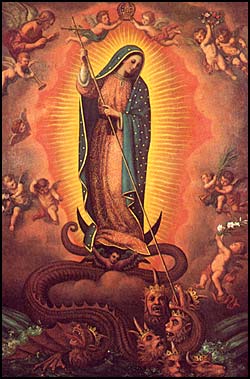
I. Consider first, that this blessed earth here spoken of is, according to the strictest interpretation, no other than Our Lady, that inviolate Virgin and immaculate Earth, from which, without human agency, there sprang that Divine Bud, desired by Isaias so long before, when he exclaimed: "Let the earth be opened, and bud forth a Savior." This being so, it will at once strike thee as strange that this form of expression should be used. For, if the Earth here spoken of was so inviolate as to remain as much closed during as before childbirth, how can the Prophet pray that it might be opened? "Let the earth be opened."

But observe to Whom it was to be opened. To Him Who was able to come forth, and yet leave it inviolate. Wonder, then, no longer. A window is said to be open to the light when the shutters are removed and only the panes remain, although it is all the time closed to water, air, and to all the animals which may go about trying to get in. And why is it said to be open to light? Because the light is able to penetrate notwithstanding. Therefore, because the Divine Incarnate Word was able to pass through Mary's virginal womb, as light passes through crystal without injuring it—"For Sion's sake I will not hold my peace, till her Just One come forth as brightness" [Isaias lxii, 2]—it might well be said to be opened for Him when He left it, since it is well known that everything which can be penetrated by the power of any one is said to be open to Him.

Observe, therefore, that the first thing the Prophet asks is not that the earth may be opened, but that the heavens should rain—"Drop down dew, ye heavens, from above, and let the clouds rain the Just; let the earth be opened, and bud forth a Savior"—because the favorable influences must first come from Heaven, and then the earth must give her fruit: " The Lord will give goodness, and our earth shall yield her fruits." [Psalm lxxxiv, 13]. Thy heart is closed earth, not because it is virgin, but because it is barren and dry, yielding no fruit of devotion. Wouldst thou know what is the real reason of this? It is that thou hardly ever lookest up to heaven: " He prayed; and the heaven gave rain, and the earth brought forth her fruit." [St. James v, 18].

II. Consider secondly, that Christ was to be conceived by Mary purely through the operation of the Holy Ghost, and therefore the Prophet here exclaims with uplifted eyes : "Drop down dew, ye heavens, from above, and let the clouds rain the Just." He invites the Divine Spirit to descend into Mary's virginal womb, and to make it fruitful, so as in due time, like chosen earth, to bring forth the blessed Fruit of the Incarnate Word, by which we were to be saved. And if thou askest why the Incarnation of the Word is compared to dew rather than to any other rain, it is because the silence of His coming was in proportion to the greatness of the salvation He brought.

Mary was seen to have conceived before it was possible to know the manner of the conception: "Before they came together, she was found with child of the Holy Ghost."[St. Matthew i, 18] Therefore it is that all will not equally experience the good effects of this dew; but it is just as it was with that which fell on Gideon's fleece: the first night the fleece was wet and not the floor round it; and the second night the floor was wet and not the fleece. So the first to benefit by Christ's coming were the Jews, the rest of the world remaining dry; and afterwards the rest of the world received the benefit and the Jews remained dry: "To you it behoved us first to speak the word of God, but because you reject it ... we turn to the Gentiles." [Acts xiii, 46]. Do thou return lively thanks to God that thou art in a place where this dew has descended most abundantly? but if as yet thou hast gathered no fruit in consequence, what does this show? It shows that thy heart is not of earth, but of stone.

III. Consider thirdly, that Jesus is here, by antonomasia, called "the Just"—"Drop down dew, ye heavens, from above, and let the clouds rain the Just"—for to Him alone can that name be given.

Everyone who is holy can be called just, but not "the Just," for when we call any one just, it implies accidental justice, so to speak; but when we say "the Just," essential justice is implied. And there never has been essential justice save in Christ, Who, for that reason, is called Justice itself: "Who is made unto us . . . Justice." [I Corinthians i, 30]. In all others justice has been accidental, because it was possible for it to exist and not to exist in them; whereas it was essential in Christ, because in Him it was not possible for it not to exist; and if it is in others by grace only, it is in Him by nature.

See, therefore, how well the Prophet here says: "Drop down dew, ye heavens, from above, and let the clouds rain the Just," because there were many just men at that time on the earth, but not "the Just." "The Just" had yet to come : "They have slain them who foretold of the coming of the Just One." [Acts vii, 52]. And when He came, whence could He come save from Heaven ? Hence it is that, as there are in Christ two Natures, the Human and the Divine, it is with reference especially to the latter that the Prophet said, "Drop down dew, ye heavens, from above, and let the clouds rain the Just;" and with reference to the former, "Let the earth be opened, and bud forth a Savior," because, if Christ was not just only, but "the Just," this was so because of the Divine Nature, to which sanctity is essential—"One is good, God"— and if Christ was a Savior, this was not only by the Divine but by the Human Nature, which gave Him power, as our Head, to infuse salvation into us, in the same way that Adam, as our head, had infused perdition into us. In receiving Him as a Savior, thou hast certainly to reverence, to thank, and to love Him; but in receiving Him as " the Just," this is not enough: thou hast also to imitate Him. Indeed, why shouldst thou not imitate Him as Savior also, if so great a grace is given thee? But take heed, for the first glory which is here given to Him is that of being Just, and then that of Savior; how, then, canst thou presume to reverse the order?

IV. Consider fourthly, how great is the salvation which this Savior comes to bring thee. It is as great as the evils from which He comes to set thee free. There are two of these: the evil of guilt, and the evil of penalty. But in these two fatal species, how many separate evils are contained! Think on it thyself, if thou hast courage to go through the catalog. And yet from all these this life-giving Bud is to save thee: "I will raise up for them a Bud of renown (nominatum), that is, "named" or foretold for so many ages, "and they shall be no more consumed with famine in the land, through the want of all good, "neither shall they bear any more the reproach of the Gentiles." [Ezech. xxxiv, 29].

See, therefore, that this great Savior is not compared to a precious metal hidden in the earth, but to a bud, which springs from it spontaneously—"Let the earth be opened, and bud forth a Savior"—in order to show thee that thou art not obliged to labor to find Him, but that He is to come of His own free choice to find thee, so great is His desire for thy happiness. How easily, then, mayest thou derive all possible good from Him by approaching to receive Him! Is it not very easy for thee to gather a bud from the earth? Just as easily mayest thou receive thy Savior from Mary's arms, if thou approachest Him full of sorrow to lay before Him thy miseries, and to beg Him devoutly to deliver thee from them. "The earth shall yield her increase," or " bud" (germen), that is, Jesus; and His people "shall be in their land without fear" of their infernal enemies: "and they shall know that I am the Lord when I have broken the bonds of their yoke," that is, sin, "and shall have delivered them out of the hand of those that rule over them," [Ezech. xxxiv, 27] that is, of their irregular appetites.

Paolo Segneri, S.I.
La manna dell'anima (1683)
___________________
On the Fourth Sunday of Advent (Rorate cæli Sunday),
Fourth Anniversary of this web log.

Our traditional anniversary post, with apologies for the extended recess of the past few weeks, which should continue up until Septuagesima.

"The maniple... was never abrogated"

ZENIT has just published an article by Fr. Mauro Gagliardi, in which he speaks of the continued importance of the vesting prayers of the priest even in the Novus Ordo.

Some of the more interesting excerpts:

Beyond the historical circumstances, the sacred vestments had an important function in the liturgical celebrations: In the first place, the fact that they are not worn in ordinary life, and thus possess a "liturgical" character, helps one to be detached from the everyday and its concerns in the celebration of divine worship. Furthermore, the ample form of the vestments, the alb, for example, the dalmatic and the chasuble, put the individuality of the one who wears them in second place in order to emphasize his liturgical role. One might say that the "camouflaging" of the minister’s body by the vestments depersonalizes him in a way; it is that healthy depersonalization that de-centers the celebrating minister and recognizes the true protagonist of the liturgical action: Christ. The form of the vestments, therefore, says that the liturgy is celebrated "in persona Christi" and not in the priest's own name. He who performs a liturgical function does not do so as a private person, but as a minister of the Church and an instrument in the hands of Jesus Christ. The sacred character of the vestments also has to do with their being donned according to what is prescribed in the Roman Ritual.

In the extraordinary form of the Roman Rite (the so-called Mass of Pius V), the putting on of the liturgical vestments is accompanied by prayers for each garment, prayers whose text one still finds in many sacristies. Even if these prayers are no longer obligatory (but neither are they prohibited) by the Missal of the ordinary form promulgated by Paul VI, their use is recommended since they help in the priest's preparation and recollection before the celebration of the Eucharistic sacrifice. As a confirmation of the utility of these prayers it must be noted that they are included in the "Compendium Eucharisticum," recently published by the Congregation for Divine Worship and the Discipline of the Sacraments.[2] Moreover it is useful to recall that Pius XII, with the decree of Jan. 14, 1940, assigned an indulgence of 100 days for the individual prayers.


***

The maniple is an article of liturgical dress used in the celebration of the extraordinary form of the Holy Mass of the Roman Rite. It fell into disuse in the years of the post-conciliar reform, even though it was never abrogated. The maniple is similar to the stole but is not as long: It is fixed in the middle with a clasp or strings similar to those of the chasuble. During the celebration of the Holy Mass in the extraordinary form, the celebrant, the deacon and the subdeacon wear the maniple on their left forearm. This article of liturgical garb perhaps derives from a handkerchief, or "mappula," that the Romans wore knotted on their left arm. As the "mappula" was used to wipe away tears or sweat, medieval ecclesiastical writers regarded the maniple as a symbol of the toils of the priesthood.

***

In conclusion, one hopes that the rediscovery of the symbolism of the liturgical vestments and the vesting prayers will encourage priests to take up again the practice of praying as they are dressing for the liturgy so as to prepare themselves for the celebration with the necessary recollection.

While it is possible to use different prayers, or simply to lift one's mind up to God, nevertheless the texts of the vesting prayers are brief, precise in their language, inspired by a biblical spirituality and have been prayed for centuries by countless sacred ministers. These prayers thus recommend themselves still today for the preparation for the liturgical celebration, even for the liturgy according to the ordinary form of the Roman Rite.


DECLARATION ON THE PROTECTION OF THE FIGURE OF THE POPE

Recent years have witnessed a great increase of affection and esteem for the person of the Holy Father. There has also been a desire to use the Pope’s name in the title of universities, schools or cultural institutions, as well as associations, foundations and other groups.

In light of this fact, the Holy See hereby declares that it alone has the right to ensure the respect due to the Successors of Peter, and, therefore, to protect the figure and personal identity of the Pope from the unauthorized use of his name and/or the papal coat of arms for ends and activities which have little or nothing to do with the Catholic Church. Occasionally, in fact, attempts have been made to attribute credibility and authority to initiatives by using ecclesiastical or papal symbols and logos.

Consequently, the use of anything referring directly to the person or office of the Supreme Pontiff (his name, his picture or his coat of arms), and/or the use of the title "Pontifical", must receive previous and express authorization from the Holy See.


From the Sala Stampa

Pius XII to be beatified
(and John Paul II, too)


The Pope today authorized the Congregation for the Causes of Saints to promulgate the decrees recognizing the heroic virtues of the Servants of God Pius XII (Eugenio Pacelli) and John Paul II (Karol Wojtyła). The recognition of a miracle is the only step needed for a beatification.
---

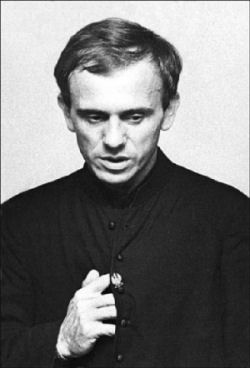
The Pope also recognized the martyrdom of Father Jerzy (George) Popiełuszko, killed by the Communists in 1984.

Communiqué of the Holy See Press Office
regarding the dismissal of Emmanuel Milingo from the clerical state

For a number of years the Church has followed with great concern the difficulties caused by the regrettable conduct of Archbishop Emmanuel Milingo. Many attempts have been made to bring Archbishop Milingo back into communion with the Catholic Church, including the consideration of suitable ways to enable him to exercise the episcopal ministry. Pope John Paul II and Pope Benedict XVI were directly involved in those efforts and both Popes personally followed the case of Archbishop Milingo in a spirit of paternal solicitude.

In the course of this unhappy series of events, Archbishop Milingo became irregular in 2001 as a result of his attempt to marry Mrs. Maria Sung, and incurred the medicinal penalty of suspension (cf. Canons 1044 § 1, n. 3; 1394 § 1 of the Code of Canon Law). Thereafter, he headed certain groups calling for the abolition of clerical celibacy and gave numerous interviews to the media in open disobedience to the repeated interventions of the Holy See, creating serious upset and scandal among the faithful. Then, on 24 September 2006 in Washington, Archbishop Milingo ordained four Bishops without pontifical mandate.

By so doing, he incurred the penalty of excommunication latae sententiae (Canon 1382) which was declared by the Holy See on 26 September 2006 and is still in force today. Sadly, Archbishop Milingo has shown no sign of the desired repentance with a view to returning to full communion with the Supreme Pontiff and the other members of the College of Bishops. Rather, he has persisted in the unlawful exercise of acts belonging to the episcopal office, committing new crimes against the unity of Holy Church. Specifically, in recent months Archbishop Milingo has proceeded to several other episcopal ordinations.

The commission of these grave crimes, which has recently been established, is to be considered as proof of the persistent contumacy of Archbishop Emmanuel Milingo. The Holy See has therefore been obliged to impose upon him the further penalty of dismissal from the clerical state.

According to Canon 292 of the Code of Canon Law, the penalty of dismissal from the clerical state, now added to the grave penalty of excommunication, has the following effects: loss of the rights and duties attached to the clerical state, except for the obligation of celibacy; prohibition of the exercise of any ministry, except as provided for by Canon 976 of the Code of Canon Law in those cases involving danger of death; loss of all offices and functions and of all delegated power, as well as prohibition of the use of clerical attire. Consequently, the participation of the faithful in any future celebrations organized by Archbishop Emmanuel Milingo is to be considered unlawful.

It must be pointed out that the dismissal of a Bishop from the clerical state is most extraordinary. The Holy See has felt obliged to act in this way due to the serious consequences for ecclesial communion resulting from repeated episcopal consecrations carried out without pontifical mandate; nevertheless, the Church hopes that Archbishop Milingo will see the error of his ways.

As for those recently ordained by Archbishop Milingo, the Church’s discipline in imposing the penalty of excommunication latae sententiae upon those who receive episcopal consecration without pontifical mandate is well-known. While expressing hope for their conversion, the Church reaffirms what was declared on 26 September 2006, namely that she does not recognize these ordinations, nor does she intend to recognize them, or any subsequent ordinations based on them, in the future. Hence the canonical status of the supposed bishops remains as it was prior to the ordination conferred by Archbishop Milingo.

At this moment, as the Church experiences profound sorrow for the grave acts perpetrated by Archbishop Milingo, she entrusts to the power of prayer the repentance of the guilty party and of all those who - be they priests or lay faithful - have in any way cooperated with him by acting against the unity of Christ’s Church.
__________________
Source; recess continues.

Crash Courses in Traditional Catholic Philosophy

From Patrick McCloskey of the International Society of Scholastics comes the following announcement:

The professors of the International Society of Scholastics are pleased to present Saturday morning online Crash Courses in traditional Catholic philosophy—part of our Sapientis Online Education program. These are 3-hour seminars on some of the most important scientific, ethical, and political questions of the day—all examined from the common sense perspective of Thomas Aquinas and the Thomistic tradition—including a philosophic defense of the Traditional Latin Mass.

We’re hoping to give you the chance to inherit the intellectual patrimony of the Church; and the foundation needed to defend her ethical, political, scientific principles by reason alone. Take a look at the topics:

January 16th, 2010 - What is the State and Why Should I Care? On the origin and nature of civil society

January 23rd, 2010 - Democracy or Tyranny? The legitimate and illegitimate forms of government

January 30th, 2010 - How Far Can the Government Go? On the limits of civil authority

February 6th, 2010 - Conservatives are Liberals? Classical liberalism and the corruption of the modern state

February 13th, 2010 - Is Capitalism evil?

February 20th, 2010 - What is Socialism?

February 27th, 2010 - What is the Natural Law and How Do I Defend It?

March 6th, 2010 - What is Education? A guide for homeschool parents

March 13th, 2010 - What is a Just War? And What Can’t You Do in One?

March 20th, 2010 - The Natural Superiority of Traditional Worship

March 27th, 2010 - Thumbscrews and Guillotines: on the morality of torture and the death penalty

April 17th, 2010 - Is Brain Death Really Death?

April 24th, 2010 - Is There Such a Thing as a ‘Right to Privacy’?

May 8th, 2010 - What is Culture and How Does I Gets Me Some?

May 15th, 2010Why Homosexual Marriage is a Contradiction in Terms

May 22nd, 2010 - The Moral and Immoral Roles of Insurance Companies

June 5th, 2010 - Is Rebellion Ever Justified?

June 12th, 2010 - Homeschooling: The rights of parents in regard to education

June 19th, 2010 - The Devil Made Me Do it: on cooperation in evil

June 26th, 2010 - Fundamental Issues in Bioethics

Fuller descriptions can be found on our website www.societyofscholastics.org/sapientis Just click on ‘Crash Course.’ New topics with special guest lecturers will be added periodically throughout the spring semester.

All Crash Courses are hosted live, online using our state-of-the-art video conferencing software, giving you the chance to interact with the professor and other students by voice chat and/or instant text messaging. Sapientis supports PCs, Macs, and smartphones like Blackberries and iPhones—so you can logon from almost anywhere, while waiting at the airport or sipping cappuccino at the local coffee shop.

Online seating is limited, so sign up early!

Why Thomistic philosophy? Here’s an argument from authority:

“And so we have desired that all who are engaged in the task of teaching philosophy and sacred theology be warned that they cannot depart from Aquinas in the slightest degree, especially in metaphysics, without great harm resulting therefrom...and if the doctrine of any other writer or saint was ever approved by Ourselves or Our predecessors with singular praise and the invitation or command to spread and to defend it were added to that commendation, it must be clearly understood that that doctrine is approved to the extent that it agreed with the principles of Aquinas or at least in no way contradicted them.” (Pope St. Pius X)


The International Society of Scholastics is an intellectual association founded in 2005 by students of the Roman Pontifical Universities. The ISS is committed to restoring the philosophic doctrines, didactic principles and scientific synthesis of the greatest masters of the classical universities, the Scholastics. We now have several hundred members representing 19 countries.

We hold Thomas Aquinas to be the paradigm of Scholastic scholars, and we apply ourselves to renewing the great tradition of Thomistic science forged by his Commentators throughout the centuries.

It is our purpose to reestablish the Scholastic synthesis in all speculative and practical fields as offering the normative model for rational inquiry and practical activity resulting in personal perfection, economic stability, and political faultlessness.

Sapientis is our online course of studies in science and ethics based entirely on the common sense principles of Scholastic Thomism. Its goal is to lead students to a complete understanding of the natural and artificial orders in the universe and of their moral duties resulting from this order. We aim to make Scholastic Thomism available in its classical, unadulterated form; educational materials which follow not only the content of Thomism, but its structure as well.

For more info, visit our website at www.SocietyofScholastics.org or send us an email at TheSchoolmen@SocietyofScholastics.org


Modifications to the CIC:
appropriate distinction between diaconate and higher ministries;
other modifications regarding marriage

VATICAN CITY, 15 DEC 2009 (VIS) - Made public today was Benedict XVI's Motu Proprio, "Omnium in mentem" [in Italian]. The document is dated 26 October 2009 and contains two variations to the Code of Canon Law (CIC), variations which have long been the object of study by dicasteries of the Roman Curia and by national episcopal conferences.

The document published today contains five articles modifying canons 1008, 1009, 1086, 1117 and 1124. According to an explanatory note by Archbishop Francesco Coccopalmerio, president of the Pontifical Council for Legislative Texts, these variations "concern two separate questions: adapting the text of the canons that define the ministerial function of deacons to the relative text in the Catechism of the Catholic church (1581), and suppressing a subordinate clause in three canons concerning marriage, which experience has shown to be inappropriate".

The variation to the text of canon 1008 will now limit itself to affirming that "those who receive the Sacrament of Orders are destined to serve the People of God with a new and specific title", while canon 1009 "will be given an additional third paragraph in which it is specified that the minister constituted into the Order of the episcopate or the priesthood receives the mission and power to act in the person of Christ the Head, while deacons receive the faculty to serve the People of God in the diaconates of the liturgy, of the Word and of charity".

Archbishop Coccopalmerio's note then goes on to explain that the other changes contained in the Motu Proprio all concern the elimination of the clause "actus formalis defectionis ab Ecclesia Catholica" contained in canons 1086 para. 1, 1117 and 1124. This clause, "following much study, was held to be unnecessary and inappropriate", he writes.

"From the time the Code of Canon Law came into effect in the year 1983 until the moment of the coming into effect of this Motu Proprio, Catholics who had abandoned the Catholic Church by means of a formal act were not obliged to follow the canonical form of celebration for the validity of marriage (canon 1117), nor were they bound by the impediment concerning marriage to the non- baptised (canon 1086 para. 1), nor did they suffer the prohibition on marrying non-Catholic Christians (canon 1124). The abovementioned clause contained in these three canons represented an exception ... to another more general norm of ecclesiastical legislation according to which all those baptised in the Catholic Church or received into her are bound to observe ecclesiastical laws (canon 11).

"With the coming into effect of the new Motu Proprio", Archbishop Coccopalmerio adds, "canon 11 of the Code of Canon Law reacquires its full force as concerns the contents of the canons thus modified, even in cases were there has been a formal abandonment. Hence, in order to regularise any unions that may have been made in the non-observance of these rules it will be necessary to have recourse, if possible, to the ordinary means Canon Law offers for such cases: dispensation from the impediment, sanation, etc".

Recess till end of December; relevant news may be posted at any moment.

Bishop Schneider continues his worldwide pilgrimage
in defense of Traditional Communion


Bishop Athanasius Schneider, ORC, in Estonia

Bishop Athanasius Schneider visited Estonia December 10, 2009, for the publication of his book Dominus est in Estonian. After the presentation, Bishop Schneider celebrated a Missa Cantata in the Cathedral of Saints Peter and Paul.

In the book presentation the Bishop explained how the present form of hand communion has nothing to do with the practise of hand communion in the early centuries. The new way was adapted by some liberal priests in Holland directly from the Calvinists in 1965.

The Bishop ultimately decided to write a book defending the traditional way of receiving Holy Communion, and when the work was finished he gave a manuscript to the Holy Father. The Pope wrote back to the Bishop praising the work and his accuracy of knowledge of the patristics.

Bishop Schneider told he had also asked the Pope to stop distributing Communion in the hand in Papal Masses, and even if the Pope's answer was supportive it was not certain that it would happen. But since only a few months later, all communicants have been asked to receive Holy Communion from the Pope only kneeling and on the tongue. A true miracle, says Bishop Schneider.
________________
From our friends in the Baltic (Blog
Summorum); recess continues until mid-December.

A Documentary on the Seminary of Frejus-Toulon

From the website of the Diocese of Frejus-Toulon:

TIEMPO DE ORACIÓN

The abortion lobby, led by the United Nations, the European Union, and by American and European Foundations, is fighting with all of its diabolical strength to institute abortion on demand in Latin America, the second Land of Mary, Tierra de María.

Every single day, from Colombia to Uruguay, from Nicaragua to Brazil, from Peru to Mexico, more efforts of the diabolical forces are revealed. As it happened in the United States and in Canada, since they cannot prevail through the legislatures and since popular opinion soundly rejects this barbarous practice, they try to force the genocide of the unborn through stealth measures: court rulings (as it happened in America and Canada), "morning-after pills" dispensed as contraceptives, and through ambiguous "health measures" to protect "women's health".

If it is possible, add a prayer to your daily schedule so that the culture of death and of hatred of the unborn shall not prevail in Latin America.

____________________________________

AVE MARIA,
GRATIA PLENA,
DOMINUS TECUM.
BENEDICTA TU IN MULIERIBUS
ET BENEDICTUS FRUCTUS
VENTRIS TUI,
IESUS.
SANCTA MARIA,
MATER DEI,
ORA PRO NOBIS
PECCATORIBUS,
NUNC ET IN HORA
MORTIS NOSTRÆ.
AMEN.


____________________________________


Sancte Michaël Archangele,
defende nos in prælio.
Contra nequitiam
et insidias diaboli
esto præsidium.
Imperet illi Deus,
supplices deprecamur.
Tuque, princeps militiæ caelestis,
Satanam aliosque
spiritus malignos,
qui ad perditionem animarum
pervagantur in mundo,
divina virtute in
infernum detrude.
Amen.

______________________
Recess continues for several days; rare updates in the following week.

Requiem for a Warrior for the Mass of Ages


It is with sadness that we report the death of the Rt. Rev. Tullio Andreatta, K.C.H.S. Monsignor Andreatta died on December 1, 2009, at San Diego. He was 95 years old. Born in Crespano Del Grappa, Italy, near Venice, he was ordained a priest on June 29, 1938. Nine months later he arrived in the United States beginning ten years of service at various Italian parishes across the country. He arrived in the Diocese of San Diego on December 3, 1949 and was assigned to serve as the Assistant Pastor at Our Lady of Guadalupe Church in San Bernardino. In 1951, at the direction of Bishop Buddy, he established a new parish in San Bernardino which he named Our Lady of Fatima. Other pastoral assignments included Blessed Sacrament Church (now Our Lady of Light) in Descanso, Our Lady of Mount Carmel, and Our Lady of the Lake Church in Lake Arrowhead. In 1978, he was invested as a Prelate of Honor of the Pope on the occasion of the 40th Anniversary of his ordination. On October 30, 1983, he was invested in the Knights of the Holy Sepulchre of Jerusalem as a Knight Commander in recognition of his devoted service to Holy Mother Church

Following Pope John Paul II's 1984 authorization allowing the public celebration of the Tridentine Lain Mass, Monsignor Andreatta was the first priest in the United States to obtain permission from a diocesan bishop to do so. Following his appointment as chaplain, beginning on February 24, 1985, the Tridentine Latin Mass was offered by Monsignor Andreatta at St. Vincent de Paul Church in central San Diego. Due to the objections of several of the clergy the Tridentine Latin Mass was soon moved to Holy Cross Cemetery Mausoleum Chapel where it was offered every Sunday and Holyday without exception by Monsignor Andreatta until his retirement in 1991.

It was Monsignor Andreatta's hope and prayer that a parish church be provided where his beloved Mass could be offered and the other sacraments provided. Thanks be to God, he lived to see the day when, on October 7, 2008, the Feast of Our Lady of the Rosary, a personal parish was erected for the Traditional Latin Mass apostolate at St. Anne Catholic Church.

Monsignor Andreatta will be laid to rest on Saturday, December 12, 2009, following a Solemn Requiem High Mass which will be offered at The Immaculata where Monsignor Andreatta celebrated the Golden Jubilee of his priesthood. The Rosary will be prayed at 9:45 a.m. PST followed by Mass at 10:00 a.m. PST. The procession to Holy Cross Cemetery will depart at 1:00 p.m.

By Mr. Carl Horst (originally posted on CTNGreg and edited for reposting on RC.)

You report -- Daily Lauds with the laity in Sacramento

Tish Gallagher of the Traditional Latin Mass community of Sacramento has sent the following, very encouraging story about daily Lauds and the frequent chanting of other parts of the Divine Office in her parish:

The Latin Mass community of Sacramento, California began more than twenty years ago. In 1997 the Priestly Fraternity of St. Peter was invited into our diocese to serve what was then known as the Ecclesia Dei Community. In 2002 a property was purchased and given by our diocese for our use; this included a church and small school. At the time, Fr. John Berg, FSSP (now the superior general of that congregation) was the priest in charge of our Latin Mass community. In the approximately five years that Fr. Berg was with us, he tried to give our parish, St. Stephen, the First Martyr (not formally a parish yet) a character and tradition which he hoped we would maintain. Among these traditions were things such as Sunday Vespers, the Rorate Mass in Advent, and Tenebrae. Happily, the priests who have come after him have kept these traditions, and even added to them.

Even at this time in the early morning the priest would sing Lauds together in the sanctuary of our church. I would silently pray from a breviary with the Pius XII Psalter, which of course was not the same. Occasionally we would also have Compline, especially after big feasts and after evening adult education classes. We would print out the Latin so that everyone could sing; it was a very prayerful and joyful time!

Now, we are blessed to have many resources for the words of the Divine Office so consequently people are beginning to download the Office from the internet and bring it with them to St. Stephens. What began as community prayer among the priests is becoming more of prayer also for the laity. We very gingerly attempt to pronounce the words of the psalms along with the priests each morning at lauds and as each day passes we learn more, and more people seem to come.

We also have an opportunity on Monday and Thursday each week for the office of Sext. After our priests teach their Latin classes they come into the church to sing this hour together. In addition to this we regularly have Thursday evening Compline which is very well attended after evening Mass.

The Divine Office is very much a part of our Catholic culture at St. Stephens. Most of our children have some opportunity for learning some of the Psalms either in choir or even at our summer camps where Compline is sung each evening.

St. Stephen is a little bit of heaven on earth. It is a place where the Church is living and growing. It is a place where in the midst of all the trials of this world you can find peace.

Manila's Grand Marian Procession in honor of the Immaculate Conception

Every first Sunday of December, the old city of Manila witnesses the Philippines' greatest Marian procession, the "Grand Marian Procession" in honor of the Immaculate Conception, Patroness of the Philippines. It is a rare moment of liturgical splendor in what is otherwise a terrible liturgical desert, featuring blue copes and tunicled acolytes (remnants of the liturgical privileges that the Hispanic colonies had) and dozens of statues and paintings of the Blessed Virgin, from the most famous to the most obscure (such as the Our Lady of the Dormition). This year's procession had 80 statues.


The Immaculate Conception

Relics

Where is the procession?

Tunicled acolytes

Tunicled acolyte

Incensation of an image of the Virgin. (Take note of the blue cope.)

Incensation of Our Lady of the Rosary

Archbishop Diosdado Talamayan of Tuguegarao with tunicled acolytes

Nuestra Senora de la Anunciacion

Nuestra Senora de la Esperanza


Nuestra Senora de la Dormicion


Divina Pastora

More pictures can be found here.

For this year, incredibly enough, five of the acolytes (including some of those who assisted the archbishop and the rector of the cathedral) were sourced from the corps of TLM servers of the Parish of the Lord of Divine Mercy, the only church under diocesan auspices in Metro Manila that has a daily Traditional Latin Mass. Fifteen other acolytes -- the majority -- came from the Hermanded dela Sagrada Pasion, which is devoted to the preservation of Catholic pious traditions.

On the loss of Latin -- and bringing it back

During the debates of the Second Vatican Council one prelate after another addressed the Fathers of the Council in fluent Latin. That they did so is hardly surprising, for Latin remained the living language of the Roman Catholic Church. What may be surprising, however, is their collective level of fluency. The European prelates in particular displayed in their speeches and lively discussions a near-native mastery of Latin that would have been the envy of Renaissance humanists living five hundred years previously.

***

...if living Latin dies, the consequences for the Church are grave. What is significant about the fact that the Fathers of the Council spoke readily in Latin is that they thought in Latin, which gave them easy access to the length and breadth of the Catholic tradition. The Church’s treasury of writings spanning the centuries is like a large chest in the attic, to which Latin is the key. Unfortunately, we stand in danger of losing the key, for few now live who can actually think in Latin. This is especially true within the Church herself. A sign of this is that even at the Vatican documents are no longer composed in Latin and then translated into vernacular languages but are first thought in the vernacular and then translated into Latin. We are in fact in danger of becoming strangers to our own tradition, for few can read the thoughts of our Catholic tradition in the language in which they were thought.

At this point, a word of clarification about what I mean by “reading” is in order.There are many young persons, a good number of them Catholic, studying Latin. Indeed, if we are to believe the New York Times, we are in the midst of a Latin-learning renaissance of sorts. Nevertheless, there is a world of difference between studying Latin and actually learning Latin. Folks today study Latin, but rarely learn it. A short while ago, folks studied Latin to learn it. They could read it, write it, speak it, and generally think in it as well or nearly as well as they could think in their own native tongue. By “reading Latin” or “thinking in Latin,” therefore, I mean the ability to understand Latin at a pace approaching the native facility of an educated person.

***

Sad to say, however, that tradition has all but passed away. Only a few Latin-speaking prelates remain today, and the number of Catholic priests or other religious working on the original sources of our tradition is now minimal. A few personal anecdotes will serve to illustrate how much things have changed. In the fall of 2007, while staying with the Dominicans at Saulchoir in Paris, I had the chance to speak about the decline of Latin within the Church with the Dominican scholars of the Leonine Commission, whose task it is to make available the best critical editions of St. Thomas. To a man these outstanding scholars and Latinists lamented the passing away of the Church’s Latin tradition and urged me to do whatever I could to make available to priests and other religious the resources for mastering Latin that had once been routinely available. Last summer I had dinner with Monsieur Luc Jocques, head of the Latin Section of Corpus Christianorum, the modern project whose aim is to make available modern, critical editions of the vast body of Christian literature produced down through the centuries that still survives in libraries all over the world in manuscripts, unedited and unstudied. Monsieur Jocques told me that when he started at Corpus Christianorum, the roster of scholars working on Latin critical editions was filled with Catholic priests and religious, but that now he can think of only one or two among the army of scholars working worldwide on such projects. In short, the Church itself can no longer take for granted the fluency in Latin that was until recently seemingly its birthright.

I have put off until now answering an obvious question, namely, why does all this matter? Just as the academy and the educated world outgrew Latin, why not allow the Church to do the same? I respond that, even if, Deo gratias, the Church should encompass the globe and become literally catholic in language and culture, and even if, Deus vetet, the Catholic Church in Europe should wither on the vine, it would still be true that the vast majority of Roman Catholic culture and tradition grew up and was formed speaking Latin. It is, as it were, the native language of the Roman Catholic Church, and were we to let it die we would in fact suffer the loss of our mother tongue. We would have access to our patrimony, that wonder-filled treasury that now lays unseen in the Church’s attic, only in bits and pieces and then only in translation. We would become foreigners to our own tradition, to our own thoughts. This is a potentially grievous loss for a Church that holds Tradition sacred. Both Pope John Paul II and Pope Benedict XVI have recently reminded us that the Church needs Latin for this very reason.


Do read the rest of the article: Bringing back Latin, by Mark J. Clark, from the December 2009 edition of Homiletic and Pastoral Review.

This essay reminds me of the fact that the most recent Latin edition of the Missal of Paul VI had quite a number of grammatical errors. (See this and this).