Dominica IV Post Pentecosten
Luke 5:1-11

Today, Father's Day, we encounter in our Gospel God the Father – also in the 16 new priests ordained yesterday for the Archdiocese, along with thousands more during this season around the world.
Dominica IV Post Pentecosten
Luke 5:1-11
Today, Father's Day, we encounter in our Gospel God the Father – also in the 16 new priests ordained yesterday for the Archdiocese, along with thousands more during this season around the world.


From the Dicastery for Promoting Christian Unity:
The Dicastery Promoting Christian Unity is pleased to publish with the approval of Pope Francis its new document The Bishop of Rome. Primacy and synodality in ecumenical dialogues and responses to the encyclical Ut unum sint.
The document is available in English here.
[Rorate editor - Just to be clear: Rorate's editoral position is that Francis is indeed the Pope -- his election was obviously valid, as Don Pietro Leone explains below - and a new one will be elected by an upcoming conclave. NC]
Don Pietro Leone, who has contributed many articles for Rorate Caeli for more than 13 years, offers our readers the following essay on the much discussed and delicate matter of the validity of Pope Benedict's demission and the validity of Pope Francis' election. His primary motive for writing this essay 'is to rebut false theories, offer the faithful an understanding of the status quo according to the Catholic Faith' and define the competent authority through which this contentious issue must be judged. F.R.
 |
| Photo by Fr Lawrence Lew OP |

I write to deal once again with the case of Abp. Gabriel Mestre, fleeting Archbishop of La Plata. [See first article here] In only eight and a half months he had attracted the attention of the local clergy, free at last from the persecutory ideology of “Tucho” Fernandez. In view of the regrettable fact of the Franciscan request for the resignation of Monsignor Mestre, it would be opportune for the priests of La Plata to make a public pronouncement, discreetly and without fear. I do not believe that his interim replacement, Bishop Bochatey will react against the exercise of a qualified democracy that corresponds, after all, to the polyhedral ecclesiology of Pope Bergoglio.

by Fr. Richard Cipolla

ECCLESIASTICAL ODDITIES
 |
| [La Plata, Argentina: Immaculate Conception Cathedral in central Moreno Square] |
The corresponding adjective is "odd" ("rare"), which has several meanings in the dictionary; I choose one: odd is that which has little density and consistency. Although it also refers to extraordinary and extravagant things. I mean: it is an oddity that the Pope is Argentinian, what is also odd is the fact that in over a decade he has not had the concern to visit his homeland. John Paul II (Wojtyla) and Benedict XVI (Ratzinger), as soon as they were elected, the first trip they made took them to their homeland, respectively Poland and Germany. I read in “La Prensa”, a Buenos Aires newspaper: “Francis revealed that he would like to come in November or at the beginning of 2025”. Under this title, the newspaper says that the Pope “commented that it is in his plans to travel to Argentina either at the end of November or at the beginning of 2025”. According to the old saying, “think wrong and you will be right,” I dare to think that he will not come, and I outline a reason: he knows that he is not going to do very well. I may be wrong, of course, but this opinion of mine responds to a 46-year-old knowledge of Jorge Bergoglio.
From Fiducia supplicans to the norms on the discernment of supernatural phenomena
by Roberto de Mattei


Dear Brothers and Sisters,
My dearly beloved Sons,
The mystery of the Most Holy Trinity, which we celebrated last Sunday, rounded off the liturgical cycle dedicated to the Christian mysteries. Two feasts, however, come and complete this cycle: Corpus Christi, and the feast of the Sacred Heart. The former dates back to the 13th century. The latter is in line with the development of the devotion to the Heart of Jesus during the Middle Ages, and in the wake of the apparitions of Paray-le-Monial between 1673 and 1675. The feast of the Sacred Heart was extended to the universal Church by Pius IX in 1856.
Some outstanding news from Italy. The Benedictines of Norcia, currently celebrating their 25th year as a monastery, received a canonical elevation. The monastery is now an abbey, and current prior Dom Benedict Nivakoff, O.S.B., has been elected abbot.

This writer was privileged to attend a recent 25th anniversary luncheon in Washington, D.C., with several of the Benedictines, including Dom Benedict. It is hard to say enough good things about these holy and prayerful men. They pray for you. They pray for the Church. They are growing. They are building -- and indeed still rebuilding after a massive earthquake. They are smart, savvy and dedicated servants of our Lord and His Church.
Exceptional weather events, including eclipses and northern lights, have multiplied around the world over the past year.
On April 8, 2024, there was a major solar eclipse in the Americas, visible from Mexico to the United States to Canada, 14 days after a lunar eclipse that had darkened the skies over parts of the Americas and Europe on March 25.
This is my destiny
(Sermon for Pentecost Sunday given by Fr Augustin-Marie Aubry, Prior of the Fraternity of Saint Vincent Ferrer, to the pilgrims walking to Chartres)

Come, O Holy Ghost, and send from heaven a ray of thy light
To enlighten our souls about our mysterious destiny
I have a question for all of you who are gathered before the altar, and for all of you who are following this Mass of Pentecost from a distance, this Mass of the pilgrimage of Chartres: dear pilgrims, do you know what your destiny is?
Considering the new situation created by the motu proprio Traditionis custodes and the documents of the Dicastery for Divine Worship in 2021, Father Louis-Marie de Blignières proposes the establishment of a "traditional ordinariate", i.e., in canonical terms, an ecclesiastical circumscription dedicated to the ancient Latin rite. This type of structure (like military ordinariates, ex-Anglican ordinariates or Eastern Catholic eparchies) consists of a group of faithful served by a clergy, headed by a prelate appointed by the Holy See. The "traditional ordinariate" would offer a stable structure for Catholic faithful wishing to receive the sacraments according to traditional forms.

The former prior of the Fraternity of Saint Vincent Ferrer is interviewed on this subject in the FSSP magazine Tu es Petrus :
Why are you proposing the creation of an ecclesiastical circumscription for the Ancient Latin Rite?
A great multitude of over 16,000 pilgrims left Saint-Sulpice after Mass this morning in their pilgrimage to Chartres.
Follow their live feed and past events here:

Ladies and gentlemen of the class of 2024. I would like to start off by congratulating all of you for successfully making it to this achievement today. I’m sure your high school graduation was not what you had imagined. And most likely, neither was your first couple years of college.
By making it to this moment through all the adversity thrown your way from COVID. I hope you learned the important lessons that suffering in this life is only temporary. As a group you witnessed firsthand how bad leaders who don’t stay in their lane can have a negative impact on society. It is through this lens that I want to take stock of how we got to where we are and where we want to go.


The progressive official party installed in Rome for just over a decade goes on in its policy of “cancellation” of those who, with freedom of spirit, seek to serve Jesus Christ in orthodoxy and Tradition. By “cancellation” one means all forms of ignoring, conspiracy of silence, marginalization, prohibition of publishing in media and social media, and even the cessation of functions of those who do not adhere “synodally” to the current Vatican ideologies and discretions.

Mary alone found grace before God without the help of any other creature. All those who have since found grace before God have found it only through her. She was full of grace when she was greeted by the Archangel Gabriel and was filled with grace to overflowing by the Holy Spirit when he so mysteriously overshadowed her. From day to day, from moment to moment, she increased so much this twofold plenitude that she attained an immense and inconceivable degree of grace. So much so, that the Almighty made her the sole custodian of his treasures and the sole dispenser of his graces. She can now ennoble, exalt and enrich all she chooses. She can lead them along the narrow path to heaven and guide them through the narrow gate to life. She can give a royal throne, sceptre and crown to whom she wishes. Jesus is always and everywhere the fruit and Son of Mary and Mary is everywhere the genuine tree that bears that Fruit of life, the true Mother who bears that Son.
Neapolitan diocesan priest and third-order Franciscan, Dolindo Ruotolo, was the author of theological, ascetical and mystical treatises as well as thousands of letters on spiritual direction. He devoted every moment of his day to prayer, penance and charity towards the sick and the poor. An unflagging apostle, his life was filled with suffering of all kinds, intensified by his decision to offer himself as a victim soul for humanity and the Church.


The Corner Cabinet magazine is organizing a conference in London on June t1st hat will delve into Chesterton's enduring influence on literature, philosophy and Catholic thought. The conference promises to be a stimulating event featuring esteemed speakers including Fr. David Sherry, and Kennedy Hall, as well as engaging discussions on Chesterton’s legacy and relevance in today’s world:


Being a Catholic in 2024 is no easy endeavour. The West is undergoing a massive de-Christianization, so much so that Catholicism appears to be vanishing from the public sphere. Elsewhere, the number of Christians being persecuted for their faith is on the rise. What’s more, the Church has been struck by an internal crisis that manifests itself in a decline in religious practice, a downswing in priestly and religious vocations, a decrease in sacramental practice, and even a growing dissension between priests, bishops and cardinals which, until very recently, was utterly unthinkable. Yet, among all the things that can contribute to the internal revival of the Church and to the renewal of her missionary zeal, there is, above all, the worthy and reverent celebration of her liturgy, which can be greatly fostered thanks to the example and the presence of the traditional Roman liturgy.
As missiles and drones ply the skies from the Black Sea to the Mediterranean, the concern of Western diplomacies seems to be to procrastinate as much as possible a general conflagration that everyone believes is inevitable. One reason for this pessimism is the apparent lack of a way forward in the face of increasingly intractable international issues, such as those in Ukraine and the Middle East. Only an axiological view of politics could offer a glimmer of light, but today every state, every coalition, makes Carl Schmitt's categories its own, according to which it is up to those who guide the destinies of peoples to decide from time to time who is the friend and who is the enemy. To the traditional social order, based on the Augustinian "tranquility in order"(De Civitate Dei, lib. 19, c. 12, 1), Schmitt opposes, as the norm of politics, the principle of disorder, based on Hobbes' theory of homo homini lupus . However, in the age of international disorder, nothing can be predicted and calculated with certainty, and politics turns into a game of chance, whose only rule is the imponderable. Probably neither Russia had calculated well the risk of the invasion of Ukraine, nor Hamas the consequences of the October 7 attack. The process of subsequent events is fraught with uncertainty and randomness.
April 17, 2024
The question of abortion continues to be an important object of debate in many countries. The worldwide wave of approval of the "abominable crime", as the Second Vatican Council called it, is driven by feminist movements, progressive sectors, and the left in the nations; and "Catholic" groups, which submit to the neo-pagan conception of life, supported by alleged anti-human "rights", and contrary to the Law of God.


 |
It is often assumed that there is a deep and irreconcilable tension between allowing the continued celebration of the traditional Latin Mass and the Second Vatican Council. After all, the reform of the liturgy was itself set in motion by the Vatican II document Sacrosanctum Concilium. Thus, Pope Francis stated in his apostolic letter Desiderio Desideravi, “I do not see how it is possible to say that one recognizes the validity of the Council — though it amazes me that a Catholic might presume not to do so — and at the same time not accept the liturgical reform born out of Sacrosanctum Concilium, a document that expresses the reality of the Liturgy intimately joined to the vision of Church so admirably described in Lumen Gentium.” It was for this reason, Pope Francis explained, that he felt it “his duty” to issue his motu proprio Traditionis Custodes, restricting the celebration of the traditional Latin Mass.

Last Sunday, Dr. Joseph Shaw delivered a lecture for the Arlington Latin Mass Society titled Traditionis Custodes and the Future of the Traditional Latin Mass. In it, he provides an update on the status of Latin Mass restrictions and their future, and answers audience questions. We are delighted to share this lecture at the following link: https://www.youtube.com/watch?v=PHay2Vl0I2A.
Edward Feser
for Rorate Cæli
 |
| Saint Thomas Aquinas, by Juan de Peñalosa |
 |
| (source) |

On April 8, 2024, the Dicastery for the Doctrine of the Faith, headed by Cardinal Víctor Manuel Fernández, published the Declaration Dignitas infinita on Human Dignity, with the "ex audientia" approval of Pope Francis. Cardinal Fernández, dwelling in the Introduction of the Declaration on its genesis, clarifies that the first draft of the text, which dates back to 2019, is due to his predecessor, Cardinal Luis Francisco Ladaria Ferrer.

Declaration “Dignitas Infinita”
on Human Dignity
Presentation
During the Congresso of 15 March 2019, the then-Congregation for the Doctrine of the Faith decided to commence “the drafting of a text highlighting the indispensable nature of the dignity of the human person in Christian anthropology and illustrating the significance and beneficial implications of the concept in the social, political, and economic realms—while also taking into account the latest developments on the subject in academia and the ambivalent ways in which the concept is understood today.” An initial draft of the text was prepared with the help of some experts in 2019 but a Consulta Ristretta of the Congregation, convened on 8 October of the same year, found it to be unsatisfactory.
The Doctrinal Office then prepared another draft ex novo, based on the contribution of various experts, which was presented and discussed in a Consulta Ristretta held on 4 October 2021. In January 2022, the new draft was presented during the Plenary Session of the Congregation, during which the Members took steps to shorten and simplify the text.
Following this, on 6 February 2023, the amended version of the new draft was reviewed by a Consulta Ristretta, which proposed some additional modifications. An updated version was then submitted for the Members’ consideration during the Ordinary Session of the Dicastery (Feria IV) on 3 May 2023, where Members agreed that the document, with some adjustments, could be published. Subsequently, Pope Francis approved the deliberations of that session during the Audience granted to me on 13 November 2023. On this occasion, he also asked that the document highlight topics closely connected to the theme of dignity, such as poverty, the situation of migrants, violence against women, human trafficking, war, and other themes. To honor the Holy Father’s directions, the Doctrinal Section of the Dicastery dedicated a Congresso to an in-depth study of the Encyclical Fratelli Tutti, which offers an original analysis and further consideration of the theme of human dignity “beyond all circumstances.”
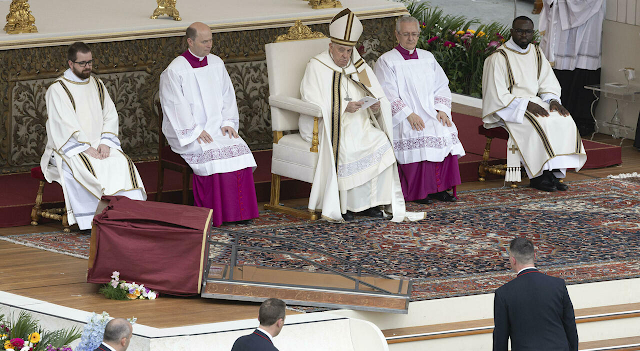
A certainly unforeseen anomaly that has inevitably been juxtaposed with other signs that have occurred in recent years coinciding with major Vatican changes
[Main excerpt]
On Easter Day, during Mass at the Vatican, a gust of wind more powerful than the others caused the ancient icon of the Christ the Redeemer on the courtyard facing St. Peter's Basilica to fall ruinously to the ground. Two attendants immediately intervened to put back up the heavy support that had collapsed just a few meters from the Pope during the Easter ceremony. An anomalous and curious episode on which many have dwelt trying to identify messages, as if that fact could be a heavenly sign, capable of unveiling future events.
