Rorate Caeli

Fulfilling our daily duties with Saint Joseph

Saint Peter tells us in his First Epistle (v, 5): "Be ye humbled therefore under the mighty hand of God, that He may exalt you in the time of visitation: casting all your care upon Him, for He hath care of you. Be sober and watch: because your adversary the devil, as a roaring lion, goeth about seeking whom he may devour. Whom resist ye, strong in faith: knowing that the same affliction befalls your brethren who are in the world. But the God of all grace, who hath called us into His eternal glory in Christ Jesus, after you have suffered a little, will Himself perfect you and confirm you and establish you."

"Blessed are they that trust in Him" (Ps. ii, 13)." They that hope in the Lord, " says Isaias, "shall renew their strength.... They shall walk and not faint" (xl, 31).

We have a perfect model of this abandonment to divine providence in Saint Joseph, in the many difficulties that beset him at the moment of our Lord's birth at Bethlehem, and again when he heard the mournful prophecy of the aged Simeon, and during all the time that elapsed from the flight away from Herod into Egypt until the return to Nazareth.

Following his example, let us live our lives in that same spirit, fulfilling our daily duties, and the grace of God will never be wanting. By His grace we shall be equal to anything He asks of us, no matter how difficult it may sometimes be.
Réginald Garrigou-Lagrange, O.P.

"From the example of Saint Joseph, it comes to us all a strong invitation to proceed in faithfulness, simplicity, and modesty in the task Providence has given us."
Benedict XVI, March 19, 2006

Go to Joseph

'Tis told in Holy Writ
that famine unto Egypt came
and Pharaoh had no choice,
he raised his mighty voice,
"Go to Joseph", said the King, "and do
"all that he shall speak unto you."

From royal line, the Lord
chose, when time's fullness came,
the Blessed Virgin's spouse,
a guardian for His house.
"Go to Joseph," says Our Lord, "and do
"all that he shall speak unto you."

Dedicated to a very special little person, under the protection of the glorious Saint Joseph.

SSPX: The Answer comes from across the Pond

For some time now we have been planning to give some coverage to the very illuminating "Letter to the Friends and Benefactors" of February 2006, written by the SSPX Superior to Ireland, Father Ramón Anglés. In homage to Saint Patrick, today seems to be a most perfect day. In his letter, Father Anglés gives us a glimpse of the what the nature of the Society is:

(...)First of all, the Society of St. Pius X is a priestly work. A priestly institution of the Catholic Church. It is not an independent church, a religious movement, an ecclesiastical club, or a confused alliance of otherwise well-intentioned faithful and priests united in combat against common enemies. It is a canonically established society of common life without vows, formed by priests, clerics, religious brothers, and oblates, whose purpose is the sanctification of the priesthood, and whose distinctive spirituality is oriented towards the Holy Sacrifice of the Mass, placing itself under the double patronage of Our Lord Jesus Christ Eternal Priest and Mary Mother of Priests. Its goal, as indicated in our constitutions, "is the priesthood and everything that relates to it. (...)

(...) We are therefore a living, thriving part of the Roman Catholic Church, and the apparent anomaly of our canonical situation is an unwanted consequence of our fidelity to the mission for which we were founded by Archbishop Lefebvre in 1970, with the approval and blessing of the bishop of Lausanne-Genève-Fribourg, and with the further recognition and praise by local ordinaries and by the Holy See (...)


But Father Anglés does a little more than that, he goes on to say what the Society wishes for, at least in the short term:

(...) Pope Benedict has not "freed the Mass" or addressed the invalid sanctions. He may do it, and if and when he or a future pope does it, the historical wrong perpetrated against Archbishop Lefebvre and his priestly Society will be amended by the official recognition of our work. The precise juridical figure of this recognition will be for the experts to determine: a personal prelature, an apostolic administration, a new canonical circumscription for our particular work, it is immaterial as long as it allows us to continue exactly as we are. The Society's houses throughout the world would thus enjoy official Vatican recognition, but would remain under the jurisdiction of the general superior rather than the diocesan bishops. Then there would certainly be a considerable influx of bishops, priests, and faithful into the Society, and a widespread return to Tradition could begin. All this only if God wishes, whenever God wishes, and in the manner God wishes. We cannot precede the designs of Divine Providence. (...)

But this is all wishful thinking, right? Maybe not? The answer, again, seems to come from accross the pond, again, from a SSPX superior, but this time from England.In his March 2006 letter, Father Paul Morgan gives an inside look at a letter written by Bishop Fellay himself to the Superiors of the Society, which, among other interesting details, gives us a look of what might actually happen in the short term:

Commenting upon this meeting Bishop Fellay makes the point that for the first time Rome now gives the impression of adopting the conditions we had asked for in 2001 prior to any formal negotiations, namely the lifting of the alleged excommunications and the freedom for any priest to unconditionally celebrate the Traditional Mass.

This would place the Society in an intermediary situation without there being any commitments on our part.(...)

It is clear that such an intermediary situation, which would not change anything in our attitude or in our way of doing things, would nevertheless present a new situation, itself susceptible of creating more confusion than we have known to date." Hence the importance of the priests and the faithful understanding well what we are about and what we are doing.(...)


Interesting texts which should be carefully read.

The March 23 Papal meeting: what it could look like

Excerpt of an article in today's edition of Il Tempo:
"A meeting preceded by a brief speech by the Pontiff who, during the rest of the assembly, will listen in silence and, afterwards, in private, will add his own personal considerations.

"There will be many themes in the order of the day: the imminent reform of the Roman Curia (begun last Saturday with the news of the reunion of the dicastery of Interreligious dialogue with the one of Culture; and of the dicastery of Migrants ... with the one of Justice and Peace); the eventual revokal of the excommunication of the followers of Marcel Lefebvre (in a recent interview to Il Tempo, bishop Fellay, current head of the schismatic [sic] group of Traditionalist priests, declared his expectation of possible developments); the challenges which the Church is called to withstand in the several continents: moral issues of the clergy, the advance of Islam, secularization."


Papal Meetings on March 23 and April 7

According to the Italian daily L'Indipendente, the papal meeting of reflection with all members of the College of Cardinals (including, probably, the men who will be made cardinals the following day) will discuss an open number of topics, though probably not relations with the SSPX, as it had been rumored.

But the real important meeting, for the future of the Roman Curia, will be on April 7 -- the second meeting of the Pope with the heads of dicasteries in less than two months. The discussions related to a possible reconciliation with the SSPX could be among the topics debated in the meeting (it was the only topic in the meeting of February 13), but this is far from certain.

The weeks which precede Easter will be marked Oltretevere [across the Tiber, i.e., at the Vatican] by two important moments of "dialogue" willed by Benedict XVI with the States-General of the Catholic Church. Next March 23, all cardinals, assembled in Rome to take part in the consistory of the following day, will meet the Pope to a common reflexion and a moment of free debate on the "hot" questions of the Ecclesial agenda.

The second summit of the Pope with all the heads of the dicasteries of the Roman Curia will take place next April 7. At the center of the previous meeting was the controversial question of the relations with the Traditionalist galaxy, with the prospect of a full reconciliation between the spiritual children of bishop Lefebvre and the Catholic Church. The great round of consultations willed by the Pope a year after his election will serve to make an evaluation of his first twelve months of pontificate and to collect suggestions and propositions on the priorities of the next Ecclesial period, in primis the reform of the Curia, already begun, and the ecumenical dialogue with the Orthodox Churches.

A second Benedict-Fellay meeting next March 23? Is it true?

Increasing numbers of sources have mentioned that on March 23, the same day of the pre-consistory meeting for prayer and discussion, scheduled by the Pope himself, the Holy Father will also meet bishop Bernard Fellay. Is it true?

At the present time, we cannot confirm this rumor, which has been floating around for many weeks, but it is true that it has been published by the French Traditionalist newsletter Aletheia (PDF file) -- which, in its turn, is probably based on the editorial introduction to the interview of Bishop Richard Williamson published by Minute (PDF file). An American website is reporting this, despite what it proclaims, based on this story published by the French Sedevacantist website Virgo Maria (PDF file)-- which, regardless of its theological position, is a principled site because it always mentions the sources of its stories (this time, Aletheia). So all online rumors originate from one source. This does not mean it is not true, but we would just like to make it clear that it is a rumor (especially regarding the date, which seems implausible).

The Ratzinger pontificate: Conservatives leave, liberals remain?

Perhaps, perhaps not. Are the changes in the higher ranks of one of the most delicate and problematic Congregations, the Congregation for Bishops, made with the Pontiff's consent? Or are they merely an administrative choice of Cardinal Re? The Italian daily Il Foglio in its edition of this Wednesday notices some interesting facts:

With the arrival of the new Annuario Pontificio, the departure from the Congregation for Bishops of American Monsignors Daniel E. Thomas and James D. Conley, both considered solidly conservative, has been made official.

Churchmen of an opposite tendency remain in the same dicastery, such as the head of department Monsignor Giovanni Sonda, who was the private secretary of the omnipotent Sebastino Baggio, prefect of the Congregation between 1973 and 1984, and also Chilean Monsignor Fernando Ramos Pérez, true dominus of the dossier of the episcopal nominations in Latin America and the Mexican priest Juan Espinoza Jiménez, who was made known by the marked sympathy he feels for the former bishop of Chiapas, privileged interlocutor of the [Marxist-Indian] Comandante Marcos and a great exponent of Indian theology and of Latin-American Catholic liberalism [progressismo].

The Battle for the Heart of Tradition


At this point, nobody outside the inner circles of the Vatican knows for sure if or what the Holy Father will offer toward a possible reconciliation between the SSPX and Rome, but that does not prevent people from expressing their firm opinions, and they have:

AGAINST a possible reconciliation (February 2006):
...Clearly, we are at an important crossroads. The aging Roman establishment is losing confidence that their conciliar Revolution will survive. Tradition is storming back into the lifeblood of the universal Church as the churches of the Novus Ordo empty out and are sold to the highest bidder. This is obviously no time for traditionalists to back down, nor is the time right for the SSPX to end its standoff in the name of holy Tradition or to agree to anything less than a deal based on Rome’s promise to recall Vatican II...
FOR a possible reconciliation and a response to the previous statement (March 13, 2006):


...In conclusion we might ask ourselves: what is going to be the probable outcome of the bitter zeal of the writers of this manifesto in the case that their wrong advice is taken? First, that the full union of the SSPX with the Church will be further delayed. Second, that their current irregular canonical position might evolve with the passage of time into a formal schism. Third, that it is a totally flawed way of thinking to assert: "In fact, it seems obvious that at this point in time, the entire traditionalist movement benefits from the SSPX remaining exactly where it is." Any traditional manual of Moral theology would show to the authors of this manifesto that we should never do evil to obtain good...


The battle rages on...
--

Dear reader, in order to fully appreciate the current affairs involving the SSPX and understand the many views involved, please read the latest interviews of actual decision makers, Bishop Bernard Fellay (here - "I would say that regarding this case Williamson is more pessimistic and I am more optimistic.") and Bishop Richard Williamson (here).

A warm welcome...

...to the dear friends who heard about us in The Wanderer, this true treasure of the American lay apostolate, arriving today in mailboxes throughout North America! The founders of The Wanderer were inspired by the same great liturgical Tradition of the Latin Church which we cherish so dearly here and by great love of the Faith ..."wherefore, by divine and Catholic faith all those things are to be believed which are contained in the word of God as found in Scripture and Tradition, and which are proposed by the Church as matters to be believed as divinely revealed, whether by her solemn judgment or in her ordinary and universal magisterium." (First Vatican Council, Dogmatic Constitution on the Catholic Faith Dei Filius, chap. 3).

Holy See-SSPX - Winds blow (Part 2): Bishop Fellay speaks

In the second of its articles dedicated to the talks between the Priestly Fraternity of Saint Pius X (FSSPX/SSPX), the Italian daily Il Tempo publishes today an interview with Bishop Bernard Fellay, the Superior-General of the Fraternity. The article has not been completely translated, for copyright reasons, and it includes an introduction (without any new information) and then the interview itself, translated as precisely as possible below (with only a small change of format).

Bernard Fellay ... expresses satisfaction for "the steps so far taken" with Rome ... .

...

Bishop Fellay, next March 23, the eve of his first consistory, Benedict XVI will meet the College of Cardinals and, in the list of discussions, other than those questions inherent to the reform of the Roman Curia, there may be the questions inherent to the talks which could bring back your Fraternity to full communion with Rome. Are you aware of anything?

-I know what the papers print. I have learned from newspapers that maybe the Pope would talk about us next March 23.

Therefore, you do not know if the Pope will revoke the excommunications soon?

-No, but we are not truly outside the Catholic Church.

In what sense?

-We live the Tradition of the Church. We celebrate Mass with the old rite and for this we cannot feel outside the Church, also because the Church cannot break with her past.

But did you receive the excommunications?

-Rome declared excommunicated only the bishops consecrated by Lefebvre without the mandate from Rome.

When was the last time you met the Pope?

-Last summer, in Castel Gandolfo.

Have you met again afterwards?

-Not anymore. Some have written and said that I had been in telephonic contact with him. But that is false.

In the August meeting, did you have the impression that the Pontiff wished to heal, after so many years, the wound provoked by Lefebvre's decision of ordaining [sic] priests without the mandate from Rome?

-The problem is not this. The consecration made by Archbishop Lefebvre of some bishops -- a very grave measure -- was an act which was proportionate to the situation which the Church lived. The true solution to the problems of the Fraternity with Rome may be found if there is an effort to overcome the crisis which has hit the Church.

In the future, in case the talks with Rome shall reach a definitive reconciliation, how do you see your Fraternity? Could it become a Personal Prelature or an Apostolic Administration?

-I cannot answer precisely. In any case, it is Rome which will make the proposals.

Do you consider yourself submitted to the Pope?

-We recognize the Pope because he is the Vicar of Christ. In this sense, we recognize the supremacy of the Pope.

How many times did you meet John Paul II?

-Only once.

When?

-On December 30, 2000, in the Vatican. It was a quick visit, a hand-kissing and nothing else. He did not tell me anything in particular, except that he was content that the dialogue between Rome and us was open. We met him in his private chapel.

Is it true that, inside your Fraternity, bishop Richard Williamson does not wish to accept reconciliation with Rome?

-I would not say that. I would say that regarding this case Williamson is more pessimistic and I am more optimistic.

Quick Note: Pope begins Curial restructuring

As it had been rumored for months and as it was mentioned yesterday here, based on a report by the Italian daily Il Tempo, the pope merged today (per ora, for the time being) the presidencies of the Pontifical Council for Migrants (having accepted the resignation of Cardinal Hamao) and of the Pontifical Council for Justice and Peace, under the joint chairmanship of Cardinal Martino; and the presidencies (per ora, for the time being) of the Pontifical Council for Interreligious Dialogue (whose former chairman, Archbishop Fitzgerald, was promoted to the nunciature in Cairo last month) and the Pontifical Council for Culture, under the joint chairmanship of Cardinal Poupard.


Holy See-SSPX - Winds blow in Rome and Menzingen (Part 1)

Yesterday, the Italian daily Il Tempo published a very interesting report on the papal meeting with all cardinals, on March 23. It indicates that the pope may then tell the College of Cardinals of his plans to begin to restructure the Roman Curia [which would include (a) the end of the Pontifical Council for interreligious dialogue and its incorporation within the Pontifical Council for Culture; (b) the end of the Pontifical Council for Migrants and its incorporation within the P. Council for Justice and Peace; (c) a complete unification of all Vatican media apparatus within one single control, under the Pontifical Council for media].

The article then mentions that the Pontiff wishes to do "something" to reintegrate the SSPX to the Church [will this happen in the March 23 meeting with all cardinals? or will it happen on March 20, in a meeting with the heads of the dicasteries only, as it happened in February? -- the paper does not say]; but that, in turn, the SSPX will have to accept in toto all documents of the Second Vatican Council.

Now, of course there would never have to be such a declaration in such terms. Benedict knows better than that -- and much better than Il Tempo's sources... The wish of Il Tempo's sources is, thus, to increase the angst among those who are not as well-informed of the deep wish of the Holy Father and of the options put in place by Cardinal Castrillón Hoyos.

SSPX/Rome: Bishop Williamson Raises the Stakes

The French weekly "Minute" has just published an interview with Bishop Williamson , and, for copyright reasons, we have translated only the most relevant parts. We have chosen to be as literal as possible, and the Gallicisms will be quite obvious to the attentive reader.

Bp. Richard Williamson is the superior of the seminary of La Reja(Argentina) which belongs to the Priestly Fraternity of Saint Pius X (FFSPX), created by Abp. Marcel Lefebvre. He is one of four bishops consecrated by Abp. Lefebvre in 1988 ... Bp. Williamson, considered as a hardliner regarding the Holy See, answers our questions. Remarks which, is it is important to underline, do not bind Bp. Fellay ...

"Minute" : Monseigneur, the Priestly Fraternity of Saint Pius X seems to have hesitated these last months to reconcile itself with Rome. The situation appears confused. How does it seem to you?

Bp. Richard Williamson : Catholics are in great confusion because the dogma of the faith has been lost.

"Minute": Allow me to interrupt you, but what does this little strange expression, "dogma of the faith", mean?

Bp. Richard Williamson: The expression is by the Virgin Mary herself : in July 1917, Our Lady revealed to the children of Fatima (to Lucia) that which is called the Third Secret. Beyond the controversy on the so-called "publication", by the Vatican, of this text in 2000, it is undeniable that Sister Lucia revealed the first words of them: "Portugal will not lose the dogma of the faith." These two words go right to the heart of the crisis which affects us since Vatican II. ...

"Minute": What do you think of the recent meetings between Bp. Fellay, the superior of Fraternity, and the Roman authorities?

Bp. Richard Williamson: I have followed the events with attention through the media, like everyone. Moreover, a few days after the meeting on November 15 in Rome between Bp Fellay and cardinal Castrillón Hoyos, prefect of the Congregation for the Clergy and chairman of the pontifical commission Ecclesia Dei, I received from Bp. Fellay a report on this meeting, which lasted more than five hours. I must acknowledge that reading this report was for me rather disappointing. It seemed to me that cardinal Castrillón has not at all understood the Fraternity better than in 2000/2001, at the time of the last negotiations between Rome and the Fraternity, which ended in failure.

"Minute": What did you think of the speech of Benedict XVI on December 22, 2005, in particular establishing a distinction between the text and the spirit of the Vatican II council?

Bp. Richard Williamson: This speech seems to present the program of his pontificate. Its main idea is that the Vatican II council would be the solution of the problems between the Church and the modern world and that the key to this solution would be the principle of religious freedom. ...

The speech of December 22 thus shows that the Rome of the Council did not change. The dogma of the faith is always undermined there. Thus, it seems to me that Benedict XVI, despite his apparent goodwill, can hardly promote the true welfare of the Church, because he does not understand it [the welfare].

"Minute": What may Catholics faithful to the Tradition hope for this pontificate ?

Bp. Richard Williamson: Unless there is one great miracle from God to give back to the men of the Church of the council their own sense of the dogma of the faith, it does not seem that there is much, humanly speaking, to hope of this pontificate. But "divinely speaking", Catholics must keep great hope because this new situation of the Church makes them earn great merits! ...

"Minute": Do you think that dialogue with Rome is possible?

Bp. Richard Williamson: It seems to me that, since the consecrations of 1988, dialogue between this conciliar Rome and the FSSPX is quite difficult, even impossible. "Cum negante principia nequit disputar": "It is impossible to discuss with anyone who denies principles", the well-known Scholastic proverb. However, as Abp. Lefebvre underlined by breaking the dialogue with Rome in 1988 to proceed to the consecration of the bishops, this Rome – Cardinal Ratzinger at that time! – seeks with the principles of the council to dechristianize the world whereas the Fraternity seeks to christianize it. The opposition is diametrical! What is there to be discussed ?Moreover, the dialogue itself is not without danger, because it raises false hopes, controversies, and disappointments if it does not succeed. The very opening [ofthe dialogue] must be gravely considered. However, I know that since the collapse of the conversations between conciliar Rome and the Fraternity in 2001, Cardinal Castrillón completely wished to reestablish contacts. The visit of the Superior-General [Bp. Fellay] and of the First Assistant [Fr.Schmidberger] of the Fraternity to honor the new pope in the month of August offered him the occasion… [ellipsis in the original text]

"Minute": Is any dialogue thus definitively excluded ?

Bp. Richard Williamson: If discussion must take place, the great principle must be the primacy of the doctrine of the faith. The tension between this conciliar Rome and the FSSPX is not a little thing: it proceeds from this Catholic faith without which no human being can save his soul. Therefore, the interests of this faith are much more important than the interests both of this Rome or of the FSSPX.

...

"Minute": The Fraternity has completed its 35 years. What would you say of its accomplishments?

Bp. Richard Williamson: Such as it was founded by Abp. Lefebvre, the Fraternity was at the forefront of the combat of the faith and it still is, but it would not be there anymore if it compromised the dogma of the faith. ...The faithful have great regard and affection for the Fraternity, but the best among them would cease following it if it compromised with these Romans who have lost the dogma of the faith.

"Minute": Does the Fraternity have wrinkles?

Bp. Richard Williamson: ... Up to 1991, the Fraternity had before its eyes the admirable conjunction of faith and charity in the person of its founder, Abp. Lefebvre. Since he left us, we can be tempted, either to disregard charity by limiting ourselves to the accuracy of our faith, or to disregard faith by having too much compassion for the errors of the world arround us, including those of the conciliar Church. We must believe and love. From there we can question ourselves: do we always have the missionary zeal of our founder? His ardor and firmness to defend the faith?

...

"Minute":The FSPPX will elect its next Superior-General in July. What will the stakes of this election be for you?

Bp. Richard Williamson: We have seen that at the heart of this crisis is the loss of the sense of truth, of the primacy of the doctrine, and of the purity of the Catholic faith. This is what the next Superior-General should consider his priority. From there, it would be easier to practice and to make understood this true charity about which saint Paul speaks and which the souls greatly need.

"Minute": But, Your Excellency, what does this concretely mean?

Bp. Richard Williamson: Oh, well, the future Superior-General will have to guide the small barque of the Fraternity amidst increasingly high waves! We see well that the change of the world accelerates, the old references disappear one after the other. The conciliar Church decomposes and we will see the official clergy even more rarified. At the same time, other religions have each day more rights in our old Christian lands. The weight of anti-Christian ideologies becomes heavy, that of the democratic State, too. Family structures weaken, even among Catholics. All this weighs directly on the life of the faithful and of our congregation. From a human point of view, nothing seems to be able to slow down this decline. The Superior-General will have thus the responsibility to keep the faith and the zeal of our priests in this environment which always moves away from natural and supernatural reality.

"Minute": Is the Fraternity, therefore, at a turning point?

Bp. Richard Williamson: Yes. It will either take the heroic road of the summits and, refusing prestige and honor, accept to be calumniated and persecuted by the world. It then will be loved and followed by "the small flock" of Our Lord Jesus Christ. Or it will take the road of comfort and ease, while being compromised with the world and with the Church of the world, that is, the conciliar Church. It will then be abandoned, little by little, by the sheep, who will not recognize anymore in it the voice of the Divine Master.

"Minute": Which will be the most important qualities of the future Superior-General to face these stakes ?

Bp. Richard Williamson: First, to be strong in faith, and also humane, especially regarding his priests. He will also need judgment, prudence, and capability for adaptation, so he can discern and safeguard what is essential. This was one of the great qualities of Abp. Lefebvre himself. However, the Superior does not need to be a saint. For a superior, sanctity is a luxury, one might say. Saint Thomas Aquinas said once and for all: "Let the knowledgeable man teach. Let the holy man pray. Let the prudent man rule."

"Minute": One last message?

Bp. Richard Williamson: Let us keep vigil and pray to Our Lady.

____________________________________
[Update: this relevant portion had been lost in translation:]

"Minute": Some faithful seem tired of the fight for Tradition. What do you tell them?


Bp. Richard Williamson: Courage! Meditate, meditate on the last things! What does it profit a man to gain the whole Rome yet let his faith be undermined? ...

Quick Note: Celebrate an occasion with the opening of an
Abortion Clinic

Today is something called "International Women's Day". Did you know that? It was one of those Communist dates internationalized by that organization which adopts all wrong causes, the United Nations.

Anyway, there are celebrations taking place in many countries, including France. There, as part of the celebrations for this day, an Abortion and Family Planning Clinic ("centre de planification familiale et d'IVG") will be opened in Nantes by none other than Simone Veil, the favorite French friend of the Community of Sant'Egidio (the people of the "Spirit of Assisi") -- this while a commission of the French Parliament has issued grave warnings about the demographic collapse of Europe.

We have covered the great admiration of Sant'Egidio for the most famous European abortion-campaigner here before.

(Tip: Le Salon Beige)

Quick Note: new tune at St. Peter's

The chapter of Saint Peter's Basilica has dismissed Spanish Monsignor Pablo Colino Paulis as head of the Cappella San Pietro and named as his replacement a Roman layman, Claudio Dall'Albero -- foremost disciple of the old director of the Cappella Sistina, Domenico Bartolucci. (From Settimo Cielo, link at the sidebar).

More on Bartolucci here.

Pope: the (always male) Priesthood will always govern the Church

[1] I now answer the vice-Parish Priest of Saint Jerome -- I see that he is even quite young -- who speaks of how much women do for the Church, even for priests themselves.
[2] I can only underline that, in the first Canon, the Roman one, the special prayer for the priests always gives me a strong impression: "Nobis quoque peccatoribus". Well, in this realistic humility of priests, we, as true sinners, pray to the Lord so that He may help us be his servants. In this prayer for the priest, actually only in this one, there are seven women who surround the priest [Saints Felicitas, Perpetua, Agatha, Lucy, Agnes, Cecilia, and Anastasia -- See the Canon]. This actually shows how the faithful women help [us] in our way. Each one certainly has this experience.

[3] And therefore the Church has a great debt of gratitude to women. And you have underlined that, at a charismatic level, women make so much, I would dare say, for the government of the Church, beginning with the sisters, the little sisters of the great Fathers of the Church, as Saint Ambrose, up to the great women of the Middle Ages -- Saint Hildegard, Saint Catherine of Siena, then Saint Teresa of Avila -- and up to Mother Teresa.

[4] I shall say that this charismatic field certainly differs from the ministerial field, in the strict sense of the word, but it is a true and deep participation in the government of the Church. How could the government of the Church be imagined without this contribution, which at times becomes very visible, as when saint Hildegard criticizes the bishops, or when Saint Bridget and Saint Catherine of Siena admonish and obtain the return of the Popes to Rome? It is always a determining factor, without which the Church cannot live.

[5] However, you say: we wish to see women in the government of the Church even more visibly in a ministerial way . Let us say that the issue is this. The priestly ministry of the Lord is, as we know, reserved to men, while at the same time the priestly ministry is government in the deep sense in which, definitely, it is the Sacrament which governs the Church. This is the decisive point. It is not man who does anything, but the priest faithful to his mission governs, in the sense that the Sacrament, that is, through the Sacrament, it is Christ himself who governs, be it through the Eucharist or through the other Sacraments, and Christ thus always presides.

[6] Nonetheless, it is fair to wonder if even in the ministerial service -- notwithstanding the fact that here Sacrament and charism are the only binary in which the Church realises itself -- there may not be offered more space, more positions to women.


Now, you must have read last Thursday in many news outlets that "the Pope wants the Church to open up for women". The Pope made such remarks in the Q&A section of his discussion with the priests of Rome on March 2 (previous comments on it here) -- and the speed in which this very incomplete piece of news was reported makes one remember the role of the press during and immediately after the Second Vatican Council, when reporters and commentators were used by the ultra-progressive wings of the Church to "force events" or to distort them."No more Latin!" "Mass facing the People!" "The Church will allow contraception!". And that was very much how the Church was informed in the 1960s and 1970s.

The words above are the actual words of the Holy Father. Numbers have been included for reference purposes. Now, we see that at the end (n. 6), the Pope reaffirmed the current position of the Church of allowing some positions for women, with the great examples of those great Holy Women who changed the History of the Church, without any heterodox aspiration to Holy Orders-- the most important part, though, was number 5. So important, in fact, that I would not be surprised to see it in an Enchiridion someday...

Many in Western Europe and North America have reduced the Priest's power to almost nothing. He is the "Eucharist-factory" and that is it. Many parishes actually call their priests "Eucharistic ministers", "sacramental leader", or by any similar title, while reserving to women positions of "pastoral minister" or "parish administrator" -- in a clear effort to undermine the governing role which belongs to priests, not because they are men, but because they are priests.

In this "Denzinger" moment, the Pope made clear that the governing power of priests (that is, priests and bishops) is part of the Divine Constitution of the Church. It is an unalienable aspect of the character of priesthood itself and of Church governance: the Sacrament of Orders, which perpetuates the Most Holy Sacrament of the Eucharist, determines the way by which the Church is governed.

--
P.S.
Dear friends: with this, I interrupt my regular posts for a couple of weeks for professional reasons. I will be (God willing) back for the decisive week of March 19-25 (a St.Joseph-Annunciation Lenten week...) and will also try to post any urgent news at any time. If you have any comments or questions, contact me (click on my profile in the sidebar). May the Undivided Trinity protect His Church and strengthen her Unity, through the intercessions of the Most Holy Mother of God and her Chaste Spouse.

Liturgy gone mad: the neverending horror.

(1) In Rome, the Neocatechumenal Way (which calls itself "The Way" -- read more here, here, and here) teaches the Pope what is the correct way of receiving communion (they ARE "The Way"; they know better...) . This is how they address the Successor of Peter:

Dearest Father,

The love of God the Father, the holy humility of Christ, and the consolation of the Holy Spirit be with You. ...

You have shown to those farthest away in allowing the moving of the sign of peace and in granting a period of two years for the adaptation of the manner of distributing the Communion of the Body and the Blood of the Lord: we have always shown to the many brothers who have emerged from hell, full of wounds and of self-loathing, that in the Holy Eucharist the Lord makes present his love, dying and rising for them; and not only that, but prepares a table, an eschatological banquet, which makes Heaven present and where He himself, full of love, has them sit down and comes to serve them: “He will have them recline at the table and will come and wait on them” (Lk 12:37). ... [Source: Korazym and Sandro Magister]


(2) In Linz, Austria, the mess is as bad as before.

(3) In the Jesuit Youth House in Brazil (mentioned here before), the horror never ends and "stealth-priestesses" are in full swing:


First Sunday in Lent - Patriarchal Basilica of the Most Holy Savior and of Saints John the Baptist and John the Evangelist in the Lateran

It is most fitting that the Station for the first Sunday in the most solemn season of the year is at the Mater et Caput omnium Ecclesiarum, the Cathedral of the Holy Roman Church, the Basilica of the Most Holy Savior in the Lateran, better known by the secondary patronage under Saints John the Baptist and John the Evangelist. In the primitive days of the Roman Church, before four ferias were added by Saint Gregory the Great (or some other Pontiff in the following decades) to complete 40 days of fasting, the Station at the Lateran, the old palatial basilica on the ancient estate of the Lateran family handed to Saint Sylvester, signaled the beginning of Lent (from the Secret of the Mass: "sacrificium quadragesimalis initii", of the beginning of the Lenten sacrifice).


ECCE NUNC TEMPUS ACCEPTABILE!
ECCE NUNC DIES SALUTIS!
"Behold, this is the acceptable time! Behold, this is the day of salvation!": these are the words of the Apostle in today's Epistle, pronounced from the Mother church of the City and of the World, words repeated by Saint Leo the Great in his sermon (Matins), pronounced so many centuries ago in this very Church. The glory of this Church does not come from this world, though, but from the mission of the Son of God, who refused the passing glories of this earth, as mentioned in this Sunday's Gospel (St. Matthew, iv, 1-11), on the Temptation of Christ (and the forty-day-long fast of the Divine Master):

...the devil took Him up into a very high mountain and showed Him all the kingdoms of the world and the glory of them, and said to Him: All these will I give Thee, if falling down Thou wilt adore me. Then Jesus saith to him: Begone Satan! for it is written: The Lord thy God shalt thou adore, and Him only shalt thou serve.
The infallibility and indefectability of the Church do not come from the glory of the stones in the Lateran, but from the power of God Incarnate --who refused compromises with the world--, power which handed down to Simon Peter and his successors.

Boston: The Right to Choose

Abortion-friendly politicians may choose what to do in Boston. For instance, they may choose to receive communion.


"Gay Catholics" have plenty of choices in Boston. They may choose to go to the Jesuit Urban Center, for instance -- described by Boston Magazine as “best place to meet a mate—gay” -- something which the Jesuits themselves see as quaint.

They may choose to go to a very Traditionally Catholic act of worship: the Healing Service, at the Paulist Center.


If they want dance in the liturgy, no problem! Fr. Bob Ver Eecke, SJ, of the Boston Liturgical Dance Ensemble, can always provide Catholic Bostonians with tons of fun.


But, if faithful Catholics, true victims of a diocese gone bankrupt, petition in August for a Traditional Roman Rite parish, for their daily Mass, served not by heterodox Jesuits or Paulists, but by the most faithful orders authorized by the Holy See to serve the "legitimate aspirations of the faithful" to the Traditional Roman Mass and Sacraments, what do they get? They get this answer, six months later:

ARCHDIOCESE OF BOSTON
2121 COMMONWEALTH AVENUE
BRIGHTON, MASSACHUSETTS 02135-3193
(617) 254-0100
FAX (617) 783-2947
VICAR GENERAL
MODERATOR OF THE CURIA
15 February 2006


Dear ____________:

First I wish to express my regrets that your 21 August 2005 is being acknowledged in such a tardy manner; however, I only recently have received it from the Office of the Archbishop with a request to respond to it. I note that your letter regards Holy Trinity Parish in Boston and specifically your request that the Archbishop invite either the Fraternity of Saints Peter and Paul or the Institute of Christ the King to come to the Archdiocese of Boston to service the Tridentine Community.

Please know that the Archbishop has received requests similar to yours in the past and has consistently responded that in accord with the request of Ecclesia Dei the Archdiocese of Boston provides the celebration of Mass in the Tridentine Rite and has the qualified priests to celebrate this Mass. It is not the intention of the Archbishop to begin a Tridentine Rite parish, thus at this time he does not envision the necessity nor the advantage of inviting priests from either of the two groups that you mention to the Archdiocese as we can provide for the celebration of the Mass on a weekly basis.

With my best wishes, I am

Sincerely yours in Christ,
Most Reverend Richard G. Lennon
Vicar General and Moderator of the Curia


They could not recognize the aspirations of so many Catholic Bostonians to an official, fully Traditional, parish?... Not even as a mere choice? As a mere personal preference? No, the Traditional Roman Mass has very few rights in Ecclesia Bostoniensis. (Tip and whole letter from Recta Ratio)

Bienvenue aux amis du Forum Catholique


Lisez, observez, commentez (en français, bien sûr).

Merci à XA pour la gentillesse.

Day 37 - Saturday after Ash Wednesday - Saint Tryphon

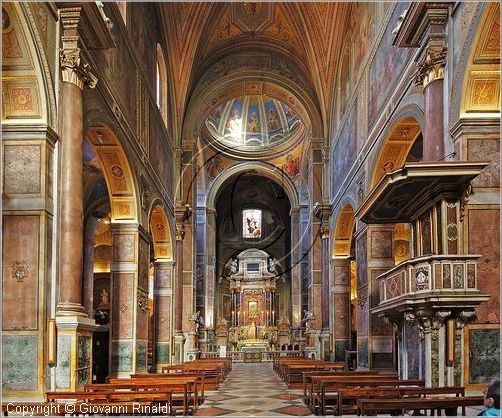
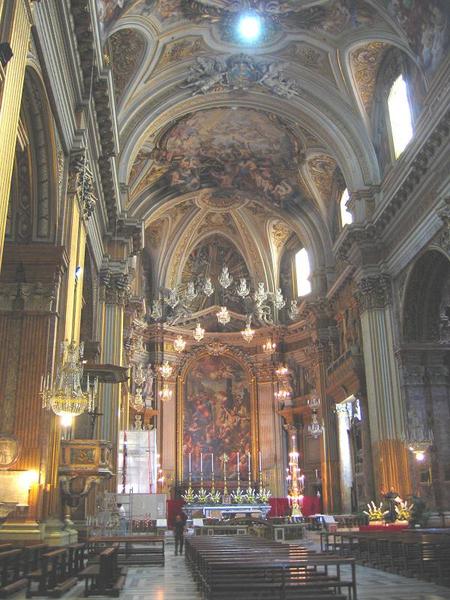
The Church of Saint Augustine, in the Campus Martius, is certainly one of the most glorious churches of its size in the world. Porphyry, marble, gold, a magnificent High Altar by Bernini himself, paintings by Raphael, sculptures by Sansovino -- all for the greater glory of God and the Holy Sacrifice of the Mass.
Saint Augustine? Yes, the ancient title of the church which used to be at this spot was that of Saint Tryphon, as it had been dedicated to the great Phrygian martyr of that name. In the end of the 15th century, the small church dedicated to Saint Tryphon was substituted by this jewel of Catholic beauty (the old small church survived as an annex of the current building well into the 19th century), under the patronage of Saint Augustine "and very loved by Romans, for there the Madonna del Parto is [particularly] venerated".

In the Gospel side "of the High Altar are the remains of Saint Monica, who died and was buried in Ostia, and whose relics were translated to this place in the 15th century ... Monica followed Augustine because she willed his salvation; the Church follows all because of the redemptive sacrifice of Christ." (Source)

Today's readings (the Saturday after Ash Wednesday was probably the last day of Lent to have its own Mass, late in the History of the Rite -- which means around the late first millenium, in the last formative age of the Traditional Roman Mass, and many centuries after the fixation of the Roman Canon), as always, are particularly related to the Station Church. Saint Tryphon was venerated as a patrons of gardens and gardeners, and the Epistle may be a coincidence...

"And the Lord will give thee rest continually, and will fill thy soul with brightness and deliver thy bones, and thou shalt be like a watered garden, and like a fountain of water whose waters shall not fail." (Epistle of the Mass of the Day, Isaias, lviii, 9-14)


Saint Tryphon was particularly venerated as a miracle-worker, "From a young age he was blessed with the divine power to cure any type of sickness" (Source). Which is why the Gospel of this Saturday (St. Mark, vi, 47-56) mentions the miracle-working powers of the Lord:

"...when they had passed over, they came into the land of Genesareth and set to the shore. And when they were gone out of the ship, immediately they knew Him: and running through that whole country, they began to carry about in beds those that were sick, where they heard He was. And whithersoever He entered, into the towns or into villages or cities, they laid the sick in the streets and besought Him that they might touch but the hem of His garment, and as many as touched Him were made whole."

What we have lost: Pope misses the readings of the Traditional Lenten Masses

When we first began our very modest series on the Station Churches of Lent, our aim was just to present a little aspect of the most venerable Traditions of the Church of Rome, as ancient as the Traditional Roman Mass (wrongly named by some as "Tridentine" -- which is not demeaning, since there was no Council as successful as Trent, but is historically inaccurate and is usually used with the intent of implying that a completely new liturgy may naturally follow a new Council).

This passage of the pope's conversation (it was more a long discussion than a speech) with the Roman clergy yesterday was particularly moving to us, as we had yesterday remarked on the happy link between the Gospel of the day and its origin from the choice of the Station church, which we also noted today. What the Holy Father said at the darker portion below is undeniable -- there is some continuity between the new readings and the "Lenten spirit". Yet it is an "example" (his words) of the post-conciliar discontinuities.

It is also good to see that the Holy Father has been meditating on the Traditional readings for the daily Mass of his Church, the Church of Rome. These were the Pope's words:
...It is necessary, above all, to avoid being careless with the common Catholic spirituality, which expresses itself in the Liturgy and in the great Tradition of the faith. This seems very important to me. This point is important also regarding the Council. There is no need to live -- as I said before Christmas to the Roman Curia [read more here]-- the hermeneutics of discontinuity, but to live the hermeneutics of renewal, which is the spirituality of continuity, of going forward in continuity.
This seems very important to me even regarding the Liturgy. I pick a concrete example, which has come to mind today with the short meditation of this day. The 'Statio' for today, Thursday after Ash Wednesday, is Saint George [see here]. Related to this holy soldier, there were two readings on two holy soldiers. The first [reading] speaks of king Ezekias [Epistle of the Mass for the Thursday after Ash Wednesday in the Traditional Roman Rite], who, when infirm, is condemned to death and prays to the Lord, weeping: give me a little more life! And the Lord is good and gives him 17 more years of life. Therefore, there is a nice defense [for the city] and a soldier who can resume anew his activity.
The second [reading] is the Gospel [Gospel of the Mass for Thursday after Ash Wednesday in the Traditional Roman Rite] which tells the story of the officer at Capharnaum and his ill servant. We have, then, two themes: the one of the defense [of the city] and the one of the 'militia' of Christ, of the great struggle.
However, in the current Liturgy, we have two completely different readings. We have the one in Deuteronomy: 'Choose life', and the Gospel: 'Follow Christ and take up your cross', which means not to care for one's own life, but to give life, and is an interpretation of what 'to choose life' means.
I must say I have always deeply loved the Liturgy. I was truly passionate about the Lenten path of the Church, with these 'Station churches' and the readings related to these churches: a geography of faith which becomes a spiritual geography of the pilgrimage with the Lord. And I felt somewhat bad for the fact that all links between the "Stations" and the reading were removed.

Today I see that these readings are quite beautiful and express the program of Lent: to choose life, that is, to renew the 'Yes' of Baptism, which is a true choice of life. In this sense, there is an intimate continuity and it seems to me that we should observe it as a very small example of discontinuity and continuity.
We should accept innovations, but also love continuity and see the Council through this light of continuity. This is helpful even in the mediation between generations in their way of passing down the faith.


Day 38 - Friday after Ash Wednesday - Saints John and Paul on the Coelian

The Station is at the Church of Saints John and Paul on the Coelian Hill.

"Many books have been written on this Shrine built on the Coelian, on the church now standing, of the 18th century, which modifies the one [built] by Pascal II in 1099, ...on the oratory of the 4th century... discovered at the end of the 1800s." (Source)
The patrons of the Station Church, killed in the terrible persecutions unleashed by Julian the Apostate, inspire the Gospel (St. Matthew, v, 43-48; vi, 1-4) of the day:
Love your enemies, do good to them that hate you; and pray for them that persecute and calumniate you: that you may be the children of your Father who is in heaven, who maketh His sun to rise upon the good and the bad, and raineth upon the just and the unjust. For if you love them that love you, what reward shall you have?
A good day to meditate on some words of the Imitation of Christ, book I, chapter 16:

THOSE things that a man cannot amend in himself or in others, he ought to suffer patiently, until God order things otherwise. Think that perhaps it is better so for your trial and patience, without which all our good deeds are not much to be esteemed. You ought to pray notwithstanding when you have such impediments, that God would vouchsafe to help you, and that you may bear them kindly.

Modern Man-child

Those who say that it isn’t fair to blame the Novus Ordo for its abuses by all and sundry have a point, though not much of one, IMO. For all the snarky reminders of the bad old good old days, it seems safe to say that one never saw abuses in tridentine days on the scale of the last forty years, and certainly never saw such abuses as there were so lovingly tolerated. No, the present buffoonery began with the NO. IMO, it derives from the NO’s raison d’etre, the lately perceived indispensability of the vernacular, in the sense not only of linguistic accommodation, but in the wider and deeper sense of a general accommodation of the clumsily perceived “needs”, and often whims, of that most childish of creatures, modern man.
.
Indeed, “we must be vigilant” concerning these abuses! Capital idea! Alas, the simple, forlorn fact of the matter is that the lion-hearted vigilance of the little man in the pew goes for naught if one’s bishop is a Levadaesque, go-along get-along schmoozer – not exactly an unheard of character among bishops. This makes for a dreadful equation: servile accommodation of the modern man-child + refusal to decisively curb abuses of said accomodation = general squalor. If such squalor did not already thrive in the Church like kudzu in Mississippi, this blog might very well not exist.
.
And tell me, please, I really want to know: exactly what makes the modern man-child so different from his forebears? Why can these luminous paragons of Dr Spock’s wisdom not bear the discipline of church tradition? Why can these shining beacons of erudition not handle a small Latin vocabulary with the ease of their peasant great grandparents? Why are they “insulted”, or made to feel excluded, by having to face the back of the priest, who, after all, worships Him, not them? Why, in this land of rugged individualists and freedom-jabberers, must all emphasis be placed not on the final, unalterably personal judgment we all face alone, but on a contrived sense of “community” that has not been valid or viable since the days of Constantine, if indeed it ever was? Why has the mystical body of Christ on earth been reduced to a self-congratulatory community of sin-eaters?
.
With this latest expostulation I will cease blogging until the day after the morning of the risen Christ. See you in (give or take) forty days.

Ecclesia Dei: SSPX priests and faithful are not "excommunicates"

We try to be as fair as possible here, even though we know we tread in passion-filled themes. It is not anything new to any Catholic who follows the news with attentiveness that the Holy See has often been precise in its considerations of the priests of the Priestly Fraternity of Saint Pius X (FSSPX/SSPX) and the faithful Catholics who go to their chapels.
__________________________________

The first significant event was the case which became known as "the Hawaii Six" (1991-1994): six lay men and women who had a radio show deeply critical of the Diocese of Honolulu and its leadership and who helped fund and build a SSPX chapel in Hawaii. The bishop of Honolulu excommunicated these Catholics for the crime of schism. Then-Cardinal Ratzinger, through the Congregation for the Doctrine of the Faith, had to intervene twice: once to nullify the excommunications (image here), in a letter of the pro-nuncio of Washington in which the latter convened his own ideas, with specific canons, as if they had also been part of the decree declaring the nullity of the excommunications; the second time (read here), after the CDF was notified of the Content of the first letter, the pro-nuncio in Washington had to make clear that the Canons he had mentioned had been his own idea, and that the decree of the CDF had not mentioned those canons. The decree declared that Petitioner had been "blameworthy on various accounts", but that these had not been "sufficient to constitute the crime of schism".

__________________________________

The second significant event happened with the famous "Australian letters". An Australian Catholic asked the Pontifical Commission Ecclesia Dei precise canonical questions regarding the attendance at SSPX Masses -- specifically if it constituted a "sin". The answer of the Commission was that "We have already told you that we cannot recommend your attendance at such a Mass and have explained the reason why. If your primary reason for attending were to manifest your desire to separate yourself from communion with the Roman Pontiff and those in communion with him, it would be a sin. If your intention is simply to participate in a Mass according to the 1962 Missal for the sake of devotion, this would not be a sin". After being questioned by many Catholics, the secretary of the Commission, Monsignor Camille Perl, made several clarifications, but, in the end, confirmed the basic outline of what had been said (read here).
__________________________________

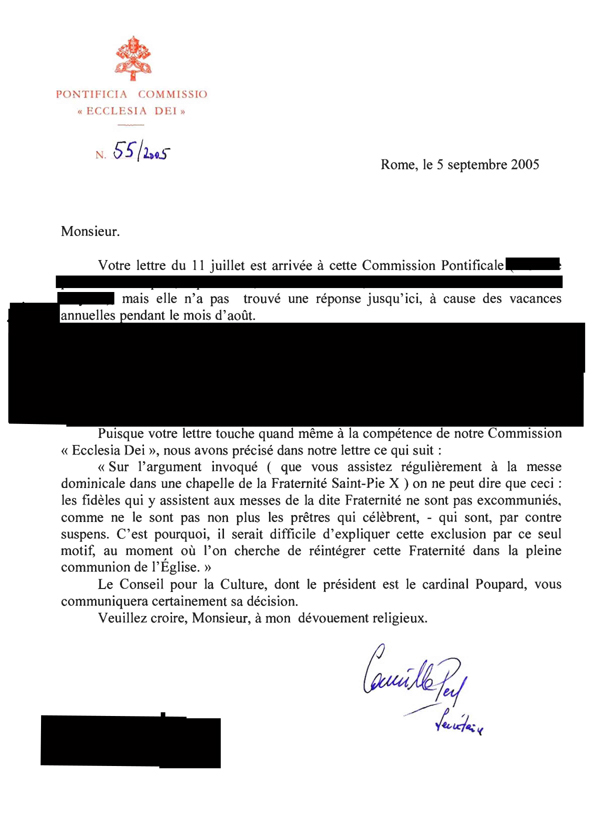
In July 2005, a French Catholic sent a letter to the Holy See regarding a personal incident. He had been denied application, by the Abbot of Fontgombault , to the board of administration of a Schola because he attended masses at SSPX venues (Fontgombault, of course, is a foundation of Dom Prosper Guéranger's Abbey of Solesmes and is one of the most prestigious Benedictine abbeys in the world; it is one of the centers of the "Reform of the Reform" movement and mother house of the Traditional Clear Creek Benedictine community in Oklahoma). He petitioned the Holy See and the answer came from two dicasteries, the one related to the Schola itself; and the Pontifical Commission Ecclesia Dei, regarding the matter of its competence. This is a copy of the letter, from which we have deleted the more personal information of the case.


PONTIFICIA COMMISSIO
'ECCLESIA DEI'

n. 55/2005 Rome, September 5, 2005

Sir,

Your letter of July 11 arrived at this Pontifical Commission (...), but it has not been answered up to now due to the annual vacations during the month of August.

...

Because your letter actually involves the competence of our Commission 'Ecclesia Dei', we have precised in our letter what follows:

'On the argument presented (that you regularly attend Sunday Mass at a chapel of the Fraternity Saint Pius X) one cannot say but this: the faithful who attend the Masses of the aforesaid Fraternity are not excommunicates, and the priests who celebrate them are not, either -- the latter are, in fact, suspended. Which is why it would be difficult to explain this exclusion by this sole motive, at a time in which the reintegration of this Fraternity to the full communion of the Church is sought.'

The Council for Culture, whose president is Cardinal Poupard, will certainly let you know of his decision.

Receive, sir, my religious regards, [Veuillez croire, Monsieur, à mon dévouement religieux,]

CAMILLE PERL
Secretary

__________________________________
No qualifications. No "buts"; no "if they adhere"; no "whether they share a certain mentality" or not. Neither the priests of the Fraternity nor the faithful Catholics who attend their Masses are excommunicates. Moreover, the Ecclesia Dei Commission had no objection that Petitioner, on the grounds that he is a regular attendee of a SSPX chapel, be accepted as an administrator of a Schola. Together with the precise (though not as official as this letter) words of Cardinal Castrillón Hoyos that there "was not a formal schism", one hopes there will be more respect from certain quarters at this delicate time.

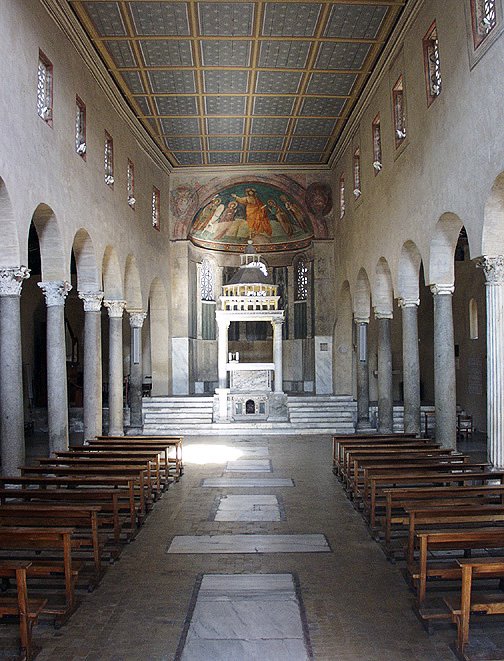
Day 39 - Thursday after Ash Wednesday - Saint George in Velabrum


"The Church of S. George in Velabrum is not very dissimilar to S. Sabina and S. Mary in Cosmedin.


"The origins of the temple are much earlier than the 6th century. ...S. Gregory II instituted it as a Lenten Station. Leo XII joined the patronage of S. Sebastian to that of S. George and another Gregory, the fourth of that name, gifted it with mosaics and porticos; in 1325, Giotto frescoed the apse."


A soldierly chapel, dedicated to brave soldiers, George and Sebastian, as also is the Gospel of the day (St. Matthew viii, 5-13). In the spirit of the ancient Roman churches, we link to this article by Fr. Ignacio Barreiro, on the prospects for the current pontificate: Tidings of Comfort and Joy.

Saving the Cathedral

Readers of this Blog may be interested to know that a fascinating ecclesiastical drama is being played out in an Irish hotel in these days. The Bishop of Cloyne (in the County of Cork), John Magee, former secretary to two Popes, has his heart set on 're-ordering' his Cathedral. The Cathedral was designed by Pugin, and is arguably Ireland's finest. To date it has survived the ravages of the post-Vatican II period, but, alas, while the rest of the world is gradually coming to its senses, His Lordship of Cloyne has taken leave of his. The proposed alterations involve removing the altar rails, extending the sanctuary, and 're-locating' the exquisite mosaic work. Thank God, a group of local worshippers, the Friends of St Colman's Cathedral (http://www.foscc.com/), are having none of it. Permission to carry out the destruction was stealthily gained from the civil authorities, but now this is being challenged by the Friends. And here we come to the hotel. Yesterday the Irish Planning Appeals Board began a special sitting in the Midleton Park Hotel, Cork, precisely to review this case. The bishop himself was in attendance, along with his Metropolitan, and several other Lordships; but the majority of those who filled the room were ordinary folk from the Cathedral parish who are appalled at the thought of the impending demolition. Both sides have engaged expert legal representation, but the Friends have flown in two heavy-weight witnesses: a judge of the Roman Rota, and no less a liturgist than Dom Alcuin Reid, OSB. Initial indications are that the bishop has a very weak case indeed. Let us pray that good sense - the sensus fidelium - will prevail.

Day 40 - Ash Wednesday - Saint Sabina in the Aventine


The Station in the first day of Lent is at one of the most beautiful and traditional churches in Rome, Saint Sabina in the Aventine Hill (also known as the mother Church of the Friars Preachers).

"The current basilica is dated, as reported in the great inscription in the entrance:'it was built by the priest Pietro Illirico, at the time of Pope Celestine I (422-432)'. But a Titulus Sabinae previous to that age is known. ...

"The basilica of the 5th century was frequently restored and modified, as almost all the ancient churches of Rome: fires, earthquakes, invasions, new styles were their greatest enemies. In 1914-1918, A.Munos restored it to its [original] style, using many original pieces, which fortunately had not been destroyed: this is [the Basilica] we currently admire.(Source)"

S. Sabina, the station established by Urban VIII for Ash Wednesday, is the most important of all because it was long customary for the popes to repair thither on that day to distribute the ashes to the people. (Source)
Read more on the Station Days and their history in the Catholic Encyclopedia.

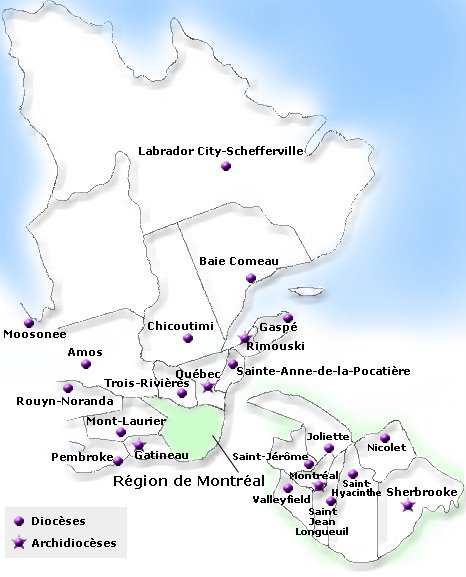
A Map of Episcopal Ineptitude

This is not a map of the dioceses of Québec. This is a map of the foremost sign of the post-Conciliar age: the complete ineptitude of bishops.

Last Sunday, the most influential newspaper in the French-speaking province, once the most Traditional area of North America, La Presse, published a letter signed by 19 priests, titled "Enough is enough", denouncing the Church's teaching on the disordered condition of homosexuality. These are the names of the priests:

Archdiocese of Montréal:

1. Fr. André Anctil
2. Fr. José V. Arruda
3. Fr. Jean-Pierre Langlois
4. Fr. Claude Lefebvre
5. Fr. Claude Lussier.

Diocese of Joliette:

6. Fr. Raymond Gravel (leader of the group)
7. Fr. Eric Généreux
8. Fr. Bernard Houle
9. Fr. Pierre-Gervais Majeau
10. Fr. Guylain Prince
11.Fr. Claude Ritchie

Diocese of Saint-Jean-Longueuil:

12. Fr. Jean-Yves Cedilot
13. Fr. Jocelyn Jobin
14. Fr. Alain Léonard
15. Fr. Lucien Lemieux (professor at the University of Montréal and also a Regional Vicar for the Diocese; one of the most influential priests in Québec)

Archdiocese of Gatineau:

16. Fr. Benoît Fortin
17. Fr. Michel Lacroix
18. Fr. Claude St-Laurent

Diocese of Gaspé:

19. Fr. Jacques Pelletier

The letter affirms that the Church does not possess "the truth on human beings". "We wish that Christians listen to the life experience of their homosexual brothers and sisters". Regarding the bishops' opposition to the iniquitous "same-sex marriage" legislation approved last year in Canada, the priests asked: "Was there any trace of the compassion that marked Jesus's passage on Earth? Not a paragraph, not a sentence in your brief that takes into account the historical discrimination against homosexuals and the tragedy of their social and ecclesial exclusion."

All 19 priests were immediate suspended from their positions, right? Well, not exactly:

On Sunday, no official response was forthcoming from the Vatican or the Canadian Conference of Bishops. The Montreal diocese office was similarly quiet. Cardinal Jean-Claude Turcotte is out of the country, in Peru.

At Montreal's Cathedral Mary Queen of the World, however, worshippers were instructed to inform themselves and to make up their own minds on the issue.

During the 5 p.m. mass, Rev. Michel de la Chevrotiere mentioned the letter and told people it is up to them to make up their own minds. (Source)


Since the bishops won't, can you do something about it? A lay canon lawyer believes so. Read more here.

Remembering 1988

Nobis Quoque Peccatoribus has a welcome and balanced reminder of the issues involved in the dramatic events of 1988 which led to the consecration, by Archbishop Marcel Lefebvre and Bishop Antonio de Castro Mayer, of the four bishops of the Priestly Fraternity of Saint Pius X (FSSPX/SSPX), including the similarities and differences regarding the current developments.

The history of the Rome-SSPX negotiations of late 1987-early 1988 which, in the end, led to the consecrations, is quite complex and it involves many passionate views from all sides. It is important, though, to remember that even after the traumatic Assisi events of 1986, Archbishop Lefebvre never gave up talking to Rome, reaching the point of actually signing with then-Cardinal Ratzinger the famous protocol of May 5, 1988.

Strange things happened on both sides immediately thereafter -- including tremendous pressure on Pope John Paul himself, which prevented Cardinal Ratzinger from presenting the details (implied in the Protocol) which he had promised the Archbishop.

"Gay Church" holds service in Catholic chapel during WCC Meeting

"In the 9th assembly of the World Council of Churches, a gay Church celebrates service in the Chapel of PUCRS [Pontifical Catholic University of Rio Grande do Sul]." Feb. 21, 2006 - News from the newspaper Zero Hora (Porto Alegre, Brazil)


by Itamar Melo

A church [sic] whose bishops [sic] , ministers, and faithful are homosexual celebrated a service yesterday [February 20, 2006] in Porto Alegre [Brazil] during the 9th assembly of the World Council of Churches (WCC). Founded in 1968 in the United States and with a parish [sic] in Rio since 2004, the Metropolitan Community Church (MCC) plans to open a church in the Capital [Porto Alegre].

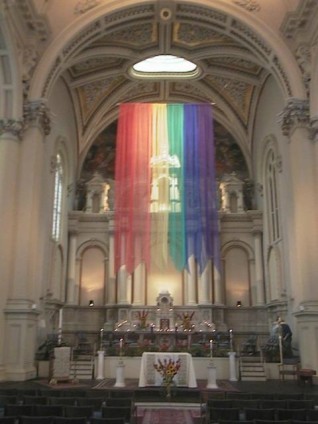
The service happened in the morning in the chapel of the PUCRS [the Pontifical Catholic University of Rio Grande do Sul, a Catholic university of Pontifical right and status, owned by the Marists], where the religious forum takes place. Three foreign female bishops [sic] as well as Gelson Piber, the minister responsible for the Brazilian parish [sic], participated in the celebration. The homosexual aspect of the service was visible in some details: the lilac color of the altar cloth, the rainbow-colored stole of one of the female bishops [sic], and in the prayers for the memory of gays and lesbians.

-Our message is that God does not discriminate anyone. Prejudice against homosexuality is based in equivocal interpretations of the Bible -- said bishop [sic] Darlene Garner, MCC's woman in charge for Latin America.

The institution was founded by Troy Perry, a minister who was expelled from a Pentecostal church when his homosexuality was discovered. Today, the MCC is present in 26 countries, 20 of them in Latin America. The church's delegation at the WCC assembly, where it participates as an observer, is composed of 15 people. Its members are usually people who went through discrimination, healing attempts, and guilt crises in other denominations. In the MCC churches, gays are baptized, receive the eucharist [sic] , and may get married [sic].
Links to the WCC Assembly, the Pontifical Catholic University of Rio Grande do Sul, its Chapel (actually, the "University Church Christ the Master" of the "Pastoral Center" -- where one may check that it is the exact same place), the Marists, and the original report (which is available for free only today, with a complex registration, but which we have saved just in case). The Catholic Church was an observer in the WCC Assembly.

Saint Marcellin Champagnat, founder of the Marist School Brothers, would be proud of this, right?

Thanks to our South American reader who sent us this.