Rorate Caeli

After Christmas, maybe?

Going with the whole "sources close to the Vatican" bit, ACI Prensa is reporting that the Motu Proprio "may be published after Christmas; while the post-Synodal [Apostolic] Exhortation on the Eucharist will see the light [of day] by mid-January"
---
Fr. Zuhlsdorf found the news first, and we are only sharing the wealth. Thanks, Father.

Some more information on yesterday's meeting


On this Wednesday's edition of Il Giornale, Andrea Tornielli confirms the words provided by Cardinal Medina on the content of the plenary meeting of the Ecclesia Dei commission, reported here yesterday, and adds some new information:

...

In the order of the day for the meeting was also a discussion on the juridical framework in which to place the Lefebvrists after their readmission into full communion with the Holy See.

The debated questions were, thus, two. ...

Benedict XVI intends to extend the indult of his predecessor, in fact withdrawing from the bishops discretionary power on the matter: the Missal of Saint Pius V is no longer abolished, and even if the ordinary Roman Rite is that originated from the post-conciliar liturgical reform, the old one -- used by centuries in the Church -- can subsist as an "extraordinary rite".

The bishops, therefore, will not be able to deny the ancient mass anymore, but only regulate its eventual celebration, together with the parish priests, harmonising it with the need of the community. The corrections included would have reduced from 50 to 30 the minimal number of faithful who ask for the celebration according to the old rite. As for the readmission of the Lefebvrists, once the rite of Saint Pius V is liberalized, the deal should be easier.

An eminent confirmation


From a news dispatch by the Italian news agency ANSA:

"The publication of the Motu Proprio from the Pope which will liberalize the celebration of the Latin Mass according to the Missal of Saint Pius V is close." Who affirmed this was Cardinal Jorge Arturo Medina Estevez, member of the Ecclesia Dei Commission, which met this morning to discuss the liberalization of the Mass in Latin. "We studied the document with tranquility," the Cardinal affirmed. "We discussed [it] together for over 4 hours and to make some corrections to the text of the Motu Proprio." The next step belongs to Cardinal Dario Castrillon Hoyos (president of the commission), who will present the text to Benedict XVI. There shall perhaps be another meeting of the Ecclesia Dei Commission, Medina added. Another member of the [Commission], the Cardinal of Lyon [sic -> Bordeaux], Jean Pierre [sic] Ricard, did not wish to make any comment, underlining that "[he] is bound by the pontifical secret".
Thanks to Gilbert and other readers for the tip (and I apologize for not posting it before -- busy day). (Sources: in French --in which it is reported that Medina would have said that another plenary meeting is "probably not needed"; original ANSA dispatch in Italian)

Old News, Old Commission, Old Mass

In today's edition of Le Figaro, Sophie de Ravinel tells us that her paper has had access to the minutes of a 1982 meeting of curial cardinals that dealt with the abrogation, or not, of the Traditional Mass.

The Commission, led by then Cardinal Ratzinger, concluded, inter alia, that the "Roman Missal, in the form which was used up to 1969, should be allowed by the Holy See to be used, in the whole Church, for Masses celebrated in the Latin language."

Beyond that conclusion, the Commission recommended a series of steps aimed at curbing liturgical abuses, and a possible reunification of the the Old and New rites, which Mrs. de Ravinel connects to the so called "Reform of the Reform".

Post-Synodal Exhortation signed

According to the Vaticanist of the Italian weekly Panorama, Ignazio Ingrao, the post-synodal Apostolic Exhortation would already have been signed:

Benedict XVI has just signed the document which forbids married men from reaching the priesthood [in the Latin Church]. It is the "Post-Synodal Exhortation on the Eucharist". The text is already in the hands of the translators and the publication is forecast for the second half of January. The themes considered in the document are destined to open new discussions: priestly celibacy, communion to remarried divorced persons, the use of Latin in Mass.
...

The recourse to the ordination of married priests of proven virtue ("viri probati") to face the lack of vocations is excluded; the admission of remarried divorced persons to Communion is forbidden, but it is recommended that the Christian community welcome and value their presence; the study of the liturgy in Latin and of Gregorian Chant in seminaries is recommended.


The article also included several references to the late attempt by Cardinal Hummes to derail some of the conclusions related to the ordination of married men, absurdly justified by the "need" to confront the advance of Protestant sects in Latin America -- exactly the kind of liberal technique already exposed here. Even the Maronite Patriarch, Cardinal Sfeir, weighs in against the extension of the practice in the West.

Regarding the liturgy, there is no indication at this moment that the Traditional liturgy is directly mentioned in the exhortation.

Ecclesia Dei meeting tomorrow to discuss liberalization


Benedict XVI shortens the timing for a reconciliation with the followers of Archbishop Marcel Lefebvre.

The "Ecclesia Dei" Commission, established for this purpose by John Paul II, will meet tomorrow in a first plenary session to discuss the question of the liberalization of the Mass in Latin.

The meeting of December 12 is reported by the French news agency I.Media and will include the presence of Cardinal Ricard, a member of the Commission and president of the French Episcopal Conference.

The first "liturgists" - II


The adversaries ... make a great ado concerning the desolation of churches, namely, that the altars stand unadorned, without candles and without images. These trifles they regard as ornaments to churches. (Although it is not true that we abolish all such outward ornaments; yet, even if it were so, Daniel is not speaking of such things as are altogether external and do not belong to the Christian Church.) It is a far different desolation which Daniel means, 11, 31; 12, 11, namely, ignorance of the Gospel.

...

Concerning the exercises of faith struggling with despair, and the free remission of sins for Christ's sake, all the books and all the sermons of the adversaries were silent (worse than worthless, and, moreover, caused untold damage). To these, the horrible profanation of the masses and many other godless services in the churches were added. This is the desolation which Daniel describes. ... Candles, golden vessels (tapers, altar-cloths, images), and similar adornments are becoming, but they are not the adornment that properly belongs to the Church. ...

...

The adversaries also refer us to philology. ... Why do they ... omit the old appellation synaxis, which shows that the Mass was formerly the communion of many? ...

Philipp Melanchthon
Apologia Confessionis Augustanæ

Litoo

To our French readers, at the request of one of our readers: is there a working e-mail for those who are responsible for the Litoo Traditional Catholic Publishers' website (www.litoo.com), an e-mail which actually works, unlike the e-mail (info@litoo.com) and contact forms available in their website?

Please, send any information to my e-mail, available here. Thank you.

The first "liturgists" - I

We allow the vestments, altars, and candles to remain in use until they are used up or it pleases us to make a change. But we do not oppose anyone who would herein do otherwise. In the true Mass, however, of real Christians, the altar could not remain where it is and the priest must always face the people as doubtless Christ did in the last Supper. But let that await its own time.
Martin Luther
Preface to "The German Mass"

Tota Pulchra es - III


IMMACULATE CONCEPTION: These words fell from the lips of the Immaculata herself. Hence, they must tell us, in the most precise and essential manner, who she really is.

Since human words are incapable of expressing Divine realities, it follows that these words, "Immaculate" and "Conception", must be understood in a much more profound, much more beautiful and sublime meaning than usual: a meaning beyond that which human reason at its most penetrating commonly gives to them.

...

Who then are you, O Immaculate Conception?

Not God, of course, because He has no beginning. Not an angel, created directly out of nothing. Not Adam, formed out of the dust of the earth. Not Eve, molded from Adam's rib. Not the Incarnate Word, Who exists before all ages, and of Whom we should use the word "conceived" rather than "conception."

Humans do not exist before their conception, so we might call them created "conceptions." But you, O Mary, are different from all other children of Eve. They are conceptions stained by Original Sin; whereas you are the unique, Immaculate, Conception.

Everything which exists, outside of God Himself, since it is from God and depends on Him in every way, bears within itself some semblance to its Creator; there is nothing in any creature which does not betray this resemblance, because every created thing is an effect of the Primal Cause.

...

Who is the Father? What is His personal life like? It consists in begetting, eternally, because He begets His Son from the beginning and forever.

Who is the Son? He is the Begotten-One, because from the beginning, and for all eternity, He is begotten by the Father.

And Who is the Holy Spirit? The flowering of the love of the Father and the Son. If the fruit of created is a created conception, then the fruit of Divine love, that prototype of all created love, is necessarily a Divine "conception." The Holy Spirit is, therefore, the "uncreated, eternal conception," the prototype of all the conceptions that multiply life throughout the whole universe.

The Father begets; the Son is begotten; the Spirit is the "conception" that springs from their love; there we have the intimate life of the Three Persons by which They can be distinguished from one another. But They are united in the Oneness of Their Nature, of Their Divine existence. The Spirit is, then, this thrice holy "conception," this infinitely holy Immaculate Conception.

...

The creature most completely filled with this love, filled with God Himself, was the Immaculata, who never contacted the slightest stain of sin, who never departed in the least from God's will. United to the Holy Spirit as His spouse, she is one with God in an incomparably more perfect way than can be predicated of any other creature.

What sort of Union is this? It is above all an interior union, a union of her essence with the "essence" of the Holy Spirit. The Holy Spirit dwells in her; lives in her. This was true from the first instance of her existence. It was always true and it will always be true.

And in what does this life of the Spirit in Mary consist? He Himself is uncreated Love in her; the Love of the Father and of the Son, the Love by which God loves Himself, the very love of the Most Holy Trinity. She is a fruitful Love, a "Conception." Among creatures made in God's image, the union brought about by married love is the most intimate of all. In a much more precise, more interior, more essential manner, the Holy Spirit lives in the soul of the Immaculata, in the depths of her very being. He makes her fruitful, from the very first instance of her existence, all during her life, and for all eternity.

This eternal "Immaculate Conception" [the Holy Spirit] produces in an immaculate manner Divine life itself in the womb or depths of Mary's soul, making her the Immaculate Conception, the human Immaculate Conception. And the virginal womb of Mary's body is kept sacred for Him; there He conceives in time the human life of the Man-God.

... she, the Immaculata, grafted into the Love of the Blessed Trinity, becomes, from the first moment of her existence and forever afterwards, the "complement of the Blessed Trinity." In the Holy Spirit's union with Mary we observe more than the love of two beings... . ... in this union, Heaven and Earth are joined; all of Heaven with the Earth, the totality of eternal love with the totality of created love. It is truly the summit of love.
Saint Maximilian Kolbe

Tota Pulchra es - II


When the supreme hour of the Son came, beside the Cross of Jesus there stood Mary His Mother, not merely occupied in contemplating the cruel spectacle, but rejoicing that her Only Son was offered for the salvation of mankind, and so entirely participating in His Passion, that if it had been possible she would have gladly borne all the torments that her Son bore. And from this community of will and suffering between Christ and Mary she merited to become most worthily the Reparatrix of the lost world and Dispensatrix of all the gifts that Our Savior purchased for us by His Death and by His Blood.

We are ... very far from attributing to the Mother of God a productive power of grace - a power which belongs to God alone. Yet, since Mary carries it over all in holiness and union with Jesus Christ, and has been associated by Jesus Christ in the work of redemption, she merits for us de congruo, in the language of theologians, what Jesus Christ merits for us de condigno, and she is the supreme Minister of the distribution of graces.

...

...who will not see that we have with good reason claimed for Mary that - as the constant companion of Jesus from the house at Nazareth to the height of Calvary, as beyond all others initiated to the secrets of his Heart, and as the distributor, by right of her Motherhood, of the treasures of His merits, - she is, for all these reasons, a most sure and efficacious assistance to us for arriving at the knowledge and love of Jesus Christ. Those, alas! furnish us by their conduct with a peremptory proof of it, who seduced by the wiles of the demon or deceived by false doctrines think they can do without the help of the Virgin. Hapless are they who neglect Mary under pretext of the honor to be paid to Jesus Christ! As if the Child could be found elsewhere than with the Mother!

...it is this end which all the solemnities that are everywhere being prepared in honor of the holy and Immaculate Conception of Mary should have in view. No homage is more agreeable to her, none is sweeter to her than that we should know and really love Jesus Christ. Let then crowds fill the churches - let solemn feasts be celebrated and public rejoicings be made: these are things eminently suited for enlivening our faith. But unless heart and will be added, they will all be empty forms, mere appearances of piety. At such a spectacle, the Virgin, borrowing the words of Jesus Christ, would address us with the just reproach: "This people honoureth me with their lips, but their heart is far from me" (Matth. xv., 8).

Pope Saint Pius X
Ad Diem Illum Lætissimum

Would Fessio actually know this?...

The Pope has reportedly already written the post-synodal exhortation and has written a motu proprio too. I don't know what is in them. But at the 2001 Fontomgbault Conference, Cardinal Ratzinger said he thought the Holy See should let the Traditional Roman rite coexist with the Novus Ordo to show continuity.
Read the whole interview of Father Joseph Fessio, SJ, to The Wanderer, in Brian Mershon's most recent column.
In the Blue Mosque,

"...I turned to the One Lord of Heaven and Earth, merciful Father of the whole mankind. May all believers recognize themselves as His creatures and give witness of true brotherhood."

Benedict XVI
General Audience, December 6, 2006

Tota Pulchra es - I


Was the Blessed Virgin conceived in sin? The answer is no, for as Augustine writes: "When sin is treated, there can be no inclusion of Mary in the discussion." And Anselm says: "It was fitting that the Virgin should be resplendent with a purity greater than which none under God can be conceived." Purity here is to be taken in the sense of pure innocence under God, such as was in Christ.

The contrary, however, is commonly asserted on two grounds. First, the dignity of her Son, who, as universal Redeemer, opened the gates of heaven. But if Blessed Mary had not contracted original sin, she would not have needed the Redeemer, nor would He have opened the door for Her because it was never closed. For it is only closed because of sin, above all original sin.

In respect to this first ground, one can argue from the dignity of her Son as Redeemer, Reconciler, and Mediator, that she did not contract original sin.

For a most perfect mediator exercises the most perfect mediation possible in regard to some person for whom he mediates. Thus Christ exercised a most perfect act of mediation in regard to some person for whom He was Mediator. In regard to no person did He have a more exalted relationship than to Mary. Such, however, would not have been true had He not preserved her from original sin.
Blessed John Duns Scotus
Ordinatio II, d. 3, q. 1

Oops

This question [of priestly celibacy] is not currently on the agenda of church authorities, as recently restated after the last reunion of heads of dicasteries with the Holy Father.

From a statement by the new head of the Congregation for the Clergy, Cardinal Hummes, on his first day in office.

The progressive technique in a nutshell: raise a subject which should not have been raised in the first place, preferably by the way of an interview; then, deny what had been said, while the matter is discussed according to the first controversial declaration.

This technique, the "apparent about-face", is a "Progressive Classic". Congratulations to Cardinal Hummes for his successful first day as head of Clergy!

If not Ecône..., Constantinople?...

Some interesting words from an exclusive interview of Patriarch Bartholomeos with the semi-official daily of the Italian Episcopal Conference, Avvenire:

This morning's speeches and the joint declaration that you have undersigned sounded "lofty" and certainly promising. You have even spoken of the future, regarding the [future] steps?

Regarding this, I can say that I have spoken to His Holiness about something, something we can do. I have made him an offer about which I cannot yet talk, while we wait for an official response in this sense; however, I can say that His Holiness displayed great interest and welcomed the offer favorably. We hope that it can be accomplished, because it truly follows the prospects of that ecumenical progress which, as we have affirmed and even written in the Joint Declaration, we both are determined to pursue.

Sophia!

It is sad to realize that the most striking words during the journey of our Supreme Pontiff to Asia Minor and Eastern Thrace were pronounced not by the visiting Vicar of Christ, but by the welcoming Patriarch of Constantinople in imperfect communion with him. Words of wisdom from the Phanar on that most sublime of subjects, Sacred Liturgy:

...
Every celebration of the Divine Liturgy is a powerful and inspiring con-celebration of heaven and of history. Every Divine Liturgy is both an anamnesis of the past and an anticipation of the Kingdom. We are convinced that during this Divine Liturgy, we have once again been transferred spiritually in three directions: toward the kingdom of heaven where the angels celebrate; toward the celebration of the liturgy through the centuries; and toward the heavenly kingdom to come.

...in Christ, there is a deep connection between past, present, and future. In this way, the liturgy is more than merely the recollection of Christ's words and acts. It is the realization of the very presence of Christ Himself, who has promised to be wherever two or three are gathered in His name.

At the same time, we recognize that the rule of prayer is the rule of faith (lex orandi lex credendi), that the doctrines of the Person of Christ and of the Holy Trinity have left an indelible mark on the liturgy, which comprises one of the undefined doctrines, "revealed to us in mystery," of which St. Basil the Great so eloquently spoke.
...
Thus our worship coincides with the same joyous worship in heaven and throughout history. Indeed, as St. John Chrysostom himself affirms: "Those in heaven and those on earth form a single festival, a shared thanksgiving, one choir" (PG 56.97) ... In its spacious embrace, it includes the whole world, the communion of saints, and all of God's creation. The entire universe becomes "a cosmic liturgy", to recall the teaching of St. Maximus the Confessor. This kind of Liturgy can never grow old or outdated.

How very true: the Traditional Liturgies, of East and West, never grow old. Never.

Real Turkish interests

From some famous exchanges between Turkish Interior Minister, Mehmet Talaat Pasha (soon to be one of the last Ottoman Grand Viziers, Talaat was one of the leaders of the "Young Turks" and an architect of the Armenian Genocide), and American Ambassador in Constantinople, Henry Morgenthau, in 1915 (in "Ambassador Morgenthau's Story", by Henry Morgenthau):

"...I have asked you to come here"[, Talaat said,]"so as to let you know that our Armenian policy is absolutely fixed and that nothing can change it. We will not have the Armenians anywhere in Anatolia. They can live in the desert, but nowhere else."

I still attempted to persuade Talaat that the treatment of the Armenians was destroying Turkey in the eyes of the world, and that his country would never be able to recover from this infamy.

"You are making a terrible mistake," I said, and I repeated the statement three times.

"Yes, we may make mistakes," he replied, "but" -- and he firmly closed his lips and shook his head -- "we never regret."

...

One day Talaat made what was perhaps the most astonishing request I had ever heard. The New York Life Insurance Company and the Equitable Life of New York had for years done considerable business among the Armenians. The extent to which this people insured their lives was merely another indication of their thrifty habits.

"I wish," Talaat now said, "that you would get the American life insurance companies to send us a complete list of their Armenian policy holders. They are practically all dead now and have left no heirs to collect the money. It of course all escheats to the State. The Government is the beneficiary now. Will you do so?"

This was almost too much, and I lost my temper.

"You will get no such list from me," I said, and I got up and left him.

News from the "secular" Muslim country

[November 29, 2006] Turkish President Ahmet Necdet Sezer vetoed an EU-inspired law to improve the property rights of non-Muslims, the president's office said on Wednesday.

...

The so-called foundations law, which fell short of European Union expectations, affects Greek Orthodox, Syriac and Armenian communities, and was approved after months of fierce debate in officially secular but predominantly Muslim Turkey.


The Great Church is a dead shell. One enters it, and one is struck by its immensity and antiquity. But then, as one walks about it, one is struck by something else: its stasis. The house of God has no God in it, no worshippers of any kind, and no future to complement its past. The other great churches of Christendom are at the least well-preserved, and most even have active congregations. Aggressively secular Paris manages to find congregants -- and funds -- for Notre Dame. The Basilica of St Peter retains an active glory. St Mark's in Venice, nearest to the Hagia Sophia in decor and form, is yet alive with something more than tourists. The Church of the Holy Sepulchre in Jerusalem is patrolled by prickly monks of various denominations. ... And among them, only the Hagia Sophia is dead. It is a metaphor and a warning -- of the Ecumenical Patriarchate under the Turks, and of Christianity under Islam.


Dear brothers and sisters, in this visit I have wanted to convey my personal love and spiritual closeness, together with that of the universal Church, to the Christian community here ..., a small minority which faces many challenges and difficulties daily. With firm trust let us sing, together with Mary, a magnificat of praise and thanksgiving to God who has looked with favour upon the lowliness of his servant (cf. Lk 1:48). ... Mary teaches us that the source of our joy and our one sure support is Christ, and she repeats his words: "Do not be afraid" (Mk 6:50), "I am with you" (Mt 28:20).

Benedict XVI, in Ephesus
"In matters political Islam is a system of despotism at home and aggression abroad. The Prophet commanded absolute submission to the imâm. In no case was the sword to be raised against him. The rights of non-Moslem subjects are of the vaguest and most limited kind, and a religious war is a sacred duty whenever there is a chance of success against the 'Infidel'.


"Medieval and modern Mohammedan, especially Turkish, persecutions of both Jews and Christians are perhaps the best illustration of this fanatical religious and political spirit."
Gabriel Oussani, The Catholic Encyclopedia (1910)

More information and pictures of the Turkish persecution of the Christian Greek-speaking population in the 1890-1955 period in Asia Minor and East Thrace here.

On the Armenian Genocide, visit the websites of the Armenian National Institute and of Never Again.

On the Assyrian Genocide.

From Genoa

The Archdiocese of Genoa, headed by Archbishop Angelo Bagnasco (very close to Cardinal Bertone, his predecessor in Liguria), made public today a very substantial note on the prospect of the Motu proprio for the liberalization of the Traditional Mass. The whole text is available here.

Precisions regarding [in merito] an eventual promulgation of a "Motu proprio" to ease the appliction of the indult on the use of the Missal called of Saint Pius V

November 27, 2006
...

1) the Pope, due to his supreme authority, has the faculty to put in practice universally valid and binding juridical and pastoral acts;
...

8) the Council of Trent did not intend to unify with an act of authority the existing rites of the Latin Church; in fact, based on the principle established by the same Saint Pius V -- who, at the request of the Council, effected the reform --, the churches and religious orders which had for at least two centuries their own rite of venerable tradition, could preserve it. With the passing of the years, in fact, the Roman Rite established itself, though not in an exclusive way; the case of the Ambrosian rite, spread through some valleys of the Ticino (called "Ambrosian Valleys") and the entire Archdiocese of Milan (though, even there, with exceptions: Monza, Trezzo, Treviglio) is symbolic [of that].

9) two valid expressions of the same Catholic faith -- that of Saint Pius V and that of Paul VI -- cannot be presented as "expressing opposite views" and, thus, as mutually irreconcilable;

...

Conditions

From a conference of Bishop Richard Williamson (one of the four bishops consecrated by Archbishop Marcel Lefebvre and co-consecrated by Bishop Antonio de Castro Mayer in 1988) in Warsaw, on November 19, 2006 (mp3 file).

I heard two days ago in Paris that the Motu Proprio liberating the Tridentine Mass should soon appear. I also heard, the same source said, that the lifting, that the decree of excommunication of the four bishops should also be soon lifted. In other words, the two conditions that the Society of Saint Pius X asked for in 2001, it looks as though they may be granted.

...

He may not succeed with the Motu Proprio against the opposition of all the French bishops. ... So the well-meaning pope may or may not succeed in establishing his Motu Proprio.

...

"Jesu! Jesu! Jesu! Have mercy on me!"


...considering that this matter, although already decided, had been by certain persons for whatever reason recalled into discussion, and that thence it might follow that a pernicious error would be fostered in the minds of many who might suppose that they possessed the Sacrament and effects of Orders, where these are nowise to be found, it seemed good to Us in the Lord to pronounce our judgment.

Wherefore, strictly adhering, in this matter, to the decrees of the pontiffs, our predecessors, and confirming them most fully, and, as it were, renewing them by our authority, of our own initiative and certain knowledge, we pronounce and declare that ordinations carried out according to the Anglican rite have been, and are, absolutely null and utterly void.

It remains for Us to say that, even as we have entered upon the elucidation of this grave question in the name and in the love of the Great Shepherd, in the same we appeal to those who desire and seek with a sincere heart the possession of a hierarchy and of Holy Orders.

Perhaps until now aiming at the greater perfection of Christian virtue, and searching more devoutly the divine Scriptures, and redoubling the fervor of their prayers, they have, nevertheless, hesitated in doubt and anxiety to follow the voice of Christ, which so long has interiorly admonished them. Now they see clearly whither He in His goodness invites them and wills them to come.

In returning to His one only fold, they will obtain the blessings which they seek, and the consequent helps to salvation, of which He has made the Church the dispenser, and, as it were, the constant guardian and promoter of His redemption amongst the nations. Then, indeed, "They shall draw waters in joy from the fountains of the Savior", His wondrous Sacraments, whereby His faithful souls have their sins truly remitted, and are restored to the friendship of God, are nourished and strengthened by the heavenly Bread, and abound with the most powerful aids for their eternal salvation. May the God of peace, the God of all consolation, in His infinite tenderness, enrich and fill with all these blessings those who truly yearn for them.

We wish to direct our exhortation and our desires in a special way to those who are ministers of religion in their respective communities. They are men who from their very office take precedence in learning and authority, and who have at heart the glory of God and the salvation of souls. Let them be the first in joyfully submitting to the divine call and obey it, and furnish a glorious example to others. Assuredly, with an exceeding great joy, their Mother, the Church, will welcome them, and will cherish with all her love and care those whom the strength of their generous souls has, amidst many trials and difficulties, led back to her bosom.
Apostolicæ Curæ
Leo XIII
September 18, 1896

With regard to those truths connected to revelation by historical necessity and which are to be held definitively, but are not able to be declared as divinely revealed, the following examples can be given: the legitimacy of the election of the Supreme Pontiff or of the celebration of an ecumenical council, the canonizations of saints (dogmatic facts), the declaration of Pope Leo XIII in the Apostolic Letter Apostolicæ Curæ on the invalidity of Anglican ordinations.
Doctrinal Commentary on the Concluding Formula of the Profession of Faith
Congregation for the Doctrine of the Faith
June 29, 1998


__________
(Recess continues for a few more days. Relevant news may be posted at any time.)

Benedicta es cælorum Regina
Et mundi totius Domina,
Et ægris medicina;
Tu præclara Maris Stella vocaris,
Quæ Solem Iustitiæ paris,
A quo illuminaris.

Te Deus Pater,
Ut Dei Mater
Fieres, et ipse frater
Cuius eras filia,
Sanctificavit,
Sanctam servavit,
Et mittens sic salutavit:
"Ave, plena gratia."

Per illud Ave prolatum
Et tuum responsum datum
Est ex te Verbum incarnatum
Quo salvantur omnia.

Nunc Mater, exora natum,
Ut nostrum tollat reatum
Et regnum det nobis paratum
In cælesti patria.

Amen.
__________
(Recess continues for a few more days. Important news may be posted at any time.)

Back from Rome


[In Rome for his ad limina visit,] Bishop Hofmann, of Würzburg [Germany], made clear that the Motu proprio for an eventual liberalization of the celebration of the Mass according to the Ordo called "of Saint Pius V" was still under preparation.

Bishop Hofmann emphasized that the bishops [of Germany] had been pleased to be able to freely and constructively discuss this liturgical question with those in charge of the Congregation for Divine Worship.

Source (via Le Forum Catholique)

Original Source: Die Tagespost (interview, via Kath.net - "We do not want a biritual Church")
Recess for a few days. Urgent news may be posted at any time.

True ecumenism and respect for Traditional Liturgies

On the feast of Saint Josaphat, a lesson from the past for all Catholics*.

...We desire ... that all the faithful, following the teachings and in the footsteps of Saint Josaphat, may strive, each according to his ability, to cooperate with Us towards the achievement of this purpose [the unity of the Church]. May all realize, too, that unity is not so much promoted by discussions or by other artificial means, as by the example of a holy life and by good works, especially those dictated by charity towards our Slav brethren and all other Easterners.

This, too, is the thought of the Apostle Saint Paul when he writes: "Be of one mind, having the same charity, being of one accord, agreeing in sentiment. Let nothing be done through contention, neither by vain glory; but in humility, let each esteem others better than themselves: each one not considering the things that are his own, but those that are other men's," (Philippians II, 2, 4).

...

If We begin in this way by reconciling individuals and nations with one another, there will come about at the same time unity for the Church, for then there shall return to her bosom all those who have separated from her, no matter what their motives for doing so may have been. The actual effecting of this unity will not be brought about by human effort, but only by the goodness of that God who "is not a respecter of persons" (Acts X, 34) and who "puts no difference between us and them." (Acts XV, 9) In such a union, all nations, no matter what their race, their language, or their liturgy, will enjoy the selfsame rights, for the Roman Church has always and religiously respected and preserved these liturgies. She has even decreed that they must be used, and she has adorned herself with them as with precious garments, like "a queen . . . in gilded clothing; surrounded with variety." (Psalms xliv, 10)
Pius XI
Ecclesiam Dei
November 12, 1923

*Particularly bishops, to whom the letter was addressed.

"You ask...in your simplicity"


We do not only celebrate anniversaries of recent (since the Pontificate of Pius VII) events and documents. For instance, today we remember the 1140th anniversary of one of the most famous papal documents of the ninth century, the Response of Pope Saint Nicholas I to Prince Boris, ruler of the Bulgarians, concerning various points of doctrine, morals, and practices.

The document ("Ad Consulta", "Ad Consulta Vestra", or also "Responsa Nicolai I ad consulta Bulgarorum"), signed by the great Saint Nicholas I on November 13, 866, is thorough and direct in the answers it provides, several of which are collected in the Enchiridion Symbolorum et Definitiorum (see Denz. 334 and 335; DS 643-646).

One of those answers which is not exactly doctrinal is, nonetheless, quite interesting:

We consider what you asked about pants (femoralia) to be irrelevant; for we do not wish the exterior style of your clothing to be changed, but rather the behavior of the inner man within you, nor do we desire to know what you are wearing except Christ — for however many of you have been baptized in Christ, have put on Christ [Gal. 3:27] — but rather how you are progressing in faith and good works. But since you ask concerning these matters in your simplicity, namely because you were afraid lest it be held against you as a sin, if you diverge in the slightest way from the custom of other Christians, and lest we seem to take anything away from your desire, we declare that in our books, pants (femoralia) are ordered to be made, not in order that women may use them, but that men may.

But act now so that, just as you passed from the old to the new man, [cf. Eph. 4:22-24; Col. 3:9-10] you pass from your prior custom to ours in all things; but really do what you please. For whether you or your women wear or do not wear pants (femoralia) neither impedes your salvation nor leads to any increase of your virtue. Of course, because we have said that pants are ordered to be made, it should be noted that we put on pants spiritually, when we restrain the lust of the flesh through abstinence; for those places are constrained by pants in which the seats of luxury are known to be. This is why the first humans, when they felt illicit motions in their members after sin, ran into the leaves of a fig tree and wove loin cloths for themselves.[cf. Gen. 3:7] But these are spiritual pants, which you still could not bear, and, if I may speak with the Apostle, you are not yet able; for you are still carnal.[I Cor. 3:2] And thus we have said a few things on this matter, although, with God's gift, we could say many more.

New Meeting with the heads of Dicasteries

The Italian news agency ANSA informs (see similar dispatch at Corriere della Sera) that a new meeting of the heads of Dicasteries would have been called by Pope Benedict to discuss the current situation of the "Lefebvrist" question, as it happened last April 7.

The meeting is scheduled for November 16, next Thursday and would also involve a discussion on the question of "Viri Probati", related to the "Milingo Crisis".

Update (2100 GMT): France-Presse (AFP) states that "the Vatican spokesman" said that the ANSA story is incorrect and that "only" the "Milingo situation", "the requests for dispensation from the celibacy obligation", and "the demands for readmission into priestly life from married priests" (see APcom dispatch - APcom is the Italian branch of The Associated Press) will be discussed in the Thursday meeting.


Martin Mosebach at the Brompton Oratory

At the request of Father U.M.Lang, we announce that the presentation of the English version of Martin Mosebach's book "The Heresy of Formlessness" will take place on December 7, in St Wilfrid's Hall at the London Oratory.

"The Heresy of Formlessness", for those who do not know it yet, is a collection of essays on the liturgy and its recent reform not from the perspective of a theologian, but from the perspective of a literary writer (excerpt here). The book helped to bring the debate on the liturgy to a wider public in Germany.

Martin Mosebach, who will be present at the event, is a well-known and award-winning German author who has published novels, stories, and collections of poems; he has also written scripts for several films, opera libretti, theater, and radio plays. He is a regular contributor to the Frankfurter Allgemeine Zeitung, and also writes on art and literature for other newspapers and journals. Most recently, Mosebach has been awarded the Großer Literaturpreis der Bayerischen Akademie der Schönen Künste.
________________

Magister on the Document Imbroglio

From L'Espresso's Vaticanist Sandro Magister, who has at last written a piece on the imbroglio of the papal project for the recognition of the Traditional rites of the Latin Church:

Benedict XVI wants to heal this schism – which is, in effect, more doctrinal than liturgical – but he also wants to grant, beginning immediately, the innocent desire of those priests and faithful who are fond of the Latin Mass in the ancient rite. He therefore has it in mind to facilitate the use of the Tridentine missal, in particular by removing the obligation to obtain permission from the local bishop.

...

It is thus foreseeable that Benedict XVI will take a little more time, will listen to the objections from some bishops and cardinals, but in the end – probably by winter – will issue the Motu Proprio that will facilitate the use of the Tridentine rite.

Declaration of the Bishops of France
Motion of Confidence

This document had not been published here. The closing speech by Cardinal Ricard, already mentioned here, included the main aspects of this "Message", dated from the closing day of the Plenary Assembly of the French Episcopal Conference, which is now presented for documentary purposes.


Conference of the bishops of France
Plenary Assembly - November 2006


Message of the Assembly of the bishops of France
to Cardinal Jean-Pierre Ricard,
President of the Conference

Assembled in Lourdes for their Plenary Assembly, the bishops of France wish to express their communion with Pope Benedict XVI.
With him, they recognize the riches of the teaching of the Second Vatican Council, fruit of the living Tradition of the Church.
With him, they wish to proceed with the reception of the various faithful of Christ attached to the liturgical forms previous to this Council.
With him, they share the desire for the reconciliation of the priests and lay faithful which have separated themselves from ecclesial communion after this Council.


The bishops expect from these faithful a gesture of unequivocal assent to the teachings of the authentic Magisterium of the Church.
French history has its own complexity; the liturgical question is not the sole source of difficulties. In its Tradition, the Church has always associated the liturgy to her faith.

The bishops affirm their attachment to the liturgical renewal willed by the Second Vatican Council, whose implementation, [which is] always to be promoted, testify to the fidelity both of priests and of communities.

The Assembly expresses its fraternal confidence to the President of the Conference, Cardinal Jean-Pierre Ricard. It restates to the Holy See the will of the bishops of France to work for reconciliation in truth and in charity.

November 9, 2006
On the feast of the Dedication of Saint John Lateran

...quorum deus venter est...


Fratres, imitatores mei estote, et observate eos, qui ita ambulant, sicut habetis formam nostram. Multi enim ambulant, quos sæpe dicebam vobis (nunc autem et flens dico) inimicos crucis Christi: quorum finis interitus; quorum deus venter est; et gloria in confusione ipsorum, qui terrena sapiunt. (From the Epistle for the Twenty-Third Sunday after Pentecost - Philippians, iii, 17-19: "Be ye followers of me, brethren, and observe them who walk so as you have our model. For many walk, of whom I have told you often (and now tell you weeping), that they are enemies of the cross of Christ: whose end is destruction; whose God is their belly; and whose glory is in their shame; who mind earthly things.")

____________________________
...[the] lovers of life and the lovers of their bodies are enemies of the Cross. And every one, who is a friend of luxury and of present safety is an enemy of that Cross in which Paul makes his boast, which he embraces, with which he desires to be incorporated, as when he saith, "I am crucified unto the world, and the world unto me."

Yet here he saith, "I now tell you weeping." Why? Because the evil was urgent, because such deserve tears. Truthfully, the luxurious are worthy of tears, who make fat that which is thrown to them (I mean the body) and take no thought of that soul [for] which [they] must give account.

Behold thou livest delicately, behold thou art drunken, today and tomorrow, ten years, twenty, thirty, fifty, one hundred, which is impossible -- but if thou wilt, let us suppose it. What is the end? What is the gain? Nothing at all! Doth it not then deserve tears, and lamentations, to lead such a life?

God hath brought us into this course, that He may crown us, and we take our departure without doing any noble action. Paul weepeth, while others laugh and live in pleasure. So sympathetic is he: such thought taketh he for all men. "Whose god," saith he, "is the belly."

For this have they a God! That is, "let us eat and drink!" Dost thou see, how great an evil luxury is? To some, their wealth, and to others their belly is a god. Are not these too idolaters, and worse than the common?

...

"Let us build houses." Where, I ask? "On the earth," they answer. "Let us purchase farms." "On the earth," again. "Let us obtain power"; again on the earth. "Let us gain glory"; again on the earth. "Let us enrich ourselves"; all these things are on the earth. These are they, whose god is their belly; for if they have no spiritual thoughts, but have all their possessions here, and mind these things, with reason have they their belly for their god, in saying, "Let us eat and drink, for tomorrow we die."

...

Thou hast received a belly, that thou mayest feed, not distend it, that thou mayest have the mastery over it, not have it as mistress over thee; that it may minister to thee for the nourishment of the other parts, not that thou mayest minister to it, not that thou mayest exceed limits.

The sea, when it passes its bounds, doth not work so many evils, as the belly doth to our body, together with our soul. The former overfloweth all the earth, the latter all the body. Put moderation for a boundary to it, as God hath put the sand for the sea. Then if its waves arise, and rage furiously, rebuke it, with the power which is in thee. See how God hath honored thee, that thou mightest imitate Him, and thou wilt not; but thou seest the belly overflowing, destroying and overwhelming thy whole nature, and darest not to restrain or moderate it.

Saint John Chrysostom
Homilies on the Epistle of Saint Paul to the Philippians,
Homily XIII

160 years of Qui Pluribus

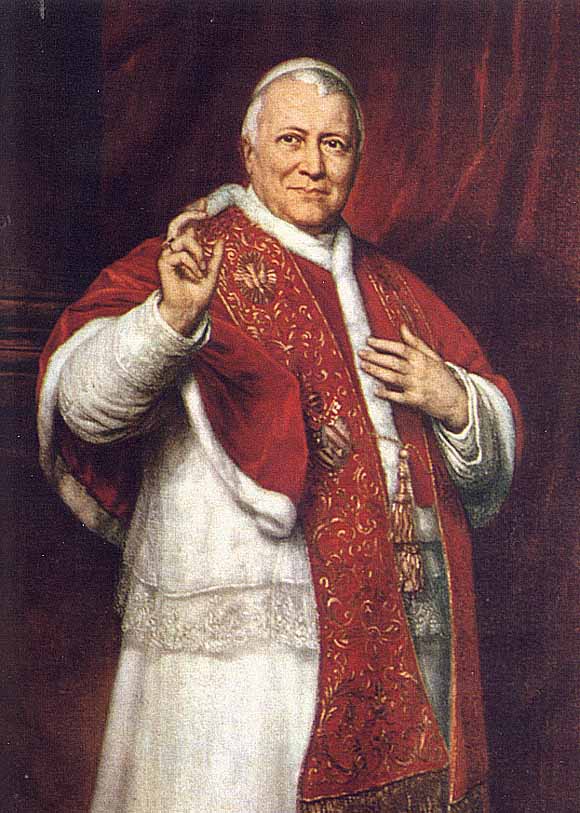
The "liberal Pope" had been elected in June 1846, and many did not know what to expect from Mastai-Ferretti. Pope Pius would still suffer bitterly in the hands of men who would receive so much from his mercy. He was a generous man -- but he was no liberal, and nothing could make this as clear in the first year of his pontificate as his first encyclical, Qui Pluribus, signed at the Patriarchal Basilica of Saint Mary Major on November 9, 1846.

As with all great popes, the first remarks of Blessed Pius emphasized his view of his own weaknesses:

We are well aware of Our weakness. So when We reflect on the most serious duties of the supreme apostolate especially in a period of great instability, We would simply have fallen into great sadness, did We not place all Our hope in God who is Our Saviour.
Qui Pluribus is, however, much more than a simple "introductory" Encyclical. When, in one of the most sollemn moments of his reign, Pope Pius signs Quanta Cura and, with it, the Syllabus, in 1864, a great number of the collected errors are those condemnations mentioned in his first encyclical. In it, one can read all the signs of Pope Mastai-Ferretti's concerns for the salvation of souls and for the integrity of the Doctrine of the Faith in the post-Enlightenment age, which is also our own.

Let us read anew the always necessary teachings and warnings of that great and holy Pontiff.
__________________
Private Interpretation:

God Himself has set up a living authority to establish and teach the true and legitimate meaning of His heavenly revelation. This authority judges infallibly all disputes which concern matters of faith and morals, lest the faithful be swirled around by every wind of doctrine which springs from the evilness of men in encompassing error. And this living infallible authority is active only in that Church which was built by Christ the Lord upon Peter, the head of the entire Church, leader and shepherd, whose faith He promised would never fail.

Bible Societies and dangerous biblical translations:

...the crafty Bible Societies ... renew the old skill of the heretics and ceaselessly force on people of all kinds, even the uneducated, gifts of the Bible. They issue these in large numbers and at great cost, in vernacular translations, which infringe the holy rules of the Church. The commentaries which are included often contain perverse explanations; so, having rejected divine tradition, the doctrine of the Fathers and the authority of the Catholic Church, they all interpret the words of the Lord by their own private judgment, thereby perverting their meaning. As a result, they fall into the greatest errors.

Indifferentism and Universalism:

Also perverse is the shocking theory that it makes no difference to which religion one belongs, a theory which is greatly at variance even with reason. By means of this theory, those crafty men remove all distinction between virtue and vice, truth and error, honorable and vile action. They pretend that men can gain eternal salvation by the practice of any religion, as if there could ever be any sharing between justice and iniquity, any collaboration between light and darkness, or any agreement between Christ and Belial.
Priestly celibacy under attack...:

The sacred celibacy of clerics has also been the victim of conspiracy. Indeed, some churchmen have wretchedly forgotten their own rank and let themselves be converted by the charms and snares of pleasure.
Anti-Catholic teaching methods:

...the prevalent but wrong method of teaching, especially in the philosophical disciplines, a method which deceives and corrupts incautious youth in a wretched manner and gives it as drink the poison of the serpent in the goblet of Babylon.
Communism:

...the unspeakable doctrine of Communism ... a doctrine most opposed to the very natural law. For if this doctrine were accepted, the complete destruction of everyone's laws, government, property, and even of human society itself would follow.
The prophetic view of our depraved age:

As a result of this filthy medley of errors which creeps in from every side, and as the result of the unbridled license to think, speak and write, We see the following: morals deteriorated, Christ's most holy religion despised, the majesty of divine worship rejected, the power of this Apostolic See plundered, the authority of the Church attacked and reduced to base slavery, the rights of bishops trampled on, the sanctity of marriage infringed, the rule of every government violently shaken and many other losses for both the Christian and the civil commonwealth.
The duties of Bishops:

...in accordance with your pastoral care, work assiduously to protect and preserve this faith. Never cease to instruct all men in it, to encourage the wavering, to convince dissenters, to strengthen the weak in faith by never tolerating and letting pass anything which could in the slightest degree defile the purity of this faith. With the same great strength of mind, foster in all men their unity with the Catholic Church, outside of which there is no salvation; also foster their obedience towards this See of Peter on which rests the entire structure of our most holy religion. ... to assure the greater glory of God and the Church, venerable brothers, join together with all eagerness, care and wakefulness to repulse error and to root out vice.
May Our Lady ("our mediatrix, advocate, firmest hope, and greatest source of confidence", cf. Qui Pluribus) and Blessed Pius IX pray for the Church of the Lord in these even more perilous times.

For the record

Two Italian news sites, the political newsletter "Il Velino" and the Catholic "Korazym" (in a thorough article on the latest events), mention an inter-dicasterial meeting next week (on November 15), between those Curial authorities involved with the document on the liberalization of the Traditional rites of the Latin Church.

Both articles also mention dates for the release of the document which range from after Christmas to Epiphany. And one of the articles mentions a removal, by Easter, of the excommunications of the bishops consecrated by Archbishop Lefebvre and co-consecrated by Bishop Castro Mayer in 1988. (We remain, as we have always been, extremely skeptical of specific dates, especially those which coincide with great feasts of the Church.)

The French People speak...

In his speech today to the Plenary Assembly of the French Episcopal Conference, Cardinal Ricard, again, claims to be speaking on behalf of the lay faithful who are supposedely distraught by any Petrine overture towards Traditionalists. The Church is not a democracy, quite right. Yet, since His Eminence and many other French Bishops have been claiming to speak for the laity, maybe they should check out the latest polls.

The pollsters at the CSA Institute, one of the most prestigious in France, were hired by the association Paix Liturgique to ask some questions reagrding the Traditional rites of the Roman Church (CSA interviewed 1,007 people throughout the nation, 55% of which identified themselves as Catholics, on November 8, 2006; the results reflect the opinion of those who identified themselves as Catholics).

1) Do you believe it is desirable that Catholics may have the choice to, according to their sensibility, go to either the Traditional Mass in Latin with Gregorian chant or to the Modern Mass in French?

Yes: 65%
No: 13%
Do not care: 22%

2) If you had the occasion to occasionally go to a Mass in Latin with Gregorian [chant], what would you say?

I would go: 60%
I would not go: 39%
No answer: 1%

3) In your opinion, the fact that various kinds of celebrations of the Mass, one Traditional, in Latin and with Gregorian [chant], and the other modern in French, may be recognised by the Church would be...?

A good thing, because it allows for some diversity within the Church: 65%
A bad thing, because it risks provoking divisions within the Church: 31%
No answer: 4%

4) If a Mass in its Traditional form were celebrated, in Latin and with the permission of the Pope, close to your home, you would say...

I would go there frequently: 6%
I would go there occasionally: 31%
I do not know if I would got there or not: 12%
I would rarely go there: 29%
I would never go there: 22%

(Source: Paix Liturgique à Reims)
87% of all the French Catholic faithful, according to the poll, either want liturgical freedom or are completely indifferent to it (see first question). Well, if they do not share the opinion of the Pope, nor the opinion of the French laity, whom do the recalcitrant French bishops represent, except their own disastrous leadership, their dismal presence in the French society at large (as it happened with their inaction regarding the approval of the Loi Veil, on the liberation of abortions, 30 years ago), and bankrupt theological concepts?

The French Bishops speak...

From the closing speech of Cardinal Ricard, President of the French Episcopal Conference (CEF), before the Plenary Assembly of the CEF.


"UNITY OF THE CHURCH, RECONCILIATION, AND THE LITURGY

...

"6) We wish to proceed with the reception of those who feel attached to the Mass said of 'Saint Pius V'. A diversity is possible. But this [diversity] must be regulated. This follows from the unity of the liturgy and from the unity of the Church. One cannot leave the choice of one of the forms of the Roman Rite –Mass of 'Saint Pius V' or Mass of 'Paul VI' – up to one’s own subjectivity. A Church in which each one could build his own chapel following his personal tastes, his sensitivity, his choice of liturgy, or his political opinions would not still be the Church of Christ. It is necessary today to resist the temptation of a 'religion à la carte'. As bishops, we are ready to care, with the Holy Father and under his authority, for unity and communion in the bosom of our local Churches and among our Churches."


Read a translation of the other five items here.

The Passion of Spain
The Martyrs of Paracuellos de Jarama


[From our ongoing series on the 70th Anniversary of the Passion of Spain.]


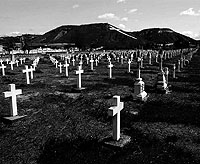
Exactly 70 years ago, on November 7 and November 8 (and from November 28 to November 30), 1936, the largest isolated massacre of Catholics in modern times happened in the outskirts of Madrid, near the foot of a hill called Cerro San Miguel (Saint Michael Hill), in Paracuellos de Jarama.

Many thousands of Catholics were martyred by the forces which defended the Spanish Republic (including Communists, Socialists, and Anarchists), in the most brutal and despicable ways, before and especially during the nearly three years of the Spanish Civil War -- yet no place was as soaked with the blood of martyrs in so short a time as the fields of Paracuellos.

Madrid would only fall in the hands of the Nationalists at the end of the war. Yet, in late October 1936, it seemed to the Republican government and its allies that the Capital was about to fall. The government would be transferred to Valencia, and the thousands upon thousands of prisoners (many of whom were not political partisans, but simply Catholic priests, religious, and lay faithful) kept in the prisons and detention centers throughout the city had to be "discarded"...

By trains and trucks they went, hundreds and hundreds for three days, beginning on November 6. When the prisoners arrived at Paracuellos, they had to dig up their mass graves, and were shot by the leftist squadrons, dozens at a time. Many were also buried alive.

The flow of prisoners to Paracuellos was interrupted on November 8, when the advance of the Nationalist forces seemed under control, and due to the intervention of many foreign diplomats.

On November 28-30, thousands more were murdered at Paracuellos, including almost all the Augustinian friars of the great Royal Monastery of Saint Lawrence of El Escorial. Some historians estimate that the total number of people murdered in Paracuellos in November 1936 may have reached almost 5,000, of whom an incalculable number killed solely for their Faith.

We publish below the names of some of the martyrs of Paracuellos, priests and religious brothers [identified as (br)]. Many more unidentified priests and religious, as well as non-religious laymen, were also martyred in that sanctified place. Some have been beatified; the list was obtained from several sources and is incomplete. We honor with their names all Martyrs of Paracuellos, known and unknown (the second part of the list is dedicated to the Martyrs from the Monastery of El Escorial). Their names include the sounds of all "Spains", from Catalonia to Galicia, from the Basque Country to Andalusia, all martyred in the tablelands of old Castile.

May the Martyrs of Paracuellos never be forgotten, as well as the lessons learned from days of terrible persecution under an Atheist tyranny.


Martyrs of Paracuellos, pray for us!

Martyrs of November 7-8 and November 28-30, 1936

  1. Adalberto Juan (Brother of the Christian Schools)
  2. Adradas Gonzalo, Juan Jesús (Blessed)
  3. Alcalde Alcalde, Juan (br) (Blessed)
  4. Alcalde González, Benito
  5. Alcalde Negredo, Pedro María (br) (Blessed)
  6. Alcobendas Merino, Severino
  7. Alfonso, José (br)
  8. Alfonso Beltrán (Brother of the Christian Schools)
  9. Alonso Cadierno, Pedro Nolasco
  10. Álvarez Melcón, Bernardino
  11. Álvarez Rego, Manuel
  12. Arnaiz Álvarez, Atanasio
  13. Baldajos Pérez, Juan (br)
  14. Basilio Julián (Brother of the Christian Schools)
  15. Bautista Jiménez, Eduardo (br) (Blessed)
  16. Bernalte Calzado, Pedro Alcántara (br) (Blessed)
  17. Blanco, Vicente
  18. Bocos, Ángel (br)
  19. Caballero, Juan José (subdeacon)
  20. Carmona, Isabelino
  21. Daciano (Brother of the Christian Schools)
  22. Delgado Pérez, José (br)
  23. Delgado Vílchez, Hilario (br) (Blessed)
  24. Díez Fernández, Jenaro
  25. Díez Sahún, Clemente (br) (Blessed)
  26. Donoso Murillo, Arturo (br) (Blessed)
  27. Escribano Herranz, Mariano
  28. Esteban, Francico
  29. Esteban, Gregorio
  30. Eufrasio María (Brother of the Christian Schools)
  31. Fanjul Acebal, Alfonso
  32. Feijoo, Zacarías
  33. Fernández González, Justo (br)
  34. Floriano Félix (Brother of the Christian Schools)
  35. Franco Prieto, Emilio
  36. García González, Senén
  37. García Molina, Diego de Cádiz (br) (Blessed)
  38. García Pérez, José (novice)
  39. Garzón González, Anastasio
  40. Gesta de Piquer, Jesús (br) (Blessed)
  41. Gil Arribas, Valentín
  42. Gil, Justo (deacon)
  43. Gomara, Vidal Luis
  44. Gómez Lucas, Daniel (br)
  45. González Bustos, Maximino
  46. Guerra, José (br)
  47. Iglesias Suárez, Ramón
  48. Ismael Ricardo (Brother of the Christian Schools)
  49. Juan Pablo (Brother of the Christian Schools)
  50. Juanes Santos, Justo
  51. Julián Alberto (Brother of the Christian Schools)
  52. Llop Gayá, Guillermo (br) (Blessed)
  53. López Arroba, Rogelio
  54. Luis Victorio (Brother of the Christian Schools)
  55. Marcelino Rebollar, Julián (br)
  56. Marco, Alberto
  57. Martín Gago, Victorio
  58. Martín Gómez, Manuel
  59. Martín López, Francisco José
  60. Martínez Gil-Leonis, Antonio (br) (Blessed)
  61. Martínez Izquierdo, Isidoro (br) (Blessed)
  62. Martínez Vélez, Dámaso
  63. Martínez y Martínez, José
  64. Mata Pérez, Anastasio (br)
  65. Meléndez Sánchez, Martiniano (br) (Blessed)
  66. Mendivelzúa, Juan
  67. Mendoza Sabada, Jacinto
  68. Menes Álvarez, Antonio
  69. Monterroso García, Crescencio
  70. Mora Velasco, José (Blessed)
  71. Morquillas Fernández, Francisco
  72. Múgica Goiburu, Lázaro (br) (Blessed)
  73. Muñiz, Félix
  74. Nogueira Guitián, Manuel (Carlos de los Santísimos Sacramentos)
  75. Pablo de la Cruz (Brother of the Christian Schools)
  76. Pajares García, Samuel
  77. Peña, Vicente
  78. Peque Iglesias, José (br)
  79. Pérez Buenavista, Marcos (br)
  80. Pérez Carrascal, Laureano
  81. Pérez Díez, Gabriel (Manuel del Rosario)
  82. Pérez Nanclares, Florencio (br)
  83. Plazaola Artola, Julián (br) (Blessed)
  84. Poveda Daries, Luis
  85. Prado, Eleuterio (br)
  86. Prieto Fuentes, José (br)
  87. Reguero, Victoriano
  88. Renuncio Toribio, Vicente
  89. Riaño Herrero, Serviliano (br)
  90. Rodrigo Fierro, Sabino
  91. Rodríguez Alonso, Avelino
  92. Rodríguez Crespo, Agustín
  93. Rodríguez Fernández, Vicente
  94. Rodríguez Peña, José María
  95. Rodríguez, Clemente (br)
  96. Rodríguez, Publio (br)
  97. Rueda Meijías, Miguel (br) (Blessed)
  98. Ruiz Cuesta, José (postulant) (Blessed)
  99. Ruiz Ruiz, Leonardo
  100. Ruiz Valtierra, Luciano (br)
  101. Sáenz Gastón, Romualdo
  102. Salvador del Río, Nicéforo (br) (Blessed)
  103. Sánchez Fernández, Marcelino (br)
  104. Sanz Domínguez, Manuel (br)
  105. Sastre Corporales, Ángel (novice) (Blessed)
  106. Sedano Sedano, Enrique
  107. Sinfronio (Brother of the Christian Schools)
  108. Soria Castresana, Juan
  109. Touceda Fernández, Román (br) (Blessed)
  110. Turrado Crespo, Eleuterio
  111. Valiente, José María (br)
  112. Vega Riaño, José
  113. Villarroel Villarroel, Balbino
  114. Zubillaga Echarri, Joaquín


  115. Augustinian Martyrs of El Escorial (Martyred on November 30, 1936)

  116. Abia Melendro, Luis (br)
  117. Alonso López, Ramiro (br)
  118. Arconada Merino, Dámaso
  119. Calle Franco, Bernardino (br)
  120. Carvajal Pereda, Pedro J. (br)
  121. Cerezal Calvo, Miguel
  122. Cuesta Villalba, Víctor (br)
  123. Dalmau Regas, José M. (br)
  124. Diez Fernández, Nemesio (br)
  125. Espeso Cuevas, Matías
  126. Fariña Castro, José Agustín
  127. Fincias, Julio María (br)
  128. Fuentes Puebla, Francisco (br)
  129. Gando Uña, José (br)
  130. García Ferrero, Joaquín
  131. García de la Fuente, Arturo
  132. García Fernández, Nemesio (br)
  133. García Suárez, Esteban
  134. Garnelo Alvarez, Benito
  135. Gil Leal, Gerardo
  136. Guerrero Prieto, Marcos (br)
  137. Iturrarán Laucirica, Miguel (br)
  138. Largo Manrique, Jesús
  139. López Piteira, José (br)
  140. Malunbres Francés, Constantino
  141. Marcos del Río, Francisco
  142. Marcos Reguero, Ricardo (br)
  143. Marcos Rodríguez, Julio (br)
  144. Martín Mata, Román (br)
  145. Martínez Antuña, Melchor
  146. Martínez Ramos, Pedro
  147. Mediavilla Campos, Isidro (br)
  148. Merino Merino, Heliodoro
  149. Monedero Fernández, Juan
  150. Noriega González, José (br)
  151. Pascual Mata, Gerardo (br)
  152. Pérez García, José Antonio (br)
  153. Renedo Martin, Agustín
  154. Revilla Rico, Mariano
  155. Rodríguez Gutiérrez, Conrado
  156. Rodríguez González, Benito
  157. Sánchez Sánchez, Juan
  158. Sánchez López, Macario (br)
  159. Sánchez López, Tomás (br)
  160. Simón Ferrero, Pedro (br)
  161. Suárez Valdés, Luis
  162. Terceño Vicente, Dionisio (br)
  163. Valle García, Máximo (br)
  164. Varga Delgado, Pedro de la
  165. Velásco Velásco, Benito
  166. Zarco Cuevas, Julián

The speech that wasn't

Many news agencies and weblogs reported with great joy the words pronounced by Pope Benedict XVI to the Swiss bishops today.

Except that they were not pronounced by him. Or by anyone else.

The speech which was made public today was the one which had been written for John Paul II, and which he would have probably delivered in February 2005, had he not been too ill to do so.

So, this afternoon, the Holy See Press Office stated: "The speech by the Holy Father published today in the Bollettino della Sala Stampa n. 556 regarding the meeting with the bishops of Switzerland was not pronounced. It reflected the content of a draft previously prepared for the ad limina visit of the Swiss bishops which took place in 2005." The speech has disappeared from the Bollettino and the actual papal words to the Swiss bishops will be published tomorrow.

_____________________

Well, those speechwriters are pretty good. One could just sense the professoral tone filled with German clarity! [Irony Alert: This is for those who like to read too much into the "style", rather than the content, of most contemporary papal writings.]

The tragedy of it all is this: the condition of the church (in Switzerland and elsewhere) has not improved one bit since February 2005 -- and that is why the draft seemed so up-to-date.

More news from Lourdes

In his press conference today, the President of the French Episcopal Conference, Cardinal Ricard, said, regarding the project of liberalization of the Traditional Mass, exactly the same things which he had already stated in his Saturday address, with almost exactly the same words.

"The project of motu proprio will be the object of various consultations. We may convey, from now on, our fears and desires."
Meanwhile, Sophie de Ravinel informs at Le Figaro (via Le Forum Catholique) that:

"Cardinal Jean-Pierre Ricard is about to go to Rome to rework, with other Cardinals, the first draft of the text regarding the liberalization of the Tridentine Latin Mass [sic]. The members of the Ecclesia Dei commission -- one of which is the Archbishop of Bordeaux -- will, at the request of Benedict XVI, work on the dossier, up to now entrusted only to Cardinal Castrillon Hoyos ... . No deadline has been set."