Rorate Caeli
Showing posts with label Anglicans and the Church. Show all posts

Op-Ed: A French Historian muses about the "Anglicanization" of the Catholic Church: A Priest Responds

Paul VI is paid a "solemn visit" by the high Anglican minister of Canterbury, March 23, 1966 

French historian Luc Perrin, a Professor at the University of Strasbourg, and a well-known commentator of Catholic matters, published a long comment at the French Traditional Catholic page "Le Forum Catholique", in which he asked if the Catholic Church is going through a process of "Anglicanization".

Our Contributor Fr. Richard Cipolla, DPhil, thought this was an interesting exercise and penned a response.

First, Professor Perrin's dubium:

I am submitting this reflection to the wisdom of the reader: this idea has been running around in my head since the annus terribilus of 2018 at least.

There were various theological elements of Catholicism that were the subject of discussion before 2013, but it seems to me—some will disagree on this point, but this is not what I am talking about—that in these discussions the magisterium of Vatican II and the post-conciliar developments until 2013 defended a hermeneutic of reform within a search for continuity, rejecting the hermeneutics of rupture in a direct and recurring manner (this is true for Paul VI, John Paul II, and Benedict XVI, in whose allocution of December 22, 2005 was the last to formalize this insistence on continuity.)

The Newman Lecture in Melbourne:
- Found, not Manufactured: Newman, the Roman Rite, and Cranmer's Prayer Book

The Inaugural Blessed John Henry Newman Lecture was delivered by Dr Stephen McInerney (Senior Lecturer in Literature, Campion College).

***

“Marvellous Disclosures”: 
John Henry Newman’s Anglican Reflections on the Liturgy(1)

Delivered at the Parish of Blessed John Henry Newman, Melbourne
12th October, 2014

[High Mass for All Souls at the Birmingham Oratory - Entrance]

Over fifty years ago, as he reflected on the legacy of John Henry Newman, Fr Frank O’Malley asked: “What was the spirit of this man who is with us a constant reference and a standard and a sign?” By way of an answer, he pointed to something that few Newman scholars before or since have sought to highlight:

the spirit of Newman moved within the spirit of the liturgy, the liturgy thought of in its most significant sense as the very rhythm of Christian existence, stirred and centred by the life of Christ. Newman absorbed the liturgical character of existence. He lived by the liturgy. (2)

Pell: "Three quarters of Fathers who spoke voiced problems with Report"
Quotes untableted

Quotes and views by Cardinal George Pell, Holy See Secretary for the Economy, on the Relatio, given to The Tablet, but untableted for your convenience, that is, the Cardinal's full quotes and views without the Tablet's editorializing additions:

[Pell says the relatio is] “tendentious and incomplete,”... an “incomplete resumé” of what the Synod Fathers had said it needed to be “enhanced and corrected”.

Poverty and Simplicity at the Heart of Catholic Tradition

Poverty and simplicity - Low Mass at side altar, Fontgombault Abbey
The Italian Traditional Catholic blog, Cordialiter, could never be accused of not supporting or understanding the Catholic Tradition and what it means for us today.  Its “banner” is a quote from Saint Pius X, from his Apostolic Letter “Nôtre Charge Apostolique”:  “The true friends of the people are not the revolutionaries nor the innovators, but the traditionalists.”  A recent post apparently caused quite a reaction from the readers of the blog, so much so that the author felt the need to issue a clarification.  I think important issues are raised in the post and the clarification. My translation of the post and the clarification from Italian is as follows.  My comments are below.

O Crux, Ave, Spes Unica:
The Mass of Tradition

Editorial: Radicati nella fede, July 2014
Newsletter of the Catholic community of
Domodossola and Vocogno, Diocese of Novara, Italy

________________________________


Last month, when we talked about the solemnity of Corpus Christi, we mentioned the great danger of forgetting the sacrificial nature of the Catholic Mass. A forgetfulness which leads slowly but inexorably to heresy. On this point we should never forget Michael Davies’ great work on the Anglican Reform, which underlines the danger of “what’s left unsaid” in liturgy: Cranmer’s Anglican Reform, in removing all of the explicit references to the propitiatory Sacrifice, successfully introduced Protestantism into England in the space of a generation and brought the country definitively into heresy.

Last month, however we pushed it further saying, that by forgetting the Mass is the Sacrifice of Christ on the Cross, the awareness of the Substantial Presence of Christ in the Most Holy Eucharist is inexorably lost: if we don’t have the Victim, we don’t have the Presence of Jesus Christ, since Christ is present in the Eucharist as Victim. A Mass increasingly identified as a commemoration of the Last Supper truly risks not being a Catholic Mass. It is undeniable that the last reform to the Mass, the one in 1969, made it more and more like the Protestant Holy Supper, Anglican or Lutheran - whichever it is.

There is still something else though: A Mass that is more and more “protestantized” has “protestantized” the Catholic faithful in its mission, so much so, that each day they resemble more and more Protestant congregations, “involved in the world. “

If we don’t have the Victim, we don’t have the Presence of Christ either. This is true for the Mass and the Blessed Sacrament but it is also true for the entire work of the Church. If Christ Crucified is no longer at the heart of the doctrinal preaching and pastoral work of the Church, the entire mission of the Church risks being frighteningly empty. Never before as in the last few decades have we seen so many pastoral efforts with techniques that have been refined for effective communication; never as in the past fifty years have there been so much talk of mission with hardly any good results. The Church has moved towards the world continuously announcing and announcing, and its relentless de-Christianization has taken place.

Who, among the Fathers of the Council could have imagined, that the Catholic Faith would have almost disappeared in the space of fifty years? Who among the Bishops of Vatican II, could have imagined the advent of the anti-Catholic and immoral society that we have today, where every law seems to be made purposely against the plan of God for man?

Yet, it is undeniable. This disaster is before our very eyes.

If we no longer have Jesus-Victim, we don’t have Jesus-Present either.

A Church that has been enthusiastically “encountering” the world since the ‘60s and has put the Cross of Christ in second place, has lost Christ Himself and has brought nothing or almost nothing to society. It needs to be said clearly: without the centrality of the Cross, without the centrality of Christ crucified, you lose Christ Himself. The ones who speak about Jesus without His Cross and its centrality, are suffering a terrible delusion. The ones who put the Cross of Christ “among the many other things” in the life of Jesus, but don’t’ envisage the center - in truth - they are not even talking about Christ. They are talking about a “confectioned” Jesus specially for the modern world, which like the Jews and gentiles of Saint Paul, judged Christ Crucified as a scandal and foolishness.

The decision was made to go into world and have friendly dialogue with it, avoiding the condemnations of the Church in the past; in order to have friendly dialogue, they had to “veil” or “hide” the Cross and the Sacrifice of Christ, so that the dialogue with modern society, with its religions, would be serene and amicable, resulting in the twofold tragedy of not having brought anything to the people of these times and, worse, in devastating the Sanctuary of the Presence of God, which is the Church.

We cannot avoid it: we must be the first to accept and embrace the scandal of the Cross, recognize it as the central content of the Church’s doctrine, life and mission, and so, not calculating the results, but confident in the infinite power of God’s grace, go into the world so that it will be converted and healed by the Cross of Christ.

Woe to those Catholics, woe to that Church, that wants to convey another Jesus without the Cross! It will lose its essence, strength, soul and its exclusive power of grace. In addition. it will become more and more useless and unbearable to the world that it wanted to reach. A Church without the Sacrifice and the Cross is detestable and unbearable to the world.

What is more, the world is now ready to savage such an empty Church.

In hoc signo vinces, is not only a memory from past history, it is the truth of every single moment: the victory is in the Cross and of those who bring it and show it to the world, without human calculations.

O Crux, ave, spes unica, Hail O Cross, our only hope; if there isn’t a return to this clarity in all things – truly in the entire Church - the disaster will be inevitable.

This return begins though with the Holy Sacrifice of the Mass.

If faced with this devastating picture of confusion we feel powerless; if powerless we are wondering what to do and above all where to begin, let’s remember that the rebuilding of the Church will always start from the Holy Sacrifice of the Mass. Let’s not make human calculations, let’s not make the same mistakes of the 60s, let’s not go into the world, with our techniques, not even to rebuild Tradition, but let’s start again from the Mass.

We say this first to priests and then to the faithful: let’s return immediately to the Mass of Tradition. Let’s return to the correct Rite of the Holy Sacrifice of the Mass and from there we can begin again the painstaking work of rebuilding the faith. Let’s not make the mistake of doing the opposite, first pastoral work, then a return to the Mass of Ages, it would be basically hiding the Cross of Christ again, in the expectation of better times, as the deluded missionaries did in the post-conciliar years.

The truth instead is Christ.


The truth instead is in the reality of His Redeeming Sacrifice, perpetuated in the Catholic Mass. The first duty of priests is to celebrate it. The first duty of everyone is to live by it, so that life, true life, will continue.

______________________
[Translation: Contributor Francesca Romana. Main image, and in details: Diego Velázquez, Cristo Crucificado (1632), Museo Nacional del Prado.]

Breaking news from the most useless and expensive
debate society in the world

Summary: In the most liberal religious building in Italy (Bose), the most useless debate society in history keeps on as if nothing had changed.

The Anglican - Roman Catholic International Commission has completed the first meeting of its new phase (ARCIC III) at the Monastery of Bose in northern Italy (May 17-27, 2011). The Commission, chaired by the Most Reverend David Moxon (Anglican Archbishop of the New Zealand Dioceses) and the Most Reverend Bernard Longley (Roman Catholic Archbishop of Birmingham) comprises eighteen theologians from a wide range of backgrounds across the world. [If you wish to waste your time, keep reading it here.]
The Anglican side included a delightful provocation: a "bishopess" (the "Right Reverend" Linda Nicholls, Area "Bishop" for Trent-Durham, "Diocese" of Toronto) and a "canoness" ("Canon" Alyson Barnett-Cowan, pictured above in Saint Peter's with another Anglican "canon"- image source). The ladies, of course, helped the number of ordained clerics on the Anglican side reach the total of zero.

So, "Whence Ecumenism," Michael Davies's repeated question regarding ARCIC? The Personal Ordinariates mandated by Anglicanorum Coetibus are the true ecumenism, not ARCIC. But it is hard, very hard, to give up a lifetime of soft theology, empty careerism, free travel, free lodging, and free food.

Sancta Dei Genetrix, Regina Angliae, ora pro nobis.
Sancte Augustine, ora pro nobis.

Aidan Nichols on Benedict XVI and his "Noah's Ark"

Over the past weekend, the Ordinariate Portal published Fr. Aidan Nichols' lengthy address to the Anglicanorum Coetibus conference in Canada (March 24-26, 2011): The Ordinariates, the Pope, and the Liturgy. Part 1 and Part 2.

Nichols characterizes the Pope's reach-out to four specific groups -- conservative "Catholic" Lutherans, Eastern Orthodox, the Society of St. Pius X, and Anglo-Catholics -- as an invitation to them to board the "Noah's Ark" that is the Catholic Church in the face of the flood of relativism, secularism and militant Islam:

An Anglican Ordinariate for Ex-Catholics?

From the Church of England's "Church Times":


AN “Ordinariate of Postulants” has been set up by the diocese of Peru in the Anglican Church of the Southern Cone to host a growing number of Roman Catholic priests who are keen to join the Anglican Church.

In contrast to the situa­tion in England, where three former bishops recently joined the Ordinariate for former Anglicans established by Rome, clerics are making the reverse journey in South America.

The Bishop of Peru, the Rt Revd William God­frey, said that, so far, about ten RC priests had joined the new group to explore the possibility of switching denominations. Some may bring con­gregations with them.

About half of them are from churches that have become indepen­dent from the RC Church, often because the priests have got married.

Bishop Godfrey said that he had also received requests from RC clergy in Uruguay, Ecuador, and Ar­gentina, to join the Anglican Church.

He said that it was not entirely new for Roman Catholics to make this journey, as “the Anglican Church in Latin America would not exist if it wasn’t for ex-Roman Catholics”, but priests were now leaving on a larger scale.

He said that many of these priests were looking for stability in their ministry, and that the Postulate was “some sort of body where these people can draw close to the An­glican Church and experience its liturgical and pastoral tradition and theology, before taking the final step of being received. It provides a buffer zone in which we can prepare to receive them.”

Bishop Godfrey believes that some priests may have been en­couraged by Pope Benedict XVI’s positive words about Anglicanism when setting up the Or­dinar­iate, when he was “extra­ordinarily pos­itive” about the An­glican tradition.

He said that the new body was not meant to be “provocative” towards Roman Catholicism; there was in fact “a lot of respect towards the Pope” in the region. There is no financial motivation for clerics to move to the An­glican Church, as there is no guarantee of a stipend when they join the diocese of Peru.

The diocese currently has 35 clerics, an increase from just four in the late 1990s. It has two seminaries in Lima and Arequipa. RC orders are recog­nised by Anglicans.

The diocese is currently working out how it will deal with bishops from indepen­dent RC churches who wish to become Anglicans.

A Jubilee worth remembering: Casti Connubii at 80

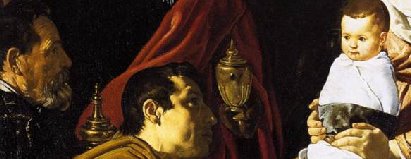
In this glorious day of the Epiphany, when the adoration of a Baby by strange noblemen from distant lands is remembered by us, we would like to remind every Catholic of one of the most important Encyclical letters of the 20th Century: Casti Connubii, signed on December 31, 1930, and published 80 years ago.

This encyclical is especially important to those converts who saw the beauty of the One True Faith from afar in its moral teachings long, much long actually, before even entertaining with any seriousness the notion of becoming Catholic.

In this Diamond Jubilee, we wish, once again, to thank particularly those "bishops" of the Anglican Communion who, assembled in the Lambeth Conference of 1930, had agreed that, in very exceptional circumstances, married couples could make some use of artificial contraception. The amazing text (which would be clearly considered exceedingly "conservative" by many today) is the following:

Where there is clearly felt moral obligation to limit or avoid parenthood, the method must be decided on Christian principles. The primary and obvious method is complete abstinence from intercourse (as far as may be necessary) in a life of discipline and self-control lived in the power of the Holy Spirit. Nevertheless in those cases where there is such a clearly felt moral obligation to limit or avoid parenthood, and where there is a morally sound reason for avoiding complete abstinence, the Conference agrees that other methods may be used, provided that this is done in the light of the same Christian principles. The Conference records its strong condemnation of the use of any methods of conception control from motives of selfishness, luxury, or mere convenience.


It was a first in the history of all self-declared Christian bodies and it sounded like a thunder throughout the West.

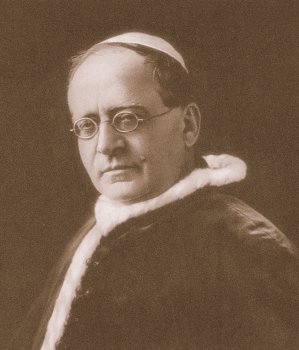
In the Catholic world, the eyes of those who had seen another step by the Anglicans in their self-demolition turned to the See of Peter. For the first (but not the last) time in the 20th century, an absurd decision by the Anglicans would force the Holy See to issue a fast response. The faithful did not have to wait for long: Pope Pius XI gave the Catholic (that is, the universal, perennial, and traditional) response to the problem:

"Since, therefore, openly departing from the uninterrupted Christian tradition some recently have judged it possible solemnly to declare another doctrine regarding this question, the Catholic Church, to whom God has entrusted the defense of the integrity and purity of morals, standing erect in the midst of the moral ruin which surrounds her, in order that she may preserve the chastity of the nuptial union from being defiled by this foul stain, raises her voice in token of her divine ambassadorship and through Our mouth proclaims anew: any use whatsoever of matrimony exercised in such a way that the act is deliberately frustrated in its natural power to generate life is an offense against the law of God and of nature, and those who indulge in such are branded with the guilt of a grave sin."
How useless are the "solemn" declarations of those communities separated from Peter! How disastrous were the inevitable consequences of Lambeth 1930 for families, social order, and social mores!

"Ah, but Catholics had to wait until the 'Theology of the Body' to see marriage truly appreciated beyond reproduction," some of those ignorant of Church History say. This is said especially by those who believe that the Church began circa 1965 -- but it is denied by the whole Tradition of Holy Mother Church. As Pius XI reminded his children in 1930, quoting the Catechism of the Council of Trent:

"This mutual molding of husband and wife, this determined effort to perfect each other, can in a very real sense, as the Roman Catechism teaches, be said to be the chief reason and purpose of matrimony, provided matrimony be looked at not in the restricted sense as instituted for the proper conception and education of the child, but more widely as the blending of life as a whole and the mutual interchange and sharing thereof."

December 31, 1930: truly another day of glory in the long history of the Church of Rome! In her is the unbroken Doctrine of the Faith, which cannot deceive or be altered. In this Church we can trust. Thank you, dear Anglicans, for the warning which forced the Mother of all Churches to pronounce, once again, her sweet words of Truth!

Ordinariate in England and Wales: January 2011

In less than two months, the first Ordinariate established according to the norms of Anglicanorum Coetibus will be established in England and Wales. Let us all pray for this incredible canonical achievement, which is a great hope for all Catholics and a precedent of particular relevance for Traditional Catholics.

In collaboration with the Congregation for the Doctrine of the Faith (CDF) in Rome, the Bishops of England and Wales have been preparing for the establishment of an Ordinariate early in January 2011. Although there may be practical difficulties in the months ahead, the Bishops are working to address these at a national and local level.

Five Anglican Bishops who currently intend to enter the Ordinariate have already announced their decision to resign from pastoral ministry in the Church of England with effect from 31 December 2010. They will enter into full communion with the Catholic Church early in January 2011. During the same month, it is expected that the Decree establishing the Ordinariate will be issued and the name of the Ordinary to be appointed announced. Soon afterwards, those non-retired former Anglican Bishops whose petitions to be ordained are accepted by the CDF, will be ordained to the Catholic Diaconate and Priesthood for service in the Ordinariate.

It is expected that the retired former Anglican Bishops whose petitions to be ordained are accepted by the CDF, will be ordained to the Catholic Diaconate and Priesthood prior to Lent. This will enable them, together with the Ordinary and the other former Anglican Bishops, to assist with the preparation and reception of former Anglican clergy and their faithful into full communion with the Catholic Church during Holy Week.

Before the beginning of Lent, those Anglican clergy with groups of faithful who have decided to enter the Ordinariate will then begin a period of intense formation for ordination as Catholic priests.

At the beginning of Lent, the groups of faithful together with their pastors will be enrolled as candidates for the Ordinariate. Then, at a date to be agreed between the Ordinary and the local diocesan Bishop, they will be received into the Catholic Church and confirmed. This will probably take place either during Holy Week, at the Mass of the Lord’s Supper on Holy Thursday or during the Easter Vigil. The period of formation for the faithful and their pastors will continue to Pentecost. Until then, these communities will be cared for sacramentally by local clergy as arranged by the diocesan Bishop and the Ordinary.

Around Pentecost, those former Anglican priests whose petitions for ordination have been accepted by the CDF will be ordained to the Catholic Priesthood. Ordination to the Diaconate will precede this at some point during Eastertide. Formation in Catholic theology and pastoral practice will continue for an appropriate amount of time after ordination.

In responding generously and offering a warm welcome to those seeking full ecclesial communion with the Catholic Church within the Ordinariate, the Bishops know that the clergy and faithful who are on that journey of faith will bring their own spiritual treasures which will further enrich the spiritual life of the Catholic Church in England and Wales. The Bishops will do all they can to ensure that there is effective and close collaboration with the Ordinariate both at diocesan and parish levels.

Finally, with the blessings and encouragement they have received from Pope Benedict’s recent Visit, the Catholic Bishops of England and Wales are resolved to continue their dialogue with other Christian Churches and Ecclesial Communities on that journey towards the communion in faith and the fullness of unity for which Christ prayed.

Preparing to swim the Tiber

From Damian Thompson's blog:

Like many in the catholic tradition of Anglicanism, we have followed the dialogue between Anglicans and Catholics, the ARCIC process, with prayer and longing. We have been dismayed, over the last thirty years, to see Anglicans and Catholics move further apart on some of the issues of the day, and particularly we have been distressed by developments in Faith and Order in Anglicanism which we believe to be incompatible with the historic vocation of Anglicanism and the tradition of the Church for nearly two thousand years.

The Apostolic Constitution, Anglicanorum cœtibus, given in Rome on 4th November 2009, was a response to Anglicans seeking unity with the Holy See. With the Ordinariates, canonical structures are being established through which we will bring our own experience of Christian discipleship into full communion with the Catholic Church throughout the world and throughout the ages. This is both a generous response to various approaches to the Holy See for help and a bold, new ecumenical instrument in the search for the unity of Christians, the unity for which Christ himself prayed before his Passion and Death. It is a unity, we believe, which is possible only in eucharistic communion with the successor of St Peter.

As bishops, we have even-handedly cared for those who have shared our understanding and those who have taken a different view. We have now reached the point, however, where we must formally declare our position and invite others who share it to join us on our journey. We shall be ceasing, therefore, from public episcopal ministry forthwith, resigning from our pastoral responsibilities in the Church of England with effect from 31st December 2010, and seeking to join an Ordinariate once one is created.

We remain very grateful for all that the Church of England has meant for us and given to us all these years and we hope to maintain close and warm relationships, praying and working together for the coming of God’s Kingdom.

We are deeply appreciative of the support we have received at this difficult time from a whole variety of people: archbishops and bishops, clergy and laity, Anglican and Catholics, those who agree with our views and those who passionately disagree, those who have encouraged us in this step and those who have urged us not to take this step.

The Right Revd Andrew Burnham

The Right Revd Keith Newton

The Right Revd John Broadhurst

The Right Revd Edwin Barnes

The Right Revd David Silk


Subtle

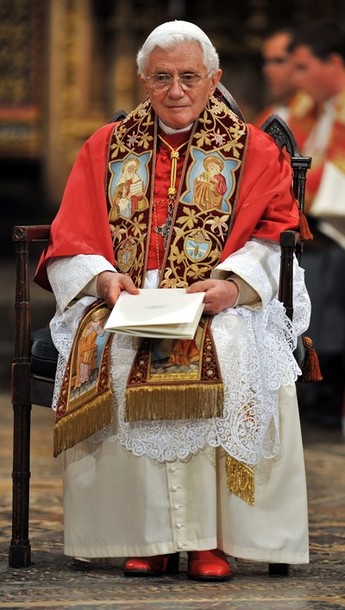
In the Evensong service with Anglicans at Westminster Abbey, Pope Benedict XVI wore a stole first worn and which first belonged to Pope Leo XIII.


[Tip: Cantuale Antonianum, via Le Forum Catholique]

"The question of how it is to continue is a serious one."

John Broadhurst, Anglican bishop of Fulham, Chairman of Forward in Faith and one of the three bishops of the CofE reported to have gone to Rome in order to "set in motion steps that would allow priests to convert to Catholicism en masse", (in the words of the Sunday Telegraph), has issued the following statement regarding said trip to Rome:


I feel as your Chairman that I should say something about the reported trip to Rome. As you all know, I am interested in the Ordinariate. I had the opportunity to accompany Bishop Andrew and Bishop Keith to the Vatican to discover what was intended. As Chairman of Forward in Faith International it was important that I was present, as FIF Australia is totally committed to it. Also many members in America and here are actively interested. I can say nothing more about the visit.


However, I am embarrassed by the leak to the press that we had visited the Holy See. All of us have expressed an interest in the Ordinariate and so it is obviously necessary to understand exactly what is intended and how the Ordinariate will be implemented. We were certainly neither negotiating nor plotting. The leak came as a real surprise to me as it happened whilst I was abroad. As we had not informed others of our visit, who leaked it - and why - is a very serious question. It risks damage to the Church of England, and to Catholic Anglicans in particular, as well as to the forthcoming visit to the UK of the Holy Father. It also has serious ecumenical implications. To say it was malicious would seem to fit the facts.


I have a deep love for the Church of England and its Anglo-Catholic tradition in particular. The question of how it is to continue is a serious one. Though the signs in General Synod do not look good, many still hope for proper provision in line with previously made promises. Our visit must not be allowed to colour these discussions.


Others believe the Pope's offer gives a very real chance that much that is valuable in our tradition can be preserved. All need to try, carefully and prayerfully, to read the signs of the times.

What a shock!
Harsh words by leader of the Established religious sect in England?

Well, we should all be glad that the phony feelgoodism of the usurpers of the abolished see of Canterbury is coming to an end - and that the Established Protestant sect is reverting to mode. Saint Oliver Plunkett would not be surprised!

And one tends to agree with the Protestant leader: the Church in Ireland has lost credibility. But at least it is still a Church! And its bishops are real bishops, not overdressed laymen. And they do not use the holiest days of the year to fire cheap shots at other religious groups amidst a highly secularized environment.

Perhaps this was planned by him all along: his timing and comments are so despicable that he actually make the bishops of Ireland look good!
___________

Regarding the Anglicans who will be forming the new Anglican Catholic ordinariates, the Protestant leader adds, "I can only say fine, God bless them. I don’t at the moment." And we can respond: good for them! A mother's blessing is much more meaningful and powerful than that of a false bishop.

"Union with the Catholic Church is the goal of ecumenism"

On Saturday, March 6, William Joseph Cardinal Levada, prefect of the Congregation for the Doctrine of the Faith, delivered an address at Queen's University in Kingston, Ontario, Canada. Titled, "Five Hundred Years After St. John Fisher: Pope Benedict's Initiatives Regarding the Anglican Communion," the address recounted the background to the Holy Father's recent Apostolic Constitution Anglicanorum coetibus and discussed hopes and prospects for uniting Anglican groups with the Catholic Church.

An unofficial transcript of Cardinal Levada's address is available at Salt + Light. Here follow a few key excerpts:

Cardinal Walter Kasper, current President of the Pontifical Council for Promoting Christian Unity, addressed this point in an intervention given in June 2006 to the House of Bishops of the Church of England during its discussions on the ordination of women to the episcopate. In his talk he said this: “Because the Episcopal office is a ministry of unity, the decision you face would immediately impact on the question of the unity of the Church and with it the goal of ecumenical dialogue. It would be a decision against the common goal we have until now pursued in our dialogue: full ecclesial communion, which cannot exist without full communion in the episcopal office.”

As we met with Anglican consultants in the preparation of 
Anglicanorum coetibus, these bishops and theologians themselves proposed the Catechism of the Catholic Church as the norm of faith for the corporate groups of Anglicans who might avail themselves this new instrument for full corporate union with the Catholic Church. Thus, I would also characterize the Catechism as an ecumenical initiative of Pope Benedict XVI and of his predecessor.


Union with the Catholic Church is the goal of ecumenism—one could put, “we phrase it that way”. Yet the very process of working towards union works a change in churches and ecclesial communities that engage one another in dialogue, in actual instances of entering into communion do indeed transform the Catholic Church by way of enrichment. Let me add right away that when I say enrichment I am referring not to any addition of essential elements of sanctification and truth to the Catholic Church. Christ has endowed her with all the essential elements. I am referring to the addition of modes of expression of these essential elements, modes which enhance everyone’s appreciation of the inexhaustible treasures bestowed on the Church by her divine founder.

The new reality of visible unity among Christians should not thought of as the coming together of disparate elements that previously had not existed in any one community. The Second Vatican Council clearly teaches that all the elements of sanctification and truth which Christ bestowed on the Church are found in the Catholic Church. What is new then is not the acquisition of something essential which had hitherto been absent. Instead, what is new is that perennial truths and elements of holiness already found in the Catholic Church are given new focus, or a different stress by the way they are lived by various groups of the faithful who are called by Christ to come together in perfect communion with one another, enjoying the bonds of creed, code, cult and charity, in diverse ways that blend harmoniously.

"On the Gathering of Anglicans"

Archbishop John Hepworth, primate of the Traditional Anglican Communion, has released an important pastoral letter, "On the Gathering of Anglicans," dated 20 Jan. 2010 and addressed to the bishops, clergy and lay faithful of the TAC, regarding the Apostolic Constitution Anglicanorum Coetibus and the TAC's request for full, corporate communion with the Catholic Church. The pastoral letter is published in its entirety at The Angl0-Catholic, and includes the petition the TAC had sent to the Holy See, requesting the Pope's fatherly guidance in bringing the members of the TAC into unambiguous unity with the Catholic Church in a way that would preserve that which is good in Anglican tradition. Below are just a few excerpts, including reflections of Archbishop Hepworth in which he gently calls on the TAC's bishops, priests, and deacons to submit to re-ordination, since that is what Rome will requires:

Our Petition

. . . It is fundamental to the life of the church that its bishops and the churches they lead be in Eucharistic Communion with the See of Rome to which bishops of the ancient church looked as the instrument of unity and Catholic authenticity.

. . . The fullest statement of contemporary Christian belief, the bishops [of the TAC] believe, is to be found in the Catechism of the Catholic Church. It is deeply biblical and patristic, and addresses matters that puzzle and confront Christians at the present moment. The bishops understand that not everything in the Catechism is of equal authority, and also understand that the faith must be proclaimed to every generation in language that accurately portrays what the Church has received. Therefore they acknowledge that the Catechism is the most complete and authentic expression and application of the Catholic faith in this moment of time, and that they signed a copy on the altar as attesting to the faith they aspire to teach and hold. None of the bishops would claim to understand every aspect of the faith with perfection, and none would claim to teach perfectly at all times. But they do claim to aspire to teach and to hold the faith that is set forth in the Catechism. . . .

The Standard of Belief

. . . Many members of our community have been using the Catechism as a reference and a sourcebook for years. Its language is contemporary and its methodology, based on the Scriptures, the Fathers of the Church, and the liturgical Creeds, is already familiar to Anglicans.

Many of the things being denied at this moment in the world have been taken for granted for centuries. The nature of God, the revelation of God in Christ, the nature of holy scripture, the authority of Christian moral teaching about life and sexuality, the attack on the nature of marriage, and the widespread abandonment of holiness of life (especially among some of those consecrated to religious and priestly life), have all posed enormous problems for those who seek to teach and understand the Christian faith. The Catechism is a contemporary document addressing contemporary problems of contemporary unbelief.

What of the re-ordination of clergy?

. . . Not only the ordination of women to all three sacred orders, but the redefining of the Anglican understanding of itself as part of the “Church Catholic” that the ordination of women has necessitated, has introduced more than grave doubt about the validity of any Anglican Communion ordinations. It is now difficult to determine whether any particular Anglican Bishop has any intention to do as the Church has always done, when he (or she) specifically intends to do that which the Church has never done. The almost complete elimination of what was once a dominant Anglo-Catholicism from many provinces of the Anglican Communion has removed the clearest statement of Catholic belief about Holy Orders from the Anglican consciousness.

. . . It is my wish, and I believe the wishes of my fellow bishops, that every deacon and priest in our Communion has a certainty of validity that rests, not on the winning of a theological argument, not on the best that was available at the time, but on the indisputable certainty of Catholic practice. I have said to a number of priests that when they are saying Mass in the crypt of St Peter’s on the tombs of the Apostles, I want them to be able to look to one side and the other and to know with absolute certainty that their priesthood has the same objective reality as the priesthood of those on either side.

Finally, I commend this development to your prayers and the deepest parts of your conscience. I believe with all my heart that this is a work of God and an act of great generosity by Pope Benedict. The Anglican tradition that we treasure will only survive, I believe, across the generations yet to come if it discovers the protection of apostolic authority. It is my cherished wish that each of us can stand at the altar with our fellow Christians and receive the same Eucharistic Christ. That is the ultimate test of unity. In the centuries since the church in the West became fractured there has been no offer such as the one that is now before us. For Anglicans, Unity has been a dream beyond reach. Now it is a dream that can be fulfilled. I understood when I became a member of the Traditional Anglican Communion (in a dark period of my life when it became impossible to practice my priesthood in a diocese about to ordain women) that this was a Communion heading towards a goal. It had separated from the Anglican Communion. Instead of drifting at the whim of wave and wind, it had chosen to head towards the only realistic destination, that from which Anglicans had separated centuries before. I was grasped by that vision of those who founded this Communion. We are now in the waves just beyond the harbour entrance. Pray God that we have the courage to enter and make our homes there.

New link

Our blog has always linked exclusively to other blogs run by Catholics. That is why we have not linked to even very friendly Eastern Orthodox and Anglican blogs.

An exception will be opened for a very worthy cause: The Anglo-Catholic, a blog run by a member of the "Anglican Church in America" (the American province of the "Traditional Anglican Communion") in an endeavor to introduce his fellow Anglicans in America to the great gift represented by Anglicanorum Coetibus.

A lay martyr for the true Mass
reminds us of the power of the true Priesthood

"You may make the hearing of a blessed Mass treason, or the saying of an Ave Maria treason . . . but I have committed no treason, although, indeed, I suffer the punishment due to treason."

Blessed John Bodey,
on the day of his martyrdom (Andover, Hampshire, November 2, 1583)

________________________________________
[C]onsidering that this matter, although already decided, had been by certain persons for whatever reason recalled into discussion, and that thence it might follow that a pernicious error would be fostered in the minds of many who might suppose that they possessed the Sacrament and effects of Orders, where these are nowise to be found, it seemed good to Us in the Lord to pronounce our judgment.

Wherefore, strictly adhering, in this matter, to the decrees of the pontiffs, our predecessors, and confirming them most fully, and, as it were, renewing them by our authority, of our own initiative and certain knowledge, we pronounce and declare that ordinations carried out according to the Anglican rite have been, and are, absolutely null and utterly void.

It remains for Us to say that, even as we have entered upon the elucidation of this grave question in the name and in the love of the Great Shepherd, in the same we appeal to those who desire and seek with a sincere heart the possession of a hierarchy and of Holy Orders.

Perhaps until now aiming at the greater perfection of Christian virtue, and searching more devoutly the divine Scriptures, and redoubling the fervor of their prayers, they have, nevertheless, hesitated in doubt and anxiety to follow the voice of Christ, which so long has interiorly admonished them. Now they see clearly whither He in His goodness invites them and wills them to come.

In returning to His one only fold, they will obtain the blessings which they seek, and the consequent helps to salvation, of which He has made the Church the dispenser, and, as it were, the constant guardian and promoter of His redemption amongst the nations. Then, indeed, "They shall draw waters in joy from the fountains of the Savior", His wondrous Sacraments, whereby His faithful souls have their sins truly remitted, and are restored to the friendship of God, are nourished and strengthened by the heavenly Bread, and abound with the most powerful aids for their eternal salvation. May the God of peace, the God of all consolation, in His infinite tenderness, enrich and fill with all these blessings those who truly yearn for them.

We wish to direct our exhortation and our desires in a special way to those who are ministers of religion in their respective communities. They are men who from their very office take precedence in learning and authority, and who have at heart the glory of God and the salvation of souls. Let them be the first in joyfully submitting to the divine call and obey it, and furnish a glorious example to others. Assuredly, with an exceeding great joy, their Mother, the Church, will welcome them, and will cherish with all her love and care those whom the strength of their generous souls has, amidst many trials and difficulties, led back to her bosom.
Leo XIII
Apostolicæ Curæ
September 18, 1896

With regard to those truths connected to revelation by historical necessity and which are to be held definitively, but are not able to be declared as divinely revealed, the following examples can be given: the legitimacy of the election of the Supreme Pontiff or of the celebration of an ecumenical council, the canonizations of saints (dogmatic facts), the declaration of Pope Leo XIII in the Apostolic Letter Apostolicæ Curæ on the invalidity of Anglican ordinations.
Congregation for the Doctrine of the Faith
Doctrinal Commentary on the Concluding Formula of the Profession of Faith
June 29, 1998


_____________
Recess continues for a few more days; relevant news may be posted at any time.

October 25,
1970


1970 was the first full liturgical year of the New Roman Rite (the "Ordinary Form" of the Roman Rite), a bitter year for all Catholics who love and cherish the Tradition and traditions of their Church. Amidst the ruins of the post-Conciliar years, the event of October 25, 1970, was a glorious exception: the canonization of the 40 Martyrs of England and Wales. 40 Catholic men and women, priests, religious, and lay faithful, who represented hundreds more killed in England and Wales since the tragic events of the 16th century simply because they were Catholics and faithful to the Tradition and traditions that they had received.

May the blood of these Martyrs be able to heal the great wound inflicted upon God’s Church by reason of the separation of the Anglican Church from the Catholic Church. Is it not one - these Martyrs say to us - the Church founded by Christ? Is not this their witness? Their devotion to their nation gives us the assurance that on the day when-God willing-the unity of the faith and of Christian life is restored, no offence will be inflicted on the honour and sovereignty of a great country such as England. There will be no seeking to lessen the legitimate prestige and the worthy patrimony of piety and usage proper to the Anglican Church when the Roman Catholic Church - this humble “Servant of the Servants of God” - is able to embrace her ever beloved Sister in the one authentic communion of the family of Christ: a communion of origin and of faith, a communion of priesthood and of rule, a communion of the Saints in the freedom and love of the Spirit of Jesus.

Perhaps We shall have to go on, waiting and watching in prayer, in order to deserve that blessed day. But already We are strengthened in this hope by the heavenly friendship of the Forty Martyrs of England and Wales who are canonized today. Amen.
"That blessed day" are the historic days we live today: in the time and manner set by the Almighty, the reunion of all serious-minded Anglicans with the Church will take place. It is certainly not the way many thought reunion would take place in those hectic post-Conciliar years... But it will take place.

Thank you, Holy Martyrs of England and Wales.