In the Evensong service with Anglicans at Westminster Abbey, Pope Benedict XVI wore a stole first worn and which first belonged to Pope Leo XIII.
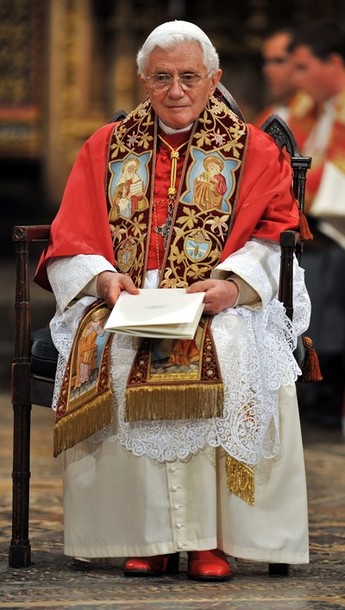
[Tip: Cantuale Antonianum, via Le Forum Catholique]


England has a long tradition of martyr saints, whose courageous witness has sustained and inspired the Catholic community here for centuries. Yet it is right and fitting that we should recognize today the holiness of a confessor, a son of this nation who, while not called to shed his blood for the Lord, nevertheless bore eloquent witness to him in the course of a long life devoted to the priestly ministry, and especially to preaching, teaching, and writing. He is worthy to take his place in a long line of saints and scholars from these islands, Saint Bede, Saint Hilda, Saint Aelred, Blessed Duns Scotus, to name but a few. In Blessed John Henry, that tradition of gentle scholarship, deep human wisdom and profound love for the Lord has borne rich fruit, as a sign of the abiding presence of the Holy Spirit deep within the heart of God’s people, bringing forth abundant gifts of holiness.
Cardinal Newman’s motto, Cor ad cor loquitur, or "Heart speaks unto heart", gives us an insight into his understanding of the Christian life as a call to holiness, experienced as the profound desire of the human heart to enter into intimate communion with the Heart of God. He reminds us that faithfulness to prayer gradually transforms us into the divine likeness. As he wrote in one of his many fine sermons, "a habit of prayer, the practice of turning to God and the unseen world in every season, in every place, in every emergency – prayer, I say, has what may be called a natural effect in spiritualizing and elevating the soul. A man is no longer what he was before; gradually … he has imbibed a new set of ideas, and become imbued with fresh principles" (Parochial and Plain Sermons, iv, 230-231). Today’s Gospel tells us that no one can be the servant of two masters (cf. Lk16:13), and Blessed John Henry’s teaching on prayer explains how the faithful Christian is definitively taken into the service of the one true Master, who alone has a claim to our unconditional devotion (cf. Mt 23:10). Newman helps us to understand what this means for our daily lives: he tells us that our divine Master has assigned a specific task to each one of us, a "definite service", committed uniquely to every single person: "I have my mission", he wrote, "I am a link in a chain, a bond of connexion between persons. He has not created me for naught. I shall do good, I shall do his work; I shall be an angel of peace, a preacher of truth in my own place … if I do but keep his commandments and serve him in my calling" (Meditations and Devotions, 301-2).
The definite service to which Blessed John Henry was called involved applying his keen intellect and his prolific pen to many of the most pressing "subjects of the day". His insights into the relationship between faith and reason, into the vital place of revealed religion in civilized society, and into the need for a broadly-based and wide-ranging approach to education were not only of profound importance for Victorian England, but continue today to inspire and enlighten many all over the world. I would like to pay particular tribute to his vision for education, which has done so much to shape the ethos that is the driving force behind Catholic schools and colleges today. Firmly opposed to any reductive or utilitarian approach, he sought to achieve an educational environment in which intellectual training, moral discipline and religious commitment would come together. The project to found a Catholic University in Ireland provided him with an opportunity to develop his ideas on the subject, and the collection of discourses that he published as The Idea of a University holds up an ideal from which all those engaged in academic formation can continue to learn. And indeed, what better goal could teachers of religion set themselves than Blessed John Henry’s famous appeal for an intelligent, well-instructed laity: "I want a laity, not arrogant, not rash in speech, not disputatious, but men who know their religion, who enter into it, who know just where they stand, who know what they hold and what they do not, who know their creed so well that they can give an account of it, who know so much of history that they can defend it" (The Present Position of Catholics in England, ix, 390). On this day when the author of those words is raised to the altars, I pray that, through his intercession and example, all who are engaged in the task of teaching and catechesis will be inspired to greater effort by the vision he so clearly sets before us.
While it is John Henry Newman’s intellectual legacy that has understandably received most attention in the vast literature devoted to his life and work, I prefer on this occasion to conclude with a brief reflection on his life as a priest, a pastor of souls. The warmth and humanity underlying his appreciation of the pastoral ministry is beautifully expressed in another of his famous sermons: "Had Angels been your priests, my brethren, they could not have condoled with you, sympathized with you, have had compassion on you, felt tenderly for you, and made allowances for you, as we can; they could not have been your patterns and guides, and have led you on from your old selves into a new life, as they can who come from the midst of you" ("Men, not Angels: the Priests of the Gospel", Discourses to Mixed Congregations, 3). He lived out that profoundly human vision of priestly ministry in his devoted care for the people of Birmingham during the years that he spent at the Oratory he founded, visiting the sick and the poor, comforting the bereaved, caring for those in prison. No wonder that on his death so many thousands of people lined the local streets as his body was taken to its place of burial not half a mile from here. One hundred and twenty years later, great crowds have assembled once again to rejoice in the Church’s solemn recognition of the outstanding holiness of this much-loved father of souls. What better way to express the joy of this moment than by turning to our heavenly Father in heartfelt thanksgiving, praying in the words that Blessed John Henry Newman placed on the lips of the choirs of angels in heaven:
Praise to the Holiest in the heightAnd in the depth be praise;In all his words most wonderful,Most sure in all his ways!(The Dream of Gerontius).

This is an evening of joy, of immense spiritual joy, for all of us. We are gathered here in prayerful vigil to prepare for tomorrow’s Mass, during which a great son of this nation, Cardinal John Henry Newman, will be declared Blessed. How many people, in England and throughout the world, have longed for this moment! It is also a great joy for me, personally, to share this experience with you. As you know, Newman has long been an important influence in my own life and thought, as he has been for so many people beyond these isles. The drama of Newman’s life invites us to examine our lives, to see them against the vast horizon of God’s plan, and to grow in communion with the Church of every time and place: the Church of the apostles, the Church of the martyrs, the Church of the saints, the Church which Newman loved and to whose mission he devoted his entire life....Let me begin by recalling that Newman, by his own account, traced the course of his whole life back to a powerful experience of conversion which he had as a young man. It was an immediate experience of the truth of God’s word, of the objective reality of Christian revelation as handed down in the Church. This experience, at once religious and intellectual, would inspire his vocation to be a minister of the Gospel, his discernment of the source of authoritative teaching in the Church of God, and his zeal for the renewal of ecclesial life in fidelity to the apostolic tradition. At the end of his life, Newman would describe his life’s work as a struggle against the growing tendency to view religion as a purely private and subjective matter, a question of personal opinion. Here is the first lesson we can learn from his life: in our day, when an intellectual and moral relativism threatens to sap the very foundations of our society, Newman reminds us that, as men and women made in the image and likeness of God, we were created to know the truth, to find in that truth our ultimate freedom and the fulfilment of our deepest human aspirations. In a word, we are meant to know Christ, who is himself “the way, and the truth, and the life” (Jn 14:6).Newman’s life also teaches us that passion for the truth, intellectual honesty and genuine conversion are costly. The truth that sets us free cannot be kept to ourselves; it calls for testimony, it begs to be heard, and in the end its convincing power comes from itself and not from the human eloquence or arguments in which it may be couched. Not far from here, at Tyburn, great numbers of our brothers and sisters died for the faith; the witness of their fidelity to the end was ever more powerful than the inspired words that so many of them spoke before surrendering everything to the Lord. In our own time, the price to be paid for fidelity to the Gospel is no longer being hanged, drawn and quartered but it often involves being dismissed out of hand, ridiculed or parodied. And yet, the Church cannot withdraw from the task of proclaiming Christ and his Gospel as saving truth, the source of our ultimate happiness as individuals and as the foundation of a just and humane society.Finally, Newman teaches us that if we have accepted the truth of Christ and committed our lives to him, there can be no separation between what we believe and the way we live our lives. Our every thought, word and action must be directed to the glory of God and the spread of his Kingdom. Newman understood this, and was the great champion of the prophetic office of the Christian laity. He saw clearly that we do not so much accept the truth in a purely intellectual act as embrace it in a spiritual dynamic that penetrates to the core of our being. Truth is passed on not merely by formal teaching, important as that is, but also by the witness of lives lived in integrity, fidelity and holiness; those who live in and by the truth instinctively recognize what is false and, precisely as false, inimical to the beauty and goodness which accompany the splendour of truth, veritatis splendor.Tonight’s first reading is the magnificent prayer in which Saint Paul asks that we be granted to know “the love of Christ which surpasses all understanding” (Eph 3:14-21). The Apostle prays that Christ may dwell in our hearts through faith (cf. Eph 3:17) and that we may come to “grasp, with all the saints, the breadth and the length, the height and the depth” of that love. Through faith we come to see God’s word as a lamp for our steps and light for our path (cf. Ps 119:105). Newman, like the countless saints who preceded him along the path of Christian discipleship, taught that the “kindly light” of faith leads us to realize the truth about ourselves, our dignity as God’s children, and the sublime destiny which awaits us in heaven. By letting the light of faith shine in our hearts, and by abiding in that light through our daily union with the Lord in prayer and participation in the life-giving sacraments of the Church, we ourselves become light to those around us; we exercise our “prophetic office”; often, without even knowing it, we draw people one step closer to the Lord and his truth. Without the life of prayer, without the interior transformation which takes place through the grace of the sacraments, we cannot, in Newman’s words, “radiate Christ”; we become just another “clashing cymbal” (1 Cor 13:1) in a world filled with growing noise and confusion, filled with false paths leading only to heartbreak and illusion.One of the Cardinal’s best-loved meditations includes the words, “God has created me to do him some definite service. He has committed some work to me which he has not committed to another” (Meditations on Christian Doctrine). Here we see Newman’s fine Christian realism, the point at which faith and life inevitably intersect. Faith is meant to bear fruit in the transformation of our world through the power of the Holy Spirit at work in the lives and activity of believers. No one who looks realistically at our world today could think that Christians can afford to go on with business as usual, ignoring the profound crisis of faith which has overtaken our society, or simply trusting that the patrimony of values handed down by the Christian centuries will continue to inspire and shape the future of our society. We know that in times of crisis and upheaval God has raised up great saints and prophets for the renewal of the Church and Christian society; we trust in his providence and we pray for his continued guidance. But each of us, in accordance with his or her state of life, is called to work for the advancement of God’s Kingdom by imbuing temporal life with the values of the Gospel. Each of us has a mission, each of us is called to change the world, to work for a culture of life, a culture forged by love and respect for the dignity of each human person. As our Lord tells us in the Gospel we have just heard, our light must shine in the sight of all, so that, seeing our good works, they may give praise to our heavenly Father (cf. Mt 5:16)....And now, dear friends, let us continue our vigil of prayer by preparing to encounter Christ, present among us in the Blessed Sacrament of the Altar. Together, in the silence of our common adoration, let us open our minds and hearts to his presence, his love, and the convincing power of his truth. In a special way, let us thank him for the enduring witness to that truth offered by Cardinal John Henry Newman. Trusting in his prayers, let us ask the Lord to illumine our path, and the path of all British society, with the kindly light of his truth, his love and his peace. Amen.

The visitor to this Cathedral cannot fail to be struck by the great crucifix dominating the nave, which portrays Christ’s body, crushed by suffering, overwhelmed by sorrow, the innocent victim whose death has reconciled us with the Father and given us a share in the very life of God. The Lord’s outstretched arms seem to embrace this entire church, lifting up to the Father all the ranks of the faithful who gather around the altar of the Eucharistic sacrifice and share in its fruits. The crucified Lord stands above and before us as the source of our life and salvation, "the high priest of the good things to come", as the author of the Letter to the Hebrews calls him in today’s first reading (Heb 9:11).It is in the shadow, so to speak, of this striking image, that I would like to consider the word of God which has been proclaimed in our midst and reflect on the mystery of the Precious Blood. For that mystery leads us to see the unity between Christ’s sacrifice on the Cross, the Eucharistic sacrifice which he has given to his Church, and his eternal priesthood, whereby, seated at the right hand of the Father, he makes unceasing intercession for us, the members of his mystical body.Let us begin with the sacrifice of the Cross. The outpouring of Christ’s blood is the source of the Church’s life. Saint John, as we know, sees in the water and blood which flowed from our Lord’s body the wellspring of that divine life which is bestowed by the Holy Spirit and communicated to us in the sacraments (Jn 19:34; cf. 1 Jn 1:7; 5:6-7). The Letter to the Hebrews draws out, we might say, the liturgical implications of this mystery. Jesus, by his suffering and death, his self-oblation in the eternal Spirit, has become our high priest and "the mediator of a new covenant" (Heb 9:15). These words echo our Lord’s own words at the Last Supper, when he instituted the Eucharist as the sacrament of his body, given up for us, and his blood, the blood of the new and everlasting covenant shed for the forgiveness of sins (cf. Mk 14:24; Mt 26:28; Lk 22:20).Faithful to Christ’s command to "do this in memory of me" (Lk 22:19), the Church in every time and place celebrates the Eucharist until the Lord returns in glory, rejoicing in his sacramental presence and drawing upon the power of his saving sacrifice for the redemption of the world. The reality of the Eucharistic sacrifice has always been at the heart of Catholic faith; called into question in the sixteenth century, it was solemnly reaffirmed at the Council of Trent against the backdrop of our justification in Christ. Here in England, as we know, there were many who staunchly defended the Mass, often at great cost, giving rise to that devotion to the Most Holy Eucharist which has been a hallmark of Catholicism in these lands.The Eucharistic sacrifice of the Body and Blood of Christ embraces in turn the mystery of our Lord’s continuing passion in the members of his Mystical Body, the Church in every age. Here the great crucifix which towers above us serves as a reminder that Christ, our eternal high priest, daily unites our own sacrifices, our own sufferings, our own needs, hopes and aspirations, to the infinite merits of his sacrifice. Through him, with him, and in him, we lift up our own bodies as a sacrifice holy and acceptable to God (cf. Rom 12:1). In this sense we are caught up in his eternal oblation, completing, as Saint Paul says, in our flesh what is lacking in Christ’s afflictions for the sake of his body, the Church (cf. Col 1:24). In the life of the Church, in her trials and tribulations, Christ continues, in the stark phrase of Pascal, to be in agony until the end of the world (Pensées, 553, éd. Brunschvicg).We see this aspect of the mystery of Christ’s precious blood represented, most eloquently, by the martyrs of every age, who drank from the cup which Christ himself drank, and whose own blood, shed in union with his sacrifice, gives new life to the Church. It is also reflected in our brothers and sisters throughout the world who even now are suffering discrimination and persecution for their Christian faith. Yet it is also present, often hidden in the suffering of all those individual Christians who daily unite their sacrifices to those of the Lord for the sanctification of the Church and the redemption of the world. My thoughts go in a special way to all those who are spiritually united with this Eucharistic celebration, and in particular the sick, the elderly, the handicapped and those who suffer mentally and spiritually.Here too I think of the immense suffering caused by the abuse of children, especially within the Church and by her ministers. Above all, I express my deep sorrow to the innocent victims of these unspeakable crimes, along with my hope that the power of Christ’s grace, his sacrifice of reconciliation, will bring deep healing and peace to their lives. I also acknowledge, with you, the shame and humiliation which all of us have suffered because of these sins; and I invite you to offer it to the Lord with trust that this chastisement will contribute to the healing of the victims, the purification of the Church and the renewal of her age-old commitment to the education and care of young people. I express my gratitude for the efforts being made to address this problem responsibly, and I ask all of you to show your concern for the victims and solidarity with your priests.Dear friends, let us return to the contemplation of the great crucifix which rises above us. Our Lord’s hands, extended on the Cross, also invite us to contemplate our participation in his eternal priesthood and thus our responsibility, as members of his body, to bring the reconciling power of his sacrifice to the world in which we live. The Second Vatican Council spoke eloquently of the indispensable role of the laity in carrying forward the Church’s mission through their efforts to serve as a leaven of the Gospel in society and to work for the advancement of God’s Kingdom in the world (cf. Lumen Gentium, 31; Apostolicam Actuositatem, 7). The Council’s appeal to the lay faithful to take up their baptismal sharing in Christ’s mission echoed the insights and teachings of John Henry Newman. May the profound ideas of this great Englishman continue to inspire all Christ’s followers in this land to conform their every thought, word and action to Christ, and to work strenuously to defend those unchanging moral truths which, taken up, illuminated and confirmed by the Gospel, stand at the foundation of a truly humane, just and free society.How much contemporary society needs this witness! How much we need, in the Church and in society, witnesses of the beauty of holiness, witnesses of the splendour of truth, witnesses of the joy and freedom born of a living relationship with Christ! One of the greatest challenges facing us today is how to speak convincingly of the wisdom and liberating power of God’s word to a world which all too often sees the Gospel as a constriction of human freedom, instead of the truth which liberates our minds and enlightens our efforts to live wisely and well, both as individuals and as members of society.Let us pray, then, that the Catholics of this land will become ever more conscious of their dignity as a priestly people, called to consecrate the world to God through lives of faith and holiness. And may this increase of apostolic zeal be accompanied by an outpouring of prayer for vocations to the ordained priesthood. For the more the lay apostolate grows, the more urgently the need for priests is felt; and the more the laity’s own sense of vocation is deepened, the more what is proper to the priest stands out. May many young men in this land find the strength to answer the Master’s call to the ministerial priesthood, devoting their lives, their energy and their talents to God, thus building up his people in unity and fidelity to the Gospel, especially through the celebration of the Eucharistic sacrifice.

As I speak to you in this historic setting, I think of the countless men and women down the centuries who have played their part in the momentous events that have taken place within these walls and have shaped the lives of many generations of Britons, and others besides. In particular, I recall the figure of Saint Thomas More, the great English scholar and statesman, who is admired by believers and non-believers alike for the integrity with which he followed his conscience, even at the cost of displeasing the sovereign whose “good servant” he was, because he chose to serve God first. The dilemma which faced More in those difficult times, the perennial question of the relationship between what is owed to Caesar and what is owed to God, allows me the opportunity to reflect with you briefly on the proper place of religious belief within the political process.This country’s Parliamentary tradition owes much to the national instinct for moderation, to the desire to achieve a genuine balance between the legitimate claims of government and the rights of those subject to it. While decisive steps have been taken at several points in your history to place limits on the exercise of power, the nation’s political institutions have been able to evolve with a remarkable degree of stability. In the process, Britain has emerged as a pluralist democracy which places great value on freedom of speech, freedom of political affiliation and respect for the rule of law, with a strong sense of the individual’s rights and duties, and of the equality of all citizens before the law. While couched in different language, Catholic social teaching has much in common with this approach, in its overriding concern to safeguard the unique dignity of every human person, created in the image and likeness of God, and in its emphasis on the duty of civil authority to foster the common good.And yet the fundamental questions at stake in Thomas More’s trial continue to present themselves in ever-changing terms as new social conditions emerge. Each generation, as it seeks to advance the common good, must ask anew: what are the requirements that governments may reasonably impose upon citizens, and how far do they extend? By appeal to what authority can moral dilemmas be resolved? These questions take us directly to the ethical foundations of civil discourse. If the moral principles underpinning the democratic process are themselves determined by nothing more solid than social consensus, then the fragility of the process becomes all too evident - herein lies the real challenge for democracy.The inadequacy of pragmatic, short-term solutions to complex social and ethical problems has been illustrated all too clearly by the recent global financial crisis. There is widespread agreement that the lack of a solid ethical foundation for economic activity has contributed to the grave difficulties now being experienced by millions of people throughout the world. Just as “every economic decision has a moral consequence” (Caritas in Veritate, 37), so too in the political field, the ethical dimension of policy has far-reaching consequences that no government can afford to ignore. A positive illustration of this is found in one of the British Parliament’s particularly notable achievements – the abolition of the slave trade. The campaign that led to this landmark legislation was built upon firm ethical principles, rooted in the natural law, and it has made a contribution to civilization of which this nation may be justly proud.The central question at issue, then, is this: where is the ethical foundation for political choices to be found? The Catholic tradition maintains that the objective norms governing right action are accessible to reason, prescinding from the content of revelation. According to this understanding, the role of religion in political debate is not so much to supply these norms, as if they could not be known by non-believers – still less to propose concrete political solutions, which would lie altogether outside the competence of religion – but rather to help purify and shed light upon the application of reason to the discovery of objective moral principles. This “corrective” role of religion vis-à-vis reason is not always welcomed, though, partly because distorted forms of religion, such as sectarianism and fundamentalism, can be seen to create serious social problems themselves. And in their turn, these distortions of religion arise when insufficient attention is given to the purifying and structuring role of reason within religion. It is a two-way process. Without the corrective supplied by religion, though, reason too can fall prey to distortions, as when it is manipulated by ideology, or applied in a partial way that fails to take full account of the dignity of the human person. Such misuse of reason, after all, was what gave rise to the slave trade in the first place and to many other social evils, not least the totalitarian ideologies of the twentieth century. This is why I would suggest that the world of reason and the world of faith – the world of secular rationality and the world of religious belief – need one another and should not be afraid to enter into a profound and ongoing dialogue, for the good of our civilization.Religion, in other words, is not a problem for legislators to solve, but a vital contributor to the national conversation. In this light, I cannot but voice my concern at the increasing marginalization of religion, particularly of Christianity, that is taking place in some quarters, even in nations which place a great emphasis on tolerance. There are those who would advocate that the voice of religion be silenced, or at least relegated to the purely private sphere. There are those who argue that the public celebration of festivals such as Christmas should be discouraged, in the questionable belief that it might somehow offend those of other religions or none. And there are those who argue – paradoxically with the intention of eliminating discrimination – that Christians in public roles should be required at times to act against their conscience. These are worrying signs of a failure to appreciate not only the rights of believers to freedom of conscience and freedom of religion, but also the legitimate role of religion in the public square. I would invite all of you, therefore, within your respective spheres of influence, to seek ways of promoting and encouraging dialogue between faith and reason at every level of national life.
The evangelization of culture is all the more important in our times, when a “dictatorship of relativism” threatens to obscure the unchanging truth about man’s nature, his destiny and his ultimate good. There are some who now seek to exclude religious belief from public discourse, to privatize it or even to paint it as a threat to equality and liberty. Yet religion is in fact a guarantee of authentic liberty and respect, leading us to look upon every person as a brother or sister. For this reason I appeal in particular to you, the lay faithful, in accordance with your baptismal calling and mission, not only to be examples of faith in public, but also to put the case for the promotion of faith’s wisdom and vision in the public forum. Society today needs clear voices which propose our right to live, not in a jungle of self-destructive and arbitrary freedoms, but in a society which works for the true welfare of its citizens and offers them guidance and protection in the face of their weakness and fragility. Do not be afraid to take up this service to your brothers and sisters, and to the future of your beloved nation....Finally, I would like to say a word to you, my dear young Catholics of Scotland. I urge you to lead lives worthy of our Lord (cf. Eph 4:1) and of yourselves. There are many temptations placed before you every day - drugs, money, sex, pornography, alcohol - which the world tells you will bring you happiness, yet these things are destructive and divisive. There is only one thing which lasts: the love of Jesus Christ personally for each one of you. Search for him, know him and love him, and he will set you free from slavery to the glittering but superficial existence frequently proposed by today’s society. Put aside what is worthless and learn of your own dignity as children of God. In today’s Gospel, Jesus asks us to pray for vocations: I pray that many of you will know and love Jesus Christ and, through that encounter, will dedicate yourselves completely to God, especially those of you who are called to the priesthood and religious life. This is the challenge the Lord gives to you today: the Church now belongs to you!

The name of Holyroodhouse, Your Majesty’s official residence in Scotland, recalls the "Holy Cross" and points to the deep Christian roots that are still present in every layer of British life. The monarchs of England and Scotland have been Christians from very early times and include outstanding saints like Edward the Confessor and Margaret of Scotland. As you know, many of them consciously exercised their sovereign duty in the light of the Gospel, and in this way shaped the nation for good at the deepest level. As a result, the Christian message has been an integral part of the language, thought and culture of the peoples of these islands for more than a thousand years. Your forefathers’ respect for truth and justice, for mercy and charity come to you from a faith that remains a mighty force for good in your kingdom, to the great benefit of Christians and non-Christians alike.We find many examples of this force for good throughout Britain’s long history. Even in comparatively recent times, due to figures like William Wilberforce and David Livingstone, Britain intervened directly to stop the international slave trade. Inspired by faith, women like Florence Nightingale served the poor and the sick and set new standards in healthcare that were subsequently copied everywhere. John Henry Newman, whose beatification I will celebrate shortly, was one of many British Christians of his age whose goodness, eloquence and action were a credit to their countrymen and women. These, and many people like them, were inspired by a deep faith born and nurtured in these islands.Even in our own lifetime, we can recall how Britain and her leaders stood against a Nazi tyranny that wished to eradicate God from society and denied our common humanity to many, especially the Jews, who were thought unfit to live. I also recall the regime’s attitude to Christian pastors and religious who spoke the truth in love, opposed the Nazis and paid for that opposition with their lives. As we reflect on the sobering lessons of the atheist extremism of the twentieth century, let us never forget how the exclusion of God, religion and virtue from public life leads ultimately to a truncated vision of man and of society and thus to a "reductive vision of the person and his destiny" (Caritas in Veritate, 29).


The Holy Father will be paying an apostolic visit to Scotland and England from the 16 to the 19 September. He will be coming for the beatification of Cardinal Newman, the Anglican theologian priest who converted to Catholicism. Our movement has seized the occasion of this much-awaited trip across the channel: we have commissioned a new survey on the Motu Proprio’s reception among British Catholics along the lines of the survey conducted during the Holy Father’s recent trip to Portugal.I – A PECULIAR CONTEXTEver since the sixteenth-century Anglican schism, Catholicism has had a peculiar position in Great Britain. The Church was institutionally oppressed down to the nineteenth century; indeed both the authorities and the people considered Catholicism to be antinational.The Catholic Relief Act of 1829 allowed Catholicism to organise freely, particularly once the 1850 Pontifical Brief re-established the Catholic hierarchy in the country. Since that time, in which Cardinal Newman lived, British Catholicism has had a remarkable influence in the island’s intellectual and cultural circles. Such singular figures as Chesterton and Tolkien emerged from this influence; it did not, however, bring about a massive return of Anglicans to Rome.The first important act in defence of the traditional liturgy came from England in 1971: a petition signed by dozens of personalities, among whom Agatha Christie (though not herself a Catholic). This action was rewarded by the immediate grant of an indult, commonly called the “Agatha Christie indult,” whose unabridged text we are publishing in appendix. This indult, which was formulated in the classic form of an answer of the Congregation for Divine Liturgy to the Cardinal President of the Bishops’ Conference of England and Wales, provided for the possibility of “certain groups of the faithful on specific occasions be allowed to participate in the Mass celebrated according to the rites and texts of the former Roman Missal."Despite this text’s importance for the history of the defence of the Church’s traditional liturgy (it established a precedent, which is very important in the Roman curia’s modus operandi, and it would be constantly cited in the context of the 1988 Motu Proprio), the dearth of eagerness in its application on the part of the British Episcopal hierarchy (already in 1971 . . .) deprived it of any fruit. Consequently the situation of English, Welsh, and Scottish Catholics attached to the traditional liturgy has ended up being closer and closer to that known on the continent: disdain and marginalization.The 2007 Motu Proprio has not yet reversed the situation, despite some overtures on the part of certain British prelates and the activity of lay movements, among whom the Latin Mass Society holds the first rank. It has organised many formation seminars for priests to learn how to celebrate the extraordinary form.Yet some effervescence has been observed at the approach of the pontifical visit. It has been fed in part by the Apostolic Constitution Anglicanorum Coetibus setting up personal Ordinariates for Anglicans who enter into full communion with the Church. Indeed this text, a new fruit of Benedict XVI’s generosity, offers some hope to those Anglican faithful who no longer recognise themselves in the recent evolution of the Anglican Communion as it keeps caving in to pressure on the matter of women’s ordination and the admission of active homosexuals to “holy orders.” Until then it had seemed to be the Protestant community that was the closest to Rome. Furthermore, the Sovereign Pontiff is constantly under attack from many pressure groups that have access to the English media and do not shrink from utterly shameless provocations; there is even talk of sending the Pope to gaol! It is within this context that Paix Liturgique wished to measure what Catholics in Great Britain know about the Motu Proprio Summorum Pontificum and how they react to it.II – THE RESULTSHere are this survey’s results. It was conducted on line, 21-28 June 2010, by Harris Interactive. There were 800 British Catholic participants, from a sampling of 6153 persons over the age of 18.Question #1: Do you attend Mass?Weekly: 24.3%Monthly: 7.8%On Holy Days: 10.1%Occasionally (e.g. for weddings): 45.6%Never: 12.3%Question #2: In July [2007] Pope Benedict XVI restated that the Mass could be celebrated both in its modern, "ordinary," or "Paul VI" form--i.e. in English, with the priest facing the faithful, communion received standing--and in its traditional, "extraordinary," or "John XXIII" form--i.e. in Latin and Gregorian chant, with the priest turned towards the altar, communion received kneeling. Were you aware of this?Yes: 39.4%No: 60.6%Question #3 : Would you consider it normal or abnormal for both liturgical forms to be celebrated regularly in YOUR parish?Normal: 44.9%Abnormal : 21%No opinion: 34.1%Question #4: If Mass were celebrated with Latin and Gregorian chant in its extraordinary form in YOUR parish, without taking the place of the ordinary one in English, would you attend it?The following answers are from all Catholics polled:- 15.6% would attend every week- 10.8% once a month- 11.1% for Holy Days- 46.1% occasionally- 16.4% neverAnswers from those regularly practicing (weekly and monthy) alone:- 43% would attend every week- 23.4% once a month- 7.8% for Holy Days- 17.6% occasionally- 8.2% never
III - PAIX LITURGIQUE’S COMMENTS1/ The first lesson to draw from this survey, and good news for the entire Church too, is that 32% of British Catholics claim to attend Mass at least once a month. This reported rate of practice is far superior to that in old Catholic countries such as France or Portugal (both at 19% according to the December 2009 IFOP survey for La Croix and the May 2010 Harris Interactive poll for PL, respectively).2/ The second lesson is that this survey, which was conducted by a professional and independent institution, confirms all earlier polls conducted in different places and at different times on the question of the Church’s traditional liturgy (see here). Let those that have eyes see; and those that have ears, hear. . . .In Great Britain as everywhere else, a strong proportion of Catholics would gladly attend the extraordinary form of the Roman rite if it took place right in THEIR OWN parish. The only difference is that the proportion is higher than the average obtained during the preceding surveys, where about one third of regularly practicing Catholics would gladly attend the traditional Mass if it were celebrated in their parish. In Great Britain, 43% of those who go to Mass every week would attend the traditional Mass if it were celebrated in their parish (Great Britain outstrips Italy, which until now held the record of 40% of weekly Mass goers answering that they would go to the traditional Mass every week if it were offered). The result even reaches 66.4% (i.e. 2 out of 3) if one lumps together all those who attend Mass at least once a month, which is even more than in Italy (63% according to the 2009 Doxa survey).When one notes (see question 2) that 60% of Catholics are not aware of the Motu Proprio’s existence, one can easily imagine that the aforementioned 66.4% of Mass goers would increase if awareness of the MP were spread more broadly. . . .3/ This study’s third lesson is the confirmation that in Great Britain too the overwhelming majority of the faithful find it absolutely normal for both forms of the Roman rite to cohabitate in peace in the parish setting.This is not entirely surprising: British Catholics, long persecuted as “Papists,” are indeed particularly attached to the successor of Peter. In Great Britain as elsewhere, the wish of the faithful to see the Motu Proprio being applied seems in direct proportion to the opposition that the Pope’s texts elicits among most bishops. The hierarchy’s lack of awareness of the reality before it, brought out by this study, is noteworthy.Only 21% of the Faithful find the peaceful coexistence of both forms of the Roman rite abnormal. This figure might be lower if more of the Faithful (i.e. more than the current 39.4%) knew the provisions in Benedicts XVI’s Motu Proprio. One can legitimately think that, among these 21%, there are some who believe what has been repeated to them for so long, namely that this liturgy had been “abrogated,” if not “forbidden” . . . .In Great Britain as elsewhere, the argument resting on the lack of interest among the Faithful for the application of the Motu Proprio is unfair. When their point of view is solicited in an opinion poll, the results are quite different to those obtained when one merely speaks in their name . . . all the while taking care not to consult them, unless it’s through parish councils, which as a matter of principle (whether because of ideology, fear, or simple post-conciliar conservatism) are not inclined to favour the reform of the reform undertaken by Benedict XVI.4/ Regarding the Agatha Christie Indult: from 1971 on it allowed the celebration of the 1965 Missal with the modifications of 1967 (as opposed to that of the 1962 Missal allowed in Summorum Pontificum and, before that, in Ecclesia Dei). One might have thought that this watered-down and modernised form of the John XXIII missal would have been more acceptable to the bishops of Britain and that it would therefore have helped spread a more traditional liturgy in the post-conciliar context . . . But such was not the case as the British bishops perceived no substantial difference between the 1965 liturgy and that of 1962. It is of course needless to press this point with too much insistence upon those who naively reckon that the celebration of the 1965 form would be more acceptable at the diocesan level than the 1962 form. There is likewise no need to mention the naïveté, which is in this case abysmal, of the few militants who are dead set on the celebration of the Paul VI liturgy in Latin . . . .5/ Above all this new survey underscores the (in this case British) bishops’ astounding deficiency—to put the best face on it—when it comes to communication. Indeed, a full three years after the publication of the Motu Proprio on 7 July 2007, only 40% have been informed of it. In fact one must call a spade a spade, particularly in so serious a matter as liturgical and sacramental life: in Britain as elsewhere, the issue is pastoral blindness to the expectations of the Faithful. This blindness on the part of bishops has once again been scientifically measured and put into figures. It is tempting to wonder whether the bishops might not need a new pastoral Council entirely dedicated to listening skills for the benefit of the “Silent ones of the Church,” and to meeting their expectations.6/ One final remark: because of the small proportion of Catholics in the country (13%), it was necessary to poll more people than usual (6153 individuals) in order to work with a representative number of people who declare themselves to be “Catholic.” Consequently this survey is the costliest of all those we have commissioned to date. It cost €10,000 with tax. If you wish to participate in its financing it and thus allow us to continue our work of information, you can post your donation to Paix liturgique, 1 allée du Bois Gougenot, 78290 CROISSY-SUR-SEINE (write out the cheque to Paix liturgique), or you can transfer funds: IBAN : FR76 3000 3021 9700 0500 0158 593 - BIC : SOGEFRPP.