Rorate Caeli
Showing posts with label Liturgical Beauty. Show all posts

The Masses of Holy Week & Tenebrae — A Publication to Assist in Pre-55 Services

Those who are blessed with access to Holy Week in the Tridentine Rite, that is, the rite celebrated for a thousand years and more prior to Pius XII's changes in the mid-1950s, may find helpful a resource published by Os Justi Press: The Masses of Holy Week & Tenebrae, which contains the liturgy (in Latin with English translation) for Palm Sunday, the Triduum Masses, and the Office of Tenebrae, including complete Gregorian chants. Summary rubrics are indicated. No page turning is required. The book features many medieval illustrations as well.

This second edition features a new cover and, for the first time, full-color printing throughout, which dramatically enhances the beauty of the illuminations found within. Additionally, some typographical errors discovered in the first printing have been corrected.

Leo XIV on Liturgy: "We have great need to recover the sense of mystery that remains alive in your [Eastern] liturgies."

Hierarchical Divine Liturgy in Rome for Jubilee Pilgrims from the Eparchy of Mukachevo (May 12, 2025)

***
 

In his audience with Eastern Catholics in Rome for the Jubilee:


I would also like to mention Pope Leo XIII, the first Pope to devote a specific document to the dignity of your Churches, inspired above all by the fact that, in his words, “the work of human redemption began in the East” (cf. Apostolic Letter Orientalium Dignitas, 30 November 1894).

Book Announcement: “Good Music, Sacred Music, and Silence: Three Gifts of God for Liturgy and for Life”

I am happy to share with readers of Rorate the announcement of my latest book, released today: Good Music, Sacred Music, and Silence: Three Gifts of God for Liturgy and for Life (TAN, 2023). This book—the fruit of decades of working as a church singer, choir director, composer, and teacher of music at the college level—is a heartfelt appeal to take the art of music as seriously as it deserves to be taken.

The first part deals with the corrosive cultural and psychological effects of a lot of modern popular music, contrasted with the numerous benefits of a lifelong apprenticeship to the great music of the Western tradition (including the many excellent composers working today). Here I draw upon such thinkers as Plato, Aristotle, Aquinas, Pieper, and Ratzinger as well as years of interesting interactions with young people, whom I often guided through what might be called their “musical conversion.”

Led by the Star of Beauty to the Love of Beauty Unseen: The Epiphany of Christ in the Ancient Roman Liturgy

Photo by John Aron: LMS Pilgrimage to Chideock, England, with the ICKSP

In Plato’s famous dialogue on love, the Symposium, Socrates relates the “tale” he learned from his teacher Diotima of Mantineia. She tells him that love is caused by the beautiful, and that the ultimate goal of our love is absolute Beauty itself:

He who has been instructed thus far in the things of love, and who has learned to see the beautiful in due order and succession, when he comes toward the end will suddenly perceive a nature of wondrous beauty (and this, Socrates, is the final cause of all our former toils)—a nature which in the first place is everlasting, not growing and decaying, or waxing and waning; secondly, not fair in one point of view and foul in another, or at one time or in one relation or at one place fair, at another time or in another relation or at another place foul, as if fair to some and foul to others… but beauty absolute, separate, simple, and everlasting, which without diminution and without increase, or any change, is imparted to the ever-growing and perishing beauties of all other things….

“Given a Choice, Why Should I Consistently Attend the Traditional Latin Mass?” — Full Text of Dr. Kwasniewski’s Charlotte Lecture

The following lecture, sponsored by the Charlotte Latin Mass Community, responds to a question many Catholics have today: “Why should I go to the extra trouble of attending the Latin Mass consistently or exclusively, when it’s so much more convenient to go to a closer church that has a decently reverent Novus Ordo? And after July 16th’s motu proprio, Church leaders are making it more difficult than ever to make the Latin Mass our liturgical home. What reasons should motivate us to stay faithful to it, despite those challenges?” Along the way, I furnish arguments in favor of the content and form of the TLM and respond to some of the usual objections made by Bergoglianity against tradition. A video of the lecture has also been posted at YouTube.

Given a Choice, Why Should I Consistently Attend the Traditional Latin Mass?

Lecture by Dr. Peter Kwasniewski
St. Thomas Aquinas Catholic Church, Charlotte, North Carolina
Saturday, November 6, 2021

AUDI, ISRAËL:
Jewish Feasts in the Propers of the Traditional Roman Rite

by Alisa Kunitz-Dick


Christ unrolls the scroll at the Synagogue at Nazareth [Lk. 4]
James Tissot (c. 1890), Brooklyn Museum

Several weeks ago, Fr Albert Marcello wrote of the commemoration (in the nontechnical sense of the word) of Tisha B'Av within the propers at Mass.  What Fr Marcello noticed is not an isolated incident.  There are a number of commemorations of holidays from the Jewish calendar in the propers of the ancient Latin liturgy, which do not appear in the Novus Ordo.   


I have complied a list of all of the ones that I have noticed, and explain in bold how they correspond to the holiday, if it is not obvious.  Altogether there are commemorations of all the major Jewish Holy Days and feasts, roughly at the same time they occur in the Jewish calendar, with the exception of Chanukkah.  I do not know, from an historical perspective, when each of these entered the Roman rite, but perhaps there is a liturgical historian out there who would be able to explain [1]. 


The feasts are, as follows:


1.  Rosh Hashanah [The New Year]

MASS OF THE AGES - First episode of the documentary trilogy on the Traditional Mass

With a goal of reaching 10 million Catholics, an incredible new documentary on the traditional Latin Mass premiered on YouTube last night, and can now be watched any time with the entire family. 


Executive produced by Harrison Butker, one of the best (and current) NFL kickers who part times as a TLM server, Mass of the Ages exceeded expectations in both production and content. 


With the horrors of Traditionis Custodes closing in on many traditional Catholics around the world, the need to both educate, and inspire, as many Catholics as possible is critical and urgent. 


You may watch episode 1, below. 


To help fund the project and ensure they can market it to as many people as possible, CLICK HERE


Sophia Press Announces Benedictus, a New Monthly Guide to the Traditional Latin Mass

Sophia Institute Press, which has been publishing so many good traditional Catholic books in recent years, has announced a major new initiative that should be of exceptional interest to all Catholics in the USA: Benedictus: The Traditional Catholic Companion. Think Magnificat, except keyed to the Tridentine Mass, making use of the Roman Breviary, and quoting from classic authors.

The dedicated website (www.praybenedictus.com) tells us what subscribers will find in each monthly booklet:

DAILY MASS COMPANION
Pray the Traditional Latin Mass, with the 1962 Missale Romanum presented in a clear and simple format. Continuous Latin and English text with reduced rubrics are included for Sundays (no page-jumping required), and complete Mass propers are offered in English for weekdays and feasts of each month.

MORNING AND EVENING DEVOTIONS
Enter the broader stream of Catholic liturgy with daily excerpts included from both Lauds and Vespers of the 1960 Breviarum Romanum, the official morning and evening hours of prayer used by traditional clergy and religious throughout the world. Excellent for family devotions, which, as a result, will synchronize better with the prayers and atmosphere of the traditional Latin Mass.

DAILY MEDITATIONS
Learn at the feet of Catholic spiritual masters each day, with devout meditations curated exclusively from saints and scholars who prayed and loved the traditional Mass, from the early Church to the early 1900s. Guaranteed to be free of soft modernism or fluffy pablum.

INFORMATIVE COMMENTARY
Dive deeper into our heritage of Faith through insightful mini-essays on the feasts and saints of the traditional calendar, as well as brief catecheses and ideas for extending a liturgical life into the home. Unlock the riches of Tradition like never before!

CLASSIC PRAYER COLLECTION
Several pages of superb Catholic prayers and chants, proven over generations of pious use. Some are offered in Latin as well as English, to further enable and enrich personal and communal prayer in the mother tongue of the Church.

BEAUTIFUL ARTWORK
Contemplate a masterpiece of religious art in every issue, rendered in stunning color and clarity. Thematic works are selected to suit each month, and print subscribers receive a separable holy card with every issue. No weird or goofy or trendy or faux-primitive modern art.

CATHOLIC CULTURE
Foster a vibrantly Catholic culture in your soul and in your family circle with monthly pages of edifying prose, poetry, or music. Enjoyable in themselves, the selections are made to help cultivate a thoroughly Catholic imagination. There should never be any opposition between the true, the good, and the beautiful, and Benedictus will demonstrate their unbreakable bond each month.

A sample issue is available at the Benedictus website.

Some might be wondering: Why have a monthly paperback when you can just buy a missal? And I agree, in the sense that a full 2,000-page missal is what everyone should end up with. But there are key advantages to a publication like this, which is not meant to rival a hand missal, but to complement it:

(1) For newbies
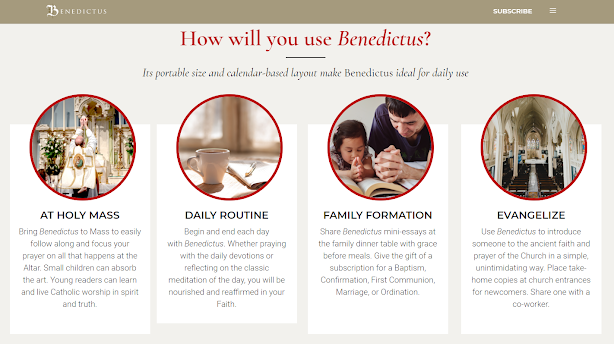
: there are NO PAGE TURNS required with Benedictus. The whole Mass — full Ordinary and Propers in parallel Latin and English — is laid out, in order, FOR EACH SUNDAY. No bookmarks or ribbons necessary. For someone who is just getting into the TLM, or someone who might on a certain occasion prefer an easy-to-use book (e.g., a mother with small children to mind), or when you invite a friend or relative and want something to hand to them, this could be a life-saver.

(2) For training kids up
to their big hand missal: no more fussing in the pews as five kids simultaneously try to figure out where the propers are... or give up and start daydreaming...

(3) For introducing the family to the Breviary
(and warming up one's spouse to the prospect of eventually plunking down several hundred for a full Breviary!), or, as mentioned, for enriching home prayer time with chants and prayers, which will vary from month to month, following the traditional calendar.

(4) For liturgically-themed table readings
at, or before, or after dinner, or at the time of the Rosary, etc. The commentary/reflections from classic authors in each issue of Benedictus will be one of its strongest features, because no hand missal will have this variety of sources, keyed to the traditional liturgical calendar as it unfolds year to year.

(5) As a daily devotional: one of the most promising aspects of Benedictus will be its fittingness as a daily devotional, filled with the contemplative insights of authors who drank deeply from the Church's ancient liturgical rites. Even the sample issue includes such standouts as Aquinas and De Montfort, Cyril and Thomas a Kempis, as well devotional writers that were household names just a few generations ago: Gueranger, Goffine, and Schuster.


To all the above: “Yes, please!”


The first issue is planned for August, shipping out in July. As can be well understood, a project of this ambitious magnitude can succeed only if there is a certain minimum number of subscribers to support its publication going forward. (Any subscription-based magazine or journal or newspaper faces similar constraints and demands.) I believe Sophia is looking to obtain 5,000 subscriptions to make it work. May this great enterprise of Benedictus meet with the success it deserves!

Moreover, generous bulk discounts are available for parishes, so it would be very worthwhile for groups of laity, families, clergy, religious, to get together and place a larger order. Sophia is shipping free bulk boxes of the March sample issue, in any quantity, to any church or chapel that asks, so email them (HERE) to request a crate for your own location. They will ship out at the end of February in order to arrive in time for the March week that the sample contains.

Visit the website for more information, to see a sample issue, to read the endorsements (Archbishop Viganò, Bishop Schneider, Bishop Strickland, Fr. James Jackson, FSSP, Fr. Armand de Malleray, FSSP, Canon Matthew Talarico, ICKSP, and Michael Matt), or, most importantly, to SUBSCRIBE.

Those who subscribe now will receive a free copy of my new book The Holy Bread of Eternal Life: Restoring Eucharistic Reverence in an Age of Impiety.

(Note: At this time, Benedictus is being distributed in the United States, but Sophia is looking into the possibility of international subscriptions.)


(For the sake of full disclosure: I am not an employee of the team that is producing Benedictus, but I enthusiastically support what they are doing. Moreover, Rorate Caeli is not affiliated with Benedictus and receives no financial compensation for this or any other promotion of it.)

New Book from Angelico Press: Noble Beauty, Transcendent Holiness: Why the Modern Age Needs the Mass of Ages

I am pleased to announce the publication of my new book with Angelico, now available on Amazon.

(The publisher's announcement:)

THE TRADITIONAL LITURGY OF THE ROMAN CATHOLIC CHURCH is a highly formal ritual unfolding in layers of elaborate gesture, rich symbolism, whispered Latin, and ancient plainchants. “Experts” after the Second Vatican Council were convinced that such a ritual was irrelevant to “modern man.” To the shock of some, the delight of many, and the surprise of everyone, the old Latin Mass (and much that went along with it) has tenaciously survived during the past half-century and become an increasingly familiar feature in the Catholic landscape. What are the reasons for this revival, especially among the young? And why is this development so important for the renewal of Catholicism? 

Peter Kwasniewski offers a lively account of the noble beauty and transcendent holiness of the traditional Roman liturgy, which humbles us before the mystery of God, stirs us with its pageantry, carries us into sacred silence, and bears us to a world of invisible realities. He contrasts this priceless treasure with the rationalistic reforms of the sixties, which yielded a Catholic liturgy severed from its own history, inadequate to its theological essence, unequal to its ascetical-mystical purpose, and estranged from its cultural inheritance. His conclusion: if there is to be a new springtime in the Church, the widespread restoration of the traditional liturgical rites will be at the heart of it.

Guest Op-Ed: Beauty as an essential element of the sacred liturgy

By Veronica A. Arntz

“O Lord, I Have Loved the Beauty of Thy House”
Beauty as an Essential Element of the Sacred Liturgy

In Sacramentum Caritatis, Pope Benedict XVI writes, “Beauty…is not mere decoration but rather an essential element of the liturgical action, since it is an attribute of God himself and his revelation” (art. 35). Beauty, therefore, is not merely an external; rather, beauty is inseparable from the liturgy itself. To say this in the abstract is one thing, but to understand it in the concrete is much more difficult. To understand how beauty is an essential element of the liturgy, we will look to Joseph Ratzinger/Benedict XVI’s writings to elucidate three main indicators of beauty: liturgy must be Christocentric; situated within the long-standing, sacred tradition of the Church; and permeated with beautiful music. 

Liturgy as the Court Ritual of the Heavenly Kingdom

(cross-posted from New Liturgical Movement)


Fr. Anthony Ruff, O.S.B., regnant spirit of PrayTell and heir to Collegeville’s long line of liturgical iconoclasts and modernizers, has this to say about the “paradigm shifts” inaugurated by the Second Vatican Council:

The Council fathers didn’t get into all the specifics of the reform of the liturgy. They left most of that to a future commission under the pope. The fathers approved a major paradigm shift — from liturgy as Carolingian clerical drama to liturgy as act of all the people — and then left open what the implications of that shift would be. No doubt some or many of the fathers didn’t yet have in mind all the possible implications of the paradigm shift. Nor did they need to.

Spaemann: "The Greatest Liturgical Problem is the Direction of Celebration of the Mass."

Robert Spaemann: “The biggest problem is the direction of the altar”


A native of Berlin and professor emeritus of philosophy at the University of Munich, Robert Spaemann is a member of the Pontifical Academy for Life. A specialist in the thought of Fénelon and author of a well-known critique of political utopia, as well as numerous moral works (including Happiness and Benevolence, PUF, 1997), he is a great friend of Pope Emeritus Benedict XVI. He received recent attention on account of some very critical comments on Amoris Laetitia. We are taking advantage of the holidays to present you with the reflections on the liturgy which he gave to Fr. Claude Barthe for the work Reconstruire la liturgie, published by Éditions Francois-Xavier de Guibert in 1997, that is, 10 years before the Motu Proprio Summorum Pontificum. Here, he explores the direction of the celebration, a question which has recently been the subject of a strong and clear intervention on the part of Cardinal Sarah, who was appointed Prefect of the Congregation for Divine Worship by Pope Francis, and to which we will return in subsequent letters.

***

Fr. Claude Barthe – You have often echoed the profound dissatisfaction of Catholics who are unhappy with the new forms of worship. You have contributed to a certain number of them rediscovering the traditional liturgical practice in Germany today.

All Saints of God, Pray for Us! - Video of Litany of Saints during Priestly Ordination


Priestly Ordinations of five deacons of the Institute of the Good Shepherd (IBP), in Bordeaux, on June 25, 2016.

Op-Ed: "The Conversation that must be had: a genuine Theological debate about the Church and the World"

by Fr. Richard G. Cipolla


[Rorate note: This is intended to be the beginning of a conversation among Rorate's contributors about the Reform of the Reform and its future..]

What is so sorely needed in the Church today is genuine theological debate about important issues both within the Church and also within the world.  And this debate is sorely needed within the Traditional movement within the Church.  What is at stake is the very concept and understanding of the Tradition of the Church that encompasses both Scripture and the teaching of the Church to the present time.  For the Catholic, Scripture cannot be divorced from the Tradition, which must include the teaching of the Church and its binding nature.  You notice I did not invoke the term “Magisterium” with respect to the teaching office of the Church.  The Magisterium, as understood today, did not, at least in an explicitly defined sense, exist before Vatican I.   I would submit that the concept of the Magisterium as consisting of the Pope united with the bishops and the levels of Extraordinary and Ordinary teaching is a rather modern concept. This is not to say that this concept is in error or that it is not useful.  But this understanding of the teaching role and office of the Church defined in this narrow and legalistic way impoverishes the meaning of the Ecclesia Docens by overlooking the role of the Liturgy and of the piety of the people in the teaching of the Church as embodied in the Tradition. The omission of the role of the Liturgy and the piety of the people in the concept of the Magisterium is one of the chief reasons why we find ourselves in the parlous situation of the Church today. 

Advent and Christmas 2015 Photo-Post

(This post will be updated as we receive more links and pictures.)

1. Messa in Latino has published the following pictures of the Solemn Pontifical Christmas Midnight Mass celebrated by Cardinal Burke at the Ss. Trinitá dei Pellegrini, Rome's personal parish dedicated to the Traditional Latin Mass. 


On "liturgical blue" for the Feast of the Immaculate Conception


At the end of last year the Filipino Traditionalist Catholic blog Dei praesidio fultus published a comprehensive article on the use of blue -- or, rather, cerulean -- vestments for the Feast of the Immaculate Conception:


The article defends the existence of the privilege while meticulously noting the restrictions placed upon it to prevent its indiscriminate dissemination. The privilege was not automatically given to every portion of the former Spanish empire, but had to be specifically petitioned by a Hispanophone diocese, ecclesiastical province or national hierarchy from the Holy See and granted by the Sacred Congregation of Rites. 

EXCLUSIVE: CARD. MÜLLER'S pre-Synod presentation of Card. Sarah's book in Germany - Liturgy, Grace, Marriage, and the New Danger of Schism


"SCHISM"
Since the date of Cardinal Gerhard Müller's presentation of the German translation of Cardinal Robert Sarah's book "God or Nothing" in Regensburg, much has been said of his dire warnings that the Catholic Church may be on the verge of schism, once again originating from a confusion originated in Germany, today as in 1517.


In his September 1, 2015, lecture, Müller, the Prefect of the Congregation for the Doctrine of the Faith, in the presence of Sarah, Prefect of the Congregation for Divine Worship, had much more to say - a strong lesson on how true, actual poverty (as exemplified by the life and strong and orthodox beliefs of Cardinal Sarah) is translated into "full apostolic candor and zeal", not in a false doctrine that bends to the whim of the current preference of the post-modern European. That will not do.

We leave you with our exclusive translation of the main excerpts of the original German text provided by the Vatican website:

God or Nothing
Thoughts Concerning the Book by Cardinal Robert Sarah
by Cardinal Gerhard Müller

First of all, I would like to thank Cardinal Robert Sarah for his witness to the Faith, which he presents with his book Dieu ou rien. Entretien sur la foi, which has been published just this year. At the same time, I congratulate the German-speaking world that is able now to get to know in their own language the richness of thought of a great theologian and spiritual man.
[…]

In ten circles of questions, the Cardinal reflects theologically and spiritually upon the situation of the Catholic Church in the world of today and offers not only a diagnosis, but also a therapy for the postmodern man who has no orientation any more: that is to say, the Faith in Jesus Christ, the Son of God and Redeemer of the whole world. […]
In the liturgy, the Faith expresses itself as an immediate response to the Triune God Who reveals Himself to each person in His Incarnate Word, in His Son Jesus Christ, and Who means Himself to be seen as the Way, the Truth, and the Life. […] It is not about an external staging of rites and symbols in which man plays with himself, turns around himself, honors and adores himself – but still without crossing over into the true transcendence of God. In the liturgy, there happens the elevation of man through Grace. Because it is the opposite of an egotistical trip full of self-pity; the liturgy means to elevate one's heart to God, Whom alone deserves adoration and glorification; it is not like in a Pagan cult and myth where man flatters the gods in a servile manner, or revolts against them in a Promethean way, but it is, rather, as in Christ, where God and man encounter each other. That is how Christians worship God. “The Glory of God lives in man (who lives in Grace), but man lives in the vision of God.” That is how Saint Irenaeus of Lyon put it in the 2nd century (Adv. Haer. IV, 20, 7: Gloria enim Dei vivens homo, vita autem hominis visio Dei). The Triune God is adored, glorified, and loved, He Who Himself Assumed our flesh and Who in Jesus Christ in His truly human nature, in His human history, in His sacrificial death for us on the Cross and in His real Resurrection from the dead overcame death and the separation from God. This is the same Jesus Christ Who as the Exalted Lord meets us historically, bodily, and communally, in the Church and in Her Sacraments realistically from person to person. […]

In the age of the creeping or noisy de-Christianization of the Global Society, the true understanding of the liturgy and of its dignified celebration becomes a crucial question of survival for Christianity in the world of today and tomorrow. In order to be able to fulfill this task, one needs more than a professional knowledge of the art of the liturgy in the stricter sense. The intellectual horizon of a Cardinal Prefect of the Congregation for Divine Worship has to have permeated intellectually the philosophical, fundamentally theological, the dogmatic and cultural, as well as political preconditions and conditions of being a Christian in modern and postmodern times. Only a deep and thorough diagnosis of the spiritual and cultural structure of the globalized world can also lead to the development of a therapy which overcomes the Nihilism – as the common denominator of all expectations and yearnings of a world without God – and thus can make the Faith in God as the reason and purpose for man to shine anew. The liturgical incapacity of the modern man – of which Romano Guardini already spoke in 1948 at the Katholikentag in Mainz – and the “crisis of the sacramental idea” in a conscience which is reduced only to the aspect of immanence (as observed by Joseph Ratzinger), both have their roots in the monistic system of a naturalism which denies the transcendental dependency of man – both in spirit and in freedom – upon the Mystery of God. Consequently, this naturalism limits man one-dimensionally and intra-worldly and it is not capable of seeing man as a listener of the word that points to a supernatural Revelation of God in the world, in history and in the spirit of man. […]

Man is oriented toward the absolute. Only where God is above and in man, there is truth in freedom and justice in love. Where man tries to take power over the absolute, he turns himself into an idol who, with the help of the clench for a totalitarian dominance, brings man sternly into line and thus enslaves him by means of a political exercise of power which makes use of the media. […]

Beautiful Ars Celebrandi Traditional liturgy workshop in Poland - report and pictures, with declarations by Bp. Schneider

On 19 August 2015, at the “Ars Celebrandi” workshop of traditional liturgy [see announcement here], bishop Athanasius Schneider from Kazakhstan celebrated Pontifical Mass and Vespers, and gave a lecture on the proper renewal of the liturgy and due adoration of the Blessed Sacrament. He also answered questions from the participants of the workshops and signed his latest book Corpus Christi.

In his lecture, entitled “The Renewal of the Liturgy and the Perennial Sense of the Church”, which abounded in quotations from the New Testament, the writings of the Church Fathers and the Second Vatican Council’s Constitution on the Liturgy Sacrosanctum Concilium, His Excellency pointed out that the essential feature of the sacred liturgy is the adoration of God.