Christ, present to us in His Body, which is the Church, is the one Mediator and the unique way of salvation. In explicit terms He Himself affirmed the necessity of faith and baptism and thereby affirmed also the necessity of the Church, for through baptism as through a door men enter the Church. Whosoever, therefore, knowing that the Catholic Church was made necessary by Christ, would refuse to enter or to remain in it, could not be saved. (Lumen Gentium, 14)
RORATE CÆLI Editorial note: The time is up
Initial reaction from conservative Anglo-Catholics (UPDATED)
The See of Ebbsfleet has also issued its own statement, with the following announcement:
This is not a time for sudden decisions or general public discussion. We call for a time of quiet prayer and discernment. The coming season of Advent and the celebration of the mystery of the Incarnation at Christmas, seem to us to provide a good opportunity for this quiet prayer and discernment to take place, as well as some pastoral discussions. Some Anglicans in the Catholic tradition understandably will want to stay within the Anglican Communion. Others will wish to make individual arrangements as their conscience directs. A further group of Anglicans, we think, will begin to form a caravan, rather like the People of Israel crossing the desert in search of the Promised Land. As bishops we would want to reassure people that, whatever decisions people, priests and parishes make, they will find peace and blessing in following what they discern to be God’s will for them. We have chosen 22nd February, The Feast of the Chair of Peter, to be an appropriate day for priests and people to make an initial decision as to whether they wish to respond positively to and explore further the initiative of the Apostolic Constitution. Many, understandably, will need a much longer period of discernment and we would counsel against over-hasty reactions of whatever kind.

Anglican-Vatican Rumblings
Si informano i giornalisti accreditati che domani, martedì 20 ottobre 2009, alle ore 11.00, nell’Aula Giovanni Paolo II della Sala Stampa della Santa Sede, si terrà un briefing su un tema attinente ai rapporti con gli Anglicani, cui parteciperanno l’Em.mo Card. William Joseph Levada, Prefetto della Congregazione per la Dottrina della Fede e S.E. Mons. Joseph Augustine Di Noia, O.P., Segretario della Congregazione per il Culto Divino e la Disciplina dei Sacramenti.
We inform accredited journalists that tomorrow, Tuesday, 20 October 2009, at 11 a.m., in the John Paul II Hall of the Press Office of the Holy See, a briefing will be held on a theme pertaining to the relationship with the Anglicans, at which His Eminence Cardinal William Joseph Levada, Prefect of the Sacred Congregation for the Doctrine of the Faith, and His Excellency Msgr. Joseph Augustine Di Noia OP, Secretary of the Congregation for Divine Worship and the Discipline of the Sacraments will take part.
The main speakers will be the Prefect of the Congregation for Doctrine of the Faith, His Eminence Card. Levada and the fomer Sotto-Segretario of the same CDF, now Secretary of the Cong. for Divine Worship H.E. Augustine DiNoia, OP.
This all makes sense if…if… this is to announce that there will be a reunion of Traditional Anglicans with the Catholic Church. This would be in the bailiwick of the CDF. And Archbp. DiNoia would have been involved when he was at the CDF.However, a group of Traditional Anglicans would also no doubt have the Anglican Use for their liturgy, and therefore having the English speaking Secretary who had been at the CDF, rather than the Spanish speaking Prefect of the CDW makes perfect sense.So… I suspect this is about the reunion of the so-called Traditional Anglicans.
1000 years ago today
The sparkle that set all Christendom on fire

If this land is spoken of in the sacred writings of the prophets as the inheritance and the holy temple of God before ever the Lord walked about in it, or was revealed, what sanctity, what reverence has it not acquired since God in His majesty was there clothed in the flesh, nourished, grew up, and in bodily form there walked about, or was carried about; and, to compress in fitting brevity all that might be told in a long series of words, since there the blood of the Son of God, more holy than heaven and earth, was poured forth, and His body, its quivering members dead, rested in the tomb. What veneration do we think it deserves? If, when the Lord had but just been crucified and the city was still held by the Jews, it was called holy by the evangelist when he says, 'Many bodies of the saints that had fallen asleep were raised; and coming forth out of the tombs after His resurrection, they entered into the holy city and appeared unto many,' and by the prophet Isaiah when be says, 'It shall be His glorious sepulchre,' then, surely, with this sanctity placed upon it by God the Sanctifier Himself, no evil that may befall it can destroy it, and in the same way glory is indivisibly fixed to His Sepulchre. Most beloved brethren, if you reverence the source of that holiness and if you cherish these shrines which are the marks of His footprints on earth, if you seek (the way), God leading you, God fighting in your behalf, you should strive with your utmost efforts to cleanse the Holy City and the glory of the Sepulchre, now polluted by the concourse of the Gentiles, as much as is in their power.If in olden times the Maccabees attained to the highest praise of piety because they fought for the ceremonies and the Temple, it is also justly granted you, Christian soldiers, to defend their liberty of your country by armed endeavor. If you, likewise, consider that the abode of the holy apostles and any other saints should be striven for with such effort, why do you refuse to rescue the Cross, the Blood, the Tomb? Why do you refuse to visit them, to spend the price of your lives in rescuing them? You have thus far waged unjust wars, at one time and another; you have brandished mad weapons to your mutual destruction, for no other reason than covetousness and pride, as a result of which you have deserved eternal death and sure damnation. We now hold out to you wars which contain the glorious reward of martyrdom, which will retain that title of praise now and forever.... If all that there is of Christian preaching has flowed from the fountain of Jerusalem, its streams, whithersoever spread out over the whole world, encircle the hearts of the Catholic multitude, that they may consider wisely what they owe such a well-watered fountain. If rivers return to the place whence they have issued only to flow forth again, according to the saying of Solomon, it ought to seem glorious to you to be able to apply a new cleansing to this place, whence it is certain that you received the cleansing of baptism and the witness of your faith.
Excellent
Events - Year for Priests Clergy Conference, in Rome
The upcoming "Year for Priests' - Clergy Conference - Rome 2010" is the ONLY international conference in the Year for Priests specifically for English-speaking clergy.The acclaimed Lassus Scholars from Ireland will be providing music for the liturgies, including a Mass in the Extraordinary Form in the Lateran with Cardinal Cañizares Llovera.Registrations are open only till Nov. 3, 2009.
A Note of Thanks
How to get Italians back to Church
Question 1: Are Italian Catholics aware of the existence of the Motu Proprio "Summorum Pontificum" by which Benedict XVI approved the celebration of the two forms of the Roman rite?
Yes, say 64% of practicing Catholics (attending Mass at least once a month) as opposed to 36% who know nothing about it. Considering all Catholics, practicing or not, 58% are aware and 42% unaware of its existence.
Question 2: Would you find it normal to have both forms of the rite celebrated in your parish?
Tied: 71% of practicing Catholics as well as 71% of all Catholics are in favor of the coexistence of both forms in their churches.
Question 3: If a Mass in the extraordinary form were celebrated in your parish would you attend?
63% of Italians who practice their faith say they would attend at least once a month (33% for all Catholics). The figure breaks down as follows: 40% would attend weekly and 23% at least once a month.
The first meeting of the foreseen discussions with the Fraternity of Saint Pius X will take place on Monday, October 26, in the morning.Those who will participate [in the meeting] will be, from the part of the Commission Ecclesia Dei, other than the Secretary of said Commission, Mons. Guido Pozzo, the Secretary of the Congregation for the Doctrine of the Faith, H.E. Archbishop Luis F. Ladaria Ferrer, S.I., and the already named experts: Fr. Charles Morerod, O.P., Secretary of the International Theological Commission, consultant of the Congregation for the Doctrine of the Faith; Rev. Mons. Fernando Ocáriz, Vicar General of Opus Dei, consultant of the Congregation for the Doctrine of the Faith; Rev. Fr. Karl Josef Becker, S.I., consultant of the Congregation for the Doctrine of the FaithThe meeting will take place at the Palace of the Holy Office. The contents of the conversations, which regard open doctrinal questions, will remain strictly reserved.At the end of the meeting, a communiqué will be released.
Bishop Bernard Fellay has named as representatives of the Priestly Fraternity of Saint Pius X for the theological discussions with the Congregation for the Doctrine of the Faith: Bishop Alfonso de Galarreta, director of the Seminary Nuestra Señora Corredentora de La Reja (Argentina), Father Benoît de Jorna, director of the Séminaire International Saint-Pie X of Ecône (Switzerland), Father Jean-Michel Gleize, professor of Ecclesiology at the seminary of Ecône, and Father Patrick de La Rocque, prior of the Priory of Saint Louis in Nantes (France).Bishop de Galarreta had already been the president of the commission which was in charge of the preparation of these discussions withon the Fraternity, after the month of April 2009.The works will start in the second half of the month of October and will require the discretion needed for a serene exchange on difficult doctrinal questions.Menzingen, October 15, 2009
COLUMBUS NOSTER EST

Now that four centuries have sped since a Ligurian first, under God's guidance, touched shores unknown beyond the Atlantic, the whole world is eager to celebrate the memory of the event, and glorify its author. Nor could a worthier reason be found where through zeal should be kindled. For the exploit is in itself the highest and grandest which any age has ever seen accomplished by man; and he who achieved it, for the greatness of his mind and heart, can be compared to but few in the history of humanity.By his toil another world emerged from the unsearched bosom of the ocean: hundreds of thousands of mortals have, from a state of blindness, been raised to the common level of the human race, reclaimed from savagery to gentleness and humanity; and, greatest of all, by the acquisition of those blessings of which Jesus Christ is the author, they have been recalled from destruction to eternal life.Europe, indeed, overpowered at the time by the novelty and strangeness of the discovery, presently came to recognize what was due to Columbus, when, through the numerous colonies shipped to America, through the constant intercourse and interchange of business and the ocean-trade, an incredible addition was made to our knowledge of nature, and to the commonwealth; whilst at the same time the prestige of the European name was marvellously increased.Therefore, amidst so lavish a display of honour, so unanimous a tribute of congratulations, it is fitting that the Church should not be altogether silent; since she, by custom and precedent, willingly approves and endeavours to forward whatsoever she see, and wherever she see it, that is honourable and praiseworthy. It is true she reserves her special and greatest honours for virtues that most signally proclaim a high morality, for these are directly associated with the salvation of souls; but she does not, therefore, despise or lightly estimate virtues of other kinds. On the contrary, she has ever highly favoured and held in honour those who have deserved well of men in civil society, and have thus attained a lasting name among posterity.For God, indeed, is especially wonderful in his Saints - mirabilis in Sanctis suis; but the impress of His Divine virtue also appears in those who shine with excellent power of mind and spirit, since high intellect and greatness of spirit can be the property of men only through their parent and creator, God.But there is, besides, another reason, a unique one, why We consider that this immortal achievement should be recalled by Us with memorial words. For Columbus is ours; since if a little consideration be given to the particular reason of his design in exploring the mare tenebrosum, and also the manner in which he endeavoured to execute the design, it is indubitable that the Catholic faith was the strongest motive for the inception and prosecution of the design; so that for this reason also the whole human race owes not a little to the Church....We say not that he was unmoved by perfectly honourable aspirations after knowledge, and deserving well of human society; nor did he despise glory, which is a most engrossing ideal to great souls; nor did he altogether scorn a hope of advantages to himself; but to him far before all these human considerations was the consideration of his ancient faith, which questionless dowered him with strength of mind and will, and often strengthened and consoled him in the midst of the greatest difficulties. This view and aim is known to have possessed his mind above all; namely, to open a way for the Gospel over new lands and seas....[I]n his mind, he sought first of all to extend the Christian name and the benefits of Christian charity to the West, as is abundantly proved by the history of the whole undertaking. For when he first petitioned Ferdinand and Isabella, the Sovereigns of Spain, for fear lest they should be reluctant to encourage the undertaking, he clearly explained its object: "That their glory would grow to immortality, if they resolved to carry the name and doctrine of Jesus Christ into regions so distant." And in no long time having obtained his desires, he bears witness: "That he implores of God that, through His Divine aid and grace, the Sovereigns may continue steadfast in their desire to fill these new missionary shores with the truths of the Gospel."He hastens to seek missionaries from Pope Alexander VI, through a letter in which this sentence occurs: "I trust that, by God's help, I may spread the Holy Name and Gospel of Jesus Christ as widely as may be." He was carried away, as we think, with joy, when on his first return from the Indies he wrote to Raphael Sanchez: "That to God should be rendered immortal thanks, Who had brought his labours such prosperous issues; that Jesus Christ rejoices and triumphs on earth no less than in Heaven, at the approaching salvation of nations innumerable, who were before hastening to destruction." And if he moved Ferdinand and Isabella to decree that only Catholic Christians should be suffered to approach the New World and trade with the natives, he brought forward as reason, "that he sought nothing from his enterprise and endeavour but the increase and glory of the Christian religion." And this was well known to Isabella, ... [f]or she had declared of Columbus that he would boldly thrust himself upon the vast ocean, "to achieve a most signal thing, for the sake of the Divine glory." And to Columbus himself, on his second return, she writes: "That the expenses she had incurred, and was about to incur, for the Indian expeditions, had been well bestowed; for thence would ensure a spreading of Catholicism."
The Saint of Molokai

Damien was COARSE.It is very possible. You make us sorry for the lepers, who had only a coarse old peasant for their friend and father. But you, who were so refined, why were you not there, to cheer them with the lights of culture? Or may I remind you that we have some reason to doubt if John the Baptist were genteel; and in the case of Peter, on whose career you doubtless dwell approvingly in the pulpit, no doubt at all he was a ‘coarse, headstrong’ fisherman! Yet even in our Protestant Bibles Peter is called Saint.Damien was DIRTY.He was. Think of the poor lepers annoyed with this dirty comrade! But the clean Dr. Hyde was at his food in a fine house.Damien was HEADSTRONG.I believe you are right again; and I thank God for his strong head and heart.Damien was BIGOTED.I am not fond of bigots myself, because they are not fond of me. But what is meant by bigotry, that we should regard it as a blemish in a priest? Damien believed his own religion with the simplicity of a peasant or a child; as I would I could suppose that you do. For this, I wonder at him some way off; and had that been his only character, should have avoided him in life. But the point of interest in Damien, which has caused him to be so much talked about and made him at last the subject of your pen and mine, was that, in him, his bigotry, his intense and narrow faith, wrought potently for good, and strengthened him to be one of the world’s heroes and exemplars.
Interview with Bishop Bernard Fellay, Roodepoort (South Africa)
How long will these discussions last? What are the main points that will be addressed and in what fashion?
Both rosary crusades have borne fruit. With regards to the Motu Proprio of July 2007, what should our attitude be towards the priests who celebrate the traditional Mass now, even if not exclusively, since they say the New Mass regularly?
What advice can you give to the faithful concerning these priests? What should be the approach of the laity be towards them?
To your knowledge, is there now a greater number of priests who celebrate the Mass of all time exclusively?
The crisis of the Church is a crisis of faith. It will take some time until all priests say only the "old" Mass. Is it correct to say that even if, through the doctrinal discussions Rome returned to the fullness of truth, there would always be much opposition about the Mass and Vatican II?
Collegiality has been a disaster for the Church. Can we not see in spite of everything, a slight "crack in the wall of collegiality" with the Motu Proprio of Pope Benedict XVI and more recently with the withdrawal of the decree of excommunication?
It actually depends on the point of view. The authority of the Pope was truly shaken by the tumult at the beginning of the year. It can only be regarded as a good thing due to the opposite effect that it would bring upon Rome, which will allow us to understand who loves the Church and works to build it and who does not.
For the first time in 40 years we see the supreme authority of the Church recognize that there are problems both theological and doctrinal. Does the Pope not realize that the "conciliar church" (to use the words of Cardinal Benelli), and its reforms are doomed and that a return to tradition is necessary?
I'm not sure everyone sees the doctrinal discussions in that way. I would say that for most of the hierarchy these discussions are necessary, not for the Church, but for us and our "return to full communion" to adopt the new ways. In fact, I feel that we are facing a very delicate situation. The reality of the crisis is acknowledged, but not the remedies. We say, and it is proven by the facts, that the solution to the crisis is a return to the past. Benedict XVI said the same thing: He emphasizes the importance of not breaking with the past (the hermeneutic of continuity), but he maintains the improvisations of the council as though they are not a break with this past. According to him the only ones which are wrong and break with the past are those which go beyond the council. It is a very sensitive issue.
The Pope's position on ecumenism does not seem to be as enthusiastic as that of his predecessor. Is it because he sees ecumenism as something more theological as opposed to "ut unum sint" with its dire consequences for the Church?
I do not think the Pope sees ecumenism as a bad thing. He cherishes the fact that the Church continues in this direction and he even said that it was irreversible ... but he seems to want to differentiate between the various faiths and favor those who are nearer such as the Orthodox rather than the Protestants.
This year we celebrate 25 years of the presence of the Society in Africa, specifically the Priory of Our Lady of Sorrows in Johannesburg. What advice or encouragement can you give our parishioners and to all the faithful of the district of Africa?
Thank God for this wonderful anniversary. Given the length of the crisis, 25 years is a great achievement for which we must give thanks. It also demonstrates great loyalty from the faithful. Loyalty is a true glory. It involves the preservation of faith, steadfastness, and perseverance in the battle. So, the best wish I could offer them – to all of us – is that they would be more faithful than ever.
"In the Church, the bad are many and the good few"

[I]t should not frighten you that in the Church the bad are many and the good few. [Terrere ...vos non debet quod in Ecclesia et multi mali et pauci sunt boni] For the Ark, which in the midst of the Flood was a figure of this Church, was wide below and narrow above, and at the summit measured but one cubit (Genesis vi, 16). And we are to believe that below were the four-footed animals and serpents, above the birds and men. It was wide where the beasts were, narrow where men lived: for the Holy Church is indeed wide in the number of those who are carnal minded, narrow in those who are spiritual. For where she suffers the morals and beastly ways of men, there she enlarges her bosom. But where she has the care of those whose lives are founded on spiritual things, these she leads to the higher place; but since they are few, this part is narrow. Wide indeed is the gate and broad is the way that leadeth to destruction; and many there are who go in thereat. How narrow is the gate that leadeth to life; and few there are that find it!
The Ark is made narrow at the summit, so that it is but one cubit wide: because, of those in the Church, the holier they are, the fewer they are. She reaches her highest perfection in Him Who alone among men was born Holy, and there is none to be compared with Him. He Who, in the words of the Psalmist, has become as a sparrow all alone on the housetop (Psalm ci, 8). And so the more the wicked abound, so much the more must we suffer them in patience; for on the threshing floor few are the grains carried into the barns, but high the piles of chaff that are burned with fire. ...
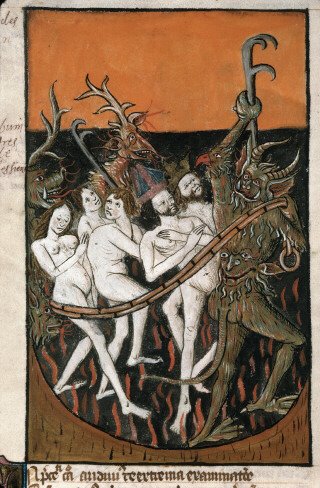
Then the king said to the waiters: "Bind his hands and feet, and cast him into the exterior darkness. There shall be weeping and gnashing of teeth." Then through this dread sentence, their hands and feet are bound who now will not restrain them from evil deeds, through amendment of life. For then chastisement shall bind those whom sin now restrains from doing good. For the feet that cared not to visit the sick, the hands that gave nothing to those in need, are now through their own fault no longer free to do what is good. Those therefore who now of their own free will are bound fast in sin, shall then against their will be bound fast in torment.
Rightly is it said that he shall be cast into exterior darkness. For we call blindness of heart, interior darkness; exterior darkness, the eternal night of damnation. Each one therefore who is damned, is cast, not into interior, but into exterior darkness: for there against his will he shall be cast forth into the night of damnation who here of his own will has fallen into blindness of heart; where, we are told, there shall also be weeping and gnashing of teeth: so that there teeth shall gnash which here delighted in gluttony, there eyes shall weep which here turned hither and thither in wanton desire. For each single member shall suffer punishment for the sins for which they were used in this life.
And when this one has been cast forth, in whom manifestly the whole body of the wicked is set before us, straightaway He adds a general sentence, which says: "For many are called, but few are chosen."
Dearest brethren, we should fear with a great fear the words we have just now heard. All we here present, already called through faith, have come to the marriage of the Heavenly King. We believe and confess the mystery of His Incarnation, and we partake of the banquet of the Divine Word. But in a day to come the King of judgement will enter in among us.
That we are called, we know; that we are chosen, we do not know. And so the more each one of us knows not whether he is chosen, so much the more do we need to humble ourselves in humility. There are, we know, those who do not even begin to do good; and some who do not remain constant in the good works they begin. Another is seen to pass almost his whole life in evil-doing, but close to the end he is drawn back from wickedness through tears of earnest repentance. Another seems to lead the life of one of the elect, and yet it happens that at the end of his life he will turn aside to the wickedness of heresy. Another begins well, and ends even better; while another, from his first years, gives himself to every evil, and growing ever worse than himself is destroyed in the midst of these very evils. In the measure therefore that each one knows not what is yet to come, in that measure should he live in fear and anxiety for himself before God: for, and let us say it over and over again, and let us never forget it: many are called, but few are chosen.
Homilia XXXVIII
(Habita ad populum in Basilica Beati Clementis Martyris)
On the 400th Anniversary of the death of St. John Leonardi

There is another aspect of the spirituality of St. John Leonardi that I would like to highlight. In many circumstances he had to confirm that a living encounter with Christ is realized in his Church: holy but fragile, rooted in history and in a sometimes dark future, where wheat and weeds grow together (cf. Matthew 13:30), but, nevertheless, always the sacrament of salvation.Having a clear awareness that the Church is the field of God (cf. Matthew 13:24), he was not scandalized by her human weaknesses. To oppose the weeds he chose to be good wheat: He decided, that is, to love Christ in the Church and to contribute to render her an ever more transparent sign of him.He saw the Church with great realism, her human frailty, but also her being "God's field," the instrument of God for the salvation of humanity. And not only this. For love of Christ he worked with alacrity to purify the Church, to render her more beautiful and holy. He understood that every reform is made within the Church and never against the Church.In this, St. John Leonardi was truly extraordinary and his example is always timely. Every reform certainly involves structures, but in the first place it must be engraved in the hearts of believers. Only the saints, men and women who allow themselves to be guided by the divine Spirit, ready to carry out radical and courageous choices in the light of the Gospel, renew the Church and contribute, in a decisive way, to building a better world.Dear brothers and sisters, St. John Leonardi's existence was always enlightened by the splendor of the "Holy Face" of Jesus, kept and venerated in the Cathedral Church of Lucca [his hometown], becoming the eloquent symbol and the indisputable synthesis of the faith that animated him.Conquered by Christ like the Apostle Paul, he pointed out to his disciples, and continues to point out to all of us, the Christocentric ideal for which "it is necessary to divest oneself of every self interest and only look to the service of God," having "before the mind's eye only the honor, service and glory of Christ Jesus Crucified."
The "Axé" Mass
Jewish-Catholic Dialogue: Not an invitation to baptism
Now a clarification on the clarification has been issued. On October 5, 2009, the USCCB issued a "Statement of Principles" affirming, among other things, that "Jewish-Catholic dialogue, one of the blessed fruits of the Second Vatican Council, has never been and will never be used by the Catholic Church as a means of proselytism – nor is it intended as a disguised invitation to baptism.” (Statement of Principles #3, emphasis mine). The statement of principles accompanied a letter from Francis Cardinal George and four other prelates responding to a letter from several rabbis attacking the June 18 "Note". In their letter, in addition to affirming that they expect to encounter Jews "faithful to the Mosaic covenant" in Jewish-Christian dialogue, the bishops also stated that the following passage will be removed from the "Note on Ambiguities":
"For example, Reflections on Covenant and Mission proposes interreligious dialogue as a form of evangelization that is 'a mutually enriching sharing of gifts devoid of any intention whatsoever to invite the dialogue partner to baptism.' Though Christian participation in interreligious dialogue would not normally include an explicit invitation to baptism and entrance into the Church, the Christian dialogue partner is always giving witness to the following of Christ, to which all are implicitly invited."
The final sentence had been the particular object of ire of certain rabbis, who considered it an invitation to "apostasy."
For more details: Bishops revise commentary on Catholic-Jewish dialogue
Uh-oh
Investigations against SSPX Bishop progressing [BILD]After months of cliffhanging, the investigation into the controversial Bishop and Holocaust denier Richard Williamson is progressing again. According to the Regensburg Prosecutor's Office on Monday, the case now has before them a declaration of a Swedish television company. A reporter from Sweden interviewed last year, the bishop of the ultra-conservative SSPX. Williamson had forcibly relativised the mass murder of Jews. Because of legal issues, a journalist in Sweden could not so far be questioned. Now, the investigators are examining the new letter.
Metropolitan John of Pergamon: No imminent reunion between Orthodoxy and Catholicism
3. It is being propagated very falsely and conspiringly that the signing of the union of the Churches is imminent! A professor emeritus of Theology, who is well known for his ill-will towards my person, had visited a Hierarch of the Church of Greece and had told him that he knew with certainty (!) that the union had already been signed (in Ravenna!) and that the relative announcement was a matter of time!!! Clergy and laity have approached me and asked me if it is true that the union is to be signed in Cyprus, in October! Obviously, a feeling of unrest is being attempted among the people of God through this behaviour, with unpredictable consequences for the unity of the Church. However, those who are disseminating these things are fully aware (as long as they have not been blinded by empathy, fanaticism or a mania for self-projection), firstly, that the ongoing theological Dialogue has yet to span an extremely long course, because the theological differences that have accumulated during the one thousand years of division are many; and secondly, that the Committee for the Dialogue is entirely unqualified for the "signing" of a union, given that this right belongs to the Synods of the Churches. Therefore, why all the misinformation? Can't the disseminators of these false "updates" think of what the consequences will be for the unity of the Church? «He who agitates (God's people) shall bear the blame, whoever he may be» (Galatians 5:10)
While the letter is directed towards some sectors of the Orthodox Church of Greece, its strictures are doubtless applicable as well to certain Catholic journalists, apologists and clerics who have been perpetually predicting the imminent reunion of Orthodoxy and Catholicism, without regard for the continued dogmatic differences (whether real or perceived) between the two. The letter also shows how imprudent and unrealistic talk about "imminent reconciliation" only causes renewed anti-Roman agitation within the Orthodox Churches.
Also of interest: a letter from the very anti-Roman Metropolitan Seraphim of Pireaus, quoting the harsh denunciation by Patriarch Bartholomew of Constantinople in 1997 of papal infallibility and of the Filioque -- something that I suspect some of our professional ecumenists, with their rose-tinted glasses, have either not read or do not want to read.
"Stand up, stand up, People of God!"
Chorus:Debout, debout, Peuple de Dieu ! [Stand up, stand up, People of God!]Debout, debout, tous les vivants ! [Stand up, stand up, all living things!]Debout, debout, Peuple de Dieu ! [Stand up, stand up, People of God!]Le monde t'attend ! [The world expects you!]
The face of the Church in Canada
Fellay watch
[T]he superior general of the Priestly Fraternity of Saint Pius X [FSSPX / SSPX], Bishop Bernard Fellay, would have been seen in Saint Peter's Square [near the Congregation for the Doctrine of the Faith] last Friday, September 25. The rumors of a new rapprochement between the Holy See and this movement are, therefore, still on the rise.
Scandal in Brazil
Bishops' Conference Chairman
defends appointment of abortion supporter to Supreme Court

José Antônio Toffoli has been the personal lawyer of President Lula in the last three [presidential] campaigns, occuppied the juridical consultancy of the Office of Chief of Staff in the administration of the former minister José Dirceu and, since March of 2007, he has been the Solicitor-General of the government - sort of a legal consultant of the government. At the age of 41, he is preparing himself for a big leap in his career: he is the favorite in the Planalto [Presidential Palace] to fill one of the two positions of Justice of the Supreme Federal Court that will be open before the end of 2010. Toffoli says that he will accept the position if he is invited, but he rejects the suggestions that he will be a soldier of the Workers' Party [the government party] in the Court. In an interview to VEJA, the young lawyer ... defends the decriminalization of abortion and gay marriage - even though he is a practicing Catholic, the brother of a priest and nephew of a monsignor and goes assiduously to Sunday Mass.

The secretary-general of the CNBB [Conferência Nacional dos Bispos do Brasil - National Conference of the Bishops of Brazil], Bishop Dimas Lara Barbosa, defended the appointment of the Solicitor-General, Minister José Antônio Dias Toffoli, to the STF [Supreme Federal Court] this Tuesday. The bishop said that Toffoli, a Catholic by formation, has the competency to take over the position of Justice Menezes Direito in the Court - who died one month ago."The Minister has declared to be a Catholic person. Father Toffoli himself attested to the competency and ethical behavior of his brother. Therefore, we expect that the Judiciary may exert its function with the collaboration of the future Justice in order to make justice happen in our country", the bishop affirmed.
The lawyer is the brother of Father José Carlos Toffoli, a former assistant of the CNBB. Toffoli will be heard this Wednesday by the CCJ [Constitution and Justice Committee] of the Senate. His name must be approved by the full Senate before being named to the STF.