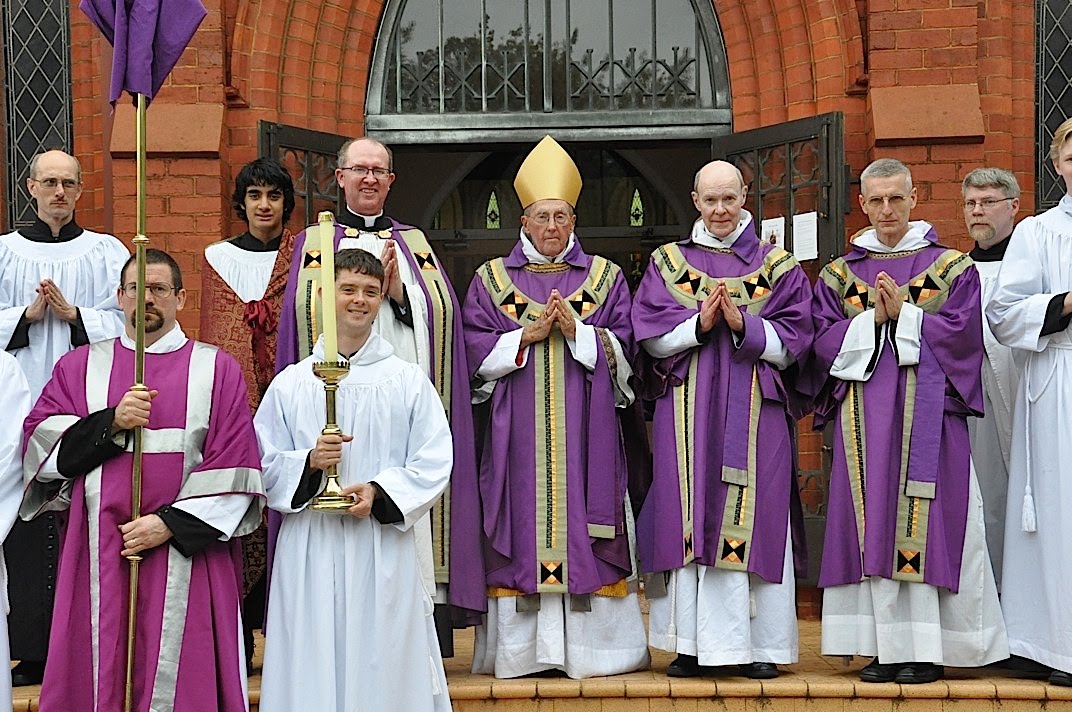
The Most Rev. Jose Gomez, our Archbishop, and Fr. Francis McHugh deserve a huge deal of credit for withstanding the barrage of criticism they have received for allowing the Traditional Latin Mass into the mainstream of Catholic life here in San Antonio.
Jose Gomez: Coadjutor Archbishop of LA?
Pontifical Holy Week in Melbourne: more pictures
Pontifical Low Mass for Spy Wednesday:


Commemoration of the Passion and Death of Our Lord and Savior, Jesus Christ:

Paschal Vigil and Solemn Pontifical Vigil Mass:


Terce and Solemn Pontifical Mass of Easter:
Pontifical Mass


All behind you, Peter!

...
Holy Father, the People of God is with you, [the People] who are not impressed by the idle gossip of each moment, or by the troubles that at times hurt the community of the faithful. Jesus, in fact, had told us: 'In this world you will have troubles,' immediately adding, 'but take heart! I have overcome the world'.Last Thursday, in the Holy Mass for the benediction of the Holy Oils, Your Holiness edified us all by speaking of the goodness of God and recalling the inspired words of the first Bishop of Rome, the Apostle Peter, who described the attitude of Christ during his Passion with these words: 'When he was reviled, did not revile: when he suffered, he threatened not: but delivered himself to him that judged him unjustly' (I Peter ii, xxiii).Holy Father, we will treasure your words. In this Paschal feast, we will pray that the Lord, the Good Shepherd, will keep supporting you in your mission at the service of the Church and of the world.Happy Easter, Holy Father! Happy Easter, Sweet Christ on Earth! The Church is with you!
EX ORIENTE LUX
Osanna, Sanctus Deus Sabaoth,
superillustrans claritate tua
felices ignes horum malacoth!
di complession potenziata tira
lo raggio e 'l moto delle luci sante;
ma vostra vita sanza mezzo spira
la Somma Beninanza, e la innamora
di sé sì che poi sempre la disira.
E quinci puoi argomentare ancora
vostra resurrezion, se tu ripensi
come l'umana carne fessi allora
che li primi parenti intrambo fensi.
Hosanna holy God of Sabaoth,/ abundantly illumining with thy brightness/ the blessed fires of these kingdoms ... The soul of every brute and of each plant,/ The ray and motion of the sacred lights,/ Draw from complexion with meet power endued./ But this our life the Eternal Good inspires/ Immediate, and enamours of itself;/ So that our wishes rest forever here./ And hence thou mayst by inference conclude/ Our resurrection certain, if thy mind/ Consider how the human flesh was framed,/ When both our parents at the first were made. (Transl. H.F.Cary) - ...Our regular Paschal feature...
Homily of the Holy Father, Benedict XVI, for the Mass of Easter Vigil
You Report: Palm Sunday and Tenebrae in St. Mary's, Norwalk, CT
The full Tenebrae service in the old rite (2.5 hours!) was celebrated on the evening of Holy Wednesday at St. Mary Church, Nowalk, CT, USA. At the end, the choir sang William Byrd's setting of the Miserere into a dark church, followed by the strepitus and the final prayer. All departed in silence. Photos are here:
Tenebrae
Also, last Sunday we had Solemn Mass for Palm Sunday, marking a return to our newly restored church. Photos are here:
Palm Sunday in the Restored Church of St. Mary, Norwalk
This liturgy began at an outside altar for the chanting of the first Gospel of the day, followed by a procession into the church. Almost 450 people were in attendance, owing in large part to the many young families who accompanied the members of a 50-strong children's schola. The children sang the "Hosanna filio David", "Pueri Hebraeorum", and "Gloria laus" under the direction of St. Mary's choirmaster, David Hughes. The Schola Cantorum of the parish performed all the other proper chants for the liturgy, as well as William Byrd's sublime "Mass for Four Voices". The whole passion of St. Matthew was chanted in Latin, with the turba responses of Victoria. Our wonderful pastor, Fr. Greg Markey, preached a short sermon relating the mysteries which we will celebrate in Holy Week to what everyone could see and marvel at in the restored church: the new baptistery (relocated near the entrance to the church), the beautiful confessional, and of course the splendid sanctuary designed by Prof Duncan Stroik of the University of Notre Dame.
Regarding the ongoing renovation of our church, you can find a photographic record of the first phase here:
The Renovation
Inter alia, the renovation has replaced a fixed with a movable freestanding altar in order to facilitate the celebration of the traditional Mass. We are blessed to have Solemn Mass every Sunday morning of the year at 9:30am -- Deus laudetur!
In addition to this report from Mr. Dobbins, I'd like to draw attention to the following gems on the blog of the Society of St. Hugh of Cluny:
Links to the videos of Spy Wednesday Tenebrae
Holy Thursday at Holy Innocents Church in NYC
The Good Friday Liturgy at St. Mary's Norwalk
To bring to all people the fruit of Easter

Yes, my brothers and sisters, Easter is the true salvation of humanity! If Christ – the Lamb of God – had not poured out his blood for us, we would be without hope, our destiny and the destiny of the whole world would inevitably be death. But Easter has reversed that trend: Christ’s resurrection is a new creation, like a graft that can regenerate the whole plant. It is an event that has profoundly changed the course of history, tipping the scales once and for all on the side of good, of life, of pardon. We are free, we are saved! Hence from deep within our hearts we cry out: "Let us sing to the Lord: glorious his triumph!"
The Christian people, having emerged from the waters of baptism, is sent out to the whole world to bear witness to this salvation, to bring to all people the fruit of Easter, which consists in a new life, freed from sin and restored to its original beauty, to its goodness and truth. Continually, in the course of two thousand years, Christians – especially saints – have made history fruitful with their lived experience of Easter. The Church is the people of the Exodus, because she constantly lives the Paschal Mystery and disseminates its renewing power in every time and place. In our days too, humanity needs an "exodus", not just superficial adjustment, but a spiritual and moral conversion. It needs the salvation of the Gospel, so as to emerge from a profound crisis, one which requires deep change, beginning with consciences.
***
May the Risen Lord sustain the Christians who suffer persecution and even death for their faith, as for example in Pakistan. To the countries afflicted by terrorism and by social and religious discrimination, may He grant the strength to undertake the work of building dialogue and serene coexistence. To the leaders of nations, may Easter bring light and strength, so that economic and financial activity may finally be driven by the criteria of truth, justice and fraternal aid. May the saving power of Christ’s resurrection fill all of humanity, so that it may overcome the multiple tragic expressions of a "culture of death" which are becoming increasingly widespread, so as to build a future of love and truth in which every human life is respected and welcomed.
Pope Benedict XVI
Urbi et Orbi Address, Easter Sunday, April 4, 2010
What a shock!
Harsh words by leader of the Established religious sect in England?

On the Reform of Holy Week under Pope Pius XII
Among other things the essay informs us that, in 1959, Pope John XXIII made a point of observing Good Friday according to the pre-1955 rite.
The essay is in Italian. A Google translation into English can be found here. A more formal translation into English should be available soon.
Incidentally, the Italian blog post has a picture of the rite of un-nailing of the Corpus, a Holy Week devotional practice that has largely disappeared in the last 50 years.
A victim of collective violence
He said: "I am following with indignation the violent and concentric attacks against the Church, the Pope and all the faithful by the whole world. The use of stereotypes, the passing from personal responsibility and guilt to a collective guilt remind me of the more shameful aspects of anti-Semitism. Therefore I desire to express to you personally, to the Pope and to the whole Church my solidarity as Jew of dialogue and of all those that in the Jewish world (and there are many) share these sentiments of brotherhood. Our Passover and yours undoubtedly have different elements, but we both live with Messianic hope that surely will reunite us in the love of our common Father. I wish you and all Catholics a Good Easter."
Homily in the presence of the Holy Father at the Liturgy of Good Friday
April 2, 2010
Crucifige, crucifige eum!
Besides friends and disciples, there is another tribunal before which every new doctrine must appear, namely, the tribunal of the people. After having spoken in secret to the chosen ones, it becomes needful to quit the chamber, to appear in public, to speak to mankind of all ages and conditions, to those who have not leaned upon the bosom of the Master, who have not received the education of friendship, who know not what is required of them, who oppose to the word of doctrine a host of passions blended with as many prejudices.
Jesus Christ did this; He heard the murmurs of the crowd around Him, and was undaunted before the account which He had to give them of Himself. "How long," cried they to Him, "dost Thou hold our souls in suspense? If Thou be the Christ, tell us plainly." Jesus Christ answered them: "I speak to you, and you believe not; the works that I do in the name of My Father, they give testimony of Me. ...I and the Father are one.".

At that saying, which expressed all, the Jews took up stones to stone Him, and Jesus said to them: "Many good works I have showed you from My Father; for which of these works do you stone Me?" The Jews answered Him : "For a good work we stone Thee not, but for blasphemy; and because that Thou, being a man, maketh Thyself God."
The language which Jesus Christ held towards the people in order to make known to them the origin and mission of their new spiritual Master, was, then, language free from all constraint and obscurity. He fearlessly uttered to them that terrible phrase : "I and my Father are one", EGO ET PATER UNUM SUMUS. But, above the people, that confused mass whose voice is at the same time the voice of God and the voice of nothingness, above the people who form at the same time the highest and the lowest authority rises, with calm vigilance and self-respect, the highest representation of right and truth, every nation possesses a supreme magistracy which concentrates in itself the glory and enlightenment of the country. And before it every doctrine claiming to rule, either by doing apparent or real violence to received traditions, must at last appear. Jesus Christ could not escape from this general law of the human order. He is called before the council of the elders, the priests, and the princes of Judea.
After hearing evidence more or less inconsistent, the high priest at length resolves to place the question in its true light; he stands up and addresses this solemn charge to the accused : "I adjure Thee by the living God that Thou tell us if Thou be the Christ, the Son of God." Jesus Christ calmly replies in two words: "EGO SUM", I am! And He immediately adds, in order to confirm His avowal by the majesty of His language: "I am; and you shall see the Son of Man sitting on the right hand of the power of God, and coming with the clouds of heaven."

Then the high priest tears his garments. "What need we any further witnesses?" he exclaims. "You have heard the blasphemy! What think you?" And they all condemn him, as guilty, to death. He is then brought before the Roman governor, who, not finding good reasons for His condemnation, wishes to release Him; but the princes of the people persist: "We have a law," say they, "and according to the law he ought to die, because he made himself the Son of God." Pilate so fully comprehends this, that his Roman, and therefore religious, ear is all attention; he draws Jesus Christ aside, and timorously asks Him whence He is: "UNDE ES TU?" Jesus Christ is silent; He confirms by His silence all that He is accused of having said of Himself, and what, in fact, He has said.
The people who witness His crucifixion understand His condemnation in the sense in which it was pronounced; they insult Him even in death by these expressive derisions : "Vah, Thou that destroyest the temple of God, and in three days dost rebuild it: save Thy own self; if Thou be the Son of God, come down from the cross." And, when darkness covers the earth, when the rocks are broken in pieces, when the veil of the temple is torn in two, and all Nature proclaims to mankind that a great event is in action, the lookers-on and the Roman centurion strike their breasts, saying: "Indeed, this was the Son of God!" And the apostle St. John concludes his gospel in these words: "These [things] are written that you may believe that Jesus is the Christ, the Son of God."
Conférences de Notre-Dame de Paris (1846)
The Battle of Christians

A further aspect of the symbolism of oil is that it strengthens for battle. This does not contradict the theme of peace, but forms part of it. The battle of Christians consisted – and still consists – not in the use of violence, but in the fact that they were – and are – ready to suffer for the good, for God. It consists in the fact that Christians, as good citizens, keep the law and do what is just and good. It consists in the fact that they do not do whatever within the legal system in force is not just but unjust. The battle of the martyrs consists in their concrete "no" to injustice: by taking no part in idolatry, in Emperor worship, they refused to bow down before falsehood, before the adoration of human persons and their power. With their "no" to falsehood and all its consequences, they upheld the power of right and truth. Thus they served true peace.Today too it is important for Christians to follow what is right, which is the foundation of peace. Today too it is important for Christians not to accept a wrong that is enshrined in law – for example the killing of innocent unborn children. In this way we serve peace, in this way we find ourselves following in the footsteps of Jesus Christ, of whom Saint Peter says: "When he was reviled he did not revile in return; when he suffered, he did not threaten; but he trusted to him who judges justly. He himself bore our sins in his body on the tree, that we might die to sin and live to righteousness" (1 Pet 2:23f.).
Pravda publishes a defense of the Pope
To Confuse the Wood with the Trees
H/t to Wilfredo Balza
Editorial note: For Christ and His Vicar

[D]eliberate dilatation of the cervix, usually over a sequence of days; instrumental or manual conversion of the fetus to a footling breech; breech extraction of the body excepting the head; and partial evacuation of the intracranial contents of the fetus to effect vaginal delivery of a dead but otherwise intact fetus. (AMA)
Sacred Triduum in NYC
For those of you close to Manhattan, NYC… the Sacred Triduum will be observed in the Extraordinary Form of the Roman Rite, according to 1962 Roman Missal at the Church of the Holy Innocents in Manhattan:
- Maundy Thursday, 4/1, at 7:30 PM
- Good Friday, 4/2, at 6:00 PM
- Easter Vigil, 4/3, at 11:00 PM
On Good Friday, the choir will sing De Victoria’s turba setting for the Passion, as well as his setting of the Reproaches.
Holy Innocents Church is located on 37th Street between Broadway and 7th Avenue.
***
Joint Declarations Are Out of the Question

A useful roundup
Media attacks on Pope Benedict, and responses (Roundup)
Pope Benedict, the Catholic Church and the sexual abuse crisis [Roundup]
Cardinal Ratzinger / Pope Benedict XVI and "The Murphy Case"
Setting the record straight in the case of abusive Milwaukee priest Father Lawrence Murphy
Avvenire: New York Times Contradicts Itself
The Thiberville saga continues
One wonders to what extent this decision will negatively impact on the implementation of Summorum Pontificum, not to speak of its effect on tradition-minded parish or assistant priests.
The following is a quick translation of the Osservatore Vaticano article, courtesy of our friend Natasja Hoven of Katolsk Observator:
Everybody knows the very famous Thiberville case, in the diocese of Évreux. This diocese is one of the most ill-fated in France. After Mgr Gaillot and Mgr David, the not so genial Mgr Nourrichard administers the collapse of a land which in times past was Christian, a land where churches are closed one after the other, catechism is deserted, vocations discouraged and finances dried up.
In this desert, a priest, abbé Francis Michel, maintains the most flourishing of parishes, Thiberville. This parish priest, not coming from a traditionalist milieu but profoundly traditionalist, in anticipation had applied the motu proprio Summorum Pontificum since many years back. In his church the masses are celebrated according to the form in our days called “the extraordinary form” and also masses according to the “ordinary” form, but in a manner in conformity with the wishes of Pope Benedict XVI, that is, turned towards the Lord.
And what was the result? Thiberville and the 14 parishes which abbé Michel is serving formed the most living Catholic ensemble and the one with the greatest missionary zeal of the diocese of Évreux : the church of Thiberville is full at all the masses, assuring the service “in turn” for the other churches ( desserte « tournante » des autres églises), there we find sound catechism, active participation of the faithful, abundance of ministrants, confraternities, all the churches magnificently restored, funerals celebrated by the parish priest himself … Those parishes where the communion of all the Catholics are lived in an exemplary way are a model for the application of the pope’s wish.
This is exactly what the “spirit of Vatican II”, with 40 years of delay, is not able to stand. At the end of December of last year, Mgr Nourrichard informed the parish priest … that his parish was abolished and brought together with a “parish ensemble”. By this procedure, the parish of Thiberville would no more have a parish priest of its own, as he was “withdrawn”.
We all know what followed: On January 3rd the bishop went to Thiberville with his collaborators in order to announce “with distress” the decision “beyond recall”. However he met with the revolt of the whole canton, which refused the end of the Catholic faith in this corner of the Norman land. A church full to the brim, on the first row of which were present the mayor and the county councilor together with the whole municipal council, acclaimed their parish priest and hindered the bishop to announce that he was suppressing the parish and its parish priest.
An appeal was then (twice) presented within the prescribed delay, before the Congregation for the clergy. The case was overwhelming for the bishop. It is necessary to understand that such an appeal is a delaying appeal: things remain as they are as long as the Roman decision does not intervene. In similar cases the Roman decision usually comes very late, when emotions have calmed down.
On the other hand everybody knows that Rome strongly disapproves of parish regroupings that are legally indefinable, this being a problem which retains the keen interest of the Roman canonists. Since the Council the rights of the parish priest have diminished. The traditional principal of the irremovability of the parish priest remaining (as in the popular saying: “the parish priest is the pope of the parish”). But the bishops’ conferences of each country have received the faculty of disregarding this right. This is how it is in France: the parish priests are from now on nominated "ad tempus", which is something that notably puts off balance the structure of the traditional diocesan life: the post-conciliar French bishop actually has much more power over his priests through the nomination “game” than the traditional bishop had. Moreover, it frequently happens that bishops do not nominate parish priests but only “parish administrators”, which makes the priests even more dependent on the diocesan administration.
In this case there was thus now the situation where there was a slow process while the Congregation of the Clergy examined the case, and thus there was a recovering of calm and common sense told that the Catholic life would continue in the parishes of abbé Michel and that the unjust – legally – and disastrous – pastorally – decision of the bishop could be nothing but reversed.
And then it was exactly the opposite that happened! The appeal that was presented in the end of February received a reply less than a month later …: On March 26th abbé Michel was informed … that his appeal was turned down and purely and simply rejected! The decision is signed by Cardinal Hummes, Prefect of the Congregation for the clergy: the parish of Thiberville does not exist anymore and thus has no parish priest.
Even in Rome one is dumbfounded. But everybody understands that the pressure exercised by the French bishops’ conference has had an uncommon force. The most eminent French instances have made it a question of principle. And they have won.
At least as yet. This decision is certainly going to be subject to appeal, and other means may be used. There is a rumor already on this matter. I will tell you more about it as soon as possible …
However it remains that for the good people of God, the negative sign that has been given is catastrophic.
Believing with the Church is an essential condition for following Christ

Humbly believing with the Church, like being bound together in a roped party [1] ascending to God, is an essential condition for following Christ. Not acting as the owners of the Word of God, not chasing after a mistaken idea of emancipation -- this is also part of being together in the roped party. The humility of "being-with" is essential to the ascent. Letting the Lord take us by the hand through the sacraments is another part of it. We let ourselves be purified and strengthened by him, we let ourselves accept the discipline of the ascent, even if we are tired.
Finally, we must again say that the cross is part of the ascent toward the height of Jesus Christ, the ascent to the height of God. Just as in the affairs of this world great things cannot be done without renunciation and hard work (joy in great discoveries and joy in a true capacity for activity are linked to discipline, indeed, to the effort of learning) so also the way to life itself, to the realization of one's own humanity is linked to him who climbed to the height of God through the cross. In the final analysis, the cross is the expression of that which is meant by love: Only he who loses himself will find himself.
Let us summarize: Following Christ demands as a first step the reawakening of the nostalgia for being authentically human and thus the reawakening for God. It then demands that one enter into the roped party of those who climb, into the communion of the Church. In the "we" of the Church we enter into the communion with the "Thou" of Jesus Christ and therefore reach the way to God. Moreover, listening to and living Jesus Christ's word in faith, hope and love is also required. We are thus on the way to the definitive Jerusalem and already, from this point forward, we already find ourselves there in the communion of all God's saints.
Homily for Palm Sunday
March 28, 2010
Palm Sunday Pontifical Mass in Melbourne


Jesus Christ, "the immortal King of souls", and his Vicar


Jesus Christ claimed the soul; He claimed that it should be free to know Him, to love Him, to adore Him, to pray to Him, to unite with Him. He did not admit that any other than Himself had right over the soul, and above all the right of hindering the soul from communicating with Him.
Yet there is much more than this: Jesus Christ claimed the public union of souls in His service; He knew nothing of secrecy; He demanded a clear and social worship. The liberty of the soul implied the right to found material and spiritual churches, to assemble, to pray together, to hear in common the Word of God, that substantial food of the soul which is its daily bread, and of which it can be deprived only by an act of sacrilegious homicide. The liberty of the soul implied the right of practising together all the ceremonies of public worship, of receiving the sacrament of eternal life, of living together by the Gospel and Jesus Christ.
None upon earth possessed any longer the government of sacred things, but the anointed of the Lord initiated the chosen souls into a larger faith and love, tested by the successors of the apostles, sanctified by ordination. All the rest, princes and peoples, were excluded from the administration of the body and blood of Jesus Christ, that divine centre of the kingdom of souls, and which it was not meet to deliver to dogs, according to the forcible expression of the most gentle Gospel.
But as the soul is the basis of man, by creating the liberty of the soul, Jesus Christ, at the same time, created the liberty of man. The Gospel, as the regulator of the rights and duties of all, rose to the power of a universal charter, which became the measure of all legitimate authority, and which, in hallowing it, preserved it from the excesses into which human power had everywhere fallen. On this account, the kingdom of souls was absolutely the very opposite of the Roman Empire, and it was impossible to imagine a more complete antagonism. The Roman Empire was universal servitude; the kingdom of souls, universal liberty. Between them it was a question of being or not being. The struggle was inevitable; it was to be a deadly struggle.
Now, what force did the kingdom of souls dispose of against that empire covered with legions? None. The Forum? It was no more. The Senate? It was no more. The people? They were no more. Eloquence? It was no more. Thought? It was no more. Was it at least permitted to the first Christians whom the Gospel had raised up in the world to gather one against a hundred thousand for the combat? No, that was not permitted to them.
What then was their strength? The same that Jesus Christ had before them. They had to confess His name and then to die, die today, tomorrow, the day after tomorrow, to die one after another, that is to say, to vanquish servitude by the peaceful exercise of the liberty of the soul; to vanquish force, not by force, but by virtue.
It had been said to them: If for three centuries you can boldly say, "I believe in God the Father Almighty, Maker of heaven and earth, and in Jesus Christ, His only Son our Lord, who was born of the Virgin Mary, was dead, and is risen again"; if for three centuries you can say this openly, and die daily after haying declared it, in three centuries you shall be masters, that is to say, free.
And this was done.
And this was done despite the fury of the Roman Empire ... . I will say no more of the martyrs; they conquered, as the whole world knows. And this kingdom of souls, founded by their blood; this kingdom of souls, which was to destroy idolatry, and which has destroyed it, which was to overthrow the Roman Empire, and which has overthrown it in all that was false and unjust in it; where did this kingdom of souls set up its capital? In Rome!
The seat of virtue was placed in the seat of power; the seat of liberty in the seat of bondage; in the seat of shameful idols, the seat of the cross of Jesus Christ; in the seat whence the orders of Nero were issued to the world, the seat of the disarmed and aged pastor, who, in the name of Jesus Christ, whose vicar he is, spreads throughout the world purity, peace, and blessing.
O, triumph of faith and love! O, spectacle which enraptures man above himself by showing him what he can do for good with the help of God! My own eyes have seen that land, the liberator of souls, that soil formed of the ashes and blood of martyrs; and why should I not recall that which will confirm my words by reinvigorating my life?
One day, then, my heart all trembling with emotion, I entered by the Flaminian Gate that famous city which had conquered the world by her arms, and governed it by her laws. I hurried to the Capitol; but the temple of Jupiter Capitolinus no longer crowned its heroic summit. I went down to the Forum; the orator's tribune was broken down, and the voice of herdsmen had succeeded to the voices of Cicero and Hortensius. I mounted the steep paths of the Palatine Hill; the Caesars were gone, and they had not even left a praetorian at the entrance to ask the name of the inquisitive stranger.Whilst I was pondering those mighty ruins, through the azure of the Italian sky, I perceived in the distance a temple whose dome appeared to cover all the present grandeur of that city upon whose dust I trod. I advanced towards it, and there, upon a vast and magnificent space, I found Europe assembled in the persons of her ambassadors, her poets, her artists, her pilgrims, a throng, diverse in origin, but united, it seemed, in common and earnest expectation. I also waited, when in the distance before me an old man advanced, borne in a chair above the crowd, bareheaded and holding in his two hands, under the form of mysterious bread, that Man of Judaea aforetime crucified. Every head bent before him, tears flowed in silent adoration, and upon no visage did I see the protestation of doubt, or the shadow of a feeling which was not, at least, respectful. Whilst I also adored my Master and my King, the immortal King of souls, sharing in the triumph, without seeking to express it even to myself, the obelisk of granite standing in our midst sang for us all, silent and enraptured, the hymn of God victorious: CHRISTUS VINCIT, CHRISTUS REGNAT, CHRISTUS IMPERAT, CHRISTUS AB OMNI MALO PLEBEM SUAM LIBERAT! [sic]
And, lest an enemy should have been found in that multitude, it answered itself by another celebrated hymn, which warned us to fly from the lion of Judah if we would not adore him in his victory. After many years, which have already whitened my brow, I repeat to you... those songs of joy; happy are you if ... drawing nearer, you repeat with us all, children of Christ and members of His kingdom: CHRISTUS VINCIT, CHRISTUS REGNAT, CHRISTUS IMPERAT, CHRISTUS AB OMNI MALO PLEBEM SUAM LIBERAT!
Conférences de Notre-Dame de Paris (1846)
(Special repost for Palm Sunday)
From the Closing Liturgy of the Los Angeles Religious Education Congress 2010
One wonders what the Byzantine-Rite Catholic bishops concelebrating the Mass might have been thinking...
Dominican Rite website

(We've received the following note from Fr. Dominic Legge OP of the Eastern U.S. Province of Dominicans:
The site features the commentary of St. Thomas Aquinas, St. Albert the Great and St.Vincent Ferrer on the ceremonies of the Dominican Mass (woven into the tutorial text), some historical background on the Rite, and other helpful resources. While it will be of great help to priests, it also gives to the casual observer a unique perspective on one of the ancient branches of the Western liturgical tradition.)