Rorate Caeli
Showing posts with label Don Pietro Leone's "The Roman Rite". Show all posts

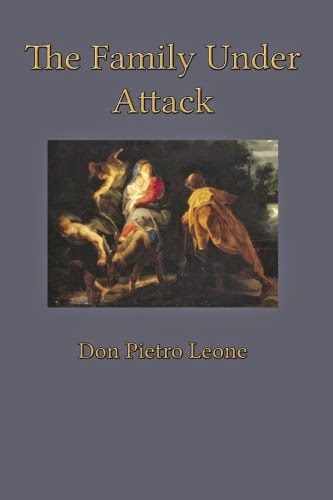
Don Pietro Leone has a new book out - buy it on Amazon

Do you remember Don Pietro Leone? This is the nom de plume of a priest in peaceful communion with his diocesan Ordinary who is dedicated exclusively to the celebration of the Traditional Mass, and years ago Rorate posted in installments his great study dedicated to the Roman Rite: "The Roman Rite: Old and New".

Well, now Don Pietro Leone has a new book out, on the most pressing issue of the day in these troublesome times in the Church: the Family and Christian Marriage. What is breaking apart the family? Why is the relevance of the Sacrament of Matrimony so misunderstood? The grave problem of divorce and its unfathomable consequences for the soul. 

It's called The Family Under Attack, and you can find it on both sides of the Atlantic, on Amazon and on Amazon UK.

We will have excerpts of this work shortly here, but by buying the book you can help Father's intellectual apostolate and research.

The Roman Rite: Old and New - X
Conclusion
& 6 years of RORATE CÆLI

Introit - Fourth Sunday in Advent

Today is Rorate Sunday, the Fourth Sunday in Advent, and a very special day for us: it is the sixth anniversary of this web log, founded on this same Sunday, 2005, and named after its introit - recurrent words throughout Advent, from its very first liturgical moment (First vespers of the First Sunday). It is a perfect day, then, to present the concluding remarks of the remarkable booklet of Don Pietro Leone on the Traditional Roman Rite and the Pauline Rite.

In his final words, Don Pietro Leone presents the shortcomings and consequences of the dreadful modern rite, the artifice created by committee in the late 1960s: God is abandoned in favor of the cult of man; the notion of sacrifice is abandoned in favor of the celebration of the individual, beginning with the celebration of the "presider" himself; the theology of the Ancient Rite, which is Catholic, is replaced by the theology of the Modern Rite, which is... something else entirely. Something which no translation, as accurate as it may be, can alter.

We thank Father deeply for his work - and we also thank you, our readers, for the faithful readership in the past six years. And thanks also to our many followers on Twitter (@RorateCaeli).


And, now, a late-Advent recess, wishing you all a very fruitful fourth week of Advent and a happy Christmastide!

____________________________________________


The conclusion of this essay is twofold: one, that the theology of the Old Rite is Catholic, and the theology of the New Rite is Protestant; two, that the theology of the Old Rite is that of the cult of God, and the theology of the New Rite is that of the cult of man.
  
Epilogue

Shortcomings and Consequences of the Novus Ordo Missae

 A. Shortcomings

Cardinal Ratzinger himself, in his preface to Mgr. Gamber’s ‘Reform of the Roman Liturgy’, called the new rite a ‘fabrication’[1], and in the next sentence a ‘falsification’[2]. Mgr. Gamber called it a ‘cancerous growth’[3].  The gravity of these allegations will justify a brief summary of the shortcomings of the New Rite that have been uncovered in the course of this study. In view of these, it is clearly impossible for us to ascribe an equal worth to both rites, that is in an unqualified sense. We may ascribe an equal worth to them in fact only inasmuch as both[4] render present the Sacrifice of Mount Calvary.

1. The Faith is Misrepresented

We have shown how the Mass is represented as a meal; how the Person and Divinity of Jesus Christ is obscured; how sin, Judgment, Hell, the Devil, the imitation of Christ, and the ascetic life are minimalized. Faith is no longer presented as the ultimate Truth[5], and the life of Faith as a spiritual battle with the powers of darkness, as a question of eternal life and eternal death.
Rather, Faith is presented as a collection of edifying stories, and the life of Faith as a commitment to some undefined, future goal. Nebulous terms such as “the people of God”, “community”[6], and “solidarity” replace those of the Church and Charity, and even the Person of God the Father and that of Jesus Christ Himself become transformed into abstract and vague concepts.

2. The Cult of God is Compromised

The Roman Rite: Old and New - IX
The motivation behind the New Mass? A liturgy for the World

In the ninth installment of Don Pietro Leone's "The Roman Rite: Old and New", the author concludes the second part of his study, going to the core of the motivation behind the New Mass, the revolutionary change that was not ordered by the Council: a liturgy made for the world, for a Church that wants to be "accepted" by the World, "loved" by Protestants, understood and engaged with Modernity. Behold the thinking of The Architect, Archbishop Annibale Bugnini. Behold the Liturgy of Man.

____________________________________________


Motivation [behind the New Mass]: Rapprochement with the World

In the first part of this essay, we considered the ecumenical motivation of the changes made to the Old Rite, in other words the motivation of rapprochement with Protestantism; in this second part, we consider the motivation of rapprochement with the world.      
Evidence of such motivation may be found in the works of Mgr. Bugnini (“La Riforma Liturgica”), and of four of his collaborators, Fathers Augé (on the Collects), Raffa (on the Secrets), Fervetti (on the Postcommunions), and Braga (on the New Roman Missal and the Propers of the Saints): see the respective articles in “Ephemerides Liturgicae” 84 (1970).
Mgr. Bugnini speaks of “adaptations” (La Riforma Liturgica III 25.1 p.391[1]); Fr. Augé speaks of abridging texts that were “too negative, moralizing, or polemical” (p. 298); Fr. Braga speaks of “not putting in difficulty the psychology of the man of to-day who has other problems, a different way of thinking, and also lives in a different material and disciplinary situation: non porre in difficoltà la psicologia dell’uomo di oggi, che sente altri problemi, ha un diverso modo di pensare, vive anche in una situazione materiale e disciplinare diversa” (p. 272).

The Roman Rite: Old and New - VIII
The New Mass destroyed centuries of propers

In the eighth installment of Don Pietro Leone's "The Roman Rite: Old and New", the author continues the second part of his study, showing in detail how the destructive spirit of the artificial pseudo-historical committees responsible for the New Rite wiped out most of the collects of the Roman Rite - and dislocated Gospel and Epistle readings proper to each day in the West since the earliest centuries. And a brief view of a minor but consistent problem in several languages: mistranslations, here viewed mostly in the Italian version (minor, because, as this work has consistently shown, the rite itself is problematic, in Latin and in any translation).

____________________________________________


Comparison of the Propers

We shall now compare the Propers of the Old and New Rites, namely the orations known in the Old Rite as the Collect, the Secret, and the Postcommunion; as well as the Gospel and Epistle Readings.
Fr. Anthony Cekada in his work “The Problems with the Prayers of the Modern Mass” (1991) writes that the orations date back in part as far as the fifth century, and that Tradition dates the nucleus of the Collects back to Pope St. Damasus (366-384). He shows the extent of the changes made to the orations: the Missal of the Old Rite contains 1,183 orations; 760 of these were completely abolished, and half of those remaining were altered so that now no more than 17 % of the original orations survive.
In the rest of this section we shall concentrate on the changes made to the Collects on the basis of the work Liturgia - Memoria o Istruzioni per l’Uso? by Lorenzo Bianchi (Piemme, 2002), although similar changes were made to the other orations as Fr. Cekada shows.

The Roman Rite: Old and New - VII
The New Mass and the Cult of Men: liturgy "etsi Deus non daretur"

In the seventh installment of Don Pietro Leone's "The Roman Rite: Old and New", the author begins the second part of his study, trying to find out the deepest motivation for the New Roman Rite. What happens when a liturgical rite is based on the cult of man, instead of the religious worship of Almighty God - and how does it compare to the apostolic motivations of an immemorial rite?

____________________________________________


II

The Cult of God and the Cult of man


We proceed to search more deeply into the motivation for the New Rite. We do so by searching more deeply into its theology, namely Protestantism. Now the essence of Protestantism is subjectivism, as has been clearly demonstrated by Jacques Maritain in his book “Les trois Réformateurs” (Plon, 1925) in the chapter “Luther ou l’avénement du moi: Luther or the Coming of the Self” and by Paul Hacker in his book “Das Ich im Glauben bei Martin Luther. Der Ursprung der anthropozentrischen Religion: The Self in the Faith of Martin Luther: The Origin of Anthropocentric Religion” (nova & vetera, Bonn 2002). And subjectivism in the realm of liturgy amounts to the cult of man.
The Mass is the cult of God, the highest form of cult that exists, and both rites render this cult to Him. But whereas the Old Rite renders it in a way that expresses in a sublime manner this cult of God, the New Rite renders it in a manner that expresses the cult of man.
That the theology of the Old Rite relates to the cult of God and the theology of the New Rite relates to the cult of man is evident at the outset in the central conception that each has of the Mass: the conception of sacrifice in the first case, and the conception a community meal in the second. For this sacrifice is “the sacrifice of God, by God, to God” (in the words of St. John of the Cross), and this meal is the celebration of the community by itself.

The Roman Rite: Old and New - VI
The New Mass and the Church: the underlying theology of the New Rite is Protestant and motivated by Ecumenism

In the sixth part of of Don Pietro Leone's "The Roman Rite: Old and New", the author reaches his conclusion on the problematic aspects of the theology of the New Mass, as compared with the Traditional Rite, now dealing with the Ecclesiological deficiencies of the New Rite and quoting numerous testimonies on the  Protestant nature of the New Mass, ending this subtantial portion of his study with the ecumenical motivation behind the enactment of the Modern Rite.
________________________________


10. The Church

The Church featured large in the Old Rite: Her three-fold nature: Militant, Suffering, and Triumphant, was clearly manifest, whereas in the New Rite She is hardly recognizable.
The Church Militant, whose goal is Grace, permanent and eternal, has been substituted by the pilgrim Church on the march to a purely temporal goal; Her Faith (as when we pray pro omnibus orthodoxis atque catholicae et apostolicae fidei cultoribus for all worshippers with the orthodox, Catholic and Apostolic Faith) has been substituted by a search with sincere heart (omnium qui te quaerunt corde sincero)[1].
The Church Suffering is no longer mentioned in the three new eucharistic prayers; the Requiem Mass has been abolished; the phrase cum signo fidei et dormiunt in somno pacis (with the sign of Faith and sleep with the sleep of peace), has been transmuted into obierunt in pace Christi tui (have died in the peace of Christ) with no mention of Faith; and a group of persons has been added: omnium defunctorum quorum fidem tu solus cognovisti (of all the deceased whose Faith is known to You alone) where two of the four characteristics of Faith, namely its unity and visibility, are lacking.

The Roman Rite: Old and New - V
The theology of the New Mass: Latin, Orientation, Altar as Table, Participation

In the fifth part of of Don Pietro Leone's "The Roman Rite: Old and New", the author continues his thorough presentation of the several problematic aspects of the theology of the New Mass, as compared with the Traditional Rite, now dealing with the language, the grave novelty of liturgical disorientation, the abomination of the sacrificial Altar seen primarily as a supper table, and the distortion of the meaning of active participation.
________________________________

[We now proceed to compare (other) general features of the Mass in the Old and the New Rites.]

6.  Latin

The Latin language in its sacred, immutable, traditional, and universal character is perfectly adapted to the Holy Sacrifice of the Mass and to the doctrine it expresses, as to the Catholic Church, and more generally to catholicity itself[1].
 In being immutable, traditional, and universal, it constitutes a principle of unity for all Catholics of the Roman rite, not only of all nations but also of all times: a principle both of visible unity and of unity in the Faith.

The Roman Rite: Old and New - IV
The theology of the New Mass: crisis in faith in the Real Presence, Sacramental Priesthood, and the Ends of the Mass

In the fourth part of our presentation of Don Pietro Leone's "The Roman Rite: Old and New", the author continues his analysis of the several problematic aspects of the theology of the New Mass, as compared with the Traditional Rite. Are there deficiencies in the way the New Mass presents the Real Presence, the Ministerial Priesthood, and the very ends of the sacramental sacrifice?
________________________________
We now proceed to compare certain general features of the Mass in the Old and the New Rites.
3. The Real Presence

We have already quoted the Council of Trent to the effect that Christ Himself is offered in the Mass. In the 4th canon of the 13th Session, the doctrine of the Real Presence is expressed in the clearest terms: “If any-one were to deny that in the Most Holy Sacrament of the Eucharist is contained truly, really, and substantially the body and blood together with the soul and divinity of Our Lord Jesus Christ and therefore the whole Christ; but were to say that he is present in it only as a sign, a figure, or a power: Anathema sit [1]”.
In the Old Rite this dogma is expressed clearly in the text of the Mass by phrases such as that which follows the consecration: “… the pure Victim, the holy Victim, the immaculate Victim, the Holy Bread of eternal life and Chalice of everlasting salvation[2].”
Respect for the Real Presence is expressed by the many genuflections, the purification of the celebrant’s fingers in the chalice, the avoidance of contact with any profane object before they are purified, the purification of the sacred vessels on the corporal immediately after their use, the use of a pall to protect the chalice, the internal gilding of the vessels, the consecration of the immobile altar, the use of the pietra sacra and relics in the mobile altar and on the mensa when the Mass is said in a sacred place, of three altar-cloths, the reception of Holy Communion and the thanksgiving while kneeling (as opposed to the former standing and the latter sitting),  the reception of Holy Communion on the tongue, the prescriptions in the case of a consecrated host falling to the ground, the prohibition that faithful and mass-servers touch the sacred vessels (see Critical Study IV 2).
The Reformer Martin Bucer, mentor of Thomas Cranmer, expressed the Protestant consensus as to the Real Presence (to which only Luther did not subscribe in virtue of his doctrine of consubstantiation) in his Censura when he said: “It becomes our duty to abolish from the churches… with all purity of doctrine whatever forms of bread-worship they wish to have employed by the anti-Christs and preserved in the hearts of the simpler kind of people” (MD p. 463).
The Roman Rite: Old and New - III
The theology of the Traditional and New Rites: Offertory, Canon, and the 'Eucharistic Prayers'

In the third part of of our presentation of Don Pietro Leone's "The Roman Rite: Old and New", the author continues his analysis of the problematic theological aspects of the New Mass, in particular how the ancient Protestant criticisms of the Offertory and of the Canon were somehow internalized by the agents of the post-Conciliar liturgical revolution.
 [I  
Catholicism and Protestantism]


B. In the Rites Themselves


We proceed to examine the theology of the Old and New Rites as contained in the rites themselves. Since our aim thereby is to manifest the Protestant character of the New Rite, we shall present the relevant material first in the Old Rite, then in the Protestant reformed rite(s), and then in the New Rite.
 We shall start by considering two parts of the Mass, we shall then consider various of its general features. In regard to the Protestant reformed rite(s) and the New Rite, we may say with Michael Davies (p. 285, quoting Dr. Francis Clark’s comment on Cranmer’s rite) “It was not what was expressed but what was suppressed that gave significance to the whole.”
In fact what was suppressed was almost everything pertaining to the very essence of the Mass, that is its sacrificial nature. It is in this light, then, that we shall compare the theology of the two rites. §1 on the Offertory concerns the anticipation of this Sacrifice; §2 on the Canon concerns the making present of the Sacrifice; §3 on the Real Presence concerns its object, namely Jesus Christ Himself; §4 on the Sacrificial Priesthood concerns the minister empowered to make the Sacrifice; §5 on the Ends of the Mass concerns the finalities of the Sacrifice; §6 on the Latin concerns the language which befits it; §7 on the Orientation of the Celebrant concerns the orientation appropriate to it; §8 on the Altar and Table concerns the altar of sacrifice; and §9 on Intelligibility and Participation concerns their principal object, namely the Sacrifice itself.
The two parts of the Mass that we shall examine are “the two particular Protestant bêtes noires” (MD p. 9): namely the Offertory and the Roman Canon.

The Roman Rite: Old and New - II
Catholicism, Protestantism, and the theology of the New Roman Rite

In the second portion of our presentation of Don Pietro Leone's "The Roman Rite: Old and New", the author goes to the heart of the matter: if the Traditional Rites have always represented and transmitted (in the very sense of the word Tradition) what Catholics believe and are both the source and the summit of Eucharistic Dogma, as defined forever in Trent, what are exactly the source and character of a New Rite transformed in almost all its characteristics?
___________________________________
 I

Catholicism and Protestantism

We proceed to set forth and compare the theology of the Mass of the Old and the New Roman Rite, first as contained in official Church documents, then as contained in the rites themselves.

A. In Official Church Documents

1. The Old Rite

Catholic Dogma on the Blessed Eucharist is set forth definitively in the Council of Trent. The Council declares: “And so this Council teaches the true and genuine doctrine about this venerable and divine sacrament of the Eucharist… The Council forbids all the faithful of Christ henceforth to believe, teach, or preach anything about the most Holy Eucharist that is different from what is explained and defined in the present decree.” (Session 21, Introduction).
If we ask ourselves how this theology corresponds to the theology of the Old Rite, we must reply that it is identical, since the principal reason for the definition of Eucharistic dogma as for the reform of the Roman rite was to provide “a bastion of the true Faith against Protestant heresies”: a bastion at once dogmatic and liturgical (MD p. 8). In the same vein the Critical Study of Cardinals Ottaviani and Bacci (September 1969) speaks of “the Catholic theology of the Holy Mass as it was formulated in Session 22 of the Council of Trent, which, by fixing definitively the “Canons” of the rite, erected an insurmountable barrier against any heresy which might attack the integrity of the mystery.” The identity of the theology of the Old Rite with the dogmas of the Council of Trent is, in fact, a particularly eminent instance of the principle “Lex orandi, lex credendi”[1].

The Roman Rite: Old and New - I
Introduction


Earlier this year, we presented the draft version, now removed, of a short, yet powerful, masterpiece: The Roman Rite: Old and New, by Don Pietro Leone Monselice (the nom de plume of a bright priest celebrating the Traditional Mass exclusively in an Italian diocese). We are honored that Don Pietro Leone has once again chosen us to present a corrected and extended version of his work. The document itself extends for nearly 80 pages, which we will serialize in next few weeks as we finalize the editing and revision together with our regular contributor, Francesca Romana. When the series is ended, we believe we will be able to make available the definitive online version of this publication, which will surely prove to be a useful informational and apologetic booklet for many of you, and as a source for studies, leaflets, and even parish bulletins: feel free to use it at will.
________________________________________

O GOD, WHY HAST THOU CAST US OFF UNTO THE END? Why is thy wrath enkindled against the sheep of thy pasture? Remember thy congregation, which thou hast possessed from the beginning: the sceptre of thy inheritance which thou hast redeemed: Mount Sion in which thou hast dwelt. Lift up thy hands against their pride unto the end: see what things the enemy hath done wickedly in the sanctuary. And they that hate thee have made their boasts, in the midst of thy solemnity. They have set up their ensigns for signs: and they knew not both in the going out and in the highest top. As with axes in a wood of trees, they have cut down at once the gates thereof: with axe and hatchet they have brought it down. They have set fire to thy sanctuary: they have defiled the dwelling place of thy name on the earth. They said in their heart, the whole kindred of them together: Let us abolish all the festival days of God from the land.
Ps.73, 1-8.