Showing posts with label FIUV Position Papers on the 1962 Missal. Show all posts
Una Voce responds to Roche Consistory Report against the Traditional Mass
During the recent consistory, the meeting of cardinals in Rome, Cardinal Arthur Roche, Prefect of the Dicastery for Divine Worship, handed out a two-sided piece of paper containing some reflections on the liturgy to those present: this has been made available by Diane Montagna here. The liturgy had been among the four topics originally proposed for discussion at the meeting, but the cardinals decided to focus on just two, leaving the liturgy out. Cardinal Roche’s document was accordingly handed out without being formally discussed.
FIUV Position Papers now a book: 'The Case for Liturgical Restoration'
Long-standing readers of Rorate Caeli will remember the series of 'Position Papers' published by me on this blog on behalf of the FIUV: Una Voce International (Foederatio Internationalis Una Voce). These were short but well-referenced discussions of rather specific issues connected with the Traditional Mass: why the priest celebrates ad orientem, what the Mass can do for the evangelisation of Africa, or why we should reconsider the Eucharistic Fast. The series concluded with number 33, on the 1955 Holy Week reform, in two parts.With the help of Angelico Press and its editors, these have now been thoroughly revised, corrected, and made more consistent and readable, and published as a book:
The Case for Liturgical Restoration: Una Voce Studies on the Traditional Latin Mass; with a Preface by Cardinal Burke.
Buy the book here (in the UK), or at Amazon (in the USA); here is the publisher's page.
See a review by Charles Coulombe on NLM.
New book: The Case for Liturgical Restoration
Long-term readers of Rorate Caeli will remember the series of short 'Position Papers' I published on behalf of the FIUV--Una Voce International--on a variety of subjects about the ancient Mass, both aspects of it which need to be explained to those unfamiliar with it, and ways in which it can assist the Church in evangelisation.
These papers, gathered together and thoroughly revised, are now available as a book from Angelico Press, with a Preface by Cardinal Burke.
I will be organising book launch events in Oxford, London, and Rome.
You can buy them from the Latin Mass Society in England, from Angelico Press in the USA, and from Amazon.
FIUV Position Paper: the Sanctoral Cycle
Today I am publishing the last of the series of FIUV Position Papers. Further ones may be published as the need arises. Although we have no exhausted the possible topics for these papers, we have done enough to make clear a number of important general principles. Bringing the series to a close will also enable us to publish them as a group.
This paper is about the Sanctoral Cycle: saints days. There are some striking contrasts between the Traditional and the Novus Ordo calendars in relation to saints days, both in detail (dates being changes) and in the fundamental principles behind them.
These differences both suggest, and render problematic, attempts to make the two calendars converge, wholly or partially. This paper seeks to set out and defend the rationale of the Sanctoral Cycle of the Traditional Roman Missal.
It can be downloaded as a pdf here.
FIUV Position Paper: Islam
![]() |
| Jesus, a minature in 17th century Ottoman manuscript. |
Today I am able to publish the latest of the 'Position Papers' of the Una Voce Federation (FIUV), on the subject of Islam. These papers have not only sought to defend aspects of the Traditional liturgy which have been criticised, but also to point out the usefulness to the Church of this liturgy in making the Faith vivid, attractive, or comprehensible, to particular groups inside and outside the Church: in Africa, in China, in relation to the Oriental Churches, to children, to men, to people influenced by the New Age, and now to Muslims.
I have put some additional commentary on my own blog here.
The Traditional Mass and the Laity: a Position Paper from the FIUV
![]() |
| The Communion of the Faithful at a Dominican Rite Mass celebrated in Oxford, England |
Today I am posting a new 'Position Paper' on the 1962 Missal published by the FIUV, the Foederatio Internationalis Una Voce. This addresses the argument, made from time to time, that by not having as many lay people involved in the liturgy in roles such as Extraordinary Minister of Holy Communion, Lector, leader of the Prayers of the Faithful and so on the Traditional Mass 'excludes' people, and fails to foster their participation.
Good Friday Prayer for the Jews: a new Position Paper from the FIUV

Last November the Bishops' Conference of England and Wales announced that they had petitioned the Pontifical Commission Ecclesia Dei to replace the Prayer 'Pro conversione Iudaiorum' in the Good Friday Liturgy, with the one used in the Ordinary Form. Readers will know, of course, that the prayer officially approved for use in the Extraordinary Form was composed by Pope Benedict XVI in 2008, replacing a prayer which had been used in the Church since, probably, the third century.
The Foederatio Internationalis Una Voce (FIUV) and the Latin Mass Society of England and Wales (LMS) had, of course, to react, both immediately, and in a more considered and scholarly fashion. Our initial (coordinated) reaction, also published on this blog, can be seen here; below is the fruits of more detailed research and consultations.
We have been obliged to broach a topic which we had not intended to make the subject of such a Position Paper. Although very interesting, the Prayer for the Jews can hardly be considered central to the lives of the Faithful attached to the Extraordinary Form, compared with issues like the use of Latin, or the ancient Lectionary. It is said once a year, on the least-well attended, and least-often celebrated, of the three major services of the Sacred Triduum. Its history is complicated by the successive attempts to defuse complaints by Jews and others about it, which resulted in official decrees about in 1948, 1956, 1959, and 1965, as well as changes in 1970 and 2008. A topic at once complicated, neuralgic, and arguably trivial: let's just leave it alone.
Since the Bishops of England and Wales have chosen not to leave it alone, however, here is our Position Paper. And the issue is, after all, important. It raises profound issues concerning the Old and New Covenants, about the nature of salvation, about the Church's mission, and about the proper attitude to the language of the Church Fathers and the liturgy. It also forces us to confront some of the most shameful episodes in the history of the Church.
The paper's conclusion is simple: that while the actions of many Catholics have been gravely sinful, the voice of the Church in the ancient liturgy, a voice from the age of the Fathers of the Church, cannot be tarred with the brush of anti-Semitism. Let us repudiate violence and hatred: to do so does not require us to repudiate the Church's traditional liturgy.
The Foederatio Internationalis Una Voce (FIUV) and the Latin Mass Society of England and Wales (LMS) had, of course, to react, both immediately, and in a more considered and scholarly fashion. Our initial (coordinated) reaction, also published on this blog, can be seen here; below is the fruits of more detailed research and consultations.
We have been obliged to broach a topic which we had not intended to make the subject of such a Position Paper. Although very interesting, the Prayer for the Jews can hardly be considered central to the lives of the Faithful attached to the Extraordinary Form, compared with issues like the use of Latin, or the ancient Lectionary. It is said once a year, on the least-well attended, and least-often celebrated, of the three major services of the Sacred Triduum. Its history is complicated by the successive attempts to defuse complaints by Jews and others about it, which resulted in official decrees about in 1948, 1956, 1959, and 1965, as well as changes in 1970 and 2008. A topic at once complicated, neuralgic, and arguably trivial: let's just leave it alone.
Since the Bishops of England and Wales have chosen not to leave it alone, however, here is our Position Paper. And the issue is, after all, important. It raises profound issues concerning the Old and New Covenants, about the nature of salvation, about the Church's mission, and about the proper attitude to the language of the Church Fathers and the liturgy. It also forces us to confront some of the most shameful episodes in the history of the Church.
The paper's conclusion is simple: that while the actions of many Catholics have been gravely sinful, the voice of the Church in the ancient liturgy, a voice from the age of the Fathers of the Church, cannot be tarred with the brush of anti-Semitism. Let us repudiate violence and hatred: to do so does not require us to repudiate the Church's traditional liturgy.
FIUV Position Paper: The Traditional Mass and Men
![]() |
| No shortage of men at Mass during the LMS' walking pilgrimage to Walsingham. This year's pilgrimage starts on August 28th; details here. |
Today I am publishing the 26th in the series of Position Papers prepared by the Foederatio Internationalis Una Voce (FIUV), on the subject of the contribution which can be made by the Traditional Mass to the Evangelisation of men.
I've put some additional commentary on my own blog here.
I hope in the course of August to publish the next paper, which is on the concepts of Tradition, Restoration, and Reform.
They attempt to summarise, in 1,600 words, the most important arguments related to the Church's ancient liturgical tradition, each paper addressing a specific issue: Prefaces, the Lectionary, liturgical participation, the use of silence, the Kiss of Peace, and so on. They are where appropriate larded with references to the Magisterium and to scholarly studies. No one interested in the debate about the Catholic liturgy, from any perspective, should fail to read them.
-----------------------------------------------------
FIUV Position Paper 26: The Extraordinary Form and the
Evangelisation of Men
Since
the 1970s, in the developed world, the ratio between Catholic men and women
attending Mass, and committed in other ways to the Church, has changed
noticeably. The size and resources of the Church in the United States enable us
to consult carefully researched statistics for this phenomenon, which can be
seen throughout the West. For example, in 1974, 46% of men and 45% of women
surveyed regarded themselves as ‘strong Catholics’; in 2012, 24% of men and 30%
of women did so.[1]
In 2005 a survey reported that only 37% of regular worshippers at Masses in the
United States were men.[2] A study published in 1985
showed that 70-90% of parish activities (catechesis, service, bible studies
groups) were led by women.[3]
The TLM and Africa
Today I am publishing the latest FIUV Position Paper, on the Traditional Mass in Sub-Saharan Africa. I am particularly grateful to our African contacts for help in preparing this paper.
Catholics of the older generation often tell me that at the time of the introduction of the reformed liturgy, it was frequently justified as being necessary for 'the missions'. This paper points to a number of difficulties with the idea that the reformed liturgy is particularly suited to Africa.
I will mention just one in this brief introduction: the implementation of a vernacular liturgy in Africa has presented the Church with peculiarly difficult challenges, because of the vast number of languages found in Africa, and the peculiarly limited resources, of money and numbers of clergy, to address these challenges. One can fairly say that, as far as many Africans are concerned, the project has been a failure in its own terms: vast numbers of African Catholics do not have access to a liturgy in their mother tongue. If that was what the Reform was all about, it simply hasn't taken place.
I have addressed another aspect of the situation, the problem of inculturation, on my own blog here.
-------------------------------------------------------------------------------

The
post-Conciliar Papal Magisterium[1] identify a number of
challenges facing the rapidly growing Church in Africa. On the one hand,
Africa’s traditional religions, culture, and tribal social structure pose both
opportunities and challenges to the evangelising Church and to social stability
and development. On the other hand, the rapid economic development,
urbanisation, and exposure to Western culture also create challenges for the
Church, as well as opportunities for Africans seeking to escape poverty.
Traditional African
culture
An
important theme is the importance of traditional African culture, including
religious culture. Pope St John Paul II expressed this powerfully when he
acknowledged, in his 1995 Apostolic Exhortation Ecclesia in Africa, that
these [sc. traditional] religions are the living expression of the soul of vast groups of people.[2]
In relation to the
influence of Western culture, which is frequently corrosive of any kind of
spirituality, he continued by urging Africans:
look inside yourselves. Look to the riches of your own traditions; look to the faith which we are celebrating in this assembly.[3]
FIUV PP: Prayers for the Persecuted
Today I can publish the FIUV's latest Position Paper, on Prayers for Persecuted Christians, and the Leonine Prayers. The purpose of the paper is to place the Leonine Prayers in a wider historical context, and, from this vantage point, to appeal for prayers, and particularly for Masses, for persecuted Christians around the world.
Catholics attached to the Church's ancient liturgy will particularly want to see, where possible, public Votive Masses celebrated for this intention, and other Masses with the appropriate Commemorations. There are several Votive Masses which could be used, in the 1962 (and earlier) Missals, which do not exist in the reformed Missal, notably the Votive Mass 'In Defence of the Church' (Exsurge, quare obdormis) and the Commemoration 'For Holy Church against Persecutors' (Collect: Ecclesiae tuae, quaesumus).
To promote the regular celebration of these Masses, and to ensure that they do not lose momentum as other issues replace the current Middle East conflict in the media, the FIUV will be sponsoring Votive Masses in key cities around the world. We would like to hear from others who are celebrating such Masses, and will post updates on our progress in spreading this campaign of prayer.
![]() |
| Prayers After Low Mass in the chapel of Wardour Castle, opened in 1776, one of the very first Catholic public places of worship built in England as the persecution of the Church began to recede in England. |
I have put some more commentary on the Leonine Prayers on my my personal blog here.
There will now be a pause in the publication of these papers, although a paper on Africa is in preparation and will probably be the next to be published.
This paper can be downloaded as a pdf here; the whole series can be seen here; the series (not including this one) are published in hard copy: click on the button.
Information about Masses being said for this intention can be posted and read on the FIUV blog here.
--------------------------------------------------------
FIUV Position Paper 24: Prayers for the Persecuted Church, & the
Leoninie Prayers
This Position Paper responds to the
heartfelt appeal of Pope Francis:
We
are witnessing a phenomenon of terrorism of previously unimaginable dimensions.
So many of our brothers and sisters are being persecuted and have had to leave
their homes, even in a brutal manner. It seems that awareness of the value of
human life has been lost. It seems that the person does not count and can be
sacrificed for other interests. And all this, unfortunately, with the
indifference of so many.
FIUV Position Paper: The Extraordinary Form and China
Today I can publish a Position Paper from the Foederatio Internationalis Una Voce (FIUV) on the Extraordinary Form in China.
While other parts of the world have been holding our attention in recent weeks, it is salutary to remind ourselves of the heroism of China's many faithful Catholics, who have faced persecution of one form or another for so many decades. Despite this, the Church in China is growing steadily, and her needs should be considered carefully.
This paper draws attention to a number of important factors in the Church's situation in China which indicate the importance of the ancient liturgy. First, the fact that it has actually survived, and continues to be celebrated widely in China: the Ordinary Form was not introduced into mainland China until the 1980s. Second, that the celebration of the liturgy in the vernacular in China is particularly difficult, since large populations speak languages, such as Cantonese, which do not have a written form into which the liturgy could be translated, and are therefore offered a 'vernacular' liturgy which can be entirely incomprehensible. Third, as the ancient liturgy represents the values of reverence, continuity, and self-restraint which are both characteristic of classical Chinese culture, and are desperately needed in China today, in the context of the country's rapid economic development and urbanisation.
The paper includes two prayers for the Church in China, the 'Church of Silence', composed by Pope Pius XII and St John XXIII, which I recommend to readers of this blog.
The next Position Paper will be on the Leonine Prayers.
I have added some extra commentary on the paper on my own blog here (where comments are possible).
-------------------------------------------------------------------------------------------
Positio 23: The
Extraordinary Form and China
The
complex recent history of the Church in China has resulted in the survival of
the Extraordinary Form, alongside the Ordinary Form, which was not introduced
until the 1980s.[1]
This raises the question of the relationship between the Extraordinary Form and
Chinese culture; evangelisation; the attitude of the state; and the needs and
resources of the Church in China today.
The
‘Chinese Patriotic Catholic Association’ (CPCA), part of the Religious Affairs
Bureau of the State, was created in 1957, as an officially approved
organisation for the Catholic Faithful, in contrast to the ‘underground’
Church. Today most bishops of the CPCA exercise a legitimate ministry,[2] and the Faithful of the
underground Church may attend their services. However, it remains impossible to
establish an Episcopal Conference recognised by the Holy See.[3]
Between
them, the CPCA and the underground Church have, on a conservative estimate,
about 15 million Faithful. Despite the many difficulties of the Church in
China, the Church is growing rapidly, although less rapidly than some
Protestant groups.
FIUV Position Paper: Headcoverings in Church
All the published FIUV Position Papers are now available in a printed book from Lulu: click on the button to buy.
Today I am publishing the 22nd Position Paper from the Foederatio Internationalis Una Voce, on the subject of head coverings in church. I have timed this to coincide with the build-up to the 'Wear the Veil Day', 8th December, promoted by the Latin Mass Society of America and Canada, which was explained on this blog a few days ago. This paper is offered as a modest contribution to a much-needed discussion.
The paper's key particular contributions are two.
First, to focus attention on the contrasting customs for men and women: men have to uncover their heads, as well as women to cover them. It is not something the Church does just to women. This is connected with the theology of the complementarity of the sexes, with consequences for the priesthood and marriage.
Second, to show that the common argument that the traditional Catholic usage was simply the cultural norm at the time of St Paul's First Letter to the Corinthians, is untenable. The tradition can't be dismissed so easily.
As noted above, all the position papers published so far, including this one (and another which I'll put on Rorate Caeli in January) are now available in hard copy from Lulu.com. An ideal Christmas gift for anyone interested in the Catholic liturgy.
Comments can be made on my blog.
Introduction
The custom of women covering their heads,
and of men uncovering them, as expressed in the 1917 Code (Canon 1262 §2),[1] is an Apostolic tradition
stressed by St Paul.[2] The tradition is
maintained in the Eastern Churches, and by many attached to the Extraordinary
Form of the Roman Rite; in the Western cultural context, head coverings can
take the form of hats, scarfs, hoods, or mantillas (‘chapel veils’).[3] Although the 1983 Code
makes no reference to it,[4] the tradition has been
described by Raymond, Cardinal Burke, then Prefect of the Apostolic Signatura,
as an ‘expectation’ in celebrations of the Extraordinary Form.[5] In the motu proprio Summorum Pontificum Pope Benedict XVI
quotes the General Instruction of the Roman Missal:
As
from time immemorial, so too in the future, it is necessary to maintain the
principle that “each particular Church must be in accord with the universal
Church not only regarding the doctrine of the faith and sacramental signs, but
also as to the usages universally received from apostolic and unbroken
tradition. These are to be observed not
only so that errors may be avoided, but also that the faith may be handed on in
its integrity, since the Church’s rule of prayer (lex orandi) corresponds to her rule of faith (lex credendi).”[6]
In light of all
this it would seem that to maintain the tradition is both highly congruent with
the ancient liturgy, and laudible in itself as an expression of fidelity to an
Apostolic tradition. This paper seeks to provide this practice, which is almost
completely unknown in the Ordinary Form, with a rationale.
FIUV Position Paper: The Extraordinary Form and the Eastern Churches
Today I am publishing the 21st in our series of Position Papers. This one looks at the Eastern Churches: or rather, the attitude of the Holy See to the Eastern Churches and their liturgical traditions.
This attitude has long been one of the utmost respect. This respect, however, is in clear tension with the attacks on the traditions of the West which, while not coming from the Magisterium, have become a dominating feature of liturgical discussion since the Second Vatican Council. In this context, the Position Paper argues that respect for the Vetus Ordo, a respect which is manifested in practice at every level of the Church, is necessary if Eastern Christians of all kinds are to be expected to take seriously the protestations of respect for their traditions which are made so often at the highest levels of the Church.
I have put some more commentary on my personal blog here.
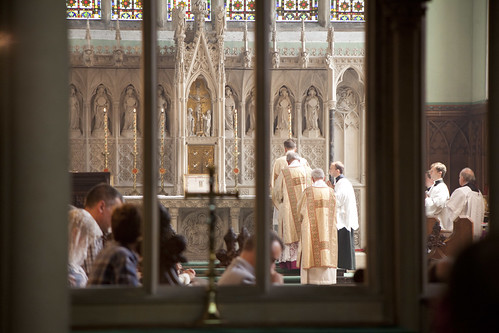
![]() |
| High Mass glimpsed through Pugin's Rood Screen at St Edmund's College, Ware. This is the only Pugin chapel in England not to have been 're-ordered' after the Council. (More photos) |
Comments can be sent to positio AT fiuv.org
I hope to publish the next paper, on head coverings in Church, in mid December.
FIUV Position Paper: Septuagesima, Vigils, Octaves
The Foederatio Internationalis Una Voce (FIUV), the world-wide federation of lay groups attached to the Traditional Mass, has since 2012 been publishing short 'Position Papers' on specific aspects of the 1962 Missal, particularly those which might seem puzzling and in need of an explanation to those not familiar with the Extraordinary Form, and those which might be thought to be candidates for reform in the ongoing development of the Extraordinary Form envisaged at the time of the motu proprio Summorum Pontificum in 2007. The full series can be seen here.
After a pause in the series over the Summer (the last one was about the Kiss of Peace), I am pleased to present a new Position Paper, number 20, on aspects of the Calendar of the Extraordinary Form: Septuagesima, Vigils, and Octaves. As we all know Septuagesima, the season of three Sundays leading up to Ash Wednesday, does not exist in the Ordinary Form, and this is one of the most noticeable conflicts between the two calendars in parishes where both Forms are celebrated. Septuagesima continued to be observed by Anglicans after the Reformation, and forms part of the Calendar of the Ordinariate. I've added some more commentary on the issues involved here.
![]() |
| Septuagesima Sunday in Reading, England, with the Fraternity of St Peter; the celebrant was Fr Angel Alfaro, FSSP, normally based in Columbia. |
FIUV Position Paper: the Kiss of Peace
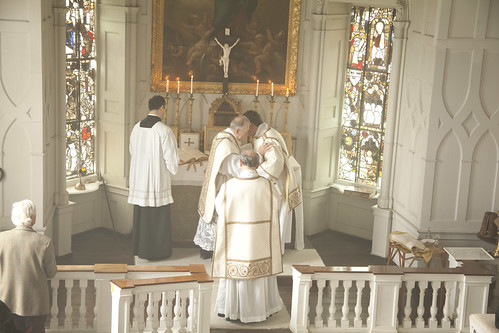
Today I can publish Positio 19, which is the twentieth in the series, counting the two parts treating Holy Week. This is on the subject of the Kiss of Peace, the Pax, which in the Novus Ordo is called the Sign of Peace.
This is an interesting topic historically, and though it may not seem of the utmost importance it illustrates two very important issues in the debate about the liturgical reform. The first is the demand, by the reformers, for more 'participation': the Peace should be exchanged, as it had been in ancient times, between all the members of the congregation. The second is the unforeseen practical difficulties which this has created, including liturgical abuses. This has reached such a pitch that, in the 2007 Synod of Bishops, it was argued that it had become so disruptive that it should no longer be part of the preparation for Communion in the Novus Ordo.
The next paper will be on the subject of Vigils and Octaves; it will be published, when it is ready, perhaps a month from now. The pace of publication has slowed, but we still have a pipeline of subjects.
![]() |
| The Kiss of Peace at High Mass in a small English chapel; more on this Mass here. |
I give some more commentary on the paper on my own LMS Chairman blog.
This paper can be downloaded as a pdf here. The whole series can be seen on the FIUV webstie here. The collected set of papers 1-13, printed as a short book, is available from Lulu here.
Comments can be sent to
positio AT fiuv.org
The
Extraordinary Form of the Roman Rite makes significant use of the osculum, the liturgical kiss, of which the amplexus, the embrace, is a variant. A number of times
throughout the Mass, the celebrant kisses the Altar, turns to the congregation
and says ‘Dominus vobiscum’;[1]
he also kisses the Altar before giving the blessing to the Faithful.[2]
2 This
conveying to the congregation the greeting or blessing of Our Lord, in these
cases represented by the Altar, is played out in a more extended fashion at the
Pax. Following the Pater Noster
and its embolism, during the latter of which the celebrant signs himself with
and kisses the paten, the celebrant says aloud ‘Pax Domini sit semper
vobiscum’, while making the sign of the cross over the Chalice with a particle
of the Host, and putting this into the Chalice. He receives the response ‘Et
cum spiritu tuo’.[3]
The celebrant then says, silently, the prayer Haec
commixtio, and then the Agnus Dei. In Missa Solemnis, while the Agnus Dei
is being sung, the celebrant and the deacon kiss the Altar and exchange the
Kiss of Peace, in the form of a light embrace, the Deacon passes it on to the
Subdeacon; it is passed thence to all clergy and servers present in choir.[4]
The Pax is omitted in the Mass for the Dead and on Maundy Thursday.
In
certain circumstances the Kiss of Peace can be given using a Paxbrede, and,
using this, at Missa Cantata and Low Mass:
again, the Pax is conveyed to the Paxbrede from the Altar, by a kiss. The use
of the Paxbrede in the Extraordinary Form today is explained in more detail in
the Appendix to this paper.
The
practice of the Extraordinary Form contrasts somewhat with the ‘Sign of Peace’,
most commonly an exchange of handshakes,[5]
found in the Ordinary Form, before the Agnus Dei. This
paper aims to provide an explanation and rationale of the practice of the
Extraordinary Form.[6]
The Historical Development of the Pax
5 While the
Pax is deeply rooted in the Latin liturgical tradition,[7]
its history is a complex one, and only a rough outline can be attempted here.[8]
Justin Martyr notes an exchange of kisses as the conclusion of the service of
prayers and readings.[9]
Later, it is
found in Gallican Rites before the Offertory. Pseudo-Germanus comments:
They offer to one other
the Peace of Christ in such a way that by a mutual kiss they may maintain the
affection of love for one another.[10]
This seems naturally
suggested by Matthew 5:23f.[11]
In the African and Roman liturgies, however, it is found
immediately before the Communion Rites,[12]
a location recommended by Pope St Innocent I in a letter of the year 416:
By the peace it is clear that the people give their consent
to all that has been done in the mysteries celebrated in the church. The peace
is the seal that shows that these mysteries have been accomplished.[13]
The Pater Noster coming before it, by the time of Pope Gregory the Great (d.604), suggests the mutual forgiveness enjoined in that prayer.[14] One may, therefore, regard the Roman practice as involving both the themes of a concluding ‘seal’ for the mysteries, similar to the Amen at the end of the Canon, and the mutual forgiveness emphasised in the Gallican tradition.
Over time the Pax developed from a simultaneous giving of the kiss between the ministers at the Altar and neighbours in the congregation,[15] to a more ceremonious practice in which the kiss is, as it were, passed from Our Lord Himself, in the Consecrated Host, or else represented by the Paten, the Altar, the Chalice, the Missal, or the Crucifix, or some combination of these, to the Sacred Ministers, and then to the Faithful, passing from one person to another. This adds an extra pertinence to the Pax taking place while the Agnus Dei is being sung, and after the Consecration: the effect is that the peace is radiating from the Lamb of God slain (as it were), upon the altar, not just because the Kiss begins there, but also because of the text and music which are simultaneous. As Joseph Jungmann expresses it:
Thus the kiss of peace is made to proceed from the altar and,
like a message or even like a gift which comes from the Sacrament, is handed on
“to the others and to the people.”[16]
This practice is well-established in Pontificals of the 10th
Century. In the context of infrequent reception of Holy Communion at that time,
the symbolism of a blessing being conveyed from the Blessed Sacrament upon the
Altar to the Faithful was of particular significance.
There is, therefore, no danger of mistaking the peace at
issue in this ceremony for a mere secular communal harmony: it is very
specifically the Peace of Christ, radiating from the Blessed Sacrament, now
present on the Altar.
In all the Rites of the Church the Kiss underwent a process of stylisation, becoming for example a bow or a kissing of the fingers in certain Oriental churches. In the West the embrace found in the Extraordinary Form today developed, and in England, the elegant solution of the Paxbrede came into use in parish churches,[17] which spread to continental Europe and appears in the 1570 Missale Romanum. Variations on the Paxbrede included the use of a crucifix or reliquary.
The Paxbrede allowed the Pax to be made between the sexes,
which had otherwise been forbidden (except, notably, for the couple at a
nuptial Mass).[18]
The direct
participation of the Faithful in the Pax, for which the Paxbrede was
particularly well suited, began to die out in the following centuries in most
countries.[19]
The liturgical scholar Polycarpus Radó suggests ‘reasons of hygiene’ for this.[20]
Another practical reason seems to have been that the practice of passing the
Paxbrede among the Faithful according to their social degree led to unedifying
disputes over precedence.[21]
A modern factor which reduces the time available to present the Paxbrede is the
frequency of the Communion of the Faithful during Mass.[22]
Participation and Proposals for Reform
The possibility
of the Faithful’s direct participation in the Pax causing disruption, just
noted, has a modern parallel in the difficulties encountered with the practice
in the Ordinary Form. This was discussed in the 2007 Synod of Bishops,[23]
and the Congregation for Divine Worship was asked to examine the proposal that
it be moved to the beginning of the Offertory to mitigate this.
However, as noted earlier, the meaning of the Pax in the
Extraordinary Form is bound up, more clearly than in the Ordinary Form, with
the Blessed Sacrament as the source of the peace. As St Alphonsus Ligouri
expressed it:
Before giving the peace, the priest kisses the Altar to show
that he cannot give peace unless he has first received it from Jesus Christ,
who is represented by the Altar.[24]
The kissing of the Altar, next to the Host Itself, as well as
the Paten, is the first link of a chain conveying the Peace of Christ to the Sacred
Ministers and others in the Sanctuary.
The Extraordinary Form is able to maintain this important and
ancient symbolism, without any danger of disruption, by inviting the Faithful
to unite themselves spiritually with the very vivid and gracious ceremony
performed in the Sanctuary by the Sacred Ministers. Any physical sign of peace
is itself a symbol, and the question is whether members of the Faithful can
best make truly their own a symbolic gesture made by the Sacred Ministers, or
one made by themselves; there is less difference between the two than may first
appear.
1 This development is an example of a very widespread twofold
phenomenon in the history of the liturgy: of rites and ceremonies being reduced
to a symbolically important minimum, and of ceremonies once involving the
Faithful being performed solely by the clergy, on the Faithful's behalf. Some
have regarded such developments as a matter of regret, but Pope Pius XII
reminds us that archaic liturgical practices are not necessarily to be
preferred to the more developed forms, since the development has taken place
under the guidance of providence.[25]
1 The Roman Rite
frequently retains archaic ceremonies in an abbreviated or even vestigial form,
allowing the meaning of the whole rite to be expressed succinctly, and
reminding us of the antiquity of the Rite. The compressed meanings of the rite
are a bulwark against banality: the smallest aspect of the Extraordinary Form
is freighted with significance, like the details of any great work of art.
Conclusion
1 The Pax in the Extraordinary Form is the most significant of
a series of occasions on which the celebrant conveys to the Faithful the peace
of Christ, represented by the Altar which he kisses. It has this special
significance because on this occasion the Lamb of God is present on the Altar in
the consecrated Host.
2 The Pax
exchanged among the Sacred Ministers and others is a visually eloquent
expression of what happens on each of these occasions, of this peace radiating
out to the Faithful. The themes of approving and sealing the foregoing mysteries,
and of mutual reconciliation and preparation for the reception of Communion,
are, in this context, dependent upon this central idea, of the Peace which
comes from Christ.
2 The continued
use of the Paxbrede in certain places and in certain Orders, discussed in more
detail in the Appendix, illustrates the legitimate diversity of the
Extraordinary Form, and the preservation of older customs in particular
contexts. Such customs are part of the authentic liturgical culture of their
proper regions or orders, and should be preserved and fostered whenever
possible.
Appendix: The Paxbrede
Subscribe to:
Posts (Atom)