On November 17 and 24, 2022, the American Catholic newspaper The Wanderer published articles by Fr. Brian Harrison about the statement ‘The Teaching of the Catholic Faith on the Reception of the Holy Eucharist,’ concerning Pope Francis’s Apostolic Letter Desiderio Desideravi (DD). The statement in question was signed by 56 Catholic clerics and scholars, and was issued on September 16, 2022. It accused Pope Francis of teaching heresy in the Apostolic Letter, as follows:
Showing posts with label Martin Luther. Show all posts
Guest Op-Ed: 500th anniversary of the excommunication of arch-heretic, Martin Luther
By Mark Thomas
This Sunday, January 3, 2021, is the 500th anniversary of the excommunication of Martin Luther as a heretic and schismatic – the greatest damage ever done to the Holy Catholic Church. He died unrepentant, without the sacraments and outside the One True Church.
Yes, Pope Leo X, who issued the excommunication decree and the previous Exsurge Domine warning (6/15/1520) to Luther, had a mixed record of papal righteousness – but in this event he is nearly unsurpassed and fairly vindicated.
In this writer's view, these documents are two of the most formidable, necessary and courageous decrees emanating from the Chair of Peter, defending the Holy Roman Catholic Church from doctrinal attack. They were subsequently, fully upheld by the Council of Trent – also one of the greatest Councils in Church history – to which we owe very much, especially on the Eucharist!
We still face great danger. With Luther, there was no warning, just 95 absurd theses appearing out of thin air.
Here today, we had a warning in 1917 at Fatima. “Russia will spread her errors throughout the world,” did Our Lady alert the three children and us Catholics.
We feel these effects today – a far more serious warning than Luther. In full deference to Our Lady and the Most Holy Trinity – it is extremely doubtful (despite assertions to the contrary) that the full, correct Consecration to Russia was done; or that the decisive 3rd Secret text was totally revealed.
Venice 31 October 2017: What goes around comes around!
Note: We missed this one on the
official day -- but better late than never. What goes around comes around!
Last October 31st on the five
hundredth anniversary of the Protestant Revolt, some unidentified person/people
stuck a copy of Pope Leo X’s Bull Decet
Romanum Ponteficem, excommunicating Martin Luther, on the main door of the
Chiesa Evangelica Alemanna in Venice.
![]() |
IL FOGLIO: A prayer to St. Charles Borromeo - bless the artists who stand firm where priests are giving in
Camillo Langone
Il Foglio
November 4, 2017
By Giovanni Gasparro
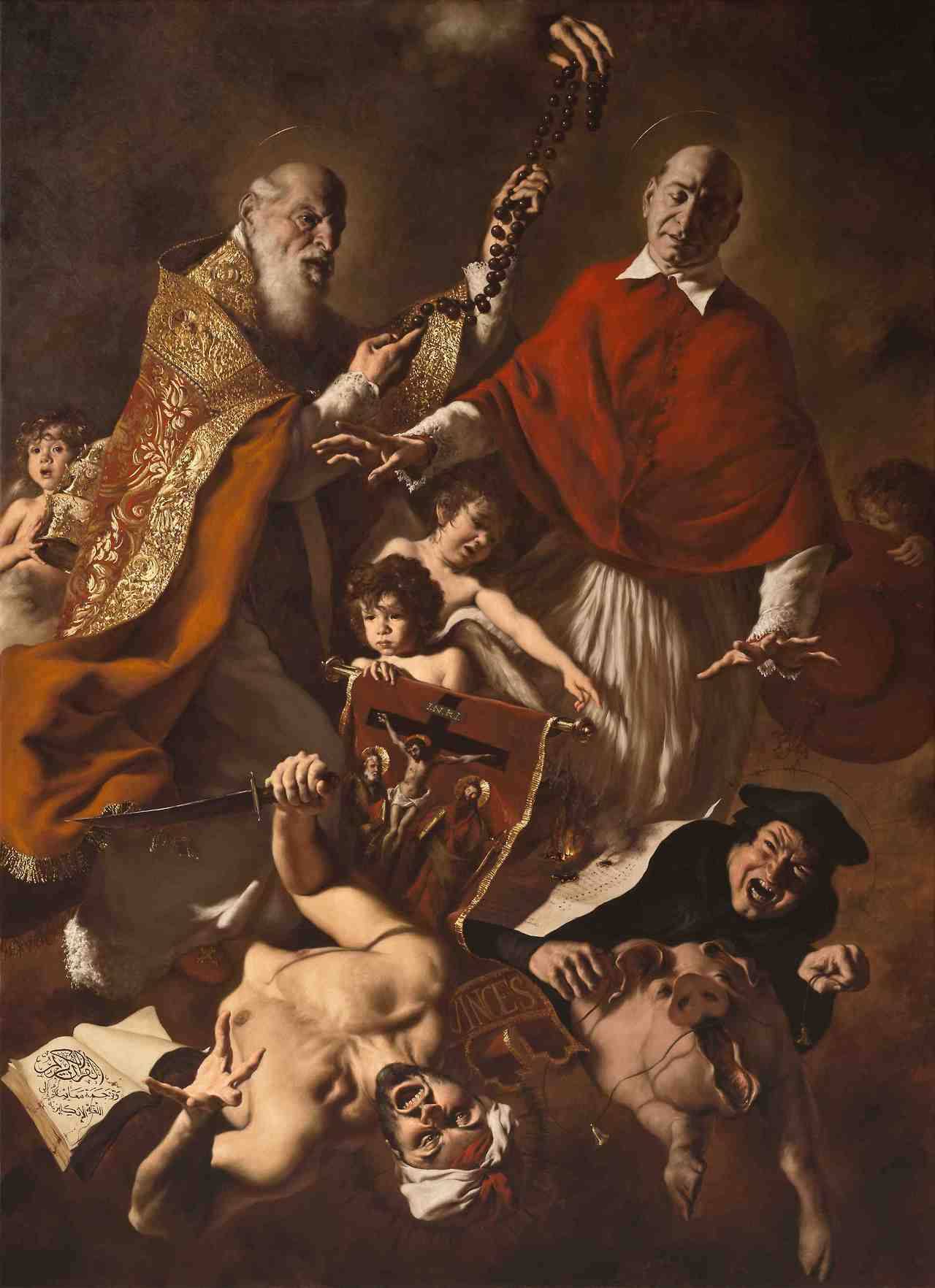
St. Charles Borromeo, flagellator of Protestants, I entreat you on this your feast day, concerning the infatuation many priests have for Martin Luther, witnessed recently in Milanese exhibitions and Vatican stamps. Yet, where priests are surrendering, painters are resisting. In Imola, Sergio Padovani at present is exhibiting a portrait fittingly entitled "Martin Luther, the Heretic" while in Aldefia Giovanni Gasparro is busy putting the final brushstrokes to his work of the following sensational title: "St Pius V and St. Charles Borromeo defending Catholicism against Islam and the Protestant Heresy." Commissioned, naturally, not by an ecclesiastic, but a member of the laity. He who was called “a blind heresiarch” by St. John Bosco and by St. Peter Canisio “an impious blasphemer” is depicted alongside a pig and with swinish eyes: inclined to evil, to guzzling and nuns, [in fact] his contemporaries used to call him Porcus Saxioniae.
Celebrating 500 years of the Lutheran Heresy, Italian Catholic Churchmen and Lutherans sign agreement towards fake unity
NOTE: Dear Readers, in all my years of translating religious
documents for Rorate Caeli, I have never translated one so devoid of any real
content, so forgive me if it’s not a “good” read -- superficiality is not easy to translate.
F.R.
To be reconciled in order to proclaim the Gospel
Declaration of the Italian Episcopal Conference and
the Italian Lutheran Evangelical Church for the 500th anniversary of the
Reformation [sic, Revolt]
“Rather than past conflicts, the divine gift of
unity among us will guide collaboration and deepen our solidarity. Closely
united in our faith in Christ, praying together, listening to one another,
experiencing the love of Christ in our relationships, we, Catholics and
Lutherans, are open to the power of the One Triune God. Rooted in Christ and
rendering witness to Him, we renew our determination to be faithful heralds of
the infinite love of God for all of mankind” (Joint Declaration on occasion of the Catholic-Lutheran Commemoration of the Reformation, Lund,
October 31, 2016). These words have
guided the path of reconciliation and sharing which has involved Catholics and
Lutherans in many places throughout this year, [so as]to experience a mutual commemoration of the 500th
anniversary of the commencement of the
Reformation, along the lines indicated in the document: From Conflict to Communion of the Lutheran-Catholic Commission for
Unity.
There have been numerous initiatives in Italy,
at various levels, in which Christians have taken part in commemorating the
Reformation of the XVI century, in a spirit which, even if it cannot be
considered a novelty in the light of steps made over the past few decades, it
has surely opened up a new season on the path to constructing a visible unity of the Church through which
the scandal of divisions can be brought to an end.
Guest Article: Martin Luther 500 Years later: prophet or revolutionary? Key-points of a thought surprisingly current
Martin Luther 500 Years later: prophet or revolutionary?
Key-points of a thought surprisingly current
By Fr Serafino M. Lanzetta
This day marks the quincentenary of Martin Luther’s protest with his 95 theses in Wittenberg. It is common to trace back to that 31st October 1517 – supposedly the day when Luther nailed his theses to the door of the Cathedral – the beginning of the Protestant Reformation, although not all historians share this view. In fact, the real Lutheran turning point is not to be found in Luther’s protest against indulgences, but rather in his “Tower experience” (or of “the latrine”, as Luther also puts it, cf. Table Talks, 3232c), which will represent the Durchbruch, the ‘compelling passage’ to the Reformation and will be ‘official’ with the year 1520, when Luther composed his De captivitate babilonica Ecclesiae, offering his new doctrine about sacraments in relation to grace.
The event of this anniversary has been greeted with unexpected emotion and enthusiasm in the Catholic world. For example, Cardinal Kasper, in a recent little book on Luther from an ecumenical prospective, has encouraged us to look at the former Augustinian monk as a new St. Francis of Assisi who wanted simply to live the Gospel with his brethren; Luther should be enumerated “in the long tradition of Catholics reformers that have preceded him”. Very recently, Msgr. Galantino, the secretary of the Italian Bishops’ Conference, said that “the [Lutheran] Reform was an event of the Holy Spirit”.
The Church triumphs over Luther
![]() |
Cast out by Jesus in the Blessed Sacrament, the Devil, false religion, and the heresiarch Martin Luther fall from heaven while an angel of God burns Luther's heretical writings and mistranslated German Bible -- from the fresco that Johann Michael Rottmayr (1656 –1730) painted within the dome of Holy Roman Emperor Charles VI's Karlskirche in Vienna, Austria.
|
While the Vatican officially celebrates heresy, schism, blasphemy, sacrilege and iconoclasm [that is to say, Protestantism], let faithful Catholics instead join with the saints and angels in celebrating the Church's eternal triumph over Protestantism's assaults on the Faith which she achieved through Leo X's bull Exsurge Domine and the decrees of the Council of Trent, which infallibly and irreformably anathematise the false teachings of the Protestants.
Roman Forum Publishes Collection of Essays on Luther and Prepares for 2017 Symposium
Angelico Press has published the proceedings of The Roman Forum's 2016 symposium in Gardone: Luther and His Progeny: 500 Years of Protestantism and Its Consequences for Church, State, and Society. The volume includes essays by John Rao, the Rev. John Hunwicke, and Christopher A. Ferrara, among others. The essays examine Luther's role in the dissolution of Christendom, and the effects of his teachings on later developments. The authors show how deeply the modern world has been marked by Luther's innovations. Traditionalists interested in a restoration of Christendom would do well to read Luther and His Progeny for insights on how Medieval Christendom declined and fell, since the success of a restoration will in part depend on understanding that fall.
NEW: Bishop Athanasius Schneider video interview
SSPX regularization, priests refusing Communion in the hand, heretic Martin Luther and Amoris Laetitia discussed
Today, along with our Spanish-language partners "Adelante la Fe," we release a video interview with His Excellency Athanasius Schneider, Auxiliary Bishop of the Archdiocese of Saint Mary in Astana. The interview, conducted by Mauricio Ponce, goes into many of the hot-button issues facing the Church today. This coincided with the Summorum Pontificum conference hosted by the FSSP in Guadalajara. The FSSP will post more of his conferences, Masses and interviews soon at www.fsspmexico.mx
Please see the video below. And, as always, we ask everyone to post this on their blogs and social media sites:
De Mattei: To which Church does Pope Bergoglio belong?
Roberto
de Mattei
Corrispondenza
Romana
October
19, 2016
Two
anniversaries overlap each other in 2017: the 100 years of the Fatima
apparitions, occurring between May 13th and October 13th 1917, and the 500
years of Luther’s revolt, beginning in Wittenberg, Germany, October 31st 1517.
However, there are two other much less discussed anniversaries which also fall next
year: the 300 years of the official foundation of Freemasonry (London, June 24th
1717) and the 100 years of the Russian Revolution of October 26th
1917 (the Julian calendar in use in the
Russian Empire: November 8th according to the Gregorian calendar).
Yet, between the Protestant Revolution and the Communist Revolution through to
the French Revolution, the daughter of Freemasonry, there runs an indissoluble
red thread which Pius XII, in his famous discourse Nel contemplare of October 12th 1952, summed up in three
historic phrases, corresponding to Protestantism, the Age of Enlightenment and
Marxist atheism: Christ – yes, Church – no. God – yes, Christ – no. Finally the
impious cry: God is dead; in fact: God has never been”.
Socci: Scandal in the Vatican
Antonio Socci
Lo Straniero
October 14, 2016
Last Thursday, the 13th
of October, marked the beginning of the
100-year anniversary of Our Lady of Fatima, yet Bergoglio, instead of honouring
Our Lady, honoured Martin Luther by taking part in an audience (in the
Vatican) where a statue of the German heretic and schismatic was exposed as if he were one of the saints.
For that matter, Bergoglio
is the Pope who, for the first time in two thousand years, has wanted
the profanation of the Sacraments!
2016 Lake Garda Statement
The Lake Garda Statement
Regarding the “Catholic” Apotheosis of Luther
Final Session of the 24th Annual Roman
Forum Summer Symposium
Feast of Saints Cyril and Methodius
July 7th, 2016
Our civilization is so sick that even
the best efforts to prop up its few tottering remnants manifest the pathetic
illness that has step by step brought the entire structure crumbling down. The
disease in question is a willful, prideful, irrational, and ignorant obsession
with “freedom”. But this is a malady that gained its initial effective entry
into Christendom in union with the concept of the natural world as the realm of
“total depravity”.
It is crucially important that we
recognize both the ultimate responsibility of this willful liberty for the
destruction of our Christian and Classical culture as well as the role played
by the idea that “incarnated” it historically in our midst. This is so for two
reasons. The first is in order that we may attempt seriously to rid ourselves
of their monstrous influence over our own minds, souls, and bodies. The second
is because a massive attempt to masquerade the truth regarding their real
character and practical alliance is being mounted in conjunction with the five
hundredth anniversary of Martin Luther’s devastating appearance on the public
scene in 1517—and this for the sake of maintaining their nefarious impact upon
believers and delivering the Faith its coup
de grace as a meaningful social force.
Should Any Catholic Praise Luther? (A cross-post)
Blogger Dr. Christopher Malloy has written an eloquent piece on why we absolutely should not praise Luther as we draw near to the 500th anniversary of his initial public act of rebellion. Rorate thanks Dr. Malloy for his permission to cross-post this timely collection of quotations here.
We praise someone who fundamentally deserves praise. No one is without fault, and no one without some merit. But only those are worthy of praise who fundamentally deserve praise, whose pith and marrow is good.
Subscribe to:
Posts (Atom)