Rorate Caeli
Showing posts with label Mullarkey. Show all posts

In God They Don't Trust: Anti-American Syllabus in Vatican journal, by Maureen Mullarkey

A view from the pew, by Maureen Mullarkey


My initial response—unbidden, unguarded—to the Civiltà Cattolica broadside against American conservatives was relief. Almost a kind of glee. The Emperor has thrown his New Clothes on the floor in a fit of pique; his courtiers bend low to pick up what is not there. The pantomime is fully in the open. Here, thankfully, is a barefaced specimen of intellectual sterility too obvious for a cosmetic gloss.
Illustration by Munro Scott Orr (1874-1955)

The Spadaro-Figueroa tirade is as nasty as it is ignorant. Writing as proxies for Francis, the pair make plain their boss’ uncomprehending distaste for America—its history, its politics, and its Christianity. They have given us an accidental exposé bereft of critical reflection and with no ear for its own cant. Of a piece with longstanding European disdain for the American character and manners, the invective suggests a crippling case of status anxiety vis-à-vis the global intellectual elite it aches to ingratiate.

Christ in Art: Caravaggio and the Noble Normalcy of the Risen Christ -- by Maureen Mullarkey

Our Gospels tell us very little of the post-Passion appearances of Jesus. In compensation for the dearth of anecdote, artists have seized that encounter on the road to Emmaus. A popular motif for centuries, it challenges artists to picture a revelation at once quotidian and sublime. Few have met that challenge with the power and subtlety of Michelangelo Merisi da Caravaggio.

Christians profess faith in Jesus as True God and True Man, his humanity and divinity indivisible. That faithful unity loses something of its purity in the effort of depiction. It is no easy thing for Western verisimilitude to suggest “the radiance of the glory of God,” as Paul states in Hebrews 1:3, without tilting the Incarnate Word into something dewy and ethereal, making human flesh a costume rather than—Paul again—“the exact imprint of his nature.” Caravaggio’s Supper at Emmaus reminds us that the resurrected Christ and the Galilean man are one.

Caravaggio. Supper at Emmaus (1601).

Caravaggio painted two renditions of the theme. The first (1601, above) hangs in the National Gallery, London. The second, painted five years later, is in the Brera, Milan. Completed while he was on the lam from Rome for having murdered a well-known pimp, the 1606 variation (below) is subdued. Gestures are restrained, color is understated, the table cleared of all but bread and wine, elements of the Eucharist. Atmosphere is darksome, the Christ figure more conventional. Its greater solemnity brings Caravaggio’s unflinching realism—not customary at the time—within the orbit of traditional patterns of depiction.

Yet it is the earlier work that conveys the drama of that instant of recognition with greater potency. And particular earthiness.

The Isenheim Altarpiece, Part II

by Rorate Contributor
Maureen Mullarkey

Stay awhile, please, with the Isenheim Altarpiece. It has no equal in Western art. Grünewald makes palpable that mystic strain in the medieval mind that prompted Hugh of St. Victor to write: “Logic, mathematics, physics teach some truth, yet do not reach that truth wherein is the soul’s safety, without which all else is in vain.”

[Grünewald. The Resurrection wing of the Isenheim Altarpiece (1516)]

The Isenheim Atarpiece, Part I

by Rorate Contributor
Maureen Mullarkey

Can the work of Protestant artists speak to pious Catholics?

It is an odd question, one that surfaces from time to time in regard to visual art only while leaving music to itself. We listen to Bach’s St. Matthew’s Passion and Handel’s Messiah with no concern that both composers were devout Lutherans. Yet a recent article in Aleteia asked: “Protestant Art, Catholic Setting: Is This Kosher?”

The headline brought to mind the Master Mathis, commonly called Matthias Grünewald. His sublime Isenheim Altarpiece, a nine-piece polyptych, is now housed in the Musée Unterlinden in Colmar, Alsace. One of the glories of sixteenth century European art—to me, the most profound—it is largely overlooked by Catholics on pilgrimage to more familiar names.

[Crucifixion panel on the opposite side.]

Candlemas in Art : A pictorial Presentation - by Maureen Mullarkey

by Rorate Contributor
Maureen Mullarkey


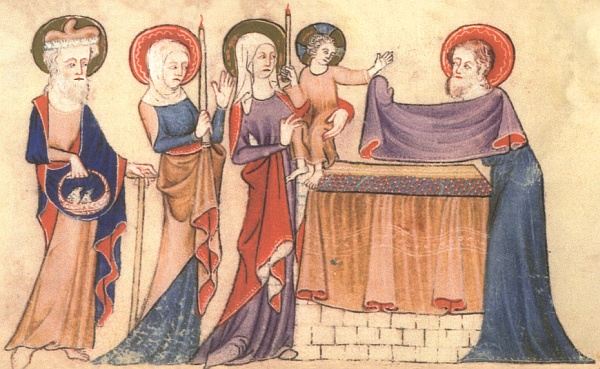
In the Latin Church, Christmastide reaches its canonical end today, on Candlemas. The name comes to us from the ancient custom of blessing candles in church this day for distribution to the congregation. Celebrated in the early Church simply as the Feast of the Fortieth Day, it is rich in liturgical significance and resonant with history. Candlemas is a double feast that binds Christian faith to its Judaic roots in the very act of proclaiming Jesus as a light for the Gentiles and, in the jubilant words of the Canticle of Simeon, “the glory of Thy people Israel.”

Presentation of Christ in the Temple. Luttrell Psalter (14th C.)

We know the story. In obedience to Jewish law, Mary—young Miriam—takes her weeks-old son to temple to undergo ritual purification on the day required of mothers of sons. The Book of Leviticus is firm: “She shall not touch any hallowed thing, nor come into the sanctuary until the days of her purification are fulfilled.”

"Post-Christmas Notes", a Maureen Mullarkey op-ed

We are very pleased to announce the new occasional contributor to Rorate Caeli, Maureen Mullarkey, who will, whenever time allows her to contribute (dare we hope, very frequently!), add the Catholic lay voice on what we might call "the Arts and Modern Concerns" to the list of matters presented and discussed on this blog.

Thank you, Maureen, and welcome to the team!

• • • •

The worthless man who loves things connected with birth keeps birthday festivals. (Origen)
It is not quite true that there is nothing new under the sun. You and I—we are what is new. Every generation is new under the sun. It all begins again with ourselves. We have a hard time imagining “is now and ever shall be” as anything that might differ substantially from our own now.


[Eugene Grasset. Angels Prepare Food for Mary and Jesus. Front cover, L'Illustration, Christmas issue, 1893]

It is easy to forget that Christmas as we know it is something of a latecomer. It was not celebrated in the early Church. Christians in the first two or three centuries understood themselves to be an Easter people, persecuted inheritors of the promise of the Resurrection. The death and resurrection of Jesus was the heartsblood of the faith. Within a community marked for martyrdom, it was the death date that earned commemoration. Death marked the day of initiation into eternal life, into the stunning mystery of Christ's victory over death.