Professor Roberto de Mattei wrote an article in his style, published on Feb. 12, with the title "Motus in fine velocior", the great Latin expression that explains both physical reality and historical events - that is, that speed of change increases with the end of a historical era. We reproduce the article at the end of this post.
For years, Prof. de Mattei had been presenting, without receiving anything in return, a special program at Italian Catholic radio network
Radio Maria dedicated to an exploration of the Christian roots of Europe.
Radio Maria's director, Fr. Livio Fanzaga, considered "
Motus in fine velocior", an op-ed published elsewhere, a step too far - the letter telling de Mattei of his removal is available below. De Mattei responded on the same day, and his letter is also available below; in it, he warns Fr. Fanzaga that, with the increasing speed of critical events, also he and his radio station will be soon forced to take a stand.
Two writers who are also bewildered by the situation in the Church in the past year, Alessandro Gnocchi and Mario Palmaro, had been fired by Radio Maria in October 2013 (we
mentioned this shortly afterwards).
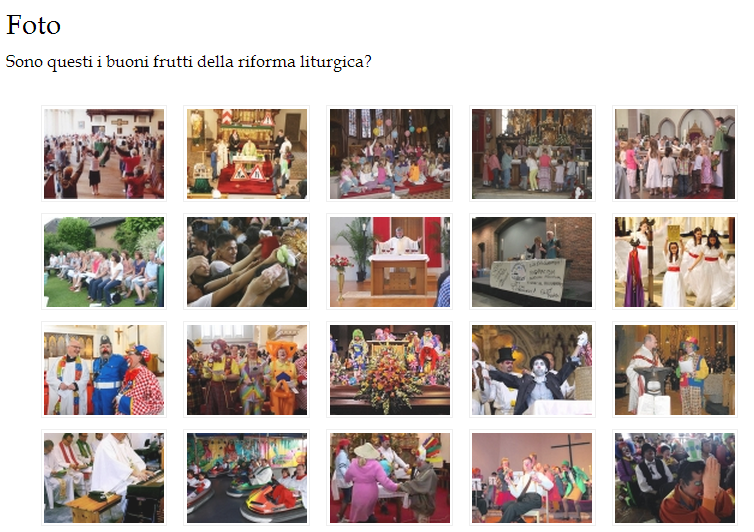
This is the new "Church of Tolerance and Mercy"!
We in
Rorate have often posted op-eds by Prof. de Mattei. We do not always agree with every single opinion point he makes. But this does not mean his voice is to be silenced. Those who love most the Roman Church, her history and her prerogatives are those to whom no tolerance is to be granted right now. No mercy for them, despite their ceaseless loyalty to the Roman See. No "
who am I to judge" for their heartfelt motivations. "
Should not the great Church also allow herself to be generous in the knowledge of her great breadth, in the knowledge of the promise made to her? Should not we, as good educators, also be capable of overlooking various faults and making every effort to open up broader vistas? And should we not admit that some unpleasant things have also emerged in Church circles? At times one gets the impression that our society needs to have at least one group to which no tolerance may be shown; which one can easily attack and hate." (Benedict XVI,
Letter to Bishops, 2009)
Documents below:
1. Letter of Removal from Director of Radio Maria to Prof. de Mattei.
2. Responding Letter from Prof. de Mattei to Radio Director.
3. Article "Motus in fine velocior", by Prof. de Mattei.
____________________________
1. Letter of Removal from the Director of Radio Maria to Prof. de Mattei.
 |
| Fr. Livio Fanzaga |
February 13, 2014
Dear Prof. Roberto de Mattei,
I read your recent article "Motus in fine velocior", and I noticed the way you have been continuously increasing your critical position regarding the Pontificate of Pope Francis. I am very displeased with it, and I would have wished you put your great cultural competence at the service of the Successor of Peter.
You will understand, dear Professor, that your position is incompatible with the presence in Radio Maria, which calls for, in its guiding principles, adherence not only to the Magisterium of the Church, but also support to the pastoral action of the Supreme Pontiff.
Regretfully and bound by conscience, I must suspend your monthly broadcast, while thanking you, also in the name of listeners, for your deep effort, made as a voluntary, in the research of the Christian roots of Europe.
Dear Professor, if your approach regarding the current Pontificate should change and become more positive, there would be no difficulty for you to resume your broadcast.
Cordially,
Father Livio Fanzaga (Director)
____________________________
2. Responding Letter from Prof. de Mattei to Radio Director.
February 13, 2014
Dear Father Livio,
With an e-mail message of February 13, you tell me that you have decided to suspend the program "Radici Cristiane" [Christian Roots] at Radio Maria, because I would "have been continuously increasing" my "critical position regarding the Pontificate of Pope Francis." "Your position" -- you write me -- "is incompatible with the presence in Radio Maria, which calls for, in its guiding principles, adherence not only to the Magisterium of the Church, but also support to the pastoral action of the Supreme Pontiff."
First of all, I thank you for the invitation you offered me four years ago to conduct the transmission “Radici Cristiane” on Radio Maria. Since then, until last January 15, every third Wednesday of the month, I tried to carry out to the best of my ability, the task that you had entrusted to me, by developing themes of a historical nature, apologetics and a spiritual and moral defense of the Church and Christian civilization. I thank you also for having publically defended me when, as a result of some of my transmissions, I was violently attacked by the secular press. All of my activity and apostolate has been and remains at the service of the Church and the Roman Pontiff, to whom I dedicated my latest book, Vicar of Christ: The Papacy - Normality and Exception Devotion to the Papacy is an essential part of my spiritual life.
Catholic doctrine teaches us however, that the Pope is infallible only in determined conditions and he can make mistakes, in the sphere of ecclesiastic politics for example, in strategic choices, in pastoral action and even in ordinary magisterium. In these cases it is not a sin, but a duty of conscience for a Catholic to criticize, provided that it is done with the maximum respect and love due to the Supreme Pontiff. The saints did so, and they have to be our models.
The Church allows Her children this freedom to criticize, and it is not a sin if one points out, with due respect, the faults of the ecclesiastical hierarchy. Instead, the one who is silent because of cowardice or conformism, does sin. The drama in the Church today is precisely the fear in priests and bishops, who constitute the pars electa of the Church, in denouncing the terrible crisis which is occurring, identifying its causes and proposing solutions.
I re-read the article which represents the reason for my dismissal - and it seems to me that there is nothing disrespectful in it towards the reigning Pontiff, but simply some considerations of a historical nature more than theological, motivated by a pure love for the Truth. Besides, I did not express my concerns about the actual situation in the Church on my monthly Radio Maria transmission, but on my own information agency.
Dear Father Livio, you have every right to dismiss me from your radio, but it would have been better if you had done it without motivations, rather than advance such weak reasons, which are, if I may say so, unfounded. This incident does not bode well for you and I am truly sorry about it. The motion of events has accelerated at an increasingly faster pace and sooner or later the whirlwind will involve you and Radio Maria, constraining you to assume, in one way or the other, positions, which you are deluded in thinking can be avoided. The time will come, however, when one has to take sides. [Emphasis added] As far as I am concerned, I shall continue to exercise my Christian freedom, to defend the faith that I have received with my baptism and is the thing I hold dearest.
May the Holy Spirit help me never to succumb to any pressure or flattery, and never cease to state the truth, and to state it as loud as the silence of those who should be giving voice to it.
With deepest respect,
Roberto de Mattei
____________________________
3. Article "Motus in fine velocior", by Prof. de Mattei.
Motus in fine velocior
by Roberto de Mattei [Feb. 12. 2014]
February 11, 2013, is a date which has entered history. It was on that day that Benedict XVI communicated to an assembly of astonished cardinals his decision to renounce the pontificate. The announcement was received “like lightning in a serene sky,” according to the words addressed to the Pope by the cardinal deacon Angelo Sodano, and the image of lightning which, that very day, had struck the Basilica of St. Peter, spread throughout the world.