Rorate Caeli
Showing posts with label Belgian collapse. Show all posts

Belgian Cardinal and Bishops Approve Liturgy for “Same-Sex Unions”


Archbishop Léonard, of Brussels-Mechlin, was one of the most conservative voices of the Church in Europe. That was enough for the petty, vengeful, small little man currently occupying the throne of Peter to not only not make him a Cardinal, but accept his retirement (unusually for a major Archbishop) as soon as he reached 75. For his place, Francis named an extremist liberal, a disciple of one of the greatest perverts ever to occupy a European see (Danneels), Jozef de Kesel. And, of course, Francis created him Cardinal as soon as possible.


Now, de Kesel has arrived decisively at what he was named to do: the bishops of Belgium are to visit Rome in the upcoming days for their Ad Limina visit and, just in time, de Kesel led the Flemish bishops in approving a special "liturgy" with prayers for the blessing of homosexual unions.

Catholic University of Louvain: abortion a 'fundamental right'

In response to a junior philosophy lecturer distributing a document to students making the argument for calling abortion 'murder', a spokewoman for the 'Catholic University of Louvain' (UCL) in Belgium has made it clear that this is 'contrary to the values' of the institution.


Tania van Hemelryck, the special adviser to the university president on gender politics, spoke to Belgian television on behalf of the university, saying: “The authorities want to find out the exact status of the text and how it was used during this course, bearing in mind that in any case UCL defends the fundamental right to abortion, and particularly women’s right to choose.”...
The official statement published by UCL on its website says much the same thing:
“Whatever the outcome of the inquiry, the right to abortion is enshrined in Belgian law and the note that was brought to the attention of UCL is at odds with the values upheld by the university. Conveying standpoints that contradict these values in the framework of a teaching course is unacceptable.”

Louvain has not been a very 'Catholic' Catholic University for a long time, but these statements take matters to a new level. Please consider signing a petition to support the lecturer at the centre of the row, Stéphane Mercier.

Appeal: New small private traditional catholic high school in 'ultra-progressive' Belgium needs your help

New small private traditional catholic high school in 
'ultra-progressive' Belgium needs your help

(Only a very small part of the buildings being currently used.)

For fans of Asterix comic books, the storyline might sound familiar: “All of Belgium is occupied, either by atheism or by a Church that has been on the international avant-garde of ‘progressivism’ for at least 50 years. (As usual, ‘progressivism’ leads to collapse.). Not to mention, of course, the abuse scandals and their cover-up. All of Belgium? No, not all of Belgium. Some small pockets of resistance by traditional catholics still exist.”

Danneels protégé set to be named new Archbishop of Brussels

Belgian news sources (such as La Libre) are reporting that the appointment to the See of Brussels of Jozef De Kesel, the current Bishop of Bruges (left), will be formally announced tomorrow shortly before noon, Rome time.

Bishop De Kesel is 68 years old, and was ordained bishop in 2002. After serving for 8 years as an auxiliary bishop in Mechlin-Brussels (mostly under Cardinal Danneels) he was appointed to the See of Bruges in 2010, as successor to the disgraced Roger Vangeheluwe. Despite being less outspoken than Bishop Johan Bonny of Antwerp (who had been considered the front-runner for Brussels), he is by all accounts scarcely less liberal. 

Within a few months of his appointment to Bruges, De Kesel publicly questioned clerical celibacy in the Latin Rite and declared that women's ordination to the priesthood is "negotiable", as Rorate reported at that time. As auxiliary bishop of Brussels he had supported the celebration of a Mass organized by several parishes in that city specifically for participants in its annual "Lesbian and Gay Pride" march.  

Despite reportedly making more orthodox-sounding noises afterwards (specifically when Benedict XVI still reigned), De Kesel continues to be identified with the liberal wing of the Belgian Church. In October last year he tried to assign to active parish duty a priest who had been convicted of molesting a teenage boy, declaring that he (the priest) deserved "a second chance"; only media outrage and the priest's own request prompted the bishop to cancel the appointment.

We refer our readers to our June post on the significance of the succession to Brussels, and why this whole matter has been exceedingly unfair to Archbishop André-Joseph Leonard (whose brief reign was spent under Danneels' shadow) and to the more conservative Francophone Belgian prelates. With this appointment the extremely toxic legacy of Danneels for Belgian (and particularly Flemish) Catholicism and indeed for European Catholicism as a whole has been given a significant boost -- not that it ever really disappeared. One has to wonder what will be left of Catholicism in Flanders and Brussels 7 or 8 years from now. 


Pope accepts resignation of Brussels Archbishop - in record time. Will a radical liberal succeed him?

The past and future of Brussels? 
Cardinal Danneels and Bishop Bonny


On June 1, Pope Francis informed André-Joseph Leonard, Archbishop of Mechlin-Brussels and Primate of Belgium, that the latter's resignation has been accepted. The news was reported by InfoCatho and Kerknet, respectively the French-language and Dutch-language official news sites of the Catholic Church in Belgium. The same reports mention that Pope Francis asked Msgr. Leonard to remain in office until his successor is appointed. It is highly unusual that the Belgian Church's own news sites would publicize the news of the resignation's acceptance well before any official announcement on the Vatican Bollettino. It points to a short wait (and eagerness) for a successor. It is also expected that the Belgian delegation to the Synod of 2015 will be headed by the new Primate. 

Cardinal Danneels (family "expert" chosen by Francis) tried to convince King Baudouin to Sign Abortion Law - and shocking news of Brussels succession

Pro-life sovereigns: Queen Fabiola, Pope John Paul II, King Baudouin (Danneels walks behind them)
Two Belgian politicians admit for the first time openly that Cardinal Godfried Danneels tried to convince King Baudouin to sign the law on abortion in 1990. Former politicians Philippe Moureau (PS, Parti Socialiste) and Mark Eyskens (CVP, Flemish Christian Democrats) said this in a documentary for the Flemish Broadcasting Corporation VTM on April 6, 2015 (http://nieuws.vtm.be/binnenland/135916-25-jaar-abortuswet-boudewijn-onder-druk, at 2:05). According to VTM, cardinal Danneels did not want to comment.

Year of the Consecrated Life - I: Some Statistics and Observations.
The Accelerated Decline of Women Religious


Reunion of Catalan Abbesses and Religious Superiors, Feb. 9, 2015. Source

February 2 was instituted in 1997 by Pope John Paul II as the world day of prayer for women and men in consecrated life, and it was on this day, just three weeks ago, that Pope Francis opened the "Year of Consecrated Life" (although it already started on November 30 last year). It is the latest in a long string of "special years" proclaimed by the Popes - the Year of the Rosary (2002-2003), the Year of the Eucharist (2004-2005), the Year of St. Paul (2008-2009), the Year for Priests (2009-2010), and finally, the Year of Faith (2012-2013), itself the second such year to be declared after Vatican II (the first was in 1967-1968). 

Surely we are not alone in observing that the current "Year of Consecrated Life" is low-key compared to its predecessors? There is, apparently, very little talk about it, very little excitement. Perhaps it is weariness over "special years"? Perhaps it is because of the very real barrenness and exhaustion in much of Catholic religious life, despite the propaganda in official statements and in much of the "establishment" Catholic media and blogosphere? There are many signs of hope when it comes to religious life (we hope to write more about these soon) but in the immediate term the main trend in Catholic consecrated life will continue to be that of decline. 

According to the Center for Applied Research in the Apostolate (source - see "World Data over Time"), in 2012 the total number of female consecrated religious in the Catholic world was 705,529 for a reported (nominal) Catholic population of 1.229 billion. Only two years before, in 2010 there were 721,935. In 2000 there were 801,185. In 1970 there were 1,004,304 female religious for a reported Catholic population of 653.6 million. Overall, there has been a reduction by nearly a hundred thousand since the "Great Jubilee" that was meant to be the celebration of the "New Springtime" / "New Pentecost" in the Church.

Great Flemish Idea: Put a Convicted Boy Molester Back in a Parish Filled with Young Men!

The news comes from much of the Dutch-speaking media, that calls him the "Pedopriester" (no translation necessary). Details are brought to you by Dutch blog In Caelo:

Bishop Jozef De Kesel [of Bruges, Flanders, Belgium] has assigned a priest, who has been found guilty of at least one case of molesting a minor in the past, to the parish federation in Middelkerke, halfway between Ostend and Nieuwpoort on the Belgian coast.

Father Tom Flamez appeared in court in 2008 and 2009, where he was found guilty of sexual molestation of teenage boy. In January of 2009, the court, for reasons of its own, decided to waive any punishment, as Bishop De Kesel explains in a statement released today:

Oster Responds to Bonny

Bishop Bonny, following the official Installment Ceremony of two Parish Assistants.
Not a single priest was ordained for Antwerp in 2012, 2013, or 2014

As we have mentioned before, the 'progressive' bishop of Antwerp, H.E. Johan Bonny, has published an open letter in several languages on his expectations for the coming Synod of Bishops. Bonny thinks that with the Encyclical Humanae Vitae, Pope Paul VI derailed the Church from the collegial, progressive course set by the Council, but he seems to hope that now the time has come to set things back on course. In his letter he uses many of the clichés of those who dissented from Humanae Vitae to argue for a new approach to the matter of 'divorced and remarried.'

Shock with the appointment of Danneels to a Synod on the Family - and the memories of a 2010 tape

It is a relief to see that the Liberal Supremo of the Americanist Church, Jesuit Thomas Reese, is "disappointed" with the "composition" of members of the upcoming Extraordinary General Assembly of the Synod of Bishops. The problem, of course, is that, since "Progressives" are unimpeded by shame or any qualms of conscience (let us call it the Modernist Taqiyya*), we never know if they mean what they say, or if they mean something quite different and just wish to gain new ground. For instance, Reese's ideas are certainly over-represented in the Synod by such luminaries as Kasper or Danneels, but he may still wish to paint the membership of the Synod as "too conservative" just to advance Modernist ideas.


Which, of course, brings to mind the very presence of Danneels, the emeritus of Mechlin-Brussels: Danneels was directly responsible for the abuse of the spirit of Catholic children in Belgium during decades, against the crying pleas of Belgian parents (shocking report), and was naturally quite happy to support "homosexual marriage" just last year. And yet he is a pontifical appointee (the second in the list of pontifical appointees) of a Synod on the Family, when his only family expertise is on the destruction of children, marriage, and family.

It's not always that an abuser-protector is caught on tape, but that happened to Danneels in 2010, when the case of his major protégé, the man he had most wanted as his successor as the Primate of Belgium, Roger Vangheluwe, Bishop of Bruges, was about to be exposed. Vangheluwe was the typical Danneels-bishop, and, unsurprisingly, he had a past filled with abuse -- and not just any kind of abuse, but that of his own nephew, during 13 years in the post-Conciliar years. (By the way, Danneels' new favorite pupil, Bishop Bonny of Antwerp, is angling for Mechlin-Brussels as well, even going to the lengths of making a personal letter on the Synod available in several languages.)

After Danneels had been replaced at the helm of the Belgian Church by a serious prelate, Archbishop Léonard, the latter made a strong speech on the shame of child abuse by priests, and the need for victims to end their silence. Encouraged by this message, four days after Léonard's brave speech, the Vangheluwe family was led to believe they would meet Léonard, who might encourage them. Instead, they were tricked into meeting Danneels, who tried to coerce them into keeping silence to protect his favorite pupil. 

What Danneels didn't know was that the meeting, on April 8, 2010, was being taped, and Flemish paper De Standaard would publish the dialogue soon afterwards. Let's go to the scene as provided by La Vie at the time:

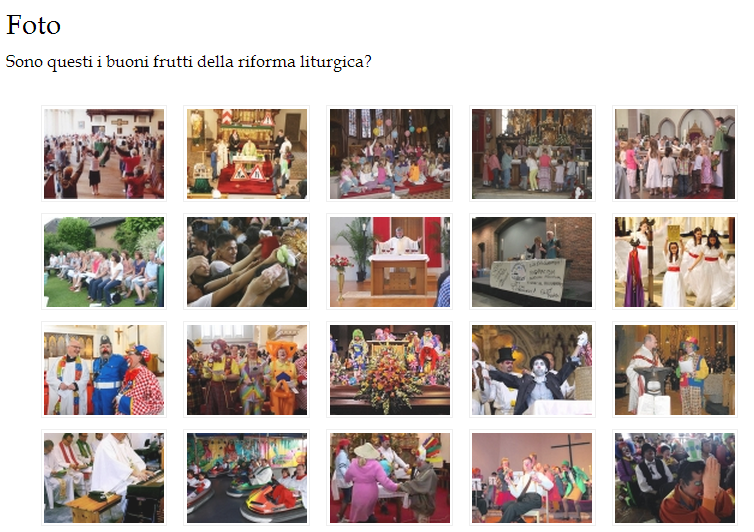
"By their fruits ye shall know them"
The Good Fruits of the Novus Ordo Missae?

Concilio Vaticano Secondo, a website dedicated to a realistic analysis of the aftermath of the Second Vatican Council, has recently posted a collection of images of what we can only call the fashion-crazed rite, the inconstant and fickle Rite of Paul VI.

Many of these are well known images, several were posted by us originally - and at least one of them is, mistakenly, from an Anglican/Episcopalian service - but we thank Mrs. Francesca Croci for having gone through the agonizing trouble of collecting them in one single page.


[We thank the Twitter follower who pointed us to this collection.]

Dictatorship of "Tolerance" at Radio Maria:
Professor de Mattei removed for article
- "Father, you're deluded if you think whirlwind won't hit you."

Professor Roberto de Mattei wrote an article in his style, published on Feb. 12, with the title "Motus in fine velocior", the great Latin expression that explains both physical reality and historical events - that is, that speed of change increases with the end of a historical era. We reproduce the article at the end of this post.

For years, Prof. de Mattei had been presenting, without receiving anything in return, a special program at Italian Catholic radio network Radio Maria dedicated to an exploration of the Christian roots of Europe. Radio Maria's director, Fr. Livio Fanzaga, considered "Motus in fine velocior", an op-ed published elsewhere, a step too far - the letter telling de Mattei of his removal is available below. De Mattei responded on the same day, and his letter is also available below; in it, he warns Fr. Fanzaga that, with the increasing speed of critical events, also he and his radio station will be soon forced to take a stand.

Two writers who are also bewildered by the situation in the Church in the past year, Alessandro Gnocchi and Mario Palmaro, had been fired by Radio Maria in October 2013 (we mentioned this shortly afterwards).

This is the new "Church of Tolerance and Mercy"!

We in Rorate have often posted op-eds by Prof. de Mattei. We do not always agree with every single opinion point he makes. But this does not mean his voice is to be silenced. Those who love most the Roman Church, her history and her prerogatives are those to whom no tolerance is to be granted right now. No mercy for them, despite their ceaseless loyalty to the Roman See. No "who am I to judge" for their heartfelt motivations. "Should not the great Church also allow herself to be generous in the knowledge of her great breadth, in the knowledge of the promise made to her? Should not we, as good educators, also be capable of overlooking various faults and making every effort to open up broader vistas? And should we not admit that some unpleasant things have also emerged in Church circles? At times one gets the impression that our society needs to have at least one group to which no tolerance may be shown; which one can easily attack and hate." (Benedict XVI, Letter to Bishops, 2009)

Documents below:
1. Letter of Removal from Director of Radio Maria to Prof. de Mattei.
2. Responding Letter from Prof. de Mattei to Radio Director.
3. Article "Motus in fine velocior", by Prof. de Mattei.
____________________________

1. Letter of Removal from the Director of Radio Maria to Prof. de Mattei.

Fr. Livio Fanzaga
February 13, 2014

Dear Prof. Roberto de Mattei,

I read your recent article "Motus in fine velocior", and I noticed the way you have been continuously increasing your critical position regarding the Pontificate of Pope Francis. I am very displeased with it, and I would have wished you put your great cultural competence at the service of the Successor of Peter.

You will understand, dear Professor, that your position is incompatible with the presence in Radio Maria, which calls for, in its guiding principles, adherence not only to the Magisterium of the Church, but also support to the pastoral action of the Supreme Pontiff.

Regretfully and bound by conscience, I must suspend your monthly broadcast, while thanking you, also in the name of listeners, for your deep effort, made as a voluntary, in the research of the Christian roots of Europe.

Dear Professor, if your approach regarding the current Pontificate should change and become more positive, there would be no difficulty for you to resume your broadcast.

Cordially,

Father Livio Fanzaga (Director) 
____________________________

2. Responding Letter from Prof. de Mattei to Radio Director.

February 13, 2014

Dear Father Livio,

With an e-mail message of February 13, you tell me that you have decided to suspend the program "Radici Cristiane" [Christian Roots] at Radio Maria, because I would "have been continuously increasing" my "critical position regarding the Pontificate of Pope Francis." "Your position" -- you write me -- "is incompatible with the presence in Radio Maria, which calls for, in its guiding principles, adherence not only to the Magisterium of the Church, but also support to the pastoral action of the Supreme Pontiff."

First of all, I thank you for the invitation you offered me four years ago to conduct the transmission “Radici Cristiane” on Radio Maria. Since then, until last January 15, every third Wednesday of the month, I tried to carry out to the best of my ability, the task that you had entrusted to me, by developing themes of a historical nature, apologetics and a spiritual and moral defense of the Church and Christian civilization. I thank you also for having publically defended me when, as a result of some of my transmissions, I was violently attacked by the secular press. All of my activity and apostolate has been and remains at the service of the Church and the Roman Pontiff, to whom I dedicated my latest book, Vicar of Christ: The Papacy - Normality and Exception Devotion to the Papacy is an essential part of my spiritual life.

Catholic doctrine teaches us however, that the Pope is infallible only in determined conditions and he can make mistakes, in the sphere of ecclesiastic politics for example, in strategic choices, in pastoral action and even in ordinary magisterium. In these cases it is not a sin, but a duty of conscience for a Catholic to criticize, provided that it is done with the maximum respect and love due to the Supreme Pontiff. The saints did so, and they have to be our models.

The Church allows Her children this freedom to criticize, and it is not a sin if one points out, with due respect, the faults of the ecclesiastical hierarchy. Instead, the one who is silent because of cowardice or conformism, does sin. The drama in the Church today is precisely the fear in priests and bishops, who constitute the pars electa of the Church, in denouncing the terrible crisis which is occurring, identifying its causes and proposing solutions.

I re-read the article which represents the reason for my dismissal - and it seems to me that there is nothing disrespectful in it towards the reigning Pontiff, but simply some considerations of a historical nature more than theological, motivated by a pure love for the Truth. Besides, I did not express my concerns about the actual situation in the Church on my monthly Radio Maria transmission, but on my own information agency.

Dear Father Livio, you have every right to dismiss me from your radio, but it would have been better if you had done it without motivations, rather than advance such weak reasons, which are, if I may say so, unfounded. This incident does not bode well for you and I am truly sorry about it. The motion of events has accelerated at an increasingly faster pace and sooner or later the whirlwind will involve you and Radio Maria, constraining you to assume, in one way or the other, positions, which you are deluded in thinking can be avoided. The time will come, however, when one has to take sides. [Emphasis added] As far as I am concerned, I shall continue to exercise my Christian freedom, to defend the faith that I have received with my baptism and is the thing I hold dearest.

May the Holy Spirit help me never to succumb to any pressure or flattery, and never cease to state the truth, and to state it as loud as the silence of those who should be giving voice to it.

With deepest respect,

Roberto de Mattei

____________________________


3. Article "Motus in fine velocior", by Prof. de Mattei.

Motus in fine velocior

by Roberto de Mattei [Feb. 12. 2014]

February 11, 2013, is a date which has entered history. It was on that day that Benedict XVI communicated to an assembly of astonished cardinals his decision to renounce the pontificate. The announcement was received “like lightning in a serene sky,” according to the words addressed to the Pope by the cardinal deacon Angelo Sodano, and the image of lightning which, that very day, had struck the Basilica of St. Peter, spread throughout the world.

Cardinal Danneels not opposed to sodomitical "marriage"

"Next Tuesday Cardinal  Godfried Danneels will turn 80. In the interview he granted us, he expressed himself notably about homosexual marriage which has been  making headlines across France in recent days.

"He says to obey the law and not oppose gay marriage. 'We need to understand: The Church has never objected to the fact that there is a sort of 'marriage' between homosexuals – however  we're talking about a sort of marriage. This is not the same as the true marriage between a man and a woman, so we need to find another word for the dictionary. However, insofar as it is legal - that it has been rendered legitimate by law - the Church has nothing to say about it. (...) If a state opens civil marriage to homosexuals, then it is the problem of that state.'


"This is the first cardinal to express himself so candidly about gay marriage."

L'Echo  
May 31, 2013

The liberal enablers of "hip" bishops

Vangheluwe: Ordinary
Yes, Bishop Roger Vangheluwe, emeritus of Bruges (and amazingly still not laicized), who resigned over having abused his own nephews, is now accused of quite more recent episodes of abuse of boys, well into the 1990s. We will not speak about this, it is easy to criticize bishops when they are down.

But how did a despicable man like Vangheluwe reach his position? In great part due to the liberal enablers, inside and outside his country, who promoted his views, views that led to the destruction of the once great Church of Belgium, because they were "popular", and "modern", and fit for the "men and women of our time", and "liturgically up-to-date", and "post-medieval", "post-Tridentine", in the spirit of the Council. For instance, a quick look at the archives of the "National Catholic Reporter" reveals that Mr. John Allen Jr was one of the leaders of the Vangheluwe Fan Club in the English-speaking world when Vangheluwe's was a voice of the change that was to come:


November 21, 2003 ... The Belgian bishops are in Rome this week for their ad limina visit, and one of them brought a rather unusual subject to put on the table: the ordination of women to the diaconate.

In 2002, the International Theological Commission, the body that advises the Congregation for the Doctrine of the Faith, examined the question of women deacons. While it did not reach a definitive conclusion, it seemed to lean heavily against the possibility. First, it held that deaconesses in the ancient Church “cannot be compared to the sacramental diaconate” today, since there is no clarity about the rite of institution that was used or what functions they exercised. Second, it said, “the unity of the sacrament of orders” is “strongly imprinted by ecclesiastical tradition, the teaching of the Second Vatican Council and the post-conciliar magisterium,” despite differences between the episcopacy and priesthood, and the diaconate.

That result built on a September 2001 notice from three Vatican offices rejecting lay-led programs ostensibly preparing women for future admission to the diaconate. “The church does not forsee such ordination,” the notice said.

Despite that, however, Bishop Roger Vangheluwe of Bruges, Belgium, is carrying the issue to Rome.

Vangheluwe  has long been concerned with women’s issues. In his diocesan newspaper Ministrando in October 2002, Vangheluwe appealed to priests and faithful of his diocese “to include more women in the administration, the organization and the basic movements inside the Church.” He asked parishes and church institutions to hold an “internal audit,” and offered a questionnaire. He noted that while Pope John Paul II has ruled out women priests, that leaves open the possibility of women deacons. He asked for comments to be sent to him.

By the beginning of March 2003, Vangheluwe said he got 500 responses from individuals and groups, and even from other dioceses. Some 86 percent were in favor of the diaconate for women.

Vangheluwe vowed to relay this sentiment during his meetings this week. I sat down with him at the Belgian College on Nov. 20 to talk about why he supports female deacons.

First, Vangheluwe said, is the pastoral desire to incorporate women more fully into the life of the church. Second is a theological need to focus the diaconate more on service.

“At the Last Supper, Jesus said ‘do this in memory of me’ twice,” Vangheluwe said. “The first was with the bread and wine, which became the sacrament of the Eucharist. The second was with the washing of the feet. We have forgotten somewhat about the second.”

In his diocese, Vangheluwe said, he has 80 deacons, who function as “little priests,” absorbed in liturgical roles. He would like to emphasize the service dimension, and said there’s no reason a woman can’t play that role.

In fact, Vangheluwe said he would favor a separation between the priesthood and the diaconate, so that in the ordinary course of things priests would not first be ordained deacons. Thus the distinction between the sacramental and service roles would be clear. The bishop would be both priest and deacon.

Vangheluwe, who was a pastor and seminary professor in Brugge before becoming bishop 19 years ago, said some Vatican officials with whom he’s spoken this week have been cool to his proposal, but others have encouraged him, telling him, “you have to go on.”

“I am not a rebel,” Vangheluwe said. “The pope has said no to women priests, and I agree. But for the moment [the diaconate] is a free question in the church, and all I am saying is that I want more study on this question.”

Vangheluwe said the International Theological Commission document is “not the last word.”

“As bishops, we have to say what we think,” Vangheluwe said.

Vangheluwe is not the only bishop to have raised the issue. In 1994, for example, Cardinal Carlo Maria Martini of Milan said that the moment had arrived for “serious consideration” of the question of whether women could be admitted to the diaconate.
The ambiguous response of the Flemish bishops to the "Faithful have their say" petition

Just a few months ago we reported on the heretical Faithful have their Say petition in Flanders, which calls (among other things) for the ordination of women to the priesthood and communion for 'remarried' divorcees. As of February 9 of this year -- when it was presented to 5 Flemish bishops as well as to Archbishop Andre-Joseph Leonard of Mechelen-Brussels -- the petition had 8,235 signatories, including 304 priests and 41 deacons. (The original Dutch text of the petition and the list of signatories can be found here.). 

The following is the response of the Flemish bishops, as translated by Mark de Vries of In Caelo (emphases are Rorate's):

“We, The Flemish bishops, attentively took note of the manifest “Faithful have their say”. The desire for change that speaks from the text, does not leave us untouched. We too are looking for renewal and a greater authenticity, loyal to Scripture and the tradition of the Church.  

The situation which we are going through as Church today is not comfortable. Much is asked from those with pastoral responsibility. We no longer have the social position nor the impact which we had in the past. We make every effort to bring the Gospel closer to the lives of the people. But this is not easy in a society in which the secular sense of life is increasing more and more. We understand the pain and powerlessness of many. How can we proclaim the Gospel in such a way that it touches the hearts of the people of this age? That is the question which lives in all of us and which remains our greatest challenge. Structural reform or adaptation will not change anything about that. But they may help us. That is why we understand that the gradual nature of these reforms try the patience. But the evolutions in our society are so fundamental that they require time and discernment to see what can and must happen in these cases. The manifest also gives us the opportunity to clarify our position. Some elements, such as the question of Word services on Sunday, are diocesan affairs and at the moment subject of deliberation. Others, especially those about Holy Orders and the priesthood, are matters of the world Church. In questions which touch upon the personal lives of people, we plead for a respectful, pastoral attitude. Even though not every state of life is equal, no one is inferior, because a human being is always more than his actions and than the situations in which he finds himself. The Church community then, built up around Christ and His Gospel, is sent to all people. She takes on this mission from a vital core which lives from the Eucharist. Because there the branches connect to the vine (John 15:5).  

God needs all faithful, all baptised, to make His love known to the world. Let us work together for a Church community which takes care of its identity, faithful to the mission it has received, a Church which is open and accessible for everyone, with a heart for all men.


Signed, the Flemish bishops.”

The crisis of the Church is a crisis of Bishops 3 - the Bishop of Antwerp on celibacy and the ordination of women

In an interview published very recently on Knack.be, the Bishop of Antwerp Johan Bonny made the following statement regarding the movement that produced the heretical Gelovigen nemen het woord manifesto (Rorate posted about that movement here):

I fully understand it. The Church can not avoid the debate about the criteria for ordination. Personally, I strongly believe in the value of the unmarried priesthood and a full availability for Christ and the Church community. But I also think that the ordination of a number of married men or deacons to the priesthood can be an enrichment for the Church. In the eastern Catholic Churches married priests are more the rule than the exception. That fact is therefore not unfamiliar for the Catholic Church. The ordination of women to priests is theologically far more difficult. In the west that concern is present in broad layers of society, but worldwide the support is extremely small. But I do think that there needs to be more discussion about the place and role of the woman in the Church. Women must be allowed to take on responsible duties in the Church, on all levels. 

(Translation by In Caelo.)

Many of our readers will certainly recall that another recently-appointed Belgian bishop, Jozef De Kesel of Bruges, expressed similar sentiments last year albeit more bluntly. Although the Bishop of Antwerp is careful not to openly question the teaching of the Church against the ordination of women, his lack of any reference to the definitive status of this teaching combined with the manner that he segues from the question of women's ordination to the need for women to take "responsible duties in the Church, on all levels", is extremely telling.

In the same interview, the bishop notes that the average age of active priests in his diocese ranges from 75 to 80 years. 

Bishop Johan Bonny (b. 1955) served as an official of the Pontifical Council for Promoting Christian Unity from 1997 to 2008, the relationship with the dissident Eastern Churches being one of his main responsibilities. He was elevated to the episcopate and appointed Bishop of Antwerp by Pope Benedict XVI in 2008. 

K is for...nothing
Just what Europe needs: in Louvain, Catholic not even in name only

The largest and historically most prestigious University in the Low Countries, the University of Louvain (the Dutch-speaking university, Katholieke Universiteit Leuven, in Flanders, from which most French-speaking aspects were transferred to a smaller sister-university in Wallonia in 1970) is about to change its name - and more. From Flemish student newspaper Veto (excerpts):

"KU Leuven - University of Leuven" [in English]. This is probably the new name of the university. A consensus has been reached in the university to keep the K, but to remove all references to the name Catholic. The proposed [new] mission statement of the university also includes independence from the Church and proactive openness.

Rebellion in Flanders

The Dutch Catholic blog In caelo et in terra has the story:

The disobedient actions of priests in Austria (there most visibly, but similar feelings are also present among clergy in other countries), who call for married priests, ordination of women and lay people ‘celebrating’ the Eucharist (a sheer impossibility, equal to, say, having fish wait tables), has also spread to Belgium. From the Diocese of Bruges, to be exact. A manifest titled “Faithful have their say” (‘Gelovigen nemen het woord’) has by now been signed by several hundred people, among them 155 priests. (The number now stands at 211 - Pascal) The full text, along with the names of the priests who signed it, is available, in Dutch, here.

The full list of signatories (5,459 and counting, including 211 priests so far) is located here. The manifesto's signatories call themselves "Flemish believers" and claim to have come up with this manifesto "in solidarity with fellow believers in Austria, Ireland and other countries who also insist on reforms".

The epicenter of this movement, the Diocese of Bruges, happens to be led by Bishop Jozef De Kesel.

The propositions of the Belgian manifesto are as follows:

Desacralization - I. Saint Catherine's church, Brussels


St. Catherine's - Said to be the largest church in the center of Brussels


The article is from the latest newsletter of DICI:

Belgium: A church soon to be turned into a fruit and vegetable market

Because it serves too few of the faithful, St. Catherine’s Church in the heart of the Belgian capital may soon be desecrated and turned into a fruit and vegetable market.

News from the Church in Belgium:
Silent apostasy is episcopal apostasy

European culture gives the impression of “silent apostasy” on the part of people who have all that they need and who live as if God does not exist.
John Paul II
Ecclesia in Europa
___________________________________
1. In Belgium (actually, it is not clear where he is), the emeritus ultra-"Progressive" Bishop of Bruges, Roger "Runaway" Vangheluwe, declares in an interview that the abuse of his nephew was no big deal.
A Belgian former bishop has disappeared from his French religious community three days after he admitted to sexually abusing two of his nephews, its leader told AFP on Sunday.