Rorate Caeli
Showing posts with label Paix Liturgique. Show all posts

The Strange Chapel of Archbishop Celestino Migliore, the Pope's Ambassador to Paris

Paix Liturgique continues to place us all in its debt, even while its websites in various languages remain unaccountably defunct. The following letter 1080 of August 8, 2024, was sent in French to email subscribers, and now we bring it to you here in English. - PAK

Prayer card illustrated by Rupnik

Praying Every Day in Front of Mosaics Created by Top-Ranking Abuser Rupnik Is Strange for a Nuncio Who Is Supposed to Fight Abuse

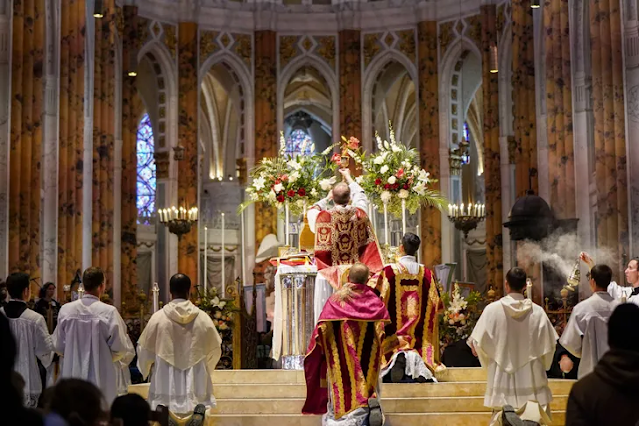
A Sacrificial and Royal Liturgy

A Sacrificial and Royal Liturgy

Paix Liturgique
Letter 986
December 15, 2023

From December 1 to 3, 2023, 600 seminarians from all French dioceses gathered in Paris. On the occasion of this gathering, Mgr de Moulins-Beaufort answered the questions they freely put to him. One of them asked: "Does the Church in France have a problem with traditionalists?" Mgr de Moulins-Beaufort replied: "Yes, no doubt because of our turbulent history since the Revolution. If there's a central question, it's one of political theology and our relationship with the world. Vatican II's decree on religious freedom is very clear. Christ didn't come to build Catholic nations; he came to found the Church. It's not the same thing. By dint of harboring nostalgia for a Catholic state, we lose our energy for evangelization."

Traditional Liturgy: How many Faithful in France? And in the World? "Many of today's Catholics are 'Hidden Traditionalists,' waiting for a Mass worthy of the name."-- An Interview

By Paix Liturgique

October 4, 2023


Although we haven't published a review of traditional liturgy in France and around the world since 2019... we felt it necessary to return to the question of the number of Catholic faithful who wish to live their faith to the rhythm of traditional liturgy. We asked Christian Marquant, who has been interested in this subject for many years, to return to this theme which, as we shall see, remains a burning issue.

***

Louis Renaudin - Dear Christian, why is it important to ask the question of the size and therefore the number of the Catholic faithful who are attached to the traditional Roman liturgy?


Christian Marquant - In theory, it doesn't matter... no one, apart from learned researchers, is going to be interested in the number of Syro-Malabar or Syro-Malankar faithful... nor in the number of priests and faithful who still participate in the Ambrosian (reformed) rite in Milan, or the Mozarabic (cobbled-together) rite in Toledo and Salamanca, because in all these cases there is no controversy or underlying problem. However, when we consider the number, and therefore implicitly the importance, of those who wish to remain attached to the usus antiquior, i.e., to the Mass that has been the Mass of all Latin Christendom for over 1,000 years, we immediately find ourselves in a polemical field whose stakes are quite considerable for a large number of pastors and for members of the "modern" lobby. We are touching on the great division that has afflicted the Church since Vatican II, and to which the Holy Father indirectly alluded at the last consistory in his appeal for unity. A pathetic appeal to an almost empty St. Peter's Square...


Louis Renaudin - What division are you referring to?

“This liturgy of Christendom spiritually energizes the remnant of faithful in secularized nations”—Christian Marquant

Rorate is pleased to offer a translation of a message from Christian Marquant and we give thanks to God for his recovery from hospitalization with Covid.
 

Our Wishes for the Year of Our Lord 2022
Paix Liturgique, Letter 842, January 3, 2022

Dear Friends,

May the freedom of the traditional liturgy come! This is the wish of Paix Liturgique for the year 2022. It may seem utopian or very wilful to you to hear me say this, bruised as we are by the persecutions that have been raining down on us again since this summer.

But all this will last only for a short time, even if it is very painful to live through it. The defenders of the liturgical revolution, which has oppressed the Church for half a century, are fighting their last battle: they have potentially lost, even if they still seem very strong, because not only have they not been able to make us disappear despite all their efforts, but we are now more numerous and alive than ever, while their ranks and places of worship are thinning out.

I form this wish, together with the whole Paix Liturgique team, first of all for those who make use of this traditional liturgy, and also for all Roman Catholics and for the entire Church, which, when it begins to recover from the terrible crisis that has overwhelmed it, will do so first of all by rediscovering this cultic treasure that has been preserved as a living reality.

I hope that this holy and venerable liturgy, which was generated by Rome our Mother, and which therefore cannot be tainted by error, will continue to produce, for the times in which we live, the fruits it has dispensed from century to century and from generation to generation:

- Fruits of growth in faith for those who practice this most pure law of prayer;

- Fruits of a call to holiness in the faithful, priests, and religious;

- Fruit of vigor in preaching and catechesis, of which this traditional Roman cultus is the backbone;

- Fruit of stimulating the missionary outreach to our contemporaries—especially the young people that this worship attracts—to help them to find or to rediscover the religion of Jesus Christ;

- Fruits of reform—of a true reform such as were the Gregorian reform and the Tridentine reform, the like of which the Church today impatiently awaits;

- Fruits of the cultivation of priestly and religious vocations to come to the rescue of the deserted and waterless land that is our society;

- Fruits also of support for a Western civilization in grave danger, for which this Roman worship represents a religious and cultural treasure;

- Finally, political fruits, I dare say, since this liturgy of Christendom is able to spiritually energize the small remnant of the faithful in the formerly baptized but now apostate Christian nations.

In the catastrophic situation of a Church that seems to be disappearing in the midst of secularized societies, I hope that the eyes of those pastors who have become persecutors of their flock will be opened: more than ever, the Church of Christ needs all of its living forces.

And in any case, I hope that the new tyrannical Roman dispositions will be put on hold by the other pastors who are aware of their duties; that there will be many diocesan bishops who understand that peace is too precious a good to be gratuitously jeopardized; and that the bishops who are friends of the Tridentine liturgy will continue to help the faithful, the priests, and the communities that live by it, especially in matters of ordinations.

I wish that all priests and communities who celebrate the traditional liturgy continue to do so, distributing all the sacraments in the traditional form as usual for the greater glory of God and for the good of souls.

But above all, I hope that, as soon as possible, the upper hierarchy of the Church will take a different path and decide to let everything that lives and bears fruit develop freely in the Church, especially the Tridentine liturgy and the lex orandi that it represents. Not freedom to do just anything, but freedom to do what is good: the very freedom of the Church is at stake.

These vows are so many prayer intentions that we will raise to heaven with urgency during this time of the feast of the Incarnation, and also every day of the year.

Finally, I would like to add a personal expression of thanks to all those who have supported me with their prayers during these last weeks in my serious health problems. With them, and to the Lord first of all, I give thanks, for Whose service and together with you I will continue to devote all my strength, as it returns to me, in the good fight for liturgical peace.

Christian Marquant

“Very Instructive Paradoxes”: Fr. Laurent-Marie Pocquet du Haut Jussé, SJM


Paix Liturgique (Letter n°840 of December 24) opened its columns to Reverend Fr. Laurent-Marie Pocquet du Haut Jussé, former superior of the Servants of Jesus and Mary (SJM), who gives us an enlightening testimony. English translation for Rorate Caeli.

The responses made by the Congregation for Divine Worship and the Discipline of the Sacraments, as well as the liturgical crisis provoked by the motu proprio Traditionis custodes, bring to light a certain number of very instructive paradoxes for pastors, theologians, and canonists.

Is a Vatican Plan Under Way to Prohibit Traditional Ordinations?

Rorate offers its readers a translation of the latest newsletter from Paix Liturgique.

Could Traditional Ordinations Be Banned?

Since the publication of the motu proprio Traditionis custodes on July 16, we know that, after a first assault on the liturgy as a whole, the Ecclesia Dei communities are to be targeted, and especially their seminaries.

In our Letter 816, dated August 20, 2021, we said, in effect, that, since Rome’s avowed intention is to stop the development of the traditional Mass and ultimately to suffocate its existence, the bringing to heel of the houses of formation of future priests should be a primary objective for the destroyers of liturgical peace.

An attack by the Congregation of Religious?

The Roadmap of Archbishop Roche: Liquidate the Traditional Liturgy!

Rorate is pleased to present a translation of the Paix Liturgique Letter 837, with permission of Christian Marquant.
 

The Roadmap of Archbishop Roche: Liquidate the Traditional Liturgy!
(Paix Liturgique Letter 837 in French)

The future Cardinal Arthur Roche is a key figure in the project to destroy the traditional liturgy. This man, who likes his ease and his tranquility, does not have the stature of a historical figure, nor does he seek to be one: Auream quisquis mediocritatem diligit, said Horace, Whoever loves golden mediocrity...

The Mass of Paul VI “Well Celebrated”—a Myth! (Guest Article by Cyril Farret d’Astiès)

Rorate Caeli is pleased to offer a translation of Paix Liturgique newsletter 833 of November 15, 2021, with permission of the editor Christian Marquant. Cyril Farret d’Astiès’s article is preceded and succeeded by remarks from Paix Liturgique.

INTRODUCTION

A few weeks ago, a group of priests, religious and lay people, led by our friend Denis Crouan of the association “Pro Liturgia,” seized the opportunity of the publication by Francis of his motu proprio Traditionis custodes to launch a plea to our pastors to “finally” implement the Novus Ordo according to its liturgical rules and to abandon all the initiatives which, according to them, distort it and constitute one of the motives for which the faithful attached to the traditional liturgy distance themselves from the Novus Ordo.

Resistance is never futile: An interview with Christian Marquant, founder of Paix Liturgique

We are pleased to present the text of an interview we recently conducted with Monsieur Christian Marquant of Paix Liturgique (“Liturgical Peace”). He belongs to the generation of extraordinary people who, as young men, acted decisively when their elders shrank from doing so: they resisted the imposition of liturgical novelty upon the people of God. Here, for the first time online, Christian recounts his adventures and misadventures from the mid-1960s to the present—above all, the establishment and work of Paix Liturgique, a multilingual, data-driven enterprise for the restoration of the usus antiquior all around the world. We are grateful for the many historic photos Mr. Marquant shared with us, most of which appear here for the first time. Dr. John Pepino kindly translated the interview from French into English.


Christian Marquant, Summorum Pontificum Conference, October 2020, Rome

The “Long March” of Paix Liturgique


Rorate Caeli: Dear Christian, you are the man who orchestrates Oremus-Paix Liturgique. Could you tell us about this movements and its activities?


Christian Marquant: It would hard to tell you what we are today without telling you at least some of our history as Catholic activists. It all began in the mid-1960s.