Rorate Caeli
Showing posts with label Traditional Mass denied. Show all posts

Pope Francis’s Autobiography, or Why the Pope Shouldn’t Be a Psychoanalyst — Article by Dr. Tomasz Dekert

In recent reports about Pope Francis's newly released autobiography, two aspects  particularly caught my attention. First, the book recounts episodes from Fr. Jorge Bergoglio SJ's life in which he sought help from a psychiatrist. Second, it includes his now-traditional (ironic, isn't it?) critique of what a German website calls the “arch-conservative church representatives who continue to cling to the so-called Tridentine Mass.”

Traditional Liturgy: How many Faithful in France? And in the World? "Many of today's Catholics are 'Hidden Traditionalists,' waiting for a Mass worthy of the name."-- An Interview

By Paix Liturgique

October 4, 2023


Although we haven't published a review of traditional liturgy in France and around the world since 2019... we felt it necessary to return to the question of the number of Catholic faithful who wish to live their faith to the rhythm of traditional liturgy. We asked Christian Marquant, who has been interested in this subject for many years, to return to this theme which, as we shall see, remains a burning issue.

***

Louis Renaudin - Dear Christian, why is it important to ask the question of the size and therefore the number of the Catholic faithful who are attached to the traditional Roman liturgy?


Christian Marquant - In theory, it doesn't matter... no one, apart from learned researchers, is going to be interested in the number of Syro-Malabar or Syro-Malankar faithful... nor in the number of priests and faithful who still participate in the Ambrosian (reformed) rite in Milan, or the Mozarabic (cobbled-together) rite in Toledo and Salamanca, because in all these cases there is no controversy or underlying problem. However, when we consider the number, and therefore implicitly the importance, of those who wish to remain attached to the usus antiquior, i.e., to the Mass that has been the Mass of all Latin Christendom for over 1,000 years, we immediately find ourselves in a polemical field whose stakes are quite considerable for a large number of pastors and for members of the "modern" lobby. We are touching on the great division that has afflicted the Church since Vatican II, and to which the Holy Father indirectly alluded at the last consistory in his appeal for unity. A pathetic appeal to an almost empty St. Peter's Square...


Louis Renaudin - What division are you referring to?

Communiqué of the International UNA VOCE Federation on Order of Malta ban of the Traditional Latin Mass

Rome, June 13, 2019

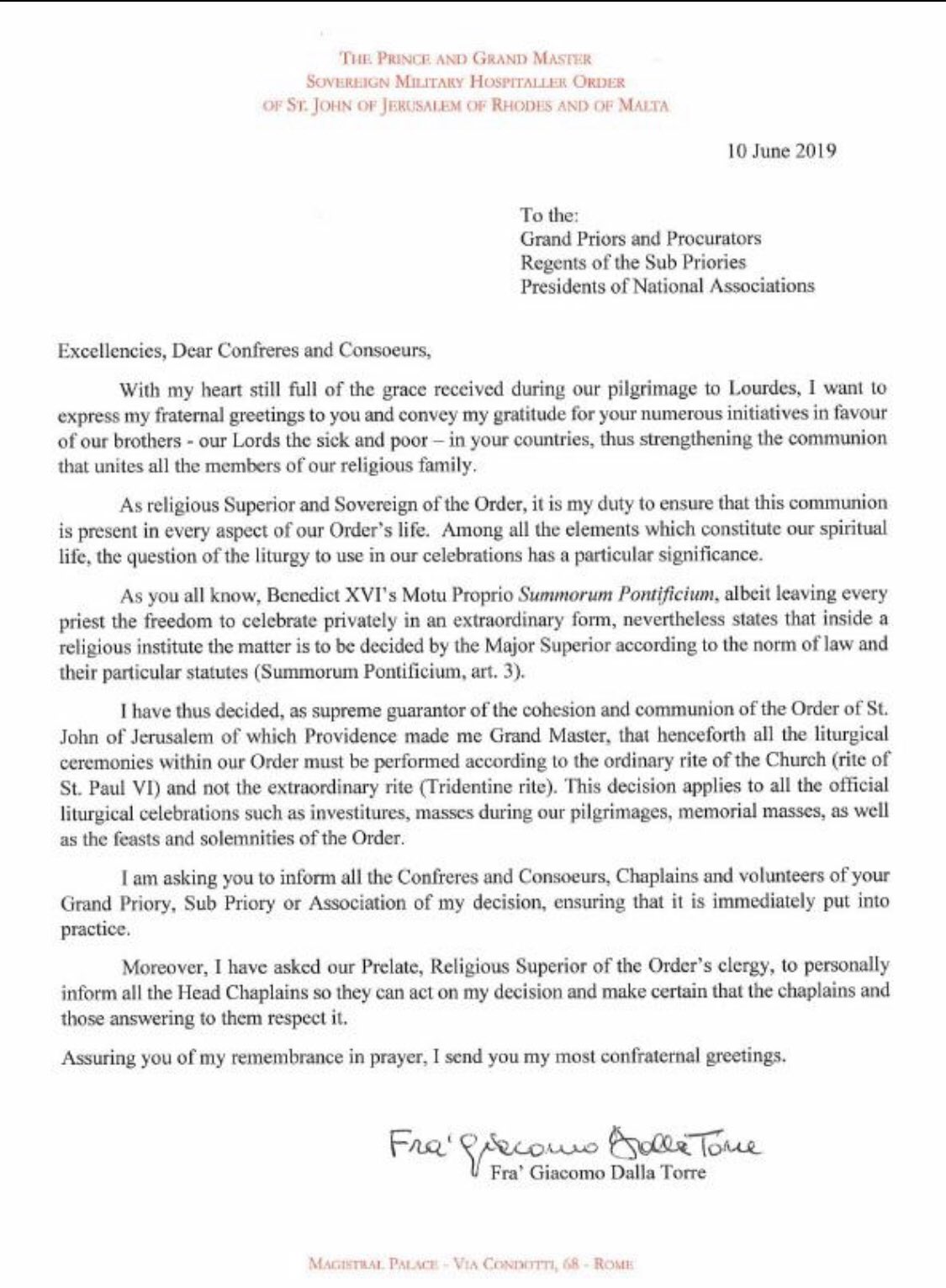
The FIUV notes with regret the letter, dated 10th June, from Fra’ Giacomo Dalla Torre, Grand Master of the Sovereign Military and Hospitaler Order of St John of Jerusalem, of Rhodes, and of Malta (the ‘Order of Malta’), forbidding the celebration of the Traditional Latin Mass (the Extraordinary Form) in the context of the Order’s liturgical life.

Since this letter has become public, we would like to observe that it does not accurately present the provisions of Pope Benedict XVI’s Apostolic Letter, given motu proprio, Summorum Pontificum. Article 3, cited in the Grand Master’s letter, explicitly allows religious communities to have not only private but conventual celebrations of Mass in the Extraordinary Form, without reference to the Major Superior (in the case of the Order of Malta, the Grand Master or the Prelate). His permission is required only in cases where the community ‘wishes to have such celebrations frequently, habitually or permanently’.

The Grand Master’s letter also neglects the right of the faithful, from which the religious and lay members of the Order of Malta are not excluded, from requesting celebrations of Mass in the Extraordinary Form (Article 4). Celebrations in the context of special occasions such as pilgrimages are explicitly anticipated (Article 5 §3). Pastors and rectors of churches are directed to accede to such requests (Article 5, §1 and §5).

The Federation would like to emphasise that the Extraordinary Form is a part of the liturgical patrimony of the Church which represents ‘riches’ for the Church, which should not be neglected or excluded, and certainly not on the basis of a narrow conception of unity which excludes the variety of liturgical expressions permitted in the Church. As Pope Benedict expressed it:

‘These two expressions of the Church’s lex orandi will in no way lead to a division in the Church’s lex credendi (rule of faith); for they are two usages of the one Roman rite.’ (Summorum Pontificum, Preamble)


Foederatio Internationalis Una Voce

Knights of the Condom ("Malta") formally forbid Summorum Pontificum

The Knights of Malta ended in 2017, with the illegitimate coup promoted by the bishop of Rome. Ever since that time, as we said then, they have simply become the Knights of the Condom.

So, it is not surprising that in their new incarnation their wicked and devilish leaders are formally suppressing the Traditional Latin Mass -- it is actually expected.

Document below (click for larger view):


 What a joke they have become. Ridiculous.

But, as ridiculous as this is, it is a sign: THEY are testing the waters.

(Image: @holysmoke, Damian Thompson; confirmed as genuine in the early morning by Knights' spokeswoman to top Vatican correspondent Edward Pentin.)

'Anything that divides must be cut away': the TLM ends in Blackfen
- I come to bury the Mass, not to praise it -

From an English correspondent:
A broken Rosary...
Rorate readers will by now know the sad fate of the parish of Our Lady of the Rosary in Blackfen, in the south east of Greater London. With the blogging priest Fr Timothy Finigan as pastor, the parish had become famous as a centre for the Traditional liturgy. On the second Sunday of his successor, Fr Steven Fisher, it was announced that the Traditional Mass would no longer be celebrated in the parish, effective from the end of the month.

In order to understand this event, readers need to bear in mind a number of facts. One is the poisonous article on the parish in 2009, which appeared in the Tablet, the British liberal Catholic weekly. In this a number of long-standing liberal dissidents who, unfortunately for the parish, live within its boundaries, queued up to attack Fr Finigan for introducing the Traditional Mass into the parish schedule: despite the fact that three of the four Sunday celebrations continued to be the Novus Ordo. They were led by Bernard Wynne, quoted in the Tablet article, a leading member of ‘Advent Group’, which campaigns against priestly celibacy, ‘Catholics for a Changing Church’, founded to oppose Humanae Vitae, and the more recently formed ‘Stand Up for Vatican II’. When people like Bernard Wynne stir up problems in a parish, periodicals like the Tablet can always be found to blame the priest for being too orthodox and the other laity for being attached to the Traditional Mass. The article has left a cloud of suspicion hanging over the parish among the establishment liberals who allow their prejudices to be formed by the Tablet.

Very Relevant Ongoing Events in New York City: Read and Interpret

[Update here: Order came "directly from the Cardinal's office".]

Fr. Justin Wylie is a priest of the Archdiocese of Johannesburg, South Africa, who, until very recently, had been on assignment in New York City as attaché to the Holy See’s Permanent Observer Mission to the United Nations. He has become an extremely popular preacher in New York and was a frequent celebrant of the Mass in the Extraordinary Form at both the Church of St. Agnes (three times a month) and the Church of the Holy Innocents (one time a month) in Manhattan. (Fr. Wylie was the celebrant at Holy Innocents on several of our visits to the church, including this one). As first reported here in Rorate, the Church of the Holy Innocents has now been placed on a preliminary list of churches in Manhattan targeted for closing by the Archdiocese.

On Sunday, May 18, 2014, Fr. Wylie preached a sermon at Holy Innocents on charity and, in particular, on the urgent need for the Archdiocese to send true and sympathetic shepherds to serve (and guide) those who attend the Extraordinary From of the Mass in the Archdiocese. Shortly thereafter copies of the text of Fr. Wylie’s sermon began to appear all over the internet - not in Rorate.

It would appear that Fr. Wylie has not survived the publication of the text of his sermon unscathed. The following does not seem to be in dispute: just days after his sermon was widely publicized on the internet, Fr. Wylie was obliged to withdraw from all of his commitments to celebrate Mass in the Extraordinary Form in the Archdiocese (and, apparently, from all public ministry in the Archdiocese of New York). It seems also that both the Holy See’s UN Permanent Observer Mission and the Archdiocese of Johannesburg received letters about the sermon from the Archdiocese of New York; Fr. Wylie no longer works for the Holy See UN Mission and he will soon be returning to South Africa.

________________________

Rorate note: These are the facts that are known. Since editorializing and sensationalism have already caused so much damage in this affair, we present the facts of which we are aware, and you, dear reader, will surely be able to provide the unavoidable interpretation. We tried to gather in the past few days as much safely available information as we could - our hand was somewhat forced to post this now because a crucial part of the information was published by another blog (CMReport) a couple of minutes ago.

Fisher More College awaiting answer from Ecclesia Dei

After having TLM suppressed by Bishop Olson, school expects answer soon

Rorate has obtained a first look at a statement to be released tomorrow by Fisher More College. In the statement below, the school -- for the first time -- confirms publicly what Rorate has known: that it has rightly appealed to Ecclesia Dei and expects an answer soon.

Back in March, Rorate broke the exclusive story that the Most Rev. Michael Olson, the newly-ordained bishop of the Fort Worth Diocese, had suppressed the Traditional Latin Mass at the college, writing to the president it was for the good of "your own soul" (read the whole story here).

Maybe most disturbing is that Bishop Olson not only took this unjust action, but has remained silent on the matter since, refusing to even meet with some of the students of whom he has banned their God-given patrimony.

Bishop Olson has also ignored a list of questions Rorate asked of him in writing, giving him every opportunity to use our blog to explain his actions to those scandalized by this matter. We still welcome His Excellency to respond to our questions and will run them in full without editorial comment.

Let us pray Ecclesia Dei steps up and stomps out this complete and unjust overreach. The statement from Fisher More College follows:

The business operations and programs of the College proceed as usual into normal summer mode. An announcement regarding fall courses and enrollment will be made as soon as it is possible. The College has petitioned the Pontifical Commission Ecclesia Dei for hierarchical recourse against the decision of Bishop Michael Olson prohibiting Mass in the forma extraordinaria of the Roman Rite at the College chapel. Based on our understanding of canonical procedure, the Commission can be expected to rule on this matter by mid-July. At this time, the College intends to withhold making any decisions regarding its campus and residential program until it receives a ruling from the Commission.

The Fisher More Academy online program is healthy and operates with business-as-usual in preparation for next school year. The Academy continues to add exceptional teachers and staff from across the country, has been accepting enrollment for grades 4 thru 12 since the beginning of April, and looks forward to another year of providing an education program to Catholic families that is traditional, formative, excellent, and affordable.

Unbelievable - dying Mario Palmaro's
only way to arrange Traditional Funeral Mass:
ask for city permit and shame pastor into "allowing" it

The other-than-human hatred for the Traditional Mass continues even after death - in January, our contributor Joseph Shaw presented the Latin Mass Society's guide on a way of ensuring your own Funeral Rites are conducted according to the Traditional Roman Rite (at least in some jurisdictions, see here: A Practical guide to having a Traditional Funeral Mass).

Now, used as he was to the diabolical hatred for the Latin Mass, the late Mario Palmaro (requiescat in pace) devised, during the several months of excruciating suffering and pain caused by the disease that led to his death, another way to ensure the pastor of the cathedral of his city, Monza, would "allow" his funeral Mass to be performed in the Traditional Roman Rite in the Duomo:

"Mario Palmaro leaves a wife and four young children, yet in order to have a Catholic funeral he had to resort to a sort of ploy: while still alive he asked the pastor (archpriest) of [the Cathedral of] Monza, to have the Holy Catholic Mass (V.O.) [i.e. Vetus Ordo] celebrated at his death; the priest answered - 'no way.' But Mario had already written to the Mayor [for a permit], if the funeral were to be refused in the Church, that it be done by a Catholic priest (faithful to the Vetus Ordo) in the square [outside the cathedral]. And the Mayor gave his consent. So, faced with something that could have become a shameful scandal, the pastor had the Mass of All Ages celebrated inside the Cathedral in the presence of a deeply moved crowd." [Riscossa Cristiana, in Italian]*

A great friend of Rorate was present in the Duomo, and he tells us well over one thousand faithful attended the Funeral Mass. Palmaro acted based on experience: one of the first articles we published in translation here by Mario Palmaro and Alessandro Gnocchi was on the denial of the Traditional Funeral Mass for Alessandro Gnocchi's own father (Another traditional funeral Mass denied by a diocese, Nov. 11, 2011).

A subitanea et improvisa morte, libera nos, Domine.

*[Important update, Mar 19, 9:00pm]: the original text of this note, translated above, was the following: "Mario Palmaro lascia la moglie e quattro figli in giovane età e per avere il funerale cattolico ha dovuto ricorrere ad una astuzia: ancor vivo ha chiesto all’arciprete di Monza che nel duomo, alla sua morte, fosse celebrata la S. Messa cattolica; l’arciprete rispose picche. Ma Mario aveva già scritto al sindaco che nel caso gli fossero state vietate le esequie in Chiesa, fossero fatte da un sacerdote cattolico (fedele al vetus ordo) in piazza. E il Sindaco acconsentì. Così, di fronte a quello che poteva divenire uno scandalo vergognoso, l’arciprete ha fatto celebrare la S. Messa di sempre nel duomo alla presenza di una immensa e commossa folla di fedeli." || Several days after our publication, it was changed to this in Riscossa Cristiana, which was brought to our attention today, and changes the order of events: "Ma Mario minacciò di chiedere al Sindaco l’autorizzazione a celebrare le esequie in piazza, con un sacerdote cattolico (fedele al vetus ordo). Così, di fronte a quello che poteva divenire uno scandalo vergognoso, l’arciprete ha fatto celebrare la S. Messa di sempre nel duomo alla presenza di una immensa e commossa folla di fedeli." [Translation: "But Mario threatened to ask the Mayor for a city permit to celebrate the funeral in the square with a Catholic priest (faithful to the vetus ordo). So, faced with something which could have become a shameful scandal, the archpriest allowed the Holy Mass of Ages to be celebrated in the Duomo in the presence of a deeply-moved crowd of people."]

For the Record - Costa Rica: step-by-step account of how
Latin Mass was banned in practice in an entire country

A stable group of faithful tried for years to convince their Archbishop in San José, Costa Rica, to please, for the love of God Almighty, be open to the celebration of a regular Traditional Latin Mass in their diocese. Some of them have been contacting the blog for help at least since 2010. There are priests who are qualified, but afraid and silent. Even visiting priests (one of them a priest who works for the Pontifical Commission Ecclesia Dei!) are told that they can celebrate only private Masses without any faithful - yes, all of this is a clear violation of Summorum Pontificum, but why would the authorities care?

This, dear readers in more privileged areas, is the reality in most of the Catholic world. Is there a thirst for the Latin Mass in Latin America? Yes there is, desperately: it was the traditional Latin liturgy that was the liturgical instrument of the greatest work of evangelization ever accomplished, the conversion of what would become Latin America. But violent rejection is what is found instead in many places. It appears beyond comprehension because it is beyond human understanding, as this hatred for the Traditional Mass cannot come from a mere human source.
_____________________________

From the Una Voce of Costa Rica blog:

Official Communiqué
- To the Confused Catholics of Costa Rica and Abroad -
[versión en español aquí]


The purpose of this statement is to present a summarized report of the situation in Costa Rica, particularly in the Archdiocese of San José, in relation to the Mass of Ages, also called the Tridentine Mass, Traditional Latin Mass or Extraordinary Form of the Roman Rite.

Una Voce Costa Rica, member of the Foederatio Internationalis Una Voce, a federation with recognition from the Holy See, has been working in recent years for all Catholics in Costa Rica to enjoy what in the letter accompanying the Motu Proprio Summorum Pontificum of His Holiness Benedict XVI was called "a precious treasure to be preserved."

For the record: College responds
Both Board and President release statements

For Rorate, this isn't about defense of a college -- it's about the Mass and the precedent being set (read here).

That being said, it's certainly newsworthy that Fisher More College has now officially responded to the allegations made by many, including a former chancellor. Click here to read the statements from the school's Board and the President. We link it here for the record of events.

Guest Op-Ed: First Things First
The Traditional Latin Mass and the Fort Worth Affair

a guest-post by Steve Skojec

Yesterday, news broke here on Rorate that the Most Rev. Michael Olson of the diocese of Fort Worth had ordered Fisher More College to completely cease offering Mass in the Extraordinary Form. Despite the implication of some schismatic attitude (perhaps "crypto-Lefebvrian" in nature?), the college made an immediate announcement of its compliance.

As one might expect, reports concerning this suppression of the Traditional Latin Mass reverberated like a shot heard round the world. A shot, as it were, over the bow of every Catholic attached to the ancient liturgy of the Roman Rite.

As social networks and comment boxes lit up with passionate discussion, again and again came the pleas to reserve judgment and wait for more information to come to light. "There are problems at Fisher More," people reminded us, and people not directly involved "don't really know what's going on."

Anyone who has followed the saga of the college, which has lost major contributors and has struggled to raise money to continue its operations, knows that there is turmoil brewing at the school. Some of this turmoil has surrounded the traditionalist theological orientation of the school itself -- a major draw for many prospective students. Certainly, the official statement of the college on the matter is difficult to find fault with. That the Bishop suppressed the Extraordinary Form at a college which offers this liturgy as a principal draw to its prospective students raises a red flag. It is difficult not to question whether this decision was, in fact, aimed at the very destruction of the school. Take away their Mass, and surely many of the students will no longer come.

But these issues, while important on their own and relevant to the future of Fisher More, are distractions from the larger -- and dare I say, more dangerous -- ecclesiastical action that took place, which sets a precedent for the larger Church. In the wake of the situation with the FFI, it is, in fact, strikingly inauspicious. Bishop Olson chose to target the Extraordinary Form -- and only the Extraordinary Form -- as an apparent disciplinary action in violation of the motu proprio Summorum Pontificum.

While I do not represent myself as an expert in such matters, the Canon Law Center has issued a canonical opinion on the matter that cuts to the quick:

With the promulgation of Summorum Pontificum, the diocesan bishop no longer has the discretion either to permit or restrict the celebration of Mass according to the usus antiquor, a prerogative he previously enjoyed. Thus, no bishop has the authority to arbitrarily restrict the celebration of Mass according to the traditional Roman Rite. While the diocesan bishop has “all ordinary, proper, and immediate power which is required for the exercise of his pastoral function” (CIC/83, c. 381, §1), his authority is not absolute.
The faithful have a right, enshrined in ecclesiastical law, to have access to the Mass and sacraments celebrated according to the usus antiquior. Celebration of the traditional Roman liturgy is no longer a privilege extended to the faithful on an individual basis but rather a right that can be properly vindicated if requests for such celebrations are not satisfied (cf. SP, art. 7).
[...]
For several years following the promulgation of Summorum, the legal mechanisms for the vindication of rights relative to the proper implementation of the motu proprio left much to be desired. With the promulgation of the Instruction Universae Ecclesiae of April 30, 2011, the universal law of Summorum was effectively given teeth: the process of hierarchical recourse may now be utilized by faithful who believe their rights have been violated by a decision of an Ordinary which appears to be contrary to the motu proprio. (cf. UE, 10 § 1)
The recent letter of Bishop Olson to Fisher-More College certainly appears to represent such a decision. Insofar as it has unlawfully restricted the rights of the faithful, the bishop’s administrative act can and ought to be challenged.

The canonical opinion above validates my own understanding of the matter, namely: the authority for a bishop to forbid this Mass which was "never abrogated" (SP, art. 1) does not exist. As Pope Emeritus Benedict XVI wrote in the accompanying letter to Summorum, "What earlier generations held as sacred, remains sacred and great for us too, and it cannot be all of a sudden entirely forbidden or even considered harmful."

Contrast these words with those of Bishop Olson, who wrote (after forbidding the Extraordinary Form and making provision only for celebration of the Ordinary Form), “I make these norms out of my pastoral solicitude and care for the students of Fisher-More College as well as for your own soul.”

These words imply that continuing to offer the Traditional Latin Mass at Fisher More would be substantively harmful to the souls who attend it. Bishop Olson also makes the draconian threat that any violation of his proscription would result in “withdrawal of permission to celebrate the Eucharist in your chapel along with withdrawal of permission to reserve the Blessed Sacrament in the Chapel.”

What it seems Bishop Olson disregards is the critical phrase, "Never abrogated." Had it been abrogated, no priest would licitly be able to celebrate it. Since it has not been abrogated, every priest of the Roman Rite has the *right* to say it. It is, in fact, a completely licit and authorized Mass of the rite in which he received his ordination. There is no legal suppression of one Mass in favor of the other. This is the very situation Summorum sought to address. A bishop has authority over sacramental jurisdiction, and can at his discretion order that no Masses be said in a certain chapel. What he does not have the authority to say is, "You may have only the Ordinary Form of Mass, but not the Extraordinary Form." This creates a false dichotomy between the forms, and violates the rights and freedom of the faithful.

It is true that there are certain restrictions in Summorum Pontificum which apply to the approved celebration of the Extraordinary Form. These are clearly not meant as impediments, but as safeguards against the potential for disruptive autonomy on the issue, which is why they appear in reference most specifically to "Communities of Institutes of consecrated life and of Societies of apostolic life" (SP, art. 3) and "not parish or conventual churches" (Sp, art. 5 § 5). Put another way: approval is needed in situations where lack of oversight concerning the discretion of which form of Mass to celebrate could create considerable conflict.
If Summorum is to be referenced at all in favor of Bishop Olson's decision, it is the provision in article 5 § 5, that strikes me as the most likely to be invoked. Still, a full reading of the text of this section should put the question to rest (emphasis mine):

§ 5 In churches that are not parish or conventual churches, it is the duty of the Rector of the church to grant the above permission.

A college chapel is neither a parish or conventual church. The Code of Canon law makes clear (556-557) that "Rectors of churches are here understood to be priests to whom is entrusted the care of some church which is neither a parochial nor a capitular church ... which holds services in it" and that rectors of churches are "freely appointed by the diocesan Bishop". But a rector has a duty to grant the permission for celebration of the Extraordinary Form, not the authority to forbid it. If permission is not granted and the bishop will not accommodate the faithful who request it, they have recourse to the Ecclesia Dei commission directly (SP, art. 7).

In the post-Summorum Church, there is almost no instance where it is possible to legally suppress an Extraordinary Form Mass that has been requested by the faithful. In fact, I have yet to hear of such an example.

Pope Benedict spoke often of the "hermeneutic of continuity." In this instance, the connection seems clear: Summorum Pontificum reaffirmed what Quo Primum guaranteed.

Steve Skojec is a Catholic writer. He blogs at www.steveskojec.com.

BREAKING & EXCLUSIVE: Bishop Bans Fisher More College from offering Traditional Latin Mass to students

Stunning letter gives no reason, simply bans the Mass said daily for last three years at school for sake of "your own soul"

Canon Law Centre: Bishop has "unlawfully restricted the rights of the faithful"

An effect of new Pontificate? First the FI, now the youth in America

* Rorate analysis and commentary here & Twitter @RorateCaeli *

BREAKING NEWS: MUST SOURCE RORATE CAELI

** Updates At Bottom of Post **

In a stunning and breathtaking letter, the Most Rev. Michael Olson, the newly-ordained bishop of the Fort Worth Diocese and the second-youngest bishop in the United States, has fully and totally banned the offering of the Traditional Latin Mass in the chapel of Fisher More College, where it has been offered for the last three years on a daily basis by chaplains all approved by his predecessor bishop according to the college. This blow comes after the students of the college raised $300,000 in about a week to keep the school open for the spring semester (see here). 

Rorate has exclusively obtained -- through a source who has requested anonymity -- a copy of the letter sent last week by the bishop after a personal meeting with the college's president, Michael King. Even more striking, the letter from Bishop Olson states that he's doing this "for your own soul," addressing Mr. King, apparently saying in some twisted way the offering of the Mass in the Extraordinary Form is a danger to Mr.King's soul

When asked by Rorate for a response to the letter from Bishop Olson, the school declined to comment.

Here is the letter from Bishop Olson to Mr. King: 


** CLICK HERE to donate to Fisher More College **


NB: The only option Bishop Olson offers to the students to assist at the Traditional Latin Mass is in a parish where it is offered only on Sundays, at 5:30 p.m. This parish in turn is the only place in the whole diocese where the TLM is now available under diocesan authority. 
Nothing in the morning on Sunday, nothing on Saturday, nothing during the week. Students who have traveled across the country to attend this school, surely due in part to its daily Traditional Mass and sacraments, should now simply have next to nothing, according to the bishop.

Rorate will be following this closely, and we not only permit, but urge other blogs and mainstream media to do the same. We will also be offering deeper analysis in the days and weeks to come. For now, some initial reactions:

1): We have already seen the clampdown, ordered by Pope Francis, on the Franciscans of the Immaculate (FI) and have covered it in depth. At least, with the FI, there were -- albeit ridiculous -- scenarios listed by Fr. Volpi about extremism in the order, giving them -- again, ridiculous -- reasons to ban the Traditional Mass, as if the Mass of the saints could cause negative extremism. However, in this letter, there are no scenarios like this -- it's just a complete ban on the Mass, a naked power grab by a young bishop who clearly has a lot to learn about the politics of abusing authority. Why not just ask them to offer the Novus Ordo along with the TLM? Not that they should have to, but he would have at least come off, to some, as a bit less heavy handed and somewhat more compassionate towards the students. We fully expect him to come up with some other "evidence" once he feels the heat this is sure to bring.

2): This is, along with the FI, another important test case, this time on the availability of the TLM in Catholic schools, already a severely under-served sector despite the best efforts of Pope Benedict and his Motu Proprio Summorum Pontificum.

3): This extremism, regrettably, involves a very young bishop (47) -- which just goes to show that younger prelates do not automatically represent a "biological solution" that will solve the problem of hierarchical opposition to Tradition or outright modernism. (This comes in the wake of the "example" given by the young and outspokenly modernist bishop Stephen Ackermann in Germany, with regards to sexual morality.)


4.): There are so many problems with Catholic higher education as presently available in hundreds of colleges and universities like Notre Dame and Georgetown, yet, what gets the sledgehammer from a bishop is one of the few loyal and orthodox colleges where the students simply want to live their faith and accept all the demands of that faith by the Church.


5.): We believe the outrage of this action will not only resonate with traditional Catholics, but conservative Catholics as well, who may not attend or even like the TLM but surely understand the direct wishes of Pope Benedict expressed in Summorum Pontificum regardless of whether schools were specifically named in the still-binding document. However, we fully expect some Catholics who purposely and poorly disguise themselves as orthodox to justify this case in regards to the action of Bishop Olson, and to dismiss the very obvious "Effect" of at least a perception of the new Pontificate that is taking root around the world and spreading rapidly among priests and prelates.

Creative Minority Report weighs in with further important points:

"I will also note that the Bishop made this decision just over 3 weeks into his tenure in the Diocese. Hardly enough time to address any underlying issues fairly with the college. As such, this seems directed at the TLM only.

"Whether beyond his authority under Summorum Pontificum or not, this draconian action with minimal justification directed at something so ancient and sacred, reverberates far beyond the confines of campus. This is reminiscent of other recent actions directed against the TLM with minimal justification and will likely be seen as very chilling by traditionalists within the Church, increasing that very dangerous sense of isolation."

Follow @RorateCaeli on Twitter for more commentary & developments

Rorate has also reached out to our long-time partners at the Canon Law Centre for their review of Bishop Olson's action. Their strong response follows:

CALL TO ACTION: Please, dear readers, blog about this grave injustice. Email this to your families and friends. Tweet it on Twitter, including retweeting our Tweets which you will see on the right-hand side of this page. Send it to the media. We must do everything in our power to spread the word and help this school and students regain their God-given patrimony. Don't think for a second this starts and stops with this college. If we don't act now, we will surely regret it later.

MEDIA: for your reporting purposes, you may accurately refer to Rorate Caeli as the most-read international traditional Catholic blog on the Internet.

UPDATES:


-- Fisher More College has posted its first official response to today's news. Click here to read more.

-- As is typical, certain bloggers who don't like to do their homework, are suggesting the chaplains at Fisher More could have been SSPX or independent priests. A nominal amount of fact checking would have informed them that there were four chaplains, all in good standing. And all were personally approved by the previous bishop (or diocesan authority). Click here for a link to the list.
 

** We have reached out to Bishop Olson and the USCCB for official reaction. We will print their responses in full if they respond. **

[Opinion updates - Feb. 4: 1. Guest op-ed by Steve Skojec2. Op-ed: It's not about specific persons, it's about the grave precedent: Fr. Finnegan, Dr. Shaw, and the Instruction Universae Ecclesiae; 3. The example of Fréjus-Toulon, France: how a good bishop can bring about liturgical peace]

It did not take long for news to spread to Europe. Italy, Germany, Poland, France and others have already begun reporting. A couple of examples below:

Click here to read Corrispondenza Romana

Click here to read TradiNews

Another traditional funeral Mass denied by a diocese

52 months after the publication of the Apostolic Letter Summorum Pontificum, and the denial of the Traditional Mass is still common throughout the world - but it can reach levels of cruelty when it is denied to the families of deceased traditional Catholics. We reported such an occasion in September, when the Mass was denied to a family in France, who simply wished to fulfill the last wish of a dear mother. Now, a well-known Italian Catholic writer, Alessandro Gnocchi (whose book with Alessadro Palmaro was recently reviewed by Roberto de Mattei, in an article also published here), describes how the diocese of Bergamo (Lombardy, Italy) denied a funeral Traditional Mass to his family on the occasion of the death of his own father. Please, read the following report carefully.

_________________________________


HOLY MASS DENIED
 Alessandro Gnocchi e Mario Palmaro
The diocese  of Bergamo forbids the celebration of Holy Mass in the Gregorian Rite for the funeral of Alessandro Gnocchi’s father.