Rorate Caeli
Showing posts with label Proust. Show all posts

“Death Comes for the Cathedrals”: Proust's Masterful Essay Now Published as a Deluxe Hardcover

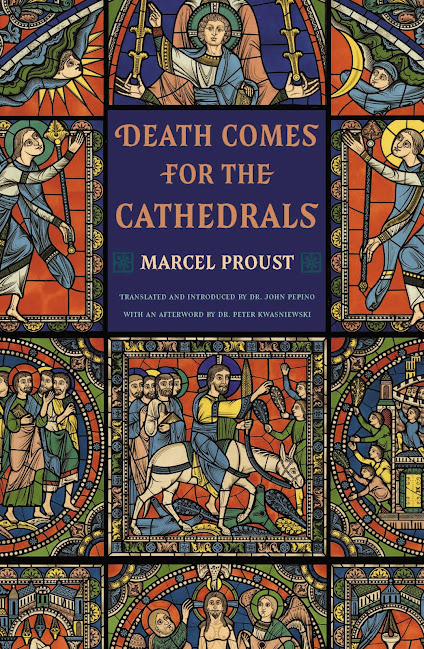
In keeping with recent news about Notre Dame Cathedral, it's worth mentioning a beautiful new title just released by the Catholic publisher Wiseblood Books: Death Comes for the Cathedrals.

The heart of this book is a translation of Marcel Proust's influential 1904 essay in Le Figaro that brilliantly argued, from a cultural and philosophical viewpoint, against the total secularization of churches in France, and led to less extreme measures being taken by the French anticlerical government. This eloquent translation by John Pepino made its first appearance here at Rorate Caeli on January 13, 2015.

THE DEATH OF CATHEDRALS - and the Rites for which they were built
- by Marcel Proust (full English translation)

Notre-Dame d'Amiens in the 19th century
It is not a common event for a blog to publish a full translation of a great text of a major literary figure over one hundred years after its original publication, being able to claim it as a new event. Yet, this is just such a case.

On August 16, 1904, Marcel Proust had a major article published in the French paper of record, Le Figaro, called "La mort des cathédrales" (The Death of Cathedrals). The debate was raging in French political circles as Atheists and Freemasons, against the largely majoritarian sentiment of the population, pushed through Parliament the unilateral abrogation of the Napoleonic Concordat and the complete secularization of the French Republic (what would become the 1905 "Law of Separation" - for the appropriate Catholic view on the issues involved and its aftermath, read Saint Pius X's encyclicals on the issue, Vehementer Nos,  Gravissimo officii,  Une fois encore - and Pius XI's 1924 encyclical Maximam gravissimamque settling the matter). An important part of the debate was what exactly would happen to the upkeep and life of the highest point of French art and civilization, the Cathedrals.

Proust, an Agnostic in practice, but who never denied or stopped admiring his own Catholic roots and upbringing, could not stand in silence. Cathedrals as mere monuments, without the Traditional Catholic rites for which they were built, did not make any sense. What he could not know, the poor man, whose passion for the traditions and rites of the Church is palpable in the article, is that the Church herself would destroy and wipe out from most Cathedrals the venerable rites for which they were created. But, slowly and surely, they will return. As in Chartres in last year's ordinations for a traditional Fraternity. As in the occasional traditional Mass (such as the simple Mass celebrated each Sunday in that first Gothic jewel, Noyon). They will return.

Our deepest thanks to Prof. John Pepino for the remarkable translation of a landmark article, made especially for Rorate.

***

THE DEATH OF CATHEDRALS
Marcel Proust
Le Figaro
August 16, 1904

A Consequence Of the Briand Bill 
On the Separation of Church and State

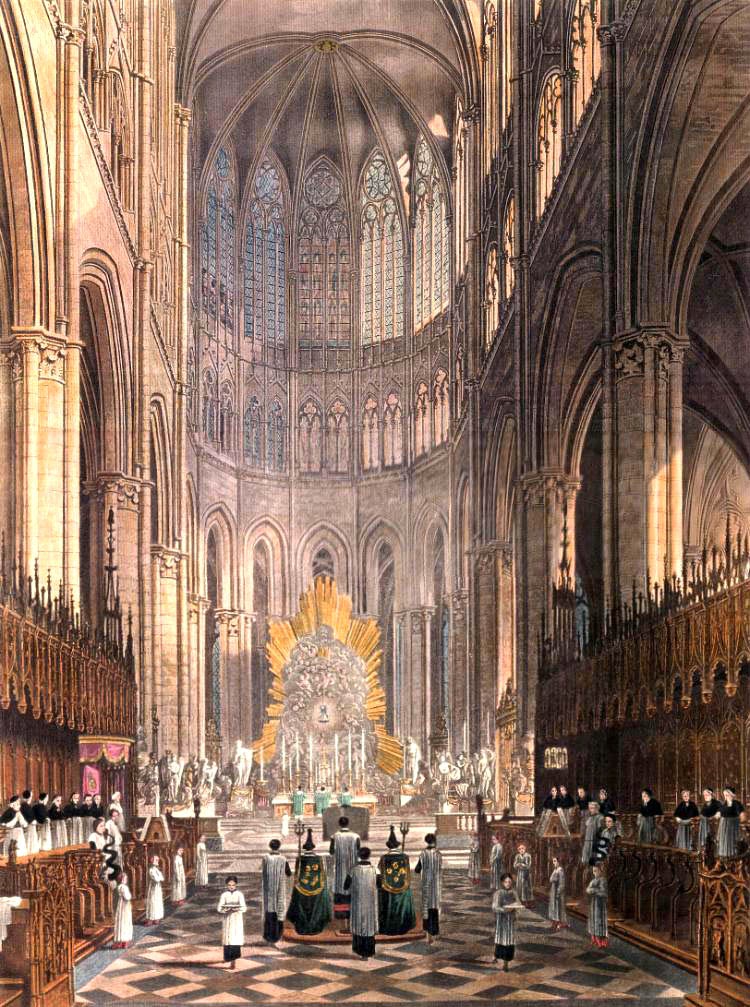
Suppose for a moment that Catholicism had been dead for centuries, that the traditions of its worship had been lost. Only the unspeaking and forlorn cathedrals remain; they have become unintelligible yet remain admirable.  

Then suppose that one day scholars manage, on the basis of documentary evidence, to reconstitute the ceremonies that used to be celebrated in them, for which men had built them, which were their proper meaning and life, and without which they were now no more than a dead letter; and suppose that for one hour artists, beguiled by the dream of briefly giving back life to those great  and now silent vessels, wished to restore the mysterious drama that once took place there amid chants and scents—in a word, that they were undertaking to do what the Félibres have done for ancient tragedies in the theatre of Orange.[1]


Notre-Dame de Chartres
                Is there any government with the slightest concern for France’s artistic past that would not liberally subsidize so magnificent an undertaking? Do you not think that it would do what it did in the case of  Roman ruins for these cathedrals, which are probably the highest, and unquestionably the most original expression of French genius? After all, one may well prefer the literature of other peoples to ours, prefer their music to ours, their painting and sculpture to ours, but it is in France that Gothic architecture created its first and most perfect masterpieces.  All other countries have done is to imitate our religious architecture without ever matching it.

                And so, to return to my hypothesis, here come scholars who have been able to rediscover the cathedrals’ lost meaning. Sculptures and stained-glass windows recover their significance, a mysterious odor once again wafts in the temple, a sacred drama is performed, and the cathedral starts to sing once more.  When the government underwrites this resurrection, it is more in the right than when it underwrites the performances in the theaters of Orange, of the Opéra-Comique, and of the Opéra, for Catholic ceremonies have an historical, social, artistic, and musical interest whose beauty alone surpasses all that any artist has ever dreamed, and which Wagner alone was ever able to come close to, in Parsifal—and that by imitation.

The Traditionalist: The Keeper of the Gifts

by Alessandro Gnocchi
[Italian daily] Il Foglio
November 6, 2014

[Notre-Dame de Chartres Cathedral, June 28, 2014]

***

Traditionalist, yes, but not distant from the world,
as some of us would like to be in times of ruin and destruction.

Talking about the Traditionalist is a little like seventy years ago when Leo Longanesi said “Let’s talk about the elephant.” (1) The intellectual bad habits of Italy straddling between fascism and anti-fascism were always the same; anyway, Italy was a little Catholic, Apostolic and Roman, greatly resembling the Church of today, which anyway, is always a little Italian. At that time, Longanesi made mockery of the quirks and hypocrisies of an intellectual class that liked showing off in exotic discourses and loved “talking about the elephant” instead of the destruction of which it was both the victim and the perpetrator. Similarly, a great show is put on in today’s Church, by those who prefer “talking about the traditionalist”, instead of acknowledging the superficial atmosphere of self-demolition, in which, as the saying goes, “they are both singing and carrying the cross.”(2)

It’s easy to say “traditionalist” with the same levity as Longanesi said: “Gentlemen, let’s talk about the elephant” - said the ineffable gentleman - “it’s the only animal of a certain importance that we can safely talk about without risk, these days.”

Yet the traditionalist, if we really want to know him, is not an animal you talk about resorting to banality. He is not the one reviled in the sermons and tischreden [little speeches at the table] of [the papal household of Casa] Santa Marta; he is not the one of the windbags in the press reviews of the mass-media; he is not the one of the sociology-lovers hanging onto the fleeting instant of doctrines which are in continuous evolution; he is not the one of the bishops who issue pitiful decrees of excommunication against the faithful who dare to attend the Mass of Ages. He is not any of these things and others more besides.

The traditionalist is not at all what he seems. He is in ‘mysterious and inalienable intimacy’ with the thing he no longer possesses, he is a haven for the bond between heaven and earth in times of an oblivion dictated by worldly desires that infiltrated into the temple: it is his very own poverty and his very own solitude that create a place for soul and flesh to encounter greatness and wretchedness, salvation or perdition. The rock on which he can save himself or be shipwrecked is the evangelical life in the world - without being of the world.