Rorate Caeli
Showing posts with label This is the Mass. Show all posts

Book review - Nothing Superfluous: An Explanation of the Symbolism of the Rite of St. Gregory the Great

By Mrs. Adfero


If there was ever a book for our times, it is Nothing Superfluous: An Explanation of the Symbolism of the Rite of St. Gregory the Great by The Rev. James W. Jackson, FSSP. 

We have found ourselves in a pivotal moment in history as we watch the COVID-19 pandemic unfold.  We are deprived of assisting at the Mass in a Church.  We are isolated from one another.  We find ourselves depending upon the fickle internet on our technological devices to connect with one another and to help us fulfill the Sunday obligation we hold so dear. 

With so much anxiety, uncertainty, and an onslaught of information regarding the coronavirus crisis, Nothing Superfluous will bring you calm and a deeper, richer appreciation for the Mass, “A Pearl of Great Price.” Written plainly and clearly, as for an adult education class, it does not intimidate with lofty academic language, making the information in this book accessible for all. 

The symbolism in this book of the Rite of St. Gregory the Great is stunning.  Fr. Jackson does not leave anything out – from the reason we use the Latin language in the Mass, which many may know, to the symbolism of the cavity of the bell, which many may not know.

Exactly! First Things compares Novus Ordo to the Protestant Revolt

For those paying attention, First Things has had a lot to say lately, so much of it timely and important. In the following piece, that we find fitting to bring to our readers' attention, not only do they rightly compare the Novus Ordo to the Protestant Revolt, but credit the saving of the Roman Rite to Archbishop Marcel Lefebvre. 


RETURN TO FORM

A CALL FOR THE RESTORATION OF THE ROMAN RITE

The times in which a new form is born are extremely rare in the history of mankind. Great forms are characterized by their ability to outlive the age in which they emerge and to pursue their path through all history’s hiatuses and upheavals. The Greek column with its Doric, Ionic, and Corinthian capitals is such a form, as is the Greek tragedy with its invention of dialogue that still lives on in the silliest soap opera. The Greeks regarded tradition itself as a precious object; it was tradition that created legitimacy. Among the Greeks, tradition stood under collective protection. The violation of tradition was called tyrannis—tyranny is the act of violence that damages a traditional form that has been handed down.One form that has effortlessly overleaped the constraints of the ages is the Holy Mass of the Roman Church, the parts of which grew organically over centuries and were finally united at the Council of Trent in the sixteenth century. It was then that the missal of the Roman pope, which since late antiquity had never succumbed to heretical attack, was prescribed for universal use by Catholic Christendom throughout the West. If one considers the course of human history, it is nothing short of remarkable that the Roman Rite has survived the most violent catastrophes unaltered.

Crisis in the Church: "The Mass, Prayer, the Rosary — nothing else can avail"

Monsignor Robert Hugh Benson 

Persecution, he said, was coming. There had been a riot or two already. But persecution was not to be feared. It would no doubt cause apostasies, as it had always done, but these were deplorable only on account of the individual apostates. On the other hand, it would reassure the faithful; and purge out the half-hearted.

Sermon: "The Celebration of the Traditional Roman Mass is a Prophetic Statement"


Sermon for the 14th Sunday After Pentecost, 2015
Fr. Richard G. Cipolla

Yesterday was the feast day of the Beheading of St. John the Baptist.  I would like to say that there are very few people who do not know the details of the story surrounding the beheading—which actually has a proper English word derived from the Latin—the “decollation” of St. John the Baptist.  But we live in a culture in which stories from the Bible no longer form an integral part of the culture. It would be interesting to do a survey in Grand Central Station at rush hour and ask people if they have ever heard of the Beheading of St. John the Baptist, or even, whether they have heard of St. John the Baptist. 

But those possessing an aesthetic sensibility would know about this event, for the story, with its lurid details, has been the basis of paintings by artists from Fra Lippo Lippi to Titian and Caravaggio.  Oscar Wilde’s play in French called Salomé, which he (of course) wrote before his death- bed conversion, was notorious in its day.  The script was made into an opera by Richard Strauss that still plays in opera houses throughout the world, its most famous scene being the Dance of the Seven Veils.

Why do we celebrate this feast?  We celebrate this feast for the same reason we celebrate the birth of John the Baptist in June as a first class feast.  Because of who he is in salvation history.  John the Baptist is not only the forerunner of Christ. He who comes out of the desert preaching repentance for sin is the last of the prophets, that majestic line including Moses and Elijah and Jeremiah and Isaiah and Zephaniah and Malachi.  And the role of the prophet was to speak the word of the Lord God to his people and, most often, to tell the people that they had turned their backs on the law of God and were sinning grievously and if they did not repent, terrible things would happen to them.  Most of the prophets were reluctant to take on this mantle.  Moses demurred on the basis of a speech impediment, Isaiah claimed unworthiness, Jonah tried to get out of it by running away by ship-- with disastrous results.  The calling of Jeremiah is one of the most moving of prophetic callings:

God bless your soul, Alaister: may you rest in peace!

Mr. Alaister Lim was a young parishioner and occasional altar server at the Bl. John Henry Newman Parish (exclusively dedicated to the Traditional Latin Mass), in Melbourne, Australia.

This was his departing letter to his pastor and priests, and fellow parishioners:

June 11, 2015

Dearest Reverend Fathers Tattersall, Marshall, and McDaniels; brothers and sisters of the Newman Parish in Christ,

It is with great sadness that I say goodbye to you through this letter, and not in person. My health is rapidly deteriorating, at this time, after an X-ray scan, I have only half a functioning left lung, all else defective (my lungs, not the rest of my organs!). This means I cannot travel great distances, as the trip would be way too taxing on me.

Dear Fathers, your spiritual guidance has strengthened my faith so much, I’ve said many times that I’ve learned so much more about my faith in my one and a half years there than I did in my entire life, and I mean every word of it. Thank you for all you’ve done for me, the Masses you’ve offered for me, for the honour of letting me serve your Masses, and also for your friendship. May God bless all of you abundantly for the good works that you do.

The Glory of the Low Mass - Together with the Martyrs in the Catacombs

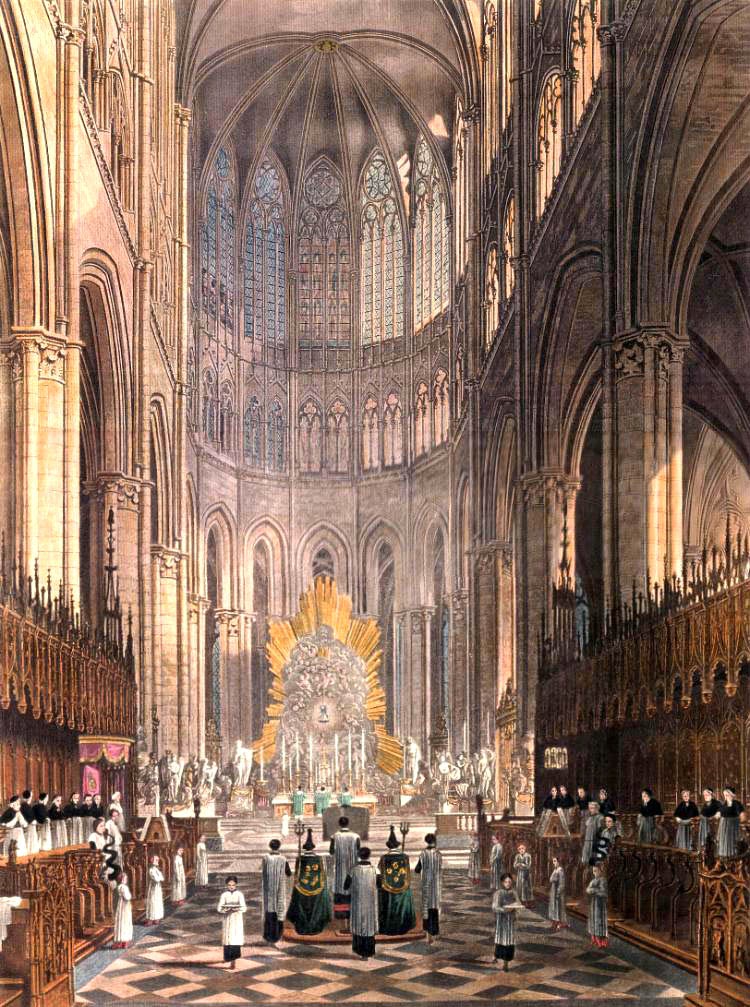
The tiny transept had its little altar, with a Greek cross in relief against a purple disk. Overhead the enormous curve of the vaulting hung heavy, and so low that a man could touch it by stretching an arm; it was as black as the mouth of a chimney, and scorched by the fires that had consumed the cathedrals built above it.

Presently the clap-clap of sabots became audible, and then the smothered footfall of nuns; there was silence but for sneezing and nose-blowing stifled by pocket-handkerchiefs, and then all was still.

This is the Mass: Hanc igitur...

click for larger view
Easter Mass celebrated by the prefect of studies of the Wigratzbad Seminary (Fraternity of St. Peter), Fr. Leclère, in the Opfenbach parish church, near the Seminary. (Source)

THE DEATH OF CATHEDRALS - and the Rites for which they were built
- by Marcel Proust (full English translation)

Notre-Dame d'Amiens in the 19th century
It is not a common event for a blog to publish a full translation of a great text of a major literary figure over one hundred years after its original publication, being able to claim it as a new event. Yet, this is just such a case.

On August 16, 1904, Marcel Proust had a major article published in the French paper of record, Le Figaro, called "La mort des cathédrales" (The Death of Cathedrals). The debate was raging in French political circles as Atheists and Freemasons, against the largely majoritarian sentiment of the population, pushed through Parliament the unilateral abrogation of the Napoleonic Concordat and the complete secularization of the French Republic (what would become the 1905 "Law of Separation" - for the appropriate Catholic view on the issues involved and its aftermath, read Saint Pius X's encyclicals on the issue, Vehementer Nos,  Gravissimo officii,  Une fois encore - and Pius XI's 1924 encyclical Maximam gravissimamque settling the matter). An important part of the debate was what exactly would happen to the upkeep and life of the highest point of French art and civilization, the Cathedrals.

Proust, an Agnostic in practice, but who never denied or stopped admiring his own Catholic roots and upbringing, could not stand in silence. Cathedrals as mere monuments, without the Traditional Catholic rites for which they were built, did not make any sense. What he could not know, the poor man, whose passion for the traditions and rites of the Church is palpable in the article, is that the Church herself would destroy and wipe out from most Cathedrals the venerable rites for which they were created. But, slowly and surely, they will return. As in Chartres in last year's ordinations for a traditional Fraternity. As in the occasional traditional Mass (such as the simple Mass celebrated each Sunday in that first Gothic jewel, Noyon). They will return.

Our deepest thanks to Prof. John Pepino for the remarkable translation of a landmark article, made especially for Rorate.

***

THE DEATH OF CATHEDRALS
Marcel Proust
Le Figaro
August 16, 1904

A Consequence Of the Briand Bill 
On the Separation of Church and State

Suppose for a moment that Catholicism had been dead for centuries, that the traditions of its worship had been lost. Only the unspeaking and forlorn cathedrals remain; they have become unintelligible yet remain admirable.  

Then suppose that one day scholars manage, on the basis of documentary evidence, to reconstitute the ceremonies that used to be celebrated in them, for which men had built them, which were their proper meaning and life, and without which they were now no more than a dead letter; and suppose that for one hour artists, beguiled by the dream of briefly giving back life to those great  and now silent vessels, wished to restore the mysterious drama that once took place there amid chants and scents—in a word, that they were undertaking to do what the Félibres have done for ancient tragedies in the theatre of Orange.[1]


Notre-Dame de Chartres
                Is there any government with the slightest concern for France’s artistic past that would not liberally subsidize so magnificent an undertaking? Do you not think that it would do what it did in the case of  Roman ruins for these cathedrals, which are probably the highest, and unquestionably the most original expression of French genius? After all, one may well prefer the literature of other peoples to ours, prefer their music to ours, their painting and sculpture to ours, but it is in France that Gothic architecture created its first and most perfect masterpieces.  All other countries have done is to imitate our religious architecture without ever matching it.

                And so, to return to my hypothesis, here come scholars who have been able to rediscover the cathedrals’ lost meaning. Sculptures and stained-glass windows recover their significance, a mysterious odor once again wafts in the temple, a sacred drama is performed, and the cathedral starts to sing once more.  When the government underwrites this resurrection, it is more in the right than when it underwrites the performances in the theaters of Orange, of the Opéra-Comique, and of the Opéra, for Catholic ceremonies have an historical, social, artistic, and musical interest whose beauty alone surpasses all that any artist has ever dreamed, and which Wagner alone was ever able to come close to, in Parsifal—and that by imitation.

Benson at 100:
"The Mass, Prayer, the Rosary — nothing else can avail"

Monsignor Robert Hugh Benson 
died exactly 100 years ago, 
on October 19, 1914.

Persecution, he said, was coming. There had been a riot or two already. But persecution was not to be feared. It would no doubt cause apostasies, as it had always done, but these were deplorable only on account of the individual apostates. On the other hand, it would reassure the faithful; and purge out the half-hearted.

A Return to Sacrifice, in order to Save the Sacrament

Tintoretto, The Crucifixion (Scuola Grande di San Rocco)
_________________________

Editorial: Radicati nella fede, June 2014
Newsletter of the Catholic community of
Domodossola and Vocogno, Diocese of Novara, Italy

June is the month of Corpus Christi. It is the month of the great feast dedicated entirely to Our Eucharistic Jesus. As in all parishes, we too are preparing to celebrate it on Sunday 22nd of June, seeing that the Thursday of the Solemnity is no longer a feast day in Italy. We will celebrate it mainly, with a solemn procession after the sung Mass, by carrying the Most Sacred Host through the streets of the town.

This should be the most important procession of the year, since here we are not carrying a venerated statue of the Blessed Virgin Mary nor a saint or relic, but Jesus Himself, living and real in the Most Blessed Sacrament; living and real with His Body, Blood, Soul and Divinity. This procession should be the most solemn, filled with adoration and holy respect for Our Lord Who is passing by.

Certainly many will sense distinct melancholic thoughts arising: “it is no longer like this in our towns now, Corpus Christi can’t be celebrated as it once was; the streets used to be adorned and the sides along the way used to be covered with the most beautiful drapes; and do you remember the altar- stops? There was a competition to see who could make the most beautiful altar! And the people – how they used to kneel…! Yes, it’s no longer like that. Today, if all goes well, Corpus Christi is the procession of a small remnant of believers who still adore the Most Holy Eucharist. For Our Lady’s procession we can hope for one or two more Catholics – but for Corpus Christi…!”

These are all realistic considerations, but we would be wrong if we only complained without thinking about it all more deeply.

Why has the spirit of adoration been lost? Why do so many baptized souls not recognize the Lord passing by in the Sacred Host anymore?


Among the “conservatives” many will say that it was all caused by certain factors: a) the moving of the tabernacles in churches – from the altars they were relegated into some corner; b) genuflections are no longer made; c) receiving Communion standing and in the hand; d) the reduction if not the disappearance of Eucharistic fasting, etc...

All of which are true, but these are not the main causes – the real one is deeper.

It all began with the disastrous reform to the Rite of the Mass which followed the Second Vatican Council.

With the pretext of translating the Mass into the vernacular in 1969 - it was changed radically, practically re-made and purged of all the explicit references to the Propitiatory Sacrifice – in order to please the Protestants.

In fact, the Mass was increasingly transformed into a Holy Supper and this was done basically, so that the priests and the faithful [could] be nurtured at the “two tables” of the Word and the Body of Christ; in short, the Mass was done so as to have Communion.

So the central and determining factor of the Sacrifice of Christ disappeared from the everyday life of Catholics. It was for this Jesus instituted the Eucharist so that His sacrifice on the Cross be perpetuated - the sacrifice, which alone cancels sins and placates Divine Justice.

It is essential that each day in all the churches of the world, the Sacrifice of Christ be offered, so that the world may be saved from the abyss. What has this all got to do with the presence of Jesus in the Host, Adoration and Corpus Domini? It is simple. If the Mass is no longer intended as the oblation of Christ on the altar of the Cross, but is intended merely as a holy meal, the presence of Christ Himself is put at risk.

A great writer wrote:

“There are two great realities in the Mass, the sacrifice and the sacrament. These two great realities are fulfilled at the same instant, at the moment when the priest pronounces the words of consecration over the bread and wine. When he finishes the words of consecration of the Precious Blood, the Sacrifice of Our Lord is fulfilled and Our Lord is also present at the that moment, as is the Sacrament of Our Lord as well. […] This mystical separation of the species in the bread and wine fulfills the sacrifice of the Mass. Thus, these two realities are achieved at the consecration. They cannot be separated. And this is what the Protestants did; they simply wanted the sacrament without the sacrifice. This is the danger of the new Masses. Sacrifice is no longer spoken of; it seems that sacrifice has been set aside. You only hear talk about the Eucharist, and having a “Eucharist” as if it were merely a meal. The risk is present that we have neither one nor the other. It is very dangerous. In the measure that the sacrifice disappears, the Sacrament also disappears, since it is the Victim Who has been presented in the Sacrament. If there is no sacrifice there is no Victim.”

“If there is no sacrifice there is no Victim.” These are strong but very logical words which conform to the faith. Without entering into extremely delicate sacramentary reflections we can easily say, that what has happened in the lives of Catholics is this: the obscuring of the sacrificial character of the Mass has caused the loss of awareness of Christ’s substantial presence in the Sacrament.

The Old Mass meets the emphasis of the propitiatory Sacrifice of Christ’s substantial presence in the Sacred Host.

The New Mass meets the emphasis of the Eucharistic banquet, Holy Communion, and – strangely enough – the almost complete disappearance of the spirit of adoration.

It is not a coincidence: if there is no Sacrifice, there is not even a Victim – and Jesus is not present.

This is why it is a mistake to curtail the liturgical disaster with some simple work of “maquillage”, by perhaps bringing the exterior signs of adoration back – incense, candles, altar rails and kneelers, nocturnal adoration, but with no concern [however] of a return to the correct rite of the Mass i.e. the Mass of Tradition.

Those who stop at exterior signs are making a mistake, when they occupy themselves with a vague sentiment of tradition and play merely with aesthetics which deceive.

The answer is a return to the complete Catholic clarity of the Propitiatory Sacrifice expressed in the right Mass.

A return to the right Mass will rectify the procession of Corpus Christi as well and [even] before that, it will rectify the lives of Christians who are called to participate in the Sacrifice of Christ with every fiber of their being.

[Translation: Contributor Francesca Romana]

"When you have lifted up the Son of Man,
then you will know that I am He."

Sacrifice demands tranquility: including at Holy Mass

"When you have lifted up the Son of Man, then you will know that I am He, and that of Myself I do nothing; but that I preach only what the Father has taught Me. And He Who sent Me is with Me; He has not left Me alone, because I do always the things that are pleasing to Him." (Gospel for Monday following the II Sunday in Lent, St. John viii, 28-29)
___________________________________

Today, a meditation on the tranquility of Christ, the High Priest, as He offers His Sacrifice of His own Self:


On the eve of His death,... Our Lord sweats, trembles and shudders at the terrible vision of His torture that rises before Him; but when His heavy troubles have actually come upon Him, He seems to be another man, to whom torments are indifferent. He talks quietly to the happy thief; He looks upon and recognizes all those of His own people who are at the foot of the Cross, speaks to them, and comforts them; and, at last, seeing that He has accomplished all He had to do, and carried out the Will of His Father in every particular, He gives up His Soul to Him in such a peaceful, free and deliberate manner that there can be no doubt of its being His own act. It is just as He had said: "No man taketh it away from Me, but I lay it down of Myself!"

... [T]he reason probably is that the scheme of our redemption was necessarily a work of strength and weakness combined. Christ wished to show by His fears that, like us, He felt trouble keenly; while by His firmness He had to prove that He could perfectly master His feelings and make them yield to His Father's Will. Such is the reason of our Redeemer's attitude at this supreme moment, given by Saint John Chrysostom; and doubtless it is a solid one. Yet other reasons too may be found; and I venture to suggest one (...).

I think we may believe that one most probable cause of Our Lord's peace on Calvary, when the Mount of Olives had witnessed His agony, was the fact that the Cross on Mount Calvary found Him in the very act of His Sacrifice, and there is no action in the world that should be performed in so calm a spirit as this one. Those who let their thoughts wander here and there without restraint, according as curiosity or inclination suggest, while present at the Holy Sacrifice of the Mass, cannot have the least idea of what Sacrifice means.

Sacrifice is an act by which we offer our homage to God; and who does not know that any act of respect demands a quiet and collected demeanor? It is the very nature of respect to require this, God sees into the depth of all hearts, and holds us to be wanting in due respect for His majesty when our souls are uncontrolled and distracted in His presence. How important, then, that the High Priest who actually offers the sacrifice should do so with a perfectly calm mind! The oil with which Aaron is anointed, that symbol of peace poured so abundantly over his head, is in fact intended to warn him of the peace that he should attain to in his own mind and heart by banishing every distracting thought and feeling.

Hence it was, we cannot doubt, that Our Divine Pontiff Jesus Christ showed Himself so perfectly calm in His death-agony. If He had appeared troubled on Mount Olivet, it was, says St. Augustine, a voluntary anguish that He suffered, for only by his own will could it affect Him, and for this reason: He was then, in His own eyes, simply the victim, and He willed to behave as a victim. Therefore He adopted, if we may be allowed to say so, the very actions and posture of a victim which was being dragged, terrified and shuddering, to the altar.

But on the Cross it is quite otherwise. He it now at the altar, as Priest; and from the moment that His innocent hands have been raised to present Himself as our victim to the Wrath of Heaven, He is exercising His priestly function, and He will allow no more fear to be seen lest it should imply any repugnance for the sacrifice. His Divine Will, to which all His emotions are subject, prevents the peace of His Soul from being troubled and represses all outward sign of anguish; and thus we are made to understand that our most merciful High Priest offers Himself for us quite freely and from pure love of our salvation. According to St. Augustine, again, "He dies as gently as we might go to sleep".

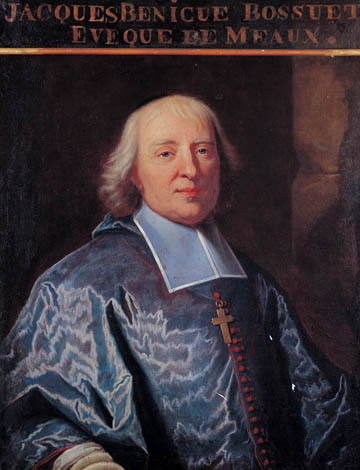
Jacques-Bénigne Bossuet
Sermon sur la Compassion de la Sainte Vierge

Traditional Mass, the Mass of all Times and Places

Requiem Mass 
celebrated for the fallen soldiers of Free France
in the Western Desert Campaign
in the presence of Generals de Larminat and Kœnig
Jan. 1944

This is the Mass


Solemn Requiem Mass
for the 220th anniversary of the death of Louis XVI
Parish Church of Saint Eugene,  Arch. of Paris
January 21, 2014

At the Altar at the Ninth Hour. Silence and Solitude of Golgotha: Assisting at the Traditional Mass

By Antonio Margheriti  Mastino


There are two facets in particular that afford us a deeper understanding of the Mass, especially according to the Extraordinary Form, which I personally prefer:  silence and solitude.  The altar, before, during and after the Sacrifice is covered in silence. And by solitude: that of the celebrant, the “Alter Christus.”

But how can this be, one will say, since Easter and therefore the celebration are triumphs?  That is true.  But the celebration of the Mass is also the re-presentation of the Passion and Death of Christ, which unfolds in silence, in solitude, in betrayal, in denial, in the flight of the disciples.  At the Last Supper Christ is betrayed and sold by Judas. In the Garden of Olives on the night before his death Christ is left alone to sweat blood, while his disciples sleep instead of praying with him, the only thing he had asked of them.  On that same night Peter denies him three times. No one tries to save him, no one offers to bear the burden of his cross even for a while (the Cyrenian was forced to do this).  No one seems to know him or recognize him.

Christ, in a moment of truly human pain, cries out in a loud voice to his God, to Abba, the abyss of wretchedness and aloneness into which he plunges in stillness.  “Aloneness”.  The same aloneness that the priest, the Alter Christus, experiences in that moment on the altar of the Supreme Sacrifice, the renewed Golgotha, where in a real way and once again the Passion of Christ breaks through. The priest is alone at the altar.  And to this aloneness is joined the protecting shade of aloneness:  silence. On the desolate hill of Golgotha,  first in the Garden and then as well in the tomb, Christ is alone and in silence: the silence of his obedience, of the chalice of bitter woe, of the sweat mingled with blood.  And this is the silence of powerlessness, a powerlessness that for a moment seems even that of God.  “My Father, Abba, why have you abandoned me?” The “silence” of God, in this moment when the wave of the abyss is breaking over Christ, seems almost like the sinking of Divinity into nothingness.

But it is also the powerlessness and the desolation that comes from the first and eternal “Yes” in obedience from Mary at the foot of the Cross, in accepting this Son that was not for her to keep: “Stabat Mater dolorosa…” This is the fearful silence that was experienced by the wonderful St. Thérèse of Lisieux on her death-bed, when she cried out, in that final moment of agony and darkness, that she had no sense of the presence of God.

Silence.  Just as the disciples were silent, just as Mary was silent, all of whom loved Christ as man and Messiah.  There was silence at the foot of the Cross. There was silence where the others hid.  There was silence because of obedience. There was silence because of cowardice.  They were silent, transfixed by pain. They were silent in confusion. Or because in the end things “had to turn out” in this way….All stood in silence.  They just stood there:  at the Passion and Death of the Son of God.  For the same reason, at the Mass of Sacrifice, the faithful should not “participate” but "assist", by keeping watch in silence, in that silence that cloaks the priest while he offers the Sacrifice of Christ and of himself.  And they must be in a state of active acceptance, they must offer their support of what is not penetrable, the miracle that, as the Messiah promised, he has not left us as orphans.


But what of the Resurrection?  It is the triumph, that is true.  But it is a triumph lived out in hiddenness, by a God without arrogance. It happens yet again, but in silence and solitude.  Within the tomb of stone, at night, no one there, except for the soldiers guarding the entrance.  In the same manner, in the lowered voice, in the silence that lies hidden in the depths of the words of the priest, the “Alter Christus” at the altar of Sacrifice, the Resurrection will once again be present.  In silence and aloneness.


And so we see the “why” and the “how” of what it means “to be at Mass”, how one “assists” at the Holy Sacrifice of the Mass, the Missa antica.  This is far from the shouting and the applause, far from the freneticism and the syndrome of wanting to be the center of attention, far from the crackling and sound-warping microphones, far from the flood of frigid phraseology, and far from the reformed Mass in the style of the 1970s, a decade full of tiresome rhetoric laced with populists slogans that in the end are of no use to anyone of any time, one of the worst decades ever lived through on the face of the earth. 


Translated by Father Richard G. Cipolla

Source:  “La Cuccia del Mastino", January 14, 2014

This is the Mass

Holy Mass for the 25th Anniversary of the Fraternity of Saint Peter
Saint-Sulpice, Paris
November 16, 2013