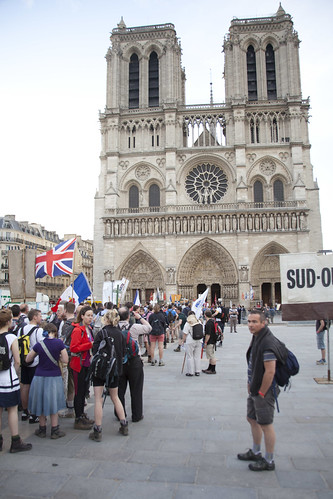
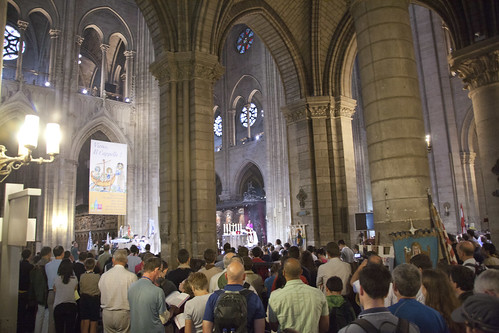
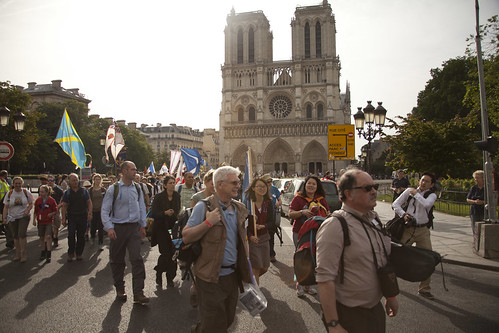
The Chartres Pilgrimage is complete for another year, and the pilgrims have a chance to recover, upload their photographs, and blog about it.
Counter Cultural Father was there; the
official photos are available; I've had a problem with most of mine (cough), so I'll be pinching other people's; these are from
Notre Dame de Chrétienté, the organisers.

It is quite simply the biggest event of the traditional Catholic calendar. Depending on where you start from, the Camino to Compostella is likely to be a lot longer, but the Chartres Pilgrimage is a single, huge movement of people on the same pilgrimage, attending the same Masses, blessed together at the beginning and the end. The sense of solidarity with so many thousands of other pilgrims is extraordinary. We fill every inch of Notre Dame de Paris at the beginning, and overflow into the square in front of Notre Dame de Chartres at the end.

For various reasons (including economic ones, I suspect) numbers have fallen in recent years; I think this is an event which should be supported with more vigour internationally. One of the founding organisers of the Australian 'Christus Rex' pilgrimage said to me that the it was valuable to have an event each year which acted as a 'gathering of the tribe' for the Traditionalist community in Australia. The Chartres Pilgrimage does that for France, but also for the whole world. Traditional Catholics need an opportunity to meet others from other parishes and nations, served by different orders or dioceses, and sustained by distinct traditions of popular piety, to sing together, to share experiences, to grow in mutual understanding and respect.

There is something uniquely and wonderfully Catholic about the pilgrimage. The different national flags and banners in honour of the patron saints of the different groups, the variety of songs and devotions, all united in one great religious act. In what other context, than a Catholic one, could one see a German flag the size of a football pitch (so it seemed) march across the French countryside, not only in peace, but in solidarity with a French pilgrimage and for the conversion of France?