Rorate Caeli

IF this is true, one cannot help but think...

...that a bit of research on the Internet might actually have averted this appointment.

From Sandro Magister's latest column: The school of Bologna gets its own Cardinal.


But let's get back to Archbishop Tagle, who, as soon as he was appointed to Manila, was immediately honored with the title of "new papal contender" by vaticanista John L. Allen of the progressive American weekly "National Catholic Reporter."

It was Allen himself who emphasized how Tagle, after being a student of the theologian Joseph Komonchak of the Catholic University of America, joined the team of scholars put to work by Alberto Melloni and his mentor, Giuseppe Alberigo – both disciples and successors of Fr. Giuseppe Dossetti – on their controversial history of the Council. In the fourth volume of this history, published in 1999 and dedicated to the turbulent conciliar period of the autumn of 1964, it is Tagle who signs the key chapter, the one dedicated to the "storm in November: the black week."

Si, there is life beyond the financial crisis - and beyond the Euro.

Contributor Francesca Romana translates and sends us this text by Paolo Deotto, of Riscossa Cristiana.


Your Eminence,

The recent developments in the Italian political situation bring to light great confusion and general disorientation. The excessive emphasis on economic problems, even if important, could cause us to lose sight of the great dangers impending over our nation, which, given the disconcerting international panorama, still manages to maintain considerable fidelity to its Christian roots. The European Union, established for economic purposes, has, over the years, become clearly anti-Catholic, which in diverse nations has translated into legislation that distorts the foundations of the family and of society, legalizing behaviours absolutely incompatible with Catholic morality and foreboding only disaster.

A Filipino Archdiocese to the SSPX: "You remain excommunicated in conscience because of doctrinal error"

The Archdiocese of Davao, one of the largest dioceses of the Philippines, has been involved in an acrimonious public debate with the Society of St. Pius X in the past several weeks -- a story that will be told in full in the next few days here on Rorate. For now, we present to our readers the latest open letter of the Archbishop of Davao to the SSPX. (Click on the images to be able to read them. A transcription of the letter has been added to this post, below the images.)


Upcoming event: Abp. Thomas Wenski to offer Pontifical Mass

From the blog of Eric Giunta:

In case there was any doubt that the Catholic Reformation is proceeding apace in South Florida, look no further than the fact that, less than a year-and-a-half after his installation to the See of Miami, Archbishop Thomas Wenski has announced that he will be celebrating a Pontifical High Mass at Miami’s Church of the Epiphany (7:30pm) on 2 February 2012, Feast of the Presentation of Jesus at the Temple.

Is the Church collapsing under its "business model"?...

A post by Father Ray Blake which is worth re-posting in its entirety; in this month of the Holy Souls of Purgatory, it is worth remembering that justice transcends this earthly life (if only those who should act as overseeing fathers above all act as mere administrators - and are not very good at that, either - understood that).

All Christians should be concerned about Justice, about living justly, about doing what is right. It is truly scandalous when the Church of the Living God is seen to be less than just.

Recently I was shown a ranting mad letter from a Bishop to one of his priests, which basically said, "I cannot be bothered to read what you have written or to listen to what you have to say or to investigate what you are accused of but whatever it was it was wrong and hate filled", it actually wasn't, it was a gentle argument trying to explain the faith.

The SSPX and Ecclesia Dei communities

Saint Damien of Molokai, 49, near the end of his earthly life"They that 
are well have no need of a physician, but they that are sick." (Mk ii, 17)

From a November 2011 bulletin of a local house of the French district of the Priestly Fraternity of Saint Pius X (FSSPX / SSPX), made available in the district website (tip: Fecit Forum):

Democracy - but inasmuch...


The Church values the democratic system inasmuch as it ensures the participation of citizens in making political choices, guarantees to the governed the possibility both of electing and holding accountable those who govern them, and of replacing them through peaceful means when appropriate. Thus she cannot encourage the formation of narrow ruling groups which usurp the power of the State for individual interests or for ideological ends.

... [I]f there is no ultimate truth to guide and direct political activity, then ideas and convictions can easily be manipulated for reasons of power. As history demonstrates, a democracy without values easily turns into open or thinly disguised totalitarianism.

...
Even in countries with democratic forms of government, these rights are not always fully respected. Here we are referring not only to the scandal of abortion, but also to different aspects of a crisis within democracies themselves, which seem at times to have lost the ability to make decisions aimed at the common good. Certain demands which arise within society are sometimes not examined in accordance with criteria of justice and morality, but rather on the basis of the electoral or financial power of the groups promoting them. With time, such distortions of political conduct create distrust and apathy, with a subsequent decline in the political participation and civic spirit of the general population, which feels abused and disillusioned.

John Paul II
Centesimus Annus

_______________________________________

From this class war there result frequent interruptions of work, the causes for which most often can be laid to mutual provocations. There result, too, revolutions, riots, and forcible repression of one side or other by the government, all of which cannot but end in general discontent and in grave damage to the common welfare.

To these evils we must add the contests between political parties, many of which struggles do not originate in a real difference of opinion concerning the public good or in a laudable and disinterested search for what would best promote the common welfare, but in the desire for power and for the protection of some private interest which inevitably result in injury to the citizens as a whole. From this course there often arise robberies of what belongs rightly to the people, and even conspiracies against and attacks on the supreme authority of the state, as well as on its representatives. These political struggles also beget threats of popular action and, at times, eventuate in open rebellion and other disorders which are all the more deplorable and harmful since they come from a public to whom it has been given, in our modern democratic states, to participate in very large measure in public life and in the affairs of government. Now, these different forms of government are not of themselves contrary to the principles of the Catholic Faith, which can easily be reconciled with any reasonable and just system of government. Such governments, however, are the most exposed to the danger of being overthrown by one faction or another.

Pius XI
Ubi Arcano Dei Consilio

Cloak of charity - cape of love

Today, 11 November, the Church remembers Saint Martin, Bishop of Tours, one of the most celebrated and venerated Saints of Europe. Born of pagan parents in Pannonia, in what is today Hungary, he was directed by his father to a military career around the year 316. Still an adolescent, Martin came into contact with Christianity and, overcoming many difficulties, he enrolled as a catechumen in order to prepare for Baptism. He would receive the Sacrament in his 20s, but he would still stay for a long time in the army, where he would give testimony of his new lifestyle: respectful and inclusive of all, he treated his attendant as a brother and avoided vulgar entertainment. Leaving military service, he went to Poitiers in France near the holy Bishop Hilary. He was ordained a deacon and priest by him, chose the monastic life and with some disciples established the oldest monastery known in Europe at Ligugé. About 10 years later, the Christians of Tours, who were without a Pastor, acclaimed him their Bishop. From that time, Martin dedicated himself with ardent zeal to the evangelization of the countryside and the formation of the clergy. While many miracles are attributed to him, St Martin is known most of all for an act of fraternal charity. While still a young soldier, he met a poor man on the street numb and trembling from the cold. He then took his own cloak and, cutting it in two with his sword, gave half to that man. Jesus appeared to him that night in a dream smiling, dressed in the same cloak.

Dear brothers and sisters, Saint Martin's charitable gesture flows from the same logic that drove Jesus to multiply the loaves for the hungry crowd, but most of all to leave himself to humanity as food in the Eucharist, supreme Sign of God's love, Sacramentum caritatis.
Benedict XVI
November 11, 2007

As is well known, the relic of Saint Martin's cape of charity, and the intense veneration given to it, were at the origin of the ubiquitous word "chapel" and its derivations. May this great Pannonian and Gallic - and, above all, Roman - saint intercede for Europe, East and West, forever.

The Roman Rite: Old and New - VII
The New Mass and the Cult of Men: liturgy "etsi Deus non daretur"

In the seventh installment of Don Pietro Leone's "The Roman Rite: Old and New", the author begins the second part of his study, trying to find out the deepest motivation for the New Roman Rite. What happens when a liturgical rite is based on the cult of man, instead of the religious worship of Almighty God - and how does it compare to the apostolic motivations of an immemorial rite?

____________________________________________


II

The Cult of God and the Cult of man


We proceed to search more deeply into the motivation for the New Rite. We do so by searching more deeply into its theology, namely Protestantism. Now the essence of Protestantism is subjectivism, as has been clearly demonstrated by Jacques Maritain in his book “Les trois Réformateurs” (Plon, 1925) in the chapter “Luther ou l’avénement du moi: Luther or the Coming of the Self” and by Paul Hacker in his book “Das Ich im Glauben bei Martin Luther. Der Ursprung der anthropozentrischen Religion: The Self in the Faith of Martin Luther: The Origin of Anthropocentric Religion” (nova & vetera, Bonn 2002). And subjectivism in the realm of liturgy amounts to the cult of man.
The Mass is the cult of God, the highest form of cult that exists, and both rites render this cult to Him. But whereas the Old Rite renders it in a way that expresses in a sublime manner this cult of God, the New Rite renders it in a manner that expresses the cult of man.
That the theology of the Old Rite relates to the cult of God and the theology of the New Rite relates to the cult of man is evident at the outset in the central conception that each has of the Mass: the conception of sacrifice in the first case, and the conception a community meal in the second. For this sacrifice is “the sacrifice of God, by God, to God” (in the words of St. John of the Cross), and this meal is the celebration of the community by itself.

Events: Talk this Thursday in Magdalen College, Oxford;
Requiem for the souls of Priests in Pennsylvania

1. 

At 8pm on Thursday, 10th November, Dr Brian Sudlow will give a talk titled, "A Reactionary Revolution? The Society of St Pius X and the Roman Catholic Church" in the Old Law Library of Magdalen College, Oxford. His remarks will be followed by questions and discussion. 

With Passing of Fr. Hopkins, Tradition Takes a Step Back in Miami


Fr. Timothy Hopkins, pastor of the National Shrine of St. Philomena in Miami, Florida, this week suddenly passed away at a young age. South Florida is not exactly a traditional Catholic stronghold, which means Fr. Hopkins' death will be felt hard, not just in Little Havana but in the region. Having assisted at one of Father's Masses, I can attest that they don't have much at the Shrine, but they have the Faith. The Shrine will now be run by the SSPX.

From Una Voce Miami:

+++ Fr. Timothy Alban Hopkins Leaves Us For Eternity +++

News of the death of Fr. Timothy, age 56, in an accident at home, has been a terrible shock to all who knew and loved this kindhearted and tireless Catholic priest. He was ordained a priest by His Grace, Archbishop Marcel Lefebvre and was a long-time friend of the Priestly Society of Saint Pius X. As a staunch defender of Christian Civilization and devoted shepherd of souls, Fr. Hopkins founded the National Shrine of Saint Philomena at 1621 SW 6 Street, Miami, FL 33135. The Shrine offers the Catholic faithful the Traditional Latin Mass. All who were touched by his piety, intellect, faith, and pastoral solicitude mourn him. Hewill be sorely missed.

The public viewing is from 3 PM to 7 PM, Sunday, November 6th, 2011 at the Shrine of Saint Philomena. The Requiem Mass is on Monday, November 7th, 2011 at 10 AM. Christian Burial will be immediately after the Requiem Mass at Little Havana’s Woodlawn Park Cemetery, 3260 SW 8 Street, Miami.

With the tragic passing of Fr. Hopkins on Wednesday, November 2, 2011, the National Shrine of Saint Philomena, founded by him in 1989, will come under the loving pastoral care of the North American District of the Society of Saint Pius X.

Resquiat in Pacem Fr. Timothy Alban Hopkins.

Eternal rest grant unto him O Lord and may Your perpetual light shine upon him. May he rest in peace. Amen.

Truly and fully Catholic

A guest-post by Côme de Prévigny

These past few days, several journalists, with intentions as diverse as they are contradictory, have put forward, based on a London letter, that the Priestly Fraternity of Saint Pius X would refuse the doctrinal preamble proposed by the Congregation for the Doctrine of the Faith on September 14. Considering that both parties had clearly indicated that no due date had been established and made clear that the text was modifiable and flexible, it seemed understandable that reservations could be entertained and that a time for reflection be assured. The journalists who were tempted by sensational declarations and deadlines jumped upon the most insignificant amount of information in order to create headlines, distort, and, in the end, to extrapolate. Far from being confirmed, the scoop was finally denied.

Within the work founded by Abp. Lefebvre, there is no superior who considers irregularity to be a glory or an honor. It is a situation that is tolerated, in which its members were placed from the day on which they were forbidden to keep the Traditional Mass and the catechism that goes along with it. Consequently, the refusal, as a matter of principle, of the betterment of the situation is not professed. The priests of Écône simply refuse to sign texts that would render the impression of giving a recognition to themes, such as religious liberty, that were recognized by experts of the Council as dissociated from Tradition.

There are prelates in Rome who would undoubtedly love to hear the Fraternity proclaim a definitive "no" to all these conversations, relations, discussions. They would wish to anathematize it forever and to see it lost in the hell of excommunicates - which they had, however, swore to keep empty! Faced with their motivations, the tenacious persistence of Benedict XVI, the same one that begot the Motu Proprio, despite episcopal rage, the one that suppressed the condemnations of the Fraternity, despite the violent campaign against him, should end with a sad confession: "I was mistaken...?" Should it be turned into that condemnation for which they are eager and which they expect? That would be ignoring a whole pontificate that began on December 22, 2005. While Bishops view as relative the most sacred dogmas, such as the Resurrection of the Lord, humiliate the Pope when he visits them, watch still as Protestants simulate sacraments in their presence, resist with all their strength the texts that the Pope proclaims motu proprio, those faithful before condemned to the graciousness of the juridical blunder that had been the prohibition of the eternal rite of the Latin Church would be relegated to the underclass simply because they professed the faith that goes with this liturgy, this same faith, firm and demanding, missionary and salvific, that Thérèse de Lisieux and Charles de Foucauld professed?

If the Fraternity, its priests, and its seminaries have lost the official canonical regularity, it was because, from 1975 onwards, Abp. Lefebvre continued celebrating the Tridentine rite. This rite being rehabilitated, it follows that its rescuers should also be. In a subtle manner, Cardinal Castrillón Hoyos, even before the removal of the excommunications, had recognized, regarding these complete Christians: "the communion exists". Mgr. Pozzo confirmed it in September 2011, by affirming regarding the Fraternity: "I would say simply that those who are truly and fully Catholic can live fully and properly in the Catholic Church wherever the Catholic Church exists and develops." It was to Peter that the power of binding and loosing was granted by Our Lord.

Confirmations in Germany


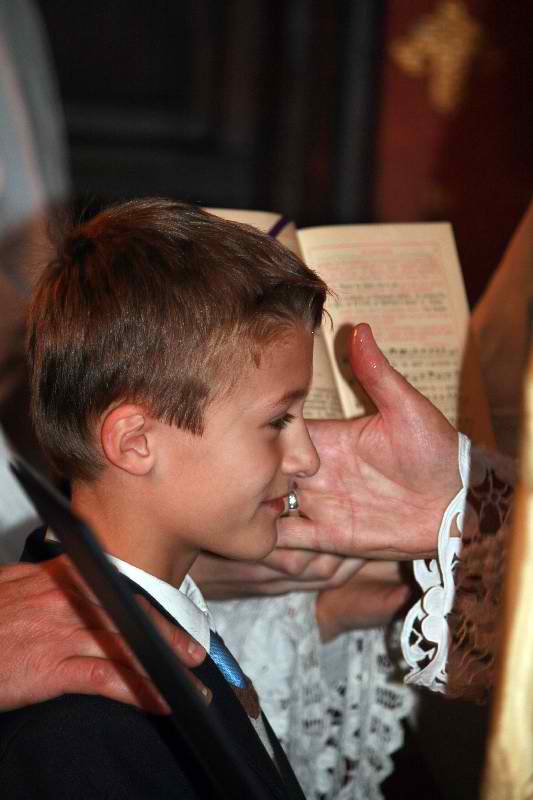
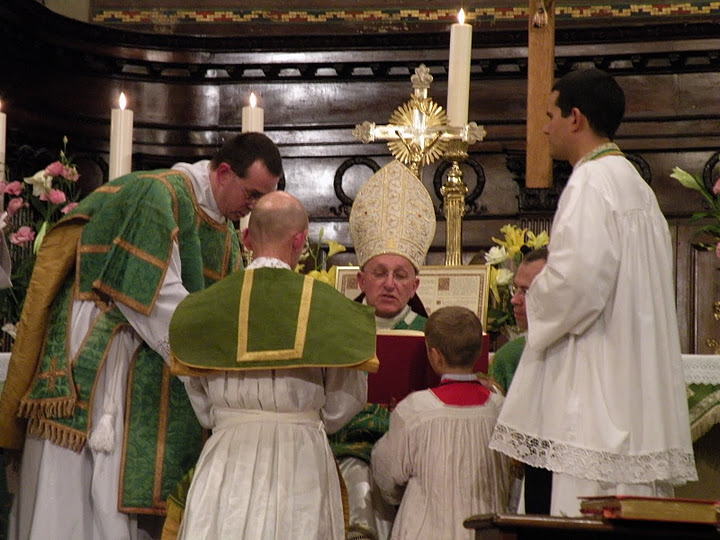
The German Catholic website Katholisches has a short article and a small photo-gallery on the Traditional Confirmations conferred by a retired auxiliary bishop of the Diocese of Münster, Friedrich Ostermann on November 6, 2011 in the St. Aegidii church of that same diocese. The Confirmations were followed by a Prelatical Mass. (St. Aegidii is one of the churches in that diocese where Mass according to the 1962 Missal is offered every Sunday).

Bishop Ostermann has conferred Confirmations according to the traditional Roman Rite since 2008, the year after his retirement.

Vatican II at 50: Apologies coming in A.D. 3011


"The traditionalists of the Council"

Dom Romain [cath.ch]

Isabelle Gaulmyn [a "Progressive" journalist], in La Croix, speaks of the celebrations of the 50th anniversary of the Council. As she correctly recalls, "in the nation where the Lefebvrist crisis originated [France] and where the number of faithful of the Fraternity of Saint Pius X, opposed to the Council, remains significant, the fifty-year anniversary of the Conciliar texts should lead to a deep reflection." However, her proposal of "...re-reading the texts of Vatican II, in light of the fifty years that have just ended," seems to me to go against "the hermeneutic of reform," the key of interpretation given by Benedict XVI in his address of December 22, 2005. To reread the texts in "light" (?) of the last fifty years of the life of the Church is to confine oneself to the conflicts and clashes that the author recalls in the beginning of her article.

Quite the contrary, what is needed is a return to the bimillenary teaching of the Church, in order to allow, not only the young people who do not know the Council, but also the aged ones who believe to have known it, to view the texts of Vatican II in the perspective of a just reform and not of a change of look. Moreover, the Council is not an end in itself! It is not for nothing that the Pope makes us enter, in the occasion of this celebration, in the year of the faith. The Council is an instrument at the service of the faith, as it has always happened in the life of the Church. To stop at the Council it to risk ignoring the faith, perhaps even of losing it...[sic] Beware of turning into the traditionalists-of-Vatican-II.

On the other hand, in the perspective of the "apologies" dating from the beginning of the third millenium, one can foresee a penitential ceremony for the conflicts, the clashes, the mutual condemnations, the anathemas which have marked these 50 last years of the life of the Church. ... Let us not wait another millennium so that others may admit guilt on our behalf.

Events: TLM at Franciscan Monastery in Washington, D.C.


Rorate Caeli Purgatorial Society (forty-eighth posting of souls)


Below, please find the forty-eighth posting of enrolled souls of the Rorate Caeli Purgatorial Society, which has 16 holy priests saying regular Traditional Latin Masses for the souls.

This week is a huge list, with over 1,000 souls enrolled.

How to enroll souls: please email me at athanasiuscatholic@yahoo.com and submit as follows: "Name, State, Country." If you want to enroll entire families, simply write in the email: "The Jones family, Ohio, USA". Individual names are preferred. Be greedy -- send in as many as you wish and forward this posting to friends as well. PLEASE follow this format strictly, as any deviation creates a lot of extra work.

Please consider forwarding this Society to your family and friends, announcing from the pulpit during Holy Mass or listing in your church bulletin. We need to spread the word and relieve more suffering souls.

Please pray for the enrolled souls and the 16 holy priests saying Traditional Masses for the Society:

Celebrating Assisi in Arras with the Koran on the Altar

In the Church of the Holy Savior (Saint-Sauveur), in the Diocese of Arras (Pas-de-Calais, France), an "Interreligious prayer vigil" was held on October 26, 2011, to celebrate the 25th anniversary of the first Assisi interreligious meeting:

Loyalty of tears

Centuries ago, my ancestors left this land: this beautiful enchanted land, its hills and fields, its trees and their fruit, its rivers, its flavors and smells, flowers, sea, stones, bricks - and immemorial churches made of stones and bricks, and the unmistakable sounds of their bells. They left it never to come back.

The natural duty of a soldier to his nation is in great measure the defense of the soil where the bones of his ancestors are buried. Love for country is also devotion to the sacred abode of one's forefathers. Yet... what can one do when, going back just a few centuries, the bones, the sacred abode, the remains are elsewhere, forever hidden from sight, but known only to God? 

Can there be a loyalty of mind and a loyalty of tears?... If so, dear land of my ancestors, my tears now fall on the land, rivers and sea on which the tears of those men and women so many years ago fell. God bought you forever with the Blood of His Son, which faithful Priests elevate in oblation and adoration, in the Latin Mass you have known from your earliest days, even under oppression and in times of persecution: may He, on the day of His coming, find in you more justice than "in the land of Sodom and Gomorrah" (cf. Mt. x, 11-15).

Pontifical High Mass in Amsterdam

As announced here in early September, Cardinal Burke, Prefect of Apostolic Signatura, celebrated today a Pontifical High Mass in the Church of Saint Agnes, the church granted to the Priestly Fraternity of Saint Peter (FSSP) in the Diocese of Haarlem-Amsterdam. The local Ordinary, Bishop Joseph Punt, attended in choir (the first Dutch bishop to be present in one in decades) and delivered the sermon.


Other images are available at the church website.

--

From St. Conleth's Catholic Heritage Association: images of the Mass celebrated yesterday by Cardinal Castrillón Hoyos in the Chapel of the Most Holy Sacrament of the Vatican Basilica (it was also announced by us).

Dom Marmion: To hope against all hope

By the light of faith, God has infused into the soul of the Faithful, the burst of hope; that is to say, that intimate persuasion to reach the Beatitude in spite of obstacles, that constant desire to arrive there, depending on the powerful help of God, on His promises and above all, on the merits of Christ. This is the Christian hope upon which Dom Marmion writes astounding pages.


Hope is a necessary, though difficult virtue, the practice of which, for many souls, entails hard trials. Dom Marmion never ceased, in the days of trial to encourage souls to trust in the mercy of God.

“Nothing is more pleasing to God than unshaken faith and confidence in the midst of darkness. Make great practice of acts of confidence, even when you feel nothing. It is precisely in these moments of dryness and darkness that these acts are most meritorious, most pleasing to God and most useful to your soul. Ordinary souls, that have not given themselves without reserve to God, find no difficulty in making acts of love and confidence in God during times of consolation and success, but it is the property of those whom God calls to union, to more intimate familiarity with Himself, to persist in hoping in Him in spite of every appearance which might tend to make them doubt the Divine promises. Such as these say with holy Job: ‘Although He should kill me, I will trust in Him.’ (Job 13:15). They say to God: ‘My God you are my Father, Your Son Jesus has said that You are our Father, that you love us, that You never refuse anything we ask in His Name. My God I believe all this, and although the world, the devil and all Hell should tell me the contrary, I believe Your word simply because You have said it.’ Never forget that faith is the beginning, the progress and the consummation of perfection.” (13th January 1895)

The revolution continues

These are three of the "art works" designed to show the "the beauty in the the Word" in the new Ambrosian Evangeliarium (with the Gospels arranged according to the new lectionary adopted by the Archdiocese of Milan in 2008):


Exaltation of the Cross


Nativity of the Blessed Virgin Mary


The production of the new Evangeliarium was initiated last year by Cardinal Tettamanzi and the Archdiocese of Milan has a new website dedicated to this new Gospel Book and its art (with images even worse than the ones featured above. See, for instance, the illustration for the 'Mass of the Day' of Easter Sunday and the one for the Solemnity of Christ the King).


Best ecclesial comment on the so-called "Peace Movement"


[Radio announcer:] Citizens, listen to the voice of your conscience: remember, in the secret of the voting booth, God can see you -
[Don Camillo:] But Stalin can't!
...
[Helper:] Reverendo, it's 5 PM, it's time to shut down the speaker.
[Don Camillo:] It's 5, Moscow time; it's 10 to 5 in Rome!
...
[Don Camillo:] Fellow citizens, do not forget it: the Peppone party is the Baffone [Stalin] party. Chi vota colomba, si scava la tomba. [Whoever votes for the dove digs his own grave.]

Don Camillo e l'onorevole Peppone (1955)
Script: G. Guareschi

For those still predicting the 'imminent' reunion of Orthodoxy and Catholicism...


...please read this article on a speech given two days ago by Metropolitan Hilarion (Alfeyev) regarding the 'Pan-Orthodox Council' that the Orthodox have been preparing for since 1961, and which remains unscheduled to this very day (italics and emphases mine):


He assured all those doubting that the Council will not be the Eighth Ecumenical Council and will not rescind or review the decisions of the Seven Ecumenical Councils. The Council will not cancel fasts, nor will it introduce married episcopate or allow a second marriage to clergyman. It will not recognize the authority of the Pope of Rome over the Orthodox Church or sign union with the Catholics. The long and short of it is that the Council will do nothing of that what some “defenders of Orthodoxy” fear, displaying zeal that exceeds reason. In case something adverse to the spirit and the letter of the Seven Ecumenical Council happens, the Russian Orthodox Church will renounce this Council and its decisions as she renounced the Council of Ferrara and Florence in 1441. I believe, however, that the other Local Orthodox Church (sic) will renounce it, too.

You report: Brazil's equivalent of the Chartres Pilgrimage


This event was announced by us in August. The following report was sent to Rorate by Mr. Rafael Cresci, a Brazilian Traditionalist Catholic. The pilgrimage described here is intended to be an annual event, Brazil's short version of the Traditional Catholic pilgrimage to Chartres.

In a display of unity 3 months in the making, more than 130 people went on a marvelous demonstration of faith in Christ and in His Church at Rio de Janeiro, Brazil. The last Sunday of October - in this year's case, the 30th day of the month - is traditionally consecrated in the liturgical calendar prior to the 1970 reform, to the solemnity of Christ the King. Instituted by Pius XI to remind us of the real meaning of the Lordship of Christ, His social kingdom, this feast brings us beautiful lessons and also implications.

The Roman Rite: Old and New - VI
The New Mass and the Church: the underlying theology of the New Rite is Protestant and motivated by Ecumenism

In the sixth part of of Don Pietro Leone's "The Roman Rite: Old and New", the author reaches his conclusion on the problematic aspects of the theology of the New Mass, as compared with the Traditional Rite, now dealing with the Ecclesiological deficiencies of the New Rite and quoting numerous testimonies on the  Protestant nature of the New Mass, ending this subtantial portion of his study with the ecumenical motivation behind the enactment of the Modern Rite.
________________________________


10. The Church

The Church featured large in the Old Rite: Her three-fold nature: Militant, Suffering, and Triumphant, was clearly manifest, whereas in the New Rite She is hardly recognizable.
The Church Militant, whose goal is Grace, permanent and eternal, has been substituted by the pilgrim Church on the march to a purely temporal goal; Her Faith (as when we pray pro omnibus orthodoxis atque catholicae et apostolicae fidei cultoribus for all worshippers with the orthodox, Catholic and Apostolic Faith) has been substituted by a search with sincere heart (omnium qui te quaerunt corde sincero)[1].
The Church Suffering is no longer mentioned in the three new eucharistic prayers; the Requiem Mass has been abolished; the phrase cum signo fidei et dormiunt in somno pacis (with the sign of Faith and sleep with the sleep of peace), has been transmuted into obierunt in pace Christi tui (have died in the peace of Christ) with no mention of Faith; and a group of persons has been added: omnium defunctorum quorum fidem tu solus cognovisti (of all the deceased whose Faith is known to You alone) where two of the four characteristics of Faith, namely its unity and visibility, are lacking.

A diocesan priest ordained according to the 1962 Pontifical


On October 23, 2011 the Bishop of Frejus-Toulon, Msgr. Dominique Rey, ordained a new priest for his diocese using the 1962 Pontifical. The new priest, Fr. Jean Christophe Pelegri, was ordained by Msgr. Rey to the diaconate on May 11 of this year, only two days before the promulgation of Universae Ecclesiae.) A photo gallery is in the Picasa account of the Cathedral of Frejus-Toulon.

Msgr. Rey has been known to give the seminarians of his diocese the privilege of choosing the rite of their ordination, and it seems that Universae Ecclesiae will not put a stop to this practice, as had been earlier feared or predicted by some commentators. Earlier this year, Msgr. Rey ordained 15 new priests for the Diocese of Frejus-Toulon according to the liturgical books of Paul VI.


A Thomist Bishop in Suisse Romande


Father Charles Morerod, O.P., Secretary of the International Theological Commission and rector of the Pontifical University of Saint Thomas Aquinas (the Angelicum) - one of the men responsible for the reform of ecclesiastical studies of philosophy and also chosen as one of the Vatican representatives in the doctrinal dialogues with the Society of Saint Pius X - will have his name announced tomorrow by the Holy See as the new Bishop of the very important Swiss Diocese of Lausanne, Geneva, and Fribourg. The See of Fribourg will have as its bishop a respected Thomist scholar (he is considered orthodox by many) in a strategic location in Central-Western Europe. [Kipa/Apic - tip: FC]

Our best wishes to the future bishop: Félicitations, Révérend Père!

Events: FSSP minor orders


You may remember one year ago this week Rorate reported that the Priestly Fraternity of Saint Peter (FSSP) would, at the time, be conferring the minor orders of Lector and Porter on their seminarians - the practice of the Fraternity since its foundation. Almost instantly, some "conservative Catholics" were beside themselves, claiming they "were not valid." Right ...

Traditional-minded Catholics, however, were not surprised when Universae Ecclesiae pronounced:

31. Only in Institutes of Consecrated Life and Societies of Apostolic Life which are under the Pontifical Commission Ecclesia Dei, and in those which use the liturgical books of the forma extraordinaria, is the use of the Pontificale Romanum of 1962 for the conferral of minor and major orders permitted.

We will not discuss the merit of this limitation only to Ecclesia Dei institutes -- but it is clear that the mens of the Supreme Authority of the Church includes the conferral of minor orders, even if this "does not introduce any change in the discipline of the Code of Canon Law of 1983" (Universae Ecclesiae, 30).

This year, we are glad to report that, on November 13, at 10 a.m. at Our Lady of Guadalupe Seminary in Lincoln, Nebraska, seminarians of the Priestly Fraternity of Saint Peter (FSSP) will be ordained to the minor orders of Exorcist and Acolyte by His Excellency Archbishop Pendergrast of Ottawa.

The minor orders are of a very ancient origin in the Church. There are four minor orders and three major orders, the last of which is the priesthood. Thus, the minor orders mark important steps in one's formation and progress towards the sacred priesthood. Each minor order brings with it certain duties proper to it that enable the cleric to participate more closely in the sacred liturgy.

Porter: Porters receive custodial power over the church, which is entrusted to their care along with everything that lies within. They summon Christians to prayer and guard God’s temple against intruders. The porter is so to live that his conduct and behavior will be as so many little bells calling, inviting and impelling men to know God and serve Him with love.

Lector: Lectors are given the power to read the Lessons in the church, to catechize children and the uneducated, and to bless bread and new fruits. This act of blessing is prefigured in the ministry of lower-ranking Levites and gives the lector priestly dominion over the elements that will become the matter for the Eucharistic Sacrifice. The lector should possess all the virtues in an eminent degree so that he may indeed be a guide and a model of the spiritual life to those who see and hear him.

Exorcist: Exorcists receive the power to expel demons from the possessed in the name of the Church. This is referred to as a ‘bound power’ since Church law has for centuries reserved the solemn public exorcism of the possessed to the diocesan bishop or to a priest delegated by him. Exorcists are exhorted, however, to pray more fervently for the delivery of all souls who may find themselves oppressed by evil influences, and do so with priestly efficacy. In the ancient Church, exorcists purified the priests hands with water in preparation for the Sacrifice, and were responsible for making way among the faithful for the communicants to approach for Holy Communion.

Acolyte: Acolytes are given the power to carry the candles at Holy Mass and present the water and wine to the priest for offering at the Holy Sacrifice. They thereby gain a nearer proximity to the Blessed Sacrament, closely collaborating with the ministry of the subdeacon. Acolytes are to attain to holiness of life so as to imitate their divine Savior who is “the light of the world.”

Please remember these fine young men and all the holy priests of the FSSP in your prayers.

And, please, remember to follow @RorateCaeli on Twitter.

Communiqué of the General House
of the Society of St. Pius X

Following the meeting of the Superiors of the Seminaries and Districts of the Society of Saint Pius X in Albano (Italy), on October 7, 2011, several comments have appeared in the press on the response Bishop Bernard Fellay [Superior General of the Society] would give to the Roman proposals of September 14, 2011. It is recalled that only the General House of the Society of Saint Pius X is entitled to make public an official communiqué or authorized commentary on this matter. Until further notice, reference should be made to the communiqué of October 7, 2011. (DICI of Nov. 2, 2011) [Original language: French]

Please Remember the Church Suffering on All Souls Day


Please remember your deceased family and friends and enroll them in the Rorate Caeli Purgatorial Society. This is a free service and we have 16 holy priests saying weekly or monthly TLMs for the enrolled souls.

How to enroll souls: please email me at athanasiuscatholic@yahoo.com and submit as follows: "Name, State, Country." If you want to enroll entire families, simply write in the email: "The Jones family, Ohio, USA". Individual names are preferred. Be "greedy" -- send in as many as you wish and forward this posting to friends as well. PLEASE follow this format strictly, as any deviation creates a lot of extra work.

Please consider forwarding this Society to your family and friends, announcing from the pulpit during Holy Mass or listing in your church bulletin. We need to spread the word and help relieve more suffering souls.

And please remember to follow @RorateCaeli on Twitter.

R is for rest: the eternal rest of a friend of God

Nolite mirari, hoc, quia venit hora, in qua omnes, grave qui in monumentis sunt, audient vocem Filii Dei: et procedent, qui bona fecerunt, in resurrectionem vitæ; qui vero mala egerunt, in resurrectionem judicii. (From the Gospel for the first Mass for the Commemoration of All the Faithful Departed, John v, 28-29: "Wonder not at this, for the hour cometh wherein all that are in the shall hear the voice of the Son of God; and they that have done good things shall come forth unto the resurrection of life, but they that have done evil, unto the resurrection of judgment.")

In the ... book of Ecclesiasticus we read that God hears the prayer of the poor man, especially at the time when this man has to die, and that He punishes hearts that are without pity: 

Worthy is the Lamb that was slain: The Feast of All Saints

Instituted in the year 835, thanks to Pope Gregory, IV, the Feast of 1st November recalls the attention of believers to the blessed eternity that our brothers and sisters in the Faith already enjoy, and to which – by their example and through their intercession – they continually draw us. That is why – according to some ancient documents – on this day there was “the same eagerness which there is at Christmas, for assisting at the Holy Sacrifice of the Mass in honour of the Saints.”


THE FEAST OF THE CHURCH TRIUMPHANT


“I saw a great multitude which no man could number, of all nations and tribes and peoples and tongues, standing before the throne and in the sight of the Lamb, clothed with white robes, and with palms in their hands: and they cried out with a loud voice saying ‘Salvation to our God’” (Apoc 7:9-10). 


Time is no more and the human race is thus presented in a vision to the Prophet of Patmos.  Our life of struggle and suffering on earth (Jb 7:1) is one day to have an end. Our long lost race is to fill up the angelic ranks thinned by Satan’s revolt; and, uniting in the gratitude of the redeemed of the Lamb, the Angels will sing with us: “Thanksgiving, honour and power and strength to our God for ever and ever!” (Apoc 7:12).

Divino Afflatu centennial - III
The Centenary of Divino Afflatu and St. Pius X’s Breviary Reforms: A Personal Appreciation


All Saints' Day, the first day in November, marks the first centennial of the Apostolic Constitution "Divino Afflatu", signed by Pope Saint Pius X in 1911. This remarkable document enacted, among other measures, the order of the psalter used in the recitation of the Divine Office in the Traditional, Ancient, or Extraordinary Use of the Roman Rite - the Breviarium Romanum, according to the rubrics of 1960, which may be used as the normative Office by all those in the clerical state in the Latin Church (Summorum Pontificum, Art. 9, § 3) and, naturally, by all lay faithful who wish to do so (and are, indeed, encouraged to do so - Sacrosanctum Concilium, 100).

Fr. Anthony Cekada, regardless of our natural and strong disagreements with him in a matter of rock-solid and foundational relevance, is one of the most knowledgeable living analysts of the liturgical developments of the Latin Church in the last few centuries. His most famous publication, Work of Human Hands: A Theological Critique of the Mass of Paul VI (Philothea Press - also now with a related YouTube channel), has received compliments from different places (from Msgr. A. Wadsworth, ICEL General Secretary, who remarked that it is "full of interesting and credible analysis... an important contribution... scholarly ...I encourage others to read it," to Dr. Alcuin Reid, who, in a review published by The New Liturgical Movement, wrote that “Father Cekada’s great service is to flag the big question that we have not widely, as yet, been prepared to face…," that is, “if the Missal of Paul VI is indeed in substantial discontinuity with the preceding liturgical and theological tradition, this is a serious flaw requiring correction.”)

We deeply thank him for accepting our invitation to put his vast liturgical knowledge to good use once again in writing this most thorough (and also very personal) account of the impact of the admirable work put in place by Saint Pius X one hundred years ago today and that is an intimate part of the life of every traditional priest, every single day, from Matins to Compline.


_______________________________________

The Centenary of Divino Afflatu
and St. Pius X’s Breviary Reforms:
A Personal Appreciation
by
Rev. Anthony Cekada
  

Plenary Indulgence Reminders for the first week in November

There are several plenary indulgences available for the first week in November. They are the following:


29
For the faithful departed 
§ 1. A plenary indulgence, applied exclusively to the souls in Purgatory, is granted to the Christian faithful who:

1° on each single day, from the first to the eighth day in November, devoutly visit a cemetery and, even if only mentally, pray for the faithful departed; [Note: one plenary indulgence for each day, if the usual conditions are met]

2° on the day of Commemoration of All Faithful Departed [November 2] (or, according to the Ordinary, on the preceding or subsequent Sunday, or on the day of the solemnity of All Saints) piously visit a church or oratory and there recite the Pater and the Credo

(Reference: Enchiridion Indulgentiarum, 4th edition, al. concessiones.)

Cleaning the stables

A regular bishop (that is, an "extremist conservative" and "hateful fundamentalist" for the "Progressives") is named as Auxiliary in a Dutch diocese; one year later, he is named by the titular bishop to help run a problematic parish, whose governing board is dominated by those same Progressives.

The Auxiliary Bishop is Robertus Mutsaerts, of 's Hertogenbosch (Den Bosch, in the Netherlands); the Parish Church is that of San Salvator, in the city itself; the date for the beginning of the bishop's administration of the Parish is November 1, All Saints' Day; and the open revolt by the Liberal board began as soon as the measure was announced, about one month ago. The board, in order to force the Bishop to back down, threatened to have the community leave the church buildings and create a lay-run independent foundation. The diocesan spokesman's answer to the threat? "All are free to profess their faith". Ouch!

Help the Priestly Fraternity of Saint Peter!
Appeal from FSSP Australia Ezechiel House Novitiate


His Eminence Cardinal George Pell of Sydney Australia is speaking at a fundraising dinner for the Priestly Fraternity of Saint Peter (FSSP) on Saturday, November 19, 2011. Cardinal Pell is helping the FSSP to raise funds to build the Fraternity's Ezechiel House Novitiate in Sydney. Ezechiel House has trained the FSSP first year seminarians from Australia, New Zealand, Asia and sometimes Nigeria so far. However, they won't be able to accept any more candidates until the house is complete, due to safety reasons.

The FSSP priest in charge of the building is Fr Laurence Gresser who was horribly injured in a fire last year. During his recovery he has been able to oversee the building, but was unable to do much fundraising. So Cardinal Pell has generously offered to promote the cause.

Fr Phil Wolfe (American) has just visited Ezechiel House and seen the wonderful quality of the work. He asks for your prayers for the success of the fundraising dinner. They need another $250,000 to complete the seminary.

For more information about the dinner or to help financially, please click here. If you run a Catholic blog, and want to help this great cause, please link to this as well.

Ezechiel House is producing a DVD for the dinner which will show the Novitiate and featuring many of the FSSP priests stationed in Australia including Fr Duncan Wong, Fr John Rizzo and Fr Define, who are remembered very fondly from their time in US apostolates. Fr Wong is the Director of Ezechiel House and has done a magnificent job in forming men in a half built house. He will try to make the DVD available after the dinner.

The Royal Word of God sits in judgment of the world

I saw heaven opened, and behold a white horse; and he that sat upon him was called faithful and true, and with justice doth he judge and fight. And his eyes were as a flame of fire, and on his head were many diadems, and he had a name written, which no man knoweth but himself. And he was clothed with a garment sprinkled with blood; and his name is called, THE WORD OF GOD.

And the armies that are in heaven followed him on white horses, clothed in fine linen, white and clean. And out of his mouth proceedeth a sharp two edged sword; that with it he may strike the nations. And he shall rule them with a rod of iron; and he treadeth the winepress of the fierceness of the wrath of God the Almighty. And he hath on his garment, and on his thigh written: KING OF KINGS, AND LORD OF LORDS.

And I saw an angel standing in the sun, and he cried with a loud voice, saying to all the birds that did fly through the midst of heaven: "Come, gather yourselves together to the great supper of God: That you may eat the flesh of kings, and the flesh of tribunes, and the flesh of mighty men, and the flesh of horses, and of them that sit on them, and the flesh of all freemen and bondmen, and of little and of great."

And I saw the beast, and the kings of the earth, and their armies gathered together to make war with him that sat upon the horse, and with his army. And the beast was taken, and with him the false prophet, who wrought signs before him, wherewith he seduced them who received the character of the beast, and who adored his image. These two were cast alive into the pool of fire, burning with brimstone. And the rest were slain by the sword of him that sitteth upon the horse, which proceedeth out of his mouth; and all the birds were filled with their flesh.


Apocalypse of Saint John, xix
____________________________________

Bishop Slattery: "They shouldn't have viewed the old liturgy...as something that needed to be fixed."


From Bishop Edward Slattery's interview with the National Catholic Register, published on October 28, 2011: Bishop Slattery on Prayer, the Mass and New Vocations.


You’ve made public statements about problems with the liturgy. What changes would you like to see?

I would like to see the liturgy become what Vatican II intended it to be. That’s not something that can happen overnight. The bishops who were the fathers of the council from the United States came home and made changes too quickly. They shouldn’t have viewed the old liturgy, what we call the Tridentine Mass or Missal of Pope John XXIII, as something that needed to be fixed. Nothing was broken. There was an attitude that we had to implement Vatican II in a way that radically affects the liturgy.

What we lost in a short period of time was continuity. The new liturgy should be clearly identifiable as the liturgy of the pre-Vatican II Church. Changes, like turning the altar around, were too sudden and too radical. There is nothing in the Vatican II documents that justifies such changes. We’ve always had Mass facing the people as well as Mass ad orientem [“to the east,” with priest and people facing the same direction]. However, Mass ad orientem was the norm. These changes did not come from Vatican II.

Also, it was not a wise decision to do away with Latin in the Mass. How that happened, I don’t know; but the fathers of the Council never intended us to drop Latin. They wanted us to hold on to it and, at the same time, to make room for the vernacular, primarily so that the people could understand the Scriptures.


You yourself have begun celebrating Mass ad orientem.

Yes, in our cathedral and a few parishes where the priests ask me to. Most of the time, I say Mass facing the people when I travel around the diocese or when I have a large number of priests concelebrating, because it works better that way.

A few priests have followed my example and celebrate ad orientem as well. I have not requested they change. I prefer to lead by example and let the priests think about it, pray about it, study it, and then look at their churches and see if it’s feasible to do.


And it’s positive when people are thinking about and talking about the liturgy.

When people make the liturgy part of their conversation, it is a good thing. As priests and laypeople discuss the liturgy, they’ll see how important it is and how it is a work of God and not our own.

But we must approach the liturgy on bended knee with tremendous humility, recognizing that it doesn’t belong to us. It belongs to God. It is a gift. We worship God not by creating our own liturgies, but by receiving the liturgy as it comes to us from the Church. The liturgy should be formed and shaped by the Church itself to help people pray better. And we all pray better when we are disposed to receive what God has offered, rather than creating something of our own.

Photo source: LINK