"A man who governs his passions is master of the world. We must either rule them, or be ruled by them." Saint Dominic


1. Christianity’s judgment on homosexual conduct has been undoubtedly very severe for two thousand years: the first losing move consists in progressively softening this judgment of truth, which anyway does not take away the message of forgiveness and redemption for the sinner, as the same for every other sin.2. Being silent about the fact that homosexual behaviour is a sin. Out of human respect and because of the complexity of the causes, it is deduced that this behavior cannot be substantially judged. If you notice, even the most rigorous Catholics feel the need to state beforehand “that they do not have anything against homosexuals”. On the other hand, when speaking about the ninth commandment, they would never say as a premise “I have nothing against adulterers.”3. The subsequent step is to deny explicitly that it is about sin: there are those who are born like that and so nothing can be done to change things.4. The term “against nature” is abolished from language use in sermons, conferences and books, liquidating also the idea of nature in the philosophical sense. What remains is merely the “nature” that you find in Piero Angela’s TV documentaries.5. Every pretension at conserving a distinction in judgment with regard to the homosexual in the juridical order, is abandoned. For centuries, laws considered this phenomenon tolerable, or as totally irrelevant on a juridical level, but they always maintained an implicit negative valuation towards this condition, which can have problematic aspects of public relevance. For example, the possibility of the role as educator, or of being part of a community organized in a specific way, such as the military or a religious order. Specific and motivated distinctions that came from recognition of the pathological character of this condition, were recognized world-wide until 1973.6. At this point the effect of “the lay state” spreads: since the law cannot give ethical judgment, everyone must be treated in the same way; ergo every emotional relationship is of the same moral and social value; therefore, the laws will treat homosexuals and heterosexuals, and eventual ulterior categories, in exactly the same way.7. Now, at this point, the person who tries to say homosexuality goes against nature, and that they would not want a homosexual teacher, becomes an outlaw, first at the level of the mass-media (pilloried by TV and newspaper journalists) and then at the juridical level (laws on homophobia); and here, the Catholic world abandons to their fate, all those who run into the executioner’s axe which has been set up by the new “homo-cracy”, liquidating them as “imprudent” or “integralists.”8. So then the law on “homosexual unions” is passed, and here the Catholic loser displays satisfaction because “they have not been defined as marriages”.9. “Homosexual marriages” obviously then are passed and here the Catholic loser displays optimism, because “adoptions by homosexuals are not foreseen.”10. Adoptions by homosexuals are passed and here the Catholic loser concludes, with satisfaction, that anyway “the idea of the family still exists.”

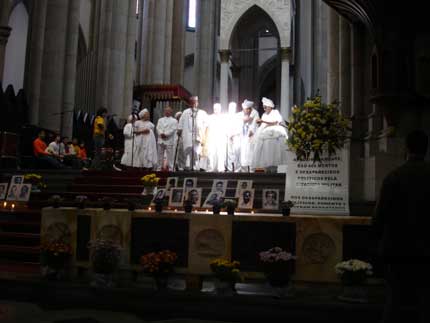

"An atheist by conviction, as a Communist militant, 'Comandante Crioulo' [his alias] received the homage of religious [leaders] of African persuasion, such as Pai Francisco de Oxum, Pai Persio and the ogans [some kind of 'divinized' drum players, see here] of the orishas Ogum and Oxossi [African gods, see here] and ebomi Conceição Reis de Ogum, vice-president of the National Institute of African-Brazilian Tradition and Culture (Intecab). Tata Nkisi Taua, president of the Confederation of Angola Kongo Traditions in Brazil (Cobantu) also took part in the ceremony, with his mametus and makotas [as far as we can tell, other kinds of followers of African gods]. They sang chants from the altar of the Cathedral to the dead militant. ... Representatives of the Jewish and of the Muslim communities of Sao Paulo also took part in the celebration."

"I believe that Plan B ought to be -- ought to require a prescription for minors. That's what I believe," he said, adding that he supports "Andy's decisions."

"Authentic love transforms itself into a light that guides one's life to fullness, generating a society that man can live within. The communion of life and love that is marriage thus configures as an authentic good for society. Avoiding confusion with other types of union based on a weak love is of special urgency today. Only the rock of total and irrevocable love between man and woman is capable of founding the construction of a society that becomes a home for all mankind."
"Family, established on marriage, is a 'heritage of mankind', a fundamental social institution; it is the vital cell and the pillar of society, and that is of interest to believers and non-believers. This is the reality which all States must hold in utmost consideration. ...
"In the modern world, in which some equivocal conceptions of men, of liberty, of human love are being spread, we must not prevent ourselves anymore from the portrayal of the truth of the familial institution, as it was willed by God since Creation.
"The historical moment we are living demands Christian families to witness with courageous coherence that procreation is the fruit of love. A similar testimony shall not be lacking so that politicians and legislators may be inspired to safeguard the rights of the family. It is well known, in fact, how legal solutions for the so-called 'civil unions' are being discussed, rejecting the duties of matrimony while intending to enjoy similar rights."
The future approval of a Gender Identity Act to regulate the change of the sex and of the name of transsexuals is a "legal matter" which is not at all "frivolous", the Cardinal-Archbishop of Seville, Carlos Amigo, affirmed yesterday. A person's sex, "simply determined by an external inspection of the genital organs" may not be one's identity, he added. Amigo directed the regulation of such matters to "the experts".
A person's sex is "simply determined by an external inspection of the genital organs", and such identification may not be the most accurate, opined the Archbishop. In this, he concurs with the essence of the complaints of transsexual persons, who feel [they belong to] a sex which is not the one their genitalia portray. "Sex determination is made simply by an external inspection of the genital organs and one sex or the other is determined, but there may be a person whose only feature as a woman or as a man is this external appearance and that is not the identity of that person", he remarked.
Amigo was questioned after, in the past week, several groups of transsexuals began a campaign so that the Government fulfills its electoral pledge to regulate the change of name and sex in the Civil Registry with no need of complete surgery for the re-determination of sex.
At the annual "Lodge meeting" of the Grand Lodge of Italy, assembled at the Palacongressi [Convention Hall] of Rimini, from March 31 to April 2, a distinguished presence among the orators was that of the South-Tyrolese [altoatesino] priest Paul Renner, director of the Institute of Religious Sciences of the Diocese of Bolzano since 1984.
During the occasion, the Grand Lodge edited and published a CD with music of Freemason Wolfgang Amadeus Mozart. And, in the website of the Grand Lodge, the presentation of the CD is written and signed by Giovanni Carli Ballola, a well-known music critic, but who also is a deacon incardinated in the Diocese of Rome, in [actual] service to a Parish.
Not only that. In the April issue of the "Jesus" magazine, Carli Ballola publishes a Letter to the Editor in which, "as an observant Catholic", he expresses his "conviction that reciprocal incomprehensions and prejudices between the Catholic world and the Masonic environment shall, sooner or later, arrive at honest clarifications".
Carli Ballola writes that he has "very dear friends, estimable in every level" among Masons. And he defines the rituals of the Grand Lodge as "deeply touching for the expressions of inner peace, efforts for moral and material assistence, fraternal love which is expressed in tangible signs such as the triple embrace".
According to him, the God worshipped by the Freemasons "is not deistic or theistic, but rooted upon the Judeo-Christian faith, as it is noticed by the open Bible in the center of the Lodge, left open on the beginning on the Gospel of John".
This is not all, though. In the April 14 issue of Avvenire [the semi-official daily of the Italian Episcopal Conference], among the Letters to the Editor, there is a "signed letter" which, while criticizing the secularism of the current Great Master [of the Grand Lodge of Italy], Gustavo Raffi, affirms that "a considerable amount of Masons live in suffering this separation from the Church." As a comforting [example], he mentions "the precious words by don Renner at his Rimini intervention". And he adds that "Freemasonry works under the light of the Gospel of Saint John, Masons were for centuries exclusively Catholic and many still are."

At first sight, the intervention of Cardinal Martini weighing in on the wrong side of some of the most important moral discussions of this age would seem irrelevant. It is true that he was the President (Rettore) of the most prestigious Pontifical University, the Gregoriana; and archbishop of the largest Italian diocese, Milan - from which the world received Popes Ratti and Montini in the 20th century - for more than 20 years. But he has been retired since 2002, and, according to most rumors, he was in an extremely weak position in the last conclave.
Therefore, to understand the relevance of the interview Martini gave to the most important Italian newsweekly, L'Espresso, one needs to consider the current political and religious circumstances in Italy.
First, though formatted to look like a "discussion" between a "man of science" (Doctor Ignazio Marino) and a "man of faith" (Cardinal Martini), it is actually an interview: Marino presents his philosophy and questions Martini, who virtually always agrees with him. It is all about Martini's answers, not about Marino's "parallel ideas".
Second, Ignazio Marino is not just any physician: he is a member of the Democratici di Sinistra-DS (the "Leftist Democrats"), the post-Cold War name of the largest Communist Party in the West, the Partito Comunista Italiano (PCI). The Communists are the main leftist components of the "center-left" coalition, the Unione, led by Romano Prodi which has recently won the Italian parliamentary elections. Marino has just been elected to one of the Communist seats in the Senate for the Latium region (Lazio).
So this interview by Marino, who presents himself as a "Catholic" (in the style of the Dossettian "Bologna School" of "Progressive Catholicism"), has the following meaning: the left asks the Church for its opinion, and Martini is chosen as the official spokesman by the Italian "progressive elite", represented by L'Espresso magazine and by the Unione.
It is clear that if Marino were to interview Cardinal Ruini, the Cardinal Vicar of Rome and President of the Italian Episcopal Conference, or Pope Benedict, he would not receive the answers he wants. So the progressive manipulation technique involves picking a specific person who will provide the desired answers; the second step is to wait for an official response by the Church, which will probably not come. Then, the preposterous answers provided by the favored churchman become, if not official opinions, at least acceptable positions in the "rainbow of opinions" which shape the Church.
____________________
Now, why is this "semi-official Church position" by a man like Martini so important at this moment? It is far from a coincidence that this interview has been released right after the official results of the elections were announced. Despite the great deterioration in its position in the post-Conciliar age, the Church is still an important player in Italian politics.
A center-left coalition which has barely won its majority in Parliament will force its leader, Romano Prodi, willingly or not, to give in to the most extremist forces inside his coalition if he wishes to remain in power. Ironically, Marino's DS (the "former" Communists) are among the most moderate forces in the Prodi coalition. However, among Italian leftwing politicians, the rage against the Church, against public funds given to the Church, against crucifixes in classrooms and courtrooms, against the Church's opposition to abortion, embryonic manipulation, "fast-track divorce" laws, homosexual civil unions is considerable -- especially as an angry response to a wrong perception of the Church (embodied in its most visible face in Italian politics, Ruini) as the "conservative anchor" of the leaving prime-minister, Silvio Berlusconi.
As prime-minister Rodríguez Zapatero in Spain, Prodi (though in many ways a much more moderate man than the Spaniard) will probably have to feed anti-clericalism to the extremists of his coalition. And this is where Martini's opinions are relevant, and it is why this ecclesiastical has-been is in the cover of this week's L'Espresso.
If the Italian public opinion may be persuaded, by Martini's words and by the official silence from the Vatican and from Ruini regarding those words, that opposition to the Magisterium is an acceptable position for Catholics, then the probable extreme measures which the center-left governing coalition will defend in moral matters will become more palatable to the population at large. And this is why this apparently unimportant intervention may mark a turning point in the Ratzinger pontificate.
