Rorate Caeli

Exultet Note
"Be ye wise as serpents and simple as doves"


Our skepticism was proven right.

In the days leading up to Holy Thursday, I had already made my skepticism regarding the date for the release of a possible document known when I published the words, "Ja nicht auf das Fest, auf daß nicht ein Aufruhr werde im Volk!" (i.e. "Not on the feast day, lest there be an uproar among the people," St. Matthew, xxvi, 5, famously set to music by Bach in his Matthäuspassion). That obviously was too cryptic for many, so I had to write down more intelligible reasons for my skepticism.

Around the world, pedophiles, sodomites, perverts of all kinds, and other abusers of the body are commended and promoted in the Church; and, only when their abuse is made public, they are hidden and quietly dismissed. Around the world, heretics, dissenters, liturgical wreckers, and other abusers of the soul are praised and elevated.

Meanwhile, Traditional Catholics, those who merely want to be catechized, to pray, and to worship as countless generations of Catholics did, are the lepers of Catholicism. They are despised, trampled upon, hated, persecuted, and, when tolerated, ghettoized. They receive hatred and ridicule from "liberal" bishops. They are seen with mistrust and disdain by "conservatives".

This reality is very clear to me and to most Traditionalists, who are keenly aware of the Catholic version of "Murphy's Law": "If a measure which favors Traditional Catholics is expected, then it will probably not happen." This law has been in force for 40 years and Catholics who follow this kind of news must never forget it -- I certainly never did and I had assumed most, if not all, Traditional Catholics were experienced enough to know it.

Another blogger amusingly saw despair here... Not at all, I have always expected the worst, and I have never expected much, not even in the most optimistic days, for this is the state of our times -- even though I felt compelled to report and translate what I had read elsewhere. This is an unfortunate age, but it auspiciously allows Catholics to earn many merits which otherwise would have been impossible for them to earn: "...the Divine permission of the greatest evils is holy, for it aims at a superior good, a good which we will one day contemplate and which only God may judge." (Fr. Garrigou-Lagrange, The Three Ages of the Interior Life). If we do not see the supernatural side of things, we will always be disappointed about ecclesiastical power struggles which are not for us to settle.
___________________
And the document, will it come out? Well, why not? But the eventual signs for it will have to be clearer (see items (b) and (c) of my "increasingly skeptical" post here). A surprise, perhaps?... That would be very unlikely, but may God choose the time He sees fit.
___________________
In Dr. Philip Blosser's parallel blog Scripture and Catholic Tradition, a wonderful interview, first printed in the Latin Mass Magazine, with Dr. Alice von Hildebrand, with very good insights on the worst pontificate in modern times (Which one? Check here.)
___________________
A Happy Easter to all!

Triduum recess

This blog now enters in complete recess during the Triduum, a recess which will only be interrupted if the measure many have been anticipating is made public in these most sacred days.

We are increasingly skeptical regarding the release of a document dealing with the Traditional Mass tomorrow, for the following reasons, among others:

(a) Traditional Catholics have been deceived and kicked around for too long and this could well be another episode of the same old story;

(b) The complete silence of the first-rate Vaticanists, both conservative and progressive;

(c)
The fact that most if not all well positioned Traditional Clergy seem to remain completely in the dark, the same men who, at this point, should have known whether something was going to happen tomorrow or not.

We hope the Traditional Rites of the Holy Roman Church have their rightful place once again duly recognized in the Latin Church, and we hope this happens as soon as possible, this very Maundy Thursday if Our Lord wills it! We earnestly hope our skepticism is proven wrong and that this ultimately proves to be a master stroke by the Holy Father.

May you and your families have a very holy Triduum and a happy Easter.


Sub tuum præsidium
confugimus, Sancta Dei Genetrix.
Nostras deprecationes ne despicias in necessitatibus,
sed a periculis cunctis libera nos semper,
Virgo gloriosa et benedicta.
Amen.

Il Tempo: "Yes to the Mass..."

UPDATED ON APRIL 12- SEE END OF ARTICLE

At last, the matter has reached the Italian press. This Palm Sunday, the old Roman daily Il Tempo publishes the following article filled with the kind of information we have been witnessing for a couple of weeks. All information contained in the following article is provided by Il Tempo and we cannot vouch for its details of date or nature of the possible "gesture" (you will notice that the reporter himself is very careful). Parts of it are unrelated to the Mass and, naturally, we cannot translate all of it, for legal reasons:


Yes to the Mass "with the back to the people"

by PAOLO LUIGI RODARI

[THE GESTURE]

IN the next few days, maybe on Holy Thursday (the news is not still certain), Benedict XVI could decide to fulfill an official gesture in which he would grant the possibility, to whomever wishes to do so, to celebrate Holy Mass according to the ancient rite, that of Saint Pius V, and could do so by declaring that this rite (which was the one in force before the Second Vatican Council) is still in effect today simply because it has never been abolished.

[WHAT COULD HAPPEN]

The Pope's gesture, which, if accomplished, could determine an important development even towards the schismatic Priestly Fraternity of Saint Pius X, founded by bishop Marcel Lefebvre. With this kind of indult, in fact, all Traditionalists of the Holy Roman Church could return to celebrate Mass with the ancient rite without asking for the permission of a diocesan bishop and, in the meantime, the Lefebvrists, in view of the openness to Tradition made by Rome, could arrive at a declaration of acceptance, without conditions, of the accomplishments made by the Church during and after the Second Vatican Council and, in this way, receive the revocation of the excommunication by the pope, they themselves also returning [and] celebrating freely the Mass with the old rite.

[The new members of P. C. Ecclesia Dei]

Yesterday, ... the Pontifical Commission Ecclesia Dei, ... received the nomination of three new members..., all cardinals created in the last consistory. They are William Levada,...Jean-Pierre Ricard, ... and Antonio Canizares [sic] Llovera..., three routine nominations, probably made on the suggestion of Cardinal Castrillon Hoyos, who is the president of Ecclesia Dei.

It is a common practice, in fact, that, after every consistory, the new porporati be admitted as members of a few dicasteries of the Roman Curia and the choice of these three for the commission which cares for the relations with the Lefebvrists is justifiable, more than anything else, for technical reasons. ... Levada has been named as prefect of the former Holy Office (when he was a cardinal, Ratzinger occupied this position), because it is obvious that the president of Doctrine of the Faith be a member of a commission which deals with doctrinal questions. Ricard was already a member of Ecclesia Dei from the time he was a bishop (he has been nominated because it is in France that there is the highest number of practicing Lefebvrists [sic]) and, thus, his has been above all an ordinary reconfirmation. Perhaps the only unexpected nomination was that of Canizares, a great friend of Ratzinger, whose outstanding theological preparation can only add to the commission. ...


Some have said this blog has declared something will happen during Holy Week. Something may happen; we have only forwarded news from different sources, but we really cannot vouch for specific dates or for the content of a hypothetical document. All kinds of things may happen and we can only say that there is a clear crescendo (and also an enormous amount of rumors, some of which clearly wild and unfounded), though we do not know for sure what will come out of it. We have always recommended, since those early days of Septuagesima, prayer and penance, which are within our reach. Pray especially for the Pope -- and celebrate the most solemn days of the year.

Confidite, Ego vici mundum!

Laudetur Iesus Christus!

_____________________________
Observation (1730 GMT): It is an often repeated quip that the Italian press is unreliable. In our experience, it is not more or less reliable than the English-language press (we would say it is probably more reliable than the average American newspaper -- just check the ridiculous propaganda piece in The New York Times Magazine on abortion in El Salvador this Sunday). What is definitely true is that some journalists are more reliable than others. This particular journalist, Paolo Luigi Rodari, has twice before just in the past month described well: what would be the main theme of the pre-consistory meeting (and even we considered unlikely that the question of Archbishop Lefebvre would be a main theme of the meeting of all cardinals -- link); as well as what would happen on the eve of the merger of the presidencies of four Roman dicasteries (link).

You may take it or leave it, but just to yell "Italian Press!" is not enough.
____________________________
Monday Update (April 10, 1700 GMT):
Yves Chiron's Aletheia bulletin (in French) and Alejandro Bermúdez's Catholic News Agency-CNA/ACIPrensa have joined the choir of those who have declared that the Pope has signed a document and will have it published in the next few days.

Following an excellent review of the steps taken during the past ten months, Aletheia declares: "• Holy Thursday, April 13: Benedict XVI should make public a motu proprio on the rite of the mass."

CNA publishes the information that "according to [its] source, the announcement could come 'between Holy Thursday and Easter Sunday,' but the exact day has not yet been set. Nevertheless, the source said the decision has already been made by the Holy Father and that it’s ' only a matter of time' before it is publicly announced."

Caveat: It could be that all of these new sources are simply echoing Il Tempo and others; nevertheless, these news sources, particularly CNA, usually double-check their own sources, so we are inclined to believe that they are not merely copying Il Tempo. (If you have any difficulties linking to CNA, you can find a copy of the original release at Angelqueen).

_____________________________
Tuesday Update (April 11, 2230 GMT):

Now even the very careful CWN admits that something is going on... (copy of the original release at Angelqueen), though unfortunately this news agency does not acknowledge the Il Tempo report, first translated here (CWN says: "My own prediction-- based on hints and inferences and hunches, nothing more-- is that the document will be at least as strong as a universal indult, but will not resolve the canonical status of the Society of St. Pius X. Again that is a prediction, not a report.").

Nonetheless, it is particularly odd that many well-known Vaticanists seem to be ignoring what could be a turning point in the current pontificate. Some of our own favorites, including Sandro Magister, Andrea Tornielli (since immediately after the March 23 pre-consistory meeting), and Vittorio Messori have been completely silent on the matter. It is also curious that "progressives", as Marco Politi and Giancarlo Zizola, have not mentioned anything on this pivotal subject, to our knowledge.

_____________________________
Wednesday Update (April 12, 1000 GMT):

1. Archivum, which first mentioned the news of the possible document on the Traditional Rites of the Latin Church, adds the following information today: "Several sources confirm that tomorrow, Holy Thursday, an important Papal document should be released, having as its subject the current validity of the Tridentine liturgy. This document --in the form of a Motu Proprio, it is said -- has already been signed and would simply be officially promulgated. Very recent Papal audiences with card. Arinze allow [us] to reasonably suppose that the date of publication shall be precisely tomorrow."

2. (1200 GMT) It still seems odd to us that not a word on this possible document has been uttered by other well-known sources, if only to deny its existence. In his latest web article, Sandro Magister once again deals with liturgical matters, but is completely silent on the possible document, as if it were a non-issue.

On the other hand, the almost complete silence of our own Vatican sources is of a kind unknown to us and is startling.

3. (1700 GMT) The website of the Latin Mass Community in Melbourne, Australia, administered by priests of the Fraternity of Saint Peter (FSSP), has published the following news: "It now appears certain that the Holy Father has signed a significant document on the Sacred Liturgy, and on the classical Latin liturgy in particular. We will let you know as soon as further details are to hand." Anything is possible at this moment, but we truly believe an official website would be careful with its sources and that these would be internal sources. (Thanks to reader Jon for pointing this out).

It is already Maundy Thursday in Australia and we hope they are right...


4. (2000 GMT) Regarding the news mentioned in the previous item, unofficial contacts have not confirmed the information made public in the FSSP website, though they have not denied it, either.

_____________________________

Miserere nobis + + + HEBDOMADA SANCTA + + + Miserere nobis

Dear friends,

During Holy Week, we will post only urgent news. The days whose solemnity we have expected since Septuagesima have arrived. Fast and prayers intensify as we approach the annual celebration of the glorious days of our Redemption.


Sanctus Deus! Sanctus fortis! Sanctus immortalis!
Miserere nobis!


Introit for Palm Sunday, 15th Century

____________________________________
Holy Tuesday addition:
(moved from April 11, 1700 GMT, individual post)

Ja nicht auf das Fest,
auf daß nicht ein Aufruhr werde im Volk!
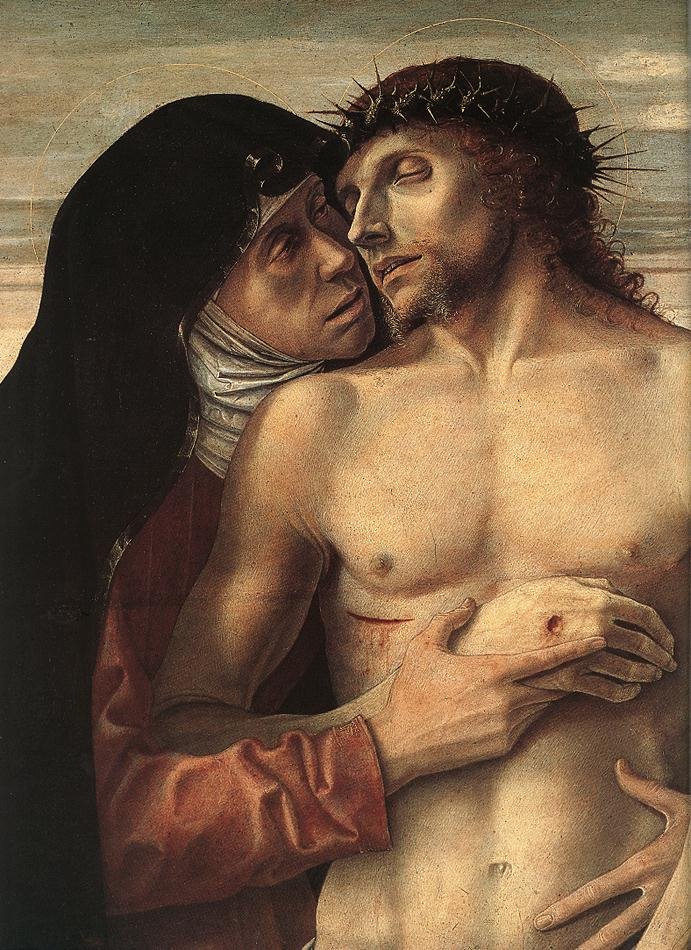
(One devotional image as a gift to the avid reader who mailed us...)
His time was coming!...
____________________________________

Collect for Maundy Thursday (Missa Nos Autem), 1250


Introit for Maundy Thursday (Missa Nos Autem), 16th century

O CRUX, AVE, SPES UNICA!

"A document has been signed..."

Yesterday, we closed our third and last update on the April 7 meeting with a note, from Archivum: His Holiness "has signed a document regarding the Rite of the Mass".

One of our most trustworthy sources has finally broken the general silence and has confirmed that truly a document of great importance on the liturgy of the Latin Church "has been signed".

However, just as yesterday we mentioned "...the Rite of the Mass...", this source cannot or will not confirm if this document of great importance impacts (a) the Traditional Roman Rite (or, as it is usually called in more adequate terms, "the liturgical rite and discipline, according to the prescriptions of Saint Pius V, with the adaptations introduced by his successors up to Blessed John XXIII"); or (b) the New Roman rite (which, regarding the rite of the mass, was approved on Holy Thursday, 1969, by the Apostolic Constitution "Missale Romanum", of Paul VI); or (c) both rites.


PS 1: The Pope named today as members of the Pontifical Commission "Ecclesia Dei": Cardinals Levada (as had happened with the previous head of the CDF...), Ricard (who had been first appointed to the Commission by Pope John Paul), and Cañizares Llovera. The nominations, of course, are not donec aliter provideatur, but for regular five-year terms (Pastor Bonus, 5). Does this mean the Commission still has a long life ahead of it in its current format?...

PS 2: We thank the dear commentator who was able to transcribe what would have been said at Radio Vaticana, though apparently later expunged from the official transcript. Amidst the report on the conclusions of the Assembly of the French Episcopal Conference regarding "the Traditionalist question" (see Update 1, item d), the reporter would have said: "...Ciò, soprattutto, in vista della pubblicazione del motu proprio del Papa sul rito della Messa..." (That is: "This [the measures towards Traditionalists] especially in view of the publication of the Motu Proprio of the Pope on the rite of the Mass.").

PS 3: We apologise for not linking to specific published news sources in different languages, as we usually do, but this time we depend mostly on unpublished sources. Almost all Italian newspapers have remained silent. The usual online news sources have also been silent, except for ACI (see our Update 2), which did mention a few aspects of yesterday's meeting. We refuse to link to the Zenit or CWN reports which have absolutely nothing new.

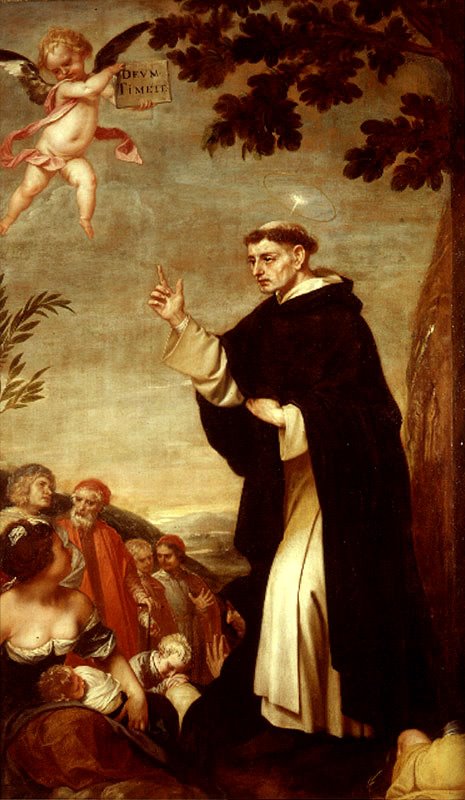
Great Orators of the Order of Friars Preachers


"A man who governs his passions is master of the world. We must either rule them, or be ruled by them."

Saint Dominic

"How ... strongly should we be drawn to Christ if we find our pleasure in truth, happiness, justice, eternal life: all of which Christ is!"
Saint Thomas Aquinas

"Regard yourself as more vile and miserable in the sight of God because of your faults than any sinner whatsoever, no matter what his sins."

Saint Vincent Ferrer

"The Glorious Virgin Mary...by the blessed fruit of her womb has saved a world condemned by the fall of our first parents."
Pope Saint Pius V

"God is the proper name of Truth, as Truth is the abstract name of God."
Lacordaire

"We must accompany [gay people] as they discern what this means, letting our images be stretched open... This means watching 'Brokeback Mountain,' reading gay novels, living with our gay friends and listening with them as they listen to the Lord."

The April 7 meeting : what to expect

What will this Friday's meeting of the Pope with the heads of dicasteries look like?

In fact, nobody outside of the most exclusive papal circles knows for sure.

From what we gathered and published in the past, this is what the meeting could look like.

___________________________

First option: a meeting for the ratification of a Papal decision:

One of the possibilities is that His Holiness, with the results of the first consultative meeting (of February 13), and emboldened by the "free pass" (the "via libera") garnered at the pre-consistory meeting (of March 23), will announce some strong decisions regarding the Traditional Rites of the Latin Church.

If that is truly the case, then the result may either be announced in a short time or could be delayed until sometime in the near future. Could it be announced to the general public immediately? This possibility should not be entirely discarded.
Second option: the meeting will be of a merely consultative nature:

As the meeting of February 13, the meeting of April 7 could include only a convergence of opinions among the dicasteries, under the guidance of the Pope (considering the final opinions issued by the dicasteries involved in the process, as determined in the February meeting), before a more definitive move is decided by His Holiness. The meeting will nevertheless be guided by him -- unlike the February and pre-consistory meetings, in which he mostly listened.

Third option: the meeting will include only the discussion of matters unrelated to the Traditional Rites of the Latin Church. (This could well be the case; nothing is completely certain in the modus operandi of Pope Benedict, "the Serene"...)

In any case, it is certain, as we first reported here in March, that this second meeting will include (perhaps as its main topic) discussions on the new structure of the Roman Curia.

Finally, we call your attention to some of our February advices, which still hold true.

____________________________________
Update 1 (April 7, 1100 GMT): (a) The Bollettino simply confirms that the meeting took place, with no information of the matters discussed (exactly as it happened in February -- though differently from what took place after the pre-consistory meeting with the College of Cardinals).

(b) The Thursday edition of La Croix (the semi-official "progressive" Catholic French daily) mentions that the moment for the publication of a Papal "Motu Proprio" on the "rite of the Mass" is close. This is the first time the nature of the hypothetical document is mentioned in a reliable source.

(c) Le Salon Beige reports that Radio Vaticana (in its Italian feed) also mentioned that a "Motu Proprio" for the "liberalization" of the Traditional Missal could be issued shortly (in days?... weeks?... ). We have not been able to verify if Radio Vaticana has actually broadcast this information.

(d) Le Forum Catholique links to the final conclusions of this week's Assembly of the French Episcopal Conference (PDF file) in which the bishops reject a structure which is separate from the Diocesan Churches (Well... Is it really their decision?...); but they recognize that, regarding the Priestly Fraternity of Saint Pius X (FSSPX/SSPX), the Pope "has a concern" and that "in the weeks or months ahead, [the pope] shall lay down the directives to facilitate the way to a possible return to full communion".

____________________________________
Update 2 (April 7, 1900 GMT): We have never witnessed this kind of silence before. Utter and complete silence. ACI Prensa (the Spanish original version of the Catholic News Agency), reports that "according to Vatican sources, the reform of the Roman Curia and a liberalization of the Missal of Saint Pius V would have been discussed".

As we suggested yesterday as our second option, ACI (i.e. Alejandro Bermúdez) reports that:

"In this second meeting with the Roman Curia, celebrated in the Bologna Hall of the Vatican, Benedict XVI would have collected the opinions of the heads of the dicasteries to take decisions regarding the liturgical reform in the line willed by John Paul II in his encyclical letter 'Ecclesia de Eucharistia'...

"According to the same cources, the most important announcement which would follow this meeting would be the liberalization of the Missal of 1962, a decision which is part of the liturgical reform set in motion by Pope Benedict XVI, but which could have a significant impact in the reconciliation process with the Lefebvrist schism."


Much of what is reported seems to be recycled news, though nonetheless encouraging.

____________________________________
Update 3 (April 7, 2100 GMT): As we first published in our Update 1 of 1100 GMT, item (c), Archivum confirms that Radio Vaticana has announced that His Holiness "has signed a document regarding the Rite of the Mass, as previously announced". The document will, "with all probability be made public on Maundy Thursday". We still have not been able to hear this news directly from Radio Vaticana -- we are, understandably, skeptical (since announcing breaking news of this kind has never been the tradition of Radio Vaticana).

In any case and at all times, regardless of what may happen,
Laudetur Iesus Christus.

The Traditionalist strength in France


One of the topics discussed by the French bishops this week, in one of the two meetings they hold each year, was "the Traditionalist question".

Thanks to the link provided by Le Forum Catholique, the exclusive survey given to the bishops for their consideration (prepared by the Oremus group) is available here (PDF file).

General statistics:

1. The study estimates the number of Traditionalist Catholics in France as 80,000 (45,000 in Ecclesia Dei communities; 35,000 in FSSPX/SSPX communities).

2. This would mean that the percentage of practicing Catholics in France who are Traditionalists (both ED and SSPX*) is of 5%. (This estimate is based on what we believe to be an almost ridiculously inflated number of practicing Catholics: Oremus estimates that there are 2.5 million practicing French Catholics... based on a CSA/La Croix survey according to which 7% of all French Catholics are "practicing" Catholics.)


Specific examples:

1. Based on specific examples of Traditional communities in the Diocese of Versailles, Oremus estimates that 85-90% of Traditionalists (both ED and SSPX) are 55 years old or younger. That would mean that 8% of all practicing French Catholics below that age are Traditionalists (considering the aforesaid ridiculous number of 2.5 million practicing Catholics). Among ALL practicing Catholics in France, Oremus estimates that 66% are OLDER than 55 (and 50% are older than 65), which shows the great vitality and youth of Traditionalists.

2. In fact, based on actual samples, the study estimates that 59% of French Traditionalists are 24 or younger: an impressive number.


More interesting facts from the study in the next few days.
_________________________
*Throughout the survey, the estimates consider both the Ecclesia Dei and the SSPX communities as a single phenomenon; perhaps the French bishops may soon accept the fact that the whole Traditionalist movement could be brought back into the heart of the Church...

Communists eat children

Literally.

Thursday in Passion Week
and First Thursday


Super flumina Babylonis illic sedimus et flevimus,
cum recordaremur Sion.

(Offertory of the Mass of the Feria)

There, above the garden, was the Holy Mountain of Sion (Zion), for which the Psalmist in exile had wept. Just a few days before his Passion, the Lord himself had wept again, pouring forth the unfathomable Love which fills His Most Sacred Heart: "Jerusalem, Jerusalem, thou that killest the prophets, and stonest them that are sent unto thee, how often would I have gathered together thy children, as the hen doth gather her chickens under her wings, and thou wouldest not?"

[Regarding the Holy Hour, at every First Thursday of the month, Saint Margaret Mary Alacoque said]: [The Lord] "told me at that time [1674] that, every night from Thursday to Friday, I should wake up, at the time which he appointed, to pray five Paters and five Aves prostrated on the ground, with five acts of adoration which he had taught me, to render him honor in the extreme agony which he suffered at the night of his Passion."[...]
Our Lord himself tells Saint Margaret Mary the spirit in which this exercise should be done [...]:

1. To appease Divine wrath;
2. To demand mercy for sinners;
3. To make reparation for the Apostles' abadonment of Christ.

From the French-Canadian edition of Father Crawley-Boevey's Holy Hour
______________________
A wonderful source for devotions to the Sacred Heart of Our Lord is Catholic Tradition.

Xavier 500: The great Japanese sins

Saint Francis Xavier, the Apostle of the East, was a complete Hispanic (see Hispania): Navarran and Spanish, by birth; Portuguese, by loyalty; Catholic, above all, and a true glory of the Society of Jesus, of which he was one of the founders. The 500th anniversary of his birth will be marked by special celebrations in and around the Castle of Javier (Xavier), where he was born, on April 7, 1506.

It is a good time to remember important moments in his life. Father John Laures, SJ, remembered, right after the war which devastated Japan (including the sad destruction of its most Catholic city, Nagasaki), some special moments of Xavier's apostolate in the Far East:

On June 24, 1549, Xavier set out from Malacca, accompanied by two European companions, three Japanese who had been prepared for the work of catechists, and two Indian servants. They landed at Kagoshima, Yajiro's birthplace, on August 15 of the same year. His ambition was to obtain permission from the Emperor to preach the Gospel and convert the Japanese in any part of the country. Shimazu Takahisa, Daimyo of Satsuma, greatly rejoiced to receive the foreign preacher and was anxious to keep him in Kagoshima, for he secretly hoped to attract Portuguese ships to his harbors by the presence of foreign missionaries. Xavier waited more than a year but seeing Shimazu was not interested in his journey to the capital, he left Kagoshima to proceed to Hirado, a port frequented by Portuguese ships. Nor did he linger at Hirado long but set out for Kyoto, the capital arriving on the way at Yamaguchi in the middle of November, 1549.

Yamaguchi was at that time a very important town, being the seat of the mighty Ouchi clan which ruled not only the Province of Suwo but also a number of neighboring provinces on the mainland of Honshu and the island of Kyushu. Having learned that Ouchi, the head of the clan was the slave of a most abominable vice, Xavier determined to stay in the city for some time to preach the Gospel. Every day, he and his companion, Brother Fernandez, took their stand at a crossroads, Brother Fernandez reading a passage from the handwritten catechism prepared by Xavier and Yajiro while they were at Kagoshima. After reading the account of the creation of the world, Fernandez would denounce in a loud voice what he believed to be the three cardinal sins of the Japanese people, viz. idolatry, sodomy, and infanticide. While he was inveighing against these vices, Xavier would stand by and pray fervently for the success of their mission. This was done twice every day and always in a different section of the city so that very soon there was no corner in Yamaguchi where the word of God was not heard.
What would Xavier have thought had he known that the barbaric sins of Japan would take over Christendom and be celebrated in his own Spanish motherland some hundreds of years later?

The One-Two-Three Strategy

The Superior for the District of France of the Priestly Fraternity of Saint Pius X (FSSPX/SSPX), Father Régis de Cacqueray, published a communiqué on the official website of the District (which is by far the largest district of the Fraternity), warning the faithful against the rumors and especially the malicious comments spread by two well-known websites, one French and the other American*.

Father de Cacqueray is considered a "hardliner" ("anti-reconciliation"), but this does not mean much: we Catholics of all people must be wary of such labels, which are used with malevolent intentions but do not possess any clear meaning. The most important passage of his communiqué is not particularly related to the condemned websites:

Whatever they [the websites] are interested in portraying [that is, that the Fraternity is dominated by a "cabal of conspirators" willing to "sell out"], the Fraternity of Saint Pius X remains faithful to a line [which has been] clearly expressed and regarding which it has not wavered:

- obtaining the two preconditions, which are the withdrawal of the decree of excommunications and the freedom of every priest to celebrate the Mass of Saint Pius V;

- the resolution of doctrinal questions;

- the search for the most adequate canonical solution.

Father de Cacqueray is right, of course: that has been the steady position of the Fraternity, expressed (as we have commented before), for instance, in the very illuminating letter of Bishop Fellay (the Superior-General of the Fraternity) to Cardinal Castrillón in 2004 (repeated in his latest interview). But this line of thought has rarely been so clearly and synthetically expressed, and for that we thank Father de Cacqueray. Will we see this strategy unfold in its clear steps in the near future?... Perhaps.

Some may also believe that "doctrinal discussions" are unacceptable -- but that is preposterous. The Holy See has been hopelessly dialoguing, since the Council, with the Anglican Communion, which lost any sign of faith sometime between 1860 and 1960... Honest and topical discussions with the Fraternity would be far more objective, since there is no dogmatic issue involved, and could set the basis for a very useful definition of the "hermeneutics of continuity" proposed by Pope Benedict. Such discussions could also happen after a clearer canonical framework is established, since they are not among the "preconditions".

Therefore, one could envision a situation whereby the creation of a "Doctrinal Commission" -- which would then be the institutional "locus" of the debates between the Fraternity and the Holy See -- serves as the fulfilment of this step ("the resolution of doctrinal questions"), allowing for the complete canonical regularization of the Society even though not every controversy is actually resolved before the establishment of the new canonical framework.

-----
*[It should be said, in fairness, that the French Sedevacantist website has one thing to be said in its favor: it ALWAYS mentions its sources, which is essential in the web; while the American website shamelessly copies commentaries, translations, and other texts without the minimal courtesy of crediting its sources.]

Miscellany

Today, Angelqueen published a very interesting interview with Dom Fernando, as the Traditional Catholics in Campos (Brazil) call their beloved Bishop Rifan. Very noteworthy is his straightforward answer to whether Catholics may attend Masses at a SSPX chapel. Guess what? He said it was OK.

Busy with Traditional Mass matters, we have chosen not to engage in the debate on whether we are ready to attach the epithet "The Great" to Pope Wojtyla's name. But we believe that those clever students over at The Cornell Society for a Good Time might have a point or two.

Iacta alea est

Some thoughts of Michael Davies (Requiescat in pace) recently crossed our mind. At first, we could not find the link to them -- but it was a sure bet that we would be able to find the piece through the archives of the greatest Catholic news source in English, Seattle Catholic.

Michael Matt, the editor of The Remnant, recalled some of Davies' most controversial convictions near the end of his life:

I make no secret of the fact, for example, that I questioned (and still question) Michael's dogged defense of Cardinal Ratzinger. Over the years and to Michael's dismay, I published criticisms of some of the Cardinal's more perplexing statements. But I can also assure the reader that there was much more to that story. As someone who took issue with him on this very point, I hasten to set the record straight—Michael Davies, through it all, had only the best interest of traditional Catholics at heart. And here's what I mean: He firmly believed (and had been assured on numerous occasions) that Cardinal Ratzinger is "on our side" and would do all in his power, short of touching off a schism in Rome, to gradually turn things in Tradition's favor. All His Eminence required of us was patience and time.

Some of us were (and are) skeptical. But, as Michael saw it, the Cardinal had demonstrated enough good will on our behalf to justify our giving him the benefit of the doubt, i.e., the Cardinal's foreword to Msgr. Gamber's book; the Cardinal's historic rehabilitation of Pat Morely and the Honolulu Six who had been placed under interdict for "formal adherence" to the SSPX; the Cardinal's public celebration of the Tridentine Mass on occasion; the Cardinal's willingness to meet personally with traditionalists, etc.

Whether we can bring ourselves to accept the Cardinal's assurances that he is "on our side" is not at issue. What is at issue is that Michael believed that the Cardinal believed he was our ally. His great "sin", then, was to take his friend, the Cardinal, at his word; but this was very much the British thing to do. There was no conspiracy or dark and dastardly plotting going on behind the scenes. Michael simply believed, based on private meetings with His Eminence (to which none of us was privy, by the way), that the Cardinal would prove an invaluable ally to us all. What of it? Wouldn't it be grand!

As we sit and wait, and see apparent signs, like Caesar across the Rubicon, we must wonder: was Michael Davies right? The die is cast, and there is nothing we can do but pray -- "patience and time" (and prayer) are all it takes.

No denial so far

As many of you know, we prefer to publish news already printed in regular media outlets. However, we thought it right to forward the rumor of the supposed signing of a document granting (or recognizing) the freedom of the Traditional Latin Mass because this rumor was bound to be spread throughout the web without a proper knowledge of its source -- the Archivum blog.

We have never seen such silence regarding any rumor... Our usual sources do not wish to comment and the only one who said anything remarked that "something has apparently occurred". On the other hand, there has been no denial. We will just have to wait and pray.

---
Update (2115 GMT): Regarding Bishop Fellay's interview, we had already commented upon it when in was released in French (last March 26 -- see here), and there is nothing else to add.

Mass for Monday in Passion Week

Comments on Today's Readings

A Note on the Epistle for Passion Sunday


The epistle for Passion Sunday is taken from the letter to the Hebrews:

A reading from the Epistle of the blessed Apostle Paul to the Hebrews

Brethren: Christ being come, a High Priest of the good things to come, by a greater and more perfect tabernacle, not made with hands, that is, not of this creation, neither by the blood of goats or of calves, but by His own blood, entered once into the Holies, having obtained eternal redemption. For if the blood of goats and of oxen, and the ashes of an heifer being sprinkled, sanctify such as are defiled, to the cleansing of the flesh, how much more shall the blood of Christ, who through the Holy Ghost, offered Himself without spot to God, cleanse our conscience from dead works, to serve the living God? And therefore He is the Mediator of the New Testament; that by means of His death, for the redemption of those transgressions which were under the former Testament; they that who are called may receive the promise of eternal inheritance; in Christ Jesus our Lord.


Aside from the lector's introduction, so irritating to liberals today, which announces the epistle to the Hebrews as a writing "of the blessed Apostle Paul", what can we say about this reading?

It points us, of course, in the direction of Calvary by reminding us of the Passion - as it should, since this is Passion Sunday, and the Church's thoughts are from now until Easter occupied solely with the Passion of Her Bridegroom.

But not everyone immediately sees the second layer of meaning underneath the words of the epistle. On the surface, it speaks of Christ as having "entered ... into the Holies," where He "offered Himself without spot to God," and therefore became "the Mediator of the New Testament" in order that "that who are called may receive the promise of eternal inheritance."

In general, then, it speaks of the Passion and the Ascension of Our Lord, and of His redemptive work.

But look more closely.

What lies just under the shadow of Calvary? What lies just under the shadow of the crucifix on the sanctuary wall of your parish? The Eucharist. The Mass.

If we strip out some of the extra clauses in the opening sentence, we have this basic statement: "Christ being come ... entered once into the Holies, having obtained eternal redemption."

How did accomplish this? Again, stripping out the subordinate clauses, we have this: Christ, "by a greater and more perfect tabernacle ... by His own blood, entered once into the Holies."

His entrance into the Holy of Holies (which is where the High Priest would make the sacrifice for sins on the Day of Atonement), and the eternal redemption which follows, was effected by two things, according to the text:

1) A greater and more perfect tabernacle (Greek skene, "tent")

2) His own blood

What is this "greater and more perfect tent?"

For this, we may look to another epistle of this same St. Paul, to see in what other ways he uses the word.

In 2 Corinthians 5, we read:

For we know, if our earthly house of this habitation [skenos, "tent"] be dissolved, that we have a building of God, a house not made with hands, eternal in heaven. For in this also we groan, desiring to be clothed upon with our habitation that is from heaven. Yet so that we be found clothed, not naked. For we also, who are in this tabernacle [skenos, "tent"], do groan, being burthened; because we would not be unclothed, but clothed upon, that that which is mortal may be swallowed up by life. (2 Cor. 5:1-4)


In St. Paul's vocabulary, a "tabernacle" or "tent" can be a metaphor for the human body! Turning back to the epistle to the Hebrews, then, we have this:

1) Christ being come,
  1a) a High Priest of the good things to come,
2) by a greater and more perfect tabernacle [i.e., body],
  2a) not made with hands, that is,
  2b) not of this creation,
  2c) neither by the blood of goats or of calves,
3) but by His own blood,
4) entered once into the Holies,
5) having obtained eternal redemption.

See how the "tabernacle" is paired up with "His own blood," which is very remniscent of the usual pairing, "body and blood." The thought seems to be that Christ has "entered" into the Holy of Holies through the agency of His body and blood.

A complimentary thought is seen in the very next chapter:

Having therefore, brethren, a confidence in the entering into the holies by the blood of Christ: A new and living way which he hath dedicated for us through the veil, that is to say, his flesh: and a high priest over the house of God: let us draw near with a true heart, in fulness of faith, having our hearts sprinkled from an evil conscience and our bodies washed with clean water. (Heb. 10:19-22)


We follow where Christ has led; He has gone on ahead into the Holy of Holies to obtain redemption, but in so doing He has "dedicated" - the Greek is egkainizo, or "consecrated," which is even more illuminating - a "new and living way" for us so that we may follow Him into the Holy of Holies.

He has, the text says, entered in by His blood, and consecrated a new and living way (or "road") by His flesh - so that we may "drawn near with a true heart."

That these words are all meant to be understood in a Eucharistic sense is demonstrated by showing the striking similarities between these texts (Hebrews 9 and 10) and the ancient liturgy of St. James. Just prior to the consecration of the bread and wine, the priest prays:

We thank Thee, O Lord our God, that Thou hast given us boldness for the entrance of Thy holy places, which Thou hast renewed [Greek, egkainizo] to us as a new and living way through the veil of the flesh of Thy Christ. We therefore, being counted worthy to enter into the place of the tabernacle of Thy glory, and to be within the veil, and to behold the Holy of Holies, cast ourselves down before Thy goodness ...


The liturgy expresses the thought of the early Church: the "Holy of Holies" was the presence of God, and to enter therein was accomplished by coming into contact with the Eucharistic body of Christ, by receiving Him sacramentally in Holy Communion.

And so it continues today, and the Epistle reading for Passion Sunday points us not only to the Passion of Christ, but also the renewal of that Passion through the Sacrifice of the Holy Mass.

EGO SUM

Iudica me, Deus, et discerne causam meam de gente non sancta: ab homine iniquo et doloso eripe me: quia tu es Deus meus, et fortitudo mea. -- from the Introit for Passion Sunday

...antequam Abraham fieret, ego sum.
("Before Abraham was, I am") -- from the Gospel for Passion Sunday.

This name HE WHO IS is most properly applied to God, for three reasons:

First, because of its signification. For it does not signify form, but simply existence itself. Hence since the existence of God is His essence itself, which can be said of no other, it is clear that among other names this one specially denominates God, for everything is denominated by its form.

Secondly, on account of its universality. For all other names are either less universal, or, if convertible with it, add something above it at least in idea; hence in a certain way they inform and determine it. Now our intellect cannot know the essence of God itself in this life, as it is in itself, but whatever mode it applies in determining what it understands about God, it falls short of the mode of what God is in Himself.

Therefore the less determinate the names are, and the more universal and absolute they are, the more properly they are applied to God. Hence Damascene says that, "HE WHO IS is the principal of all names applied to God; for comprehending all in itself, it contains existence itself as an infinite and indeterminate sea of substance."

Now by any other name some mode of substance is determined, whereas this name HE WHO IS, determines no mode of being, but is indeterminate to all; and therefore it denominates the "infinite ocean of substance."

Thirdly, from its consignification, for it signifies present existence; and this above all properly applies to God, whose existence knows not past or future, as Augustine says.
Saint Thomas Aquinas

Recognize the Creator -- distinguish the creature. He who spoke was made the seed of Abraham; and that Abraham might be made, He Himself was before Abraham.

Hence, as if by the most open of all insults thrown at Abraham, they were now excited to greater bitterness. Of a certainty it seemed to them that Christ the Lord had uttered blasphemy in saying, "Before Abraham was made, I am." "Therefore took they up stones to cast at Him."

To what could so great hardness have recourse, save to its like? "But Jesus" as man, as one in the form of a servant, as lowly, as about to suffer, about to die, about to redeem us with His blood; not as He who is -- not as the Word in the beginning, and the Word with God.

For when they took up stones to cast at Him, what great thing were it had they been instantly swallowed up in the gaping earth, and found the inhabitants of hell inplace of stones? It were not a great thing to God; but better was it that patience should be commended than power exerted.
Saint Augustine

The West: preliminary musings

One could consider Saint Augustine, Saint Benedict, and Saint Gregory the Great as Fathers of the Western Civilization. They, their deeds, their thoughts built Europe -- Latin and Catholic -- and, on and beyond Europe, Christendom and its civilization, the Western Civilization.

Which of the following people, our contemporaries, would any of these great saints most likely recognize as a member of his civilization?

(a) A feminist Dutch lesbian urbanite;

(b) A devout Kentuckian Protestant minister;

(c) A devoutly Catholic Mexican farmer.


I believe I know the answer...

Freedom for the Traditional Latin Mass

The rumors regarding this have been steadily growing all week. Since Sunday, we have increasingly heard that something was imminent. Yesterday, ACIPrensa published in Spanish that the Holy Father would grant freedom to the Traditional Latin Mass. And today, our dear friends at the extremely trustworthy Archivum have published that His Holiness actually signed yesterday the papal act granting (or recognizing) this freedom (Archivum reminds its readers that this has always been one of the negotiating conditions for the Society of Saint Pius X).

We had been shy to report this (which is why we suggested the "grain of salt") because some extremely important details, regarding the exact nature of the act itself and of the amplitude given (or recognized) to priests, are still missing. When we have the details (and when we can confirm the date of signing), we will post them as soon as possible.

P.S. We are still somewhat doubtful -- not because we do not trust these sources, but because this optimism seems familiar to us and may lead to disappointment. We really need to see this published... Let us pray, let us pray!

How liberals see the Truth: backwards

John Allen's "Word from Rome":

The pope has also shown caution about moving forward with swift reconciliation with the traditionalist Society of St. Pius X, the grouped founded by the late French Archbishop Marcel Lefevbre, in part because of concerns among bishops about the group's attitude toward the teaching of the Vatican on religious freedom, ecumenism, and inter-religious dialogue. Those concerns were most recently voiced during the meeting of the cardinals last week.
The pope has shown "caution" about a "swift" reconciliation? Was it really the Pope? Do you believe Pope Ratzinger had not already heard for two decades all these "concerns"? Is any of this truly new to him?

The Pope has acted as a clear strategist, as he had set out to act. Period. Since we despise misinformation here at Rorate Cæli, we must warn our readers that much of what they read should be read with a pinch of skepticism.

Universal "indult" for the Traditional Missal?

We translate below the relevant portions of the ACIPrensa [Catholic News Agency - Alejandro Bermúdez] report. It should be read with a (huge) grain of salt...

VATICAN - March 30, 2006 (ACI) - The Missal of Saint Pius V, which the Catholic Church used up to 1962 and which was replaced by the "Novus Ordo" (New Order) liturgy approved as a consequence of the liturgical reform of the Second Vatican Council, could be approved for universal use, according to sources close to the Vatican.

The decision, regarding which Pope Benedict XVI consulted with the cardinals and with the heads of the Vatican dicasteries, could be announced after the April 7 meeting of the Pontiff with the "capidicasterio" [Heads of dicasteries].
...
The universal approval would mean that the old rite Mass may be freely celebrated throughout the world by the priests who wish to do so.

The measure is not directly related to the problem of the Lefebvrist schism, for, as a theologian, the Pontiff always expressed his wish to recover this liturgy.
...

The anguish of a Traditional priest

Q. Many Catholics believe that many self-styled traditional Catholic laymen and priestly fraternities do not pay proper reverence, respect, and obedience to the Pope. Your Fraternity was founded by a sitting Pope, and has a specific unavoidable attachment to St. Peter in your actual name. How do you react to those who accuse traditional Catholics of lacking respect for the Pope?

Fr. Gabet: We had all the benefits of Pope John Paul II and his 25 years. I was in Rome at his 25th anniversary, and was blessed to be able to offer the Traditional Latin Mass on top of the altar of where Pope St. Pius X is entombed in St. Peter's Basilica. It was really such an honor.

Our tour guide really didn't have the permission. The night before, he mentioned that [it was going to be at St. Pius' tomb], and I asked him, "Do they know it is going to be the Latin Mass?" Because I had heard that with a certain cardinal who had been the prefect there — he just would not allow it at all [in St. Peter's]. And so, the tour guide turned to me and said, "What's the difference?" I tossed and turned all night.

[I'm thinking,] we are going to go into St. Peter's Basilica. They are going to kick us out. And I can't say I've been kicked out of better places. But we went in there after beseeching the Blessed Mother all night and praying before with the group I was with — it was the Fraternity of St. Peter's 15th anniversary.

We went in there and the priest came up to us and he looked at my missal, and he said, "This is not Paul VI. This is not Paul VI." And this is my brand new missal, with gilded edges and everything! My mom and dad had just bought it for me because my birthday was around that same time.

So this priest takes my missal and walks off with it. So I thought, "Not only am I going to be kicked out of St. Peter's but I've lost my 1962 missal!" Sergio was our Roman guide there, and I said, "Sergio, what is going on?"

And Sergio looked at me and said, "Oh...it doesn't look good, Father. He said he says he has to get you a special altar."

"Oh! Okay!" [I thought]. Then, they took me down the nave, and I thought we were going to be down in the crypt. So I was looking and when we passed by those doors with the columns on either side, and we passed by the main altar there, and the baldachin, and by the two side doors, I began thinking, "Is there another door to the crypt? Where are we going?" And we just kept on heading to the front door.

And my thoughts again were, "I'm going to get kicked out." But right before we got the door, he turned right, and went right over to the altar where Pope St. Pius X is lying in state.

It was just unbelievable! My heart just stopped! It was great!

It all ended well, but is it not a pity to read about poor Father Gabet's anguish, his fear that he would not be able to say Holy Mass, the Mass of Rome itself, next to the tomb of Saint Peter? It is as if Traditional Catholics were "lepers" (not my word...). More of Brian Mershon's interview with influential Traditional priests here.

Quando uberior vitiorum copia?

"When were vices more rampant?", asked Juvenal 1900 years ago, as the faith of the Nazarenes struggled to survive under persecution in a world gone mad. Juvenal lamented the fall of the strong, harsh, Latin spirit of old, mollified by wealth and moral decay such as had never been seen before.

This year, the coincidences between the calendar and the Proper of Time were very interesting: the week which led to Laetare Sunday was filled with joyous Christmas spirit, from Saint Joseph to Lady Day. The last, most solemn part of Lent, Passiontide, begins next Sunday. The first week of Passiontide will coincide with that Traditional devotion to the Sacred Heart, the First Thursday and First Friday, a wonderful opportunity to prepare one's spirit to the following week, the holiest of weeks -- and to meditate on our own disgraceful responsibility for the vices of our age, when the Christian Latin spirit which created and strengthened the West for so long has deteriorated beyond recognition.

The Holy Father today reminded European politicians of the unwaivering principles which must guide public life:

Among these the following emerge clearly today:

- protection of life in all its stages, from the first moment of conception until natural death;

- recognition and promotion of the natural structure of the family - as a union between a man and a woman based on marriage - and its defence from attempts to make it juridically equivalent to radically different forms of union which in reality harm it and contribute to its destabilization, obscuring its particular character and its irreplaceable social role;

- the protection of the right of parents to educate their children.

Is it possible, however, that the words of Mother Church will be heard when she has become a den of discordant bureaucracies? The Church of Rome is a moral beacon, but will a Church living her own passion be heard by a continent in "silent apostasy" (Ecclesia in Europa, 9)? First, some problems have to be fixed, problems which are inside the Church, problems mentioned by His Holiness in those very stern words the then-Cardinal pronounced on March 25, 2005, Good Friday:

We have considered the fall of man in general, and the falling of many Christians away from Christ and into a godless secularism. Should we not also think of how much Christ suffers in his own Church? How often is the holy sacrament of his Presence abused, how often must he enter empty and evil hearts! How often do we celebrate only ourselves, without even realizing that he is there! How often is his Word twisted and misused! What little faith is present behind so many theories, so many empty words! How much filth there is in the Church, and even among those who, in the priesthood, ought to belong entirely to him! How much pride, how much self-complacency! What little respect we pay to the Sacrament of Reconciliation, where he waits for us, ready to raise us up whenever we fall! All this is present in his Passion. His betrayal by his disciples, their unworthy reception of his Body and Blood, is certainly the greatest suffering endured by the Redeemer; it pierces his heart.

The spirit of the Third Reich resurrects in the Netherlands

Dr. Eduard Verhagen, butcher of Groningen: where is his Nuremberg?


With the death of its favorite culprit, the (former?) Communist Slobodan Milosevic, the ex post facto court for Yugoslavia in The Hague once again displays the irrelevance of the United Nations -- which is, nonetheless VERY relevant in its attempts to impose abortion and other "rights" on unwilling countries. One should not fall for this false Manichaeism - are there innocent and guilty sides in the Balkanic Wars of the 1990s? Then, which one of them has destroyed most churches and has accomplished to eradicate Christianity in Kosovo since 1999?

Were there crimes against humanity committed in the Balkans? Probably, by all sides, but is the UN, the main abortion-promoter in the world, in any position of moral superiority to judge that? For Heaven's sake, there are handicapped babies being euthanized at the present time in the Netherlands, a few dozens of miles away from this useless Court!

Where is the United Nations' court which is ready to judge Dr. Eduard Verhagen, the main author of the Groningen Protocols, ready to "terminate" the life of any baby and child not "fit to live"? Where is the new Nuremberg Court to judge the government of Christian(!!!)-Democrat Prime-Minister Jan Peter Balkenende, ready to make the Groningen Protocols for the euthanasia of children normative throughout the Netherlands? Thank God that there is at least one reasonable politician left in Europe, Carlo Giovanardi, Italian minister for Parliamentary affairs, warning the putrefied continent that the Dutch baby euthanasia protocol is the resurrection of the Nazi spirit and thought.

Journalists are not canon lawyers - Fellay speaks once again

When we presented Andrea Tornielli's article in Il Giornale, in which he mentioned a project for a "prelature", we immediately remarked:

We do not know exactly who was Tornielli's source, but we believe that the canonical structure of the "Prelature" (or, in this case, the "Personal prelature") is not exactly what the decision-makers have in mind.
After receiving a couple of e-mail messages regarding this, we wish to add a few obscure comments. Sometimes, we cannot be too clear -- and Father Gabet's warning in his interview to Brian Mershon holds true: "Those who really know, don't say anything; and those who say, don't really know". Andrea Tornielli is not a canon lawyer, so he used the word which was forwarded to him.

In the second report, published by La Stampa the same day, the picture of the possible plans of Cardinals Castrillón and Herranz was much clearer and consistent. We knew then as we know now and as we mentioned a long time ago that a personal prelature was not, to our knowledge, seriously considered in the Sacred Halls.

Now, though the Pope is not a dictator and the Code of Canon Law (CIC) binds him, unless he first changes it (or establishes a particular canonical structure for a concrete end), it is obvious that he can enact specific measures which make use of familiar names without the restrictions those names entail -- there are several advantages, as many legislators know, of using familiar names with modified concepts... (sometimes, it is the best way of getting measures through...).

---

The FSSPX/SSPX official news agency, DICI, has released today an interview with Bishop Fellay, in French. The bishop insists that there must first be a period of experimentation and doctrinal discussion (he declares that, at this time, a "doctrinal discussion is not possible", along the lines of the Matt-Vennari February statement) and that a "canonical solution" will come only at the end (if it comes at all -- "only on the Greek calends?", the interviewer asks, and Fellay does not deny).

In a sense, it is the same argument presented to Cardinal Castrillón almost two years ago, in the very revealing letter bishop Fellay sent him. We believe most answers to those who are curious about what may happen to the SSPX are contained in this 2004 letter. [DICI's official translation of this interview will probably be released in the next few days.]

P.S. I will also be away for the next few days. Have a nice week.

Lætare, Ierusalem

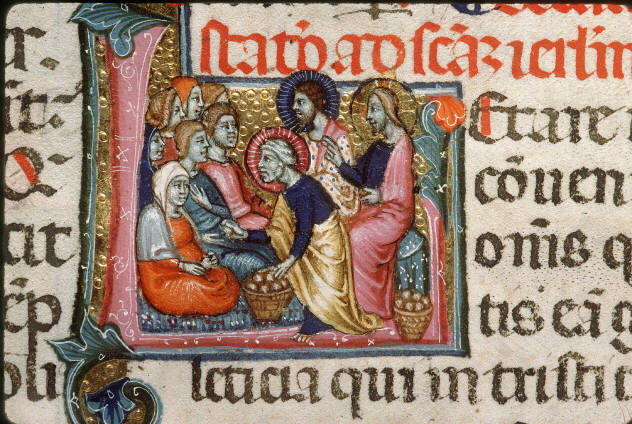
conventum facite omnes qui diligitis eam: gaudete cum lætitia, quia in tristitia fuistis: ut exsultetis, et satiemini ab uberibus consolationis vestræ. Ps. Lætatus sum in his, quæ dicta sunt mihi: in domum Domini ibimus.

[Gospel for the Sunday: St. John, vi, 1-15] v. 15: "Jesus therefore, when He knew that they would come to take Him by force and make Him king, fled again into the mountain, Himself alone."

Wonderful! How great is the tyranny of gluttony, how great the fickleness of men's minds! No longer do they vindicate the Law, no longer do they care for the violation of the Sabbath, no longer are they zealous for God; all such considerations are thrown aside, when their bellies have been filled; He was a prophet in their eyes, and they were about to choose Him for a king. But Christ fleeth. "Wherefore?" To teach us to despise worldly dignities, and to show us that He needed nothing on earth. For He who chose all things mean, both mother and house and city and nurture and attire would not afterwards be made illustrious by things on earth. The things which He had from heaven were glorious and great, angels, a star, His Father loudly speaking, the Spirit testifying, and Prophets proclaiming Him from afar; those on earth were all mean, that thus His power might the more appear.

He came also to teach us to despise the things of the world, and not be amazed or astonished by the splendors of this life, but to laugh them all to scorn, and to desire those which are to come. For he who admires things which are here, will not admire those in the heavens. Wherefore also He saith to Pilate, "My Kingdom is not of this world" (c. xviii, 36), that He may not afterwards appear to have employed mere human terror or dominion for the purpose of persuasion. Why then saith the Prophet, "Behold, thy King cometh unto thee, meek, and sitting upon an ass"(Zach, ix, 9)? He spoke of that Kingdom which is in the heavens, but not of this on earth; and on this account Christ saith, "I receive not honor from men." (v. 41).

Learn we then, beloved, to despise and not to desire the honor which is from meal for we have been honored with the greatest of honors, compared with which that other is verily insult, ridicule, and mockery. And as the riches of this world compared with the riches of that are poverty, as this life apart from that is deadness, (for "let the dead bury their dead"-St.Matthew, viii, 28) so this honor compared with that is shame and ridicule.


Saint John Chrysostom

...in omnibus caritas

The concluding words of the Supreme Pontiff's homily today, which should be deeply meditated and taken to heart by all who love and seek to restore the faith and traditions of our Holy Church:

'Everything in this world will pass away. In eternity only Love will remain. For this reason, my Brothers, taking the opportunity offered by this favourable time of Lent, let us commit ourselves to ensure that everything in our personal lives, and in the ecclesial activity in which we are engaged, is inspired by charity and leads to charity. In this respect too, we are enlightened by the mystery that we are celebrating today. Indeed, the first thing that Mary did after receiving the Angel’s message was to go "in haste" to the house of her cousin Elizabeth in order to be of service to her (cf. Lk 1:39). The Virgin’s initiative was one of genuine charity, it was humble and courageous, motivated by faith in God’s word and the inner promptings of the Holy Spirit. Those who love forget about themselves and place themselves at the service of their neighbour. Here we have the image and model of the Church! Every ecclesial community, like the Mother of Christ, is called to accept with total generosity the mystery of God who comes to dwell within her and guides her steps in the ways of love. This is the path along which I chose to launch my pontificate, inviting everyone, with my first Encyclical, to build up the Church in charity as a "community of love" (cf. Deus Caritas Est, Part II). In pursuing this objective, venerable Brother Cardinals, your spiritual closeness and active assistance is a great support and comfort to me. For this I thank you, and at the same time I invite all of you, priests, deacons, religious and lay faithful, to join together in invoking the Holy Spirit, praying that the College of Cardinals may be ever more ardent in pastoral charity, so as to help the whole Church to radiate Christ’s love in the world, to the praise and glory of the Most Holy Trinity. Amen!'

Indeed, let us pray for them.

The Liturgical Stake

I was invited in Naples, Florida, this past week by a group of Una Voce, in order to give some lectures. I spoke about the Liturgy. Here is the first lecture I gave, about the history of liturgical deviations.

God bless you and give us the strenght and the courage to persevere in our battle for the restoration of a true Catholic Liturgy in the Church!

Father Laurent Demets, FSSP


Introduction – Historical overview


The liturgical question is at the core of the current crisis in the Church. The XX century was the century of the liturgical movement. Paradoxically, it was also the century that brought a great many errors and abuses in liturgical matters. But let us not limit this liturgical problem to the only XX century. The History of the Church shows us that this is not the first liturgical crisis we have struggled through. The Church and the faithful didn’t wait for the XX century to take an interest in liturgy. As a matter of fact, the entire History of the Church, back to the very beginning is marked by liturgical questions. And this is perfectly understandable since liturgy is the expression of the faith of the Church and it involves men, who, by our very nature are imperfect.

With the help of Dom Gueranger, I am going to give you a quick overview of the liturgical errors of the past. I will preface by telling you that I am going to speak only about the Roman liturgy, even though the study and the history of other liturgies is very interested. Unfortunately we don’t have time to consider them. In addition to our time limits, I am not the best one to speak on the topic of the liturgies of other rites, since they are not my 'specialty' like the Roman Rite is.

· Early Church to Middle Ages

In the earliest years of the Church, heretics attacked the liturgy, in order to change the Faith. Paul of Samosata, Arius and then the Donatists changed the liturgy of the Church in order to teach their own doctrine. They composed their own hymns and even their own psalms in order to corrupt the Faith by their false prayers as Dom Gueranger says.
Then we have a period of few centuries during which the Liturgy further develops. It is not my purpose to speak about that today, but let us say that the Roman liturgy and the Gallican liturgy merged together into one with a pre-eminence of the Roman liturgy. The unification of the Empire under the reign of Charlemagne helped a lot. The Roman liturgy finally became predominant throughout all Europe.
The XIV and XV centuries knew a certain adulteration, especially in the area of chant. Novelties in the way of singing appeared and Pope John XXII had to intervene with his bull “Docta Sanctorum” in 1322.

· Renaissance

Then came the Humanist period, which provoked some unfortunate attempts at reform. The idea was that the ecclesiastical Latin was too rudimentary. The pontifical court was then full of poets and writers for whom the goal was to reform the Latin and they started to compose again all the hymns for the liturgical year. Pope Leo X himself ordered the composition of a new hymnal. The hymnal of Ferreri – Bishop Zacharie Ferreri was the artisan of this hymnal – was finally approved by a Brief of Pope Clement VII in 1525. According to this Brief, every cleric could choose the prayers he wanted for the Divine Office. Ten years later a new breviary was also approved. It is known as the Breviary of Quignonez, from the name of its composer Francois Cardinal Quignonez. Cardinal Quignonez had the reputation of being a man of great piety and a sincere love for the liturgy. The intention was good: it was to renew the devotion of the clerics. Nevertheless the effects were disastrous, since they were made at the expense of Tradition.
If we take stock of this reform made under the authority of these three Popes – Leo X, Clement VII and Paul III – we can only say that is was a disaster – the word is from Dom Gueranger for whom Romanita cannot be suspected. It must be acknowledged that the University of Paris has censored this Breviary promulgated by the highest authority of the Church.
The commentary of Dom Gueranger is pretty interesting. The character of the influence The Holy See exercised on the publication of this Breviary of Quignonez contradicts all that we can see in all the centuries before or after. (That was written in the XIX century!) Rome seems to desire that we use this form of Office but on other hand seems to timid to make it law. We feel as though we are in a state of transition that will last until a Pontiff – Saint Pius V – chosen by God to succeed Leo, Gelasius or Gregory comes and reforms in a saintly way the Divine worship as the Church speaks.
This reform was about the Breviary and didn’t concern the Holy Mass. But the Divine office is still a part of the Liturgy of the Church and what happened in the XVI century can help us deal with the actual liturgical wreck. Dom Gueranger gives us some considerations we can apply, mutatis mutandis, to the actual situation.
- In order first to last, the reform of the liturgy must be done by pious persons and not by erudite persons.
- In a reform of the liturgy, we must beware of novelties.
- Shortening the liturgy is not reforming it!

· The Reformation

The Protestant heresy had much impact on the Liturgy. The idea of Luther was to free man from the servitude of thought regarding the teaching power of the Church and from the servitude of the body regarding the liturgical power.
Dom Gueranger gives the principles of what he calls the “ anti-liturgical heresy.”
- Hatred of the Tradition in the expressions of the Divine worship.
- Replacing the ecclesiastical style words with readings from the Bible. The purpose is to delete what is born from Tradition and to promote the Protestant doctrine with a judicious choice of texts from the Bible. All heresies have their origin in Scriptures, but not on Scripture as a whole, only on carefully chosen passages which support their particular ideas. By the way, the meaning of the word “heresy” in Greek is “choice”.
- The fabrication and introduction into the liturgy of different words in order to spread their doctrine.
- Removing all the words that express the mysteries of the Faith. For examples, they prefer to speak about a table rather than an altar, or about the Lord’s Supper rather than the sacrifice.
- The use of the vernacular for the liturgy. Dom Gueranger says about that: The hatred of the Latin language is in the heart of all the enemies of Rome. They consider it as the good of the Catholics in the whole world, the arsenal of orthodoxy against the subtleties of the sectarian spirit.
- The hatred of the papacy, which is the foundation stone of the entire edifice that is the Church.
- The destruction of priesthood.

· The answer of the Church - a true Catholic Reform: The Council of Trent – Saint Pius V

At the 25th Session of the Council of Trent, it had been decided to entrust the Pope with the reform of the Liturgy. Pius IV began a reform of the breviary but he died and his successor, Pius V continued. The breviary of Quignonez was abolished and replaced by the Roman Breviary.
Then the Roman Missal was restored in 1570. All the dioceses had to embrace this missal except those who had a missal more than 200 years old. Almost all the dioceses of Europe accepted the Missal and the Breviary of Saint Pius V except Milan in Italy and Lyon in France, which had their own antique liturgies.
Then the occidental Church knew many decades of liturgical unity. The reform continued with the publication of the Martyrology, the Pontificale and the Rituale.

· The liturgical deviation in France ( XVII – XVIII )

It sometimes happens that the eldest daughter of the Church is also rebellious daughter. Two important trends would have a great impact on the Church in France until the XX century, these are Jansenism and Gallicanism. These trends had consequences in liturgical matter.
In 1660 Joseph de Voisin, Doctor of the University of Sorbonne published a translation in French of the Roman Missal. The Assembly of the clergy of France immediately condemned this translation. Pope Alexander VII approved this condemnation. In his Brief, He condemned those who have the impudence to translate the Roman Missal, written in the Latin language, into the French language. For the Pope this is a deterioration of the most sacred rites, which debases the majesty that the Latin language gives to them. It is a mark of the hatred of mystery. Finally the Pope prohibited the printing and the reading of the Missal in French under a sentence of excommunication.
That seems to be excessive, especially today since we have now many translations of the Missal in vernacular languages. In the XIX century, when Dom Gueranger wrote his book, there were already many translations available. And Dom Gueranger explains that it is now possible but a translation has to be accompanied by some commentary approved by the Church. Giving the translated text to the faithful without any explanations of the mysteries of the Faith would open the door to numerous and faulty personal explanations.

Then the liturgical attacks came. First was the Rituale of Alet in 1667 whose Jansenist influence was great. The Breviary of Vienne in 1678 and the Breviary of Harlay in 1680 brought more novelties. This Breviary marked the reversal of the work of Charlemagne and the Popes. This Breviary, for the use of the diocese of Paris, created a new Office which had nothing to do with the Roman Breviary. After the Breviary, Harlay, who was archbishop of Paris, published his own missal. The principle was to use only texts from the Bible that was the idea Luther had. Nevertheless, the Missal of the diocese of Paris, in spite of unfortunate changes, was still the Roman Missal.
The Abbey of Cluny went further by exchanging its old breviary for a new one. Once again the idea was to use only the words from the Scriptures. Yet some new compositions by writers of this century appeared anyway, contradicting the purpose the innovators of this breviary had claimed to be their reasoning for the changes. They even changed the liturgical calendar. The admitted goal was to diminish the cult of the Saints, especially the cult of Our Lady.
You will not be surprised to learn that among the members of the committees for the redaction of the breviary of Paris and the breviary of Cluny, were some notorious Jansenists. They attacked the true Faith through the Liturgy.

The attacks were more virulent in the XVIII century. The recitation of the Canon of the Mass in a loud voice appeared as a trend. As Dom Gueranger points out, this was: the seeds of a revolution. Indeed, if we read the Canon in a loud voice, people would ask to read it in the vernacular language. And then, people could become judges in the teaching of the Faith, which is exactly what we see today in so many places. And once again, that had already been the strategy of Luther and Calvin.
The Council of Trent had already condemned this audacity during the 22nd session. Listen to the 9th canon: CANON IX.--If anyone says, that the rite of the Roman Church, according to which a part of the canon and the words of consecration are pronounced in a low tone, is to be condemned; or, that the mass ought to be celebrated in the vulgar tongue only; let him be anathema.
But this didn’t prevent the abuses of the innovators. Thus a new Missal was printed for the diocese of Meaux – the diocese of the famous Bossuet, just few years earlier! Regardless of the integrity of the Liturgy, they introduced novelties in the rubric of the Missal, such some responses preceded by the a big letter R in red to indicate that the congregation has to make the responses just after the words of the consecration and the words of the communion. Thanks be to God, the Bishop of Meaux, who was the successor of Bossuet, did not approve this missal and prohibited it under the sentence of suspension.
But in spite of the orthodoxy of many good bishops and priests – as Father Le Brun, for example, who wrote a very good book about the Holy Sacrifice of the Mass – the novelties increased throughout the entire country.
The Missal of Troye was published in 1736. Its rubrics dictates that the Canon has not to be said “ submissa voce ” – in a low voice – but “ submissiora voce ” – in a lower voice! The Troyen Missal also dictates that a priest who says a solemn Mass does not have to say the prayers and readings sung by the choir or said by other ministers. The altar crucifix and the candles are no longer mandatory. The second Confiteor before the communion was removed. Many texts born from Tradition throughout the centuries were replaced by texts from the Scriptures. A good Bishop, Jean-Joseph Languet de Gergy, archbishop of Sens denounced this Missal for being full of Calvinist conceptions.
The rabid trend of secularization and naturalization of the Liturgy did not abate. The symbolism and mysticism of the rites was attacked. In the name of reason – this was the “Century of Lights” – when it seemed necessary to find an explanation for all, even for the mysteries of the Faith. In accordance with this, they claimed that people needed to understand all the ceremonies of the Liturgy. Hence a simplification of the rites.

The parish of Asnières, a town near Paris, embodied perfectly the goals of the innovators. The pastor at Asnières was Father Jacques Jubé, a zealous Jansenist. Now, let me describe how the liturgy of this parish was – and I remind you this liturgy I am about to describe was a liturgy in the XVIII century.
There was only one altar in the church, called “Sunday altar” because Mass took place only on Sunday and feast days. When there was no Mass, this altar was totally stripped, as every altar has to be on Good Friday. For Mass, they just put one altar cloth and nothing else: no crucifix, no candle. The only crucifix in the sanctuary was the crucifix of procession that preceded the priest as he ascended the altar. After the beginning prayers of the Mass, he went to sit on a seat on the epistle side from where he started the Gloria and the Credo without reciting them in full, nor were the pieces sung by the choir. During the offertory, there was a procession and bread and wine were offered to the priest. Dom Gueranger says this custom was not reprehensible in itself since it was usual in France in many dioceses at this time, and came from an old tradition. The problem was that in the church of Father Jubé, they added fruits and vegetables which they placed on the altar along with the bread and wine to be consecrated. Then the chalice was brought to the altar without a veil. The priest and the deacon said the prayers of the offering of the chalice in a loud voice to signify that they offered it in the name of the congregation. The Canon was in a loud voice also. And there were no specific prayers before communion.
Are you not familiar with this liturgy? I would say, yes, except for one thing. It was still all in Latin. But as you see, our innovators of today have not come up with anything new. They have simply copied the liturgy of the Jansenists from the XVIII century.
We now look at the Missal of Vintimille, published by the Archbishop of Paris, Charles-Gaspard de Ventimille in 1738. In addition to all previous changes made to the Roman Missal, there was now a complete modification of the parts of the Proper in this new Missal of Ventimille. The intention of Archbishop Vintimille was to arouse piety, to make the chant easier to sing and to renew the Faith, Hope and Charity of the people. But as Dom Gueranger continuous to point out, this was also the goal of Popes Saint Gregory and Saint Pius V and there was no need to change what the Church had established. In order to infuse a new richness in the Liturgy, the doctors of the Sorbonne composed new Prefaces, instead of using the traditional Prefaces available in the old Sacramentaries. At the height of these innovations one of the authors was expulsed from the University of Sorbonne as a heretic. Once again, the consequences were disastrous. By the second half of the XVIII century, three quarters of the French dioceses have abandoned the Roman Liturgy. The French Revolution with its Civil Constitution of the Clergy, which created a schismatic Church, would soon foment further confusion.

· The Synod of Pistoia (Italy 1786)

Scipion de Ricci, Bishop of Pistoia, wanted to introduce to Italy the ideas of his friends from France. With the approbation of the Grand Duke of Tuscany, he convoked a “Diocesan Council” as he called it. Here are some of the reforms they tried to impose:
- They wanted to rid the churches of much of their precious and exquisite decorations.
- Reforming religious orders. They shouldn’t have churches open to the congregations. Their Divine Office would be diminished and they would be permitted to have only one or two Masses a day in their churches. The other priests would have to concelebrate.
- Suppressing processions in honor of Our Lady or the Saints.
- Removing pictures of the Sacred heart and any other pictures that express a “false dogma”
- Only one altar in every churches, which should be without relics or flowers
- Use of the vernacular language in a loud voice
- There would be exposition of the Most Holy Sacrament only once a year for the feast of Corpus Christi. A blessing with the ciborium could be given every Sunday.
- They advised against the Station of the Cross


Fortunately, this Synod was condemned by Pope Pius VI with his famous Bull Auctorem Fidei in 1794.

· First efforts of restoration in the XIX

The coming of Pope Pius VII to France for the coronation of Napoleon proved that the love for the true liturgy was not dead in France. The Pope remained four months in the country and everywhere he went, the churches were full and thousands of faithful tried to receive communion from his hand. The spectacle of these crowds singing the Credo in unison with the Pope was a sign of the beginning of the restoration of the Roman Liturgy in France.

This restoration would be done time after time in the dioceses of the country. The restoration of the Benedictine Order by Dom Gueranger in Solesmes would have an important role.


*
* *


Let us now draw some conclusions from this historical overview. First I would say that the Novus Ordo is not, as its name says, new at all. It is rather the outcome – or should I say the triumph? – of the assault by what Dom Gueranger calls “anti liturgical sect.” It appears that Bugnini is not an innovator, but rather a copier of the Jansenists of the XVIII century. But there is a major difference, and herein lies the problem.
In the past all the so-called reforms were made against the will of the Pope, or at least without his approbation. We can wonder about the silence of the Vatican regarding the liturgical experimentation in France in the XVII and XVIII centuries. But a silence from the highest authority doesn’t necessarily mean approbation. In fact, Rome had already spoken at Trent and then through the pen of Pius V. Rome spoke again through Pius VI who condemned the liturgical abuses proposed by the Synod of Pistoia.
But today, the Missal of Bugnini has been requested, approved and promulgated by the Pope, so that we don’t call it the Missal of Bugnini, but the Missal of Paul VI. The Vatican itself has tried to make everybody believe that this Missal is now the only missal for the Roman Church and that the Missal of Saint Pius V has been abolished. Yet, this is a lie.
Thanks be to God, after 30 years of resistance, the Vatican has had to acknowledge that this old and venerable Missal is still in effect, and further, that every priest of the Roman Rite may freely celebrate Mass according to this Missal of Saint Pius V without any specific permission. But this right has yet to be recognized everywhere. The Tridentine Mass still has many enemies everywhere within the Church.
In fact there is a precedent in History with the Hymnal of Ferreri and the Breviary of Quignonez promulgated with the approbation of the Pope. And for this particular precedent I say, thanks be to God, because this precedent shows us that even with the authority of the Pope, a liturgical reform can be wrong. A good reform, indeed, is not a creation of something new, but a restoration of the Tradition when it happens to have been damaged in some way. And that is what distinguishes the true reformer Popes from the others. On one hand, we find some Popes as Saint Gregory the Great, Saint Gregory VII, Saint Pius V and Saint Pius X. On the other hand, we have Leo X, Clement VII, Paul III and Paul VI.
My intention is not to set these Popes in opposition or necessarily to say that some Popes are better than others, although it is a fact that the great reformers of the Liturgy have been canonized. Maybe it is a strong indication that a good reform can be done only holy persons rather than erudite persons as we have already said. But what is true – and this will be my conclusion for today – is that a good reform brings unity and harmony. We judge the tree by its fruits.