Rorate Caeli

The Imperishable Traditional Mass: Photos and Information of the Largest Traditional Rite Workshops in the World -- Ars Celebrandi, Poland, 2021


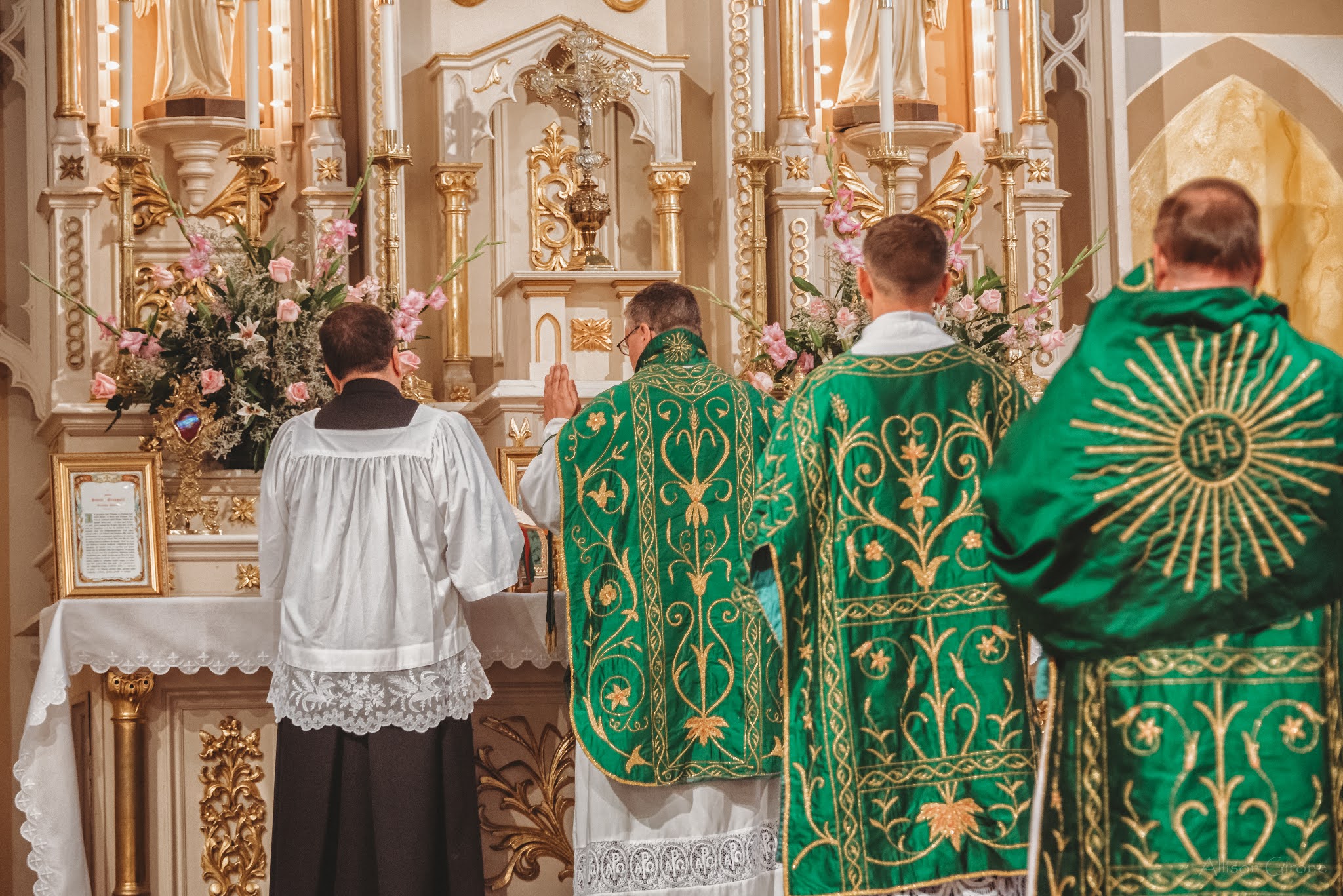
“Ars Celebrandi” liturgical workshops started on July 8, 2021, with a record number of over 230 participants -- among them priests, seminarians, lay brothers as well as laymen and laywomen. They will learn the secrets of all the skills needed to celebrate Holy Mass and other sacraments in the Extraordinary Form of the Roman Rite, as well as the Divine Office and selected services, in nine different workshop groups. 

 “Ars Celebrandi” takes place at the Basilica-Shrine of Our Lady at Licheń, Poland, where several churches and a dozen or so chapels as well as an excellent accommodation are available. This year's edition is the eighth one. Most of the participants come from Poland, but participants from Germany and France also arrived despite travel difficulties resulting from the pandemic. The organizers are particularly pleased with the participation of a large group of 60 clergymen. There are diocesan and religious priests: Salvatorians, Franciscans, Piarists, Pallottines, and others.  Another large group is male youth who are learning altar service. There are also two groups of singers, separately for men and women, who prepare Gregorian chants for solemn or sung Masses as well as services celebrated during the workshops. 

“Beyond Summorum Pontificum: The Work of Retrieving the Tridentine Heritage”: Full Text of Dr. Kwasniewski’s Roman Forum Lecture

The following is the transcript of the lecture I gave at the Roman Forum on July 3. A video of the lecture has been posted at Remnant-TV (link). A synopsis (less than one-third the length) was published at Crisis Magazine on July 7, under the title “Summorum Pontificum at Fourteen: Its Tragic Flaws.” As we near the imminent restriction or suppression of this motu proprio, it is important to step back and look at the bigger picture: What is—or is not—the role of the papacy vis-à-vis the liturgy handed down in tradition? What should our attitude be to abuses of papal authority, particularly in regard to its attempts to “allow” or “forbid” immemorial rites of divine worship? I would draw the reader’s attention to the notes, which contain important supporting material.—PAK


Beyond Summorum Pontificum: The Work of Retrieving the Tridentine Heritage


Peter A. Kwasniewski


As we find out more and more about the sheer corruption of the papal court today, which rivals the record of the Renaissance, it seems (if anything) still more remarkable, bordering on the miraculous, that Summorum Pontificum was ever issued at all. It was a watershed moment, a gesture of fortitude and favor, and a clear factor in multiplying old Masses around the world and weakening the modernist hegemony. We were grateful to have a pope who, instead of throwing a bone to the nostalgics—the so-called “indults” of Paul VI and John Paul II—had the courage to say the truth: that the great liturgy of our tradition had never been abrogated and could never be abrogated. In just a few sentences, central claims of Archbishop Lefebvre, Michael Davies, Count Neri Capponi, and others were vindicated.


I think it is fair to say right from the start that Summorum Pontificum was useful to our movement in the way that an enormous booster rocket is useful for launching a spaceship into orbit: it has a lot of raw power, but it can only do so much, and when it’s empty, it falls away. Summorum Pontificum is destined to be one of the great papal interventions in all of history, but it is no more than damage control; it is not a pillar, much less a foundation, of a permanent structure. And those who lean on it too much will find themselves crushed by its incoherences. My goal in this presentation will be to walk through Summorum Pontificum and identify its principal flaws, the elements in it that act as weights pulling us down, so that we can resolutely go beyond it to retrieve the fullness of the Tridentine heritage that constitutes the authentic Roman rite.


I can imagine what some of you may be thinking: “Rumors are swirling everywhere that Summorum Pontificum is about to be severely curtailed or shelved—and you are complaining about its imperfections? Right now, we’d all be grateful and relieved if we could just hold on to this motu proprio, warts and all.” My response is that unless we understand precisely the weak points of Summorum Pontificum, we will not be able to understand why we are still so vulnerable to the machinations of Francis and his circle, and, more to the point, we will not be able to summon the necessary strength to ignore or to oppose what the Vatican might do to reduce or prevent the celebration of the classical Roman rite. For the motu proprio establishes or reaffirms false principles that are coming back to haunt us, or perhaps have never stopped haunting us. As much as the traditional movement has benefited pragmati­cally from Summorum (and of that, there is no doubt), we must learn to put our weight fully on our own two feet, so that when the legal crutch or brace is suddenly removed, we do not topple over helplessly.


URGENT - PRAYERS! - Highly Reliable Source says Motu Proprio against Summorum could be published this Friday

We have learned from a source that is usually highly reliable that Francis’ attack on Summorum Pontificum is signed & is expected to be promulgated this Friday.


Perhaps prayers from the Faithful around the world - even at this late stage - to Our Lady of Mt Carmel, will avert a disaster.

Fontgombault Sermon for the Feast of Saint Benedict in Summer: "We should take note of our social regression: God has been eliminated from the States and societies."


Sermon of the Right Reverend Dom Jean Pateau
Abbot of Our Lady of Fontgombault
Fontgombault, July 11, 2021
Gaudeamus.
Let us rejoice.

Dear Brothers and Sisters,
My dearly beloved Sons,

On this Sunday, from the very first word of the introit, the Church invites us to rejoice. Is that so astonishing? Sunday is quintessentially a day of joy. After a week of work, man is invited by God Himself to rest. Such is the commandment, or more exactly the word, a word of love, which God addressed on Mount Sinai to the people He had just brought out of Egypt:


"Six days shalt thou labour, and shalt do all thy works. But on the seventh day is the Sabbath of the Lord thy God: thou  shalt do no work on it, thou nor thy son, nor thy daughter, nor thy manservant, nor thy maidservant, nor thy beast, nor the stranger that is within thy gates. For in six days the Lord made heaven and earth, and the sea, and all things that are in them, and rested on the seventh day: therefore the Lord blessed the seventh day, and sanctified it." (Ex 20:9-11)


God had just set His people free from Pharaoh, and He did not want greed for lucre to shackle it, and lead it through a ceaseless frenzy of work to forget its Maker. The seventh day therefore became the day on which man would remember that he had been freely liberated by God from bondage.


For Christians, Sunday has been enriched with a new gift. Man, who from the very beginning had rebelled against God, had to be liberated from another form of bondage, a deeper, more universal, and multifaceted one, that is, sin. Man needed to be reconciled with God, with the design God had prepared in His immense love for His so puny creature: eternal beatitude, that is to say, life in communion with God, the vision of God for eternity. Such is the reward of rewards, to which God in His goodness calls us.

Cardinal Sarah intervenes on the debate over Summorum Pontificum

Cross-posted from FIUV.org


A series of Tweets sent but Robert, Cardinal Sarah, @Card_R_Sarah, at 12pm on 8th July 2021 (translated from French).

History will remember Benedict XVI, not only as a great theologian but also as the Pope of Summorum Pontificum, the Pope of liturgical peace, who built an ecumenical bridge with the Christian East by means of the Latin-Gregorian liturgy.


He will be remembered as the Pope who had at heart the desire to find again the Christian roots and unity of Europe. He opposed meaningless secularism [laicisme] and the disintegration of European culture.


Following the Motu Proprio Summorum Pontificum, despite difficulties and resistance, the Church embarked on a path of liturgical and spiritual reform, which, though slow, is irreversible.


Event: Solemn Mass in Philly, with a timely intention


A timely repost: 'in a certain sense there is no such thing as a sad saint'


CHEERFULNESS


Don Pietro Leone


According to St. Thomas Aquinas, cheerfulness is a particular virtue which is a part of justice. The virtue of justice is defined as the virtue of giving the other his due, whether that other is God or man. An example of justice in the strict sense is paying back a debt. Now cheerfulness involves giving another something which is not due to him strictly, but in equity, in fairness:  namely by behaving pleasantly to those around one. Cheerfulness, like truthfulness, is completely natural, because man naturally lives in society, and without cheerfulness and truthfulness society would not last. St. Thomas quotes Aristotle in this regard: ‘No-one could abide a single day with the sad or with the joyless’.


    Why cheerfulness is necessary to society is because it maintains harmony between the different members of society, both in actions and in words. Cheerfulness, apart from being a part of justice, is a form of friendliness. We can distinguish between two forms of friendliness: a particular form which springs from a particular affection for a friend; and a general form which springs from a general affection for all people. Cheerfulness is this latter form of friendliness: it is directed towards every-one. It is directed towards every-one, though not always in the same way: not with the same intimacy with a stranger as with a friend, for example, but in an appropriate way: in a way that suits the circumstances. Interestingly the book of Ecclesiasticus (4.7) particularly mentions the poor as the object of our cheerfulness or friendliness, perhaps because it can be more difficult to be friendly to the poor: ‘Make thyself affable to the congregation of the poor’.


EVENT: Festival of Saint Louis in St. Louis, Missouri, August 24-25, 2021

Readers may recall the first Festival of St. Louis that took place last summer. This summer, even more is planned: a splendid model of how traditional Catholic laity should respond to the challenges of our times.

Saint Thomas More: "This indictment is grounded upon an Act of Parliament, directly oppugnant to the laws of God and his holy Church..."


All which notwithstanding the jury found him guilty, and incontinent upon the verdict the Lord Chancellor [for that matter chief commissioner] beginning in judgment against him, Sir Thomas More said to him,

"My Lord, when I was towards the law, the manner in such case was to ask the prisoner before judgment, why judgment should not be given against him."

Whereupon the Lord Chancellor staying his judgment, wherein he had partly proceeded, demanded of him what he was able to say to the contrary. Who then in this sort mildly made answer:

"Forasmuch as, my Lord, this indictment is grounded upon an Act of Parliament, directly oppugnant to the laws of God and his holy Church, the supreme government of which, or of any part thereof, may no temporal prince presume by any law to take upon him as rightfully belonging to the See of Rome, a spiritual preeminence by the mouth of our Saviour himself, personally present upon the earth, to St. Peter and his successors, bishops of the same see, by special prerogative, granted, it is therefore in law amongst Christian men insufficient to charge any Christian."
...

The History of the Origins of the Pro-Life Movement around the World — by Roberto de Mattei

 At the Origins of the International Pro-life Movement


In the battle for the defense of life, the family, and traditional values, we are only fragile instruments in the hands of Divine Providence and we have the moral duty to be grateful to those who went before us and opened the way. This is why we cannot forget the first international conference for life, which took place in Rome from April 25-27 1980, on the initiative of the association Alleanza per la Vita, set up by Agostino Sanfratello, co-founder along with Giovanni Cantoni of Alleanza Cattolica in Italy.

On May 22 1978 Law 194 was passed, which legalized abortion in Italy. On October 16 of the same year, after the death of Paul VI and the brief pontificate of John Paul I, the pick for the papal throne was John Paul II, who would go on to make the fight against abortion one of the linchpins of his pontificate. It was within this historical horizon that on Friday April 25 an event opened in the main hall of the Augustinianum institute, a little way off from the Vatican, that was extraordinary for the quality and number of participants, convened in Rome at their own expense from all over the world.

“The Council and the Eclipse of God” - PART XII – How the Council insinuated the heresy of Sola Scriptura into its teachings - by Don Pietro Leone


In this last part of his discussion on Catholic – Protestant relations, Don Pietro shows how the Council insinuated the heresy of Sola Scriptura into its teaching by a change of accent and other ploys.  This he considers the fundamental Lutheran heresy because it effectively dispenses with the authority of the Church and substitutes  it with the Bible interpreted as one pleases.        F.R.


“The Council and the Eclipse of God”


by


Don Pietro Leone


Part XII


The Protestantization of Council Doctrine


II  Protestantization of Council Doctrine


  We may identify the Protestantization of  Council doctrine in the following fields particularly:


·         Ecclesiology;

·         The Holy Scriptures;

·         The Priesthood; and

·         The Mass.


We shall consider the first two themes here, the third in chapter 6, and the fourth in chapter 7.


         Ecclesiology


The novel ecclesiology that we have presented in our treatment of the attacks against the dogma of the Unity of the Church is largely of Protestant inspiration, in that:


a)  The concept that the true Church is wider in extent than the Roman Catholic Church and includes within its confines other denominations, is a heresy of the ‘German High Church’ 1 and of the Anglicans 2 ;

b)  The concept that there is more than one church is manifest most notably in the proliferation of the Protestant ‘churches’;

c) The concept of the ‘hierarchy of truth’ corresponds to the Protestant error concerning Fundamental Truths’ 3 ;  

d)  Ecumenism, is, in its origins, a Protestant fabrication4 .


Statement from the FIUV

Cross-posted from the FIUV blog.


The Una Voce Federation has taken out an advert in the mass-circulation Italian daily newspaper La Repubblica, appearing today, Sunday 4th July.

The English text is as following (for other languages see here):

Living the faith, living the future:
The Extraordinary Form of the Roman Rite
Declaration of the International Federation Una Voce

Reminder: Rorate Caeli Purgatorial Society


This is our monthly reminder to please enroll Souls of the Rorate Caeli Purgatorial Society.  The Society now stands at 110 priests saying weekly or monthly traditional Latin Masses for the Souls. 

** Click here to download a "fillable" PDF Mass Card in English to give to the loved ones of the Souls you enroll (you send these to the family and/or friends of the dead, not to us). It's free for anyone to use. CLICK HERE to download in Latin and CLICK HERE to download in Spanish

Priests: The Souls still need more of you saying Mass for them! Please email me to offer your services. There's nothing special involved -- all you need to do is offer a weekly or monthly TLM with the intention: "For the repose of the Souls enrolled in the Rorate Caeli Purgatorial Society." And we will always keep you completely anonymous unless you request otherwise. 

How to enroll souls: please email me at athanasiuscatholic@yahoo.com and submit as follows: "Name, State, Country." If you want to enroll entire families, simply write in the email: "The Jones family, Ohio, USA". Individual names are preferred. Be greedy -- send in as many as you wish and forward this posting to friends as well.

Op-Ed: "The Enemies of Summorum Pontificum Want War!"

 by German website Summorum-Pontificum.de


Paix Liturgique yesterday published its Letter 805, which contains more information on the planned restriction or abolition of Summorum Pontificum. We bring a partially condensed translation.


It begins with a long quotation: “In the coming days or weeks, there will be a new motu proprio,” the archbishop of Dijon, Minnerath, told a group of adherents of the traditional liturgy on 6/26 who wanted to express their dissatisfaction to the bishop. But even before this document is published—if it is indeed published—information is mounting about the intentions of the opponents of Benedict XVI’s previous motu proprio.


Thus, Secretary of State Cardinal Parolin [is said to have] affirmed to a group of cardinals, “We must put an end to this Mass forever!” And Msgr Roche, new prefect of the Congregation for Divine Worship, laughingly declared to a group of Roman seminary officials and English-speaking Curia staff, “Summorum Pontificum is practically dead. We are returning authority to the bishops on this matter—but certainly not to the conservative bishops.”


It should be noted that Bishop Minnerath, who began the hostilities against the traditional congregation in Dijon, is also a member of the Congregation for the Doctrine of the Faith, and is therefore in Rome every month and is very familiar with the circles preparing the attack on Summorum Pontificum.


The Motu proprio Summorum Pontificum of Benedict XVI in 2007 was a compromise that brought about with great skill a coexistence between the new Mass of Paul VI and the Tridentine Mass—one could also say between fire and water. It is clear from all our surveys that this peace treaty was widely welcomed by the vast majority of the Christian people, whether they participated in the traditional liturgy or not.

URGENT: The Abolition of Summorum Pontificum could come within days or weeks — declarations from Bishops and Cardinals

 After faithful of the abolished FSSP mission in Dijon came to complain in front of the Archdiocesan office building, on June 26, Abp. Roland Minnerath came to talk to them and had ominous menacing words.


From Paix Liturgique:

"You will have a new motu proprio in the upcoming days or weeks," Abp. Minnerath, Archbishop of Dijon, said on June 26 to the faithful of the Traditional Mass who came to display their discontent before the archdiocesan building. [Rorate: this declaration is on video]


But even before the publication of this text, if it comes to be published, the testimonials on the intentions of the enemies of the previous motu proprio, that of Benedict XVI, grow:

- Cardinal Parolin, the Secretary of State, affirmed thus before a group of Cardinals: "We must put an end to this mass forever!"

- And Abp. Roche, new Prefect of the Congregation for Divine Worship, explained, while laughing, to those responsible for [some] seminaries in Rome and members of the Curia, all English-speaking: "Summorum Pontificum is practically dead! We will give back to the bishops power on this matter, but particularly not to conservative bishops.”


It must be known additionally that Abp. Minnerath, who opened the hostilities against the traditional community of Dijon, is a member of the Congregation for the Doctrine of the Faith [Rorate: curently in charge of the application of Summorum] and due to this is present every month in Rome, surrounded by the Curial milieux that have prepared the offensive against Summorum Pontificum. [Source]


Pontifical High Mass: Washington, D.C.

A pontifical high Mass will be offered at the Basilica of the National Shrine of the Immaculate Conception in Washington, D.C., on Saturday, 14 August 2021 -- the vigil of the Assumption of the Blessed Virgin Mary.  This will be the fourth pontifical high Mass there since 1969:  2010 with Bishop Slattery; 2018 with Archbishop Sample; and 2019 with Archbishop Cordileone.


This year's (rescheduled from last year) celebrant will be His Excellency Thomas E. Gullickson, JCD, an American who recently retired as papal nuncio to Switzerland and Liechtenstein after several years in the Vatican diplomatic service.  Archbishop Gullickson was ordained for the Diocese of Sioux Falls, South Dakota.


The pontifical high Mass, like the other three offered since Summorum Pontificum, will be at the high altar in the great upper church (although the portable table in front of it is not allowed to be removed from the sanctuary, except for concerts).  EWTN will broadcast the 1 p.m. 14 August Mass, like it has done for the other three pontifical Masses.  It will be sponsored by the Paulus Institute for the Propagation of Sacred Liturgy, which sponsored the 2010 and 2018 Masses at the basilica shrine (the 2019 sponsor was the Benedict XVI Institute for Sacred Music and Divine Worship).  Thanks must be given to sponsors, as it is an understatement on just how difficult it is to fund and organize such a liturgy -- and fill the pews in the largest church in North America.  In addition to the above website (through which a donation may be made), the Paulus Institute also has a Facebook page for updates.

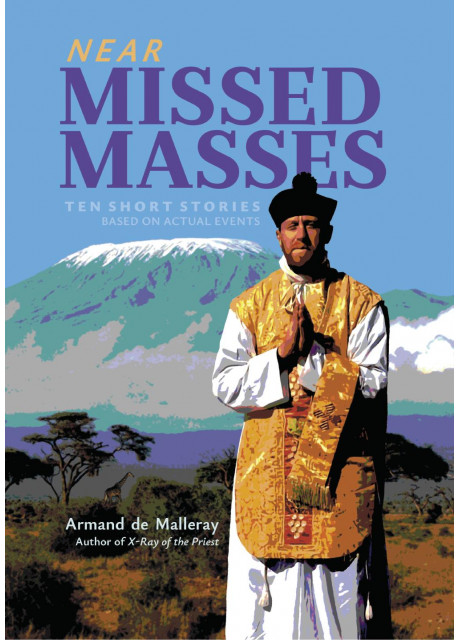
"Near Missed Masses: Ten Short Stories Based on Actual Events" -- a new book by Fr. Armand de Malleray

“Can priests miss Mass? This little book light-heartedly depicts ten Holy Masses nearly missed by priests due to some opposition. From Kilimanjaro to Loch Ness, from Burma to Paris and more, the ten humorous short stories describe obstacles to the celebration of Holy Mass, thankfully overcome. The ten priests persevered, spurred by the conviction that Holy Mass: 1) honours God, whose extrinsic glory increases each time the Holy Sacrifice of the Mass is offered; 2) helps souls through the temporal application of Christ’s saving merits that Holy Mass brings about; 3) fortifies priests, whose ontological raison d’être is to offer the divine Victim on the altar. Leaving aside theological arguments, Near Missed Masses entertainingly illustrates these truths through fiction.”


Praise for Near Missed Masses:

Fontgombault Homily for the Feast of Saints Peter and Paul: "Knowing is not enough. Proclaiming is not enough. We have to offer our own life for Christ."

Sermon of the Right Reverend Dom Jean Pateau
Father Abbot of Our Lady of Fontgombault
Fontgombault, June 29, 2021

Tu es Petrus, et super hanc petram ædificabo Ecclesiam meam. 
 Thou art Peter, and upon this rock I will build My church. (Mt 16:18)


Dear Brothers and Sisters,
My dearly beloved Sons,


Acknowledging Christ, this is the concern for truth that seems to prompt the question the Lord asks of His apostles, and especially of Peter, who answers it in the name of all. The answer is not that obvious, as witnessed by the various opinions several disciples report concerning the Son of man’s identity: John the Baptist, Elijah, Jeremy, or one of the prophets. Acknowledging the Son of man also means appropriating a mission. St. Peter’s confession in Caesarea marks a milestone in the progressive revelation Christ makes of His imminent Passion and resurrection:


From that time, Jesus began to shew to His disciples, that He must go to Jerusalem, and suffer many things from the ancients and scribes and chief priests, and be put to death, and the third day rise again. (Mt 16:21)


Confessing what the Son of man is, is not sufficient, and Peter has yet to understand it. Despite the fact that he proclaims Christ’s divinity, “Thou art Christ, the Son of the living God!” (Mt 16:16), Peter doesn’t seem to be ready to follow the path the Lord is showing him. He doesn’t under-stand the Lord’s mission, and consequently, he won’t be able to accept his own mission, in the Christ’s footsteps. Faced with the scandal of the Cross, Peter rebels, takes Christ aside, and forcefully rebukes Him:

(Somewhat) Good News from the New Archpriest of Saint Peter's Basilica -- Rules limiting Summorum Pontificum and Private Masses modified

Three months ago, a bizarre note from the Secretariat of State prohibited private masses in all altars of the Vatican Basilica and limited the Traditional Mass to one altar in the crypt -- Rorate was the first page to report on it. The note was not published, but posted in the basilica sacristy.


Today, Cardinal Mauro Gambetti, the new Cardinal-Archpriest in charge of Saint Peter's Basilica (who, all sources informed us, was caught completely unaware by the decree) published a clarification note trying to somewhat fix the situation. This time, the note (here in Italian) was signed and published in the Bollettino of the Holy See.


It is a long note, but the main points are the following: while the prohibitions are somewhat held, they are limited to the 7-9 am period, in which there are more masses; even during this time of the day, care should be taken to welcome all kinds of groups of pilgrims, in view of the Basilica being the essential focus of "unity" in the Church; private masses can also be allowed, in specific cases, when a "concelebration" is not going on at the same time, after being "the object of discernment"...


But, most important for the Traditional Latin Mass, the Cardinal states the following:

"-for the celebrations with the 1962 Missale Romanum, all must be made possible to fulfill the wish of the  faithful and priests, as foreseen in the Motu Proprio Summorum Pontificum."


We will see how this clarification note will play out exactly and in practice in the upcoming weeks: we will keep you informed.

Biden, The Eucharist, and the Bishops: WHAT IS AT STAKE


 The possibility that President Biden will be refused Holy Communion as a result of the American bishops’ decision to go ahead with writing a document on “Eucharistic coherence” is making headlines in many newspapers, especially those considered “liberal” in today’s understanding of that term.  The New York Times last Saturday featured a front-page article titled “Bishops on path to refuse Biden holy communion”. It is significant that the article is written using political terminology.  The author frames the division among the bishops in terms of “conservative” and “liberal”. In this framework, those who are “conservative” are out of step with Pope Francis and his understanding of the role of the Catholic Church in today’s world.  Those who are “liberal” are in accord with Francis’ agenda. According to the article, it is the “conservative” bishops who are in the majority, and who by means of this document---which has yet to be written and published—are determined to deny President Biden Holy Communion because of his firm governmental support of abortion.  

Little Latin Readers 'third level' now available for homeschoolers


A couple of years ago we brought our readers a wonderful new tool for children, especially homeschoolers, to learn Latin (see original post with more details below this update). 

The third level of the newly revised Little Latin Readers series, Liber Tertius: Civitates Europae, has just arrived, and it continues and expands the unique Catholic cultural experience of the preceding levels. The stories in this reader focus on the beginnings of Catholic Europe, with selections on the geography, fauna and flora, and history of four key Catholic nations: Ireland, France, Spain and Poland. 

The Sunset of a Papacy. Pope Francis also has his fans against him. By Antonio Socci


Antonio Socci

Libero

June 16, 2021


What is happening in the Catholic Church? Are we on the verge of an earthquake? There are lots of signs that would induce us to think so, and the article by Alberto Melloni from the columns of “La Repubblica” yesterday, is really quite sensational, revealing, as it does, the severe split on the part of some progressive Catholics from Pope Francis, whom they used to support enthusiastically.


Melloni, symbol of the “School of Bologna” and the “progressive wing of the Church – initiates his indictment by highlighting that the German Cardinal Marx, in his recent letter of  resignation, “was in effect asking for the Pope’s resignation”.


Marx is the leader of the powerful and affluent German Episcopate, which, through its Synod, seems to want a revolution. The German bishops are historically the supporters of Bergoglio, but their undue haste is not endorsed by him, and now they are plainly disappointed.


Melloni then cites other recent episodes, like the Papal Decree limiting to ten years “the mandate  of the leaders and bodies of lay ecclesial movements”. A norm – according to Melloni – that “constricts the rights of the faithful” and “establishes  the liquidation of the leaders presently serving, in the name of an ideologically defined good.”


“The Council and the Eclipse of God” Part XI “How the Council jettisoned true Catholic Evangelisation for shallow Ecumenism” by Don Pietro Leone


In the first section on the relations between the Church and the non-Catholic Christians Don Pietro examined Ecumenism in theory; in the second section which we publish to-day, he examines it in practice. He shows how the Council jettisoned Evangelisation and justified indifferentist religious and liturgical assemblies by hetericizing obscurantism, using the terms ‘Ecumenism’ ‘Christian’ and ‘Christian unity’in two different senses, one Catholic and the other not; by historical falsification; and by an appeal to a shallow, sentimental, surrogate Ecumenical love over that one immutable Truth capable of saving man from eternal death, which is our Holy Catholic Faith.                                                                                                            F.R.


Pope Paul VI and Patriarch Athenagoras - December 4, 1965


The Council and The Eclipse of God


by 


Don Pietro Leone 


Part XI


A. Ecumenism in Practice


October 13, 1962  at THE SECOND VATICAN COUNCIL - Cardinal Agostino Bea, standing at right, presents the schismatic and non-Catholic  observers  to  Pope John XXIII.


A.   Ecumenism in Practice


Before the Council, non-Catholic Christians were viewed as mistaken, deprived of graces, in danger of perdition, and thus in need of evangelization and conversion; but with the Council they are treated as equals (or almost as equals) of Catholics, as their friends, and thus no longer in need of evangelization.


In this section we shall examine:


1.     The Practice of Ecumenism in General; 

2.     The Practice of Ecumenism by Communicatio in Sacris;

3.     The Spirit of Ecumenism.


1.     The Practice of Ecumenism in General


i) ‘Without doubt, the differences that exist in varying degrees between them [‘the communities that became separated from full communion with the Catholic Church’] and the Catholic Church – whether in doctrine and sometimes in discipline, or concerning structures of the church – do indeed create many obstacles, sometimes serious ones, to full ecclesiastical communion. The ecumenical movement is striving to overcome these obstacles’ (UR 3);


ii) ‘The term ‘ecumenical movement’ indicates the initiatives and activities… to promote christian unity’… [These consist in] ‘every effort to avoid expressions, judgments and actions which are not truthful or fair’ in regard to non-Catholics; ‘dialogue’ in presenting respective teachings; collaboration in serving ‘the common good of humanity’; and common prayer  (UR 4). Examples of serving ‘the common good of humanity’ are given in Ad Gentes (15) in terms of the ‘social cultural, technical, and religious’ domain on the missions, and in UR 12 in terms of relieving ills such as famine and natural disasters, illiteracy and poverty, and lack of housing. Ecumenical actions aim to ‘promote justice and truth, concord and collaboration, as well as the spirit of love and unity…’ (UR 4);


iii) … as the obstacles to perfect ecclesiastical communion are overcome, all Christians will be gathered, in a common celebration of the Eucharist, into the unity of the one and only church… This unity, we believe, subsists in the Catholic Church… However it is evident that the work of preparing and reconciling those individuals who wish for full catholic communion is of its nature distinct from ecumenical action’ (UR 4).


"George Soros and Alexander Dugin: two sides of the same coin?" (by Roberto de Mattei)

In what sense may George Soros and Alexander Dugin be defined as two sides of a single coin?


In 1945 the Austrian philosopher of science Karl Popper (1902-1994) published a ponderous work in two volumes entitled The Open Society and Its Enemies (Routledge, London, 1945). In this work, Popper maintained that the totalitarian ideologies like communism and Nazism have a common element: claiming to possess absolute truth. The Austrian philosopher contrasted totalitarian societies with a model of social democratic organization that he called an “open society” because it is opposed to any cultural or moral “frontier.” Popper wrote this work in New Zealand, where he had emigrated after the rise of Nazism due to his Jewish origins. Subsequently, the philosopher moved to England, where he taught at the prestigious London School of Economics and obtained British citizenship.

Watch the SSPX ordinations live this Friday

This Friday, June 11, the Society of St. Pius X (SSPX) will live stream their ordinations to the Priesthood and Diaconate. Three priests and six deacons will be ordained this year, and this is the first year they will livestream the ordinations from the Seminary.


We all know what's going on these days. These new priests and future priests may be direly needed in the near future.


A meditation on the Heart of God and the Heart of Man


A meditation on the Heart of God and the Heart of Man


by 


Padre Natanaele Thanner, ORC


St.  Augustine said: “All of us without question want to live happily, and in the whole human race there is no one who does not assent to this proposition.” Where does this desire for happiness in every human heart come from? From God Himself.   “God has placed it in the human heart in order to draw man to the One Who alone  can fulfill it.” (Catechism of the Catholic Church, 1718).


Those who seek happiness, seek God, and those who seek God, seek happiness. “Seeking Thee, My God, I am seeking happiness. I will seek Thee so that my soul may live. My body lives from my soul and my soul lives from Thee.” (Saint Augustine).


Yes, God is the life of our soul, which is the principal of life for our body. A body without a soul is dead.  And what of a soul without God? 


Important Op-Ed by Fr Pio Pace: "Restricting Summorum Pontificum: What the Pope Said, the Credible Information, and the Risk of a War within the Church."

Rorate Note: It has been a while since that great connoisseur of the deepest secrets of ecclesiastical life in Rome, Father Pio Pace, last sent us a report.


The repeated discreet reports on the draft of a papal document restricting the application of the motu proprio Summorum Pontificum (the document by Benedict XVI that recognized the impossibility of the abrogation of the Traditional Roman Liturgy) prompted him to write to us again on this urgent matter:


Restricting Summorum Pontificum: What the Pope Said, the Credible Information, and the Risk of a War within the Church
by Father Pio Pace
Rome

A text weakening the scope of the motu proprio Summorum Pontificum, of Benedict XVI, could be about to be published: that information, that followed the announcement made "confidentially" by the Pope to the Italian bishops of the CEI [Italian Bishops' Conference], assembled at Via Aurelia, in Rome, on May 24, has been largely commented upon, notably by the major Italian press.


 The essential norms of the text, as the Pope informed them, are the following: from now on, the priests of the communities specialized in the Traditional Mass (the "Ecclesia Dei" communities) could continue to celebrate, as well as the diocesan priests that already celebrate it; on the contrary, if additional diocesan priests wish to celebrate it, they must first obtain a permission of the bishop.


Some supplementary information has been added, but this time in the shape of credible off-the-record comments: the Congregation for Divine Worship would now be in charge of the operation of the Traditional Mass and the Ecclesia Dei communities. Within this Congregation, that has just received its new Prefect, Abp. Roche, and a new Secretary, Abp. Viola, a new Under-Secretary of episcopal level, Bp. Aurelio García Macías -- former rector of the seminary of Valladolid, Spain -- would be the direct responsible man for the traditional world, as Abp. Pozzo was in the past. This ensemble of curial personnel being, in principle, hostile to the ancient Mass.