Rorate Caeli
Showing posts with label PCED Responds. Show all posts

What time can Midnight Mass begin? Updated with PCED guidance.

Last year we addressed the question "What time can Midnight Mass begin?," which is usually a novus ordo concern, but can sometimes find its way into traditional Latin Mass parishes.


The answer, using the 1962 calendar and its rubrics/liturgical law, is of course no earlier than Midnight.  The liturgical law specifying the calendar day timeline for the use of traditional Latin Mass propers is found in the very beginning of the rubrics governing the 1962 liturgy, under part one ("General Rubrics"), chapter two, number four:

4. Dies liturgicus est dies sanctificatus actionibus liturgicis, praesertim Sacrificio eucharistico et publica Ecclesiae prece, id est Officio divino; et decurrit a media nocte ad mediam noctem.

4. The liturgical day is the day sanctified by the liturgical rites, especially the eucharistic Sacrifice and the public prayer of the Church, that is the divine Office; it runs from midnight to midnight.

The rubrics go on to explain more solemn days have an Office that starts the evening before.  But it is very clear the rubric is talking about the Divine Office -- that is, First Vespers -- not the celebration of Mass.

More recently, the Pontifical Commission "Ecclesia Dei" (PCED) was asked by a priest about anticipating the Mass propers (that is, using the propers of a day of precept that has not yet started).  Rorate covered the answer here.  The priest used an example of a Saturday evening traditional Latin Mass, asking if it was licit to use Sunday's Mass propers, to which the Vatican responded "the Mass formulary used should be that permitted on a Saturday."

PCED: "anticipated" Masses, SSPX-affiliated groups' faculties, and more

The Pontifical Commission "Ecclesia Dei" responded to a 29-question letter from a priest in Poland on numerous aspects of the traditional Latin Mass and 1962 liturgical law. Posted on the Church Music Association of America's "Musica Sacra Forum," the questions ranged from ultra-specific Gregorian chant methods permitted, to who may function as a subdeacon.

Some of the answers are standard, and some simply point to Summorum Pontificum or Universae Ecclesiae.  But some of the answers are new, or at least newsworthy to see answered in 2018.

Here are a few highlights:

#2:  PCED clearly states the Confiteor before the communion of the faithful is licit, responding "in those places where the practice exists, this may be continued."

#5: The practice of "anticipated Masses" -- sadly, found in a handful of TLM locations -- is illicit.  Although technically a Mass offered on the evening before a Sunday or holy day of obligation fulfills one's obligation for the Sunday or holy day (under post-Vatican II canon law), the traditional Latin Mass may NOT use the next day's propers.  PCED has declared, using the example of a Saturday evening TLM, "the Mass formulary used should be that permitted on a Saturday."  This is perhaps the most newsworthy response of the lot, as it will require some TLM churches to change their current practice.  A TLM offered on a Saturday evening must use Saturday's propers.  A TLM offered on the evening before a holy day of obligation must use that day's (not the holy day's) propers. Although PCED did not give a reason, it is safe to say that the decision is based on the rubrics in place in 1962. Under part one, "general rubrics", chapter two, number four, the liturgical day is explicitly defined as midnight to midnight, with solemn days having first vespers -- not an anticipated Mass -- on the preceding day. 

Who may chant the Passion?

Six years ago Rorate posted on who is allowed to sing the Passion during Holy Week. The answer, we thought, was pretty clear, but apparently not everyone agreed.  Some traditional Latin Masses employed laymen to chant entire parts of the Passion, as performed via the novus ordo.

To that end, the Pontifical Commission "Ecclesia Dei" was consulted on this issue.  Here is the response:


To summarize, the privilege to chant the Passion begins at the diaconate level for all three parts of the Passion (except for the turba portion of the synagoga).

Dubia answered: Warning for priests treating afflicted souls, guidance on blessings by deacons

The following responses to dubia by the Pontifical Commission "Ecclesia Dei" (PCED) was provided to Rorate by a source with a deep concern for the spiritual welfare of priests. We post the responses below, with an explanatory note following it, written by our source. There's also an interesting response from the PCED to whether deacons can bless using the traditional Rituale. We have edited the document only to protect the privacy of the priest who submitted the dubia:


Note from our source:

Priests that pray over afflicted souls should be aware of a potential open door.

Important clarification from PCED on Sung Masses offered by Bishops

In recent years it has become more common for bishops to celebrate Sung Mass more sacerdotali, that is, just as priests do and without the sacred ministers (subdeacon, deacon and assistant priest) and ceremonies peculiar to a Solemn Pontifical Mass. This has to do with the difficulty in most places of having enough sacred ministers, and the desire to have something like a Solemn Pontifical Mass whenever there is a bishop available to celebrate Mass according to the 1962 Missal. Unfortunately, the "Pontifical Sung Mass" was not foreseen in the rubrics of the liturgical books in force by the end of 1962, raising endless questions about the licitness of the practice. In response to a dubium from a Traditional Catholic choir in the Philippines, the PCED has now responded with a clarification on Pontifical Sung Masses.

In summary: bishops who wish to celebrate according to the 1962 Missal are to choose between Low and Solemn Pontifical Mass. The "Pontifical Sung Mass" is not among the choices.

Ecclesia Dei letter: Mass of Our Lady of Fatima in the Extraordinary Form

By a letter published and dated of today, the Pontifical Commission Ecclesia Dei granted to all priests of the Latin Rite (secular or religious) the possibility of celebrating on the centenary of the first main apparition (May 13, 2017) the Mass of Our Lady of Fatima -- it is a Votive Mass of the II Class, using the exact same texts and prayers of the Votive Mass of the Immaculate Heart of the Blessed Virgin Mary (August 22nd in the Traditional Calendar).

A copy of the letter is published below:

Traditional lay acolyte installed in New Jersey

Last April we shared a response from the Pontifical Commission Ecclesia Dei (PCED) on who may serve as a "straw" subdeacon at a traditional Latin Solemn High Mass. In addition to previous PCED clarifications that any seminarian permitted to wear the cassock and collar (the post-1970s equivalent of tonsure) may do so, the letter stated "the function of Subdeacon can be legitimately assumed by an acolyte suitably instituted by a Bishop, but with the particular appropriate ritual differences."

Therefore, a man who has been ordained a priest, or deacon or, in the case of traditional societies, a subdeacon, may serve as subdeacon. A seminarian permitted the Roman collar, or an instituted lay acolyte, may serve as a straw subdeacon. The latter category requires the straw subdeacon to not wear the maniple; not pour the water into the chalice at the offertory, letting the deacon do so; not touch the chalice infra actionem, nor cover it with the pall, nor uncover it; and after the communion the straw subdeacon does not purify the chalice, as the celebrant must purify it, after which the straw subdeacon covers it with the veil and burse and carries it to the side table.

As we originally stated, it is a rare thing for a bishop to institute a lay acolyte who is not a seminarian. The Diocese of Camden, New Jersey, ran an article in its newspaper on the institution of a man from Mater Ecclesiae parish to the ministry of acolyte:

On Feb. 18, Bishop Dennis Sullivan called John Rotondi, a 36-year old married father of five, to the Ministry of the Acolyte at Mater Ecclesiae in Berlin, allowing him to assist the priest and deacon during the solemn high traditional Latin Mass.

"Straw" subdeacon PCED letter

One of the challenges concerning the traditional Latin Mass in modern times is how to reconcile 1962 rubrics and disciplines with current law.  Often times it can be like fitting a square peg into a round hole, but #28 of the instruction Universae Ecclesiae establishes a general principle:  "Furthermore, by virtue of its character of special law, within its own area, the Motu Proprio Summorum Pontificum derogates from those provisions of law, connected with the sacred Rites, promulgated from 1962 onwards and incompatible with the rubrics of the liturgical books in effect in 1962."

The role of subdeacon at a Missa Solemnis is certainly to be included in the short list of frequently asked questions by priests and organizers of Solemn High Masses.

Who can serve as subdeacon without the ritual differences required of a "straw" subdeacon?  That is an easy one -- priests, deacons and subdeacons.

Who can serve as a "straw" subdeacon?  That is a more difficult question, although it has been addressed by the Pontifical Commission Ecclesia Dei (PCED) on several occasions.  The answer seems to be: 1) most seminarians; and 2) instituted acolytes (the rare case of a bishop instituting a non-seminarian layman as an acolyte).  The differences between an ordained subdeacon and a "straw" subdeacon are that the "straw" subdeacon does not wear the maniple; he does not pour the water into the chalice at the offertory, but must let the deacon do so; he must not touch the chalice infra actionem, nor cover it with the pall, nor uncover it; and after the communion he does not purify the chalice, as the celebrant must purify it, after which the "straw" subdeacon covers it with the veil and burse and carries it to the side table.

The seminarian answer was clarified in November 2012 to include any (diocesan or otherwise) seminarian who wears clerical clothing (basically, the equivalent of a tonsured seminarian).  See here for that letter.

A month after that question was answered, a follow-up to PCED was made on the issue of laymen who are not seminarians.  In a letter, the exact question was:  "May a layman who is not a seminarian serve as a subdeacon at a Solemn High Mass?"

The Next Steps between the Holy See and the Society of Saint Pius X (SSPX) - Full Interview with Abp. Guido Pozzo.

The interview was granted days ago by the Secretary of the Pontifical Commission Ecclesia Dei, Abp. Guido Pozzo, to Jean-Marie Dumont, of French magazine Famille Chrétienne, and made available on October 20, 2015. It is published as one of the main articles of the issue of this Saturday, October 25.

The Society of Saint Pius X: Where are we now?
 Famille Chrétienne
October 25, 2014

PCED letter on fulfilling the Sunday obligation by attending an SSPX Mass and diocesan seminarians as subdeacons

The Polish Traditionalist Catholic blog Nowy Ruch Liturgiczny published yesterday the November 6, 2012 response of the Pontifical Commission Ecclesia Dei to two queries (which that blog reproduced in the original English): 


1. Is it possible to fulfill the Sunday obligation by participating in a Mass celebrated by a priest from Society of St. Pius X, if the participant is not "against the validity or legitimacy of the Holy Mass or the Sacraments celebrated in the forma ordinaria or against the Roman Pontiff as Supreme Pastor of the Universal Church" and this is the only opportunity in the local area to participate in the Mass in forma extraordinaria (which the participant is highly devoted to)? 

2. Do the decree of Sacred Congregation of Rites (no. 4184) and the decision of Pontifical Comission ‘Ecclesia Dei’ (no. 24/92), concerning the possibility of serving as a subdeacon during the Mass in forma extraordinaria, apply also to diocesan seminarians (who are not seminarians of the institutes erected by Pontifcial Commision 'Ecclesia Dei') who wear clerical clothing?

The response:


The PCED intervenes in Croatia

There is apparently, at present, not a single public Mass according to the preconciliar Roman Missal in Croatia, either in Latin or in Slavonic (the "Slav-Latin" or "Glagolitic Rite" in use in parts of the former Yugoslavia -- including in Croatia -- from time immemorial until the 1960's), and it's not due to lack of interest among the laity. Since 2008, various lay faithful of Zagreb, Croatia have been pressing for the application of Summorum Pontificum in their archdiocese, apparently to no avail. The complete correspondence of the Traditionalists of Zagreb with the archdiocesan officials and with the PCED can be found here (with English translations). The October 28, 2009 letter from the Archdiocese of Zagreb denying the request for a TLM of thirty faithful from 20 parishes is a particularly instructive example of the art of using the text of Summorum Pontificum in order to obscure its obvious meaning and to frustrate its implementation.

Today, the Croatian blog Toma Blizanac has published the following letter from the PCED:


Pontificia Comissio "Ecclesia Dei"

N. ---
Vatican City, 25 November 2010

Dear Mr. ---,

This Pontifical Commission would like to thank you for your kind letter of 8 November 2010.

This Pontifical Commission is able to inform you that after contacting His Eminence Josip Cardinal Bozanić, it has received the assurance of His Eminence that the Holy Mass in the Extraordinary Form will be celebrated in one of the churches in Zagreb.

With every good wish, I remain

Sincerely yours in Christ,
Rev. Mons. Guido Pozzo
Secretary


Thanks to Marcus M. for the tip. 

PCED responds:
Use of Traditional Liturgical Books of Religious Orders
"pertains to the superior of those orders"


Recently, a letter was written to PCED asking if it was possible utilize the liturgical variations that were particular to a certain religious order as it was used before it adopted the liturgical reforms of Vatican II. In the same letter, the question was asked if it would be possible to use the ritual in use up to 1962 for the secular (third) order which is part of that same religious order.
PCED response:

On the recent clarifications from the Pontifical Commission Ecclesia Dei

As reported recently by the New Liturgical Movement, the Pontifical Commission Ecclesia Dei, in a letter dated January 20, 2010 (Prot. 13/2007), has issued the following clarifications:

1. If there is no other possibility, because for instance in all churches of a diocese the liturgies of the Sacred Triduum are already being celebrated in the Ordinary Form, the liturgies of the Sacred Triduum may, in the same church in which they are already celebrated in the Ordinary Form, be additionally celebrated in the Extraordinary Form, if the local ordinary allows.

2. A Mass in the usus antiquior may replace a regularly scheduled Mass in the Ordinary Form. The question contextualizes that in many churches Sunday Masses are more or less scheduled continually, leaving free only very incovenient mid afternoon slots, but this is merely context, the question posed being general. The answer leaves the matter to the prudent judgement of the parish priest, and emphasises the right of a stable group to assist at Mass in the Extraordinary Form.

3. A parish priest may schedule a public Mass in the Extraordinary Form on his own accord (i.e. without the request of a group of faithful) for the benefit of the faithful including those unfamiliar with the usus antiquior. The response of the Commission here is identical to no. 2.

4. The calendar, readings or prefaces of the 1970 Missale Romanum may not be substituted for those of the 1962 Missale Romanum in Masses in the Extraordinary Form.

5. While the liturgical readings (Epistle and Gospel) themselves have to be read by
the priest (or deacon/subdeacon) as foreseen by the rubrics, a translation to the vernacular may afterwards be read also by a layman.

While other commentators have focused on the importance of nos. 2 and 3 in this clarification, there seems to have been very little discussion of the importance of no. 4. Truth to tell, this particular ruling probably has greater importance than the others for it severely limits the importation of elements from the Missal of Paul VI into the Missal of Bl. John XXIII.

To be precise, the fourth clarification has the following effects:

1) It reverses several earlier rulings of the Pontifical Commission Ecclesia Dei, in particular:

a) The decision of Augustin Cardinal Mayer OSB, the first President of the PCED, to permit the use of the Pauline Lectionary in the vernacular, in place of the readings in the 1962 Missal. This permission can be found in PCED’s Prot. 500/90, better known as the Letter of Cardinal Mayer to the Bishops of the United States. Although this provision was never popular, it was indeed practiced in a few locations, at the behest of the local bishops. (Cardinal Mayer's letter mentions this permission only in passing, and the letter, as a whole, was one of the most important documents for the "re-legitimization" of the Traditional Roman Rite in the period 1984-2007.)

b) The decision of Angelo Cardinal Felici, contained in Prot. 40/97 (March 26, 1997) to permit the use of the Prefaces of the Missal of 1970 for the “appropriate” Masses celebrated according to the 1962 Missal. (I don’t know if anyone ever availed of this permission. However, one popular guide to the Ordo Missae according to the 1962 Missal has a selection of prefaces from the 1970 Missal, so I would guess that some priests and communities made use of this decision.)

It would also be interesting to know if the newest clarification from the PCED constitutes a reversal of the same commission’s Prot. 107/97, dated October 20, 2008, (see this and this) which had granted permission for the Masses of the Holydays of Obligation that are celebrated according to the 1962 Missal to be offered on the Sundays to which these same Holydays had been transferred in the local calendars used for the Missal of Paul VI. Like the two innovations mentioned above, this permission -- which grants External Solemnities to feasts that, under historic “Tridentine” practice (including the 1962 Missal itself), never actually had them (the Epiphany and the Ascension come to mind) -- has been adopted only by a few communities, all the while causing much controversy and stoking fears of the further hybridization of the 1962 Missal.

(Someone has expressed to me the opinion that the newest letter from the PCED, which is signed by a monsignor, could not possibly overturn permissions that had been signed by Cardinals. Perhaps some of our readers could charitably respond to this argument.)

2) It more clearly delineates – for now – the limits of the “mutual enrichment” between the 1962 and 1970 Missals, and seems to indicate that there will not be any further “modernizations” of the Missal of 1962 in the near future.

I would also like to add that, as far as Low Masses are concerned, clarification no. 5 – permitting a layman to read the Epistle and Gospel in the vernacular after these had been read according to the rubrics by a priest (or deacon/subdeacon) – is not new, but merely reiterates what De Musica Sacra (September 3, 1958) had already permitted (see De Musica Sacra, no. 14.c). However the same cannot be said for Sung or Solemn Masses.

The new clarification also stipulates that the layman is to read the translation of the Epistle and Gospel after these had been read by the priest, unlike the practice that had obtained prior to Vatican II in some places where the lay reader read the Epistle and Gospel simultaneously with the priest saying these in a subdued voice.

The PCED "Official" Guide to the Mass: Some Videos now on Youtube

In August, Rorate noted that the Pontifical Commission Ecclesia Dei has made available its own 2-DVD guide to the proper celebration of the Traditional Latin Mass. Long excerpts have now been uploaded on Youtube:

Pars I: 01 - Praeparatio ad Missam, 02 - Orationes sub infimum gradum altaris, 03 - Pars Didattica.


Pars II: 04 - Offertorium, 05 - Canon Missae I


Pars III: 06 - Canon Missae II
-->

Pars IV: 07 - Pater Noster, 08 - Communio, 09 - Ablutionis.


Pars V: 10 - Dimissio, 11 - Ultimum Evangelium.


* Traditional Mass Can be Celebrated on Traditional Feast Days, Says Rome

Important news from our friends at The Latin Mass Society of England and Wales:
10 November 2008
Transferred Holydays of Obligation: an Important Clarification From the Pontifical Commission Ecclesia Dei
In April 2008, the Bishops’ Conference of England and Wales sought a ruling from the Pontifical Commission Ecclesia Dei aimed at harmonising the celebration of certain Holy Days of Obligation in the Extraordinary and Ordinary Forms of the Roman Rite. The bishops had, in the case of the Epiphany, the Ascension and Corpus Christi, transferred these to specific Sundays and in the case of all other Holy Days of Obligation that are kept in England and Wales, with the exception of Christmas, transferred them also to specific Sundays, whenever they fall on a Saturday or a Monday. They wished to ensure that these Holy Days were also kept on Sundays by those attached to the Extraordinary Form.
Consequently, the Bishops’ Conference submitted a dubium to Rome but declined to release the full text or of Ecclesia Dei’s reply. The LMS therefore submitted its own dubium to Rome in July and a reply, dated 20 October, has now been received.
The reply from the Ecclesia Dei Commission confirms that the Mass and Office of Holy Days can continue to be said on the days prescribed in the calendar for the Extraordinary Form and that the right to use this calendar is intrinsic to the right to use the Extraordinary Form.
The LMS’s letter requested confirmation that:
I. the legitimate use of the liturgical books in use in 1962 decreed by the Sovereign Pontiff in Summorum Pontificum includes the right to the use of the calendar intrinsic to those liturgical books.
II. That, whilst in accordance with Canon 1246 the Episcopal Conference with the approbation of the Holy See legitimately transfers Holydays of Obligation or suppresses the obligation of Holydays, it is legitimate to celebrate the Mass and Office of those feasts on the days prescribed in the calendar of the liturgical books in use in 1962 with the clear understanding that, in accordance with the legitimate decision of the Episcopal Conference, there is no obligation to attend Mass on those days.
III. That, in accordance with nn. 356-361 of the Rubricae generales Missalis romani of 1962, it is appropriate to celebrate the external solemnity of Holy Days on the Sunday to which they have been transferred by the Episcopal Conference as has been customary in many other countries hitherto.
Ecclesia Dei’s reply stated:
“1. The legitimate use of the liturgical books in use in 1962 includes the right to the use of the calendar intrinsic to those liturgical books.
2. While in accordance with Canon 1246 §2 of the Code of Canon Law the Episcopal Conference can legitimately transfer Holydays of obligation with the approbation of the Holy See, it is also legitimate to celebrate the Mass and Office of those feasts on the days prescribed in the calendar of the liturgical books in use in 1962 with the clear understanding that, in accordance with the legitimate decision of the Episcopal Conference, there is no obligation to attend Mass on those days.
3. Thus, in accordance with nn. 356-361 of the Rubricae Generales Missalis Romani of 1962, it is appropriate to celebrate the external solemnity of Holy Days on the Sunday to which they have been transferred by the Episcopal Conference, as has been customary in many other countries hitherto.”
Ecclesia Dei’s reply is signed by its Vice-President, Mgr Camille Perl.
As a consequence of the Ecclesia Dei ruling, the Latin Mass Society will continue to organise Masses on the days prescribed in the 1962 calendar for Holy Days but will also, where appropriate, organise feast day Masses as External Solemnities on the Sundays prescribed by the English and Welsh bishops so that obedience and communion are maintained whilst respecting the sensibilities of those who wish to celebrate the feasts on the traditional days.
Mr Julian Chadwick, Chairman of the LMS, said: ‘This ruling is very important. It confirms that the calendar for the Extraordinary Form is integral to the rite and cannot be suppressed or altered by bishops’ conferences. It also confirms the right of those attached to the Extraordinary Form to continue to celebrate the traditional feast days. Of course, when we organise Masses on the Sundays prescribed by the bishops to celebrate transferred Holy Days we will organise external solemnities of the Holy Days to fulfill the bishops’ requirement that feast days in both Forms of the Roman Rite be celebrated in common’.
____________________
Documents:

Letter to the President of the Pontifical Commission Ecclesia Dei from the Chairman of the Latin Mass Society
HE Darío Cardinal Castrillón Hoyos,
President, Pontifical Commission Ecclesia Dei,
Palazzo del Sant’ Uffizio 11,
00120 Vatican City State.
3 July 2008
Your Eminence,

Holydays of Obligation


The recent announcement by the Bishops of England and Wales that your dicastery has clarified to them “that in the Roman Rite, whichever Form of the liturgy is being celebrated, the Holydays of Obligation are held in common” has given rise to a good deal of confusion and some disquiet amongst our membership.
Whilst we most certainly wish to maintain and to manifest hierarchical communion with our bishops and through them our unity of faith with our brothers and sisters in the faith, there are a number of pastoral reasons - not the least the hope of reconciliation with those not in a regular relationship with the Church - that suggest that this question not be interpreted with a rigour that confuses or scandalises our weaker brethren.
It also seems that the statement of the Bishops of England and Wales does not sufficiently take into account the liturgical laws intrinsic to the liturgical books in use in 1962. Therefore, for the good of souls and the preservation of charity, on behalf of the Latin Mass Society of England and Wales, I request your authoritative clarification on the following points:
I. That the legitimate use of the liturgical books in use in 1962 decreed by the Sovereign Pontiff in Summorum Pontificum includes the right to the use of the calendar intrinsic to those liturgical books.
II. That, whilst in accordance with Canon 1246 the Episcopal Conference with the approbation of the Holy See legitimately transfers Holydays of Obligation or suppresses the obligation of Holydays, it is legitimate to celebrate the Mass and Office of those feasts on the days prescribed in the calendar of the liturgical books in use in 1962 with the clear understanding that, in accordance with the legitimate decision of the Episcopal Conference, there is no obligation to attend Mass on those days.
III. That, in accordance with nn. 356-361 of the Rubricae generales Missalis romani of 1962, it is appropriate to celebrate the external solemnity of Holy Days on the Sunday to which they have been transferred by the Episcopal Conference as has been customary in many other countries hitherto.

As the task of compiling the Ordo for 2009 is upon us, I would be most grateful for Your Eminence’s clarification of these questions as soon as is possible.
Your servant in Christ,
Julian Chadwick
Chairman
Latin Mass Society
____________________________________________________
Letter from the Vice-President of the Pontifical Commission Ecclesia Dei to the Chairman of the Latin Mass Society
PONTIFICIA COMMISSIO « ECCLESIA DEI »
N. 107/97
Rome, 20 October 2008
Dear Mr. Chadwick,
I wish to acknowledge receipt of your letter of 3 July 2008 in which you raise certain questions pertaining to Holydays of obligation.
In the first instance I wish to point out that the question of the liturgical calendar to be followed for the use of the liturgical books of the extraordinary form of the Roman Rite is one that will continue to be studied by this Pontifical Commission. Hence present responses should be understood without prejudice to any subsequent clarifications which may be eventually made by this Pontifical Commission.
With regard to your queries we may state that:
1. The legitimate use of the liturgical books in use in 1962 includes the right to the use of the calendar intrinsic to those liturgical books.
2. While in accordance with Canon 1246 §2 of the Code of Canon Law the Episcopal Conference can legitimately transfer Holydays of obligation with the approbation of the Holy See, it is also legitimate to celebrate the Mass and Office of those feasts on the days prescribed in the calendar of the liturgical books in use in 1962 with the clear understanding that, in accordance with the legitimate decision of the Episcopal Conference, there is no obligation to attend Mass on those days.
3. Thus, in accordance with nn. 356-361 of the Rubricae Generales Missalis Romani of 1962, it is appropriate to celebrate the external solemnity of Holy Days on the Sunday to which they have been transferred by the Episcopal Conference, as has been customary in many other countries hitherto.
With prayerful best wishes I remain,
Sincerely yours in Christ,
Rev. Msgr Camille Perl

Vice President

Ecclesia Dei: SSPX priests and faithful are not "excommunicates"

We try to be as fair as possible here, even though we know we tread in passion-filled themes. It is not anything new to any Catholic who follows the news with attentiveness that the Holy See has often been precise in its considerations of the priests of the Priestly Fraternity of Saint Pius X (FSSPX/SSPX) and the faithful Catholics who go to their chapels.
__________________________________

The first significant event was the case which became known as "the Hawaii Six" (1991-1994): six lay men and women who had a radio show deeply critical of the Diocese of Honolulu and its leadership and who helped fund and build a SSPX chapel in Hawaii. The bishop of Honolulu excommunicated these Catholics for the crime of schism. Then-Cardinal Ratzinger, through the Congregation for the Doctrine of the Faith, had to intervene twice: once to nullify the excommunications (image here), in a letter of the pro-nuncio of Washington in which the latter convened his own ideas, with specific canons, as if they had also been part of the decree declaring the nullity of the excommunications; the second time (read here), after the CDF was notified of the Content of the first letter, the pro-nuncio in Washington had to make clear that the Canons he had mentioned had been his own idea, and that the decree of the CDF had not mentioned those canons. The decree declared that Petitioner had been "blameworthy on various accounts", but that these had not been "sufficient to constitute the crime of schism".

__________________________________

The second significant event happened with the famous "Australian letters". An Australian Catholic asked the Pontifical Commission Ecclesia Dei precise canonical questions regarding the attendance at SSPX Masses -- specifically if it constituted a "sin". The answer of the Commission was that "We have already told you that we cannot recommend your attendance at such a Mass and have explained the reason why. If your primary reason for attending were to manifest your desire to separate yourself from communion with the Roman Pontiff and those in communion with him, it would be a sin. If your intention is simply to participate in a Mass according to the 1962 Missal for the sake of devotion, this would not be a sin". After being questioned by many Catholics, the secretary of the Commission, Monsignor Camille Perl, made several clarifications, but, in the end, confirmed the basic outline of what had been said (read here).
__________________________________

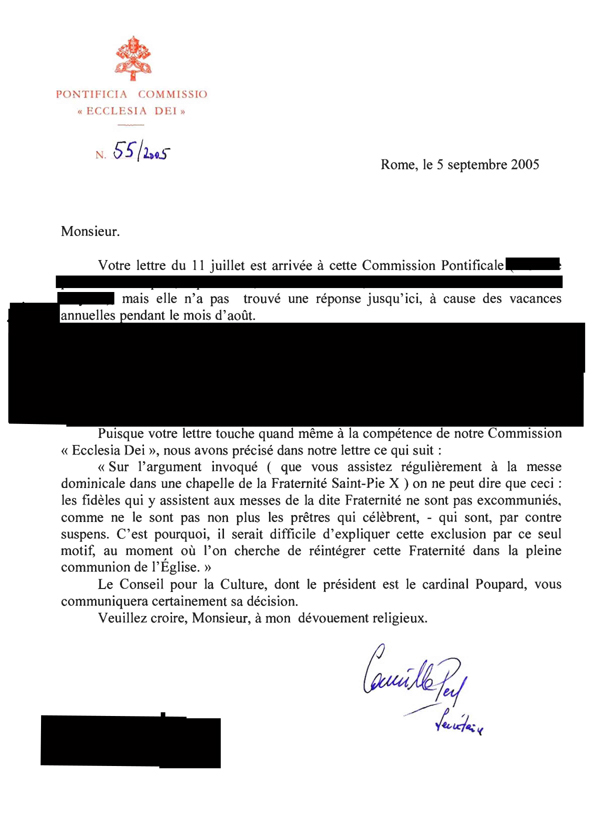
In July 2005, a French Catholic sent a letter to the Holy See regarding a personal incident. He had been denied application, by the Abbot of Fontgombault , to the board of administration of a Schola because he attended masses at SSPX venues (Fontgombault, of course, is a foundation of Dom Prosper Guéranger's Abbey of Solesmes and is one of the most prestigious Benedictine abbeys in the world; it is one of the centers of the "Reform of the Reform" movement and mother house of the Traditional Clear Creek Benedictine community in Oklahoma). He petitioned the Holy See and the answer came from two dicasteries, the one related to the Schola itself; and the Pontifical Commission Ecclesia Dei, regarding the matter of its competence. This is a copy of the letter, from which we have deleted the more personal information of the case.


PONTIFICIA COMMISSIO
'ECCLESIA DEI'

n. 55/2005 Rome, September 5, 2005

Sir,

Your letter of July 11 arrived at this Pontifical Commission (...), but it has not been answered up to now due to the annual vacations during the month of August.

...

Because your letter actually involves the competence of our Commission 'Ecclesia Dei', we have precised in our letter what follows:

'On the argument presented (that you regularly attend Sunday Mass at a chapel of the Fraternity Saint Pius X) one cannot say but this: the faithful who attend the Masses of the aforesaid Fraternity are not excommunicates, and the priests who celebrate them are not, either -- the latter are, in fact, suspended. Which is why it would be difficult to explain this exclusion by this sole motive, at a time in which the reintegration of this Fraternity to the full communion of the Church is sought.'

The Council for Culture, whose president is Cardinal Poupard, will certainly let you know of his decision.

Receive, sir, my religious regards, [Veuillez croire, Monsieur, à mon dévouement religieux,]

CAMILLE PERL
Secretary

__________________________________
No qualifications. No "buts"; no "if they adhere"; no "whether they share a certain mentality" or not. Neither the priests of the Fraternity nor the faithful Catholics who attend their Masses are excommunicates. Moreover, the Ecclesia Dei Commission had no objection that Petitioner, on the grounds that he is a regular attendee of a SSPX chapel, be accepted as an administrator of a Schola. Together with the precise (though not as official as this letter) words of Cardinal Castrillón Hoyos that there "was not a formal schism", one hopes there will be more respect from certain quarters at this delicate time.