Rorate Caeli
Showing posts with label The Mass of all Ages [and age groups]. Show all posts

March for Life TLMs in Washington, D.C.

Friday, 19 January 2018, will be the annual March for Life in Washington, D.C. Pro-life speeches begin on the National Mall at 12 Street, NW, at 12 noon, followed by the peaceful walk up Constitution Avenue to the U.S. Supreme Court. Last year Vice President Mike Pence addressed the March for Life in person -- the first time any of America's top two leaders has done so in person. It is expected there will again be very high-level officials speaking in person at the March for Life at noon. (Get there early.)

UPDATE; 17 Jan.: President Trump will address the March for Life via satellite.  Speaker Paul Ryan will address the March for Life in person.

Many, many American Catholics who attend the traditional Latin Mass will be at the March for Life. To that end, Saint Mary, Mother of God church at 5th and H streets, NW, becomes the de facto hub for the day (and Sunday morning at 9 a.m. for a Missa Cantata). Several visiting priests each year offer traditional Latin Masses at the four altars in the church on the day of the March for Life.


There will be at least four traditional Latin Masses at Saint Mary's on Friday, 19 January:

The Traditional Latin Mass and the active participation of the laity


by John R. T. Lamont

A standard criticism of the traditional Latin mass is that it leaves little or no place for the active participation of the laity. The Novus Ordo promulgated by Paul VI is held up as being far better suited to such participation; this is presented as a reason for preferring the new ritual to the earlier, and for revising the old ritual to bring it closer to the new one – if not for suppressing the old ritual altogether. I will argue that this is not only false, but the opposite of the truth; and that the greater scope for lay participation in the traditional Latin mass arises from the fact that its design aims at achieving the purpose of a liturgy, while the design of the Novus Ordo is not suited to this purpose.

Schola-Sainte-Cécile during the Traditional Latin Mass for the
Feast of St Cecilia, in the Parish Church of St-Eugène-St-Cécile, Paris (2014) - from their website
'Active participation' in magisterial teaching

The first step in addressing this question is to determine what is meant by 'active participation' in the magisterial documents of the Church that call for such participation on the part of the laity.

The first use of the phrase 'active participation' as a desideratum for lay involvement in the liturgy was in the Italian version of St. Pius X's motu proprio Tra le Sollicitudini in 1903; it did not appear in the official Latin text.

God bless your soul, Alaister: may you rest in peace!

Mr. Alaister Lim was a young parishioner and occasional altar server at the Bl. John Henry Newman Parish (exclusively dedicated to the Traditional Latin Mass), in Melbourne, Australia.

This was his departing letter to his pastor and priests, and fellow parishioners:

June 11, 2015

Dearest Reverend Fathers Tattersall, Marshall, and McDaniels; brothers and sisters of the Newman Parish in Christ,

It is with great sadness that I say goodbye to you through this letter, and not in person. My health is rapidly deteriorating, at this time, after an X-ray scan, I have only half a functioning left lung, all else defective (my lungs, not the rest of my organs!). This means I cannot travel great distances, as the trip would be way too taxing on me.

Dear Fathers, your spiritual guidance has strengthened my faith so much, I’ve said many times that I’ve learned so much more about my faith in my one and a half years there than I did in my entire life, and I mean every word of it. Thank you for all you’ve done for me, the Masses you’ve offered for me, for the honour of letting me serve your Masses, and also for your friendship. May God bless all of you abundantly for the good works that you do.

The Glory of the Low Mass - Together with the Martyrs in the Catacombs

The tiny transept had its little altar, with a Greek cross in relief against a purple disk. Overhead the enormous curve of the vaulting hung heavy, and so low that a man could touch it by stretching an arm; it was as black as the mouth of a chimney, and scorched by the fires that had consumed the cathedrals built above it.

Presently the clap-clap of sabots became audible, and then the smothered footfall of nuns; there was silence but for sneezing and nose-blowing stifled by pocket-handkerchiefs, and then all was still.

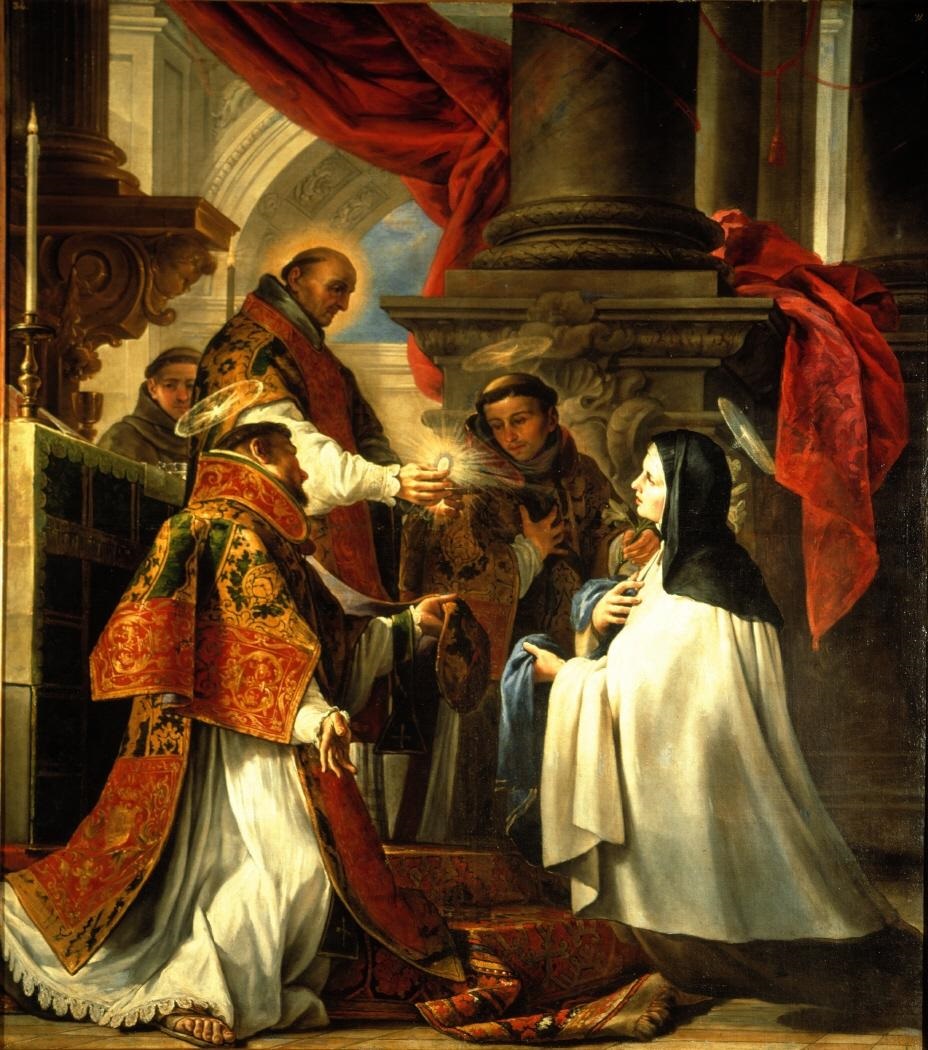
On the 5th Centenary of the Birth of Saint Teresa of Jesus, Catholic Reformer - Guest-post by Don Pietro Leone


I - The Life

St. Teresa was born in Gotarrendura, Avila, Castile, of Alonso Sanchez de Cepeda and Beatrice (Beatriz) de Ahumada on 28th March, 1515, 500 years ago. As a child she ran away from home in search of martyrdom at the hands of the Moslems Her desire was 'to see God', which was later to be realized in her exercise of mental prayer, which particularly in the form of contemplation, is of course nothing else than the knowledge and love of the Most Blessed Trinity as a foretaste of the Beatific Vision.

After a period of a certain levity and frivolity, although in innocence, she was entrusted by her father to the educative care of the Augustinian nuns of Avila, whence she later entered in the order of Our Lady of Mount Carmel.

THE DEATH OF CATHEDRALS - and the Rites for which they were built
- by Marcel Proust (full English translation)

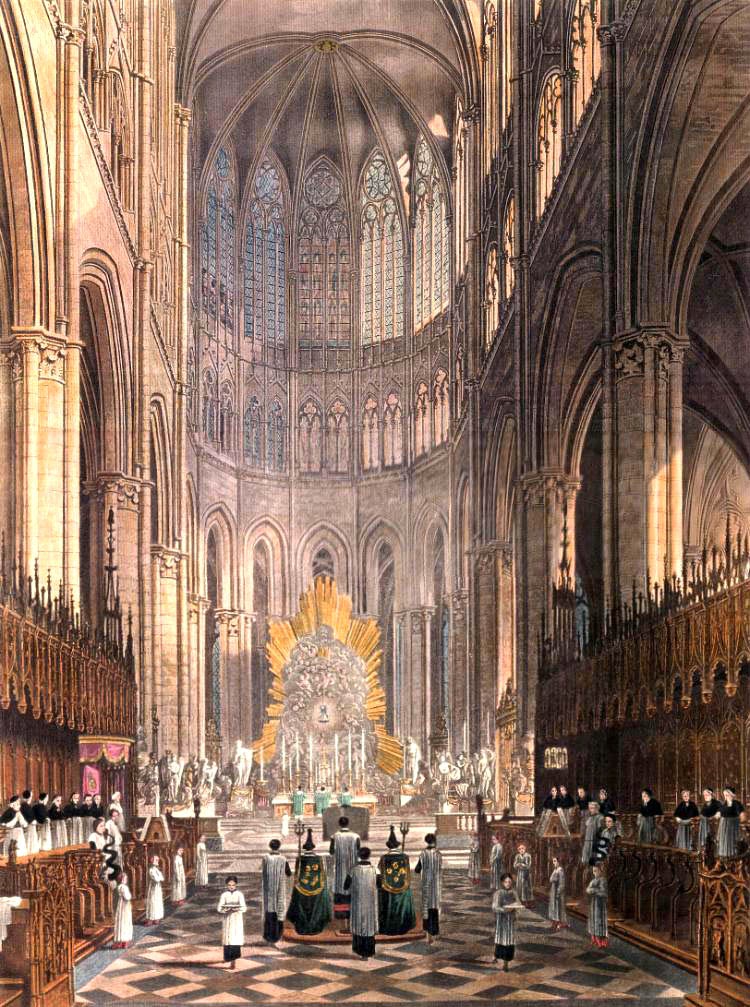
Notre-Dame d'Amiens in the 19th century
It is not a common event for a blog to publish a full translation of a great text of a major literary figure over one hundred years after its original publication, being able to claim it as a new event. Yet, this is just such a case.

On August 16, 1904, Marcel Proust had a major article published in the French paper of record, Le Figaro, called "La mort des cathédrales" (The Death of Cathedrals). The debate was raging in French political circles as Atheists and Freemasons, against the largely majoritarian sentiment of the population, pushed through Parliament the unilateral abrogation of the Napoleonic Concordat and the complete secularization of the French Republic (what would become the 1905 "Law of Separation" - for the appropriate Catholic view on the issues involved and its aftermath, read Saint Pius X's encyclicals on the issue, Vehementer Nos,  Gravissimo officii,  Une fois encore - and Pius XI's 1924 encyclical Maximam gravissimamque settling the matter). An important part of the debate was what exactly would happen to the upkeep and life of the highest point of French art and civilization, the Cathedrals.

Proust, an Agnostic in practice, but who never denied or stopped admiring his own Catholic roots and upbringing, could not stand in silence. Cathedrals as mere monuments, without the Traditional Catholic rites for which they were built, did not make any sense. What he could not know, the poor man, whose passion for the traditions and rites of the Church is palpable in the article, is that the Church herself would destroy and wipe out from most Cathedrals the venerable rites for which they were created. But, slowly and surely, they will return. As in Chartres in last year's ordinations for a traditional Fraternity. As in the occasional traditional Mass (such as the simple Mass celebrated each Sunday in that first Gothic jewel, Noyon). They will return.

Our deepest thanks to Prof. John Pepino for the remarkable translation of a landmark article, made especially for Rorate.

***

THE DEATH OF CATHEDRALS
Marcel Proust
Le Figaro
August 16, 1904

A Consequence Of the Briand Bill 
On the Separation of Church and State

Suppose for a moment that Catholicism had been dead for centuries, that the traditions of its worship had been lost. Only the unspeaking and forlorn cathedrals remain; they have become unintelligible yet remain admirable.  

Then suppose that one day scholars manage, on the basis of documentary evidence, to reconstitute the ceremonies that used to be celebrated in them, for which men had built them, which were their proper meaning and life, and without which they were now no more than a dead letter; and suppose that for one hour artists, beguiled by the dream of briefly giving back life to those great  and now silent vessels, wished to restore the mysterious drama that once took place there amid chants and scents—in a word, that they were undertaking to do what the Félibres have done for ancient tragedies in the theatre of Orange.[1]


Notre-Dame de Chartres
                Is there any government with the slightest concern for France’s artistic past that would not liberally subsidize so magnificent an undertaking? Do you not think that it would do what it did in the case of  Roman ruins for these cathedrals, which are probably the highest, and unquestionably the most original expression of French genius? After all, one may well prefer the literature of other peoples to ours, prefer their music to ours, their painting and sculpture to ours, but it is in France that Gothic architecture created its first and most perfect masterpieces.  All other countries have done is to imitate our religious architecture without ever matching it.

                And so, to return to my hypothesis, here come scholars who have been able to rediscover the cathedrals’ lost meaning. Sculptures and stained-glass windows recover their significance, a mysterious odor once again wafts in the temple, a sacred drama is performed, and the cathedral starts to sing once more.  When the government underwrites this resurrection, it is more in the right than when it underwrites the performances in the theaters of Orange, of the Opéra-Comique, and of the Opéra, for Catholic ceremonies have an historical, social, artistic, and musical interest whose beauty alone surpasses all that any artist has ever dreamed, and which Wagner alone was ever able to come close to, in Parsifal—and that by imitation.

Solemn High Mass for the Feast of St. Stephen of Hungary in Vienna


Una Voce Austria arranged a Solemn High Mass for the Feast of King St. Stephen of Hungary at the Karlskirche in Vienna. The celebrant was the Rev. Fr. Marc Hausmann, a priest of the diocese of St. Pölten and professor of metaphysics at the Pontifical University Urbaniana in Rome.

100 years ago, the Dual Monarchy delivered its ultimatum to Serbia
- A recommended video on World War I -- and the end of Civilization

July 24, 1914 paper reports on Ultimatum:
the July Crisis reaches its zenith
Vienna had received on July 6 the "blank cheque" (Blankoscheck) from Berlin, and, on July 23, 1914, the ultimatum related to the aftermath of the assassination of Archduke Franz Ferdinand and his consort was delivered to Belgrade -- exactly 100 years ago today. The ultimatum had been drafted in such a way that it would be impossible for any honorable nation to accept it, and Serbia had until Saturday, July 25, 1914, at 6 p.m. to accept it, or risk war.

At this moment, the mechanism that would trigger the war was almost in place but, incredibly, Russia and the British Government prevailed upon Serbia to practically accept all of the ultimatum's demands, except for a minor detail. In France, the secularist elite had alienated the Catholic majority of the population (that was in those days with their eyes fixed in Lourdes for the 25th International Eucharistic Congress, held from July 20 to July 25), and the country was still divided in half right before the conflict.

In any event, with the systemic failure of the elites of some (not all!) of these countries avid for war, even the late-moment efforts for peace failed, and the localized affair became a general European conflagration in just a matter of days.

The following short documentary by the United States Conference of Catholic Bishops' Catholic News Service on all aspects surrounding World War I, from its origins to its consequences, is a little web jewel, because in a very short time (under 20 minutes) and with the help of historians such as Christopher Clark, Margaret MacMillan, David Berlinski and the great Roberto de Mattei, it shows what Europe was and what Europe became.

O Crux, Ave, Spes Unica:
The Mass of Tradition

Editorial: Radicati nella fede, July 2014
Newsletter of the Catholic community of
Domodossola and Vocogno, Diocese of Novara, Italy

________________________________


Last month, when we talked about the solemnity of Corpus Christi, we mentioned the great danger of forgetting the sacrificial nature of the Catholic Mass. A forgetfulness which leads slowly but inexorably to heresy. On this point we should never forget Michael Davies’ great work on the Anglican Reform, which underlines the danger of “what’s left unsaid” in liturgy: Cranmer’s Anglican Reform, in removing all of the explicit references to the propitiatory Sacrifice, successfully introduced Protestantism into England in the space of a generation and brought the country definitively into heresy.

Last month, however we pushed it further saying, that by forgetting the Mass is the Sacrifice of Christ on the Cross, the awareness of the Substantial Presence of Christ in the Most Holy Eucharist is inexorably lost: if we don’t have the Victim, we don’t have the Presence of Jesus Christ, since Christ is present in the Eucharist as Victim. A Mass increasingly identified as a commemoration of the Last Supper truly risks not being a Catholic Mass. It is undeniable that the last reform to the Mass, the one in 1969, made it more and more like the Protestant Holy Supper, Anglican or Lutheran - whichever it is.

There is still something else though: A Mass that is more and more “protestantized” has “protestantized” the Catholic faithful in its mission, so much so, that each day they resemble more and more Protestant congregations, “involved in the world. “

If we don’t have the Victim, we don’t have the Presence of Christ either. This is true for the Mass and the Blessed Sacrament but it is also true for the entire work of the Church. If Christ Crucified is no longer at the heart of the doctrinal preaching and pastoral work of the Church, the entire mission of the Church risks being frighteningly empty. Never before as in the last few decades have we seen so many pastoral efforts with techniques that have been refined for effective communication; never as in the past fifty years have there been so much talk of mission with hardly any good results. The Church has moved towards the world continuously announcing and announcing, and its relentless de-Christianization has taken place.

Who, among the Fathers of the Council could have imagined, that the Catholic Faith would have almost disappeared in the space of fifty years? Who among the Bishops of Vatican II, could have imagined the advent of the anti-Catholic and immoral society that we have today, where every law seems to be made purposely against the plan of God for man?

Yet, it is undeniable. This disaster is before our very eyes.

If we no longer have Jesus-Victim, we don’t have Jesus-Present either.

A Church that has been enthusiastically “encountering” the world since the ‘60s and has put the Cross of Christ in second place, has lost Christ Himself and has brought nothing or almost nothing to society. It needs to be said clearly: without the centrality of the Cross, without the centrality of Christ crucified, you lose Christ Himself. The ones who speak about Jesus without His Cross and its centrality, are suffering a terrible delusion. The ones who put the Cross of Christ “among the many other things” in the life of Jesus, but don’t’ envisage the center - in truth - they are not even talking about Christ. They are talking about a “confectioned” Jesus specially for the modern world, which like the Jews and gentiles of Saint Paul, judged Christ Crucified as a scandal and foolishness.

The decision was made to go into world and have friendly dialogue with it, avoiding the condemnations of the Church in the past; in order to have friendly dialogue, they had to “veil” or “hide” the Cross and the Sacrifice of Christ, so that the dialogue with modern society, with its religions, would be serene and amicable, resulting in the twofold tragedy of not having brought anything to the people of these times and, worse, in devastating the Sanctuary of the Presence of God, which is the Church.

We cannot avoid it: we must be the first to accept and embrace the scandal of the Cross, recognize it as the central content of the Church’s doctrine, life and mission, and so, not calculating the results, but confident in the infinite power of God’s grace, go into the world so that it will be converted and healed by the Cross of Christ.

Woe to those Catholics, woe to that Church, that wants to convey another Jesus without the Cross! It will lose its essence, strength, soul and its exclusive power of grace. In addition. it will become more and more useless and unbearable to the world that it wanted to reach. A Church without the Sacrifice and the Cross is detestable and unbearable to the world.

What is more, the world is now ready to savage such an empty Church.

In hoc signo vinces, is not only a memory from past history, it is the truth of every single moment: the victory is in the Cross and of those who bring it and show it to the world, without human calculations.

O Crux, ave, spes unica, Hail O Cross, our only hope; if there isn’t a return to this clarity in all things – truly in the entire Church - the disaster will be inevitable.

This return begins though with the Holy Sacrifice of the Mass.

If faced with this devastating picture of confusion we feel powerless; if powerless we are wondering what to do and above all where to begin, let’s remember that the rebuilding of the Church will always start from the Holy Sacrifice of the Mass. Let’s not make human calculations, let’s not make the same mistakes of the 60s, let’s not go into the world, with our techniques, not even to rebuild Tradition, but let’s start again from the Mass.

We say this first to priests and then to the faithful: let’s return immediately to the Mass of Tradition. Let’s return to the correct Rite of the Holy Sacrifice of the Mass and from there we can begin again the painstaking work of rebuilding the faith. Let’s not make the mistake of doing the opposite, first pastoral work, then a return to the Mass of Ages, it would be basically hiding the Cross of Christ again, in the expectation of better times, as the deluded missionaries did in the post-conciliar years.

The truth instead is Christ.


The truth instead is in the reality of His Redeeming Sacrifice, perpetuated in the Catholic Mass. The first duty of priests is to celebrate it. The first duty of everyone is to live by it, so that life, true life, will continue.

______________________
[Translation: Contributor Francesca Romana. Main image, and in details: Diego Velázquez, Cristo Crucificado (1632), Museo Nacional del Prado.]

At the Altar at the Ninth Hour. Silence and Solitude of Golgotha: Assisting at the Traditional Mass

By Antonio Margheriti  Mastino


There are two facets in particular that afford us a deeper understanding of the Mass, especially according to the Extraordinary Form, which I personally prefer:  silence and solitude.  The altar, before, during and after the Sacrifice is covered in silence. And by solitude: that of the celebrant, the “Alter Christus.”

But how can this be, one will say, since Easter and therefore the celebration are triumphs?  That is true.  But the celebration of the Mass is also the re-presentation of the Passion and Death of Christ, which unfolds in silence, in solitude, in betrayal, in denial, in the flight of the disciples.  At the Last Supper Christ is betrayed and sold by Judas. In the Garden of Olives on the night before his death Christ is left alone to sweat blood, while his disciples sleep instead of praying with him, the only thing he had asked of them.  On that same night Peter denies him three times. No one tries to save him, no one offers to bear the burden of his cross even for a while (the Cyrenian was forced to do this).  No one seems to know him or recognize him.

Christ, in a moment of truly human pain, cries out in a loud voice to his God, to Abba, the abyss of wretchedness and aloneness into which he plunges in stillness.  “Aloneness”.  The same aloneness that the priest, the Alter Christus, experiences in that moment on the altar of the Supreme Sacrifice, the renewed Golgotha, where in a real way and once again the Passion of Christ breaks through. The priest is alone at the altar.  And to this aloneness is joined the protecting shade of aloneness:  silence. On the desolate hill of Golgotha,  first in the Garden and then as well in the tomb, Christ is alone and in silence: the silence of his obedience, of the chalice of bitter woe, of the sweat mingled with blood.  And this is the silence of powerlessness, a powerlessness that for a moment seems even that of God.  “My Father, Abba, why have you abandoned me?” The “silence” of God, in this moment when the wave of the abyss is breaking over Christ, seems almost like the sinking of Divinity into nothingness.

But it is also the powerlessness and the desolation that comes from the first and eternal “Yes” in obedience from Mary at the foot of the Cross, in accepting this Son that was not for her to keep: “Stabat Mater dolorosa…” This is the fearful silence that was experienced by the wonderful St. Thérèse of Lisieux on her death-bed, when she cried out, in that final moment of agony and darkness, that she had no sense of the presence of God.

Silence.  Just as the disciples were silent, just as Mary was silent, all of whom loved Christ as man and Messiah.  There was silence at the foot of the Cross. There was silence where the others hid.  There was silence because of obedience. There was silence because of cowardice.  They were silent, transfixed by pain. They were silent in confusion. Or because in the end things “had to turn out” in this way….All stood in silence.  They just stood there:  at the Passion and Death of the Son of God.  For the same reason, at the Mass of Sacrifice, the faithful should not “participate” but "assist", by keeping watch in silence, in that silence that cloaks the priest while he offers the Sacrifice of Christ and of himself.  And they must be in a state of active acceptance, they must offer their support of what is not penetrable, the miracle that, as the Messiah promised, he has not left us as orphans.


But what of the Resurrection?  It is the triumph, that is true.  But it is a triumph lived out in hiddenness, by a God without arrogance. It happens yet again, but in silence and solitude.  Within the tomb of stone, at night, no one there, except for the soldiers guarding the entrance.  In the same manner, in the lowered voice, in the silence that lies hidden in the depths of the words of the priest, the “Alter Christus” at the altar of Sacrifice, the Resurrection will once again be present.  In silence and aloneness.


And so we see the “why” and the “how” of what it means “to be at Mass”, how one “assists” at the Holy Sacrifice of the Mass, the Missa antica.  This is far from the shouting and the applause, far from the freneticism and the syndrome of wanting to be the center of attention, far from the crackling and sound-warping microphones, far from the flood of frigid phraseology, and far from the reformed Mass in the style of the 1970s, a decade full of tiresome rhetoric laced with populists slogans that in the end are of no use to anyone of any time, one of the worst decades ever lived through on the face of the earth. 


Translated by Father Richard G. Cipolla

Source:  “La Cuccia del Mastino", January 14, 2014

Savonarola
On Hearing Mass


Though not a Tuscan himself, a Dominican Friar named Girolamo Savonarola came to master the Florentine Republic simply by the power of his words. It was a time of enormous upheaval and crisis in the Church hierarchy, a crisis so profound that the Catholic Church would soon have half of her faithful in Europe sundered from her, and few like Savonarola reflected so forcefully the disgust of Catholics with much that was taking place in Church and State.

Fr. Dr. J.P.Kirsch
The sermons of Savonarola were greatly admired for the language skills and the persuasion he showed. In the end of his disastrous period in the helm of the Republic, against the Medicis and the Apostolic See, he was burned at the stake indeed, but he was no precursor to Protestantism; as the great Church historian Fr. Johann Peter Kirsch wrote in his article on Savonarola for the old Catholic Encyclopedia, "In the beginning Savonarola was filled with zeal, piety, and self-sacrifice for the regeneration of religious life. He was led to offend against these virtues by his fanaticism, obstinacy, and disobedience. He was not a heretic in matters of faith."

It is said that Pope Paul IV, when instituting the Index Librorum Prohibitorum, decades after Savonarola's inglorious death, wished to place all his writings in the list. But Dominicans, like Jesuits, never forget, so they strongly fought to reduce that posthumous penalty, and in the end only one book (Dialogue of Prophetic Truth) and fifteen sermons were placed in the Index, which were some of the sermons on the books of Exodus, Ruth, Ezechiel, Job, and Amos. His name seemed to slowly vanish from the Index over the centuries.

Naturally, we avoid these specific writings, but are pleased to present a translation of another sermon of the friar, made by our contributor Francesca Romana, based on a 19th century Italian version of some of his works. In it, part of the sermons on the First Epistle of St. John, a problem that affects each one of us personally: when we go to Mass, do we pay attention to others? Are you giving due reverence to the Priest who is about to perform the greatest deed on earth? And why was obedience to the Hierarchy missing -  in his age and in ours?

___________________________

ON HEARING MASS WITH AN UPRIGHT INTENTION AND OF THE COMPOSURE OF THE BODY

What will we say about the many who go to Mass with an unclean conscience and are in a state of sin? But what of those who come to sin, that is, to see their friends, or other things? O irreverent and foolish! Irreverent that they have neither faith nor reverence towards the Sacrament; foolish, because they do not fear the Judge Who is present. Or would you do anything, deserving of death, before your prince and judge? Of course not; why then, do you not fear in this place? Why are those who do such things not being punished now? O man, do you think that secretly you will escape the judgment of God? Or do you hold in contempt the riches of His benevolence, tolerance and patience? Do you ignore, perhaps that the benevolence of God invites you to penitence? Yet, according to your hardness and heart that does not repent, you earn anger in the day of wrath and revelation of the just judgment of God, Who will reward everyone according to their works.

Here are the intentions to have when you go to Mass: to give thanks for so many benefits, to offer sacrifice in the odor of sweetness for you sins, to receive the Sacred Sacrament, at least spiritually.

With what and how much reverence must you stand before the priest?
I think that we must treat further of this matter; that is, of the composure of the body, about which we must look at three things. First, the corporal distance from the priest. Second, of order. Third, of the reverence of the body.

Regarding the first, as is peculiar to this your city, some place themselves in front of the priest in order to look him in the face, some at the side and others behind his back, trying to see what is the better and most useful of these places. Where,[we] note primarily, that the tabernacle of Moses and similarly the temple of Solomon were distinct in sancta sanctorum, that place where no-one but the priest entered once a year; in sancta, where all the priests entered and in the atrium where the Levites were. The people looked on from a distance under the portico, the men on one side and the women on the other.

Thus, I tell you that you must not be too close to the priest at the altar. Firstly, because doing so, you are in the sancta sanctorum, which is the most holy place, that was not [so] in ancient times, since the Ark was there, which was [but] the symbol of Christ. However, here we have Christ and truth. Secondly, out of reverence for Christ, you as a sinner must remain at a distance, like the Publican and say: ‘be merciful unto me a sinner.’ (1) Or do you think you are so pure that you may audaciously stand in front of Christ? Thirdly, for the symbolism, since the priest is the head and you are the members. If, therefore, the hand or the foot were above the head what monster would this then be? Fourthly, for the sake of the priest, so that he is not impeded in prayer when in dialogue and in the embrace of Jesus Christ given that he may be embarrassed kissing his Lord and weeping sweetly in His presence. Thus, you impede his contemplations. Fifthly, for your own sake, since the priest’s prayer is for you. If therefore you impede him, it is not efficacious. So you must not ever in any way place yourself in front of the priest’s face. Nevertheless, the altars should be so arranged that none are able to go near. Similarly you must not stay at the sides since the first reason is against you, because there you are in the sancta sanctorum; the second reason again, is because you are too close to Christ; the third, moreover, because the head is high above the members; the fourth similarly, because also like this the priest is not concealed; the fifth likewise, because the priest is impeded in his prayer.

Moreover, a sixth reason may also be added, because we see in human affairs that servants are not positioned equally at the side of their master. The priest represents the person of Christ, thus you must hold him in reverence as you do Christ. It astonishes me therefore how greatly sullied you are in these two things. First, because you are at the front and I fear that you are there out of curiosity: you are all curious and superstitious citizens, stirred by every novelty. Second, you do not have any reverence for priests.

You will say, I do not relish the Mass if I am not near the priest, otherwise it does not seem to me that I am able to participate in such a Sacrifice. But tell me, in what way do you touch Christ? In what way are you close to Him? By faith or by the body? To the second you will say to me: this is not our custom. Thus, you do bad, because if you do not want to honour one another, at least honour the priests of Our Lord.

But what will I say since priests are treated like servants and are not given an honoured place?

Yet, Innocent III rebuked the Constantinopolitan Emperor  because he did not give due honour to his Bishop and Patriarch but made him sit below his footstool on his left-hand side. So that, he says, the other kings and princes would show tribute to bishops and archbishops and give them honorable places, [but] why defraud him of his due respect? Except that the spiritual kingdom is worthier than the temporal. ...

At present the Pontiff is not obeyed, when obedience is not agreeable, and neither bishops or priests honoured, and if they sin, they are shamed by everyone. But why? Because again, they are the cause of this, since they sin publically and expose themselves to the scorn of men. This was predicted by the Lord saying: “You are the salt of the earth. But if the salt lose its savour, wherewith shall it be salted?” (2)Which means if you lose devotion and charity, how will you be able to inflame others? With nothing, unless ‘it is cast out and trodden on by men.’ (2) [Therefore] they are cast out when they are absolutely deprived of their offices, and it is for these that they are trodden on. Nevertheless, citizens, do not either you sin, because you must honor Christ in these men.

But since we have prolonged our reasoning longer than we imagined, and the time has already passed, we need to interrupt our discourse, and next Sunday, God willing, we will complete it.

So, brothers and sisters, you must attend Mass with great reverence and there take your places in the appropriate manner, as I will teach you in the next sermon, helping you in your prayer towards the Lord Jesus Christ, Who is God and Blessed forever.

(1)Luke, 18, v,13
(2)Matthew 5, v,13


___________________________

[Personal recess for several weeks. Occasional posts when possible, or for urgent news. For up-to-date news and links, follow us on Twitter @RorateCaeli]

Yes, even here

Father Ray Blake, who will now celebrate the Traditional Mass every Sunday, says:

One of my parishioners has written a song. I don't know if it will be heard on Chant Cafe or appear on New Liturgical Movements or even Rorate Caeli. It raises lots of questions, why do intelligent young men, even with guitars, love the "Mass of Ages"? Why do they sit round a talk about vocations to the priesthood or living according to the Church's teaching? Why are the[y] eager to share their faith?

Father, votre désir est votre ordre! Dear readers, by a parishioner of Father Blake, The Ballad of Summorum Pontificum.