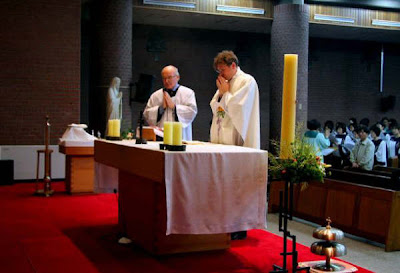
From a Korean Catholic youth (who prefers to remain anonymous) comes the following report about the first-ever TLM in a parish setting in South Korea. The Mass was offered last May 13, 2009, at 7 pm, in the Yongsan church, followed by a conference with famous German Catholic author Martin Mosebach (author of "The Heresy of Formlessness"). Fr. Michael Bauer, parish priest of the German Catholic parish in Shanghai, offered the Mass, with Mr. Mosebach himself as server.
Keep in mind that this is the FIRST TLM under South Korean diocesan auspices in forty years. Please exercise restraint in your comments. In case anyone is wondering, there is a crucifix at the center of the altar (although it is too small and dark to be easily seen in the pictures) and the number of candles (four) is just right for a Missa Cantata.
The report has been edited for this post:
Usus Antiquior Mass was celebrated by Fr. Michael Bauer in Seoul, Korea immediately followed by a conference with Martin Mosebach, the writer of “The Heresy of Formlessness”. The Goethe Institute sponsored this event and Yong-San Catholic Church provided the place for the liturgy. About 200 Catholics attended the first parish-setting EF Mass in South Korea. Most of them have never experienced the Traditional Latin Mass after the liturgical reform, since there has been no indult TLM for almost 40 years.
Most of the people, except Mr. Mosebach, looked new to the liturgy; Fr. Bauer himself is still learning the old liturgy. The choir of Yong-San Catholic Church sang for the Mass. The music setting was Missa de Angelis but Latin hymns were sung instead of chant propers. So it was a mixture of low mass and Missa Cantata. (Very understandable for a first-time TLM – CAP)
Even though the Mass setting was not satisfactory, most of the attendees said they experienced a reverent liturgy. Many of them expressed the wish that the Catholic Church in Korea could provide the EF Mass in at least one parish per diocese. They said the best part of the EF Mass was communion on the tongue whie kneeling – this has become quite rare in Korea, and many TLM attendees were touched by the reverence of this way of receiving communion.
In Seoul Archdiocese, Catholics do not kneel during the consecration, due to the excuse that churches are overcrowded during Sundays. Most of the parishes in Seoul Archdiocese have removed kneelers and it is rare to see people kneeling even during weekday Masses, when there are no crowds. Also, the Catholic Church in Korea has advised Catholics to take communion in the hand, since there have been followers of unapproved apparitions, who adhere only to communion on the tongue or with kneeling. Pastors usually use communion as a litmus test to tell apart those people, which resulted in the practical suppression of communion on the tongue or with kneeling.
After the Mass, there was a conference and Q & A session with Mr. Mosebach. The lack of interest from the Catholic Church in Korea can be seen in the fact that there was not a single Korean Catholic media report or any welcoming statement from Korean bishops or clergy on this first TLM after liturgical reform. Hopefully, the Korean Catholic clergy will listen to the vox populi and the voice of Benedict XVI.
Yours in Christ and our Lady the Coredemptrix,
XXX.
ADDENDUM: Mr. Mosebach's "The Heresy of Formlessness" was translated into Korean in 2007, with the title being translated as "Liberalism of Formlessness".
UPDATE: A clip of the Mass can now be viewed here.
19 comments:
This is encouraging as well as the fact that the tabernacle is centred at the foot of the cross. It is essential to bring this Mass into all churches even if the furnishings are not ideal at first. They will become so eventually if its presence persists with experienced & knowledgeable guidance. I am sure Koreans would really love the Holy Mass in Latin with its profound contemplative aspect.
One of the most disquieting facts in this region is the almost total ignorance of the pre-conciliar church & the all-pervasive protestant flavour of the modern liturgy. The news from S Korea is heartening but Mosebach's Formlessness Thesis is essentially a valid one where liturgy is at question.
SSPX have a presence in Japan. I will not say more about other countries here apart from those mentioned elsewhere on this site. But good work is going on quietly.
Alongside Mosebach's pertinent thesis can be demonstrated the absence of customary Roman Catholic liturgical embodiment which accounts for the overwhelming banality & inappropriateness of the modern liturgies. Symbolic interaction with sacred elements and timeless language require essential and definitive forms in the divine drama of The Holy Mass. People here are not unfamiliar with a sense of the mystical.
There is always a first time as they say. I observed that priests trained in the Novus Ordo with no background in the old rite tend to mixed up the rubrics. For instance, in the NO the priest use to sing with the congregation. When these priests say the traditional rite for the first time they tend to join also in the singing thus a low mass become a combination of a misa cantata, which is confusing. But as the priest learns the rubrics the practice tends to improve a bit.
Very few in the post-conciliar church in Korea remember how it was before -- though there are articles out there by older faithful who remember how it was. One especially dramatic change was the change of Catholic vocabulary to match that of the Protestants. For instance, the Korean word for apostles was changed from "Jong-do" to the Protestant "sa-do." The Korean transliteration of the apostle John was before the council "Yo-wang" and was changed to the Protestant usage "Yo-han." Even the word for God changed from "Cheon-ju" to "Ha-neu-nim" (though both were used before the council, the former was used a lot more often).
This is encouraging news. Those responsible deserve praise, since we all know how difficult these steps are.
A key is to educate the people to the specific advantages of the TLM. Otherwise, it will be a boring curiosity.
Well done!
I think it's sad that the heresy of formlessness has made such great inroads in Japan and Korea. I have the impression that most of the Japanese/Korean clergy want the Asian Church to be more independent of Rome and more authentically Asian. But the irony is that over the past 40 years, the Church in these countries has become just as westernised as the rest of society.
Had it not been for post-Vat II madness, the Catholic Church could perhaps have been one of the few places in these countries where traditional East Asian art, architecture, and social mores had been preserved. As it is now, the Liberal tendencies in the Church has helped wipe out all that was good about Asian culture and replace it with all that is bad about Western. Did anyone say cultural imperialism?
This is good news for the Asian community at large and I hope that this small starts spreads quickly throughout. As is mentioned the settings will improve with time as people recover that which feels sacred to them and it starts with the liturgy. Seoul should be proud to lead the return of the TLM in Korea. God Bless them.
I have always wondered how Korea can be so effective in pumping out Protestants...now we know.
Just think, there must be are other places where this is happening and of which we are unaware.
Yesterday, a friend informed me that his priest-friend had learned the old Latin Mass and was now publicly celebrating it in Guatemala. I have also been informed of another priest in Venezuela who recently celebrated his first Tridentine Mass.
God bless these priests! Keep it coming!
TO any Korean faithful gauging response to this news:
In light of megalomaniacal communist leaders in N Korea threatening to blast both S Korea and Japan, what better Heavenly response than a glimmer of the TRaditional Ordo of the Ancient Mass of the Apostles to procure more efficaciously God's mercy upon her peoples in S Korea.
May the Koreans, young and old, march in the streets as they are so wont when voicing a desire to be rid of the Americans, but rather this time for the Ancient Ordo of the Mass, with a special intention:
A papal call and command for a collegial consecration of Russia to the Immaculate Heart of Mary, the ONLY remedy and hope (as opposed to putting hope in Obama's US of A) for real and lasting deliverance and victory over the commies of the North.
Our Lady of Fatima, Protectress of Korea, pray for us!
JMJ, Toronto
Coredemptrix? Are you crazy?
Jesus Christ is our Lord. I'm an old fashioned Catholic and I smell heresy. Get a grip.
Very encouraging news. Praise the Lord!
My Asian friends here love the Mass of all times :)
Anonymous, the Old Catholics also styled themselves "old fashioned Catholics." There's nothing heretical about the Catholic belief that Mary is Co-Redemptrix. The Holy See has approvingly identified Our Lady as Co-Redemptrix for the past 100 years.
For helpful background and explanation of this entirely proper and true Marian title, see Arthur Calkins' "The Mystery of Mary Coredemptrix in the Papal Magisterium"
http://www.christendom-awake.org/pages/calkins/pontmag1.htm
Minor correction. The SSPX has had a parish in Seoul for years. It is very small, though.
In the old days a Catechist would read the text of the Mass out loud in Korean while the priest prayed the Mass in Latin. The Latin Mass would go well with Koreans that retain some sense of traditional Korean culture. For the moderns--i.e. boys who are more interested in hair gel and girls who fixated on the shape of their behinds in a mirror (i.e. 99% of the under 30 crowd here)--they will stick with the modern Mass which offers absolutely no challenge to fight sin.
I've mentioned on the blog before, to no avail that in 1999 I came back to the US and was asked by the late Bishop Ignatius Park of Andong to talk to the FSSP about sending a couple Korean students to OLGS. I was stiff-armed in about as rude a manner as one could imagine. I was told, among other things, that the FSSP doesn't have time to teach ESL. These students have already had plenty of English, and already knew Latin, Greek French and German as well as their native Korean and Chinese writing (about 1800 characters). Supreme arrogance knocked us back ten years.
Bishop Park was going to say the TLM at his cathedral in early 2001, but I the day I called to confirm the final arrangements, he had died while hiking with the priests and nuns in his diocese. Somewhere in his files, Roger McCaffrey should have a photograph (A.D. 2000) of me presenting Bishop Park a copy of the 1962 Altar Missal.
This TLM is encouraging, but the destruction of the Church in
Korea is so thorough. It's worse than just not knowing what came before. Koreans send all of their best priests to Europe and the USA for graduate school. These priests come back with the absolute worst ideas humanly imaginable and foist them on the rest of the nation as they grow in power and stature. The missionaries that come here from the West and from India have the stated goal of bringing Korea "up to date." How do I know? I'm here, and I witness it firsthand.
If anyone wants to come to a country with some of the most hideous church architecture and some of the dippiest Masses, please come to Korea. You may just throw up. I know I do.
Matt Smith
South Korea
I am sorry to tell you this but it was more like a one-time cultural event arranged by Goethe Institute. So the Mass was not seriously prepared for continuity. Fr. Bauer will not stay in Korea but return to China for German community in Shanghai.
It was not formalized as a Church document (like in the case of Manila Archdiocese that publicly restricted TLM) but I read some comments of Korean priests that in diocesan priests' meetings, Korean priests have been advised not to celebrate TLM, at least in public, with the excuse of preventing confusion with SSPX. It is exactly the same way of suppression as communion on the tongue or with kneeling.
Catholic Church in Korea has been blessed with rapid increase in the number of baptism, now over 5 million Catholics (it was 4 million in 2000) out of 50 million Korean population. However, the number and quality of vocation keep decreasing. And the bad fruits of liturgical abuses are noticeable even in secular news media. Here are some already published cases that still appear in secular newspapers and Korean Catholic media:
1) a Buddhist monk invited to give homily at Mass for the cause of environment in Jeonju diocese. The priests at the Mass are members of "Priests for Justice", a very anti-American political group.
2) a Buddhist monk giving homily at Mass for stopping naval base in Cheju island. He was welcomed by Bishop Kang in Cheju diocese.
3) a Buddhist monk giving homily at Mass of Christmas in Seoul Archdiocese
4) a Korean Jesuit priest's Mass against importing American beef in Seoul Archdiocese
5) Rap singing and dancing by a Benedictine priest and a sister of st. Paul de Chartres in Daegu Archdiocese.
Interesting, Matt. I concur: I have met only a few "orthodox" Korean priests, most are quite happy with Masses with liturgical dancing. I've even heard the common urban legend spread by Koreans that water has "feelings" from a nun at a sermon. The Church in Korea also worked with the Protestants in creating a new Bible translation in the 70s, and a "common" translation of prayers such as Our Father, replacing the ones known by the martyrs. Though I must say, Korean Catholic women still have their mantillas at Mass. That's the only thing going for them.
"a Korean Jesuit priest's Mass against importing American beef in Seoul Archdiocese"
Now THAT is something I couldn't stand!
Carlos
Beef lover
6) The link #5 is Daegu PBC (Peace Broadcasting Company) run by Catholic
Church in Korea. The website connection looks bad. So I post another
link of the same clip which has been very popular among Catholic websites in
Korea: here.
I live in South Korea and since the liberating of the TLM I was searching for it, to no avail.
It seems like Koreans have no clue about the history of the Church and what being Catholic is all about. Though they do retain some practises, like praying before meals and other things, in general they are clueless about the TLM and what the faith actually teaches.
It is all charasmatic clap trap.
The SSPX has a small presence but it is still persecuted by the NO clergy.
Post a Comment