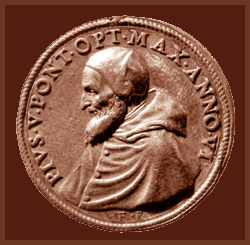
Rorate Caeli

A reminder from another Benedict


Because charity ..."is the beginning and the end of all good things, may we also let it outline the boundaries of our actions," beloved son and venerable brothers. We long for the day when the rights of Almighty God and of the Church, their laws, their worship and their authority will be restored in this troubled world. We hope that then Christian charity will end wars and furious hatreds, dissensions, schisms, and the errors which crawl everywhere. May it link the peoples by a more stable treaty than the transient pacts of men. Its special means toward this goal are the unity of faith and the ancient union with the Holy See. This Holy See was established by Christ as the foundation of his family on earth and was consecrated by the virtues, the wisdom, the efforts of so many saints and martyrs...


Once this unity of faith and hearts is established throughout the world, what Pope Clement wrote to the Corinthians in the first century will be appropriate for all of Christendom: "You would give us great joy if, obeying us, you would cease your illegitimate rivalry as we recommended in this exhortation to peace and harmony."


Benedict XV


May 14, 1919


Posted in honor of this encyclical's 90th anniversary last Thursday, May 14.
Picture comes from the St. Peter's Basilica website

Venezuelan National Assembly telling Bishops what to do

Two priests, closely linked to "Progressive" political groups (i.e. Hugo Chávez), celebrate a "People's Mass" on the day of a traditional local feast in defiance of their Bishops. The Bishops suspend the priests until they apologize for their disobedience. A dispute to be solved within the Church, right? 

Not in that new Socialist haven, the Bolivarian Republic of Venezuela.

The standoff between Fathers Máximo Ochoa and Edmundo Cadenas and their Bishops (Ramón José Viloria Pinzón, Bishop of Puerto Cabello, and Nelson Antonio Martínez Rust, Bishop of San Felipe) became a matter of national concern this week as Venezuelans watched a national broadcast of a legislative session which included the approval of a resolution against the Bishops by the National Assembly (where most seats are held by allies of President Hugo Chávez).

Fathers Ochoa and Cadenas visited the National Assembly on May 14 and testified against their Bishops: “We have done no crime in order to apologize. We would rather walk along with the simple folk, our people, according to Liberation Theology, than with the dominating class. The reprisal happened [for choosing] to lead a Christian life and for the preferential option for the poor." 

“The Bishops suspend us, but the people absolve us,” they added.

In the broadcast, the President of National Assembly, “exhort[ed] the hierarchy of the Catholic Church to follow the democratic and social justice principles of our Constitution, openly violated with the absurd political decision which threaten freedom of worship and the practices of the faithful who, year after year, take part in the Mass of the Blessing of the Sea in Puerto Cabello". [Source.]

Pope meets Greek Orthodox Patriarch of Jerusalem


Dear Brothers and Sisters in Christ,
It is with profound gratitude and joy that I make this visit to the Greek Orthodox Patriarchate of Jerusalem; a moment to which I have much looked forward.
I thank His Beatitude Patriarch Theophilus III for his kind words of fraternal greeting, which I warmly reciprocate. I also express to all of you my heartfelt gratitude for providing me with this opportunity to meet once again the many leaders of Churches and ecclesial communities present.
This morning I am mindful of the historic meetings that have taken place here in Jerusalem between my predecessor Pope Paul VI and the Ecumenical Patriarch Athenagoras I, and also between Pope John Paul II and His Beatitude Patriarch Diodoros. These encounters, including my visit today, are of great symbolic significance. They recall that the light of the East (cf. Is 60:1; Rev 21:10) has illumined the entire world from the very moment when a "rising sun" came to visit us (Lk 1:78) and they remind us too that from here the Gospel was preached to all nations.
Standing in this hallowed place, alongside the Church of the Holy Sepulchre, which marks the site where our crucified Lord rose from the dead for all humanity, and near the cenacle, where on the day of Pentecost "they were all together in one place" (Acts 2:1), who could not feel impelled to bring the fullness of goodwill, sound scholarship and spiritual desire to our ecumenical endeavors? I pray that our gathering today will give new impetus to the work of theological dialogue between the Catholic Church and the Orthodox Churches, adding to the recent fruits of study documents and other joint initiatives.
Of particular joy for our Churches has been the participation of the Ecumenical Patriarch of Constantinople, His Holiness Bartholomew I, at the recent Synod of Bishops in Rome dedicated to the theme: The Word of God in the Life and Mission of the Church. The warm welcome he received and his moving intervention were sincere expressions of the deep spiritual joy that arises from the extent to which communion is already present between our Churches. Such ecumenical experience bears clear witness to the link between the unity of the Church and her mission. Extending his arms on the Cross, Jesus revealed the fullness of his desire to draw all people to himself, uniting them together as one (cf. Jn 12:32). Breathing his Spirit upon us he revealed his power to enable us to participate in his mission of reconciliation (cf. Jn 19:30; 20:22-23). In that breath, through the redemption that unites, stands our mission! Little wonder, then, that it is precisely in our burning desire to bring Christ to others, to make known his message of reconciliation (cf. 2 Cor 5:19), that we experience the shame of our division. Yet, sent out into the world (cf. Jn 20:21), empowered by the unifying force of the Holy Spirit (ibid. v. 22), proclaiming the reconciliation that draws all to believe that Jesus is the Son of God (ibid. v. 31), we shall find the strength to redouble our efforts to perfect our communion, to make it complete, to bear united witness to the love of the Father who sends the Son so that the world may know his love for us (cf. Jn 17:23).
Some two thousand years ago, along these same streets, a group of Greeks put this request to Philip: "Sir, we should like to see Jesus" (Jn 12:21). It is a request made again of us today, here in Jerusalem, in the Holy Land, in the region and throughout the world. How do we respond? Is our response heard? Saint Paul alerts us to the gravity of our response: our mission to teach and preach. He says: "faith comes from hearing, and what is heard comes through the word of Christ" (Rm 10:17). It is imperative therefore that Christian leaders and their communities bear vibrant testimony to what our faith proclaims: the eternal Word, who entered space and time in this land, Jesus of Nazareth, who walked these streets, through his words and actions calls people of every age to his life of truth and love.
Dear friends, while encouraging you to proclaim joyfully the Risen Lord, I wish also to recognize the work to this end of the Heads of Christian communities, who meet together regularly in this city. It seems to me that the greatest service the Christians of Jerusalem can offer their fellow citizens is the upbringing and education of a further generation of well-formed and committed Christians, earnest in their desire to contribute generously to the religious and civic life of this unique and holy city. The fundamental priority of every Christian leader is the nurturing of the faith of the individuals and families entrusted to his pastoral care. This common pastoral concern will ensure that your regular meetings are marked by the wisdom and fraternal charity necessary to support one another and to engage with both the joys and the particular difficulties which mark the lives of your people. I pray that the aspirations of the Christians of Jerusalem will be understood as being concordant with the aspirations of all its inhabitants, whatever their religion: a life of religious freedom and peaceful coexistence and - for young people in particular - unimpeded access to education and employment, the prospect of suitable housing and family residency, and the chance to benefit from and contribute to economic stability.
Your Beatitude, I thank you again for your kindness in inviting me here, together with the other guests. Upon each of you and the communities you represent, I invoke an abundance of God’s blessings of fortitude and wisdom! May you all be strengthened by the hope of Christ which does not disappoint!
Benedict XVI
May 15, 2009
Note: The Greek Orthodox Patriarchate of Jerusalem has in recent decades been the most anti-Catholic among all the Orthodox Patriarchates.
H/t for picture to http://www.coptreal.com/

"I wish to proclaim anew..."

Saint John’s Gospel has left us an evocative account of the visit of Peter and the Beloved Disciple to the empty tomb on Easter morning. Today, at a distance of some twenty centuries, Peter’s Successor, the Bishop of Rome, stands before that same empty tomb and contemplates the mystery of the Resurrection. 

Following in the footsteps of the Apostle, I wish to proclaim anew, to the men and women of our time, the Church’s firm faith that Jesus Christ “was crucified, died and was buried”, and that “on the third day he rose from the dead”. Exalted at the right hand of the Father, he has sent us his Spirit for the forgiveness of sins. Apart from him, whom God has made Lord and Christ, “there is no other name under heaven given to men by which we are to be saved” (Acts 4:12).


Standing in this holy place, and pondering that wondrous event, how can we not be “cut to the heart” (Acts 2:37), like those who first heard Peter’s preaching on the day of Pentecost? 

Here Christ died and rose, never to die again. Here the history of humanity was decisively changed. The long reign of sin and death was shattered by the triumph of obedience and life; the wood of the Cross lay bare the truth about good and evil; God’s judgement was passed on this world and the grace of the Holy Spirit was poured out upon humanity. Here Christ, the new Adam, taught us that evil never has the last word, that love is stronger than death, that our future, and the future of all humanity, lies in the hands of a faithful and provident God.

The empty tomb speaks to us of hope, the hope that does not disappoint because it is the gift of the Spirit of life (cf. Rom 5:5). This is the message that I wish to leave with you today, at the conclusion of my pilgrimage to the Holy Land. May hope rise up ever anew, by God’s grace, in the hearts of all the people dwelling in these lands! May it take root in your hearts, abide in your families and communities, and inspire in each of you an ever more faithful witness to the Prince of Peace! The Church in the Holy Land, which has so often experienced the dark mystery of Golgotha, must never cease to be an intrepid herald of the luminous message of hope which this empty tomb proclaims. The Gospel reassures us that God can make all things new, that history need not be repeated, that memories can be healed, that the bitter fruits of recrimination and hostility can be overcome, and that a future of justice, peace, prosperity and cooperation can arise for every man and woman, for the whole human family, and in a special way for the people who dwell in this land so dear to the heart of the Saviour.

This ancient Memorial of the Anástasis bears mute witness both to the burden of our past, with its failings, misunderstandings and conflicts, and to the glorious promise which continues to radiate from Christ’s empty tomb. This holy place, where God’s power was revealed in weakness, and human sufferings were transfigured by divine glory, invites us to look once again with the eyes of faith upon the face of the crucified and risen Lord. 

Contemplating his glorified flesh, completely transfigured by the Spirit, may we come to realize more fully that even now, through Baptism, “we bear in our bodies the death of Jesus, that the life of Jesus may be manifested in our own mortal flesh” (2 Cor 4:10-11). Even now, the grace of the resurrection is at work within us! May our contemplation of this mystery spur our efforts, both as individuals and as members of the ecclesial community, to grow in the life of the Spirit through conversion, penance and prayer. May it help us to overcome, by the power of that same Spirit, every conflict and tension born of the flesh, and to remove every obstacle, both within and without, standing in the way of our common witness to Christ and the reconciling power of his love.
Benedict XVI 
May 15, 2009

Verbum caro factum est


A majestic address (main excerpts):
What happened here in Nazareth, far from the gaze of the world, was a singular act of God, a powerful intervention in history, through which a child was conceived who was to bring salvation to the whole world. The wonder of the Incarnation continues to challenge us to open up our understanding to the limitless possibilities of God’s transforming power, of his love for us, his desire to be united with us. Here the eternally begotten Son of God became man, and so made it possible for us, his brothers and sisters, to share in his divine sonship. That downward movement of self-emptying love made possible the upward movement of exaltation in which we too are raised to share in the life of God himself (cf. Phil 2:6-11).

The Spirit who “came upon Mary” (cf. Lk 1:35) is the same Spirit who hovered over the waters at the dawn of Creation (cf. Gen 1:2). We are reminded that the Incarnation was a new creative act. When our Lord Jesus Christ was conceived in Mary’s virginal womb through the power of the Holy Spirit, God united himself with our created humanity, entering into a permanent new relationship with us and ushering in a new Creation.

The narrative of the Annunciation illustrates God’s extraordinary courtesy (cf. Mother Julian of Norwich, Revelations 77-79). He does not impose himself, he does not simply pre-determine the part that Mary will play in his plan for our salvation: he first seeks her consent. In the original Creation there was clearly no question of God seeking the consent of his creatures, but in this new Creation he does so. Mary stands in the place of all humanity. She speaks for us all when she responds to the angel’s invitation. Saint Bernard describes how the whole court of heaven was waiting with eager anticipation for her word of consent that consummated the nuptial union between God and humanity. The attention of all the choirs of angels was riveted on this spot, where a dialogue took place that would launch a new and definitive chapter in world history.

Mary said, “Let it be done to me according to your word.” And the Word of God became flesh.

When we reflect on this joyful mystery, it gives us hope, the sure hope that God will continue to reach into our history, to act with creative power so as to achieve goals which by human reckoning seem impossible. It challenges us to open ourselves to the transforming action of the Creator Spirit who makes us new, makes us one with him, and fills us with his life. It invites us, with exquisite courtesy, to consent to his dwelling within us, to welcome the Word of God into our hearts, enabling us to respond to him in love and to reach out in love towards one another.
Benedict XVI 
May 14, 2009

The Truth about Angels and Demons: A Short Review


The Westminster Theological Seminary, a very conservative seminary in the the Reformed-Presbyterian (Calvinist) tradition, has just launched The Truth About Angels and Demons. This website is dedicated to educating people about the misinformation -- both on scientific matters and on Catholic institutions -- in that novel and the film based on it. This continues the said seminary's fight against Mr. Brown's "novels" that was begun with its site on the Da Vinci Code.


While written from a Protestant perspective and thus bearing traces of Protestant errors, this website is not anti-Catholic. Noteworthy is the account on Galileo, which records that he was opposed by “traditionalists” (not, of course, the Traditionalists of today) instead of repeating the usual line – so beloved by Evangelical and secularist apologists alike -- that he was opposed by the “Catholic Church.” The page on the differences between Catholicism and Protestantism is respectful, despite some factual errors there and in other parts of the website (Ephesus was not about Pelagianism but about the Theotokos, and the cardinals are no longer bound to elect a pope within ten days of the decease of the last one).


In asserting that Protestantism is in agreement with Catholicism in accepting the contents of the first seven Ecumenical Councils (called “universal church councils” in the website), this Calvinist website says something usually heard only in the more “Catholic” wings of the Lutheran and Anglican communities, and then not even in the name of Protestantism as a whole. The statement that “most” Protestants accept the teaching of Nicaea II (which defended the veneration of icons) is not what one would one expect from the Calvinist side; it is in fact a wildly optimistic statement, albeit pleasant to read. I happily note the admission that the veneration of icons is not worship – a distinction all too often lost on many (if not most) Protestant communities.


The Catholic Church has taken the approach of being dismissive of Angels and Demons, and there is much to be said for this tactic. Nevertheless, the fact that too many souls have been (and are being) led astray by Dan Brown’s literary fantasies cannot be ignored. Inspite of the flaws in this project, it is good to see a thoroughly Protestant institution taking the initiative to defend Catholic institutions against the new wave of disinformation about to be released by “Angels and Demons,”’ and it is equally good that this project is being carried out in a way that reveals some openness to Catholic truth.
These steps nearer to the truth need to be seen and encouraged, hence this note in Rorate.

The example of the Holy Family

All of us need, as Pope Paul VI said here, to return to Nazareth, to contemplate ever anew the silence and love of the Holy Family, the model of all Christian family life. Here, in the example of Mary, Joseph and Jesus, we come to appreciate even more fully the sacredness of the family, which in God’s plan is based on the lifelong fidelity of a man and a woman consecrated by the marriage covenant and accepting of God’s gift of new life. How much the men and women of our time need to reappropriate this fundamental truth, which stands at the foundation of society, and how important is the witness of married couples for the formation of sound consciences and the building of a civilization of love!
...

As we reflect on these realities here, in the town of the Annunciation, our thoughts naturally turn to Mary, “full of grace”, the mother of the Holy Family and our Mother. Nazareth reminds us of our need to acknowledge and respect the God-given dignity and proper role of women, as well as their particular charisms and talents. Whether as mothers in families, as a vital presence in the work force and the institutions of society, or in the particular vocation of following our Lord by the evangelical counsels of chastity, poverty and obedience, women have an indispensable role in creating that “human ecology” (cf. Centesimus Annus, 39) which our world, and this land, so urgently needs: a milieu in which children learn to love and to cherish others, to be honest and respectful to all, to practice the virtues of mercy and forgiveness.

Here too, we think of Saint Joseph, the just man whom God wished to place over his household. From Joseph’s strong and fatherly example Jesus learned the virtues of a manly piety, fidelity to one’s word, integrity and hard work. In the carpenter of Nazareth he saw how authority placed at the service of love is infinitely more fruitful than the power which seeks to dominate. How much our world needs the example, guidance and quiet strength of men like Joseph!

Finally, in contemplating the Holy Family of Nazareth, we turn to the child Jesus, who in the home of Mary and Joseph grew in wisdom and understanding, until the day he began his public ministry. Here I would simply like to leave a particular thought with the young people here. The Second Vatican Council teaches that children have a special role to play in the growth of their parents in holiness (cf. Gaudium et Spes, 48). I urge you to reflect on this, and to let the example of Jesus guide you, not only in showing respect for your parents, but also helping them to discover more fully the love which gives our lives their deepest meaning. 

In the Holy Family of Nazareth, it was Jesus who taught Mary and Joseph something of the greatness of the love of God his heavenly Father, the ultimate source of all love, the Father from whom every family in heaven and on earth takes its name (cf. Eph 3:14-15).
Benedict XVI 
May 14, 2009

Walls do not last forever

With anguish, I have witnessed the situation of refugees who, like the Holy Family, have had to flee their homes. And I have seen, adjoining the camp and overshadowing much of Bethlehem, the wall that intrudes into your territories, separating neighbors and dividing families.

Although walls can easily be built, we all know that they do not last for ever. They can be taken down. First, though, it is necessary to remove the walls that we build around our hearts, the barriers that we set up against our neighbours.

That is why, in my parting words, I want to make renewed plea for openness and generosity of spirit, for an end to intolerance and exclusion. No matter how intractable and deeply entrenched a conflict may appear to be, there are always grounds to hope that it can be resolved, that the patient and persevering efforts of those who work for peace and reconciliation will bear fruit in the end.
Benedict XVI
May 13, 2009

My Immaculate Heart will triumph!

On this Feast of Our Lady of Fatima, I would like to conclude by invoking Mary’s intercession as I impart my Apostolic Blessing to the children and all of you. Let us pray:

Mary, Health of the Sick, Refuge of Sinners, Mother of the Redeemer: we join the many generations who have called you “Blessed”. Listen to your children as we call upon your name. You promised the three children of Fatima that “in the end, my Immaculate Heart will triumph”. May it be so! May love triumph over hatred, solidarity over division, and peace over every form of violence! May the love you bore your Son teach us to love God with all our heart, strength and soul. May the Almighty show us his mercy, strengthen us with his power, and fill us with every good thing (cf. Lk 1:46-56). We ask your Son Jesus to bless these children and all children who suffer throughout the world. May they receive health of body, strength of mind, and peace of soul. But most of all, may they know that they are loved with a love which knows no bounds or limits: the love of Christ which surpasses all understanding (cf. Eph 3:19). Amen.
Benedict XVI
May 13, 2009

"The Faith that triumphs over the world!"

For men and women everywhere, Bethlehem is associated with this joyful message of rebirth, renewal, light and freedom. Yet here, in our midst, how far this magnificent promise seems from being realized! How distant seems that Kingdom of wide dominion and peace, security, justice and integrity which the Prophet Isaiah heralded in the first reading (cf. Is 9:7), and which we proclaim as definitively established in the coming of Jesus Christ, Messiah and King!

From the day of his birth, Jesus was “a sign of contradiction” (Lk 2:34), and he continues to be so, even today. The Lord of hosts, “whose origin is from old, from ancient days” (Mic 5:2), wished to inaugurate his Kingdom by being born in this little town, entering our world in the silence and humility of a cave, and lying, a helpless babe, in a manger. Here, in Bethlehem, amid every kind of contradiction, the stones continue to cry out this “good news”, the message of redemption which this city, above all others, is called to proclaim to the world. For here, in a way which surpassed every human hope and expectation, God proved faithful to his promises. 

In the birth of his Son, he revealed the coming of a Kingdom of love: a divine love which stoops down in order to bring healing and lift us up; a love which is revealed in the humiliation and weakness of the Cross, yet triumphs in a glorious resurrection to new life. Christ brought a Kingdom which is not of this world, yet a Kingdom which is capable of changing this world, for it has the power to change hearts, to enlighten minds and to strengthen wills. By taking on our flesh, with all its weaknesses, and transfiguring it by the power of his Spirit, Jesus has called us to be witnesses of his victory over sin and death. And this is what the message of Bethlehem calls us to be: witnesses of the triumph of God’s love over the hatred, selfishness, fear and resentment which cripple human relationships and create division where brothers should dwell in unity, destruction where men should be building, despair where hope should flourish!

“In hope we were saved”, the Apostle Paul says (Rom 8:24). Yet he affirms with utter realism that creation continues to groan in travail, even as we, who have received the first-fruits of the Spirit, patiently await the fulfilment of our redemption (cf. Rom 8:22-24). In today’s second reading, Paul draws a lesson from the Incarnation which is particularly applicable to the travail which you, God’s chosen ones in Bethlehem, are experiencing: “God’s grace has appeared”, he tells us, “training us to reject godless ways and worldly desires, and to live, temperately, justly and devoutly in this age”, as we await the coming of our blessed hope, the Savior Jesus Christ (Tit 2:11-13).

Are these not the virtues required of men and women who live in hope? First, the constant conversion to Christ which is reflected not only in our actions but also in our reasoning: the courage to abandon fruitless and sterile ways of thinking, acting and reacting. Then, the cultivation of a mindset of peace based on justice, on respect for the rights and duties of all, and commitment to cooperation for the common good. And also perseverance, perseverance in good and in the rejection of evil. Here in Bethlehem, a special perseverance is asked of Christ’s disciples: perseverance in faithful witness to God’s glory revealed here, in the birth of his Son, to the good news of his peace which came down from heaven to dwell upon the earth. 
...

The ancient Basilica of the Nativity, buffeted by the winds of history and the burden of the ages, stands before us as a witness to the faith which endures and triumphs over the world (cf. 1 Jn 5:4). No visitor to Bethlehem can fail to notice that in the course of the centuries the great door leading into the house of God has become progressively smaller. Today let us pray that, by God’s grace and our commitment, the door leading into the mystery of God’s dwelling among men, the temple of our communion in his love, and the foretaste of a world of eternal peace and joy, will open ever more fully to welcome, renew and transform every human heart. In this way, Bethlehem will continue to echo the message entrusted to the shepherds, to us, and to all mankind: “Glory to God in the highest, and on earth, peace to those whom he loves”! Amen.
Benedict XVI 
May 13, 2009
__________________________

Alleluia!

As the Successor of Saint Peter, I have retraced his steps in order to proclaim the Risen Christ in your midst, to confirm you in the faith of your fathers, and to invoke upon you the consolation which is the gift of the Paraclete. ...

Precisely because of your deep roots in this land, your ancient and strong Christian culture, and your unwavering trust in God’s promises, you, the Christians of the Holy Land, are called to serve not only as a beacon of faith to the universal Church, but also as a leaven of harmony, wisdom and equilibrium in the life of a society which has traditionally been, and continues to be, pluralistic, multiethnic and multireligious.
...

Here in the Holy Land, with the eyes of faith, you, together with the pilgrims from throughout the world who throng its churches and shrines, are blessed to “see” the places hallowed by Christ’s presence, his earthly ministry, his passion, death and resurrection, and the gift of his Holy Spirit. Here, like the Apostle Saint Thomas, you are granted the opportunity to “touch” the historical realities which underlie our confession of faith in the Son of God. My prayer for you today is that you continue, day by day, to “see and believe” in the signs of God’s providence and unfailing mercy, to “hear” with renewed faith and hope the consoling words of the apostolic preaching, and to “touch” the sources of grace in the sacraments, and to incarnate for others their pledge of new beginnings, the freedom born of forgiveness, the interior light and peace which can bring healing and hope to even the darkest of human realities.

In the Church of the Holy Sepulchre, pilgrims in every century have venerated the stone which tradition tells us stood before the entrance to the tomb on the morning of Christ’s resurrection. Let us return frequently to that empty tomb. There let us reaffirm our faith in the victory of life, and pray that every “heavy stone” that stands before the door of our hearts, blocking our complete surrender to the Lord in faith, hope and love, may be shattered by the power of the light and life which shone forth from Jerusalem to all the world that first Easter morn. 

Christ is risen, alleluia! He is truly risen, alleluia!
Benedict XVI 
May 12, 2009

Indulgences for the Year of Priests


URBIS ET ORBIS
[Indulgences for the Priestly Year, 
from June 19 2009 to June 19, 2010]
...

A. - To the truly penitent priests who, in any day, pray at least the morning Lauds or Vespers before the Most Holy Sacrament, exposed in public Adoration or in the Tabernacle, and, following the example of Saint John Mary Vianney, offer themselves with prompt and generous will in the celebration of the Sacraments, above all of Confession, a Plenary Indulgence is mercifully granted in God, which they may also apply to their deceased brothers in suffrage if, in conformity with the current norms, they go to sacramental confession and Eucharist, and pray for the intentions of the Supreme Pontiff.

A partial Indulgence is also granted to the priests, also applicable to their deceased brothers, every time they devoutly pray duly approved prayers to lead a holy life and to fulfill in a holy manner the duties assigned to them.

B.- To all the penitent faithful who, in a Church or Oratory, devoutly assist at the Divine Sacrifice of the Mass and offer prayers to Jesus Christ, Supreme and Eternal Priest, for the priests of the Church, as well as any good work accomplished in that day, so that He may sanctify them and conform them to His Heart, is granted a Plenary Indulgence, if they have sanctified their own sins in sacramental penance and raised prayers for the intention of the Supreme Pontiff: on the days in which the Priestly Year is opened and closed, on the day of the 150th anniversary of the pious death of Saint John Mary Vianney, on the first Thursday of every month, or on any other day established by the Ordinary of the place for the use of the faithful. ...

To the aged, the infirm, and all those who, for legitimate reason, cannot leave their house, with the rejection of every sin and the intention of fulfilling, as soon as possible, the three conditions, will also be granted in their own house, or wherever their condition retains them, a plenary indulgence if, on the aforementioned days, they recite prayers for the sanctification of priests and offer the infirmities and discomforts of their lives faithfully to God through Mary, Queen of the Apostles.

Partial indulgence is also granted to all the faithful every time they devoutly recite five times the Our Father, the Hail Mary, and the Glory be, or other appropriately approved prayer, in honor of the Most Sacred Heart of Jesus, to obtain that the priests may keep themselves in purity and sanctity of life.

Communion in diversity...
and the legacy of the Council

“When Jesus knew that his hour had come to depart from this world to the Father, having loved his own who were in the world, he loved them to the end” (Jn 13:1). The Upper Room recalls the last supper of our Lord with Peter and the other apostles and invites the Church to prayerful contemplation. In this vein we gather together, the Successor of Peter with successors of the apostles, in this same place where Jesus revealed in the offering of his own body and blood, the new depths of the covenant of love established between God and his people. In the Upper Room the mystery of grace and salvation, of which we are recipients and also heralds and ministers, can be expressed only in terms of love. Because he has loved us first and continues to do so, we can respond with love (cf. Deus Caritas Est, 2). Our life as Christians is not simply a human effort to live the demands of the Gospel imposed upon us as duties. In the Eucharist we are drawn into the mystery of divine love.
...

A new spiritual impulse towards communion in diversity within the Catholic Church and a new ecumenical awareness have marked our times, especially since the Second Vatican Council. The Spirit moves our hearts gently towards humility and peace, towards mutual acceptance, comprehension and cooperation. This inner disposition to unity under the prompting of the Holy Spirit is decisive if Christians are to fulfill their mission in the world (cf. Jn:17:21).
Benedict XVI 
Address to the Bishops of the Holy Land in the Upper Room 
May 12, 2009

______________________________
Trust is undeniably an essential element of effective dialogue. Today I have the opportunity to repeat that the Catholic Church is irrevocably committed to the path chosen at the Second Vatican Council for a genuine and lasting reconciliation between Christians and Jews. As the Declaration Nostra Aetate makes clear, the Church continues to value the spiritual patrimony common to Christians and Jews and desires an ever deeper mutual understanding and respect through biblical and theological studies as well as fraternal dialogues.
Benedict XVI 
Address to the Chief Rabbis of Israel 
May 12, 2009

In Algeria, A Christian at a Mosque

Hassan Bouziane was a serious and practicing Moslem, hardline. But in 1998 someone in his village began preaching the Gospel to him. Reading a Bible led him to see that Jesus was not merely a prophet but the Son of God, and he was baptized by Methodists a year later.

Like the missionary saints and protomartyrs of the Franciscan order during the lifetime of St. Francis, Hassan preached the Gospel at the mosque. One of only two Christians in his village, he was persecuted and brought before a prosecutor who told him that everything people need to know about Jesus is in the Koran. Hassan continued to proclaim Christ, and he was released, to the amazement of the people present. For three years people would come every night to throw stones at his house, but a few became Christians themselves, and when his mother was cured of cancer, both his parents converted as well.

Once a young man arrived with a knife, ready to kill him. Hassan went out into the street so everyone could witness whatever might happen. He asked the man with the knife, “Will you really be able to kill me?” and falling on his knees continued, “Go ahead, it will be for the glory of God”. The would-be killer trembled, lowered the knife and left. Thenceforth Hassan and his parents were left in peace.

Hassan did not stop his preaching, and he also found his way into the Catholic Church after he realized that his Protestant pastor had no true mission or authority from God.

Summarized from an article in Famille Chretienne, April 11, 2009, accessible at www.famillechretienne.fr, under the headings Agir and Evangelisation.

Committed to the teachings of Jesus

The Catholic Church, committed to the teachings of Jesus and intent on imitating his love for all people, feels deep compassion for the victims remembered here. Similarly, she draws close to all those who today are subjected to persecution on account of race, color, condition of life or religion – their sufferings are hers, and hers is their hope for justice. 

As Bishop of Rome and Successor of the Apostle Peter, I reaffirm – like my predecessors – that the Church is committed to praying and working tirelessly to ensure that hatred will never reign in the hearts of men again. The God of Abraham, Isaac and Jacob is the God of peace (cf. Ps 85:9).
...

As we stand here in silence, their cry still echoes in our hearts. It is a cry raised against every act of injustice and violence. It is a perpetual reproach against the spilling of innocent blood. It is the cry of Abel rising from the earth to the Almighty.
Benedict XVI 
May 11, 2009

The blessed memory of a great Pontiff

On the day Pope Benedict XVI visits Yad Vashem, we recall the words of Paul VI:

The Church truly loves you all.

Our great Predecessor Pius XII affirmed this with all strength, and repeatedly, in the course of the last world conflict, and all know what he accomplished in defense and for the rescue of all those who faced difficulties, with no distinction whatsoever. And nonetheless, you are aware, suspicions, and even accusations, have been hurled against the memory of this great Pontiff. We are glad of having the opportunity of affirming it on this day and in this place: nothing is more unjust that this outrage against such a venerable figure.

Those who, like Us, knew this admirable soul closely know just how far his sensibility could go, his compassion for human sufferings, his courage, the sensitivity of his heart.

Those who, just after the war, came, with tears in their eyes, to thank him for having saved their lives also knew it. In truth, following the One whom he represents down here, the Pope wishes nothing else than the true welfare of all men.
Paul VI
Farewell from the Israeli authorities
Mandelbaum Gate (Jerusalem), January 5, 1964

Christus totus

It is with great spiritual joy that I come to bless the foundation stones of two Catholic Churches to be built beside the river Jordan, a place marked by many memorable events in biblical history. The prophet Elijah the Tishbite, was from this area, not far north of Galaad. Near here, facing Jericho, the waters of the Jordan opened before Elijah who was taken up by the Lord in a chariot of fire (cf. 2 Kg 2:9-12). Here the Spirit of the Lord called John the son of Zechariah to preach a conversion of hearts. John the Evangelist also places in this area the meeting between the Baptist and Jesus, who at his baptism was “anointed” by the Spirit of God descending as a dove, and proclaimed the beloved Son of the Father (cf. Jn 1:28; Mk 1:9-11). 
...
The foundation stone of a church is a symbol of Christ. The Church rests on Christ, is sustained by him and cannot be separated from him. He is the one foundation of every Christian community, the living stone, rejected by the builders but chosen and precious in God’s sight as the cornerstone (cf. 1 Pet 2:4-5, 7). With him, we too are living stones built into a spiritual house, a dwelling place for God (cf. Eph 2:20-22; 1 Pet 2:5). 

Saint Augustine loved to refer to the mystery of the Church as the Christus totus, the whole Christ, the full or complete Body of Christ, Head and members. This is the reality of the Church; it is Christ and us, Christ with us. He is with us as the vine is with its own branches (cf. Jn 15:1-8). The Church is in Christ a community of new life, a dynamic reality of grace that flows from him. Through the Church Christ purifies our hearts, enlightens our minds, unites us with the Father and, in the one Spirit, moves us to a daily exercise of Christian love. We confess this joyful reality as the One, Holy, Catholic and Apostolic Church.
Benedict XVI 
Blessing of the foundation stones of the 
Latin and Greek Melkite churches at Bethany beyond the Jordan 
May 10, 2009

Hope in the East

The Church herself is a pilgrim people and thus, through the centuries, has been marked by determinant historical events and pervading cultural epochs. Sadly, some of these have included times of theological dispute or periods of repression. Others, however, have been moments of reconciliation – marvellously strengthening the communion of the Church – and times of rich cultural revival, to which Eastern Christians have contributed so greatly. 

Particular Churches within the universal Church attest to the dynamism of her earthly journey and manifest to all members of the faithful a treasure of spiritual, liturgical, and ecclesiastical traditions which point to God’s universal goodness and his will, seen throughout history, to draw all into his divine life.

The ancient living treasure of the traditions of the Eastern Churches enriches the universal Church and could never be understood simply as objects to be passively preserved. All Christians are called to respond actively to the Lord’s mandate – as Saint George did in dramatic ways according to popular record – to bring others to know and love him. In fact the vicissitudes of history have strengthened the members of particular Churches to embrace this task with vigor and to engage resolutely with the pastoral realities of today. Most of you trace ancient links to the Patriarchate of Antioch, and your communities are thus rooted here in the Near East. 

And, just as two thousand years ago it was in Antioch that the disciples were first called Christians, so also today, as small minorities in scattered communities across these lands, you too are recognized as followers of the Lord. ...

[The Church] is alive because Christ is alive, truly risen. Vivified by the presence of the Spirit, she reaches out every day, drawing men and women to the living Lord. Dear Bishops, priests, Brothers and Sisters, dear lay faithful, our respective roles of service and mission within the Church are the tireless response of a pilgrim people. Your liturgies, ecclesiastical discipline and spiritual heritage are a living witness to your unfolding tradition. You amplify the echo of the first Gospel proclamation, you render fresh the ancient memories of the works of the Lord, you make present his saving graces and you diffuse anew the first glimmers of the Easter light and the flickering flames of Pentecost.

In this way, imitating Christ and the Old Testament patriarchs and prophets, we set out to lead people from the desert towards the place of life, towards the Lord who gives us life in abundance. ... [Y]our presence in this society is a marvellous sign of the hope that defines us as Christian.
  
That hope reaches far beyond the confines of our own Christian communities. So often you find that the families of other religions, with whom you work and offer your service of universal charity, hold concerns and worries that cross religious and cultural boundaries. This is especially noticeable in regard to the hopes and aspirations of parents for their children. What parent or person of good will could not be troubled by the negative influences so pervasive in our globalized world, including the destructive elements within the entertainment industry which so callously exploit the innocence and sensibility of the vulnerable and the young? 

Yet, with your eyes firmly fixed on Christ, the light who dispels all evil, restores lost innocence, and humbles earthly pride, you will sustain a magnificent vision of hope for all those you meet and serve.
Benedict XVI 
May 9, 2009

It is as it was


We do not usually link to reports which are mostly pictorial, but the images of the ordinations celebrated last Sunday by the Superior General of the Priestly Fraternity of Saint Pius X (FSSPX / SSPX), Bishop Bernard Fellay, at the austere Romanesque abbatial church of the Benedictine Monastery of Our Lady of Bellaigue are truly beautiful and deserve to be seen.

Let us keep praying.

The Pilgrimage begins
On this mountain, we look forward to the new Jerusalem

It is appropriate that my pilgrimage should begin on this mountain, where Moses contemplated the Promised Land from afar. The magnificent prospect which opens up from the esplanade of this shrine invites us to ponder how that prophetic vision mysteriously embraced the great plan of salvation which God had prepared for his People. For it was in the valley of the Jordan which stretches out below us that, in the fullness of time, John the Baptist would come to prepare the way of the Lord. It was in the waters of the River Jordan that Jesus, after his baptism by John, would be revealed as the beloved Son of the Father and, anointed by the Holy Spirit, would inaugurate his public ministry. And it was from the Jordan that the Gospel would first go forth in Christ’s own preaching and miracles, and then, after his resurrection and the descent of the Spirit at Pentecost, be brought by his disciples to the very ends of the earth.

Here, on the heights of Mount Nebo, the memory of Moses invites us to “lift up our eyes” to embrace with gratitude not only God’s mighty works in the past, but also to look with faith and hope to the future which he holds out to us and to our world. Like Moses, we too have been called by name, invited to undertake a daily exodus from sin and slavery towards life and freedom, and given an unshakeable promise to guide our journey. In the waters of Baptism, we have passed from the slavery of sin to new life and hope. In the communion of the Church, Christ’s Body, we look forward to the vision of the heavenly city, the new Jerusalem, where God will be all in all. From this holy mountain Moses directs our gaze on high, to the fulfilment of all God’s promises in Christ.

Moses gazed upon the Promised Land from afar, at the end of his earthly pilgrimage. His example reminds us that we too are part of the ageless pilgrimage of God’s people through history. In the footsteps of the prophets, the apostles and the saints, we are called to walk with the Lord, to carry on his mission, to bear witness to the Gospel of God’s universal love and mercy. We are called to welcome the coming of Christ’s Kingdom by our charity, our service to the poor, and our efforts to be a leaven of reconciliation, forgiveness and peace in the world around us. We know that, like Moses, we may not see the complete fulfilment of God’s plan in our lifetime. Yet we trust that, by doing our small part, in fidelity to the vocation each of us has received, we will help to make straight the paths of the Lord and welcome the dawn of his Kingdom. And we know that the God who revealed his name to Moses as a pledge that he would always be at our side (cf. Ex 3:14) will give us the strength to persevere in joyful hope even amid suffering, trial and tribulation.

From the earliest times, Christians have come on pilgrimage to the sites linked to the history of the Chosen People, the events of Christ’s life and the nascent Church. This great tradition, which my present pilgrimage is meant to continue and confirm, is grounded in the desire to see, to touch, and to savor in prayer and contemplation the places blessed by the physical presence of our Savior, his Blessed Mother, the apostles and the first disciples who saw him risen from the dead. Here, in the footsteps of the countless pilgrims who have preceded us in every century, we are challenged to appreciate more fully the gift of our faith and to grow in that communion which transcends every limit of language, race and culture.

The ancient tradition of pilgrimage to the holy places also reminds us of the inseparable bond between the Church and the Jewish people. From the beginning, the Church in these lands has commemorated in her liturgy the great figures of the Patriarchs and Prophets, as a sign of her profound appreciation of the unity of the two Testaments. May our encounter today inspire in us a renewed love for the canon of Sacred Scripture and a desire to overcome all obstacles to the reconciliation of Christians and Jews in mutual respect and cooperation in the service of that peace to which the word of God calls us!
Benedict XVI
May 9, 2009

_______________________
For up-to-date coverage of the Pope's visit and the texts of his addresses, visit Radio Vaticana.

Ranjith to Colombo?
Follow-up


Andrea Tornielli reports in his blog today that the nomination of Archbishop Malcolm Ranjith, current Secretary of Divine Worship, as new Archbishop of Colombo, has been postponed due to the current illness of the Prefect of Divine Worship, Cardinal Cañizares Llovera (who is fully recovered from his ailment). Tornielli adds some important information:

"There are some who mention days or weeks [for the nomination], some even of some months. Certainly, some arm wrestling is taking place regarding the nomination of the new Secretary, considering the key role of that Dicastery in promoting reconciliation in the 'battlefield' of the liturgy and in trying to put forward that 'reform of the reform' hoped for many years ago by then Cardinal Joseph Ratzinger. Cañizares, the former Archbishop of Toledo, nicknamed 'the small Ratzinger', wished that Ranjith would remain in Rome. And in the probable case that he does not succeed in keeping him, he would like as his number two a collaborator who follows the same line [of thought]. The only certainty is that it will be an Anglophone. But at this moment, it is useless to mention names (that do however exist), because the situation is in constant development."
Tip: our good friends at La Buhardilla de Jerónimo.

Successful training conference in northern England


Our friends in the Latin Mass Society of England and Wales send us this report:

The Latin Mass Society’s (LMS) residential training conference for priests wishing to learn the Extraordinary Form of the Roman Rite (Traditional Latin Mass) held at Ushaw College, Durham from Monday 20 April to Thursday 23 April (Low Week) has been a great success. 

Twenty priests, mostly from the northern English dioceses, received intensive training in the celebration of Mass in the Usus Antiquior or Extraordinary Form.

Tuition was given in small groups by priests who regularly offer Mass in the Traditional Latin Rite. Four of the groups were for beginners or near-beginners and concentrated on Low Mass. The other two groups were for priests already proficient in Low Mass and who wished to study the more complicated forms of Missa Cantata or Solemn Mass. 

The conference participants felt thoroughly welcomed at Ushaw College, one of England’s most prestigious seminaries. Particularly useful was the availability of many side altars suitable for practice and private Masses. The conference made use of no less than ten of these.   

The magnificent St Cuthbert’s Chapel was used for all the public services. These included Lauds, Vespers, Compline, Rosary and Benediction as well as the daily conference Mass. The plainsong chant was provided by the schola of the Rudgate Singers; and at the final Solemn Mass the polyphonic choir, Antiphon, sang Byrd’s Mass for Four Voices.   

As a seminary chapel with plenty of choir stalls, St Cuthbert’s Chapel was ideally suited for a gathering which included so many priests. The impressive gothic architecture, cathedral-like accoustic and traditionally styled sanctuary made a perfect setting for the Latin liturgies. 

The Holy Father in his Motu ProprioSummorum Pontificum not only ‘released’ the Mass but also the other sacraments and Father Thomas Crean OP, who includes part-time hospital chaplaincy amongst his duties, gave a well-received lecture on the pastoral relevance of the Traditional Rite of Holy Unction, Viaticum and Commendation of the Dying.  

Canon Stephen Shield, Dean of St Peter’s Cathedral, Lancaster, who celebrated some of the conference liturgies, gave the keynote address at the convivial Gala Dinner at which the priests lustily sang ‘God Bless Our Pope’. 

One of the priest participants said afterwards, “It rejoiced our hearts to hear the Gothic splendours of the Pugin chapel of St Cuthbert ringing once more to the sound of plainsong and the Mass of Ages. It is to be hoped that more clergy will rekindle joy in the priesthood through discovering the riches of our Catholic heritage.” 

Doctor Joseph Shaw, LMS Chairman, said, “The glorious sight of the great chapel with Solemn Mass, two choirs, more than a score of priests in choir, and a good number of local faithful, was surpassed by the bustle of the enormous sacristy and the whisper of private Masses at innumerable altars in the early morning. What the LMS conference represented is the re-establishment of the Traditional Mass as part of the tool-kit of parish priests. It was wonderful to see Ushaw College doing what it has done for two centuries: enabling the training of priests in the Church’s great liturgical tradition”. 

The training conference at Ushaw College is the third the LMS has organised. Two very successful conferences were held at Merton College, Oxford, in 2007/8, attended by over 95 priests. However, the LMS wanted to move its conferences to unambiguously Catholic surroundings and Ushaw College was an obvious choice. 

The LMS is organising a further training conference for priests at All Saints’ Pastoral Centre, London Colney, St Albans, Herts (the Archdiocese of Westminster’s premier conference centre) from Monday 24 to Friday 28 August. Details are available from the LMS office. 

[Picture by Mr. Joseph Shaw]

Quem nos, in hoc discrimine,...quam te, Pie, invocabimus?


Many other Roman pontiffs, in the course of the centuries, showed particular solicitude in ensuring that the sacred liturgy accomplished this task more effectively. Outstanding among them is Saint Pius V who, sustained by great pastoral zeal and following the exhortations of the Council of Trent, renewed the entire liturgy of the Church, oversaw the publication of liturgical books amended and 'renewed in accordance with the norms of the Fathers,' and provided them for the use of the Latin Church.
_____________________________
Recess for a few days; 
urgent news may be posted at any moment.