Rorate Caeli
Showing posts with label France. Show all posts

Traditional Liturgy: How many Faithful in France? And in the World? "Many of today's Catholics are 'Hidden Traditionalists,' waiting for a Mass worthy of the name."-- An Interview

By Paix Liturgique

October 4, 2023


Although we haven't published a review of traditional liturgy in France and around the world since 2019... we felt it necessary to return to the question of the number of Catholic faithful who wish to live their faith to the rhythm of traditional liturgy. We asked Christian Marquant, who has been interested in this subject for many years, to return to this theme which, as we shall see, remains a burning issue.

***

Louis Renaudin - Dear Christian, why is it important to ask the question of the size and therefore the number of the Catholic faithful who are attached to the traditional Roman liturgy?


Christian Marquant - In theory, it doesn't matter... no one, apart from learned researchers, is going to be interested in the number of Syro-Malabar or Syro-Malankar faithful... nor in the number of priests and faithful who still participate in the Ambrosian (reformed) rite in Milan, or the Mozarabic (cobbled-together) rite in Toledo and Salamanca, because in all these cases there is no controversy or underlying problem. However, when we consider the number, and therefore implicitly the importance, of those who wish to remain attached to the usus antiquior, i.e., to the Mass that has been the Mass of all Latin Christendom for over 1,000 years, we immediately find ourselves in a polemical field whose stakes are quite considerable for a large number of pastors and for members of the "modern" lobby. We are touching on the great division that has afflicted the Church since Vatican II, and to which the Holy Father indirectly alluded at the last consistory in his appeal for unity. A pathetic appeal to an almost empty St. Peter's Square...


Louis Renaudin - What division are you referring to?

An iconographic project worthy of the Middle Ages — the traditionalist Fraternity of St Vincent Ferrer’s monumental altar in progress

The 1/10 scale model of the future high altar of Our Lady of the Rosary (with wings closed)

The Fraternity of Saint Vincent Ferrer, which has just finished building its conventual church, Our Lady of the Rosary, in Chéméré-le-Roi (Mayenne, France), has decided to construct a monumental historiated high altar. How did this project develop? What will it look like? Richard de Seze interviewed the Father Jordan-Mary, responsible for the project.

Re-education Decrees for “Second Class Catholics”: The Effects of Traditionis Custodes in France

The following article was published in German on December 2 at katholisches.info. It was written “von einer Katholikin,” a Catholic woman who remains anonymous. We can see in the information she provides a particular application of the general scenario Michael Charlier spoke about in his article published here two days ago, which would be the method “on the ground” for pursing Archbishop Roche’s goal, which is the Triumph of Bugnini’s Will.—PAK

Faithful gathered outside the Parish archbishop's residence

Re-education Decrees for “Second Class Catholics”: The Effects of Traditionis Custodes in France
by a Catholic Woman

Paris, Le Havre, Strasbourg, Nantes, Grenoble. The bishops are showing themselves “creative.” The list of decrees for the implementation of Traditionis custodes is growing. So is the resistance. France’s tradition-bound faithful remain visible. They pray, they write, they petition, and they demonstrate.

The Diocese of Paris and its Archbishop Aupetit’s restrictive treatment of the old Mass remain at the center of attention. But it is not only there that believers in the tradition feel pressured by their bishop.

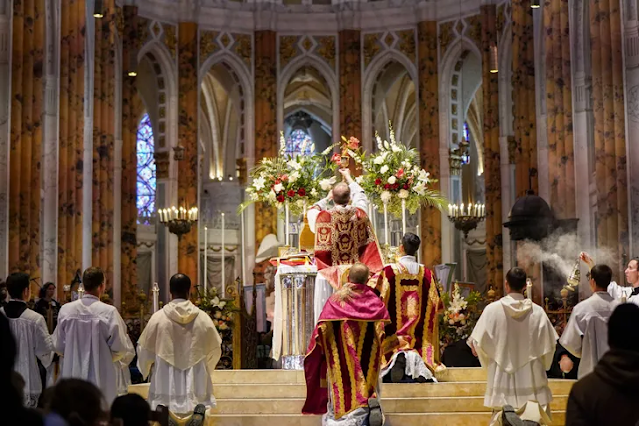
TLM strength yet again recognized by New York Times

It is always encouraging to see mainstream media observe the beauty and vibrancy of the traditional Latin Mass and its communities.  The New York Times, which has previously cited the strength of the traditional Latin Mass in France, has done so again, this time within an observation that churches there are the only places to hear live music during coronavirus shutdowns:

Every Sunday, St.-Roch, known as the “church of artists,” celebrates a Tridentine Mass, the traditional Latin Mass that was standard until the introduction of services in vernacular languages in the late 1960s. The Tridentine Mass isn’t exactly audience friendly: For starters, the priests perform most of it while turned toward the altar, with their backs to the congregation.

Still, it has its aficionados. The crowd on the first Sunday of December was among the largest I’ve seen indoors since the start of the pandemic. At least 400 people filled St.-Roch, with limited social distancing and no enforcement of mask rules.

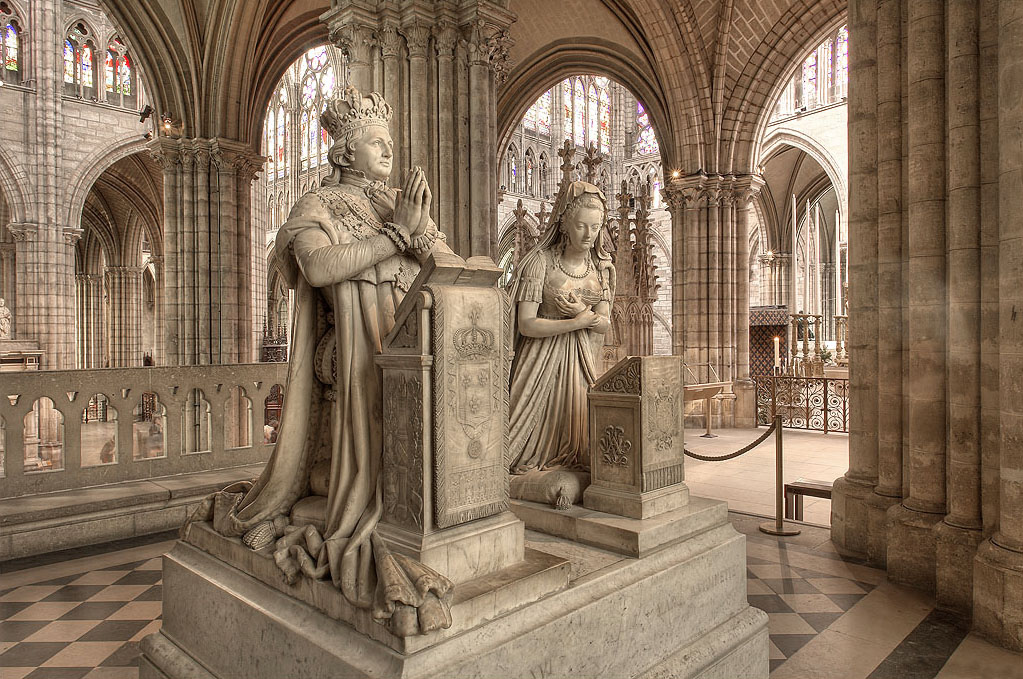
Notes for 2020 - Louis XVI, Saintly King, true Martyr: a Catholic going to death and His Last Will and Testament


Procession to eternity

On January 20, 1793, the National Convention condemned Louis XVI to death, his execution scheduled for the next day. Louis spent that evening saying goodbye to his wife and children. The following day, January 21, dawned cold and wet. Louis arose at five. At eight o'clock a guard of 1,200 horsemen arrived to escort the former king on a two-hour carriage ride to his place of execution. Accompanying Louis, at his invitation, was a priest, Henry Essex Edgeworth, an Englishman living in France. Edgeworth recorded the event and we join his narrative as he and the fated King enter the carriage to begin their journey:

"The King, finding himself seated in the carriage, where he could neither speak to me nor be spoken to without witness, kept a profound silence. I presented him with my breviary, the only book I had with me, and he seemed to accept it with pleasure: he appeared anxious that I should point out to him the psalms that were most suited to his situation, and he recited them attentively with me. The gendarmes, without speaking, seemed astonished and confounded at the tranquil piety of their monarch, to whom they doubtless never had before approached so near.


The procession lasted almost two hours; the streets were lined with citizens, all armed, some with pikes and some with guns, and the carriage was surrounded by a body of troops, formed of the most desperate people of Paris. As another precaution, they had placed before the horses a number of drums, intended to drown any noise or murmur in favour of the King; but how could they be heard? Nobody appeared either at the doors or windows, and in the street nothing was to be seen, but armed citizens - citizens, all rushing towards the commission of a crime, which perhaps they detested in their hearts.

The carriage proceeded thus in silence to the Place de Louis XV, and stopped in the middle of a large space that had been left round the scaffold: this space was surrounded with cannon, and beyond, an armed multitude extended as far as the eye could reach. As soon as the King perceived that the carriage stopped, he turned and whispered to me, 'We are arrived, if I mistake not.' My silence answered that we were. One of the guards came to open the carriage door, and the gendarmes would have jumped out, but the King stopped them, and leaning his arm on my knee, 'Gentlemen,' said he, with the tone of majesty, 'I recommend to you this good man; take care that after my death no insult be offered to him - I charge you to prevent it.'… As soon as the King had left the carriage, three guards surrounded him, and would have taken off his clothes, but he repulsed them with haughtiness- he undressed himself, untied his neckcloth, opened his shirt, and arranged it himself. The guards, whom the determined countenance of the King had for a moment disconcerted, seemed to recover their audacity. They surrounded him again, and would have seized his hands. 'What are you attempting?' said the King, drawing back his hands. 'To bind you,' answered the wretches. 'To bind me,' said the King, with an indignant air. 'No! I shall never consent to that: do what you have been ordered, but you shall never bind me. . .'

The path leading to the scaffold was extremely rough and difficult to pass; the King was obliged to lean on my arm, and from the slowness with which he proceeded, I feared for a moment that his courage might fail; but what was my astonishment, when arrived at the last step, I felt that he suddenly let go my arm, and I saw him cross with a firm foot the breadth of the whole scaffold; silence, by his look alone, fifteen or twenty drums that were placed opposite to me; and in a voice so loud, that it must have been heard it the Pont Tournant, I heard him pronounce distinctly these memorable words: 'I die innocent of all the crimes laid to my charge; I Pardon those who have occasioned my death; and I pray to God that the blood you are going to shed may never be visited on France.'

He was proceeding, when a man on horseback, in the national uniform, and with a ferocious cry, ordered the drums to beat. Many voices were at the same time heard encouraging the executioners. They seemed reanimated themselves, in seizing with violence the most virtuous of Kings, they dragged him under the axe of the guillotine, which with one stroke severed his head from his body. All this passed in a moment. The youngest of the guards, who seemed about eighteen, immediately seized the head, and showed it to the people as he walked round the scaffold; he accompanied this monstrous ceremony with the most atrocious and indecent gestures. At first an awful silence prevailed; at length some cries of 'Vive la Republique!' were heard. By degrees the voices multiplied and in less than ten minutes this cry, a thousand times repeated became the universal shout of the multitude, and every hat was in the air."

[References: Cronin, Vincent, Louis and Antoinete (1975); Edgeworth, Henry in Thompson, J.M., English Witnesses of the French Revolution (1938, Memoirs originally published 1815).]


***

LAST TESTAMENT OF LOUIS XVI

In the name of the Very holy Trinity, Father, Son and Holy Ghost.
Louis XVI, King, Martyr: a Catholic going to death and His Last Will and Testament


Procession to eternity

On January 20, 1793, the National Convention condemned Louis XVI to death, his execution scheduled for the next day. Louis spent that evening saying goodbye to his wife and children. The following day, January 21, dawned cold and wet. Louis arose at five. At eight o'clock a guard of 1,200 horsemen arrived to escort the former king on a two-hour carriage ride to his place of execution. Accompanying Louis, at his invitation, was a priest, Henry Essex Edgeworth, an Englishman living in France. Edgeworth recorded the event and we join his narrative as he and the fated King enter the carriage to begin their journey:

"The King, finding himself seated in the carriage, where he could neither speak to me nor be spoken to without witness, kept a profound silence. I presented him with my breviary, the only book I had with me, and he seemed to accept it with pleasure: he appeared anxious that I should point out to him the psalms that were most suited to his situation, and he recited them attentively with me. The gendarmes, without speaking, seemed astonished and confounded at the tranquil piety of their monarch, to whom they doubtless never had before approached so near.


The procession lasted almost two hours; the streets were lined with citizens, all armed, some with pikes and some with guns, and the carriage was surrounded by a body of troops, formed of the most desperate people of Paris. As another precaution, they had placed before the horses a number of drums, intended to drown any noise or murmur in favour of the King; but how could they be heard? Nobody appeared either at the doors or windows, and in the street nothing was to be seen, but armed citizens - citizens, all rushing towards the commission of a crime, which perhaps they detested in their hearts.

The carriage proceeded thus in silence to the Place de Louis XV, and stopped in the middle of a large space that had been left round the scaffold: this space was surrounded with cannon, and beyond, an armed multitude extended as far as the eye could reach. As soon as the King perceived that the carriage stopped, he turned and whispered to me, 'We are arrived, if I mistake not.' My silence answered that we were. One of the guards came to open the carriage door, and the gendarmes would have jumped out, but the King stopped them, and leaning his arm on my knee, 'Gentlemen,' said he, with the tone of majesty, 'I recommend to you this good man; take care that after my death no insult be offered to him - I charge you to prevent it.'… As soon as the King had left the carriage, three guards surrounded him, and would have taken off his clothes, but he repulsed them with haughtiness- he undressed himself, untied his neckcloth, opened his shirt, and arranged it himself. The guards, whom the determined countenance of the King had for a moment disconcerted, seemed to recover their audacity. They surrounded him again, and would have seized his hands. 'What are you attempting?' said the King, drawing back his hands. 'To bind you,' answered the wretches. 'To bind me,' said the King, with an indignant air. 'No! I shall never consent to that: do what you have been ordered, but you shall never bind me. . .'

The path leading to the scaffold was extremely rough and difficult to pass; the King was obliged to lean on my arm, and from the slowness with which he proceeded, I feared for a moment that his courage might fail; but what was my astonishment, when arrived at the last step, I felt that he suddenly let go my arm, and I saw him cross with a firm foot the breadth of the whole scaffold; silence, by his look alone, fifteen or twenty drums that were placed opposite to me; and in a voice so loud, that it must have been heard it the Pont Tournant, I heard him pronounce distinctly these memorable words: 'I die innocent of all the crimes laid to my charge; I Pardon those who have occasioned my death; and I pray to God that the blood you are going to shed may never be visited on France.'

He was proceeding, when a man on horseback, in the national uniform, and with a ferocious cry, ordered the drums to beat. Many voices were at the same time heard encouraging the executioners. They seemed reanimated themselves, in seizing with violence the most virtuous of Kings, they dragged him under the axe of the guillotine, which with one stroke severed his head from his body. All this passed in a moment. The youngest of the guards, who seemed about eighteen, immediately seized the head, and showed it to the people as he walked round the scaffold; he accompanied this monstrous ceremony with the most atrocious and indecent gestures. At first an awful silence prevailed; at length some cries of 'Vive la Republique!' were heard. By degrees the voices multiplied and in less than ten minutes this cry, a thousand times repeated became the universal shout of the multitude, and every hat was in the air."

[References: Cronin, Vincent, Louis and Antoinete (1975); Edgeworth, Henry in Thompson, J.M., English Witnesses of the French Revolution (1938, Memoirs originally published 1815).]


***

LAST TESTAMENT OF LOUIS XVI

In the name of the Very holy Trinity, Father, Son and Holy Ghost.

Deliver Thy Church, O Lord, from a flawed liturgy

Today (November 20) on the traditional Roman calendar is the feast of St. Felix of Valois (†1212). Who is this obscure saint, you might ask, and why is he cluttering our calendar? Would it not be fitting to cancel him out? And so, indeed, it was done in the 1969 Novus Ordo calendar: Felix evaporated into thin air, or rather, retreated to his page in the Martyrology where few souls remember him.