Rorate Caeli
Showing posts with label Traditional Catholic life. Show all posts

Published Article: Attendance of Traditional Latin Mass strongly correlated with Stronger Belief in the Real Presence in the Blessed Sacrament

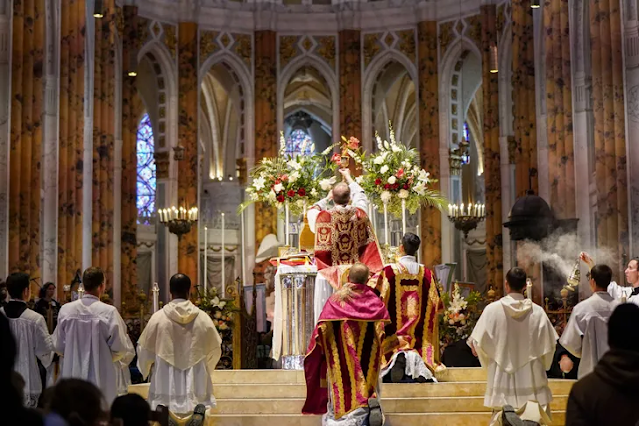
Pontifical Mass in the Cathedral Basilica of Sts. Peter and Paul, Philadelphia


It seems obvious to those of us attached to Traditional Catholicism, but Dr. Natalie Lindemann, at William Paterson University (Wayne, New Jersey), actually went to the trouble of conducting the social research to prove it and of publishing a detailed analysis of the results in the article "Liturgy Matters: Traditional Liturgical Practices Predict Belief in the Real Presence."


Interesting excerpt:

Gabon and Prague, Africa and Europe Brought Together by the Traditional Latin Mass -- by Rev. Stanislav Přibyl


Gabon in Prague

On Sunday, June 22, 2025, the Second Sunday after Pentecost, the Minister of Defense of the Republic of Gabon, Major General of the National Gendarmerie, Ms. Brigitte Onkanowa, attended Holy Mass in the Church of the Assumption of the Blessed Virgin Mary and St. Charlemagne the Emperor in Prague, commonly known to Praguers as Karlov. Since 2016, the church has been a diocesan rectory for celebrations in the traditional Roman rite. The minister was in our Republic on a business trip and expressly wanted to attend the traditional Latin “Tridentine” Mass on Sunday. It was clear that this was her personal preference, as the Catholic Church in her country attracts the faithful mainly because of its widespread celebration of traditional Masses. It turns out that Africans do not necessarily need liturgical dances to affirm their cultural identity, which are almost imposed on them by Europeans as something supposedly authentic that they should exhibit for us.

Traditional Liturgy: How many Faithful in France? And in the World? "Many of today's Catholics are 'Hidden Traditionalists,' waiting for a Mass worthy of the name."-- An Interview

By Paix Liturgique

October 4, 2023


Although we haven't published a review of traditional liturgy in France and around the world since 2019... we felt it necessary to return to the question of the number of Catholic faithful who wish to live their faith to the rhythm of traditional liturgy. We asked Christian Marquant, who has been interested in this subject for many years, to return to this theme which, as we shall see, remains a burning issue.

***

Louis Renaudin - Dear Christian, why is it important to ask the question of the size and therefore the number of the Catholic faithful who are attached to the traditional Roman liturgy?


Christian Marquant - In theory, it doesn't matter... no one, apart from learned researchers, is going to be interested in the number of Syro-Malabar or Syro-Malankar faithful... nor in the number of priests and faithful who still participate in the Ambrosian (reformed) rite in Milan, or the Mozarabic (cobbled-together) rite in Toledo and Salamanca, because in all these cases there is no controversy or underlying problem. However, when we consider the number, and therefore implicitly the importance, of those who wish to remain attached to the usus antiquior, i.e., to the Mass that has been the Mass of all Latin Christendom for over 1,000 years, we immediately find ourselves in a polemical field whose stakes are quite considerable for a large number of pastors and for members of the "modern" lobby. We are touching on the great division that has afflicted the Church since Vatican II, and to which the Holy Father indirectly alluded at the last consistory in his appeal for unity. A pathetic appeal to an almost empty St. Peter's Square...


Louis Renaudin - What division are you referring to?

Happy Thanksgiving: "Either you go to church because you’re nice or you go and it makes you nice but either way it’s good."

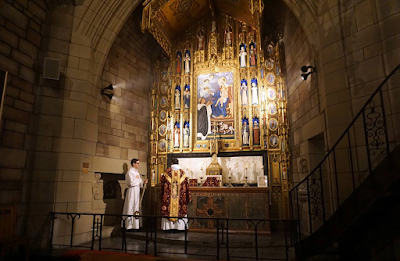
Traditional Mass at a side Rosary Altar, St. Vincent Ferrer* (New York City)


"Words of thanks to someone I knew well as a child:

"I had an old great-aunt. She was my grandfather’s sister. Her name was Mary Jane Byrne but we called her Jane Jane. When I first encountered her, in the 1950s, I was a little child and she was ancient—about 60.

"She lived in New York and went to a local parish, St. Vincent Ferrer. When I was little she told me it was the pennies of immigrants that made that great church. I asked why they did that. She said, 'To show love for God. And to show the Protestants we’re here, and we have real estate too.'
...

"If we were together on a Sunday, she [great-aunt Jane Jane] took me to Mass. I loved it. They had bells and candles and smoke and shadows and they sang. The church changed that a bit over the years, but we lost a lot when we lost the showbiz. Because, of course, it wasn’t only showbiz. To a child’s eyes, my eyes, it looked as if either you go to church because you’re nice or you go and it makes you nice but either way it’s good. 

The little boy whose existence is a threat to the new kind of Church desired by Francis

 A young boy. A symbol of a wide open future ahead of us.


In the Pontifical Mass celebrated in Philadelphia's Cathedral-Basilica of Sts. Peter and Paul on the Feast of the Assumption, a very small boy was photographed at the Communion Rail. His eyes are bright with expectation: he has certainly been taught enough about Our Lord Jesus Christ in the Blessed Sacrament.

MASS OF THE AGES - First episode of the documentary trilogy on the Traditional Mass

With a goal of reaching 10 million Catholics, an incredible new documentary on the traditional Latin Mass premiered on YouTube last night, and can now be watched any time with the entire family. 


Executive produced by Harrison Butker, one of the best (and current) NFL kickers who part times as a TLM server, Mass of the Ages exceeded expectations in both production and content. 


With the horrors of Traditionis Custodes closing in on many traditional Catholics around the world, the need to both educate, and inspire, as many Catholics as possible is critical and urgent. 


You may watch episode 1, below. 


To help fund the project and ensure they can market it to as many people as possible, CLICK HERE


Tired of Streaming Masses? An Alternative Option for How Families may worship in Spirit and in Truth in this time of Crisis.


One of the phenomena that has sprung up during the Covid-19 crisis is the “streamed” Mass.  Without going into technical details, all that is needed is a camera, even an iPhone will do, and software that allows the image and sound on the camera to be transmitted continuously for display on a computer or TV.  This is different from a “recorded” event that is stored as a whole and then can be watched at some time in the future.  In this way, a streamed Mass gives the impression that the viewer is in some sense “there” with the priest who is offering the Mass, because it is contemporaneous, or nearly so.  It is obvious why the practice of streaming Masses has become so widespread and popular during a time when the great majority of Catholic churches cannot celebrate public Masses because of the ban on groups of people congregating in the same place.  

A Catholic Survival Guide for the COVID-19 Coronavirus Pandemic, by Deacon Nick Donnelly (Part One)


by the Rev. Deacon Nick Donnelly

Christ healing the bleeding woman(Catacombs of Sts. Marcellinus and Peter, Rome)
Recourse to the sacraments is essential to the supernatural lives of Catholics. This is even more true during lifes crises, such as many face due to the COVID-19 coronavirus epidemic. This is why Archbishop Vigano is right when he describes the closure of churches in Northern Italy, and the suspension of public Mass and confession as, a real unprecedented tragedy.  For weeks now many Catholics living in China, Singapore, Hong Kong, Macau and Northern Italy have been unable to receive the Blessed Sacrament or the sacramental absolution of their sins. Not since the Protestant Reformation across Europe or the Communist persecution of the Church in Russia, Mexico and China, have so many Catholics been banned from the public celebration of the sacraments. Though this time churches have been closed to protect the physical wellbeing of Catholics, the drastic impact on the sacramental lives of the faithful cannot be exaggerated.

It is a frightening prospect to face the possibility of being denied the sacraments if instructed to self-isolate due to exposure to the COVID-19 coronavirus or being quarantined in hospital with life-threatening complications. It is highly unlikely that secular medical professionals will appreciate the stress suffered by Catholics unable to receive the pastoral care of our priests, especially the anxiety caused by the possibility of not being able to receive Extreme Unction at the hour of death. 

However, we can do much to reduce our own anxiety and stress if we find ourselves in such a situation by following two traditional devotional practices the Act of Perfect Contrition and Spiritual Communion. As Bishop Schneider observed in his recent Rorate Caeli essay on the coronavirus:

In times of persecution, many Catholics were unable to receive Holy Communion in a sacramental way for long periods of time, but they made a Spiritual Communion with much spiritual benefit.

Cardinal Johann Baptist Franzelin (1816-1885), the renowned Dogmatic theologian and Papal Theologian during the First Vatican Council, once admitted, If I were able to traverse the countryside preaching the divine word, my favourite sermon topic would be perfect contrition.

Now is the time to recover the wisdom and practice of these traditional devotions. Under certain conditions, they will enable us to receive the forgiveness of our sins, and the marvellous benefit of Eucharistic graces if for example due to self-isolation at home or quarantine in hospital we are denied the sacraments and the pastoral care of our clergy.

Trust that God wills to save all men

Op-Ed: Happy Birthday to Dog?

Paulus Potter, A farmer with his herd (1648) - Museumslandschaft Hessen Kassel

The days are getting warmer and, in a green square of a midsize town, tables are laid. A large cake, numerous snacks, "Happy Birthday to You" is sung enthusiastically -- and no child in sight.

There are sixteen adults and seven dogs.

It seems birthday parties for pets are quite common these days. It truly takes a suspension of reason to have it in such a grand form and in such a public setting. There is something inherently childish in almost every birthday party: children enjoy the small fantasy and playfulness of each of these events, it makes "sense" to them. It makes absolutely no sense to animals.

Yet, with no children around to partake of these festivities, the very absurdity of the situation is made manifest, though ignored by those present: this really is the new normal... Every month, there are growing signs that everywhere in the West children are disappearing, as pets are even more anthropomorphized by their owners than they already were.

It was not supposed to be like this.

Rorate interviews Evelyn Oliver, author of an imaginative and robustly Catholic novel

Can fiction serve faith? The Egyptian Guide: From Jihad to Joy

Rorate Caeli: Yours is a book in between two rivers, the Nile and the Thames. The plot takes us alternatively to contemporary Egypt and England. The literary pattern is transit, from one bank to the opposite one, and more generally from one river to the other. Behind the eventful itinerary of your main character, Clara, could the watermark (no pun intended) be the Book of Exodus, when the Chosen People leaves the Nile and the Red Sea behind, making their (tortuous) way towards the River Jordan? 

Evelyn Oliver: I wish London were the Promised Land! But yes, the book is about journeying from sin to grace. I didn’t intend the two rivers as a literary pattern though. I was born near one and raised near another: it must have influenced me. In retrospect however, I admit that the Nile and the Thames offer a variation on the theme of crossing. Each river is an axis along which the story takes Clara successively to a busy capital city (Cairo and London), a haven (Osly in Sudan, by a ford, and Henley-on-Thames, near a lock) and a martyr’s shrine (Alexandria and Marlow). 

Around 4,500-5,000 Priests Currently Celebrate the Traditional Mass Around the World


The number is an estimation, of course, made by Christian Marquant for the French liturgical association "Paix liturgique".

This number is reached with the following subgroups.

(1) Around 760 priests who belong to the Society of Saint Pius X (SSPX) and religious communities friendly to it.

(2) Around 600 priests from those communities previously called "Ecclesia Dei" (that is, those established regularly following the motu proprio Ecclesia Dei).

(3) Around 130 priests from religious communities that were never under the authority of the now-defunct "Pontifical Commission Ecclesia Dei" (for instance, the priests belonging to Fontgombault and its daughter-houses, or Norcia, etc).

(4) At least 3,000 diocesan priests (maybe up to 5,000, if one includes those who are very cautious because of their local bishops) who celebrate it regularly, even if not exclusively, including 1,000 at least in the United States: this is the Summorum Pontificum group, by far the largest.

Marquant adds: "Our 4,500 priests attached to the Traditional Mass (1500 "Trad" priests to which are added 3,000 diocesan or regular priests) represent at least 1.1% of the global Catholic clergy (or more, if we consider only the Latin Church priests, since it is a Latin liturgy, and if we would consider only active priests) who have remained or become Tridentine, which is far from being a ridiculous number if we consider that this identity was forbidden for a long time and remains widely persecuted. And, despite this, it is growing..."


(Paix Liturgique, via Le Salon Beige)

Event: Dr. Kwasniewski's Upcoming Lectures in Minneapolis, January 9 & 10

Next week, on Wednesday and Thursday, I will be in Minneapolis giving talks, as follows.

Time for Worldwide Sacrifice: Ember Week in September

The equinox is coming. The Roman Church will once again remind us of the cycle of the seasons in this Ember Week in September.

We re-post, for those who are not aware of it, this article first posted by us in 2008, and reposted often since. May you all have a fruitful week of sacrifice.

___________________________________________________________


THE GLOW
OF THE EMBER DAYS
By Michael P. Foley


A potential danger of traditionalism is the stubborn defense of something about which one knows little. I once asked a priest who had just finished beautifully celebrating an Ember Saturday Mass about the meaning of the Ember days. He replied (with an impish twinkle in his eye) that he hadn’t a clue, but he was furious they had been suppressed.

Traditionalists, however, are not entirely to blame for their unfamiliarity with this important part of their patrimony. Most only have the privilege of assisting at a Sunday Tridentine Mass, and hence the Ember days—which occur on a weekday or Saturday—slip by unnoticed. And long before the opening session of the Second Vatican Council, the popularity of these observances had atrophied.

So why care about them now? To answer this question, we must first determine what they are.


The Four Seasons

The Ember days, which fall on a Wednesday, Friday, and Saturday of the same week, occur in conjunction with the four natural seasons of the year. Autumn brings the September Embertide, also called the Michaelmas Embertide because of their proximity to the Feast of St. Michael on September 29.1 Winter, on the other hand, brings the December Embertide during the third week of Advent, and spring brings the Lenten Embertide after the first Sunday of Lent. Finally, summer heralds the Whitsun Embertide, which takes place within the Octave of Pentecost.

In the 1962 Missal the Ember days are ranked as ferias of the second class, weekdays of special importance that even supersede certain saints’ feasts. Each day has its own proper Mass, all of which are quite old. One proof of their antiquity is that they are one of the few days in the Gregorian rite (as the ’62 Missal is now being called) which has as many as five lessons from the Old Testament in addition to the Epistle reading, an ancient arrangement indeed.

Fasting and partial abstinence during the Ember days were also enjoined on the faithful from time immemorial until the 1960s. It is the association of fasting and penance with the Embertides that led some to think that their peculiar name has something to do with smoldering ash, or embers. But the English name is probably derived from their Latin title, the Quatuor Tempora or “Four Seasons.”2

Aldo Maria Valli and The Faith Evaluation Service

I’m in church. I  start reciting the Rosary in Latin and a man approaches me.
He says:
-          If I were you I’d steer clear of that.
Looking at him, I ask:

Quid est Veritas?

 Section on Catechesis 
Radio Roma Libera

Catechesi

Quid est Veritas? What is Truth? The question, addressed to Our Lord Jesus Christ by the Procurator Pontius Pilate in the praetorium of Jerusalem, resounds down through the centuries and calls every man to come out of himself and question the nature of Reality, on that which is the proper object of his intelligence and of the very reason for his existence.

Saint John Fisher, pray for us - "I die for the Faith of the Holy Catholic Church"


After the lieutenant of the Tower had received the writ for his execution, because it was then very late, and the prisoner asleep, he was loath to dis-ease him from his rest. But in the morning, before five of the clock, he came to him in his chamber, in the Bell-tower, finding him yet asleep in his bed, and waking him, told him, he was come to him on a message from the king, to signify unto him, that his pleasure was he should suffer death that forenoon. "Well," quoth the bishop, "if this be your errand, you bring me no great news; for I have looked a long time for this message, and I must humbly thank his Majesty, that it pleaseth him to rid me from all this worldly business. Yet let me by your patience sleep an hour or two; for I have slept very ill this night, not for any fear of death, I thank God, but by reason of my great infirmity and weakness."

Lent is coming: Time to prepare
Printable Lent worksheet

Lent is coming and it's now that we should be preparing.

Today, we once again post the worksheet below, which was made years ago for us to use by a wonderful traditional priest (click for larger view and printing). It's a good tool to make our plans, to refer to throughout Lent and to evaluate our progress when Lent ends.

Planning for Lent should be no different than planning for other things in life: Plan, prepare, execute and evaluate. Today we give you a tool to use. Tomorrow, we'll give you some inspiration. 

The spirit of the liturgy in the words and actions of Our Lady

On Saturday, November 12, I delivered the plenary address at the Annual General Meeting of the Vancouver Traditional Mass Society/Una Voce Canada. The event was located at Holy Family Parish, an apostolate of the Fraternity of St. Peter. The text of my lecture is reproduced in full below, with notes at the end. All paintings are by James Tissot (1836-1902). Those who would like to listen to the audio (including Q&A) will find it here.

The Spirit of the Liturgy in the Words and Actions of Our Lady


Peter A. Kwasniewski 

Reverend Fathers and friends in Christ: I thank all of you for coming this evening to hear my lecture, which I dedicate to Our Lady of Victories and to our saint of today, Pope St. Martin I. Rather than compromise one bit with error (as Pope Honorius had shamefully done about 15 years earlier), St. Martin energetically opposed the Monothelite heresy, on account of which he was abducted by command of the Byzantine emperor, exiled, imprisoned, and banished. Having died of exhaustion, he is revered as a martyr by both Roman Catholics and the Eastern Orthodox. He exemplifies how a pope is supposed to behave towards heresies, regardless of threats or punishments from the mighty of this world.

"Reverence Is Not Enough: On the Importance of Tradition" -- Dr. Kwasniewski's Lecture at Strahov Abbey in Prague

In the evening of Friday, October 14, 2016, the official launch of the Czech translation of my book Resurgent in the Midst of Crisis: Sacred Liturgy, the Traditional Latin Mass, and Renewal in the Church was held at historic Strahov Abbey in Prague. His Eminence Raymond Leo Cardinal Burke gave an introduction in which he spoke of the importance of the sacred liturgy in his own life, his experience of the painful years of liturgical reform and experimentation, and his joy that Catholic tradition is being rediscovered today by young people. He then spoke about the book, recommending it to the audience of about 130 people, including journalists and a national Catholic TV station, gathered in the winter refectory of the abbey. Sitting at the same table were the book's Czech translator, Fr. Štěpán Smolen, and one of the members of the publishing team, Mr. Andrej Kutarna, who also translated the lecture below into Czech.

The text of the lecture is reproduced in full.

Catholic Bible Online: The Douay-Rheims, Knox and Clementine Vulgate in one website

(Originally posted on March 1, 12:04 PM)


Baronius Press has just launched a new website: www.CatholicBible.Online, with the full texts of the Clementina Vulgata, the Douay-Rheims Bible (Challoner revision, 1899 printing) and the Knox Bible

Each of these three Bibles can be viewed separately under their respective tabs, or side by side: