Rorate Caeli
Showing posts with label TLM in Asia. Show all posts

Events: Traditional Latin Masses during the 51st International Eucharistic Congress in Cebu, Philippines
Update - Pictures of Cardinal Zen's Mass, additional TLM included

UPDATE (1/26/16):

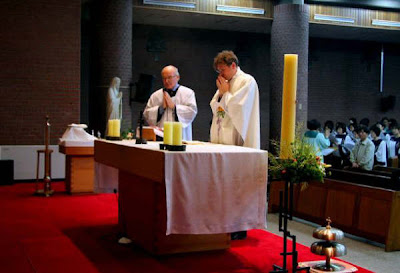
Friends from the Philippines have sent us the following pictures of the Traditional Latin Masses on January 25 and 26, and even the surprise announcement today at the International Eucharistic Congress, of Cardinal Zen's Mass.

1. Invitation to IEC delegates to attend the TLM of Cardinal Zen.

Resource: 1962 Vietnamese-Latin Missal made available online

A reader sends along the following project, which may be of use to readers in Vietnam, as well as to the Vietnamese living overseas, as well as liturgical scholars:

(September 8 - Nativity of the Virgin)
I have recently come across a Vietnamese-Latin missal from 1962 and have begun scanning it and making it available online.

In Pictures: Solemn Pontifical Mass in the Philippines

The official blog of the Societas Ecclesia Dei Sancti Joseph has published photographs of the Solemn Pontifical Mass celebrated today by the Archbishop of Cebu and the President of the Catholic Bishops' Conference of the Philippines, Msgr. Jose Palma D.D. (Rorate announced this Mass a few days ago.)


TLM News from Asia - II. President of Philippine Bishops' Conference to offer Solemn Pontifical Mass


Msgr. Palma is the Archbishop of Cebu, one of the Philippines' two "red-hat" sees. (The red hat of Cebu is currently held by Ricardo Cardinal Vidal, who turned 80 last year).

This Mass will be according to the 1962 Missal.

You report: A priest of the Institute of Christ the King visits the Philippines

Mass in the Baptistry of the Immaculate Conception Cathedral of the Diocese of Pasig, Metro Manila, Philippines. Feb. 6, 2012

The blog Veritatem facientes in caritate has a comprehensive report (many photographs and the full videos of three TLMs) of last month's visit by Canon Jean Marie Moreau to some of the Traditional Catholic communities of the Philippines: Canon Moreau's first visit to the Philippines: February 6-12, 2012. The climax of the visit was a Solemn Mass in the Holy Family Parish in the Diocese of Cubao

The Traditional Latin Mass has a small but gradually growing presence in the Philippines, with regularly-scheduled every-Sunday TLMs in 14 locations in 11 of its 86 dioceses (not counting those of the SSPX). Before Summorum Pontificum, there were only 3-4 such locations in 3 dioceses. 

You report: First TLM in Jogjakarta (Yogyakarta), Indonesia


The following report was submitted by Shevyn Andreas from the fledgling TLM community in Indonesia.

The first Mass in usus antiquior was celebrated at Jogjakarta in the Archdiocese of Semarang, Indonesia, on the Commemoration of the Seven Holy Founders of the Servite Order (Saturday, February 12th 2011).

It was Low Mass (Missa Lecta) celebrated by Fr. BA. Rukiyanto SJ at Hospital Chapel, in Panti Rapih Hospital in downtown Jogjakarta...

The Mass was attended by approximately 60 people, including several nuns.

Developments in the Philippines

1) Holy Mass according to the Missal of 1962 is now celebrated every day (Mon-Fri at 9 A.M., Sat-Sun at 4 P.M.) at St. Maximilian M. Seminary (22 John Paul St., Multinational Village, 1700 Paranaque City, Metro Manila). The celebrant is Fr. Elijah M. Pantorilla OFMConv. The seminary, which is the "post-novitiate" house of the Conventual Franciscans in the Philippines, is within the Diocese of Paranaque. (At left: Mass in St. Maximilian M. Seminary on January 15, 2011.)

With the addition of this Mass-site, Metropolitan Manila (246.5 sq.m, 638.55 sq.km) now has four locations where the TLM is publicly celebrated on a daily basis. Of these four, three are under diocesan auspices (one each in the Dioceses of Novaliches, Cubao and Paranaque) plus the SSPX priory in New Manila (in the territory of the Diocese of Cubao).

You Report: Monthly TLM in South Korea

From regular Rorate Caeli reader Mr. Peter Kim:

Dear friends,

Confraternity of Traditional Latin Liturgy announced that the confraternity will offer monthly Traditional Latin Mass. After the first TLM celebrated with members of the confraternity last month (October 31, 2010, see this -- CAP), two priests graciously suggested more frequent offering of the old rite in Korea. They are Korean fathers who had opportunity to learn how to say Extraordinary Form of Mass during their ministry abroad.

The next EF Mass according to Missale Romanum 1962 and the article 5 of Summorum Pontificum will be offered at Wonhyoro Catholic Church (previous Yongsan seminary) at 4:30 pm on Sunday, Dec. 5th (2nd week of Advent), 2010. The Wonhyoro Catholic Church, built in early 20th century by French missionary (MEP), retain its beautiful traditional altar and architecture. Robert Koehler, a professional photographer in Korea, reported about the history of the church with pictures: Wonhyoro Catholic Church and Yongsan Seminary. (See below.) The church has been managed by sisters of Society of Sacred Heart since 1956; the church is located in the campus of Songsim (Sacred Heart) Girl's High School. Here is a direction to the school.


Mass attendants are suggested to donate 5,000 won (about 4 dollars) to the confraternity for the cost of heating and renting the church. The confraternity is also seeking for cantors/chanters and organists for the old rite. The confraternity provides Gregorian chant workshops for free.

Philippine Update


First Sunday of Advent 2009, Chapel-Shrine of Our Lady of Atonement, Baguio Cathedral Compound


Bishop Angel Hobayan offers a "private" Low Mass, July 2009.

(This report is intended to be the first in a series on the state of the Traditional Latin Mass in various countries throughout the world. CAP)

In the Philippines, there are currently 9 locations (1 parish church, 1 chapel within a cathedral compound, and 7 other chapels) in 7 dioceses where the Usus Antiquior is available to the faithful on an every-Sunday basis, and under diocesan auspices. These are listed (along with weekday and monthly Masses) in an article that I’ve written for the website of the Ecclesia Dei Society of St. Joseph.


The current situation is a major improvement over the status quo of July 2007, when there were only three “indult” locations in the entire Philippines with an every-Sunday Mass that was open to the public. Filipino traditionalists are certainly thankful for the more than 300% jump in the number of Traditional Latin Masses. In particular, the openness of the diocesan authorities of Cebu and Baguio (in the former, the chairman of the archdiocesan "worship commission" offers the TLM every Sunday, while the latter is the only Filipino diocese that has promoted the TLM at its own initiative) is notable, and there is talk of establishing a personal parish for the traditional faithful in the Diocese of Cubao (but the congregation of traditionalists there has to first buy the land for the parish). Nevertheless, the situation could be a lot better – and that is an understatement!


In July 2008 there had been eleven (or twelve) locations (4 parish churches, one chapel within a parish compound, and 6 or 7 chapels) in 10 dioceses where every-Sunday Traditional Latin Masses under diocesan auspices were available to the faithful. Most of these had been listed in an article that I published on this very blog.

As much of the Traditionalist Catholic world now knows, the Archdiocese of Manila released one of the world’s most restrictive directives regarding the “implementation” of Summorum Pontificum. The hostility and ignorance manifested in the guidelines were not surprising; back in 2005, Gaudencio Cardinal Rosales had refused to legalize a TLM that was being celebrated in the city of Manila every Sunday by a South Korean priest, claiming that “Quattuor abhinc annos” (no mention of Ecclesia Dei!) required Traditional Catholics to “celebrate” the Novus Ordo (!) In 2006, the Korean priest went back to his homeland; a fresh request to the Arzobispado for an indult Mass was summarily refused.


The “Manila Guidelines”, dated December 8, 2008, were released early in January 2009 and had been drafted in response to continuing requests by at least two groups for the regular celebration of the Traditional Latin Mass. After a sustained uproar in the blogosphere, a formal statement from FIUV, and a reported intervention from Dario Cardinal Castrillon-Hoyos himself, the “Guidelines” were removed from the official website of the Archdiocese of Manila. Nevertheless, Summorum Pontificum has not been implemented in Manila, despite the presence of not a few faithful who have asked for the Mass. Even the monthly weekday TLM in the cathedral that was proposed by the Manila Guidelines has not materialized. (There is a First Friday TLM in a small private chapel in Manila, celebrated by the octogenarian former rector of Manila Cathedral, Msgr. Melencio De Vera.)


(Rorate's coverage of the Manila Guidelines can be found here.)


At present, the 9 locations for Sunday TLM seem stable and under no threat, and as the Franciscan Friars of the Immaculate in the Philippines move towards the more frequent celebration of the Mass of Ages not just for weekdays but for Sundays as well, it is to be hoped that the number of regular Sunday TLM’s will significantly increase once again in the coming years. (The FFI has houses in four archdioceses and two dioceses; of these six, three have no every-Sunday Traditional Latin Mass either under diocesan auspices or the SSPX.)


The liturgical establishment of the Philippines remains wedded to the theories of the 1960’s and 1970’s, and even the faintest signs of the “Benedictine liturgical renewal” are absent from more than a tiny number of chapels and parishes. That crowds of faithful who have no knowledge of the Traditional Mass can be attracted to it merely by hearing about it or by seeing it celebrated once or twice has been proven time and again (especially in the now-suppressed Traditional Latin Masses of the Archdiocese of Manila and the Diocese of Paranaque, both of which attracted sizeable crowds), but this seems to have no effect on the attitude of not a few ecclesiastics.


Nevertheless, there is hope that the attitude of the liturgical establishment will become more positive. One sign of hope is the strong support for the TLM given by Fr. Timoteo Ofrasio S.J., professor of liturgy in the Jesuit Loyola School of Theology, (the country's most prominent theological academy), a former member of the "old" ICEL and once a strong proponent of inculturation and liturgical experimentation. He has spoken of the prayerfulness of the older form of Mass, which he now celebrates daily from Monday to Friday.


Meanwhile, the SSPX continues to maintain a stable presence. A list of SSPX Masses can be found here and here.


(I would like to acknowledge Paix Liturgique, which published its own update on the situation of the TLM in the Philippines in November, based upon an earlier version of this article that I had privately circulated.)

Philippine diocese promotes the TLM


The Diocese of Baguio in the northern Philippines, on its own initiative, has published a leaflet introducing the Catholic faithful to the Traditional Latin Mass. Please click on the above pictures to read.


The leaflet was written by Fr. Andrew Cosalan, the Vicar General of the Diocese, who is also the initiator and celebrant of the two every-Sunday TLMs in the Our Lady of the Atonement Cathedral of Baguio. (I met Fr. Cosalan last year, he is a very orthodox priest who truly loves the Church and who is a supporter of Catholic apologetics and of Summorum Pontificum)


The leaflet is not perfect, and some things in it need correction, but overall it is much more positive than most of the diocesan material on the Traditional Latin Mass that I have read. It will hopefully go a long way towards introducing the Filipino Catholic faithful to their liturgical and theological patrimony. Baguio is one of the very few dioceses in the world, and the only one in the Philippines, to have gone out of its way to publish an introductory leaflet on the TLM for the benefit of the local faithful.

Thank you, Bishop Carlito Cenzon! And thank you, Fr. Cosalan!


H/t for images: Pro Deo et Patria

Usus Antiquior News from the Philippines

1. TLM update in Metropolitan Manila:
The Traditional Latin Mass will be celebrated (for the meantime) every Sunday, 9:30 AM, in the crypt chapel of the National Shrine of St. Therese of the Child Jesus, located in Villamor Air Base in Pasay City, Metro Manila, Philippines. The crypt chapel ("La Chapelle des Roses") is in the midst of the columbarium (sometimes called the "catacombs") located under the massive main Church. Pasay City is the territory of the Archdiocese of Manila, but the air base is under the Military Ordinariate of the Philippines.
This is one of only two publicly-accessible every-Sunday Traditional Latin Masses under diocesan auspices located in the entire Greater Manila Area (comprising Metropolitan Manila and the surrounding provinces, with a Catholic population of about 16 million, not including several million transients). The other Mass is the TLM offered every Sunday, 1:30 P.M at the Parish of the Lord of Divine Mercy in Sikatuna, Quezon City, Metro Manila (under the Diocese of Cubao). The PLDM parish also has a daily TLM, at 8:00 in the morning. You may read more about the traditionalist community in this parish here and here. (There are also some private weekday TLM's in Quezon City, but these are not fully open to the public.)
In comparison, last July 2008 there were four every-Sunday TLM's in Metro Manila, all located in easily-accessible parish churches. Today there are but two -- one in a parish, and another in this crypt chapel. All other every-Sunday TLM's once offered in parish churches in Metro Manila -- including the two Masses that had the largest congregations -- have ceased to be offered, due either to official hostility or to the lack of clergy who could offer the Mass of Ages. This is the worst time for the TLM in Metro Manila since the promulgation of Summorum Pontificum.
There is also the SSPX priory church of Our Lady of Victories in Cubao, Quezon City (a few minutes walk from the Immaculate Conception Cathedral of Cubao), with two Masses every day and every Sunday.

2. Summorum Pontificum Anniversary celebrated with a TLM in the Cathedral of Cebu:

Last July 7, 2009, in honor of the second anniversary of the Apostolic Letter Summorum Pontificum, Mass according to the Usus Antiquior was offered in the Metropolitan Cathedral of the Archdiocese of Cebu at 1:30p.m. The Holy Sacrifice was offered by Msgr. Cristobal Garcia, the chairman of the Archdiocesan Commission on Worship. Msgr. Garcia also offers the TLM in the Archdiocesan Shrine of Nuestro Padre Jesus Nazareno (Monastery of the Society of the Angel of Peace), every Sunday at 3:00 PM in Cansojong, Talisay City, Archdiocese of Cebu.
The Archbishop of Cebu is Ricardo Cardinal Vidal, now 78 years old but still reigning. This Archdiocese (with a Catholic population of about 2.5 million) is one of the most friendly in the Philippines to the TLM, and currently has two every-Sunday TLM's plus the FFI church which offers the TLM on three weekdays.
The SSPX has a Mass every 2nd and 4th Sunday in the city of Mandaue.

Traditional Holy Week in the Philippines

My friend Gerald Cenir has -- finally! -- put up the pictures from the Holy Week ceremonies in the Parish of the Lord of Divine Mercy in the Diocese of Cubao, Metro Manila. This is one of only two Filipino parishes that are under diocesan auspices where Mass is said daily according to the 1962 Missal.

Holy Week in PLDM

For the second year running, all the main celebrations of Palm Sunday and the Sacred Triduum were held according to the 1962 Missal. Do note the huge reddish purple curtain covering the entire altarpiece. The "un-nailing" of the corpus from the cross was performed during the Good Friday devotions preceding the liturgical action of the afternoon; unfortunately it was not photographed.

Please look carefully at the pictures and see the large, overflow crowds that attended the ceremonies. Many of these people traveled for hours from the provinces or from more distant parts of Metropolitan Manila just to attend the ceremonies. Who said that Filipinos -- and Asians in general -- can't relate to the Traditional Latin Mass?

You report: First parish TLM in South Korea in 40 years and a conference with Martin Mosebach


From a Korean Catholic youth (who prefers to remain anonymous) comes the following report about the first-ever TLM in a parish setting in South Korea. The Mass was offered last May 13, 2009, at 7 pm, in the Yongsan church, followed by a conference with famous German Catholic author Martin Mosebach (author of "The Heresy of Formlessness"). Fr. Michael Bauer, parish priest of the German Catholic parish in Shanghai, offered the Mass, with Mr. Mosebach himself as server.

Keep in mind that this is the FIRST TLM under South Korean diocesan auspices in forty years. Please exercise restraint in your comments. In case anyone is wondering, there is a crucifix at the center of the altar (although it is too small and dark to be easily seen in the pictures) and the number of candles (four) is just right for a Missa Cantata.

The report has been edited for this post:

Usus Antiquior Mass was celebrated by Fr. Michael Bauer in Seoul, Korea immediately followed by a conference with Martin Mosebach, the writer of “The Heresy of Formlessness”. The Goethe Institute sponsored this event and Yong-San Catholic Church provided the place for the liturgy. About 200 Catholics attended the first parish-setting EF Mass in South Korea. Most of them have never experienced the Traditional Latin Mass after the liturgical reform, since there has been no indult TLM for almost 40 years.

Most of the people, except Mr. Mosebach, looked new to the liturgy; Fr. Bauer himself is still learning the old liturgy. The choir of Yong-San Catholic Church sang for the Mass. The music setting was Missa de Angelis but Latin hymns were sung instead of chant propers. So it was a mixture of low mass and Missa Cantata. (Very understandable for a first-time TLM – CAP)

Even though the Mass setting was not satisfactory, most of the attendees said they experienced a reverent liturgy. Many of them expressed the wish that the Catholic Church in Korea could provide the EF Mass in at least one parish per diocese. They said the best part of the EF Mass was communion on the tongue whie kneeling – this has become quite rare in Korea, and many TLM attendees were touched by the reverence of this way of receiving communion.

In Seoul Archdiocese, Catholics do not kneel during the consecration, due to the excuse that churches are overcrowded during Sundays. Most of the parishes in Seoul Archdiocese have removed kneelers and it is rare to see people kneeling even during weekday Masses, when there are no crowds. Also, the Catholic Church in Korea has advised Catholics to take communion in the hand, since there have been followers of unapproved apparitions, who adhere only to communion on the tongue or with kneeling. Pastors usually use communion as a litmus test to tell apart those people, which resulted in the practical suppression of communion on the tongue or with kneeling.

After the Mass, there was a conference and Q & A session with Mr. Mosebach. The lack of interest from the Catholic Church in Korea can be seen in the fact that there was not a single Korean Catholic media report or any welcoming statement from Korean bishops or clergy on this first TLM after liturgical reform. Hopefully, the Korean Catholic clergy will listen to the vox populi and the voice of Benedict XVI.

Yours in Christ and our Lady the Coredemptrix,

XXX.
ADDENDUM: Mr. Mosebach's "The Heresy of Formlessness" was translated into Korean in 2007, with the title being translated as "Liberalism of Formlessness".

UPDATE: A clip of the Mass can now be viewed here.

Southeast Asian Updates

Our Lady of the Atonement Cathedral, Diocese of Baguio, Philippines

PHILIPPINES

1) The Our Lady of the Atonement Cathedral of the Diocese of Baguio, northern Philippines, now has a regular Mass according to the Missal of 1962. It is offered every Sunday, 7:30 AM, in the cathedral’s baptistery. Should the numbers of attendees grow the Mass will be moved to a larger location. This makes Baguio Cathedral the only cathedral in all of Asia to have a regular Mass according to the 1962 Missal. (UPDATE: There is a second TLM every Sunday, at about 3:30 P.M., also in the baptistery.)
It is my understanding that this Mass was instituted at the initiative of the Bishop of Baguio, Carlito Cenzon CICM, and his Vicar General Msgr. Andrew Cosalan, who is also its regular celebrant.
Baguio, nestled amidst pines in the Cordillera mountains and located about 250 km north of Manila, is the summer capital of the Philippines. In addition to the every-Sunday TLM in Baguio cathedral, there is a monthly Sunday Mass in La Trinidad, a town located north of Baguio City, under the auspices of the SSPX.


2) In the Archdiocese of Cebu, the FFI's Church of Mary Coredemptrix (San Jose, Talamban, Cebu) now has the TLM thrice a week, every Monday, Wednesday and Saturday at 6:30 A.M. This is in addition to the every-Sunday TLM's offered in two monasteries (one Discalced Augustinian, another belonging to a local monastic congregation) within the same archdiocese.

Unlike Cardinal Rosales of Manila, the Cardinal-Archbishop of Cebu, Ricardo Vidal, has wholeheartedly embraced Summorum Pontificum, and has himself offered Low Mass according to the 1962 Missal on occasion. Pictures of the Mass can be found here. (H/t to our friend from Ecce ego, quia vocasti me)

***


I hope to be able to update last year's listing of TLM's under diocesan auspices in the Philippines very soon. The reason for my difficulty in completing the updating is this: the Church in the Philippines lags far behind the Church in Western and even some other Asian countries when it comes to using the Internet. I often have more difficulty confirming or extracting information from Philippine provinces (or even from my very own diocese!) and from the scattered traditionalist faithful in the Philippines, than from contacts and sources in the USA or Europe. Furthermore, some of the priests and faithful attached to the 1962 Missal are still wary of misunderstandings from the local clergy, and are reluctant to publicize their Masses and other activities.


SINGAPORE


The Singaporean Traditionalist blog Extraordinary from Singapore is reporting that there will be a Missa Cantata according to the 1962 Missal on Trinity Sunday, June 7, 2009, 4:00 - 5:30 P.M. at St. Patrick's School Chapel. There is currently no regular TLM under diocesan auspices in Singapore; let us pray and hope that the traditional faithful in the city-state will soon taste the full benefits of Summorum Pontificum.


(ADDENDUM: It should be noted that there is an SSPX priory in Singapore, with two Masses every Sunday and daily Mass for the rest of the week.)

TLM Update from India

We have received the following update on the TLM situation in India. The author of this piece has long involvement in the Traditionalist movement in India, but has requested not to be named for fear of reprisals from Church authorities. Out of respect for the author of the piece, I have not edited or deleted anything in his message.
Aside from the SSPX Masses, it seems that there are no regular Sunday TLM's in India under diocesan auspices, and only two monthly Masses.
The Catholic Church in India has Asia's largest Catholic hierarchy and, with nearly 17,000 seminarians, has more seminarians than any other country in the world (indeed, more than the entire North American continent). Unfortunately, the traditional Roman liturgy has been all but obliterated in this vast and growing Church. Given the future importance of the Church in Asia to the Catholic Church as a whole, this is a terrible deficiency that needs to be repaired urgently.
In the Archdiocese of Bombay the Indult Mass has been celebrated at Our Lady of Victory Church, Mahim, Bombay, on the first Sunday of the month since January 2001. Initially done by a very senior priest who was ordained in 1956, he had forgotten how to celebrate it and made quite a mess of it. For around a year the Mass was celebrated by pre-1969 priests but thereafter it has been celebrated mostly by a post-1969 priest. Attendance in the begining was 250 but it has reportedly dwindled to around 50. A seminarian who was attending it (and was also promoting the Holy Rosary with a small group in the Bombay Seminary) was victimised by the Archbishop (Cardinal Ivan Dias, now at the Curia), called a Lefebvrist, and his ordination was therefore delayed in 2002 by 3 years during which period he was to have been indoctrinated by a modernist Jesuit. He and 3 others, who had put in 9, 8, 7 and 6 years of study at the Bombay seminary, defected to the SSPX but were told by the SSPX in Australia that as their studies in Bombay was unsuitable for the Catholic priesthood they would have to study 6 years more (to the very same studies which used to be imparted in the Bombay Seminary befire Vatican II). Three of them quit Holy Cross Seminary, Australia, unceremously end 2005/ early 2006 and returned to India after having received assurances from the same archbishop that they would be well-received but they have not been ordained by the Archdiocese of Bombay as yet and have been under observation in three different churches; one of the three reportedly has quit altogether and has gone back to his mother. The fourth in Australia, youngest of the group, was ordained a SSPX priest there on December 27, 2008. Meanwhile Cardinal Dias was moved to Rome in June 2006 and the present Archbishop of Bombay from October 2006 is Cardinal Oswald Gracias.

Testimonies of 3 of the 4 Bombay seminarians who had defected to the SSPX, on the
modernistic teachings imparted by the Novus Ordo Bombay Seminary, were hosted on the SSPX Asia website in 2003/2004 and may be accessed at:

http://www.sspxasia.com/Newsletters/2004/Jan-Jun/Indian_Seminaries.htm
http://www.sspxasia.com/Newsletters/2003/Jul-Dec/Hinduism_at_a_Glance.htm
http://www.sspxasia.com/Newsletters/2003/Jul-Dec/Scandalous_Ecumenism_with_Hinduism.htm

From January 2008 the Motu Proprio Mass, requested by a group of laypersons, is being offered in th Jesuit-run St. Peter's Church, Bandra, in the church loft by a pre-1969 priest, first a 82 year-old priest in the Clergy Home and thereafter by a Spanish Jesuit, also ordained before 1969. Attendance at the start was around 70.The Mass is only on the third Sunday of every month
In Bombay - Bassein the SSPX has 3 Mass locations.

In Goa there was a petition signed by more than 100 persons for the Indult Mass about 12 years ago but the Archbishop referred it to the Archdiocesan Pastoral Council and the Priests Council and both bodies vetoed it.