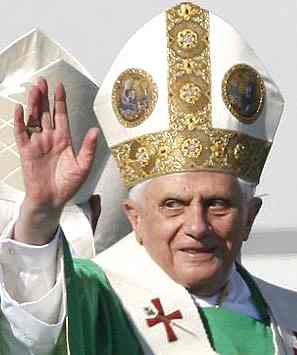
Rorate Caeli

Benedict XVI to the Jews of Rome


From the Vatican's unofficial translation of the Pope's address to the Jewish community in Rome yesterday:


2. The teaching of the Second Vatican Council has represented for Catholics a clear landmark to which constant reference is made in our attitude and our relations with the Jewish people, marking a new and significant stage. The Council gave a strong impetus to our irrevocable commitment to pursue the path of dialogue, fraternity and friendship, a journey which has been deepened and developed in the last forty years, through important steps and significant gestures. Among them, I should mention once again the historic visit by my Venerable Predecessor to this Synagogue on 13 April 1986, the numerous meetings he had with Jewish representatives, both here in Rome and during his Apostolic Visits throughout the world, the Jubilee Pilgrimage which he made to the Holy Land in the year 2000, the various documents of the Holy See which, following the Second Vatican Council’s Declaration Nostra Aetate, have made helpful contributions to the increasingly close relations between Catholics and Jews. I too, in the course of my Pontificate, have wanted to demonstrate my closeness to and my affection for the people of the Covenant. I cherish in my heart each moment of the pilgrimage that I had the joy of making to the Holy Land in May of last year, along with the memories of numerous meetings with Jewish Communities and Organizations, in particular my visits to the Synagogues of Cologne and New York.

Furthermore, the Church has not failed to deplore the failings of her sons and daughters, begging forgiveness for all that could in any way have contributed to the scourge of anti-Semitism and anti-Judaism (cf. Commission for Religious Relations with the Jews, We Remember: A Reflection on the Shoah, 16 March 1998). May these wounds be healed forever! The heartfelt prayer which Pope John Paul II offered at the Western Wall on 26 March 2000 comes back to my mind, and it calls forth a profound echo in our hearts: "God of our Fathers, you chose Abraham and his descendants to bring your Name to the nations: we are deeply saddened by the behaviour of those who in the course of history have caused these children of yours to suffer, and asking your forgiveness we wish to commit ourselves to genuine brotherhood with the people of the Covenant."

3. The passage of time allows us to recognize in the Twentieth Century a truly tragic period for humanity: ferocious wars that sowed destruction, death and suffering like never before; frightening ideologies, rooted in the idolatry of man, of race, and of the State, which led to brother killing brother. The singular and deeply disturbing drama of the Shoah represents, as it were, the most extreme point on the path of hatred that begins when man forgets his Creator and places himself at the centre of the universe. As I noted during my visit of 28 May 2006 to the Auschwitz Concentration camp, which is still profoundly impressed upon my memory, "the rulers of the Third Reich wanted to crush the entire Jewish people", and, essentially, "by wiping out this people, they intended to kill the God who called Abraham, who spoke on Sinai and laid down principles to serve as a guide for mankind, principles that remain eternally valid" (Discourse at Auschwitz-Birkenau Concentration Camp: The Teachings of Pope Benedict XVI, II, 1 [2006], p.727).

Here in this place, how could we not remember the Roman Jews who were snatched from their homes, before these very walls, and who with tremendous brutality were killed at Auschwitz? How could one ever forget their faces, their names, their tears, the desperation faced by these men, women and children? The extermination of the people of the Covenant of Moses, at first announced, then systematically programmed and put into practice in Europe under the Nazi regime, on that day tragically reached as far as Rome. Unfortunately, many remained indifferent, but many, including Italian Catholics, sustained by their faith and by Christian teaching, reacted with courage, often at risk of their lives, opening their arms to assist the Jewish fugitives who were being hunted down, and earning perennial gratitude. The Apostolic See itself provided assistance, often in a hidden and discreet way.

The memory of these events compels us to strengthen the bonds that unite us so that our mutual understanding, respect and acceptance may always increase.

4. Our closeness and spiritual fraternity find in the Holy Bible - in Hebrew Sifre Qodesh or "Book of Holiness" – their most stable and lasting foundation, which constantly reminds us of our common roots, our history and the rich spiritual patrimony that we share. It is in pondering her own mystery that the Church, the People of God of the New Covenant, discovers her own profound bond with the Jews, who were chosen by the Lord before all others to receive his word (cf. Catechism of the Catholic Church, 839). "The Jewish faith, unlike other non-Christian religions, is already a response to God’s revelation in the Old Covenant. To the Jews ‘belong the sonship, the glory, the covenants, the giving of the law, the worship, and the promises; to them belong the patriarchs and of their race, according to the flesh is the Christ’ (Rom 9:4-5), ‘for the gifts and the call of God are irrevocable!’ (Rom 11:29)" (Ibid).

5. Many lessons may be learnt from our common heritage derived from the Law and the Prophets. I would like to recall some of them: first of all, the solidarity which binds the Church to the Jewish people "at the level of their spiritual identity", which offers Christians the opportunity to promote "a renewed respect for the Jewish interpretation of the Old Testament" (cf. Pontifical Biblical Commission, The Jewish people and their Sacred Scriptures in the Christian Bible, 2001, pp.12 and 55); the centrality of the Decalogue as a common ethical message of permanent value for Israel, for the Church, for non-believers and for all of humanity; the task of preparing or ushering in the Kingdom of the Most High in the "care for creation" entrusted by God to man for him to cultivate and to care for responsibly (cf. Gen 2:15).

***

8. On this path we can walk together, aware of the differences that exist between us, but also aware of the fact that when we succeed in uniting our hearts and our hands in response to the Lord’s call, his light comes closer and shines on all the peoples of the world. The progress made in the last forty years by the International Committee for Catholic-Jewish Relations and, in more recent years, by the Mixed Commission of the Chief Rabbinate of Israel and of the Holy See, are a sign of our common will to continue an open and sincere dialogue. Tomorrow here in Rome, in fact, the Mixed Commission will hold its ninth meeting, on "Catholic and Jewish Teaching on Creation and the Environment"; we wish them a profitable dialogue on such a timely and important theme.


The picture is from Daylife.

Announcements

1) On January 16, 2010, at 11:00 A.M., Dario Cardinal Castrillon Hoyos will offer Solemn Pontifical Mass at the Chiesa dell'Ascensione a Chiaja in Naples. (Source)

2) On January 24, 2010, at 11:00 A.M., Archbishop Raymond Burke will offer Solemn Pontifical Mass from the throne at the Chiesa Parrocchiale di San Sebastiano ad Artallo in Imperia. He will then preside over Pontifical Vespers in the same parish church at 3:30 P.M. (Source)

UPDATE: The Mass of Cardinal Castrillon Hoyos was canceled almost at the last minute.

Still looking for an Ordo?


For more details: New Liturgical Ordo for 2010

THE POPE
on the SSPX
and Anglicans

VATICAN CITY, 15 JAN 2010 (VIS) - Participants in the annual plenary assembly of the Congregation for the Doctrine of the Faith, the president of which is Cardinal William Joseph Levada, were received this morning by the Holy Father. In his address to them he highlighted the fact that their dicastery "participates in the ministry of unity" which is primarily entrusted to the Pope through his "commitment to doctrinal fidelity.

"Unity", he added, "is first and foremost unity of faith, upheld by the sacred tradition of which Peter's Successor is the primary custodian and defender. ... This is an indispensable service upon which depends the effectiveness of the Church's evangelising activity unto the end of time.

"The Bishop of Rome", the Pope explained, "must constantly proclaim that ... Jesus is Lord". The Roman Pontiff's "potestas docendi" requires "obedience to the faith, so that the Truth that is Christ may continue to shine forth in all its grandeur, ... and that there may be a single flock gathered around a single Shepherd".

The goal of a shared witness of faith among all Christians "represents, then, a priority for the Church in all periods of history. ... In this spirit, I trust particularly in your dicastery's commitment to overcoming the doctrinal problems that still persist in achieving the full communion of the Society of St. Pius X with the Church".

Benedict XVI then went on to thank the members of the congregation for their efforts towards "the full integration of groups and individuals of former Anglican faithful into the life of the Catholic Church, in accordance with the provisions of the Apostolic Constitution 'Anglicanorum coetibus'. The faithful adherence of these groups to the truth received from Christ and presented in the Magisterium of the Church is in no way contrary to the ecumenical movement", he said, "rather, it reveals the ultimate aim thereof, which is the realisation of the full and visible communion of the disciples of the Lord".

The Pope then turned his attention to the Instruction "Dignitas Personae" concerning certain bioethical questions, which was published by the congregation in 2008. "It represents", he said, "a new milestone in the announcement of the Gospel, in full continuity with the Instruction 'Donum vitae' published by the dicastery in 1987. In such delicate and pressing questions as those that concern procreation and the new therapeutic advances involving the manipulation of the embryo and the human genetic patrimony, ... the Magisterium of the Church seeks to offer its own contribution to the formation of consciences, not only the consciences of believers but of everyone who seeks the truth and is willing to listen to arguments that arise not only from the faith, but also from reason itself".

"Christian faith also makes its truthful contribution in the field of ethics and philosophy, not supplying prefabricated solutions to real problems such as biomedical research and experimentation, put presenting moral standpoints within which human reason can seek and find appropriate solutions", said the Pope.

And he went on: "There are, in fact, certain aspects of Christian revelation that throw light on the problems of bioethics. ... These aspects, inscribed in the heart of man, are also understandable in rational terms as elements of natural moral law, and may find acceptance even among people who do not recognise themselves in the Christian faith".

"Rooted in human nature and accessible to all creatures possessing reason, natural moral law constitutes the foundation for opening a dialogue with all men and women who seek the truth and, more generally, with civil and secular society", said Pope Benedict. And he concluded: "This law, inscribed in the heart of all human beings, touches an essential aspect of legal theory and appeals to legislators' consciences and sense of responsibility".
---

The True Reform of Pope Ratzinger

The New Theological Movement has published a partial translation of the interview given by Antonio Cardinal Canizares-Llovera to Il Foglio, and published on January 9, 2010.

The emphases are from RC.


January 9, 2010, Il Foglio


The ex-archbishop of Toledo and primate of Spain, Cardinal Antonio Cañizares has led the Vatican "ministry" which occupies itself with the liturgy for a little than a year. A delicate task in a pontificate, such as that of Benedict XVI, in which the liturgy and its "restructuring" has a central role after the post conciliar diversions. The liturgy is the center, after all, of the life of the faithful. The Pope said it again at the Christmas Vigil: as for the monks, so it is for every man, "the liturgy is the first priority. Everything else comes after." It is necessary, "to put in second place all other occupations, as important as they may be, to set out toward God, to allow Him to enter into our life and our time."

Cardinal Cañizares says as much to Il Foglio and more in an assessment after having passed one year in the Roman Curia:

"I have received - he explains - the mission to complete, with the indispensable and most valid help of my collaborators, those tasks which have been assigned to the Congregation for Divine Worship and the Discipline of the Sacraments in the Apostolic Constitution Pastor Bonus of John Paul II with respect to the order and promotion of the sacred liturgy, in the first place of the sacraments. For the religious and cultural situation in which we live and for the same priority which corresponds to the liturgy in the life of the Church, I believe that the principal mission which I have received is to promote with complete dedication and engagement, to reinvigorate and develop the spirit and the true sense of the liturgy in the conscience and life of the faithful; so that the liturgy becomes the center and the heart of the community; so that all, priests and faithful, consider it as the substantial and essential thing of our life; so that we live the liturgy in full truth; so that in all its fullness, as the Second Vatican Council says, it is "the source and summit" of the Christian life. After a year at the helm of this Congregation, I experience and sense with greater force every day, the necessity of promoting in the Church, in every continent, a strong and rigorous liturgical impulse. An impulse which revivifies that most rich heritage of the Council and of which the great liturgical movement of the 19th and first half of the 20th century - with men like Guardini, Jungmann and so many others - rendered fruitful the Church at the Second Vatican Council. There, without any doubt, stands our future and the future of the world. I say this because the future of the Church and of the entirety of humanity is answered in God, in the life of God and of that which comes from Him; and this happens in the liturgy and by means of it. Only a Church which lives the truth of the liturgy will be in a position to give the one thing which can renew, transform and recreate the world: God and only God and His grace. The liturgy, in its most pure character, is the presence of God, the salvific and regenerating work of God, communication and participation in His merciful love, adoration, acknowledgement of God. It is the only thing that can save us."

Guardini and Jungmann were two pillars of the liturgical renewal of the past decades. Figures which also inspired Joseph Ratzinger in his The Spirit of the Liturgy. Figures which, probably, have also inspired the promulgation of the Motu Proprio, Summorum Pontificum. It is said that the Motu Proprio has represented also (there are some who say it at least) an extended hand of the Pope to the Society of Saint Pius X. Is this so?

"In fact, it is. However, I believe that the Motu Proprio has a most important value for its own sake, for the Church and for the liturgy. Although this displeases some - judging by the reactions which have arrived and which continue to arrive - it is only just and necessary to say that the Motu Proprio is not a step back or a return to the past. It is to acknowledge and receive, with simplicity, in all its fullness, the treasures and inheritance of the great Tradition, which has in the liturgy its most genuine and profound expression. The Church cannot permit herself to prescind, to forget or to renounce the treasures and the rich inheritance of this tradition, contained in the Roman Rite. It would be a betrayal and a negation of her very self. She cannot abandon the historical inheritance of the ecclesiastical liturgy, or desire to establish everything from anew - as some have pretended - without cutting off fundamental parts of the Church herself. Some understood the Conciliar liturgical reform as a rupture, and not as an organic development of the tradition. In these years after the Council, "change" was almost a magic word; it became necessary to modify that which had been, to the point of forgetting it; everything new; it was necessary to introduce novelty, in the end, a human work and creation. We cannot forget that the liturgical reform and the years after the Council coincided with a cultural climate intensely marked and dominated by a conception of man as 'creator' that only with difficulty co-exists with a liturgy, which, above all, is the action of God and His priority, "the right" of God, adoration of God and also the tradition of that which we receive and has been given to us one time and for all times. We are not able to create the liturgy ourselves, it is not our work, but the work of God. This conception of man as 'creator' which leads to a secularized vision of everything, where God, often, has no place, this passion for change and the loss of tradition has not yet been overcome. And for this reason, in my opinion, among the other things, stands the cause by which many see with such distrust the Motu Proprio or that it displeases some so much to receive and accept it, to re-encounter the great riches of the Roman liturgical tradition which we cannot squander, or to search for and accept the reciprocal enrichment of the one Roman rite between the "ordinary" and the "extraordinary" forms. The Motu Proprio, Summorum Pontificum, has a most important value, which everyone ought to appreciate, whose value has not only to do with the liturgy, but the entire Church, of that which it is and the tradition it signifies, without which the Church turns into a human institution always in change. Obviously, the Motu Proprio has to be seen with the reading and interpretation one makes or would make of the Second Vatican Council. When one reads the Council and interprets it with the key of rupture and discontinuity, he understands nothing of the Council and he completely distorts it. For this reason, as the Pope indicates, only a hermeneutic of continuity brings us to a just and correct reading of the Council, and to understand the truth of that which it says and teaches in its entirety and in particular in the Constitution, Sacrosanctum Concilium, on the divine liturgy, which is inseparable, for the most part, with this same entirety. Consequently, the Motu Proprio also has a most high value for the communion of the Church."

The Pope stands behind the slow but necessary process of the Church's rapprochement to an authentic liturgical spirit. Also, divisions and contra-positions are not lacking. Cardinal Cañizares speaks about it:

"The great contribution of the Pope, in my opinion, is that he is bringing us closer to the truth of the liturgy, with a wise pedagogy, introducing us to the genuine 'spirit' of the liturgy (the title of one of his works before becoming Pope). He, before all else, is following a simple educative process which seeks to move toward this 'spirit' or genuine sense of the liturgy, to overcome a reductive vision which is still very entrenched. As Pope, he is the first to put into practice his teachings, so rich and abundant in this area. As his evocative gestures which accompany the celebrations at which he presides, move in this direction. To accept these gestures and these teachings is a duty which we have if we are disposed to live the liturgy in a way corresponding to its very naturalness and if we do not want to lose the treasures and liturgical inheritance of the tradition. Further, they constitute a great gift for the formation, as urgent as it is necessary, of the Christian people. In this prospective, one needs to see the same Motu Proprio which has confirmed the possibility to celebrate with the Roman Missal approved by John XXIII and which goes back, with the successive modifications, to the time of Saint Gregory the Great and even earlier. It is certain that there are many difficulties which those are having who, in utilizing that which is their right, are celebrating or participating in the Holy Mass according to "the ancient rite" or "extraordinary" form. Of itself, there need not be this opposition, or even less to be seen as suspect or labeled as "pre-conciliar" or, even worse, as "anti-conciliar." The reasons for this are many and diverse. However, at bottom, they are the same which they carry to the reform of the liturgy understood as rupture and not in the horizon of the tradition and the 'hermeneutic of continuity' which reclaims the renewal and true liturgical reform in the key of Vatican II. We cannot forget, further, that in the liturgy one touches that which is most essential to the faith and the Church and, for this reason, every time in history when one has touched something of liturgical tensions, divisions have not been rare."

(The picture is from the ICRSS website)

The New Liturgical Movement has also published a fuller (but, apparently, not yet complete) translation of the same interview.

Pray for Haiti


The picture is from Daylife.

The Archbishop of Port-au-Prince, Msgr. Joseph Serge Miot, is among the dead.

Attack on Creation

[W]e must remember that the problem of the environment is complex; one might compare it to a multifaceted prism. Creatures differ from one another and can be protected, or endangered, in different ways, as we know from daily experience.

One such attack comes from laws or proposals which, in the name of fighting discrimination, strike at the biological basis of the difference between the sexes. I am thinking, for example, of certain countries in Europe or North and South America.

Saint Columban stated that: "If you take away freedom, you take away dignity" (Ep. 4 ad Attela, in S. Columbani Opera, Dublin, 1957, p. 34). Yet freedom cannot be absolute, since man is not himself God, but the image of God, God’s creation. For man, the path to be taken cannot be determined by caprice or willfulness, but must rather correspond to the structure willed by the Creator.
Benedict XVI
January 11, 2010

The Collapse of the Church in France

The IFOP Institute has just made a survey on Catholicism in France for the daily La Croix. The result is mind-blowing:

  • Whilst, in 1965, 81% of the French declared themselves as Catholics, they were no more than 64% in 2009.
  • More serious: whilst 27% of the French went to Mass once a week or more in 1965, they are no more than 4.5% in 2009.
  • At a doctrinal level, generally, it’s a catastrophe: 63% of practicing Catholics think all religions are the same; 75% ask for an “aggiornamento” of the Church on contraception and even 68% for abortion.
  • As for communion with the Roman Pontiff, the situation is no better: only 27% of practicing Catholics consider that Benedict XVI “rather well” defends “the values of Catholicism” (personally, I don’t even understand the question, but that doesn’t matter) when 34% think he defends them “rather badly”.

That’s the least we could say, that in view of the figures, it is urgent to change the strategy and reunite the living forces of French Catholicism to re-evangelise the former Eldest Daughter of the Church! To find all the survey data (in French): “La Croix“.


Read more in The Anglo-Catholic


Pontifical Mass Pictures from Copenhagen

Pictures of the Solemn Pontifical Mass offered this previous Sunday by Bishop Czeslaw Kozon are now on Katolsk Tradition. The Bishop was assisted by Fr. Josef Bisig and Fr. Martin Knudsen, both of the Priestly Fraternity of St. Peter.

Paix Liturgique on the Reform of the Reform

Paix Liturgique has published its second English letter, which contains the following essay:

Second Aim of the Motu Proprio: The Reform of the Reform


The increasing availability of Msgr Nicola Bux’s book The Reform of Benedict XVI [1] is an opportunity for us to depart somewhat from our usual focus on the application of the motu proprio “Summorum Pontificum” and to take stock of the “reform of the reform” that the Holy Pontiff has initiated in liturgy. It is also the occasion to consider what sort of relationship will slowly emerge between the two forms of the Roman liturgy.

The first aim of the motu proprio “Summorum Pontificum” is clear: to make it possible for the traditional Mass to be celebrated in every parish where it is requested. The MP will only truly be applied when we shall see the ten o’clock Sunday Mass celebrated in the ordinary form and the eleven o’clock Mass in the extraordinary form, or the reverse, in the cathedrals of Dublin or Detroit, as well as in the cathedrals of Boise or Aberdeen. In a word: as far as the MP’s application is concerned, we are still on the starting line.

Read more here.

Recent Pontifical Masses by cardinals: some pictures and a short comment


As previously announced on Rorate, Cardinal Castrillon Hoyos offered Solemn Pontifical Mass in Osimo on January 6, while Cardinal Canizares Llovera did so in St. John Lateran yesterday, January 7. The New Liturgical Movement and Orbis Catholicus have magnificent pictures of the Mass of Cardinal Canizares Llovera, while Rinascimento Sacro has the pictures of Cardinal Castrillon Hoyos pontificating in the Campocavallo sanctuary.

(Joseph Cardinal Zen, emeritus of Hong Kong, also celebrated a Missa Cantata in Hong Kong last December 27.)

The sight of these sumptuous Masses and other services being celebrated by Cardinals of the Holy Roman Catholic Church should be a matter of great rejoicing for all who love the Catholic faith, and are signs of hope for the future of the Church. There can be no gainsaying that here, we see great progress. In particular, the offering of Pontifical Masses in the two greatest basilicas of Christendom cannot but signal how much has changed since the days of the three previous Pontificates.

At the same time, it should be noted that out of 183 cardinals (as of the time of this writing), only six Cardinals publicly celebrate the Mass of the Missal of 1962 with some regularity (meaning, at least once a year or more): Cardinal Castrillon Hoyos (retired), Cardinal Rode (still active, but past retirement age), Cardinal Canizares-Llovera, Cardinal Pell of Sydney, Cardinal Zen the emeritus of Hong Kong, and Cardinal Medina Estevez (retired, former Prefect of the Congregation for Divine Worship). Of these six cardinals, only Cardinal Rode had not already offered it (as a bishop) prior to September 14, 2007. Some cardinals still living offered this Mass prior to 2007, but are now, perhaps, too old to offer it in public.

Since 2007, Cardinal Ricard of Bordeaux and Cardinal Vingt-Trois of Paris have also offered the occasional Mass. Solemn Masses have been offered as well in the presence of Cardinal Barbarin of Lyons and Cardinal George of Chicago.

We pray and hope that more Cardinals -- especially those actually reigning as Archbishops, and still quite young -- will offer the Traditional Latin Mass as well, and soon.

Protect the Pope, return the sedia!


The use of the sedia continued until very recently and many are unaware that the last pope to use the sedia was actually Pope John Paul I. While the abolition of this ancient form of transport may have since been considered appropriate in the context of the late 20th century and the need to democratise the appearance of papal ceremonies, the reality has left the Pope an isolated and vulnerable figure separated from the deacons ahead and the MCs behind, one who appears all too often like the figure in the Third Secret of Fatima: a victim walking alone simply waiting to be attacked.

While there are bound to be some who would see the return of the sedia as yet another example of this Pope "turning the clock back", in fact not only would it save an elderly man's tired legs but it would allow more of the crowd to see him. Most importantly, it would actually insulate him from the kind of physical assault we saw at Christmas by virtue of the mob of people surrounding it (who could these days be swelled by Swiss Guards and the gendarme officers in suitably formal garb) to work alongside the suited officers at the perimeter.


Naturally, the risk of attack from a gunman or explosive device would still be present and indeed potentially magnified by the sedia but the use of X-ray machines at the entrance to the basilica and physical searches of congregants should by now be mandatory at such events to confront these risks which are no more heightened by the Pope presiding at Mass from an elevated platform, as he does, than from being carried in a chair.


It was being reported earlier in the year on several Catholic blogs that the Vatican was actively considering a return for the sedia gestatoria for ceremonies in St Peter's, more because of the Pope's age than as a protection against attack. Perhaps the latest incident will persuade them that what tradition hands down frequently has a practical origin beyond merely the visually impressive spectacle that to sceptical modern eyes it had appeared to have become.

From the Catholic Herald, January 8, 2010.

Source for the pic: link.

Julian Christmas Greetings!


To all the Greek Catholics and other Eastern Christians who, on this day, observe the Feast of the Nativity of the Lord: A Blessed and Joyful Christmas!

Msgr. Graham Leonard 1921-2010

I have total confidence always in the loving power of God and in His objectives for humanity. I trust God totally and, because I believe in God, I believe in the Church that He has given us and that is why I have hope. It is this Church that must carry to fulfillment the plan of God for the salvation of man. (Source)


(H/t for the news to The Anglo-Catholic. More can be found here, here and here.)


A Guide to the Liturgical Riches of the Feast of the Epiphany


Epiphany is not merely the last of the “twelve days of Christmas”; it is itself the twin feast of Christmas, the “little Christmas”. On this day the Church contemplates once more with renewed fervor and tenderness the mystery of the Incarnation of the Lord. If, on Christmas Day, the Church emphasizes the threefold birth of the Word of God, in the Epiphany of the Lord she puts the accent on His manifestation (epiphaneia) to the world.

It is only fitting that this great feast witnesses a liturgical richness that should make it one of the highest points of the year for Catholics. Until 1955 it also had its own Octave, which was of great antiquity.

During the Mass, after the Gospel, the archdeacon, a dignitary, or another priest, dressed in a cope, goes to the customary place where he proclaims the moveable feasts for the current year. The Classical Roman Rite’s text for 2010 reads as follows:

Noveritis, fratres carissimi, quod annuente Dei misericordia, sicut de Nativitate Domini nostri Jesu Christi gavisi sumus, ita et de Resurrectione ejusdem Salvatoris nostri gaudium vobis annuntiamus. Die tricesima prima Januarii erit Dominica in Septuagesima. Septima decima Februarii dies Cinerum, et initium jejunii sacratissimae Quadragesimae. Quarta Aprilis sanctum Pascha Domini nostri Jesu Christi cum gaudio celebrabimus. Tertia decima Maii erit Ascensio Domini nostri Jesu Christi. Vigesima tertia ejusdem Festum Pentecostes. Tertia Junii Festum sacratissimi Corporis Christi. Duodetricesima Novembris Dominica prima Adventus Domini nostril Jesu Christi, cui est honor et gloria, in saecula saeculorum, Amen.

Although the custom of making this proclamation largely fell into disuse in the Modern Roman Rite, it is now being rediscovered, as this NLM article shows.

It is also customary during Epiphany to bless gold, frankincense and myrrh. The pre-Conciliar Roman Ritual has the following formula:

The Blessing of Gold, Frankincense and Myrrh
In Latin:

V. Adiutorium nostrum in nomine Domini.
R. Qui fecit caelum et terram.
V. Dominus vobiscum.
R. Et cum spiritu tuo.
Oremus. Suscipe, sancta Pater, a me indigno famulo tuo haec munera, quae in honorem nominis tui sancti, et in titulum omnipotentiae tuae maiestatis, humiliter tibi offero: sicut sacrificium Abel iustus, et sicut eadem munera a tribus Magis tibi quondam offerentibus suscepisti.
Exerciso te, creatura auri, thuris et myrrhae, per Pa+trem omnipotentem, per Iesum + Christum filium eius unigenitum, et per Spiritum Sanctum + Paraclitum: ut a te discedat omnis fraus, dolus, et nequitia diaboli, et sis remedium salutare humano generi contra insidias immici: et quicumque divino freti auxilio te in suis loculis, domibus, aut circa se habuerint, per virtutem et merita Domini et Salvatoris nostri, ac intercessionem eius sanctissimmae Genetricis et Virginis Mariae, ac eorum, qui hodie similibus muneribus Christum Dominum venerati sunt, omniumque Sanctorum, ab omnibus periculis animae et corporis liberentur, et bonis omnibus perfrui mereantur. R. Amen.
Deus invisibilis et interminabilis, pietatem tuam per sanctum et tremendum Filii tui nomen, suppliciter deprecamur: ut in hanc creaturam auri, thus, myrrhae bene+dictionem ac operationem tuae virtutis infundas: ut, qui ea penes se habuerint, ab omni aegreditudinis et laesionis incursu tuti sint; et omnes morbos corporis et animae effugiant, nullum dominetur eis penculum et, laeti, ac incolumes tibi in Ecclesia tua deserviant: Qui in Trinitate perfecta vivis et regnas Deus per omnia saecula saeculorum.
R Amen.
Et benedictio Dei omnipotentis, Pa+tris, et Filii,+ et Spiritus + Sancti, descendat super hanc creaturam auri, thuris et myrrhae, et maneat semper. R. Amen.

In English:

V. Our help is in the name of the Lord.
R. Who made heaven and earth.
V. The Lord be with you.
R. And with thy spirit.
Let us pray. Accept, O holy Father, from me, thine unworthy servant, these gifts which I offer in humility to the honour of thy holy name and to thy peerless majesty; as thou didst accept the sacrifice of the just Abel and the same gifts from the hands of the Magi.
Creatures of gold, incense, and myrrh, I exorcise you by the Father + almighty, by Jesus + Christ, His Only-Begotten Son, and by the Hol y+ Spirit, the Paraclete, that freed from all deceit, evil, and cunning of the devil, you may be a saving remedy to men against the snares of the enemy. May trustful souls who use you in their homes or about their persons be delivered from danger to soul and body, rejoicing in the possession of every good; through our Lord and Saviour's power and merits, through the intercession of Mary, most holy Virgin Mother of God, of all Saints and of them who on this day venerated Christ, the Lord with similar gifts. R. Amen.
O God, thou the invisible and unending One, in the holy and awesome name of thy Son graciously bestow blessing + and power upon these creatures, gold, incense, and myrrh. Protect them who will have them in their possession from illness, injury, and danger to body and soul, so they can joyously and securely serve thee with zeal in thy Church. Who in perfect Trinity livest and reignest, God, for ever and ever. R Amen.

There is also the custom of the annual blessing of houses, with each room being sprinkled with blessed water and incensed. Traditionally this was done by the pastor, but in the aftermath of the Council, this blessing (in reduced form) was, in many countries, handed over to the fathers of families (or even to any family member).


The Roman Ritual has the text of the Epiphany blessing of houses by priests (look for blessing # 8 in this webpage. See also this link.)

A more modern version that can be done by laymen / fathers of families can be found here.

At the end of the house blessing, the following is inscribed upon the doors:

20+C+M+B+10

(This is not the only form that the inscription could take, and sometimes the inscription is placed on the inside of the door, and sometimes on the outside or above it.)

CMB means “Christus Mansionem Benedicat” but through the centuries it has also been taken to refer to the Magi, Caspar, Melchior and Balthassar. This latter understanding is reflected in the Roman Ritual’s formula for the blessing of the chalk that is used to make this inscription, which formula reads as follows:

The Blessing of Chalk

In Latin:
V. Adiutorium nostrum in nomine Domini.
R. Qui fecit caelum et terram.
V. Dominus vobiscum.
R. Et cum spiritu tuo.
Bene+dic, Domine Deus, creaturam istam cretae: ut sit salutaris humano generi; et praesta per invocationem nominis tui sanctissimi, ut, quicumque ex ea sumpserint, vel ea in domus suae portis scripserint nomina sanctorum tuorum Gasparis, Melchioris et Baltassar, per eorum intercessionem et merita, corporis sanitatem, et animae tutelam, percipiant. Per Christum Dominum nostrum. R. Amen

In English:

V. Our help is in the name of the Lord.
R. Who made heaven and earth.
V. The Lord be with you.
R. And with thy spirit.
Bless, +. O Lord God, this creature chalk to render it helpful to men. Grant that they who use it in faith and with it inscribe upon the entrance of their homes the names of thy saints, Gaspar, Melchior, and Balthassar may through their merits and intercession enjoy health of body and protection of soul. Through Christ our Lord. R. Amen

I would like to acknowledge Michael Pearce of Maternal Heart of Mary in Sydney for providing me with the Latin texts and the English translations of the blessings.

I also recommend this article from NLM: Epiphany Customs and Blessings

1957 Missal on Biblia Clerus

Biblia Clerus, the official online library of the Congregation for Clergy, has apparently had the Traditional Missale Romanum online for quite some time now, but its presence there has scarcely been made known to the online Traditionalist community -- although Fr. Finigan mentioned it as far back as 2008. (Another link to the Missal can be found here.)

Of interest is the fact that the Missal is NOT the 1962 Missal, but the 1957 Missal -- Holy Week as reformed in 1955 (but with the "perfidis" still in the prayer for the conversion of the Jews), while the calendar outside Holy Week remains as it stood prior to the rubrical reforms of 1955 (hence the presence of the Octave Days of St. Stephen, St. John, Holy Innocents, etc.).

Remarks from Bishop Alfonso de Galarreta on the doctrinal talks between the Holy See and the SSPX

Many are probably already aware of the synthesis of remarks recently made by SSPX Bishop Alfonso de Galarreta concerning the doctrinal talks between the Holy See and the SSPX. These are not in anyway an official statement from the SSPX -- only notes on the doctrinal talks that are issued by the Holy See Press Office or by the SSPX mother house in Switzerland are official or formal announcements. Nevertheless these remarks became public last month and are certainly of interest. Bishop de Galarreta, who heads the SSPX delegation for the talks, made the remarks on the occasion of the SSPX's recent ordinations at its Argentinian seminary of La Reja. The synthesis of his comments is as follows:

1) The outcome of the first meeting has been good.
2) Primarily the agenda and the method of discussion were established.
3) The issues to be discussed are of a doctrinal nature to the express exclusion of any canonical question regarding the situation of the SSPX.
4) The common doctrinal reference point will be the Magisterium prior to the Council.
5) The talks follow a rigorous method: an issue is raised, and the party raising it sends a paper substantiating its doubts. The Holy See responds in writing, after prior email exchanges among the technical advisers. At the meeting, the issue is discussed.
6) All meetings are taped by both parties and filmed.
7) The conclusions of each topic will be submitted to the Holy Father and the Superior General of the SSPX.
8) The timing of these meetings depends on whether the topic is new or is already being discussed. In the first case, it will be approximately every three months. In the second, every two. The next meeting is planned for mid January.
10) The theological representatives of the Holy See "are people you can talk with", they speak "the same (theological) language as we". (meaning presumably they are Thomists).
11) Some of the topics mentioned by the bishop in his homily, not exhaustively, are:

a) The Magisterium of the Council and after the Council.
b) The conciliar liturgical reform.
c) Ecumenism and interreligious dialogue.
e) Papal authority and collegiality.
f) Freedom of conscience, religious freedom, secularism and the social reign of Jesus Christ.
g) Human rights and human dignity according to the Council's teaching.


The Bishop repeated that the results of the first session are good, compared to the previous situation. The parties talked entirely freely and only about doctrinal issues in a Thomist theological framework.

No one can foresee what will happen in the future. One will move forward day by day, as prudence and evangelical spirit direct.

New Director for the Sistine

"It's been decided. The choir of the Sistine Chapel will soon, very soon, have a new director. To the position of monsignor Giuseppe Liberto will arrive don Massimo Palombella [S.D.B.]."
So says Sandro Magister in his blog. He speaks of the Cappella Musicale Pontificia Sistina, the foremost pontifical choir, whose current director, Monsignor Liberto, was named after the expulsion of Monsignor Domenico Bartolucci (more on that in this post of January 2006).

The Blessing of Epiphany Water


Tomorrow, January 5, the eve of Epiphany (the “Vigil of Epiphany” in the pre-1960 liturgical books and in the 2002 Missal), the Roman-Rite Blessing of Epiphany Water will take place once more in a number of fortunate parishes or communities. A superb description (with pictures) of this splendid rite according to the pre-Conciliar Ritual can be found in the blog of the Brothers of the Little Oratory in San Diego:


This rite was inserted into the Roman Ritual in 1890, arguably making it the most recent example of the influence of Greek ceremonial on the Roman Rite prior to the liturgical reforms of the 20th century.

An English translation of the 1890 blessing can be found in Musings of a Pertinacious Papist: Part 1, Part 2.(See also this webpage, look for Blessing #5.)

There was apparently a botched attempt to abolish this ritual in the early 20th century, as the following passage from a well-known rubrical guide shows: “(t)he solemn Blessing of Water which had been introduced in some places, and which owes its origin to the Greek Church, as is shown in the Decree of the Sacred Congregation of Rites, 3730 … is to be struck out as abrogated, according to the Decree of the same Congregation, 3792, ad XV, and therefore it is not permitted to use it in the future. It is, nevertheless, retained in the revised edition of the Rituale Romanum (Vatican, typical, 1925), p. 705 ” (No. 547 of Matters Liturgical, 1938 edition, by Joseph Wuest C.SS.R and Thomas Mullaney C.SS.R.). At any rate, the blessing has continued to be used in some communities down to our own day, and is being rediscovered by others. 

It should be noted that prior to 1890, the solemn Blessing of Water was already to be found in some diocesan rituals (especially in Germany). There was also a particularly elaborate form of this blessing that was used at least until 1890 in Sant' Andrea della Valle and some other churches in Rome. It's text -- which is far longer than the 1890 text, with a Lesson and a Gospel reading, responsories and antiphons, a Preface, a Sanctus, and very long blessings -- can be found in pp. 1-46 of  The Blessing of the Waters on the Eve of the Epiphany

The Title of "Excellency" for Bishops

Another informative post by Fr. Athanasius McVay HED:

The Title of "Excellency" for Bishops

Throughout the ages, Catholic clergy have been styled by various titles. The most common title is Reverendus. In addition to the superlative degree thereof (Reverendissimus), clerical dignitaries also were styled with various secular titles such as Dominus (Lordship), Illustrissimus, and Amplitudinis (Grandeur). Into the twentieth century, bishops continued to be addressed as Most Reverend and Illustrious Lordship, while, in the English speaking world, archbishops were addressed, in the style of dukes, Your Grace. Cardinals were and are styled Eminence after the highest officials of the Byzantine court, and the Pope is called Sanctitas (Holiness) or Beatissimus Pater (Most Blessed or Holy Father).


The title of Excellency is secular in origin and began to be given to civil officials such as ambassadors in the eighteenth century. Thus apostolic nuncios (papal ambassadors) and other dignitaries of the papal court acquired the title Excellentia with the addition of Reverendissima to distinguish it from secular excellencies. Diocesan bishops began to acquire the title with greater frequency in the nineteenth century. For example, Metropolitan Sheptytsky, who held various state offices in the Austrian Imperial system, was addressed as Excellency inside Austria but as Illustrissimus ac Reverendissimus Dominus by the Roman Curia or Amplitudo Vestra/Votre Grandeur by other clergy.


Read more here.

Iesu, dulcis memoria


Iesu, dulcis memoria,
Dans vera cordis gaudia:
Sed super mel et omnia
Eius dulcis praesentia.

Nil canitur suavius,
Nil auditur iucundius,
Nil cogitatur dulcius,
Quam Iesus Dei Filius.

Iesu, spes paenitentibus,
Quam pius es petentibus!
Quam bonus te quaerentibus!
Sed quid invenientibus?

Nec lingua valet dicere,
Nec littera exprimere:
Expertus potest credere,
Quid sit Iesum diligere.

Sis, Iesu, nostrum gaudium,
Qui es futurus praemium
Sit nostra in te gloria,
Per cuncta semper saecula. Amen.

Happy New Year, Holy Father


During his first Angelus message of the year yesterday, Pope Benedict XVI made the following reflection:
"Today, the liturgy reminds us that eight days after the birth of the Child, [Mary] and her husband Joseph brought him to be circumcised, according to the Law of Moses, and gave him the name Jesus, which had been given him by the angel" (Luke 2:21).
Readers will recognize these words from the Gospel of the Feast of the Circumcision of Our Lord. The liturgy of the day for the contemporary rite was that of the Solemnity of Mary the Mother of God.

New PCED Members


Messa in Latino has announced that the newest members of the Pontifical Commission Ecclesia Dei will be Fr. Vincenzo Nuara OP and Fr. Almiro de Andrade FSSP.

Fr. Almiro de Andrade is the first member of any of the "Ecclesia Dei Communities" to be officially appointed to the Commission. He also serves as MC at SS. Trinita dei Pellegrini, and is already considered as the de facto "secretary to the Secretary" of the Pontifical Commission Ecclesia Dei, Msgr. Guido Pozzo.

Fr. Vincenzo Nuara, on the other hand, is the founder of the "Amicizia Sacerdotale Summorum Pontificum" and of "Giovane e Tradizione". Fr. Nuara, who had been removed from his position as vicar for religious in the Diocese of Acireale for his role in assisting the organizers of the celebration of the Traditional Mass in that diocese (in Sicily, which currently has only two locations with a regular TLM) -- a Mass that was saved only upon the intervention of the PCED -- has been very much at the forefront of promoting Summorum Pontificum,being one of the leaders in organizing study days and conferences on the Traditional Roman Rite, in Rome most notably the October 2009 conference that concluded with Archbishop Burke's Pontifical Mass in St. Peter's Basilica.

(H/t to our regular reader Gideon Ertner!)

Another barefaced insult from the Turks

AFP - Turkey will ask for the return of the bones of Saint Nicholas, who Father Christmas is modelled on, from their display in Italy, local media reported on Friday. (Of course, the bones of St. Nicholas are not "on display" in Bari; these were taken to Bari in order to be saved from desecration! CAP)

Saint Nicholas, from the modern-day town of Demre on southern Turkey's Mediterranean coast, is, according to tradition, the ancestor of Father Christmas, but his remains were stolen by Italian pirates in the 11th century.

"These bones should be exposed here and not in a town of pirates" in Bari, said Culture Minister Ertugrul Gunay, quoted in the newspaper Milliyet.

"If we build a museum in this town (Demre), naturally the first thing we will ask for are the remains of Father Christmas".

The minister gave no schedule for the museum construction, which would exhibit relics of ancient civilisations, but said that after a study by experts, Turkey would request that Italy return the remains of Saint Nicholas.

Many tourists, especially from Russia, visit the Saint Nicholas church in today's Demre, a fifth-century Byzantine basilica rebuilt in the 11th century.

Nicholas was a bishop in ancient Myra (Demre) in the fourth century, during the Byzantine period.

He was buried in Myra, but pirates stole his remains in the 11th century and brought them to Bari in southern Italy, placing them in its own Saint Nicholas basilica.

Saint Nicholas is celebrated for his charity, and his generosity towards others is at the origin of the character of Father Christmas, who took Nicholas's place in Christianity as the giver of presents to children.

From France 24.

BBC helpfully adds that:

Even without the bones, the town of Demre has not been shy about cashing in on its most famous native son - today visitors to the Byzantine church there are greeted by a large, plastic Santa statue, complete with beard and red snow-suit.

(The Byzantine church is currently in ruins, a casualty of Turkey's long-running campaign against Christianity.)

Click here to find out more!

A(nother) Vatican II moment in Louvain
Father De Cock and Homosexual love

"The sexual characteristics of man and the human faculty of reproduction wonderfully exceed the dispositions of lower forms of life. Hence the acts themselves which are proper to conjugal love and which are exercised in accord with genuine human dignity must be honored with great reverence. Hence when there is question of harmonizing conjugal love with the responsible transmission of life, the moral aspects of any procedure does not depend solely on sincere intentions or on an evaluation of motives, but must be determined by objective standards. These, based on the nature of the human person and his acts, preserve the full sense of mutual self-giving and human procreation in the context of true love. Such a goal cannot be achieved unless the virtue of conjugal chastity is sincerely practiced." (Gaudium et Spes, 51)

___________________


A Flemish reader reports:

At the Catholic University of Louvain (Belgium) Fr. Bernard De Cock, O.P. (Dominican) has received (9th of December) his doctor's degree with a work "Touched to Love. An Attempt at a Theological Anthropology of the Body and Homosexuality."

The promotor is prof. dr. Roger Burggraeve S.D.B. (Salesian), well known for his 'subversive' opinions on sexuality and the Church. In his work, Fr. De Cock OP states "homosexual love can be God's love".

In the third part he makes use of Xavier Lacroix' method to describe the sexual gestures between homosexual men in function of the love of God for men.

In the past, De Cock has written other articles on this subject. He was also a speaker at a colloquium on 'Homosexualty and the Church', 2005 organised by the 'holebi-pastores' ['HOmosexual-LEsbian-BIsexual-friendly priests] in the Theological and Pastoral Centre in Antwerp.