Rorate Caeli

Bishop Meeking to celebrate the ceremonies of Holy Week according to the 1962 Missal

From Fr. Glen Tattersall:

Holy Week 2010

The Classical Latin Liturgy in Melbourne

At St Aloysius’ Church, 233 Balaclava Rd, Caulfield North


The Latin liturgical tradition of the Catholic Church is one of the principal fonts of our Western culture. Pope Benedict XVI has recognised this spiritual patrimony, and urged its restoration. Now, for the first time in over 40 years in Australia, the traditional Latin ceremonies of Holy Week will be celebrated by a Bishop - His Lordship, Most Rev Basil Meeking, Bishop Emeritus of Christchurch, New Zealand

Palm Sunday, March 28, 11.00am, Solemn Pontifical Mass, with blessing of palms and procession - Gregorian chant propers and Ordinary, Pueri Hebraeorum (Victoria), Salvator Mundi (Tallis)

Spy Wednesday, March 31, 8.00pm: Tenebrae - Tenebrae Responsories (Ingegneri), Miserere (Allegri).

Maundy Thursday, April 1, 8.00pm, Mass of the Lord’s Supper, with adoration at the Altar of Repose until Midnight - Gregorian Chant Propers and Ordinary, Ubi Caritas (Durufle)

Good Friday, April 2

10.30am Stations of the Cross

3.00pm Commemoration of the Passion and Death of the Lord - Gregorian Chant and Sancte Deus (Tallis)

8.00pm Tenebrae - Tenebrae Responsories (Victoria)

Holy Saturday, April 3, 9.00pm Paschal Vigil - Gregorian Chant Propers and Ordinary, Maria Magdalene (Guerrero)

Easter Sunday, April 4, 11.00am Solemn Pontifical Easter Mass - Polyphonic Propers for Easter Sunday (William Byrd), Gregorian Chant Ordinary (Lux et Origo)

Easter Monday, April 5

11.00am Solemn Pontifical Mass

3.00pm Solemn Pontifical Vespers & Benediction

Contact Details:

Web: http://latinmassmelbourne.org

E-mail: chaplain@latinmassmelbourne.org

Tel: (03) 9532 7771

Astrology brings us closer to God!

Ummm... no, that's not my opinion, but that of a Filipino Catholic bishop, as published on the official news website of the Catholic Bishops of the Philippines -- CAP

From the news website of the Catholic Bishop's Conference on the Philippines:

Abra Bishop Leopoldo Jaucian reminded the Filipino-Chinese Catholic Community that the gift of life and love should always be attributed to God as the ultimate source of all creation—a basic Catholic teaching that he said should not be compromised given the nature of Chinese culture.

“As we celebrate the Chinese New Year on Valentine’s Day this year, let’s pray for more blessings of life and love and share it generously to others. Let us pray for God’s abundant blessing of good health and prosperity and joy in life. Without God we are nothing so let us think of him for this year of the metal tiger,” Jaucian said.

The prelate, who is the national spiritual director of the Filipino-Chinese Catholic Youth, said there is nothing wrong with observing the Chinese Culture but Chinese Catholics should keep a prayerful life and be faithful to their Catholic religion.

“God is present in other religion and culture so the belief in Feng Shui, Astrology, and praying at Buddhist temples should be perceived as instruments that all draws us closer to God. As such, we discourage too much dependence on culture especially up to the point that faith in God is compromised,” he said.

Jaucian also urged Filipino Catholics to understand and respect the Chinese’s way of life, adding that their Catholic faith should keep them united amid cultural differences.

“We should respect each otheir’s culture. Let us extend respect, understanding and solidarity to our Chinoy brothers and sisters so we can live harmoniously with each other,” he added. (Kris Bayos)

New version of the Missale Romanum


The Libreria Editrice Vaticana, the official publishing house of the Holy See, has at last published an altar version of the Missale Romanum (1962), for actual liturgical use (PAXBOOK).

The simple study version edited by Manlio Sodi is still being sold.

More on Medjugorje

Many people regard Medjugorje as the beginning of their conversion. Is there a theological logic of "good fruits", which allows for conclusions of an experience of grace or the authenticity of the phenomenon?
Fr. Manfred Hauke: Good fruits alone are still no confirmation for the supernatural origin of a visionary phenomenon. In medicine placebo therapy also sometimes brings good results, but they aren't to be credited to the medicine as such. And even at a place, at which trickery happens or even the devil acts, it is possible that divine grace acts and people convert and find God. In the criteria for the supernatural credibility of Marian apparitions the fruits are to be connected with the examination of the phenomenon itself and its confirmation through miracles. In Medjugorje there are, in addition, not only good fruits, but also a whole number of negative consequences that are connected with the phenomenon of the apparitions. One of those is the encouragement given to two Franciscan friars, who were urged by the seer Vicka in the name of the "Gospa" to set themselves against the canonically legitimate directives of the local bishop regarding their pastoral activity. At the repeated exhortations of the "Gospa" to disobedience (13 times), the ordinary at the time, Bishop Zanic, who had been originally inclined favorably to the Medjugorje phenomenon, reacted with very understandable rejection.
In his reaction to Cardinal Schönborn's visit Bishop Peric draws attention to further fruits that are connected with the same exhortation to disobedience: at present there are in the Mostar-Duvno diocese nine ex-Franciscans who were suspended from ministry, but are carrying on in usurped parishes as legal priests; certain Franciscans invited an Old-Catholic deacon in 2001, who presented himself as an "Archbishop" and "confirmed" over 700 young people in the usurped parishes, which a deacon can never validly do; two of the recalcitrant friars invited an Old-Catholic bishop from Switzerland with the request to consecrate them as bishops, which the Old-Catholic bishop, however, declined. Two friars, who were closely connected with the beginning of the Medjugorje phenomenon, were disciplined by the Church: Jozo Zovko (the pastor during the first months of the apparition, June-August 1981) was forbidden by his superiors to have any contact with Medjugorje; Tomislav Vlasic, who worked in Medjugorje from 1981-1988, was released from his priestly duties by the Holy See in 2008. The Congregation for the Doctrine of the Faith gave the reason, among other things, of offenses against the sixth commandment, exacerbated by alleged "mystical motivations". The friar had in fact, at the direction of the "Gospa" and the seer Marija Pavlovic, conducted a "mystical marriage" with a lady from Germany in the framework of a mixed religious community. This unusual connection between personal tendencies and mysticism has a longer back-story: in 1976, and therefore before his involvement in Medjugorje, the friar impregnated a religious sister in a mixed "Franciscan community", sent her with pious exhortations to Germany and denied his paternity. This case became known to Bishop Zanic and Cardinal Ratzinger in 1984. Vlasic himself brought the "word of wisdom" spoken to him at a charismatic conference in Rome (May 6, 1981) with him to Medjugorje: "Fear not, I will send you my Mother." An Irish Charismatic woman [Sr. Briege McKenna, O.S.C. --RC] asserted that from Vlasic streams of living water would flow. The influence of such a figure on the beginning period of the Medjugorje phenomenon poses a great number of critical questions. Grave moral accusations are also placed against Zovko, the pastor in the early months, and long-time spiritual confidant of the group of seers (E.M. Jones, The Medjugorje Deception, 2001).
Medjugorje is often cited as an "oasis of peace" during the civil war at the beginning of the '90s. Yet there are also uncomfortable facts that disturb the harmonious view. When revenue from the pilgrimage industry went down in 1992, there were press reports in the wake of a violent conflict among three family clans that served pilgrimage businesses. In a "cleansing action" about 140 inhabitants of Medjugorje were killed, while 600 others had to flee. "This was all kept secret from the the outside world, since it naturally could not be brought into accord with belief in the Queen of Peace" (R. Franken, "A Journey to Medjugorje", 2000, p, 45). Thus there are not only good fruits to the Medjugorje phenomenon.
***
Particularly in the early period of the phenomenon there were several very unusual messages. According to a tape-recording transcript from June 30, 1981, the seers reported, according to the assertion of the "Gospa", the end of the appearances would be in three days (on July 3), but they then went on. At the sixth apparition (June 29, 1981), the "Gospa" announced the healing of a four-year-old boy, but it never happened. Furthermore, the "Gospa" informed them (May 25, 1984) that her two-thousandth birthday would fall on August 5, 1984. Would the real Mother of God propagate a birthday celebration for herself, that sets itself apart from the date of the liturgical feast (September 8)? ... Besides untruths and ridiculous things, some erroneous teachings are also presented alongside them: Fr. Vlasic wrote on May 8, 1982, in the Chronicle he authored, that according to the utterance of the "Gospa" the Saints in Heaven are present there not only with the soul, but also with the body. Here on display is the erroneous teaching, widely spread today, but condemned by the Church, of "resurrection in death", in which awaiting the future resurrection at the Second Coming of Christ is rendered nugatory. In other words: alongside plenty of catechetical platitudes that are found with notably more substance in the Bible and the Catechism, the messages contain elements that speak clearly against a supernatural origin of the phenomenon.
More can be found here:

Mariologist Hauke on Medjugorje: "Don't let the devotees fall into the void"


Malcolm Cardinal Ranjith?

A cardinal by October?

VATICAN - Pope tipped to make four new Asian cardinals

VATICAN CITY (UCAN) — Pope Benedict XVI is tipped to make as many as four new Asian cardinals at the next consistory expected in October, writes Gerard O’Connell, special correspondent in Rome.

Sources in Rome say that among the most likely to be given red hats are Japan’s Archbishop Peter Takeo Okada, Sri Lanka’s Archbishop Malcolm Ranjith, India’s Archbishop Thomas Menamparampil, and Myanmar’s Archbishop Charles Maung Bo.

Read more here.

Source for the pic: link.

Of note: Archbishop Menamparampil is a Salesian.

Events
Roman Forum Summer Symposium, 2010

The Politics of Faith and Reason? Or the Triumph of the Will?

Weeklong event near Lake Garda, Italy.


¡El amor, el amooooor!
A Vatican II Moment in the Archdiocese of Pereira, Colombia:
The Misa Criolla


"Misa Criolla", performed by a Peruvian folk music group during a Paul VI Mass celebrated in the Cathedral of Pereira, Colombia (2009, "liturgical action" going on in the background).

"The Church acknowledges Gregorian chant as specially suited to the Roman liturgy: therefore, other things being equal, it should be given pride of place in liturgical services. But other kinds of sacred music, especially polyphony, are by no means excluded from liturgical celebrations, so long as they accord with the spirit of the liturgical action, ... ."

The Death of Spain - new chapter


A group of lawyers in the Spanish city of Murcia (Autonomous Community of Murcia) has asked the Government Delegation in Murcia to remove a statue of Our Lord, the "Cristo de Monteagudo" (built in 1951 in the fashion of the Christ the Redeemer of Rio de Janeiro). The statue is "a relic of the Catholic totalitarianism imposed by the Franco regime, and remains on top of the Muslim castle of Monteagudo, whose beauty it ruins," according to the Association for the Precedence of the Law, an association of secular lawyers, and its president, José Luis Mazón. The Association mentioned in its petition to the government, among other arguments, the decision of the European Court of Human Rights banning the image of the Crucified Lord in Italian public schools.

The Bishop of Cartagena, José Manuel Lorca Planes, has come out in defense of the religious symbol.

Though this will almost certainly be dismissed as a ridiculous petition, it is another sign of the hatred for religion in contemporary Spain, reaching levels unseen since the Second Republic. Will Spain die silently or with a bang (as the last Civil War)?...
_____________
Source: Público.es

She came to Bernadette

In many ways the nineteenth century was to become, after the turmoil of the Revolution, a century of Marian favors. To mention but a single instance, everyone is familiar today with the "miraculous medal." This medal, with its image of "Mary conceived without sin," was revealed to a humble daughter of Saint Vincent de Paul... .

A few years later, from February 11 to July 16, 1858, the Blessed Virgin Mary was pleased, as a new favor, to manifest herself in the territory of the Pyrenees to a pious and pure child of a poor, hardworking, Christian family. "She came to Bernadette," We once said. "She made her her confidante, her collaboratrix, the instrument of her maternal tenderness and of the merciful power of her Son, to restore the world in Christ through a new and incomparable outpouring of the Redemption."

...
In a society which is barely conscious of the ills which assail it, which conceals its miseries and injustices beneath a prosperous, glittering, and trouble-free exterior, the Immaculate Virgin, whom sin has never touched, manifests herself to an innocent child. With a mother's compassion she looks upon this world redeemed by her Son's blood, where sin accomplishes so much ruin daily, and three times makes her urgent appeal: "Penance, penance, penance!" She even appeals for outward expressions: "Go kiss the earth in penance for sinners." And to this gesture must be added a prayer: "Pray to God for sinners."

As in the days of John the Baptist, as at the start of Jesus' ministry, this command, strong and rigorous, shows men the way which leads back to God: "Repent!" Who would dare to say that this appeal for the conversion of hearts is untimely today?

... the world, which today affords so many justifiable reasons for pride and hope, is also undergoing a terrible temptation to materialism ...

This materialism is not confined to that condemned philosophy which dictates the policies and economy of a large segment of mankind. It rages also in a love of money which creates ever greater havoc as modern enterprises expand, and which, unfortunately, determines many of the decisions which weigh heavy on the life of the people. It finds expression in the cult of the body, in excessive desire for comforts, and in flight from all the austerities of life. It encourages scorn for human life, even for life which is destroyed before seeing the light of day. ...

May priests be attentive to [the Blessed Virgin's] appeal and have the courage to preach the great truths of salvation fearlessly. The only lasting renewal, in fact, will be one based on the changeless principles of faith, and it is the duty of priests to form the consciences of Christian people.

Following the Protomartyrs

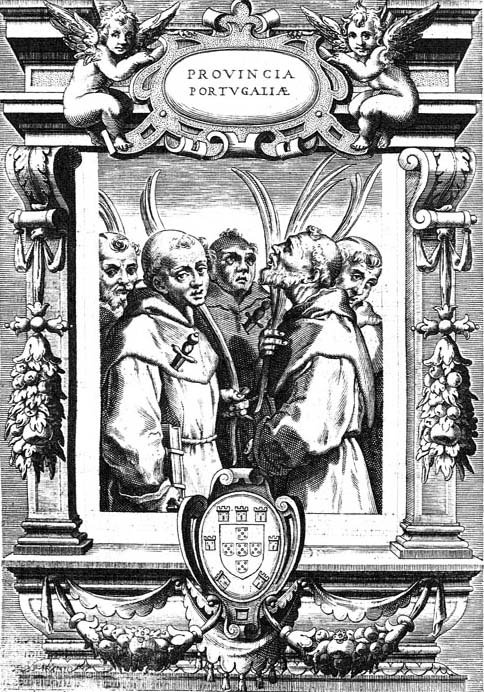
The Holy Father mentioned the Patron Saints of this blog, the Franciscan Protomartyrs, in his General Audience address today, on the life and works of one of the most popular of all saints, Saint Anthony of Padua, Il Santo. Saint Anthony's life was transformed by his meeting with those shining lights of the Friars Minor who went through Portugal on their way to Morocco, where they would be martyred:
In Coimbra, the event that would lead to a decisive turning point in his life would take place: there, in 1220, the relics of the first five Franciscan missionaries, who had gone to Morocco, where they met with martyrdom, were exposed [for the veneration of the faithful]. Their experience brought forth in the young Fernando a desire to imitate them and to follow in the path of Christian perfection: he then chose to leave the Augustinian Canons and become a Friar Minor. His wish was granted and, the name of Antonio being chosen, he also left for Morocco - but Divine Providence had other plans.

_________________________
Saints Berard, Otho, Peter, Accursius, and Adjutus,
pray for us!

"Viva il Concilio"


Austria...
America...
Australia...
Ireland...
England and Wales...
Germany... and others
What episcopate is the next one in the realm of large-scale sexual abuse scandals and systematic cover-up? There are large episcopates in Latin America and Asia going unnoticed...

An important new website

Traditional Parishes of the Roman Church

This aims to be a complete directory of all personal parishes in the Catholic world, dedicated to the Traditional Latin Mass.

Please email the webmaster at contact@traditionalparishes.net to suggest additions to the website.

Another Opus Dei church in Rome opens to the TLM

According to Messa in Latino, the Minor Basilica of Sant'Eugenio will now have a monthly TLM (every third Saturday of the month at 10 A.M.). This is in addition to the thrice-weekly private TLM's in Sant'Apollinare, earlier reported by Rorate.

What's going on in the Italian Church?

Argentinian daily La Nación summarizes the "Boffo affair" quite reasonably (the Italian dailies mostly ramble on and on...):
The Vatican, accused of an alleged conspiracy
An internal struggle divides the Church

Elisabetta Piqué
Correspondent in Italy

ROME - Intrigue, suspicion, betrayal, fratricidal war among prelates in the silent Roman palaces, in the best Borgia style. This is the climate these days surrounding the Vatican, accused by unnamed sources of being nothing less than the main source of the conspiracy that, last September, ended with the ousting of the once influential Dino Boffo from his position as editor of the newspaper Avvenire [the semi-official daily of the Italian Episcopal Conference].

The rumors, never denied by the Vatican, specifically accuse the Vatican Secretary of State, Cardinal Tarcisio Bertone, the Pope's number two, and the director of L'Osservatore Romano, Giovanni Maria Vian, of hatching a Machiavellian plan to hit Boffo, in order to attack his mentor, powerful Cardinal Camillo Ruini, former president of the Italian Episcopal Conference, and his successor, Cardinal Angelo Bagnasco, considered too independent. Everything in a dark and serious plot now under the observation of Benedict XVI [Rorate note: a report on the matter has been prepared for the Pope by his personal secretary, Mons. Gänswein, according to this Sunday's edition of La Repubblica]. A conspiracy that reflects the harsh internal struggles within the Italian Church.

To understand the plot one needs to take a step backwards. The Boffo affair erupted in late August, when Vittorio Feltri, director of Il Giornale, the Berlusconi family newspaper, launched a fierce campaign against the director of Avvenire, the daily of the Italian Episcopal Conference (CEI). Feltri then released a bomb: the information - which proved false afterwards, as [Feltri] himself would admit - on Boffo's "well-known homosexuality", even though Boffo had reached a settlement to avoid prosecution for harassing the wife of a married man 10 years earlier.

The sex scandals and parties of Berlusconi were still fresh [in the memory of Italians at the time]. And it was thought, therefore, that this was a counterattack of the Cavaliere [i.e. Berlusconi] against the daily newspaper of the CEI, which had dared to echo the protests of some Catholics against the very promiscuous behavior of the premier.

Reliable

But the "Boffo affair", which many considered closed when he resigned, dragged down by the scandal, broke out again now. It happened when Feltri, in an interview with the newspaper Il Foglio, reconstructed how he came to publish the dossier on Boffo: "A personality of the Church, which must be trusted institutionally, contacted me and sent me a photocopy of the report," he said. Feltri refused to give a name, but insisted on one point: it was someone "institutionally reliable" and "it was not possible to doubt him".

The revelation gave rise to speculations and rumors of all kinds on the plot allegedly hatched by Cardinal Bertone and Vian, in order to place in difficulties the cardinalatial duo Ruini-Bagnasco.

Made perfect in suffering

[E]t dixit mihi: Sufficit tibi gratia mea; nam virtus in infirmitate perficitur. Libenter igitur gloriabor in infirmitatibus meis, ut inhabiter in me virtus Christi.. (From the Epistle for the Sunday in Sexagesima: "And he said to me: My grace is sufficient for thee; for power is made perfect in infirmity. Gladly therefore will I glory in my infirmities, that the power of Christ may dwell in me.")
[W]hen someone desires to suffer, it is not merely a pious reminder of the suffering of the Lord. Voluntary expiatory suffering is what truly and really unites one to the Lord intimately. When it arises, it comes from an already existing relationship with Christ. For, by nature, a person flees from suffering. And the mania for suffering caused by a perverse lust for pain differs completely from the desire to suffer in expiation. Such lust is not a spiritual striving, but a sensory longing, no better than other sensory desires, in fact worse, because it is contrary to nature. Only someone whose spiritual eyes have been opened to the supernatural correlations of worldly events can desire suffering in expiation, and this is only possible for people in whom the spirit of Christ dwells, who as members are given life by the Head, receive his power, his meaning, and his direction. Conversely, works of expiation bind one closer to Christ, as every community that works together on one task becomes more and more closely knit and as the limbs of a body, working together organically, continually become more strongly one.

But because being one with Christ is our sanctity, and progressively becoming one with him our happiness on earth, the love of the cross in no way contradicts being a joyful child of God. Helping Christ carry his cross fills one with a strong and pure joy, and those who may and can do so, the builders of God’s kingdom, are the most authentic children of God. And so those who have a predilection for the way of the cross by no means deny that Good Friday is past and that the work of salvation has been accomplished. Only those who are saved, only children of grace, can in fact be bearers of Christ’s cross. Only in union with the divine Head does human suffering take on expiatory power.

To suffer and to be happy although suffering, to have one’s feet on the earth, to walk on the dirty and rough paths of this earth and yet to be enthroned with Christ at the Father’s right hand, to laugh and cry with the children of this world and ceaselessly to sing the praises of God with the choirs of angels this is the life of the Christian until the morning of eternity breaks forth.
Saint Teresa Benedicta of the Cross

Interview with SSPX District Superior for Asia

An old friend of the blog sends us the following:

This is Part I of an interview done with Fr. Daniel Couture, District Superior of Asia, for the Society of St. Pius X. In these interviews, Fr. Couture talks about the state of the Church in Asia, the history of the Asian District, its chief apostolates, the negotiations with Rome, Vatican II, and much more.

Part II of the interview is available at http://rencesvals.blogspot.com.

Proceeds from the sale of the DVD of these interviews will go directly to the SSPX Asian District. You can find the DVD here.


Bishop Fellay speaks on the Vatican-SSPX talks
An agreement is not "humanly" possible


[Update - New Catholic]

In his sermon in the Feast of the Purification, the Superior General of the Priestly Fraternity of Saint Pius X (FSSPX / SSPX) declared the following, among other things:

"And now, it is asked, will a result be achieved in the discussions with Rome, will we soon have an agreement? Frankly, sincerely, speaking in human terms, we do not see such an agreement in view. What does an agreement mean? On what are we in agreement? On the fact that only through the Church we find the means of salvation? ...
"This does not mean abandoning truth in order to find a middle way, absolutely not; yes, in human terms, we will not reach an agreement, the way we see things, [the talks] do not serve any purpose, in human terms. Yet, when we speak of the Church, we do not speak in human terms, we speak of a supernatural reality to which Our Lord promised that it would not fail, against which the gates of hell would not prevail. And, therefore, even if we face a difficult and contradictory reality, we know that events are in God's hands, He who has the means to put things in order. It would be proper to recall that to talk and to debate is necessary, but it is not enough: when one talks about saving souls, when one considers how God rescued the Church from other crises it faced through the centuries, we see that holiness is that with which He renews and heals the Church. Without grace, and remaining solely at the level of men, all is lost from the beginning. All of us, as Catholics, must, therefore, act, advancing in grace, in the love of God, in charity."

________________________________


Messa in Latino has the news of Bishop Fellay's discourse on the occasion of the reception of 13 new French seminarians for the SSPX on February 2, 2010.

The Messa in Latino article is here:

Fellay: umanamente, gli accordi con Roma sono impossibili; ma la Chiesa non e umana.

The La Porte Latine webpage with the audio recording of the bishop's speech:

Sermon des prises de soutane a Flavigny (See also this link on DICI.)

Rorate will provide a fuller report soon.

The saying aloud of the Eucharistic prayer: a development in the East


It is no secret that even the Orthodox Churches are experiencing much liturgical debate at present, although not (yet) to the same extent as the Catholic Church. Among the more important topics are: the saying aloud of Eucharistic prayers versus saying these "secretly", the question of the use of the vernacular vis-a-vis archaic Greek or Church Slavonic, the frequency of communion, the abbreviation of services or the unabbreviated serving thereof, and the question of the alleged "antisemitism" in the texts for Holy Week.

Naturally these debates are of great interest to Catholics, especially since many of the topics mirror the history of the liturgical reform in the Latin West, and many of the arguments (and much of the rhetoric) used by the various sides to these intra-Orthodox debates echo the arguments and rhetoric used by Catholics in our own debates. (I would like to add that in observing these debates, we Catholics should resist either of two excesses: the tendency to uncritically praise everything that the East does in liturgical matters, and the desire to force the Eastern Churches to adopt a Latin mindset, disrespecting their own ancient and legitimate traditions.) These are in addition to older but still smoldering controversies, such as the calendar debate.

To show our (mostly Catholic) readership a glimpse of where things might be headed, I would like to point out the following passages:

From an article marking the first anniversary of the enthronement of Kirill as Patriarch of Moscow and All Russia:

When Patriarch Kirill celebrates Divine Liturgy, sound amplifiers make every word he utters audible in every corner of the church – including the Eucharistic prayers that priests usually speak quietly at the altar during the main part of the service.

For a long time, Eucharistic prayers said aloud have been a mark of liberalism in the Russian Orthodox Church. In Russia, few priests had the bishops’ authorization to do so, and conservatives regarded the practice as inadmissible. But Patriarch Kirill resorted to high technologies to resolve the controversy – no one can accuse him of articulating those prayers loudly. At the same time, everyone can hear them. Thus the service becomes more intelligible and parishioners feel more closely involved in it.

Apparently, the late Russian Patriarch Alexy II did something similar:

Up to Patriarch Alexey’s time, it was common almost everywhere to partake of the Holy Mysteries of Christ very rarely, and people were not given communion on Nativity, Theophany, and Pascha at all. Patriarch Alexey, from the first day of his patriarchal ministry to the last, whenever he had the strength, himself communed everyone who strived to come to him to the very last person. He blessed people to commune often as well as on the feasts, and during the celebration of the divine liturgy he recited all prayers aloud. At some point, probably from over tiredness, he started to have problems with his voice and microphones began to be used. Due to that, probably not without God’s Providence, everyone who was standing in the church could hear the patriarch reading the priestly prayers in the altar and he was reading them in an absolutely marvelous way: with unusual simplicity, magnificence, and with some sort of inexpressibly beautiful intonation. Thus, the patriarchal liturgy became accessible, in much more fullness, to all the worshippers.


Photo source: link.