Rorate Caeli
Showing posts with label Ordinary-Extraordinary. Show all posts

Adventures in the Lex Orandi #3: Comparing the Old and New Orations for Our Lady of Sorrows

The feast of Our Lady of Sorrows is a relatively late addition to the Church’s universal calendar (as far as liturgical history goes): it was celebrated locally in the Middle Ages, growing in popularity in the fourteenth and fifteenth centuries. A feast of the Compassion of Our Lady entered the Roman Missal in 1482. The commemoration has been celebrated on the Sunday after the Exaltation of the Holy Cross (17th century), the Friday of Passion week (18th century), and September 15 (19th century). However much it may have moved around, this feast, like the devotion on which it is based, was always greatly loved. It was destined to survive even the otherwise ruthless scissors and paste of the Consilium in charge of the postconciliar liturgical reform. Nevertheless, as in nearly every case, the experts could not resist rewriting the orations of the day, and in this case they rewrote them completely.

First, let’s look at the old orations:

COLLECT

O God, at Whose Passion, according to the prophecy of Simeon, a sword of sorrow pierced the most sweet soul of the glorious Virgin and Mother Mary: mercifully grant, that we who with veneration ponder her sorrows may obtain the happy fruit of Thy Passion: Who livest and reignest with God the Father in the unity of the Holy Ghost, world without end, Amen.

Spaemann: "The Greatest Liturgical Problem is the Direction of Celebration of the Mass."

Robert Spaemann: “The biggest problem is the direction of the altar”


A native of Berlin and professor emeritus of philosophy at the University of Munich, Robert Spaemann is a member of the Pontifical Academy for Life. A specialist in the thought of Fénelon and author of a well-known critique of political utopia, as well as numerous moral works (including Happiness and Benevolence, PUF, 1997), he is a great friend of Pope Emeritus Benedict XVI. He received recent attention on account of some very critical comments on Amoris Laetitia. We are taking advantage of the holidays to present you with the reflections on the liturgy which he gave to Fr. Claude Barthe for the work Reconstruire la liturgie, published by Éditions Francois-Xavier de Guibert in 1997, that is, 10 years before the Motu Proprio Summorum Pontificum. Here, he explores the direction of the celebration, a question which has recently been the subject of a strong and clear intervention on the part of Cardinal Sarah, who was appointed Prefect of the Congregation for Divine Worship by Pope Francis, and to which we will return in subsequent letters.

***

Fr. Claude Barthe – You have often echoed the profound dissatisfaction of Catholics who are unhappy with the new forms of worship. You have contributed to a certain number of them rediscovering the traditional liturgical practice in Germany today.

Radicati Editorial: "Thank God We Did Not Obey Those Forcing the New Mass Upon Us"


The New Mass, Source of Pious Naturalism

Editorial: Radicati nella fede, June 2016
Newsletter of the Catholic community of
Vocogno, Diocese of Novara, Italy


Thank God we did not obey.

We are going to shock you, but some provocations are beneficial and useful.

Thank God we did not obey those, who, in order to keep us within “ordinary pastoral care” (while allowing us reluctantly an occasional Traditional Mass) asked us not to be closed to the Council’s New Mass. Thank God we did not obey: we did not cave in to the “political” concern of altering the custody of the faith which is what everyone is doing now out of “a greater obedience.”

A Vatican II Moment - True Liturgical Movement: Pontifical Bike Mass in Palermo, Italy

April 27, 2016

All vested, all wheeled: the Biking Mass, celebrated by the Archbishop of Palermo, Corrado Lorefice, part of the Jubilee for Sportsmen celebrated in the Cathedral.

(Tip: Le Forum Catholique)

OP-ED: "To Ross Douthat, With Affectionate Correction", by Fr. Richard Cipolla - Church Crisis, the True Battle, and Sacred Liturgy

To Ross Douthat, With Affectionate Correction

Fr. Richard G. Cipolla, DPhil

Paolo Veronese - The Wedding Feast at Cana (1563) - Musée du Louvre

It is certainly true, as has been observed on Rorate Caeli, that Ross Douthat’s Erasmus Lecture for First Things has caused quite a stir in traditional Catholic circles.  Msgr. Pope’s article bemoaning the lack of growth in the presence of the Traditional Mass in the Church has also gained the attention of Traditional Catholics, but that article lacks the depth and urgency that is contained in Douthat’s lecture. Many of us have admired his Op-Ed pieces in the New York Times, often wondering how he achieved his position amidst the quintessential Liberal Establishment embodied by that paper of record.  His skirmish with the Catholic theologians (and I have refrained from putting theologians in quotation marks out of some sense of objectivity, despite my belief that there may no longer be any Catholic theologians, for Catholic theologians have to be immersed in the Tradition, and there do not seem to be any who are so today) is an example of the proper role of the laity in the Church as encouraged by the Second Vatican Council. 

A Vatican II Moment in Philadelphia: Widespread Concelebration is the Celebration of Man


"Concelebration, whereby the unity of the priesthood is appropriately manifested, has remained in use to this day in the Church both in the east and in the west. For this reason it has seemed good to the Council to extend permission for concelebration..."
Sacrosanctum Concilium, 57

Yep, great idea! Click!
[Image: CNS]

Dr. Kwasniewski’s Lecture at Steubenville: “The Old Mass and the New Evangelization: Beyond the Long Winter of Rationalism”

On Monday, September 7, 2015, Dr. Peter Kwasniewski (one of our contributors and well known to lovers of the traditional liturgy) delivered a lecture at the Franciscan University of Steubenville. The event was well attended by students, faculty, and staff. Rorate is pleased to be able to publish the text in full -- an exclusive publication, for which we are very grateful.


***

The Old Mass and the New Evangelization:
Beyond the Long Winter of Rationalism

Peter A. Kwasniewski [*]
Gentile Gallery of the J. C. Williams Center
The Franciscan University of Steubenville
September 7, 2015

It is an honor and a joy for me to be here this evening. I am grateful to Dr. Michael Sirilla for the invitation to speak at the Franciscan University of Steubenville, which, for so many years, has maintained the reputation of a school where Our Lord Jesus Christ is “the king and center of all hearts” and where the Catholic Faith is taught, practiced, and loved. On a more personal note, I have the feeling of “coming full circle,” since I taught for the Austrian Program at the Kartause in Gaming, and at that time mingled with many wonderful people from the university—but never had a chance to visit the home campus.

As I was working on this talk, I came to see that my title, “The Old Mass and the New Evangelization,” really deserves to be a book, not a lecture. I decided to limit myself to an aspect that seemed especially fruitful—“Beyond the Long Winter of Rationalism”—even though one could approach the topic from so many angles.[1]

Rediscovering the Ancient Mass

Announcing a New Book on the Traditional Liturgy

We are happy to announce to readers of Rorate Caeli the publication of a new book, Resurgent in the Midst of Crisis: Sacred Liturgy, the Traditional Latin Mass, and Renewal in the Church (Angelico Press, 2014; 224 pp. paperback), by our own contributor, Dr. Peter Kwasniewski.

A Letter from a Reader: “It’s so refreshing to be able to let go of useless baggage from recent decades”

St. Josemaría Escrivá (Oct. 2, 1968)
One of the most interesting and gratifying aspects of carrying out an apostolate of writing is the letters received from readers, conveying a wide range of observations and questions, difficulties and disagreements, suggestions and requests. Occasionally I receive a letter of such superlative quality or penetrating insight that I feel it ought to be shared with readers.

What follows is one such letter, whose sender gave me permission to post it anonymously. It is in many ways a sad reflection on our times, and yet it has the virtue of eloquently expressing the growing awareness among Catholics of the abysmal failure of churchmen to address the real problems facing the Church today—problems that handicap and tranquilize the dreamt-of New Evangelization before it can even get off the starting blocks.

Here, then, is the letter. I reproduce it without comment.

O Crux, Ave, Spes Unica:
The Mass of Tradition

Editorial: Radicati nella fede, July 2014
Newsletter of the Catholic community of
Domodossola and Vocogno, Diocese of Novara, Italy

________________________________


Last month, when we talked about the solemnity of Corpus Christi, we mentioned the great danger of forgetting the sacrificial nature of the Catholic Mass. A forgetfulness which leads slowly but inexorably to heresy. On this point we should never forget Michael Davies’ great work on the Anglican Reform, which underlines the danger of “what’s left unsaid” in liturgy: Cranmer’s Anglican Reform, in removing all of the explicit references to the propitiatory Sacrifice, successfully introduced Protestantism into England in the space of a generation and brought the country definitively into heresy.

Last month, however we pushed it further saying, that by forgetting the Mass is the Sacrifice of Christ on the Cross, the awareness of the Substantial Presence of Christ in the Most Holy Eucharist is inexorably lost: if we don’t have the Victim, we don’t have the Presence of Jesus Christ, since Christ is present in the Eucharist as Victim. A Mass increasingly identified as a commemoration of the Last Supper truly risks not being a Catholic Mass. It is undeniable that the last reform to the Mass, the one in 1969, made it more and more like the Protestant Holy Supper, Anglican or Lutheran - whichever it is.

There is still something else though: A Mass that is more and more “protestantized” has “protestantized” the Catholic faithful in its mission, so much so, that each day they resemble more and more Protestant congregations, “involved in the world. “

If we don’t have the Victim, we don’t have the Presence of Christ either. This is true for the Mass and the Blessed Sacrament but it is also true for the entire work of the Church. If Christ Crucified is no longer at the heart of the doctrinal preaching and pastoral work of the Church, the entire mission of the Church risks being frighteningly empty. Never before as in the last few decades have we seen so many pastoral efforts with techniques that have been refined for effective communication; never as in the past fifty years have there been so much talk of mission with hardly any good results. The Church has moved towards the world continuously announcing and announcing, and its relentless de-Christianization has taken place.

Who, among the Fathers of the Council could have imagined, that the Catholic Faith would have almost disappeared in the space of fifty years? Who among the Bishops of Vatican II, could have imagined the advent of the anti-Catholic and immoral society that we have today, where every law seems to be made purposely against the plan of God for man?

Yet, it is undeniable. This disaster is before our very eyes.

If we no longer have Jesus-Victim, we don’t have Jesus-Present either.

A Church that has been enthusiastically “encountering” the world since the ‘60s and has put the Cross of Christ in second place, has lost Christ Himself and has brought nothing or almost nothing to society. It needs to be said clearly: without the centrality of the Cross, without the centrality of Christ crucified, you lose Christ Himself. The ones who speak about Jesus without His Cross and its centrality, are suffering a terrible delusion. The ones who put the Cross of Christ “among the many other things” in the life of Jesus, but don’t’ envisage the center - in truth - they are not even talking about Christ. They are talking about a “confectioned” Jesus specially for the modern world, which like the Jews and gentiles of Saint Paul, judged Christ Crucified as a scandal and foolishness.

The decision was made to go into world and have friendly dialogue with it, avoiding the condemnations of the Church in the past; in order to have friendly dialogue, they had to “veil” or “hide” the Cross and the Sacrifice of Christ, so that the dialogue with modern society, with its religions, would be serene and amicable, resulting in the twofold tragedy of not having brought anything to the people of these times and, worse, in devastating the Sanctuary of the Presence of God, which is the Church.

We cannot avoid it: we must be the first to accept and embrace the scandal of the Cross, recognize it as the central content of the Church’s doctrine, life and mission, and so, not calculating the results, but confident in the infinite power of God’s grace, go into the world so that it will be converted and healed by the Cross of Christ.

Woe to those Catholics, woe to that Church, that wants to convey another Jesus without the Cross! It will lose its essence, strength, soul and its exclusive power of grace. In addition. it will become more and more useless and unbearable to the world that it wanted to reach. A Church without the Sacrifice and the Cross is detestable and unbearable to the world.

What is more, the world is now ready to savage such an empty Church.

In hoc signo vinces, is not only a memory from past history, it is the truth of every single moment: the victory is in the Cross and of those who bring it and show it to the world, without human calculations.

O Crux, ave, spes unica, Hail O Cross, our only hope; if there isn’t a return to this clarity in all things – truly in the entire Church - the disaster will be inevitable.

This return begins though with the Holy Sacrifice of the Mass.

If faced with this devastating picture of confusion we feel powerless; if powerless we are wondering what to do and above all where to begin, let’s remember that the rebuilding of the Church will always start from the Holy Sacrifice of the Mass. Let’s not make human calculations, let’s not make the same mistakes of the 60s, let’s not go into the world, with our techniques, not even to rebuild Tradition, but let’s start again from the Mass.

We say this first to priests and then to the faithful: let’s return immediately to the Mass of Tradition. Let’s return to the correct Rite of the Holy Sacrifice of the Mass and from there we can begin again the painstaking work of rebuilding the faith. Let’s not make the mistake of doing the opposite, first pastoral work, then a return to the Mass of Ages, it would be basically hiding the Cross of Christ again, in the expectation of better times, as the deluded missionaries did in the post-conciliar years.

The truth instead is Christ.


The truth instead is in the reality of His Redeeming Sacrifice, perpetuated in the Catholic Mass. The first duty of priests is to celebrate it. The first duty of everyone is to live by it, so that life, true life, will continue.

______________________
[Translation: Contributor Francesca Romana. Main image, and in details: Diego Velázquez, Cristo Crucificado (1632), Museo Nacional del Prado.]

Attempting serious Communion at an unserious liturgy

Premières communiantes [First Communicants]
Musée de la civilisation, Québec

As the Church recently observed one of the ten universal holy days of the liturgical year, the subject of Holy Communion has naturally come up in different arenas for discussion following the feast of Corpus Christi.  One such blogger, Deacon Gregory Kandra of the Diocese of Brooklyn, New York, wrote a piece that offered guidance to communicants who attend the novus ordo liturgy.

In doing so, he inadvertently exposed some of the absurdities of trying to improve decorum and seriousness with the distribution of communion at a liturgy that seriously lacks seriousness.

For instance, Deacon Kandra wrote:

"The Eucharist remains the greatest gift, the 'source and summit' of our faith, and we shouldn't approach Holy Communion like we are standing in line at the DMV."

The Department of Motor Vehicles (DMV), for the benefit of our foreign readers, is, in the United States, the state-level government department responsible for the registration of motor vehicles and that administers procedures for driver licensing. It is important to note that DMV-looking lines only happen to be at locations that predominantly feature communion-in-the-hand (which Deacon Kandra seems to claim as more historically Catholic than receiving on the tongue).  And why not?  If the end-game is to approach a lady who will place a host in your palm while the communicant stands, then the casual approach is naturally going to become the norm. 

It took 20 seconds to find this photo from Deacon Kandra's own diocese.  


Compare the above Brooklyn parish to the Institute of Christ the King's mission in Gabon. Which one is more conducive to belief in the Real Presence?


In addition to the parish level, take, for instance, mass Masses. Communion was never intended to be distributed to thousands of people at Mass, even following the reforms and preachings of Pope Saint Pius X.

When Francis Cardinal Spellman, archbishop of New York, offered a traditional Latin Solemn High Pontifical Mass at Yankee Stadium in the Bronx in 1957, he alone received communion.  The 50,000 others did not receive.

When Pope Paul VI, on October 4, 1965, offered a Mass for Peace at Yankee Stadium using the "1965 missal" (the 1962 missal, with the many alterations ordered by Inter Oecumenici, as a supposed application of Vatican II), here is what one diocesan newspaper reported:

Another kind of "Reform of the Reform"?
A homily by ersatz-priest Madam Marie-Josèphe Lachat

The novus ordo mass below is not at all unusual - quite the contrary, it is an average (or even above average) "well celebrated" mass of Paul VI, in its prevalent format around the world. What is slightly more unusual (though far from surprising) is that the homily, immediately following the reading of the Gospel,* is preached by what is, in all but name, a vested female ersatz-priest, Madame Marie-Josèphe Lachat, "Pastoral Assistant," with "use of an episcopal mandate for preaching" ["au bénéfice d'un mandat épiscopal pour la prédication"]


The "homily" ["homélie"] (that is what it is called) begins soon after 23:40 -- the entire ceremony is in French, naturally.

The official information is provided by the French-language public broadcaster Swiss Radio Television (RTS):

Mass at the Church of Saint Peter at Porrentruy (Jura Canton)
Presidency: canon Jacques Oeuvray. [*note: in the Proclamation of the Gospel, just to show how "très cool" he is, the deacon does not say, "the Gospel (Évangile) according to...", but "the Good News (la bonne nouvelle) according to..."] Preaching: Marie-Josèphe Lachat, pastoral assistant. [Sunday, May 18, 2014]

Not that the bishop, who gave her the "mandate for preaching," is unaware of it. Just a couple of weeks later, in a confirmation ceremony, there was Madame Lachat one more time, vested with her alb next to all local priests and deacons.
_______________________________

Is this a rupture with the entire Tradition of the Church? Yes. Is it disobedience to all norms regarding preaching in a liturgical setting? Yes. Will anything be done about this? Of course not : in the name of "progress", all norms, of divine or human institution, Tradition, and traditions can be violated. Whoever does not see the beauty in all of it is simply a "reactionary" who "does not accept Vatican II" -- even if the conciliar documents say absolutely nothing that would ever allow for this anti-Catholic practice. And that, "reaction", is what should be punished and restricted, even if it only means wanting to worship as the Church always worshiped. 

[Tip: Riposte catholique]

Extraordinary and Ordinary: The Expected and the Unexpected

Father Richard G. Cipolla


The unexpected is often not the norm in the practice of the Catholic faith.  One of the great strengths and evidence of the truth of the Catholic faith is its "ordinariness".  The Catholic faith lives and sustains its people in everyday life in "ordinary" ways:  by prayers, often memorized, by assisting at Mass, by doing one's best to obey the precepts of the Church and living a life that is "ordinarily" Catholic.  But the extraordinary is also an important part of the Catholic faith and the experience of that faith.  The lives of the Saints in their details are obvious examples of the extraordinary that breaks through the ordinary of the practice of Catholic life.

But there are times when the extraordinary breaks through even for those of us who are not saints, at times that we do not expect this, and almost in spite of ourselves and our preoccupations.  Last Saturday, as I entered the sacristy to celebrate the Traditional Mass, I assumed that we would be using the Missa Brevior, the shorter form of the Mass for Ember Saturday in the Octave of Pentecost.  I assumed this because we were not ordaining priests on this day, which  was the traditional day for ordinations, nor was this a "conventual Mass" in the strict sense.  I was informed that we were using the  "ordinary" from of this Mass with its several Old Testament readings, its several collects, its several Alleluias.  My first instinct--and this shows how deep the corruption of the meaning of the Liturgy truly is even among those who profess to love the Tradition--was to question whether this was good "pastorally" for our people assembled for this Mass.  There was no question that I personally preferred the "ordinary" form of this Mass, as long as it was.  But I did not trust that the people could "take this", the number of readings, the Alleuias, the length of the Mass.  But I agreed that we would offer this Sung Mass in the "ordinary" form of the "extraordinary form" , despite having only one server (very faithful) for this Mass.

Two things happened.  The first concerns me personally.  As I sang the Mass, I was astounded at its beauty:  the Old Testament readings:  the repetition of the prophet Joel's "dreaming dreams", the readings from the books of the Law about the festival of the "first fruits" fifty days after Passover, and the role of the priest in this offering of thanksgiving; the deep theme of thanksgiving for the goodness of God and his favor to his people; then the marvelous reading from Daniel about the miracle of the fiery furnace, the reaching down of God to save his people in what looks to be a hopeless situation; the Epistle from Romans: that Peace that is the fruit of being justified by faith in Jesus Christ as Lord and Savior; the Gospel:  the healing of Peter's mother-in-law, itself a sign of the reality of the person of Jesus Christ. But then the point of the gospel:  the crowds want more, but Jesus retires and tells them that he has a mission to preach the kingdom of God to other towns and other places.  And each reading preceded by a prayer to God that the Holy Spirit will be a reality in the Church and among her people, and a brief but beautiful and powerful Alleluia after each reading pushing us along in this wonderful contemplation of the meaning of Pentecost.  By the time of the reading of Daniel, my heart was deeply touched, and I realized not only how foolish I had been in worrying over the long "ordinary form". But I also realized once again, as I have in so many moments in my priesthood, not only how much we have lost in the brutal Bugnini butchering of the rite of the Mass, but also the tragedy of the failure of nerve, failure of courage of the original Liturgical Movement.

While I was taking off my vestments in the sacristy after that Mass, a woman asked to see me and waited outside the door.  I was still deep in thought about what I had experienced at the Mass, when she entered to speak to me.  She is a real woman of the Church, at home in both forms of the Roman Rite, who actually attends more Novus Ordo Masses than Traditional Masses.  This is what she said: "Father, I had to tell you this.  That Mass was so beautiful that it made me cry."  And she left me standing there, as I thanked God for this unexpected confirmation of what I had experienced and what I have been given to know.

The original purpose of the Liturgical Movement of the 19th and 20th century was to educate--in the best sense of this word--Catholics in the meaning and richness of the Liturgy as given.  It was to open up to the Catholic faithful the riches of the Liturgy, which had been obscured by legalism and "rote-ism".  And at the very time that the Catholic faithful in so many parts of the Western world were taking their places among those best educated, those with jobs with great responsibility, when even public office at the highest levels became possible for Catholics:  those in charge lost their nerve, and rather than taking on the heavy but do-able task of educating both priests and laity in the glory of the Catholic Liturgy, they decided to take the much easier, and shallower, path of inventing a new Liturgy that would require no education at all, that would require no effort on the part of the priests and laity at all.  What they did in the name of aggiornamento was to lock the liturgical rites of the Church in the 1960s, and that is what we are burdened with now.  It is notable that the theatrical performances of "Hair" scheduled to open in San Francisco just recently had to be canceled for lack of interest.  Only those in their 60s and 70s have any interest in that peculiar and yet deeply anti-Traditional wind that swept through the Western world at the time of the Second Vatican Council.

Saying this does not trash the Second Vatican Council nor the Novus Ordo Mass that is a product of a particular time and place. That the Novus Ordo Mass is the "ordinary form" of the Mass that the overwhelming majority of Catholics experience every Sunday cannot call into question the validity of that Mass or the reception of grace in Holy Communion.  God can do all sorts of "extraordinary" things.  He is not limited in any way.  But we are in a situation in which most of the Church, and this includes Popes, bishops, priests, as well as laity, have no idea what we have lost.  Pope Francis gave an adress recently deploring the "loss of memory" of Europe, the loss of memory of their culture based upon the Christian faith.  But surely, this loss of memory cannot be separated from the deliberate evacuation of that deep and intrinsic source and place of memory that is the Traditional Roman Mass.


[Image source: FSSP - Wigratzbad seminary, visit to Ottobeuren Abbey]

The opinion of the most radical Council Father:
Complete Coexistence of Traditional Mass and a New Mass

Among those Council Fathers who publicly expressed their opinion on Sacred Liturgy during the debates (First and Second Sessions) on the schema De Sacra Liturgia which led to Constitution on the Sacred Liturgy (Sacrosanctum Concilium), none was more radical than German-born bishop Wilhelm Josef Duschak, S.V.D., Vicar Apostolic of Calapan, in the Philippines.

He was the only bishop ever to propose, in the official Council discussions, an actual reform of the Canon of the Mass, a matter which was considered unthinkable for most Council Fathers -- even though it would be effected "ad experimentum" in many countries as soon as the Council ended, and, permanently, with the creation of the new Ordinary of the Mass, in 1969. Duschak was, thus, in the avant-garde of the most radical liturgical reformers -- the only bishop to voice openly what other bishops and especially many periti said and wrote in the Conciliar underworld:


Bishop Duschak* from Mindoro was the first to suggest that Latin be completely eliminated from the Mass and that priests would face the people at all times; other bishops had encouraged a greater use of vernacular languages while still retaining some Latin. Duschak proposed a Missa Orbis or Mass of the World. Interviewed later, Duschak said: “I haven’t too much hope that my idea will be accepted any time soon. But, as a good Filipino, I say—paciencia!”

But even such a radical liturgical reformer as bishop Duschak displayed a demeanor towards the Traditional Latin Mass which would shame the most recalcitrant among his episcopal colleagues of our own age. As Father Ralph Wiltgen, S.V.D., the liberal-minded press coordinator for the Divine Word Missionaries' Conciliar News Service, recalled in his famous "The Rhine flows into the Tiber", regarding the memories of that first session of the Council (1962):

Bishop Duschak emphasized that he was not proposing the abolition of the existing form of the Latin Mass. He was merely proposing that an additional form or structure of the Mass be introduced.

___________
*Note 1: The original PDF file was located here (http://www.jesuits.ph/windhover/WH4Q05.pdf, visited on Oct. 26, 2006), but has since been removed. A copy is to be found at the Internet Wayback Archive. The same reference is also found in several works covering the liturgical reforms.

Note 2: Interestingly, Duschak also answered reporters on the demand for a new form of the Mass among the native peoples of his Vicariate:
Asked whether his proposal originated with the people whom he served, he answered, "No, I think they would oppose it, just as many bishops oppose it. But if it could be put into practice, I think they would accept it."
And so they did: the liturgical revolution, as almost all revolutions, emanated from the "Enlightened Élite" to the ignorant people...

[Repost. First posted on Oct. 21, 2006.]

What does it mean to be a "traditional Catholic"?
Aren't all Catholics traditional?

a guest-post by Peter Kwasniewski PhD

Tradition means handing on something to someone
(Traditio of the keys to St. Peter - 12th Cent. manuscript, France)

It is sometimes asserted that traditional Catholicism is bound up with a prideful attitude—that it is impossible to profess traditionalism without being pharisaical. Some even object to the phrase “traditional Catholic,” as if it were redundant: Aren’t Catholics by definition adherents of Catholic tradition—and thus, any Roman Catholic has as much right to be called “traditional” as he has to be called “Roman”?

How nice it would be if this were true, but alas, it is far from being the case.

First, the psychology of the issue. There is a danger of pride or pharisaism in any possible true description of oneself: Christian, Catholic, Roman Catholic, traditionalist. To say “I am a Christian” is a genuine boast for St. Paul and for every martyr who has died for Jesus Christ, including the God-fearing victims of Islamic extremism in Syria and elsewhere. Are we to say that because someone might revel too much in the title of Christian and think himself better than his unbelieving neighbor, the very title ought to be abolished? One might just as well avoid baptism, which, thanks to no merits of our own, truly makes us better than we were before, and far better off than any unbeliever.

Tradition of goods and assets: a concept well established in Roman Law. 
"Traditio nihil amplius transferre debet vel potest ad eum qui accipit, 
quam est apud eum qui tradit." (Corpus Iuris Civilis, Dig., XLI)
(Justinian, Basilica of San Vitale, Ravenna)

Or, to take up the charge of redundancy: “Catholic Christian” may seem like a triple redundancy, yet it is useful precisely because there are Protestant and Eastern Orthodox Christians.

“Traditional Catholic,” likewise, is no redundancy, because there are so many Catholics who are, intentionally or not, modernists in their thinking and their practices. In an ideal world, the Christian ought to be the Catholic, just as the Catholic ought to be traditional; but even as not every Christian is Catholic, not every Catholic is traditional in a meaningful sense of the word.

Pursuing this point, we would be deceiving ourselves if we did not recognize that it is quite possible today—in a startling and unprecedented way—for Catholics not to be traditional, not to be thinking and living in accordance with major elements of their 2,000-year tradition, such as asceticism, liturgical praxis, and adherence to orthodox doctrine. For the first time, we have seen the widespread acceptance of an interpretation of Catholicism that is anti-traditional, that considers itself free from tradition, free to reshape itself according to indeterminable “modern needs.” Apropos the concept of aggiornamento, Karl Barth apparently asked the Catholic Church this uncomfortable question in 1966: “When will you know if the Church is sufficiently updated?” This is the Achilles’ heel of every Weigel-style critique of traditional Catholicism: just like Bugnini in his liturgical reform, Weigel has to pick and choose what’s worth keeping and what ought to be discarded in his evangelical re-envisioning of the Church, as if he were standing outside of tradition, history, and papal teaching, standing over it rather than submitting to be formed, measured, and judged by all of it.

If there are dangers of pride in any state or way of life, there is no less a danger of being proud of one’s very open-mindedness, one’s freedom from ideology, one’s immunity to the error of judgmentalism, one’s superbly balanced apprehension of reality. One can be a Pharisee of open-mindedness, an ideologue of dialogue, a dogmatist about refusing to dogmatize. One can be simplistic by seeing everyone who takes a strong line as a simpleton.

The only one who can escape pride, judgmentalism, and ideology is the one who completely submits his mind to an objective external standard, one who submits his heart to another whom he loves without qualification. The traditional Catholic is one who says: There is such a standard, and it is Divine Revelation, communicated to us in Scripture and Tradition and guarded by the perennial Magisterium. He is one who says: There is such a beloved, our Lord Jesus Christ, to whom absolutely everything—all human actions and sufferings, all arts and sciences, all cultures and governments, cities and nations—must be intentionally and explicitly ordered if they are to achieve their God-given purpose. And when they are not so ordered, they are doomed, over time, to feebleness, perversion, anarchy, and suicide. The traditionalist can maintain these positions humbly because they are true, and it is the truth that sets us free from all sin, including the sin of pride.

Traditio means delivering something to someone
(St. Peter holding keys delivers Epistle to St. Silas from his Chair -
cf. I Pt 5:12 - 14th Cent. Bible, France)

The traditionalist desires to receive humbly what the Lord has given us, to open wide his heart to his blessed inheritance that is always so much greater than his own limited mind can comprehend, much less improve upon. The pridefulness of the modern(ist) Catholic consists in thinking himself superior to his Catholic inheritance—in a position, one might say, of “self-absorbed promethean neopelagian” creativity towards what has been devotedly handed down, century upon century. The judgmentalism of the modern Catholic can be seen in his dismissive attitude towards traditions and the traditionalist who loves them, whom he refuses to see as a lover of the full breadth and depth of Christ and of His Church, and whom he finds it easy to caricature as narrow-minded, rigid, joyless Pelagian, et cetera.

I am reminded in this connection of some pointed remarks by Cardinal Siri, published in the Rivista Diocesana Genovese in January 1975 (courtesy of Rorate):

Slogans abound, while catechism is not taught; “pastoral” is continually mentioned, while sacred ministries are gradually abandoned; there is talk of the Word of God—yet it is taught as if it were all a fairy tale. There are dissertations about closeness with God, while at the same time the Most Blessed Eucharist is mocked or ridiculed. At least in practice. And all of this is progress!

One might have thought, in recent years, that Catholics were at last beginning to escape the shadowlands of the seventies, leaving its pomps and works far behind. Alas, in the Church today we are seeing a renewed effort on the part of some to promote the same old postconciliar “progress” lamented by Cardinal Siri. We are being given as our “pastoral model” a modus operandi that originated in the secularizing confusion of the years immediately following the Council—a modus operandi that badly failed back then and will, by God’s justice, fail again and again, since it is anti-traditional in content, method, and goals.

Indeed, something worse has come upon us: a return to the open denigration, marginalization, and persecution of traditionalists. It is as if, in the wake of the Emancipation Proclamation, there were a new regime intent on reintroducing slavery or, at best, arranging strict segregation and second-class citizenship. In the realistic words of Don Ariel Levi di Gualdo:

We did have the Second Vatican Council, but, in practice, during the following years, we returned to the period that preceded the Council of Trent, with its corruption and alarming internal struggles for power. After abundant discourses ad nauseam about dialogue, collegiality—for nearly half a century now—new forms of clericalism and authoritarianism have emerged. The progressive champions of dialogue and collegiality use aggression and coercion against anyone who thinks outside of the “religiously correct.” (Don Ariel, cited at Rorate)

To return to our point of departure: in normal circumstances, “Catholic” should be equivalent with “traditional.” Today, it decisively does not mean that; indeed, with the infiltration of modernism into the highest echelons of the Church, it cannot mean that, for some individuals. And yet, since to be a Catholic is—and must always be—to adhere to the Tradition handed down to us from the saints and to honor and preserve Catholic traditions, it follows that an explicit or implicit adherence to Tradition is, in fact, necessary for salvation, whereas hating or despising Tradition is a sign of one’s intention to depart from the Church of Christ, as a result placing one’s soul in jeopardy. There is far more resting on this matter than a particular person’s preference or inclinations: the very salvation of souls is at stake. The joy of the Gospel is bound up with knowing the truth, confessing it in season and out of season, and clinging to it with the determination of love. May God preserve us from the false joys of this world and all of the new Gospels that clamor for acceptance.

[Images and captions chosen by NC for the Feast of the Chair of Saint Peter.]

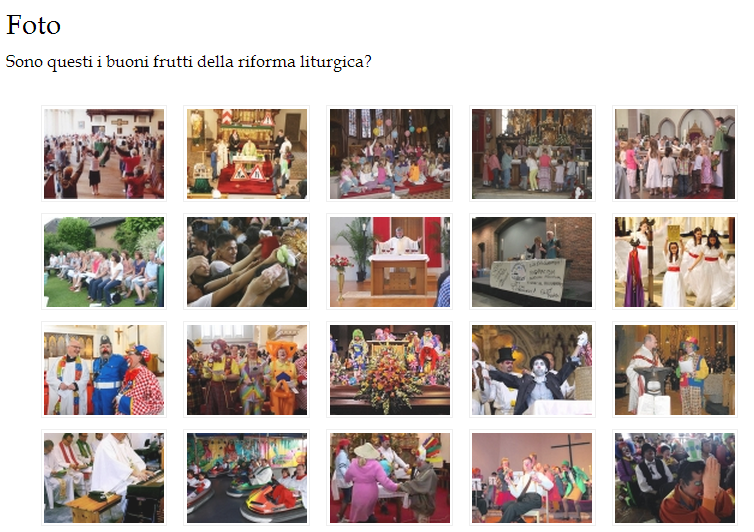
"By their fruits ye shall know them"
The Good Fruits of the Novus Ordo Missae?

Concilio Vaticano Secondo, a website dedicated to a realistic analysis of the aftermath of the Second Vatican Council, has recently posted a collection of images of what we can only call the fashion-crazed rite, the inconstant and fickle Rite of Paul VI.

Many of these are well known images, several were posted by us originally - and at least one of them is, mistakenly, from an Anglican/Episcopalian service - but we thank Mrs. Francesca Croci for having gone through the agonizing trouble of collecting them in one single page.


[We thank the Twitter follower who pointed us to this collection.]

The Devirilization of the Liturgy in the Novus Ordo Mass
[Exclusive article]

Fr. Richard G. Cipolla, Ph.D., D. Phil.(Oxon.)
Weymouth
June 5, 1944

The correspondence between Cardinal Heenan of Westminster and Evelyn Waugh before the promulgation of the Novus Ordo Mass is well known, in which Waugh issues a crie de coeur about the post-Conciliar liturgy and finds a sympathetic, if ineffectual, ear in the Cardinal.[1]   What is not as well known is Cardinal Heenan’s comment to the Synod of Bishops in Rome after the experimental Mass, Missa Normativa, was presented for the first time in 1967 to a select number of bishops. This essay was inspired by the following words of Cardinal Heenan to the assembled bishops:

At home, it is not only women and children but also fathers of families and young men who come regularly to Mass. If we were to offer them the kind of ceremony we saw yesterday we would soon be left with a congregation of women and children.[2]

What the Cardinal was referring to lies at the very heart of the Novus Ordo form of the Roman Mass and the attendant and deep problems that have afflicted the Church since the imposition of the Novus Ordo form on the Church in 1970.[3]   One might be tempted to crystallize what Cardinal Heenan experienced as the feminization of the Liturgy. But this term would be inadequate and ultimately misleading. For there is a real Marian aspect of the Liturgy that is therefore feminine. The Liturgy bears the Word of God, the Liturgy brings forth the Body of the Word to be worshipped and given as Food. A better terminology might be that in the Novus Ordo rite of Mass the Liturgy has been effeminized. There is a famous passage in Caesar’s De bello Gallico where he explains why the Belgae tribe were such good soldiers. He attributes this to their lack of contact with the centers of culture like the cities. Caesar believed that such contact contributes ad effeminandos animos, to the effeminizing of their spirits.[4] But when one talks about the effeminization of the Liturgy one risks being misunderstood as devaluing what it means to be a woman, womanhood itself. Without adopting Caesar’s rather macho view of the effects of culture on soldiers, one certainly can speak of a devirilization of the soldier that saps his strength and resolve to do what a soldier has to do. It is not a put-down of the feminine. It rather describes the weakening of what it means to be a man.

This is the term, devirilization, that I want to use to describe what Cardinal Heenan saw that day in 1967 at the first celebration of the experimental Mass.[5]    In its Novus Ordo form, what Benedict XVI’s Motu Proprio: Summorum Pontificum somewhat cumbersomely, if understandably, calls the Ordinary Form of the Roman rite, the Liturgy has been devirilized. One must recall the meaning of the word, vir, in Latin. Both vir and homo mean “man”, but it is vir alone that has the connotation of the man-hero and is the word that is often used for “husband”. The Aeneid begins with the famous words: arma virumque cano. (“ I sing of arms and the man-hero.”) What Cardinal Heenan presciently and correctly saw in 1967 was the virtual elimination of the virile nature of the Liturgy, the replacement of masculine objectivity, necessary for the public worship of the Church, with softness, sentimentality and personalization centered on the motherly person of the priest.

The people within the Liturgy [6]   stand in a Marian relationship to the Liturgy: attentiveness, openness, pondering, waiting to be filled. Within the Liturgy it is the priest as father who pronounces, announces and confects the Word so that the Word may become Food for those who stand within the supreme activation of the Ecclesia that is the Liturgy.[7]   It is the priest who offers Christ to the Father, and it is this act that contains the defining role of what it means to be a priest. And so the role of the priest as father makes his role distinct not merely in function but in the very ontology of sexuality.[8]    The priest stands at the altar in persona Christi, in persona Verbi facti hominem, and this not merely as homo, which word in a sense transcends sex, but in persona Christi viri: in a sense homo factus est ut fiat vir, ut sit vir qui destruat mortem, ut sit vir qui calcet portas inferi: God became man in order that he might be that man-hero who would destroy death and crush with his own foot the gates of hell.

The devirilization of the Liturgy and the devirilization of the priest for all practical purposes cannot be separated. In what follows I wish, however sketchily and incompletely, first to talk in more specific terms about the devirilization of the Liturgy itself in the Novus Ordo form of the Roman rite. Secondly I will address the the necessary (coming from the devirilized rite) devirilization of the priest using specific examples.

The description of the Roman liturgy using adjectives like “austere”, “concise”, “noble” and “simple,” is commonplace among many who have written about the liturgy in the modern liturgical movement of the twentieth century. Many of these writers, however, have romanticized this austerity of the Roman rite or have used it to further their own agenda of stripping the rite of the organic growth of the ages, labeling such organic growth with censorious terms like “Gallican accretions “or “useless repetitions”. Rather than denoting the Roman rite as austere, an adjective that arguably has puritan overtones, it is better to speak of the masculinity or virility of the traditional Roman rite. To do necessarily demands a definition of masculinity in this context. This is somewhat difficult, and this question needs deeper study. But I will offer several characteristics of the traditional Roman rite that help to explain what I mean about the inherent masculinity and virility in the context of that rite.[9]

First, masculinity is opposed to sentimentality—not to sentiment, but to sentimentality. There is an absence of any trace of sentimentality in the Traditional rite, also called the Extraordinary Form. This is seen in its collects and prayers that are succinct and to the point without sacrificing beauty of language, and in its rubrics that prevent the personality of the priest from inserting his own feelings and choices into the rite itself. If we take note of Cardinal Newman’s insight that sentimentality is the acid of religion, meaning that it destroys true religion, then the rubrics of the Traditional rite are the little purple pill that prevents the reflux of sentimentality into the liturgy.[10]

Interreligious dialogue 101: Ad flip-flopem

Post-Temple Judaism: Recalling the order of worship in the Temple, in the solemn prayers in the synagogue the faithful, together with the different ministers and led by them, worship all together facing East, turned to the "Ark" where the Word of God is held.


___________________

Islam: In thousands of mosques around the world, the most solemn prayers take place on Friday, as, in the noon prayers, and following the major and minor sermons, the faithful and congregation leaders bow down and pray all together in the same direction facing the mihrab wall that indicates the qibla, the direction of what they consider the holiest of places on earth: the Kaaba, in Mecca.


___________________

Post-1970 Catholicism: "Without shedding of blood there is no remission," says the Epistle to the Hebrews, and millions of Catholics assemble in their churches to witness the unbloody re-presentation of the central event in the history of the Universe, the redemptive sacrifice of the King of Time and Space, really and actually present - Body, Blood, Soul, and Divinity - in the Eucharistic species. In the religion that is incarnational in every sense, where each spatial detail makes every difference, the faithful pray all together in the same direction facing the holiest thing on earth:


Father and the band.

Ordinary - Extraordinary: an extraordinary Main Altar at the Mariawald Abbey Church

Our readers are quite aware that the Trappist Abbey of Mariawald, in Heimbach (North Rhine-Westphalia, Germany), was one of the very few institutions in the world to make use of one of the potentially most powerful words in the motu proprio Summorum Pontificum (art. 3) and became exclusively dedicated to the pre-conciliar Liturgy and customs of their venerable and glorious order.

Though questioned by the Abbot General of the Cistercian Order of the Strict Observance at the time, the matter was finally confirmed by the personal intervention of Pope Benedict XVI according to many reports.

On September 6, 2012, the new main altar was installed in the abbey church of this community dedicated exclusively to their ancient rites and customs.

Traditional Mass celebrated in the old new-style altar
(1963/1964 Volksaltar - People's Altar):


New ancient-style altar (French-speaking region, 1800s):


[Source: Abtei Mariawald. Tip: Le Forum Catholique]

You share: The lynching of the Traditional Mass
Share your liturgical memories of the Novus Ordo

Bishop Robert Lynch, of St. Petersburg, Florida, still thinks he owns the Traditional Mass - he has become known for time and again prohibiting it, or for making it impossible for his priests to implement Summorum Pontificum in the largest city within his jurisdiction: Tampa, in Hillsborough County. Yes, thanks to  Bp. Lynch, the Republican National Convention will take place in a Summorum-Free county, one of the largest Summorum-free counties in America (the Catholic version of Dry Counties). But he feels he is doing a huge favor by "allowing" a priest to celebrate a Sunday TLM in a chapel in his diocesan Cathedral - whose main nave is about to be "renovated"...

He is currently on vacation, but he took no vacation from his hideous pseudo-hip blogging. From the Traditional Mass to the "Benedictine Arrangement" favored by the reform-of-the-reformers, to the firm liturgical vision proposed by Mgr. Andrew Wadsworth, nothing of worth escapes his verbal lynching:

My personal memory of the liturgy prior to Vatican II is an awful one. I remember the daily Requiem Masses screeched by the eighth grade girls of St. Charles Borromeo parish in Peru, Indiana, mandatory prior to the start of every school day, and even with their screeching, the Mass gratefully only lasted about twenty minutes. Communion distributed to the kneeling at the altar rail was more comic than reverent (remember hearing the words “Corpus Domini. . .as the priest started at one end and then eternam” as he reached the thirtieth person kneeling?). Also strong in my memory remain Masses on Holy Days of Obligation when at the beginning of Mass, during the Offertory and at the Pater Noster, the assistant priests would come out and give communion to anyone who needed to “duck out” and get back to work (this was especially true at St. Patrick’s Cathedral in New York even when the Cardinal was the celebrant). Adult choirs attempting Mozart were only slightly better in most churches than the eighth grade girls at St. Charles. My grandparents and parents taught us to distract ourselves during Mass by following their example and either praying the Rosary continuously throughout Mass or attempting to follow along using a Missal which had Latin on one side of the fold and the English translation on the other. It was mystery, for sure, but not the kind of mystery which is reverentially spoken of now for the past. Monsignor Wadsworth calls in his talk for more attention to be paid by celebrants to the General Instruction to the Roman Missal which guides the liturgical celebration. I agree but he had better be careful for the growing practice of shielding the celebrants from congregants with candles and crosses of such size as to block the vision of many at Mass is explicitly forbidden in the same GIRM.

Since our readers are on average much younger than Bp. Lynch and the dying breed he represents (at least in the American episcopate), we would invite you to share your own personal liturgical memories of the New Mass. Those memories often explain why so many of us do our utmost to seek refuge from the Ordinary Rite of Paul VI. Please, share all your best (worst) experiences with the New Mass.

Bishop Lynch is 71. More about him in this Renew America article by Matt Abott.