Rorate Caeli
Showing posts with label Wojtyła. Show all posts

Guest Article: “Is Jorge Bergoglio a Strategist? A Reply to Caminante-Wanderer”

Readers will recall the unparalleled theological analysis of the Francis pontificate by Vigilius, first published here on July 10, 2024. Today, we are pleased to publish a follow-up (in a translation authorized by the author; original German here), in which Vigilius explains why he respectfully disagrees with the eminent Argentinean commentator about the theological program of the present pope. —PAK

Is Jorge Bergoglio a Strategist? A Reply to Caminante-Wanderer

OP-ED: "To Ross Douthat, With Affectionate Correction", by Fr. Richard Cipolla - Church Crisis, the True Battle, and Sacred Liturgy

To Ross Douthat, With Affectionate Correction

Fr. Richard G. Cipolla, DPhil

Paolo Veronese - The Wedding Feast at Cana (1563) - Musée du Louvre

It is certainly true, as has been observed on Rorate Caeli, that Ross Douthat’s Erasmus Lecture for First Things has caused quite a stir in traditional Catholic circles.  Msgr. Pope’s article bemoaning the lack of growth in the presence of the Traditional Mass in the Church has also gained the attention of Traditional Catholics, but that article lacks the depth and urgency that is contained in Douthat’s lecture. Many of us have admired his Op-Ed pieces in the New York Times, often wondering how he achieved his position amidst the quintessential Liberal Establishment embodied by that paper of record.  His skirmish with the Catholic theologians (and I have refrained from putting theologians in quotation marks out of some sense of objectivity, despite my belief that there may no longer be any Catholic theologians, for Catholic theologians have to be immersed in the Tradition, and there do not seem to be any who are so today) is an example of the proper role of the laity in the Church as encouraged by the Second Vatican Council. 

The Glory of Eucharistic Theology

A Post in Honor of St. Thomas Aquinas on his Feastday

Saint Thomas has sometimes been portrayed, especially in the theological anarchy of the postconciliar period, as a hidebound medieval scholastic trapped in a rationalistic methodology, whose works lack a palpable spirituality that resonates in the hearts of modern people. As a lifelong student and teacher of Aquinas’s works, I have two reactions: first, this stance betrays a poor understanding of the enterprise of theology itself; and second, it is simply not true on the ground, if I may judge from countless experiences I have had over the past twenty-five years with students from many countries, whom I have the privilege to see coming alive in the joy of intellectual discovery and in a growing love for the Catholic faith, as they go more and more deeply into the wisdom found in Aquinas’s works.

With St. Thomas, we learn that the essential purpose of investigating a divinely revealed truth that is inaccessible to natural reason is to raise our minds to a more intense appreciation of the very mysteriousness of the mystery. In other words, we are helped to see it in all its “dark luminosity,” a mysterium tremendum et fascinans, opaque to our intellects but full of wonder and fascination. We see the mystery as mystery only when we apply our reason to the fullest extent to see the marvelousness of the miracle; more broadly, to see the supernatural, the super-rational, in its very beyondness.

"Theology of the Body" explained - a Traditional Catholic view

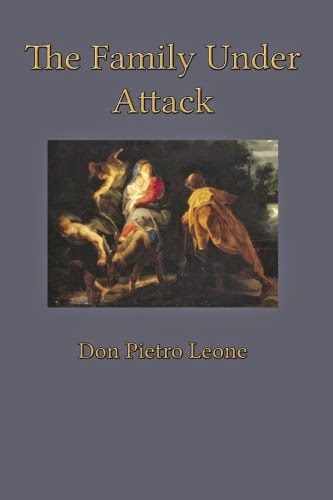
The following essay is part of Don Pietro Leone's book on marriage and family, The Family Under Attack (available on Amazon and on Amazon UK), and is exclusively published by Rorate Caeli by kind permission of thr author.

Fr. Pietro Leone also sends us the following message:

"I wish to congratulate the Editor of Rorate Caeli at the beginning of its tenth year for all his precious work in creating this most reliable and truly Catholic site. I wish also to thank him for publishing my writings over the last few years starting with my analysis of the New Rite of Mass and up to the extracts from my latest book 'The Family under Attack' of which the first appears today.

"I consider it important for Catholics of today to understand 'Theology of the Body' for what it is: to help them to know the Faith better, to practice it more fully, and so, with the help of Divine Grace, to reach the Promised Land of Heaven, where one day we may together sing the Eternal Mercies of God.

"I send my priestly blessing to all readers and promise to pray and to intercede for them before the Throne of the Highest, and that of The Most Holy Mother of God.

"I also ask them humbly to say a prayer for me."

Fr. Pietro Leone

***

‘Theology of the Body’ is the title that Pope John Paul II gave to a series of discourses delivered between September 1979 and November 1984. When we evaluate this doctrine in the light of Tradition, we see that in its principal positions it does not represent a development of Catholic teaching (in the sense of a clarification or deepening of that teaching), but rather a rupture with it, that is to say something novel. For this reason it cannot be described as Catholic doctrine, but rather as a series of personal meditations by the then Pope.

 As our source for this chapter we take the book ‘Theology of the Body for Beginners’ by Mr. Christopher West (Ascension Press, 2004), which affords a useful summary of this theory. This lecturer and writer has done much to popularize the said theory on the international level.

            The following critique (made in the briefest possible outline) will consist in the main of the application to this theory of the philosophical and theological principles established in the present book. This will involve a certain repetition of material already discussed, in the interests of providing a brief synthesis and analysis of the theory both in detail and as a whole.

             We proceed as follows: we evaluate this theory first as a personalist doctrine, then in its understanding of conjugal love in itself, and finally in its understanding of conjugal love in relation to God.

Op-Ed: "Obedience"? "Respect"? We tolerate no lessons from those who morally assassinated Benedict XVI!

We are very honored to post this new article by a very wise, knowledgeable, and highly influential cleric, writing under the pen name of don Pio Pace.

The Great Fear of the Conformists:
We Take no Lessons from Those Who Morally Assassinated Benedict XVI!
by don Pio Pace


For some time now, Modernist, Liberal, or self-defined "Moderate" and even "mildly conservative" papers and blogs have railed against the "merciless war" waged by Orthodox Catholics on Pope Francis and his orientations

We are right in the middle of the parable of the mote and the beam! Didn’t they criticize, without a moment of rest, John Paul II and his attempt at a minor "restoration", these good souls now giving lessons? Didn’t they destroy Benedict XVI up to the level of what can only be called his moral assassination? Benedict XVI, about whom liberals said among themselves, on the day after his election : "This won’t last more than a couple of years!" Benedict XVI, to whose enemies Abp. Piero Marini gave openly the battle cry: "Resistere! Resistere! Resistere!" They would like then to give us lessons, those who, through their incessant and brutal attacks on Benedict XVI, by Catholic or by mainstream media, by leaks of documents, by financial pressure, by destroying him on what he did or on what he didn’t do, on what he said or on what he didn’t say, prompted him to present his resignation. They want not only to annihilate us as they did with him, but they want us to thank them for being executed, find hilarious that we are being slaughtered, and also apologize to them for the fact that our blood may be staining their spotless clothes...

Now, these good apostles have suddenly discovered the virtues of "obedience" and "humility", preaching to us about "respect" for Peter, as if, by stating the Truth – not always easy to hear, and in a much milder and more proportionate fashion than they ever did – we were lacking in this obedience and respect. Yet it is precisely due to our faith in Peter and due to our unconditional obedience to the Church and her entire Tradition that we must speak up as we do.

The truth is that they are afraid.

I see three reasons for this.

Under Bergoglio, Christianity Matters Less - A Contradictory Pope
- A Major Interview with Sandro Magister

The Pope is confusing many bishops

Sandro Magister, interviewed by Goffredo Pistelli
Italia Oggi
November 13, 2014

This year Sandro Magister celebrates 40 years as a Vatican journalist. His first articles in L’Espresso in fact, date back to 1974.  And today, from those columns and also from the site of the weekly magazine, he still continues to report Vatican and Church news, everything very well-documented without bowing down to anyone.
Born in 1943, a native of Busto Arsizio, with degrees in Philosophy and Theology from the “Cattolica”, Magister has followed many Roman pontiffs. His articles regarding the present Pontiff, Pope Francis, are distinct from the mainstream Vatican journalists, unhesitatingly noting contradictions.  
*****
Question: Magister, Pope Bergoglio, has been basking in worldwide success these past months, but some of his decisions have given pause for thought. For example, he has presented himself as Bishop of Rome but at the Synod for the Family, he evoked the Codes of Canon Law confirming Petrine power.
R: It’s true. He did that in his closing speech.
Q: He outlined a shared and open vision in the governing Church, yet he appointed an outside commissioner with rather tough methods to the Franciscans of the Immaculate and also de facto put a bridle on the bishops conferences.
R: Some, like the Italian one, have effectively been destroyed.

Albenga-Imperia: Bp. Oliveri responds to Italian media
-Plus: Oliveri-hatred by liberals comes from 1980

Several different Italian (and non-Italian) papers have reported on an upcoming intervention that would impair the governance of Bp. Mario Oliveri, of Albenga-Imperia, generally considered a conservative and friend of Traditional practices.

IMPORTANT: The Backlash Against the Manipulated Synod of Francis
- Snippets from a Rome in Disbelief after 18 Months of Fear Under Pressure


guest-post by A Roman Source

"The general feeling is one of huge relief," says an influential professor at a Pontifical University. "On Thursday, at around noon, John Paul II operated a miracle at the Synod."

The Great Division - Wojtyła Nation to the Rescue.
President of the Polish Bishops' Conference:
"Synod Document Unacceptable"

Archbishop Gądecki: Document of the Synod of Bishops Unacceptable For Many
 The document summarizing the first week of the synod is not acceptable to many bishops - so says Archbishop Stanislaw Gądecki.
Vatican Radio, October 13, 2014

Socci - "DARKNESS IN ROME: Liberation Theology Triumphant as Work of John Paul II & Benedict XVI is Completely Wiped Out."

The Last Supper, with Marx, Lenin, Mao, Castro, and others outside a Caracas school (2007)
THE “D’ESCOTO CASE” AND THOSE WHO WANT TO WIPE OUT THE WORK DONE BY JOHN PAUL II AND BENEDICT XVI
Antonio Socci
Libero
 September 7, 2014

In the era of Bergoglio, the Vatican has practically rehabilitated Liberation Theology, which came into existence in the 1960s and has caused untold disasters, mainly in Latin America, by fostering the Church’s subordination to Marxist thought.

Rorate on the Road at Fontgombault Abbey
Abbatial Easter Sermon: Easter and the lesson of John Paul II


Dom Jean Pateau, the Abbot of Our Lady of Fontgombault Abbey delivered the following sermon for Easter Sunday Mass, made available to Rorate:

EASTER MASS

Homily of the Right Reverend Dom Jean PATEAU
Abbot of Our Lady of Fontgombault
April 20th, 2014
Dear Brothers and Sisters,
My dearly beloved Sons,

On June 1st, 1980, in Le Bourget [air field, near Paris], Blessed John Paul II asked our country a question, "France, eldest daughter of the Church, art thou faithful to the promises of thy baptism?"

On this holy Easter day, just a week before his canonisation, Pope John Paul II asks us the same question, "Friend, art thou faithful to the promises of thy baptism?" Maybe we shall have to answer, "And what are the promises of my baptism?"

Last night, during the great Vigil, we renewed these promises. We have renounced Satan, along with all the evil works which he inspires. We have forcefully reasserted the articles of the Creed: "I believe in God, Father, Son and Holy Ghost. I believe in the Holy Catholic Church, the communion of saints, the forgiveness of sins, the resurrection of the flesh, and life everlasting."

Each year during Easter night the Church thus brings us back to the holy day of our baptism, towards which we must show great veneration. Yet, does our everyday life bear the mark of our commitments? Are we convincing witnesses to Jesus Christ's redeeming love, which we received when water was being poured three times on our head and the priest said, "I baptise thee in the name of the Father, of the Son, and of the Holy Ghost"? Are we possessed with the boldness of faith which makes us say to everybody, "Please, sorry, thank you", in the name of Jesus Christ Who comes Himself to beg for our love, to forgive us and to love us? Has God entered our lives? Is our heart self-sufficient to the point of claiming the right to manage all right without Him?

To be baptised, to be a Christian, means to put on Christ, to be one with Him in His body which is the Church. Tertullian thus said: "A Christian is another Christ."

Yet, where will Christ ultimately lead me if I let Him enter my life, if I allow Him to burn my heart with His cleansing fire?

Let us once more allow Pope John Paul to teach us:

When, on October 22, 1978, I said the words "Be not afraid!" in St. Peter's Square, I could not fully know how far they would take me and the entire Church. ...

"Benedict XVI is by himself"
The disastrous "bad governance" legacy of Vatican II and John Paul II

Published today in La Croix, the semi-official daily of the French episcopate [tip: Le Forum Catholique]:

For Philippe Levillain, an expert in the recent history of the Popes, the adaptation of the Curia to the new orientations of Vatican II greatly contributed to make its governance more complex. 

LA CROIX: In the course of History, has it become more difficult to govern the Vatican? 

Philippe Levillain: Vatican II set a new stage, by making structures more complex. Numerous committees and commissions were established, in order to apply the new axes of the Council: interreligious dialogue, health, family, justice and peace, laity. These structures were added to those that were the heart of the traditional Curia, with the classic dicasteries (Congregation for the Doctrine of the Faith [Holy Office], Evangelization of peoples [Propaganda Fide]...). Out of this fact, the role of the Secretary of State, the number 2 of the Holy See, is henceforth one of an orchestra-man, charged with creating synergies and coordinating the whole of these actions while playing the part of an arbiter. It is extremely complex. A pope will undoubtedly not be able to do as Pius XII, who decreed that he would fill the functions of Secretary of State from 1944 to 1958. 


The Secretary of State chosen by Benedict XVI presents, from this point of view, a profile somewhat different from that of his predecessors? 

Yes, John Paul II had chosen Secretaries of State who knew well the machinery of the State, as Cardinals Agostino Casaroli or Angelo Sodano, personalities to whom he was not nevertheless particularly close. On the contrary, Benedict XVI named as Secretary of State someone very close to him, Cardinal Tarcisio Bertone, who was always his faithful companion in the Curia.

It is to be noted, however, that, while John Paul II had entrusted the administration to a "high-level servant" used to the Curia, he had also placed men of trust, Poles, in all dicasteries, creating in this way a kind of "Parallel Curia". Benedict XVI has absolutely not put in place a parallel German system. 

There is the sentiment that the Vatican suffers from bad governance, is that new? 

In reality, John Paul II left aside some particularly sensitive matters, without truly taking charge of them, and his successor partly pays the price of this incompetence. For instance, the question of the Legionaries of Christ, whose founder was left in place while his sexual deviations were known, at least partly. In the same way, he did not take serious charge of the consequences of the pedophilia cases, and particularly with the juridical questions on the way guilty priests should be treated. Or also, following the moment in which the Lefebvrist broke negotiations, John Paul II allowed the schism with the Traditionalists to take hold. 

Finally, was not the Vatican always a place of intrigue? 

Yes, but, before, this intrigue was mostly motivated by the desire to occupy positions. ... What is new today is the strong media promotion of all that surrounds the pope. This began with Vatican II, but was masterfully magnified by John Paul II. Today, the pope is by himself before public opinion.  

Philippe Levillain supervised the publication of the Dictionnaire historique de la papauté [Historical Dictionary of the Papacy], Fayard, 2006.

Benedict XVI on John Paul II


From the homily at the beatification:
Six years ago we gathered in this Square to celebrate the funeral of Pope John Paul II. Our grief at his loss was deep, but even greater was our sense of an immense grace which embraced Rome and the whole world: a grace which was in some way the fruit of my beloved predecessor’s entire life, and especially of his witness in suffering. Even then we perceived the fragrance of his sanctity, and in any number of ways God’s People showed their veneration for him. For this reason, with all due respect for the Church’s canonical norms, I wanted his cause of beatification to move forward with reasonable haste. And now the longed-for day has come; it came quickly because this is what was pleasing to the Lord: John Paul II is blessed!
***
“Blessed are those who have not seen and yet have come to believe” (Jn 20:29). In today’s Gospel Jesus proclaims this beatitude: the beatitude of faith. For us, it is particularly striking because we are gathered to celebrate a beatification, but even more so because today the one proclaimed blessed is a Pope, a Successor of Peter, one who was called to confirm his brethren in the faith. John Paul II is blessed because of his faith, a strong, generous and apostolic faith. We think at once of another beatitude: “Blessed are you, Simon, son of Jonah! For flesh and blood has not revealed this to you, but my Father in heaven” (Mt 16:17). What did our heavenly Father reveal to Simon? That Jesus is the Christ, the Son of the living God. Because of this faith, Simon becomes Peter, the rock on which Jesus can build his Church. The eternal beatitude of John Paul II, which today the Church rejoices to proclaim, is wholly contained in these sayings of Jesus: “Blessed are you, Simon” and “Blessed are those who have not seen and yet have come to believe!” It is the beatitude of faith, which John Paul II also received as a gift from God the Father for the building up of Christ’s Church.

Two Blessed Popes and a Holy Inquisitor

God willing, John Paul II will be beatified on May 1, 2011.

The servant of God John Paul II himself beatified Pope Pius IX.

Blessed Pius IX gave the Church a model of heroic virtue in the person of the inquisitor of Aragon, St. Pedro Arbues, martyred by conspirators in 1485 while he was praying before Matins in church. St. Peter’s defenders say that no death sentence was ever pronounced by him, and that he was a model of clemency and zeal to obtain conversion of heretics, not their death; in this he was like other servants of the Inquisition, including St. Peter Martyr (13th century) and St. Pius V. However it is said that he did employ the coercive means available to him as an inquisitor to arrest and imprison heretics. Needless to say he is a controversial figure, as a quick glance at the Google pages will show, just like the venerable and beloved Pontiff who canonized him.

Known already before his martyrdom for his holiness, he was canonized by Blessed Pius IX on June 29, 1867. The prayer assigned to his feast by Pius IX mentions God raising up the saint to combat “Jewish unbelief” and “Mohammedan superstition”. Lex orandi, lex credendi. The law of belief will be expressed again tomorrow by the prayer assigned for Blessed John Paul II—it mentions Our Lord as the only Redeemer of mankind.

John Paul II - Best lines

Therefore, by the authority which Christ conferred upon Peter and his Successors, and in communion with the Bishops of the Catholic Church, I confirm that the direct and voluntary killing of an innocent human being is always gravely immoral. This doctrine, based upon that unwritten law which man, in the light of reason, finds in his own heart (cf. Rom 2:14-15), is reaffirmed by Sacred Scripture, transmitted by the Tradition of the Church and taught by the ordinary and universal Magisterium. ...

John Paul II

Beyond his many beautiful and profound words, beyond his symbolic gestures that scandalized many, beyond acts which have affected the very life of the Church and will still create an enormous problem in the future (such as the permission for "altar girls", considered by a Cardinal one of the highest points of his Pontificate), one action (or rather, omission) is still haunting: why did he not act upon the express advice of his Cardinals in the Holy Office regarding the broad juridical rights of the Traditional Mass? This is not a matter for which it can be said - as it is said regarding several others - that he most probably could not have known, of which others might not have made him aware. They discussed the matter upon his request and, in 1982 (1982!), made clear what would only be made public in the motu proprio Summorum Pontificum, in 2007. He knew; he was aware; he remained silent.

So much pain, so many tears, so many died expecting it, so many may have been lost forever waiting for what he himself knew was lawful, right, and just. So many problems caused, so much injustice, so much persecution, in a way that sheds new lights on the dramatic events of 1988 - which themselves led to Ecclesia Dei Adflicta, a document more focused on the sentiment of some faithful than on the legitimate right of priests and laity.

Thanks to the Lord, who, through Paul VI, gave us Cardinal Ratzinger, and, through John Paul II, gave us Benedict XVI. Benedicite, omnia opera Domini, Domino!

News from the Church in Belgium:
Silent apostasy is episcopal apostasy

European culture gives the impression of “silent apostasy” on the part of people who have all that they need and who live as if God does not exist.
John Paul II
Ecclesia in Europa
___________________________________
1. In Belgium (actually, it is not clear where he is), the emeritus ultra-"Progressive" Bishop of Bruges, Roger "Runaway" Vangheluwe, declares in an interview that the abuse of his nephew was no big deal.
A Belgian former bishop has disappeared from his French religious community three days after he admitted to sexually abusing two of his nephews, its leader told AFP on Sunday.