German public broadcaster ZDF has for decades presented Sunday "divine services": Evangelical and Catholic. This past Sunday, for the first time, the Catholic "mass" was a "Queer Divine Service." We take the opportunity to remind all that Traditionis custodes, the document that attempted to abolish the Traditional Rite of the Latin Church, had the illegitimate audacity of stating: "The liturgical books promulgated by Saint Paul VI and Saint John Paul II, in conformity with the decrees of Vatican Council II, are the only expression of the lex orandi of the Roman Rite."*
Showing posts with label Deutsche mess. Show all posts
The German Rebellion on Eucharistic Communion for Protestants: The Ground Opens Up
Sandro Botticelli
Punishment of the Rebels [Moses and the Sons of Korah]
Sistine Chapel, 1482
And immediately as Moses had made an end of speaking, the earth broke asunder under their feet: And opening her mouth, devoured them with their tents and all their substance. And they went down alive into hell the ground closing upon them, and they perished from among the people. But all Israel, that was standing round about, fled at the cry of them that were perishing: saying: Lest perhaps the earth swallow us up also. And a fire coming out from the Lord, destroyed the two hundred and fifty men that offered the incense. (Numbers 16:31-35)
Once again in this Pontificate, the most sacred treasure possessed by the Church, the Blessed Sacrament of the Altar, is turned into an object of rebellion and division. The first was, of course, the fake controversy of Communion to adulterers ("remarried divorced" Catholics).
Now, following several denials by Rome, but after a clear authorization given informally by Francis in another interview granted in his return to Rome from Geneva a week ago, the first German bishop has finally awarded express authorization for Communion to be regularly offered to Protestant spouses of Catholics.
From the German-language page of the EWTN news network, the news that the Archbishop of Paderborn, Hans-Joseph Becker, has given his full authorization for the distribution of Holy Communiuon to Protestant spouses:
German Liberalism is a Cancer in the Church
Cancer: a terrible disease, with which we are, as many of you, terribly familiar. Therefore, we do not make use of it as a metaphor unadvisedly.
Since the age of the Council, and before it, Liberal Catholicism of the German extraction has been a life-threatening cancer metastasizing throughout Holy Mother Church. A Pole and a good German tried to reverse the disease, but the deep pockets of the German Bishops who funded the "St. Gallen Mafia" got what they paid for in 2013: increasing confusion throughout the Church.
Their first Trojan Horse was the non-issue of Communion for lifelong adulterers, rammed through in two Synods, followed by the outrageous liberal paragraphs and footnotes in "Amoris Laetitia".
Now, their new Horse also involves the Most Blessed Sacrament: that the Prince of Darkness is their instigator cannot be doubted because they only attack the holiest thing in the Church, the Sacred Eucharist.
Benedict XVI: "Francis = Capsizing Boat" (Updated: Full Translation)
From the 2-page written homage (German original) by Pope Emeritus Benedict read today in Cologne for the Requiem of Cardinal Meisner:
A word of greeting from Benedict XVI, Pope Emeritus, on the occasion of the funeral Mass of Cardinal Joachim Meisner, on 15th July 2017
In this hour, when the Church of Cologne and believers further afield take their leave of Cardinal Joachim Meissner, I am with them in my heart and thoughts and am pleased to accede to Cardinal Woelki’s wish and address a word of reflection to them.
When I heard last Wednesday by telephone of the death of Cardinal Meissner, I could not believe it at first. We had spoken to each other the previous day. From the way he spoke he was grateful to be on holiday now, after he had taken part the Sunday before (25th June) in the beatification of Bishop Teofilius Maturlionis in Vilnius. His love for the neighbouring Churches in the East, which had suffered persecution under Communism, as well as gratitude for endurance in suffering during that time left a lifelong mark on him. So it was certainly no accident that the last visit of his life was made to a confessor of the faith.
What struck me particularly in the last conversations with the Cardinal, now gone home, was the natural cheerfulness, the inner peace and the assurance he had found. We know that it was hard for him, the passionate shepherd and pastor of souls, to leave his office, and this precisely at a time when the Church had a pressing need for shepherds who would oppose the dictatorship of the zeitgeist, fully resolved to act and think from a faith standpoint. Yet I have been all the more impressed that in this last period of his life he learned to let go, and live increasingly from the conviction that the Lord does not leave his Church, even if at times the ship is almost filled to the point of shipwreck.
German Bishop: Communion for non-Catholics married to Catholics Possible
From the official website of the German Bishops' Conference:
Hope for shared Holy Communion for married couples
Deutschland—Church of the Rich or Church of the Poor?
News reports have been showing us for some time now that the rich German church is the main mover and shaker behind the synodal armageddon, past and future.
As we know, there are two kinds of poverty: material and spiritual. The African church, in many ways materially poor (certainly as compared with Germany), is spiritually rich, with Catholics striving, often in terribly difficult circumstances, to live what Pope John Paul II called as “the Gospel of life.”
The German church, in contrast, appears to be spiritually impoverished in proportion to its immense material assets, once more establishing a law as old as divine revelation: “One is as it were rich, when he hath nothing: and another is as it were poor, when he hath great riches” (Proverbs 13:7). “Better is a little to the just, than the great riches of the wicked” (Psalm 36:16). “And that which fell among thorns, are they who have heard, and going their way, are choked with the cares and riches and pleasures of this life, and yield no fruit” (Luke 8:14). The earthly riches of the German church will be the millstone that drags it down to Gehenna—all but the remnant that, despising these vain pomps, cleaves to the untarnished Word of God.
In his magnificent little work On the Perfection of the Spiritual Life, St. Thomas Aquinas reminds us about the dangers of material wealth and the urgent need to abandon them for the sake of Christ:
The German Catholic Collapse: The Priests confess once a year, if at all -- what about the Lay Faithful?
The Priests confess once a year. And the faithful?...
![]() |
| Saint Adelaide Catholic Church in Geldern, North Rhine-Westphalia, Diocese of Münster - demolished in 2008 to give way to a senior center |
Lorenzo Bertocchi
La Nuova Bussola Quotidiana
April 24, 2015
The German laity confirm their desire for evolution in the Church: according to a document made available on the Episcopal Conference site, the answers to the questionnaire between the Synods show that the Catholics of Germany are expecting major openings from the Synod on the Family. Mainly on the thorniest issues: “they are asking for the admittance of the divorced and remarried to the Eucharist, a “development” of moral doctrine for the pastoral acceptance of homosexual people and a form of “church blessing for second civil-marriages.”
Are these requests an expression of serious discernment or, do they show a watered-down, Catholicism, about-to-be-defeated? It is a legitimate question, especially in the light of what is emerging from another survey reported last Thursday. Again on the Episcopal Conference site, there was data as well, on the results of another analysis conducted on 8,000 “pastoral workers” from all over Germany. The examples, made up of 48% of the priests, 22% of “expert parish-collaborators”, 18% of “pastoral assistants” and 12% of deacons, had to give information on the satisfaction-level regarding their life and “work.” The survey, directed by some academics from important study centers, obtained results that perhaps help us to interpret the answers to the Synod questionnaire.
The Church of Vatican II: Going, going, gone
German Edition
| Before the post-conciliar changes |
The Parish Church of Saint Matthias, in Meiderich, Duisburg (North Rhine Westphalia), was founded in 1898 and was a functioning church with reasonable attendance.
![]() |
| After the post-conciliar changes |
A symbol of a post-conciliar Europe: in the site of what once was a vibrant large church, the corporation will build a complex of six buildings with "barrier-free apartments accessible to the elderly."
(Source of last image and quote; tip: Le forum catholique.)
"By their fruits ye shall know them"
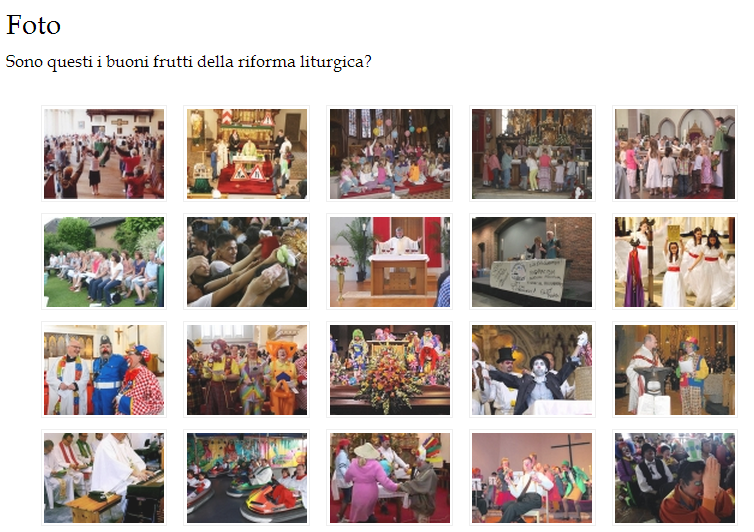
The Good Fruits of the Novus Ordo Missae?
Concilio Vaticano Secondo, a website dedicated to a realistic analysis of the aftermath of the Second Vatican Council, has recently posted a collection of images of what we can only call the fashion-crazed rite, the inconstant and fickle Rite of Paul VI.
Many of these are well known images, several were posted by us originally - and at least one of them is, mistakenly, from an Anglican/Episcopalian service - but we thank Mrs. Francesca Croci for having gone through the agonizing trouble of collecting them in one single page.
[We thank the Twitter follower who pointed us to this collection.]
More criticism of Benedict XVI from Cardinal Lehmann
While it's not the first time in the last few months he's done this, the former head of the German Bishops' Conference, Cardinal Karl Lehmann of Mainz, has once again publicly attacked Benedict XVI.
From The Tablet:
Cardinal Karl Lehmann of Mainz has criticised two major liturgical changes introduced by Pope Benedict XVI.
The former president of the German bishops' conference said that he did not think the co-existence of the old-rite liturgy alongside the new was a good idea, and that the proposed change in the German Missal from saying Christ died "for all" to "for many" was a sign of Rome trying to appease traditionalists.
He complained there were now more Tridentine Masses on offer than there was demand for and questioned the motives of fans of the old-rite Mass. He said enthusiasm for the Tridentine Mass seemed to have "a lot to do with prestige".
Lehmann also questioned why Rome was changing the translation of pro multis to "for many", noting that Pope Benedict had said that both translations were legitimate.
German Archbishop calls for women deacons, Communion for divorced Catholics, and on and on
From The Local:

Women Catholic deacons 'no longer taboo'
Germany's top Roman Catholic has called for women to be allowed to become deacons, which would enable them to perform baptisms and marriages outside of mass - a novelty for Catholic women.
Archbishop of Freiburg Robert Zollitsch, who chairs the German Bishops' Conference, called for the change at the end of a four-day meeting to discuss possible reforms.
The conference, the first of its kind, invited 300 Roman Catholic experts to propose reforms. Zollitsch's comments echo year-long calls from the Central Committee of German Catholics to permit women to become deacons. On Sunday, Zollitsch said that aim was no longer a 'taboo.'
Zollitsch said the Catholic Church could only regain credibility and strength by committing to reform. He described an "atmosphere of openness and freedom" at the conference. ...
Another proposal to emerge from the conference was to extend the rights of remarried divorcees to sit on church bodies such as parish councils. Conference members also discussed the possibility of granting them the right to receive Holy Communion and attend confession. ...
The position of divorcees remains highly controversial within the Church. The conference also touched on the difficulty, particularly in eastern Germany, of recruiting people to work for Catholic institutions such as hospitals and kindergarten. At present the Church can only employ Roman Catholics. However Zollitsch called for work permits to be extended to non-Catholics and to those with "different lifestyles." This would technically apply to homosexual people too. However Church labour reforms are unlikely to be introduced in the next three years. ...
Vatican versus Vatican: will the "Real Vatican" stand up, please?
Abortifacient in 2000 and 2008, "example to be followed" in 2013
Could it be another instance of "real" versus "virtual"?
PONTIFICAL ACADEMY FOR LIFESTATEMENT ON THE SO-CALLED
"MORNING-AFTER PILL"
As is commonly known, the so-called morning-after pill recently went on sale in Italian pharmacies. It is a well-known chemical product (of the hormonal type) which has frequently - even in the past week - been presented by many in the field and by the mass media as a mere contraceptive or, more precisely, as an "emergency contraceptive", which can be used within a short time after a presumably fertile act of sexual intercourse, should one wish to prevent the continuation of an unwanted pregnancy. The inevitable critical reactions of those who have raised serious doubts about how this product works, namely, that its action is not merely "contraceptive" but "abortifacient", have received the very hasty reply that such concerns appear unfounded, since the morning-after pill has an "anti-implantation" effect, thus implicitly suggesting a clear distinction between abortion and interception (preventing the implantation of the fertilized ovum, i.e., the embryo, in the uterine wall).
Considering that the use of this product concerns fundamental human goods and values, to the point of involving the origins of human life itself, the Pontifical Academy for Life feels the pressing duty and definite need to offer some clarifications and considerations on the subject, reaffirming moreover already well-known ethical positions supported by precise scientific data and reinforced by Catholic doctrine.* * *1. The morning-after pill is a hormone-based preparation (it can contain oestrogens, oestrogen/progestogens or only progestogens) which, within and no later than 72 hours after a presumably fertile act of sexual intercourse, has a predominantly "anti-implantation" function, i.e., it prevents a possible fertilized ovum (which is a human embryo), by now in the blastocyst stage of its development (fifth to sixth day after fertilization), from being implanted in the uterine wall by a process of altering the wall itself.
The final result will thus be the expulsion and loss of this embryo.
Only if this pill were to be taken several days before the moment of ovulation could it sometimes act to prevent the latter (in this case it would function as a typical "contraceptive").
However, the woman who uses this kind of pill does so in the fear that she may be in her fertile period and therefore intends to cause the expulsion of a possible new conceptus; above all, it would be unrealistic to think that a woman, finding herself in the situation of wanting to use an emergency contraceptive, would be able to know exactly and opportunely her current state of fertility.
2. The decision to use the term "fertilized ovum" to indicate the earliest phases of embryonic development can in no way lead to an artificial value distinction between different moments in the development of the same human individual. In other words, if it can be useful, for reasons of scientific description, to distinguish with conventional terms (fertilized ovum, embryo, fetus, etc.) different moments in a single growth process, it can never be legitimate to decide arbitrarily that the human individual has greater or lesser value (with the resulting variation in the duty to protect it) according to its stage of development.
3. It is clear, therefore, that the proven "anti-implantation" action of themorning-after pill is really nothing other than a chemically induced abortion. It is neither intellectually consistent nor scientifically justifiable to say that we are not dealing with the same thing.
Moreover, it seems sufficiently clear that those who ask for or offer this pill are seeking the direct termination of a possible pregnancy already in progress, just as in the case of abortion. Pregnancy, in fact, begins with fertilization and not with the implantation of the blastocyst in the uterine wall, which is what is being implicitly suggested.
4. Consequently, from the ethical standpoint the same absolute unlawfulness of abortifacient procedures also applies to distributing, prescribing and taking the morning-after pill. All who, whether sharing the intention or not, directly co-operate with this procedure are also morally responsible for it.
5. A further consideration should be made regarding the use of themorning-after pill in relation to the application of [Italian] Law 194/78, which in Italy regulates the conditions and procedures for the voluntary termination of pregnancy.
Saying that the pill is an "anti-implantation" product, instead of using the more transparent term "abortifacient", makes it possible to avoid all the obligatory procedures required by Law 194 in order to terminate a pregnancy (prior interview, verification of pregnancy, determination of growth stage, time for reflection, etc.), by practising a form of abortion that is completely hidden and cannot be recorded by any institution. All this seems, then, to be in direct contradiction to the correct application of Law 194, itself debatable.
6. In the end, since these procedures are becoming more widespread, we strongly urge everyone who works in this sector to make a firm objection of moral conscience, which will bear courageous and practical witness to the inalienable value of human life, especially in view of the new hiddenforms of aggression against the weakest and most defenceless individuals, as is the case with a human embryo.
Vatican City, 31 October 2000.
Five years ago Bishop -- now Cardinal -- Elio Sgreccia (Vice President of the Pontifical Academy for Life from 1996 to 2005 and President from 2005 to 2008) declared that the "morning-after pill" cannot be used even in cases of rape. As reported at that time by LifeSite News (Head of Pontifical Academy for Life Reconfirms Morning After Pill Cannot be Used Even in Cases of Rape):
LifeSiteNews.com asked Bishop Sgreccia if there was an exception in cases of rape. The President of the Pontifical Academy for Life replied, "No. It is not able to prevent the rape. But it is able to eliminate the embryo. It is thus the second negative intervention on the woman (the first being the rape itself).
____________________________
Now, the VIRTUAL VATICAN:
German bishops’ decision on morning-after pill is an example to be followed:Vatican Insider interviews the President of the Pontifical Academy for Life. He defends the German Catholic Church saying: Catholic hospitals have been handing out contraceptive pills to rape victims for 50 years...The President of the Pontifical Academy for Life, Mgr. Ignacio Carrasco de Paula, spoke to Vatican Insider about this at the end of the Academy’s plenary assembly....
Critics say this type of medication can cause an abortion, albeit unintentionally, and that this is not a risk we can afford to take. What are your thoughts on this?
The Church needs to shape people’s consciences. What Church teaching says in this case is: in cases of rape all possible action must be taken to prevent a pregnancy but not to interrupt it. Whether a given medicine is classed as a contraceptive or abortion-inducing medication, is up to doctors and scientists, not the Church.
Bp. Carrasco: your own Pontifical Academy, 13 years ago and as is well known, made clear that the "morning-after pill" is abortifacient. Being abortive (preventing, among other things, the implantation of a newly-formed human being) is one of its stated goals. It not only may be abortive - as a flight of stairs may provoke abortions if a pregnant woman accidentally falls off it -, it has among its objectives not only preventing a future fertilization but preventing the implantation of an already formed human being.
Once again, the enemies of life, the promoters of the culture of death, use extreme cases to make the Church seem fickle and unprincipled in the defense of life. And once again, with malice or naïveté, Church officials fall for it. And once again the media takes the hit: the Bishop says that, "journalistic language is different from theological or clinical language. The 'morning-after pill' is a journalistic, not a medical term"; when the Pontifical Academy itself, in its document, does not have any problem in using the popular name of the pill.
[P.S. - Augustinus] Unfortunately this is not the first time that Msgr. Carrasco has acted questionably in his capacity as President of the Pontifical Academy for Life, a post he has held since 2010 after the "promotion" of his predecessor Abp. Salvatore Fisichella in the aftermath of the Olinda and Recife Abortion case. It was under Carrasco's leadership that, almost exactly a year ago, the Academy held a conference with speakers who openly spoke in favor of IVF. (Cf. Trouble in Vatican: Pontifical Academy members upset with ethics deficit at infertility conference, Vatican’s Pontifical Academy for Life is in ‘great danger,’ warns eminent member in open letter, Controversies prompt call for resignation at Vatican's pro-life academy, Vatican board courts controversy with neutral scientists.) During last year's controversies Msgr. Carrasco received the backing of another influential figure in the Roman Curia -- Cardinal Ravasi, who denounced the "opponents of dialogue" as fundamentalists.
[P.S. - Augustinus] Unfortunately this is not the first time that Msgr. Carrasco has acted questionably in his capacity as President of the Pontifical Academy for Life, a post he has held since 2010 after the "promotion" of his predecessor Abp. Salvatore Fisichella in the aftermath of the Olinda and Recife Abortion case. It was under Carrasco's leadership that, almost exactly a year ago, the Academy held a conference with speakers who openly spoke in favor of IVF. (Cf. Trouble in Vatican: Pontifical Academy members upset with ethics deficit at infertility conference, Vatican’s Pontifical Academy for Life is in ‘great danger,’ warns eminent member in open letter, Controversies prompt call for resignation at Vatican's pro-life academy, Vatican board courts controversy with neutral scientists.) During last year's controversies Msgr. Carrasco received the backing of another influential figure in the Roman Curia -- Cardinal Ravasi, who denounced the "opponents of dialogue" as fundamentalists.
Labels:
abortion,
Deutsche mess,
Ravasi,
Sede Vacante fever
Vatican II at 50: German Bishops, in "Sede Vacante" mood,
OK abortifacient "morning-after pill"
In truth, most of them have been practical Sedevacantists for a long time, including during the entire pontificate of their fellow countryman. The German Episcopal Conference has now made its own the approval given by Cardinal Meisner to the "morning-after pill" in cases of rape.
Germany's Roman Catholic Church said on Thursday it had decided to permit certain types of "morning-after pill" for women who have been raped, after two Catholic hospitals provoked an outcry last month for refusing to treat a rape victim.
The German Bishops' Conference said church-run hospitals would now ensure proper medical, psychological and emotional care for rape victims - including administering pills that prevent pregnancy without inducing an abortion.
Archbishop Robert Zollitsch said a four-day meeting of German bishops in the western town of Trier had "confirmed that women who have been victims of rape will get the proper human, medical, psychological and pastoral care".
"That can include medication with a 'morning-after pill' as long as this has a prophylactic and not an abortive effect," he said in a statement. "Medical and pharmaceutical methods that induce the death of an embryo may still not be used."
That means there is no change to the Catholic church's ban on the so-called abortion pill based on the drug mifepristone or RU-486, and marketed as Mifegyne or Mifeprex. (Source)
Impressive...
Precisely because the distribution of the pills will always happen in an emergency situation, it will often be hard to know if fertilization has occurred or not - and therefore there is always a great, even overwhelming, chance that what is done by the pill is plain abortion. Even the contraceptive guide of the Food and Drug Administration (FDA) - not exactly a pro-life organization...-, following a serious controversy on the actual consequences of the "morning-after pill", describes that the mechanism of emergency contraception works in one of the following ways:
• It works mainly by stopping the release of an egg from the ovary. It may also work by preventing fertilization of an egg (the uniting of sperm with the egg) or by preventing attachment (implantation [of the newly-conceived human being]) to the womb (uterus). (Link and background information provided by a professor in a... Baptist seminary.)
Let us make clear: this is not a discussion on specific arguments of Moral Theology on the licitude of contraception for victims of rape - but on the fact that the "morning-after pill" not only can be abortifacient, but has abortion (prevention of the implantation of the newly-conceived human being) as one of the explicit scientific mechanisms through which its goal may be reached.
The matter if not even that new, quite the contrary. 18 years ago, Pope John Paul II stressed the abortifacient consequences of many contraceptives:
The close connection which exists, in mentality, between the practice of contraception and that of abortion [...] is being demonstrated in an alarming way by the development of chemical products, intrauterine devices and vaccines which, distributed with the same ease as contraceptives, really act as abortifacients in the very early stages of the development of the life of the new human being. (Evangelium vitae, 13)
Therefore, if the woman who is an unfortunate victim of such crimes is in her fertile period, there is an incredibly high chance that the use of emergency contraception, now liberally provided by German Catholic hospitals, will result in the abortion of a newly-conceived human being.
At the very least, the German Bishops should be honest: "Yes, we know that some newly-conceived human beings will be eliminated and destroyed as a result of substances given in our hospitals, but that is quite fine because in most cases that will probably not occur, though we cannot even really be sure of that!" Alas, honesty is not to be expected from the princes of Catholic sophistry, for whom there is only one adage: Roma locuta, causa infinita...
Vatican II at 50: Cardinal says yes to abortive pill - in his Catholic hospitals no less
The Cardinal-Archbishop of the largest German diocese, and probably the wealthiest in the world, Cologne, gives his OK to the abortive "morning-after pill" after Catholic hospitals correctly applied Catholic doctrine and refused to distribute them. It is all a matter of "ethical counterweight", apparently...
From Deutsche Welle:
German Cardinal says yes to 'morning-after pill'Two Catholic hospitals in Cologne declined to give emergency contraceptives to a rape victim. The archbishopric in Cologne has now changed its mind - and has also shown an impressive capacity for contraceptive nuance.That the Catholic Church intends unequivocally to protect conceived life is nothing new. What has changed is how Cologne Cardinal Joachim Meisner approaches the "morning-after" pill.Through his spokesman Christoph Heckley, the Cardinal issued a personal explanation on Thursday (31.01.2013) which read: "If, after a rape, a supplement is used with the intend of preventing fertilization, that is in my view justifiable." Heckley reiterated once again, however, that everything which is abortive in nature is not allowed.Cardinal Meisner's change of heart is the result of consultations with specialists. He now understands that certain forms of the "morning-after" pill prevent conception and are not technically abortive. This suggests that the Cologne church leader previously believed that all kinds of pills which could be taken by a woman after intercourse prevented an already fertilized egg cell from implanting in the uterus.The morning afterThe pill's effect is, in medicinal jargon, "anti-ovulatory." It prevents ovulation and thus the chance that an egg cell will be fertilized, resulting in conception. The active hormonal ingredient, levonorgestrel, is comparable to traditional birth-control pills but is simply taken in higher, post-coital doses.The morning-after pill has been accompanied by controversy"The Catholic Church already had a problem with that one," says Antonio Autiero, a professor of moral theology at the University of Münster, in a reference to the traditional pill. "Artificial contraceptives" have been prohibited by the Catholic Church ever since Pope Paul VI published an encyclical, "Humanae Vitae," in 1968. "Nothing has changed doctrinally to this day," Autiero said.When does life begin?Yet what happens when ovulation occurs just before unprotected sex and the pill's "anti-ovulation" effect doesn't serve its purpose? Then the pill's "anti-nidative effect" comes into play, preventing the fertilized egg from settling on the surface of the uterus. "Whether the morning-after pill inhibits ovulation or nidation, it still lacks a final safety mechanism. If that's the case then we're heading more toward abortion," Autiero said."The doctrinal outlook is very clear in that the fusion of egg and semen cells constitutes life and human dignity. That is why it is seen as a form of abortion when one prevents fertilized egg cells from nidating," Autiero said.Abortion, or the ending of human life - even a life so tiny - is something with which the church doctrine can find no accord. "There's no room for discussion within Catholic doctrine," Autiero said. The termination of a pregnancy would never be carried out at a Catholic hospital - not even in the first few hours or days of a pregnancy.Ethical absolutesOr that is the principle, at least. So are there exceptions? What happens in cases of extreme bodily harm or emotional emergencies, such as when a woman has been raped?"For the church the answer is clear," Autiero said. "Abortion and contraception are condemnable in and of themselves, and there is no situation where they can be ethically justified."Antonio Autiero: Nothing has changed doctrinallyThis "normative ethic," which allows no exception to the highest principles, has "radicalized" over the years, he said.Yet in moral theological science there is also an ethical counterweight that "depends on objectives and the context of an action." And this is where, beyond the untouched highest principles, even more questions come into play.They relate to concrete medicinal and emotional situations, human empathy, companionship, one's own conscience and professional ethics. "Are we a church of ethics or are we a church of compassion?" Autiero asked.'Deep shame'The cardinal's new position gives a sense of clarity to the work of Catholic hospital doctors. Previously they had feared that they would be drawn into conflict with their employer.
[Tip for the news: Secretum meum mihi]
And the hits keep on coming ...
The Church must rethink its approach to remarried divorcees and gay relationships, the world's youngest cardinal has said.
Cardinal Rainer Maria Woelki, 55, made his comments in an interview with the German weekly Die Zeit and said that while the Orthodox Church considers only the first marriage sacramentally valid, divorce and a second marriage is tolerated.
Asked whether this could be a model for the Catholic Church, he replied that the Church should talk about it. Commenting on gay men in relationships he said he tried not to see them as just violating natural law but as people trying to take responsibility for each other in lasting partnerships.
"We must find a way of allowing people to live without going against church teaching," he said.
Cardinal Woelki is a native of the Mülheim district of Cologne, on the right bank of the... Rhine. Of course.
Subscribe to:
Posts (Atom)