Rorate Caeli
Showing posts with label The Protestant syndrome. Show all posts

Doctrinal "devolution" to the bishops' conferences? Francis already endorsed it in 2013. UPDATE: Francis' most important speech so far on "decentralization" -- and his intentions for the Synod


[UPDATE 10/19/2015 2:30 AM GMT]: For the record: Edward Pentin has posted a complete "working translation" of Francis' watershed speech on his desire to see a more decentralized and "Synodal" Church that "begin(s) with the people and their everyday problems" and for which the "conversion of the papacy" is central.

We will not dedicate more time to commenting on the theme of decentralization. It is enough to say that so long as the good bishops and cardinals who have been attacking the proposals for "decentralization" shy away from naming the true patron of the proposal -- the Pope himself -- they are only avoiding the problem, instead of addressing it. 

Equally important as the "decentralization" aspect is Francis' assertion that it is the "flock" that is "discern(ing) the new ways that the Lord is revealing to the Church", which he uses to justify the controversial "consultation" that took place in the run-up to the Synod. Remember that it was this process of consultation that the German and Swiss bishops (and powerful lay groups such as the German Zentralkomitee der deutschen Katholiken) used to collect support for far-reaching reforms in the teachings of the Church on family life and sexual morality.

SYNOD BATTLES: Blackmail, Veiled Schism Threats, the Kasperization of the German Church, and the Destruction of Marriage - Document and Analysis


1. DOCUMENT

Zentralkomitee der deutschen Katholiken (Central Committee of the German Catholics)
Saturday, May 9, 2015
To Build Bridges between Teaching and the Reality of Life – Family and Church in the World of Today

Plenary Assembly on May 8 and 9, 2015 in Würzburg [Germany]
Declaration of the Zentralkomitee der deutschen Katholiken (Central Committee of the German Catholics) in preparation for the XIV Ordinary General Assembly of the Synod of Bishops in the Vatican [October] 2015

 The Central Committee of the German Catholics (ZdK) [Rorate note: the oldest, main and most influential group of German Catholics, founded under a different name in 1848 and responsible for the famous Katholikentage, Catholic Days] welcomes the call of Pope Francis to all the faithful to make a statement about the situation of the family in the Church and in the world of today. The world-wide reactions to this call will have to be put together during the General Assembly of the Synod of Bishops in the fall of 2015. The ZdK is aware of the universal Church's understanding of the context for the discussion of the topic and pays special attention to its own regional considerations.

[…]

With the following four central messages, the ZdK would like to make a contribution to the debate, in light of the preparation of the consultations for the XIV General Assembly of the Synod of Bishops; it would thus like to invite a discussion about its following statements and to seek allies for the upcoming challenges.

1)      We regard the sacramental marriage as the model for a life-long bond as a promise for a successful life with the help of God. We confess this to be the model of life and we encourage couples to make such a marital promise and to found a family. At the same time, we respect other forms of cohabitation in which important values are realized: reliable responsibility for one another; fidelity in that relationship; and a commitment to walk together the path [sic].

2)      As a church in the world, the ZdK works in a special way for a strengthening and for a promotion of marriage and the family in our society and in the state. By family, we mean also the different non-marital forms of reliably lived partnerships and of generational responsibility which make a large contribution to the societal solidarity and which ought to be treated justly.

3)      The Church's teaching has to be further developed with the help of a dialogue with the faithful, and with an attentiveness to their respective life realities. As a church which is attentive to men, their sorrows and hopes, we are called to engage with confidence the given society of today with all its manifold, socially accepted forms of living, and to become ourselves bridge-builders between practice and teaching.

4)      In our church [in Germany], we support a strong pastoral care for marriage and the family, which needs, locally, a convincing personal offer [of specific and special care], also in changing pastoral structures.

In detail, this means that:

[…]
In other forms of communal living, as well, there are to be found values which signify a marriage as a covenant between God and men: an unbreakable [sic] “yes” to the other person, the constant readiness to reconcile, as well as the perspective upon a fruitful relationship in exchanging the gifts of different persons.
These forms of living and family [also] have to be honored, even if they are not to be found in the form of the sacramental marriage. We think here of enduring partnerships [cohabitation], civil marriages, as well as civilly registered partnerships [i.e., homosexual unions].

Full text: German Bishops' Conference explains change in labor laws allowing for employment of homosexuals in "civil unions"

"Hi ! We're from the German Bishops' Conference and we're here to help !"

This is the original press release of the German Bishops Conference (Deutsche Bischofskonferenz), published on May 5, 2015, explaining why the bishops of Germany have chosen to change their labor rules allowing for the almost unlimited employment and the end of the possibility of dismissal of persons who enter into permanent "relationships" that violate the doctrine on Marriage established by Our Lord Jesus Christ , including (and especially, as the legalese below makes clear between the lines), same-sex civil "unions" (known as "registered life partnerships" in German law) -- just one more step in the German "Progressives" war machine effort to force the Synod to accept immorality as a fait accompli.

Press Release
5 May 2015

Revision of the Church's Labor Law
Bishops Pass an Amendment to the “Constitution of the Ecclesial Service within the Frame of the Church's Labor Conditions”

On April 27, 2015, the Plenary Assembly of the Association of the German Dioceses (VDD) passed a revision of the “Constitution of the ecclesial service within the Frame of the Church's Labor Conditions” (Constitution – Const). During the recent years, this current decision was prepared for by an episcopal working group and already discussed several times by the bishops themselves. The amendment concerns the collective, as well as the individual, Labor Law:

Radicati Editorial: Protestantism halfway is Protestantism all the way

Protestantism halfway is Protestantism all the way
Editorial: Radicati nella fede, April 2015
Newsletter of the Catholic community of
Vocogno, Diocese of Novara, Italy
The 19 Holy Martyrs of Gorkum,
hanged and mutilated by Protestants on July 9, 1572, in Brielle, Holland
Presently we are watching, resigned, at the vertiginous decline of priestly vocations and the related diminution of the priests’ presence among us. Day after day, parishes without the stable presence of a priest are increasing; undeniably, priests are becoming scarcer. More and more churches are now opened sporadically for the celebration of Holy Mass and closed for most of the year. Moreover, even when the priest is still resident in some big parish, his effective presence is progressively diminished, overloaded as he is, by having to guarantee services to innumerable small communities in the area. In many mountain valleys there isn’t even one priest left.

What is there to say? It is a sadly disheartening picture.

What it the greatest danger though? In our view, it is that the solution to all this is being dictated by those who have caused and accelerated the problem! “Protestantized” Christianity started this disaster decades ago and is now offering us the remedies!

For the Record: The 2015 British Priests' Letter in Defense of Marriage
- Plus, divorce is not the issue, marriage is the issue

This historic letter, sent to the editor of the Catholic Herald, will once again bring great honor to the Church in those islands. 

For the record of historic events related to the 2015 Extraordinary Synod on the Family, it is reproduced below, followed by the comment of one of its signatories on why the Synod is focusing on the wrong problem entirely, and why this needs to be avoided, and why Parish Priests know better:


SIR – Following the Extraordinary Synod of Bishops in Rome in October 2014 much confusion has arisen concerning Catholic moral teaching. In this situation we wish, as Catholic priests, to re-state our unwavering fidelity to the traditional doctrines regarding marriage and the true meaning of human sexuality, founded on the Word of God and taught by the Church’s Magisterium for two millennia.

The Use of Latin in Church Documents Is Not an Exercise in Preciosity


No more "propositiones". No more "relationes". No more anything. Latin will not be around, not even to ensure the precision of formulas and the exactness of final deliberations (and, presumably, the final report), unlike in any other of the previous assemblies of the Synod of Bishops. 

SYNOD AND TRUTH:
Understanding In Depth the Grave Errors of Cardinal Kasper

- A Major Article by Roberto de Mattei


KASPER’S MESS
The origins of the errors
For them, Christianity is praxis, not justice
Roberto de Mattei
Il Foglio
October 1, 2014


The upcoming Synod of Bishops has been preceded by a rumpus in the media which attaches to it a historical significance greater than its ecclesiastical importance as merely a consultative assembly in the Church. Some are complaining about the theological war the Synod promises to be, but the history of all the Episcopal meetings in the Church (such is the etymological significance of the term “synod” and its synonym “council”) has been made up of theological conflicts and bitter debates on errors and divisions that have threatened the Christian community since its beginnings.

ACHTUNG! As in Vatican II, the Germans seem to be Preparing a Coup for the Synod

Other than Cardinal Müller, the Prefect of the Congregation for the Doctrine of the Faith, it seems that the Bishops of Germany are preparing a United German Front behind the ideas of Cardinal Kasper.

So reported Matteo Matzuzzi for Il Foglio - Matzuzzi's title is indeed very "Lutheran"...


The German Bishops have their “theses” ready to nail to the door of the Synod

Matteo Matzuzzi
Il Foglio
September 17, 2014
The German Bishops are with Cardinal Walter Kasper on marriage and the family.

Since Catholic Leaders aren't Clear, "Evangelicals" respond: "We're completely different, we hate your 'Imperial Church': Please, Keep Out"

In Italy, as elsewhere, the Protestant movement is divided into two large groups: the mainstream, "historic" communities, in clear decline, which in that country include most notably the Waldensians; and the several "Evangelical", Pentecostal, and neo-Pentecostal groups which are vibrant, especially among groups of immigrants, though less vibrant than in other nations. After Vatican II, the Catholic Church has held expensive and continuous "ecumenical dialogue" with the first group, with no true practical result other than declarations that do not satisfy Catholics (see) nor Protestants (see also); while the "Evangelicals" mostly ignore any ecumenical proximity, and ravages produced by Pentecostals in the Catholic flock, particularly in Latin America, have met with Catholic indifference.

The current Pope has been approached by a small group of individual "Evangelical" leaders, most of them party to the disturbing, anti-traditional, and anti-Franciscan "Prosperity Gospel" view of the Bible, and has contacted some as well. On Monday, he will meet a friend who is an Evangelical minister in Caserta, near Naples (which he is also visiting today, in their patronal feast of Saint Anne, more as a result of embarrassment than anything else).

Are these individuals representative of anyone but themselves? Faced with the danger of confusion, also the result of "Charismatic" currents in contemporary Catholicism, the most important and more numerous "Evangelical" and Pentecostal groups in Italy assembled days ago, in the same province of Caserta, miles from where the Pope will meet his friend. They published the following note, decidedly and rabidly anti-Catholic, filled with typical misinformation and distortion of Sacred Scripture, but with the merit of being brutally clear (unlike most Catholic leaders of this age):


ITALIAN EVANGELICALS ON CONTEMPORARY CATHOLICISM

O Crux, Ave, Spes Unica:
The Mass of Tradition

Editorial: Radicati nella fede, July 2014
Newsletter of the Catholic community of
Domodossola and Vocogno, Diocese of Novara, Italy

________________________________


Last month, when we talked about the solemnity of Corpus Christi, we mentioned the great danger of forgetting the sacrificial nature of the Catholic Mass. A forgetfulness which leads slowly but inexorably to heresy. On this point we should never forget Michael Davies’ great work on the Anglican Reform, which underlines the danger of “what’s left unsaid” in liturgy: Cranmer’s Anglican Reform, in removing all of the explicit references to the propitiatory Sacrifice, successfully introduced Protestantism into England in the space of a generation and brought the country definitively into heresy.

Last month, however we pushed it further saying, that by forgetting the Mass is the Sacrifice of Christ on the Cross, the awareness of the Substantial Presence of Christ in the Most Holy Eucharist is inexorably lost: if we don’t have the Victim, we don’t have the Presence of Jesus Christ, since Christ is present in the Eucharist as Victim. A Mass increasingly identified as a commemoration of the Last Supper truly risks not being a Catholic Mass. It is undeniable that the last reform to the Mass, the one in 1969, made it more and more like the Protestant Holy Supper, Anglican or Lutheran - whichever it is.

There is still something else though: A Mass that is more and more “protestantized” has “protestantized” the Catholic faithful in its mission, so much so, that each day they resemble more and more Protestant congregations, “involved in the world. “

If we don’t have the Victim, we don’t have the Presence of Christ either. This is true for the Mass and the Blessed Sacrament but it is also true for the entire work of the Church. If Christ Crucified is no longer at the heart of the doctrinal preaching and pastoral work of the Church, the entire mission of the Church risks being frighteningly empty. Never before as in the last few decades have we seen so many pastoral efforts with techniques that have been refined for effective communication; never as in the past fifty years have there been so much talk of mission with hardly any good results. The Church has moved towards the world continuously announcing and announcing, and its relentless de-Christianization has taken place.

Who, among the Fathers of the Council could have imagined, that the Catholic Faith would have almost disappeared in the space of fifty years? Who among the Bishops of Vatican II, could have imagined the advent of the anti-Catholic and immoral society that we have today, where every law seems to be made purposely against the plan of God for man?

Yet, it is undeniable. This disaster is before our very eyes.

If we no longer have Jesus-Victim, we don’t have Jesus-Present either.

A Church that has been enthusiastically “encountering” the world since the ‘60s and has put the Cross of Christ in second place, has lost Christ Himself and has brought nothing or almost nothing to society. It needs to be said clearly: without the centrality of the Cross, without the centrality of Christ crucified, you lose Christ Himself. The ones who speak about Jesus without His Cross and its centrality, are suffering a terrible delusion. The ones who put the Cross of Christ “among the many other things” in the life of Jesus, but don’t’ envisage the center - in truth - they are not even talking about Christ. They are talking about a “confectioned” Jesus specially for the modern world, which like the Jews and gentiles of Saint Paul, judged Christ Crucified as a scandal and foolishness.

The decision was made to go into world and have friendly dialogue with it, avoiding the condemnations of the Church in the past; in order to have friendly dialogue, they had to “veil” or “hide” the Cross and the Sacrifice of Christ, so that the dialogue with modern society, with its religions, would be serene and amicable, resulting in the twofold tragedy of not having brought anything to the people of these times and, worse, in devastating the Sanctuary of the Presence of God, which is the Church.

We cannot avoid it: we must be the first to accept and embrace the scandal of the Cross, recognize it as the central content of the Church’s doctrine, life and mission, and so, not calculating the results, but confident in the infinite power of God’s grace, go into the world so that it will be converted and healed by the Cross of Christ.

Woe to those Catholics, woe to that Church, that wants to convey another Jesus without the Cross! It will lose its essence, strength, soul and its exclusive power of grace. In addition. it will become more and more useless and unbearable to the world that it wanted to reach. A Church without the Sacrifice and the Cross is detestable and unbearable to the world.

What is more, the world is now ready to savage such an empty Church.

In hoc signo vinces, is not only a memory from past history, it is the truth of every single moment: the victory is in the Cross and of those who bring it and show it to the world, without human calculations.

O Crux, ave, spes unica, Hail O Cross, our only hope; if there isn’t a return to this clarity in all things – truly in the entire Church - the disaster will be inevitable.

This return begins though with the Holy Sacrifice of the Mass.

If faced with this devastating picture of confusion we feel powerless; if powerless we are wondering what to do and above all where to begin, let’s remember that the rebuilding of the Church will always start from the Holy Sacrifice of the Mass. Let’s not make human calculations, let’s not make the same mistakes of the 60s, let’s not go into the world, with our techniques, not even to rebuild Tradition, but let’s start again from the Mass.

We say this first to priests and then to the faithful: let’s return immediately to the Mass of Tradition. Let’s return to the correct Rite of the Holy Sacrifice of the Mass and from there we can begin again the painstaking work of rebuilding the faith. Let’s not make the mistake of doing the opposite, first pastoral work, then a return to the Mass of Ages, it would be basically hiding the Cross of Christ again, in the expectation of better times, as the deluded missionaries did in the post-conciliar years.

The truth instead is Christ.


The truth instead is in the reality of His Redeeming Sacrifice, perpetuated in the Catholic Mass. The first duty of priests is to celebrate it. The first duty of everyone is to live by it, so that life, true life, will continue.

______________________
[Translation: Contributor Francesca Romana. Main image, and in details: Diego Velázquez, Cristo Crucificado (1632), Museo Nacional del Prado.]

She wanted to convert. She listened to Cardinal Ratzinger and died a Lutheran.

Sigrid Spath was the most famous German translator in Rome. She worked in the Jesuit General House, and then in the Vatican, since the days of Paul VI and translated around 70,000 pages of documents from Italian, French, English, Spanish or Polish into German, as well as several texts by Joseph Ratzinger, as Cardinal or Pope, as he also wrote original texts in Italian. The granddaughter of a Lutheran pastor, Spath was born in Villach, Carinthia (Austria), on August 1, 1939 (that is, just one month before the war), and she died this Sunday, February 2, 2014, in Rome.

May she rest in peace.

Now, the information above comes from the Vatican Radio article (in German) on Sigrid Spath, from which we have chosen this remarkable excerpt:

Sigrid Spath translated in these cases [documents written by the Pope in Italian] the German Pope into German. One of her favorite books was Ratzinger's "Introduction to Christianity", dozens of copies of which she gave to Protestant students visiting Rome.

As Prefect of the Congregation for the Doctrine of the Faith, Cardinal Joseph Ratzinger charged her personally with the German version of particularly sensitive documents, such as his response to the objections of Protestant theologians to the Joint Declaration on the Doctrine of Justification of 1999. It was also Cardinal Ratzinger who, according to her own testimony, advised Sigrid Spath to remain a Protestant, and not to convert to the Catholic Church, as she had considered in a moment of crisis. She could do more for both churches if she remained a Protestant, said the Cardinal. The Carinthian remained in the Protestant Christuskirche in Rome [the Evangelical-Lutheran community of Rome] throughout her life.

Benedict XVI visits Lutheran Christuskirche in Rome, Mar. 14, 2010:
no stand-alone altar in this church!

Note: Life-changing decisions should be avoided, if possible, in moments of distress and personal crisis, when reflection and meditation are impossible. But the justification presented by the Cardinal for why she should permanently remain a Protestant obviously influenced her in a permanent way, so that she felt compelled to declare it to others openly.

[UPDATE: Follow-up here.]

Playing Luther: extraordinary and divine vocation independent of the whole ecclesiastical hierarchy


[Luther] applies himself to maintain his mission as extraordinary and divine. In a letter he wrote to the bishops, "falsely so styled," said he, he assumed the title of Ecclesiastes [Ecclesiastical Superior], or Preacher, of Wittenberg, which none had ever given him; nor does he pretend anything else, but that he granted it himself; that so many bulls, and so many excommunications, so many condemnations from the pope and emperor, had stripped him of all his former titles, and defaced the character of the beast in him; yet he could not remain without a title, and had therefore given himself this, as a token of the ministry to which God had called him, and which he had received not from man, nor by man, but by the gift of God, and by the revelation of Jesus Christ.

Here we have his vocation as immediate, and as extraordinary, as that of St. Paul. On this foundation, at the beginning, and throughout the entire body of the letter, he qualifies himself as "Martin Luther, by the grace of God Ecclesiastes of Wittenberg;" and declares to the bishops, lest they should pretend ignorance, that this is his own title which he bestows on himself, with an egregious contempt of them and Satan; and that he might, with as good a claim, have called himself Evangelist by the grace of God; for Jesus Christ most certainly named him so, and considered him as Ecclesiastes.

By virtue of this celestial mission he did every thing in the church: he preached, he visited, abrogated some ceremonies, left others remaining, instituted and deposed. He, that never was more than a priest, dared to make, I do not say other priests, which itself would be an attempt unheard of in the entire Church since the origin of Christianity; but, what is much more unheard-of, even a bishop. It was deemed expedient by the party to invade the bishopric of Nuremberg. Luther went to this city, and by a new consecration ordained Nicholas Amsdorf bishop of it, whom he had already made minister and pastor of Magdeburg. He did not, therefore, make him bishop, in the sense he sometimes calls by that name all pastors, but he made him bishop, with all the prerogatives annexed to this sacred name, and gave him that superior character which himself had not: but all was comprised in his extraordinary vocation; and an Evangelist, sent immediately from God like another Paul, could do all he pleased in the church.

Such attempts as these, I know very well, are considered nothing in the "new reformation". These vocations and missions, so much respected in all ages, are nothing more, after all, than formalities to these new doctors, who require only what they call essentials; but these formalities established by God, preserve what is essential. They are formalities, if they please, but in the same sense the sacraments are so — divine formalities, which are the seals of the promise, and the instruments of grace.

'Vocation, mission, succession, lawful ordination,' are alike with them to be called formalities. By these sacred formalities God seals the promise he made to his church of preserving her for ever. "Go, teach and baptize; and lo, I am with you always, even to the end of time" - with you, teaching and baptizing, not with you here present only, and whom I have immediately chosen, but with you in the persons of those who shall be for ever substituted in your place by my appointment. Whoever despises these formalities of legitimate and ordinary missions, may, with the same reason, despise the sacraments, and confound the whole order of the church.

And without entering further into this subject, Luther, who said he was sent with an extraordinary title immediately from God as an evangelist and apostle, was not ignorant himself that that extraordinary vocation ought to be confirmed by miracles. Therefore, when [Thomas] Müntzer, with his Anabaptists, assumed the title and function of a "pastor," Luther would not suffer the question to turn on what he might call essential, or admit he should prove his doctrine from the Scriptures; but ordered he should be asked, "Who had given him commission to teach. Should he answer — God ; let him prove it," says Luther, "by a manifest miracle; for when God intends to alter anything in the ordinary form of mission, it is by such signs that he declares himself."

Luther had been educated in good principles, and could not avoid sometimes returning to them. Witness the treatise which he wrote of the authority of magistrates, in 1534. This date is remarkable, forasmuch as four years after the Augsburg Confession, and fifteen after the rupture, it cannot be said that the Lutheran doctrine had not at that time taken its form; and yet Luther there declared again, "That he had much rather a Lutheran should leave the parish, than preach there against his pastor's consent; that the magistrate ought not to suffer either private assemblies, or any to preach without lawful vocation; if they had suppressed the Anabaptists when they began to spread their doctrine without vocation, the many evils which desolated Germany would have been prevented; that no man truly pious should undertake anything without vocation, which ought to be observed so religiously, that even an 'Evangelical' (for so he calls his own disciples) might not preach in the parish of a papist or a heretic, without the consent of him who was pastor of it" which, proceeds he, in warning to the magistrates, "that they might shun those prattlers, who brought not good and sure testimonials of their vocation, either from God or men; without this, though they preached the pure gospel, or were angels dropped from heaven, yet they ought not to be admitted." This is to say, sound doctrine is not sufficient; but, besides this, one of two things is requisite, either miracles to testify God's extraordinary vocation, or the authority of those pastors who were already qualified to confer the ordinary vocation in due form.

When Luther wrote this, he was well aware it might be asked, whence he himself had received his authority? ... [W]hen he spoke with this assurance of his church, the question was: who had given him a charge of it; and how that vocation, which he had received with dependence, all of a sudden became independent of the whole ecclesiastical hierarchy?

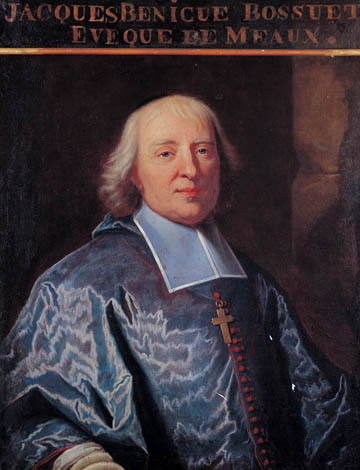
Jacques-Bénigne Bossuet
Histoire des variations des églises protestantes
(History of the variations of the Protestant churches)

Playing Calvin


But what did Jeremiah say? The Lord hath not sent thee. This refutation ought to be noticed whenever we contend with Satan’s ministers and false teachers; for whatever they may pretend, and with whatever masks they may cover their lies, this one thing ought to be more than sufficient to put an end to their boastings, — that they have not been sent by the Lord. Jeremiah might have contended in a long speech with Hananiah, for he might have been made sufficiently eloquent through the Holy Spirit suggesting and dictating whatever was needful on the subject; but this concise brevity produced much greater effect than if he had made great display and used many words. Let this, then, be borne in mind, that wherever there is a controversy about religion, we ought ever to ask whether he who speaks has been sent by God; for whatever he may babble, though the most acute, and though he may talk things which may fill with wonder the minds of the simple, yet all this is nothing but smoke when his doctrine is not from God. So also we ought at this day to deal in a brief manner with those mercenary dogs of the Pope who bark against the pure truth of the Gospel; we ought to be satisfied with this compendious answer: that God is not their master and teacher.
John Calvin 
Commentary on Jeremiah and Lamentations

Lacordaire: A Protestant is his own unity


O altitudo divitiarum sapientiae et scientiæ Dei: quam incomprehensibilia sunt iudicia eius, et investigabiles viæ eius! Quis enim cognovit sensum Domini? (From the Lesson for Trinity Sunday, Rm xi: "Oh, the depth of the riches of the wisdom and of the knowledge of God! How incomprehensible and His judgments and how unsearchable His ways! For Who has known the mind of the Lord?") 

_______________________________________ 

You will perhaps ask why God has left so many questions open to discussion. You might as well ask why God has not revealed everything. 

Now God has revealed the principles in order to serve as foundations, He has not done exactly the same with the consequences, in order to give our liberty play, like a mother who holds her child up by leading strings, but is delighted to see him try and walk like a man. You must bear in mind too, that this infallibility may, at any moment, transfer ideas from the realm of opinion to that of dogma, and consequently from the free to the necessary order. A simple decision of the Church works this change, and she never withholds that decision from the human race in case of need.

Seated in the midst of minds, unchangeable like God, whose Spirit she has, the Church diffuses in a wonderful manner light and heat, drawing to herself every soul of good will, judging human ideas by the standard of divine ones, and welding together in admirable peace the very differences she allows to exist among her childrenTheir liberty gives her no uneasiness, for she knows on the one hand, the point at which she will check them, and on the other she is certain they will stop at her bidding. It is much the same kind of feeling as that of God about the ocean.

On the contrary, Protestant liberty recognises no bounds, and is destructive of all unity. ... He [the Protestant] is his own unity: in other words, his unity is something essentially variable, a cloud, a dew drop. His individuality itself does not constitute unity: he is alone without the possibility of being one; God is one without being able to be alone, and His Church in like manner.

Henri-Dominique Lacordaire
Letter to a young man 
Solesmes, June 24, 1838

[Trans. Fr. James Trenor]

Pentecost, feast of the Unity of the Church

[W]hen I speak, think and act like a Christian, I do not stay closed off within myself – but I do so in everything and starting from everything: thus the Holy Spirit, the Spirit of unity and truth, can continue to resonate in people's hearts and minds, encouraging them to meet and welcome one another. Precisely because it acts in this way, the Spirit introduces us to the whole truth, who is Jesus, and guides us to examine and understand it. We do not grow in understanding by closing ourselves off inside ourselves, but only by becoming capable of listening and sharing, in the “ourselves” of the Church, with an attitude of deep personal humility. Now it is clearer why Babel is Babel and Pentecost is Pentecost. Where people want to become God, they succeed only in pitting themselves against each other. Where they place themselves within the Lord's truth, on the other hand, they open themselves to the action of his Spirit which supports and unites them.  ...

Saint Paul lists the works of the flesh: they are the sins of selfishness and violence, like hostility, discord, jealousy, dissent. These are thoughts and actions that do not allow us to live in a truly human and Christian way, in love. This direction leads to us losing our life. The Holy Spirit, though, guides us towards the heights of God, so that, on this earth, we can already experience the seed of divine life that is within us. Saint Paul confirms it: “The fruit of the Spirit is love, joy, peace”. We note how the Apostle uses the plural to describe the works of the flesh that provoke the loss of our humanity – while he uses the singular to define the action of the Spirit, speaking of “the fruit”, in the same way as the dispersion of Babel contrasts with the unity of Pentecost.

Dear friends, we must live according to the Spirit of unity and truth, and this is why we must pray for the Spirit to enlighten and guide us to overcome the temptation to follow our own truths, and to welcome the truth of Christ transmitted in the Church.
Benedict XVI 
Homily on the Mass for Pentecost Sunday 
May 27, 2012 
 [Translation: Vatican Radio]

Bossuet: "Two ways of aspiring to the reformation of the Church"


There were thus [prior to the 16th century] two different sorts of persons who called for reformation: one, the truly peaceful and true children of the Church, without bitterness supporting her grievances, and who, with respect, proposed a reformation of them, and in humility bore them despite its delay.

Far from desiring to effect this object by schism, they, on the contrary, looked on schism as the greatest of all evils. In the midst of these abuses, they admired the Providence of God, who, according to his promises, knew how to preserve the faith of the Church.

And, though they could not accomplish a reformation of attitudes, free from all bitterness, and free from all passion, they deemed themselves glad that nothing prevented them from accomplishing it within themselves. These were the strong ones of the Church, whose faith no temptation could shake, nor induce to deviate from unity.

Besides these, there were proud spirits, who, shocked by the disorders they saw prevailing in the Church, particularly in her ministers, did not understand how the promises of her eternal duration could subsist in the midst of such abuses; whereas the Son of God had taught to respect for  the chair of Moses, notwitstanding the evil works of the Scribes and Pharisees who sat upon it; these became proud, and thereby weak, yielding to the temptation which inclines to hate the Chair itself, due to the hatred towards those who preside upon it; and, as if the wickedness of man could make void the work of God, the aversion they had conceived against the Doctors made them hate both the doctrines they taught and the authority they had received from God to teach.

Such were the Waldensians and Albigensians; such were John Wycliffe and Jan Hus. The ordinary bait by which they induced weak souls into their webs was the hatred with which they inspired them against the Pastors of the Church; influenced by this spirit of bitterness, they desired nothing but rupture.

Jacques-Bénigne Bossuet
Histoire des variations des églises protestantes

Playing Luther

[I]t is not the pope alone who is always in the right, if the article of The Creed is correct: "I believe one holy Christian Church"; otherwise the prayer must run: "I believe in the pope at Rome," and so reduce the Christian Church to one man, -- which would be nothing else than a devilish and hellish error.

...

Balaam's ass, also, was wiser than the prophet himself. If God then spoke an ass against a prophet, why should He not be able even now to speak by a righteous man against the pope? In like manner St. Paul rebukes St. Peter as a man in error. Therefore it behooves every Christian to espouse the cause of the faith, to understand and defend it, and to rebuke errors.

...

In short, at Rome, Christ counts for nothing, the pope counts for everything; and yet they would compel us with threats to approve, and praise and honor such antichristian sins, though this is against God and against all Christian doctrine.
Martin Luther 
To the Christian Nobility of the German Nation (An den christlichen Adel deutscher Nation
1520