Rorate Caeli
Showing posts with label Brandmüller. Show all posts

Cardinal Brandmüller on the Motu Proprio: “A law must be accepted to be valid”


Cardinal Brandmüller on the Motu Proprio: “A law must be accepted to be valid”

July 29, 2021

With his motu proprio Traditionis custodes, Pope Francis has practically unleashed a hurricane that has upset those Catholics who feel attached to the “Tridentine” rite of Mass revived by Benedict XVI’s Summorum Pontificum. From now on—according to the essential declaration of Traditionis custodes—Benedict’s Summorum Pontificum will be in large measure suspended and the celebration of Holy Mass, with some exceptions, will be allowed only according to the Missal of Paul VI. A look at the blogger scene and other media outlets reveals how a global protest has erupted against this document, which is unusual in form and content.

In contrast to the protests relating to the content of the Traditionis custodes, it is necessary now to make some reflections here that refer to fundamental principles of ecclesiastical legislation—in regard to Traditionis custodes. If the discussion about Traditionis custodes has so far concerned the legislative content of the motu proprio, here the text will be considered from a formal point of view as a legal text.

Guest Op-Ed: When bishops knew how to respond to a pope suspected of heresy

by the Rev. Deacon Nick Donnelly


In his recent letter to the College of Cardinals Cardinal Brandmüller wrote that all cardinals must consider how they will react to ‘any heretical statements or decisions of the [Amazonian] synod.’ In the past, it wouldn’t have been necessary to ask this question because the bishops of the Western Church had a reputation for robustly reacting against heresy. 

A case in point is how the bishops reacted to the mere suspicion that Pope Vigilius (537-555 AD) was sympathetic towards the Monophysite heresy that sought to undermine the Council of Chalcedon. 

Pope Vigilius was already unpopular with many in Rome and the Western Church for conniving with the Monophysite Empress Theodora in the deposition and death of his predecessor, Pope Silverius (536-537 AD). Pope Silverius had earned the hostility of the heretics for refusing to restore the deposed and excommunicated Monophysite Patriarch of Constantinople. Vigilius secured the papacy by expressing sympathy for the Monophysite cause.  

The significance of Cardinal Brandmüller's latest condemnation of the Amazon Synod: "A situation never before seen in the Church's history"

By now (6th September 2019), many media outlets (among them Catholic Herald and Catholic News Agency) have reported on the latest broadside against the upcoming Amazon Synod (and its Instrumentum Laboris) by Cardinals Raymond Burke and Walter 

This is not the first time that either Cardinal has denounced this horrid document. What is new is Brandmüller's declaration that the current crisis surpasses even the Arian Crisis in severity: 

"'We must face serious challenges to the integrity of the Deposit of the Faith, the sacramental and hierarchical structure of the Church and its Apostolic Tradition. With all this has been created a situation never before seen in the Church’s history, not even during the Arian crisis of the fourth and fifth century,' Brandmüller added.

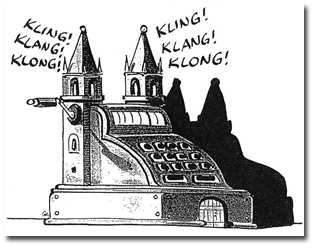
Church of Germany, Church of Simony

All talk of "poverty" and "humility" from the highest echelons of the Church must be dismissed as the irrelevant talk it is until the greatest money-related scandal in the Church, the German Kirchensteuer (Church Tax) system remains in place. No item is more single-handedly responsible for instability in the Church today than the Simoniacal Church Tax, which both renders "excommunicates" those German Catholics who refuse to pay it and makes the German Hierarchy use their immense wealth and financial resources as a tool of subversion and blackmail of the whole Universal Church.

A system that has emptied the Church in Germany at the same time as its wealth becomes a tumor threatening the health of the whole Church. When a Pope dismantles or at least decides on an overhaul of the Kirchensteuer system in Germany (and elsewhere where it works in the exact same simoniacal way), then all the talk of poverty will at last become believable.

Rich Church, Empty Church

Simone Varisco

SYNOD AND TRUTH:
Understanding In Depth the Grave Errors of Cardinal Kasper

- A Major Article by Roberto de Mattei


KASPER’S MESS
The origins of the errors
For them, Christianity is praxis, not justice
Roberto de Mattei
Il Foglio
October 1, 2014


The upcoming Synod of Bishops has been preceded by a rumpus in the media which attaches to it a historical significance greater than its ecclesiastical importance as merely a consultative assembly in the Church. Some are complaining about the theological war the Synod promises to be, but the history of all the Episcopal meetings in the Church (such is the etymological significance of the term “synod” and its synonym “council”) has been made up of theological conflicts and bitter debates on errors and divisions that have threatened the Christian community since its beginnings.

Francis, writing on the Council of Trent, explicitly affirms the authority of the 'hermeneutic of reform in continuity'


Today the Vatican website published the Latin letter addressed by Pope Francis to Cardinal Brandmuller on the celebrations for the 450th anniversary of the closing of the Council of Trent. 

The letter affirms the continued importance of the doctrine of Council of Trent. While some might dismiss this as mere routine, this letter has the significance of being the very first occasion (to our knowledge) that Francis has directly and explicitly invoked, when touching upon the interpretation of doctrine, the authority of Benedict XVI's epoch-dividing December 22, 2005 address on the "'hermeneutic of reform', of renewal in the continuity of the one subject-Church." (Sometimes shortened to 'hermeneutic of reform in continuity' and, with less precision, to 'hermeneutic of continuity'.)

Coming back to the letter's treatment of the Council of Trent: regardless of the actual "level" of this document (which at least is not a mere summary or an interview with a secular newspaper), and without the need to assume anything about future events in this unfolding Pontificate, we now have something "quotable" from this Pope about the continued importance of Trent -- not just as a historical event, but in its doctrinal heritage.

________________________________

To our Venerable Brother
Walter Cardinal Brandmüller
Deacon of St. Julian of the Flemings

As the 450th anniversary of the day on which the fortunate Council of Trent was closed approaches, it behooves the Church to recall with more prompt and attentive eagerness the most fruitful doctrine which came out of that Council convened in the Tyrolese region. Certainly not without cause, the Church has for a long time already accorded so much care to the Decrees and Canons of that Council that are to be recalled and observed, since, indeed the most grave affairs and questions having appeared at that time, the Council Fathers summoned all diligence that the Catholic Faith appear more clearly and be better understood. No doubt, with the Holy Ghost inspiring and suggesting, it especially concerned the Fathers not only to guard the sacred deposit of Christian doctrine, but also to more clearly enlighten mankind, so that the saving work of the Lord may be poured out onto the whole world and the Gospel be spread through the entire world.

Graciously hearing the very same Holy Ghost, the Holy Church of our age, even now, continues to restore and meditate upon the most abundant doctrine of Trent. As a matter of fact, the “hermeneutic of renewal” (interpretatio renovationis) which Our Predecessor Benedict XVI explained in 2005 before the Roman Curia, refers not only to the Tridentine Council but also to the Vatican Council. The mode of interpretation, certainly, places one honourable characteristic of the Church in a brighter light that is given by the Same Lord (Benedict XVI): “She is a subject which increases in time and develops, yet always remaining the same, the one subject of the journeying People of God” (Christmas Address to the Roman Curia).

Therefore, we rejoice and express gladness that, glowing with such splendor of the Church, this event is celebrated in a more solemn manner in the City of Trent. Wherefore, the Venerable Brother Luigi Bressani, Metropolitan Archbishop of Trent, requested that We assign some honourable Prelate who, on the 3rd of the following December, may pronounce the exhortatory words to all who shall attend this gladsome commemoration. Deeming this request, therefore, as just, and willing to designate You, Our Venerable Brother, who indeed have expertly investigated and have wisely carried forward the decrees of this Council. We, therefore, name You in these letters OUR EXTRAORDINARY ENVOY to the celebrations of the 450th anniversary of the day on which the Conciliar Fathers completed the works of the Council of Trent. Indeed, You will exhort all who shall participate in this event, that, souls joined together with the soul of the Most Holy Redeemer, they may be fully conscious of all the fruits derived from this Council, and that they may unite themselves in bringing these fruits to others and in propagating them in every way. You shall greet on Our behalf the Metropolitan Archbishop of Trent and all other attending holy Bishops, priests, religious men and women, and lay faithful of Christ, and You shall show them Our benevolence.

[Concluding greetings and blessing.]

Given in Rome, at Saint Peter's, on November 19th of the year 2013, 1st of our Pontificate.

FRANCISCUS


[Source (in Latin): Letter of the Holy Father to the Special Envoy to the celebrations of the 450th Anniversary of the Closure of the Ecumenical Council of Trent  - Trent, December 1, 2013]

Original translation for Rorate was made by the owner of the Philippine Catholic blog Dei Praesidio Fultus. Adapted by NC.