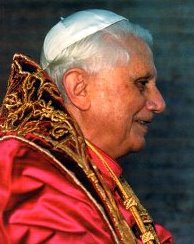
"At the end of a week in which a large part of the attention of the European media has been focused on the question of sexual abuses committed by people in institutions of the Catholic Church, we would like to make three observations:
"Firstly, the line being taken by the German Episcopal Conference has shown itself to be the right way to face the problem in its various aspects. The declarations of the president of that conference, Archbishop Zollitsch, following his meeting with the Holy Father, recap the strategy laid down in the conference's recent assembly and reiterate its essential operational aspects: recognition of the truth and help for victims, reinforcement of preventative measures and constructive collaboration with the authorities (including the judicial authorities of State) for the common good of society. Archbishop Zollitsch also unequivocally reiterated the opinion of experts according to whom the question of celibacy should in no way be confused with that of paedophilia. The Holy Father has encouraged the line being followed by the German bishops which - even taking account of the specific context of their own county - may be considered as a useful and inspiring model for other episcopal conferences that find themselves facing similar problems.
"Furthermore, an important and wide-ranging interview given by Msgr. Charles J. Scicluna, promoter of justice of the Congregation for the Doctrine of the Faith, gives a detailed explanation of the significance of the specific canonical norms established by the Church over the years to judge the heinous crimes of sexual abuse of minors by members of the clergy. It is absolutely clear that these norms did not seek, and have not favoured, any kind of cover-up of such crimes; quite the contrary, they initiated intense activities to confront, judge and adequately punish the crimes in the context of ecclesiastical legislation. And it must be remembered that all this was planned and set in motion when Cardinal Ratzinger was prefect of the Congregation. The line he followed was always one of rigour and coherence in dealing with even the most difficult situations.
"Finally, the archdiocese of Munich has replied, with a long and detailed communique, to questions concerning the case of a priest who moved from Essen to Munich at the time in which Cardinal Ratzinger was archbishop of that city, a priest who subsequently committed abuses. The communique highlights how the then archbishop was completely unconnected with the decisions in the wake of which the abuses took place. Rather, it is evident that over recent days some people have sought - with considerable persistence, in Regensburg and Munich - elements that could personally involve the Holy Father in questions of abuse. To any objective observer, it is clear that these efforts have failed.
"Despite the storm, the Church clearly sees the route she must follow, under the sure and rigorous guidance of the Holy Father. As we have already had occasion to observe, it is our hope that this torment may, in the end, help society as a whole to show ever greater concern for the protection and formation of children and adolescents."
... it is important to overcome dangerous reductionism that, in past decades, using categories that were more functional than ontological, has presented the priest almost as a "social agent," running the risk of betraying the priesthood of Christ itself. Just as the hermeneutic of continuity is increasingly revealed as urgent to understand in an appropriate way the texts of the Second Vatican Council, similarly an hermeneutic seems necessary that we could describe "of priestly continuity," which, starting from Jesus of Nazareth, Lord and Christ, and going through the 2,000 years of the history of grandeur and holiness, of culture and piety, which the priesthood has written in the world, arrives at our days.
Dear brother priests, at this time in which we live it is especially important that the call to participate in the one priesthood of Christ in the ordained ministry flower in the "charism of prophecy": There is a great need of priests that speak of God to the world and that present God to the world; men not subject to ephemeral cultural ways, but capable of living in an authentic way that liberty that only the certainty of belonging to God is in conditions to give. As your Congress has pointed out well, today the most necessary prophecy is that of fidelity, which, starting from the fidelity of Christ to humanity, will lead through the Church and the ministerial priesthood to live one's priesthood in total adherence to Christ and to the Church. In fact, the priest no longer belongs to himself but, because of the sacramental seal received (cf. Catechism of the Catholic Church, Nos. 1563;1582), is "property" of God. This "being of Another" must be made recognizable by all, through a clear witness.
In the way of thinking, of speaking, of judging the events of the world, of serving and loving, in relating to persons, also in the habit, the priest must draw prophetic strength from his sacramental belonging, from his profound being. Consequently, he must have every care to subtract himself from the prevailing mentality, which tends to associate the value of the minister not to his being, but only to his function, thus not appreciating the work of God, who influences the profound identity of the person of the priest, configuring him to himself in a definitive way (cf. Ibid., No. 1583).
The horizon of the ontological belonging to God constitutes, moreover, the appropriate framework to understand and reaffirm, also in our days, the value of sacred celibacy, which in the Latin Church is a charism required for Holy Orders (cf. "Presbyterorum Ordinis," 16) and is held in very great consideration in the Eastern Churches (cf. CCEO, can. 373). That is authentic prophecy of the Kingdom, sign of consecration to the Lord and to the "things of the Lord" with an undivided heart (1 Corinthians 7:32), expression of the gift of self to God and to others (cf. Catechism of the Catholic Church, No. 1579).
(I wonder if Fr. Touze was being prophetic about Rome's eventual extension of celibacy to the Eastern Churches, now that the Pope is speaking of "ontological belonging to God" as the proper framework for the understanding of clerical celibacy...CAP)
That which seems to Us not only the greatest evil but the root of all evil is this: often the lie is substituted for the truth, and is then used as an instrument of dispute. On the part of not a few religion is passed by as a thing of no importance, and elsewhere absolutely prohibited in family and social life as a remnant of ancient superstitions; public and private atheism is exalted in such a way that God and His law are being abolished, and morals no longer have any foundation. The Press also too often vulgarly reviles religious feeling, while it does not hesitate to spread the most shameful obscenities, agitating and with incalculable harm leading into vice tender childhood and betrayed youth.
By means of false promises a people is deceived and provoked to hatred, rivalry and rebellion, especially when the hereditary faith, the only relief in this earthly exile, is successfully torn from its heart. Disturbances, riots and revolts are organized and fomented in continuing series, which prepare for the ruin of the economy and cause irreparable harm to the common good.
We must above all deplore with overwhelming sadness that in not a few nations the rights of God, Church and human nature itself are outraged and trampled upon. Sacred ministers, even those invested with high dignities, are either driven from their proper Sees, exiled and imprisoned, or impeded in a manner preventing them from exercising their ministry. In the field of education, whether of lower or of university level, as well as in publications and the Press, permission to explain and defend the doctrine of the Church either is not given or is so restricted and subjected to such surveillance by official censorship that the arbitrary proposition that truth, liberty and religion must submissively serve only the civil authority seems to be the established principle.
Since these innumerable evils spring, as We have said, from one source only, the repudiation of God and contempt for His law, it is necessary, Venerable Brethren, to offer to God fervent prayers and recall all to those principles whence alone can come enlightenment for minds, peace and concord for souls and well ordered justice between the various social classes.
As you know, once religion is taken away there cannot be a well ordered, well regulated society...
If the Masonic and Liberal influenced Kingdom of Italy had not completed its conquest of the peninsula by finally swallowing the City of the Popes in 1870, then the Lutheran church in Rome which Pope Benedict will soon honor with his presence would not exist. While the Popes still governed Rome, Lutheran worship was confined to a chapel in the Prussian embassy. Both public immorality and public heresy were banned in the Eternal City as the Popes guarded the souls of their local diocesan flock. Blessed Pope Pius IX lamented the change since 1870 in his Consistorial Allocution of March 12, 1877: “Even those who boast of our liberty would be unable to deny the manifold, constant and grave occasions that are prepared for the demoralisation and corruption of incautious youth, and for uprooting Catholic faith from their minds. And if they walked through the streets of this City, which, as being the See of Blessed Peter, is the seat and center of religion, they could easily judge whether the temples of heretical worship, the schools of error everywhere established, the houses of ill-fame set up in many places, and the obscene and loathsome sights presented to the eyes of the people, constitute a state of things which is tolerable for him whose duty and wish it is, by reason of his Apostolic office, to destroy these many evils, but who is unable to apply a remedy to even one of them, or to help the souls that are perishing.”
The charity of Pius IX toward the souls of those who maintained the temples of heretical worship had been expressed in the Apostolic Letter Iam Vos Omnes of September 13, 1868, issued on occasion of the upcoming Vatican Council to which he invited them to send observers: “Sustained therefore by this hope, solicitous and urged by the charity of Our Lord Jesus Christ, who offered His life for the salvation of all the race of men, it is not possible for us to pass by the occasion of the future Council without turning Our paternal and Apostolic word again to all those who, even if they acknowledge Jesus Christ the Redeemer and boast of the name of Christian, do not profess the totality of the true faith of Christ and are not in the communion of the Catholic Church. This being the case, we propose with all zeal and Charity to admonish, exhort, and beseech them for this reason to seriously consider and reflect whether the way in which they continue is that which is indicated by that same Christ the Lord: which is the way that leads to eternal life. ......
It is therefore by force of the right of Our supreme Apostolic ministry, entrusted to us by the same Christ the Lord, which [must] carry out . . . the duties of the good Shepherd and to follow and embrace with paternal love all the men of the world, we send this Letter of Ours to all the Christians from whom We are separated, with which we exhort them warmly and beseech them with insistence to hasten to return to the one fold of Christ; we desire in fact from the depths of the heart their salvation in Christ Jesus, and we fear having to render an account one day to Him, Our Judge, if, through some possibility, we have not pointed out and prepared the way for them to attain eternal salvation. In all Our prayers and supplications, with thankfulness, day and night we never omit to ask for them, with humble insistence, from the eternal Shepherd of souls the abundance of goods and heavenly graces. And since, if also, we fulfill in the earth the office of vicar, with all our heart we await with open arms the return of the wayward sons to the Catholic Church, in order to receive them with infinite fondness into the house of the Heavenly Father and to enrich them with its inexhaustible treasures.”
Blessed Pius IX was greatly admired by Blessed John XXIII, who mentioned in In Petri Cathedram that the Second Vatican Council would also be for the return of the separated brethren. And Pope John showed himself remarkably like Pius IX in his own diocesan Synod of Rome which was linked in his mind with the Ecumenical Council: as he wrote in the Apostolic Constitution Sollicitudo Omnium (June 29, 1960), bringing present-day errors and dangers to light and taking precautions was one of the goals of the synod, together with the renewal of discipline, the promotion of the apostolates and of participation in the liturgy, and the accommodation of pastoral methods to present-day needs. Pope John prescribed prayer for the unity of all Christians even as he legislated for the protection of the Catholic faithful in the meantime:
“228, 2: Let Catholics pour forth earnest prayers that all may be gathered into one sheepfold, under the guidance of one shepherd. 240, 1: And laypeople, using legitimate means, and even though it may cause some inconvenience, must resist non-Catholics who would dare to disseminate among the people what they think against Catholic doctrine and try to suggest their own endeavors to the souls of others. 2: Catholics are prohibited from entering the halls and temples of non-Catholics and from being present at their rites (cfr. Can. 1258, 1 and 2), . . . nor is it licit for Catholics to read or spread or have in their homes the things which non-Catholics have published treating ex professo about religion (cfr. Can. 1399). 241, 1: If dealings must be had with those who are far from the Church, let it always be done with respect and at the same time with prudence and charity. 2: Let parents assiduously avoid welcoming into the home those who could harm faith and morals, and even less should they treat them on intimate terms.”
One of the statutes of the synod has this to say about its own laws, and therefore about the ones just quoted: “5, 2: All declarations of the Synod, including exhortations, are to be received with reverence and with full and sincere docility of mind.”
The Apostolic Constitution describes in warm terms the entire process of the synod, the prayers for its success, and the Pope’s own attention and participation. At the end he promulgates its laws: “Having implored the help of God, and trusting in the patronage of the holy apostles Peter and Paul, whose feast we celebrate today, with certain knowledge, from the plenitude of our power, as Supreme Pontiff and bishop of the Roman diocese, with this our constitution, we promulgate these laws of the first Roman Synod . . . ordering and prescribing that from the first of November of this year they begin to have binding power . . .”
50 years later: Pope Benedict’s Cardinal-Prefect of the Congregation for the Doctrine of the Faith said last Saturday in Canada that the goal of ecumenism is unity with the Catholic Church. Pope Benedict undoubtedly believes that he is serving that long-term goal by preaching in Rome’s Lutheran church next Sunday. However in the meantime, as a previous post by Bonetus pointed out (Feb. 19), the German Lutheran church in Rome probably attracts some Italians out of the true Church—they have some services in Italian--and has an ex-Catholic Italian as a parish councillor, theologian and preacher. And because of the Italian Lutheran website, divorced Italians wanting to marry a Lutheran will know that Rome’s lovely Lutheran church will give them the church wedding denied them by the Catholic Church which does not accept divorce. These sorts of things were foreseen by the anguished paternal charity of Blessed Pope Pius IX and concretely guarded against by the Roman Synod of Blessed John XXIII.
On March 6th in the Year of Our Lord 2010, The Most Reverend Arthur Saratelli, Bishop of Paterson, New Jersey, ordained 4 seminarians of the Priestly Fraternity of Saint Peter and 2 of the Carmel of the Immaculate Heart of Mary in Wyoming to the Diaconate. The ordination took place in the newly finished Chapel of Sts. Peter and Paul in Denton, Nebraska This marked the first ordinations conferred in the new chapel at Our Lady of Guadalupe Seminary. Please keep the seminarians in your prayers as they continue their ascent to the altar of our Lord.
Those ordained to the Diaconate:
Rev. Mr. Matthew McCarthy, F.S.S.P.
Rev. Mr. David Kemna, F.S.S.P.
Rev. Mr. Damonn Sypher, F.S.S.P.
Rev. Mr. Christopher Pelster, F.S.S.P.
Br. Michael Mary of the Trinity, M. Carm.
Br. Joseph Marie of Jesus, M. Carm.
In the last picture, one can see a member of the F.SS.R at the right.
Saint Bonaventure au concile de Lyon. Ecole flamande. XIVe.
At this point perhaps it is useful to say that also today there are views according to which the whole history of the Church in the second millennium is a permanent decline; some see the decline already immediately after the New Testament. In reality, "opera Christi non deficiunt, sed proficiunt," the works of Christ do not go backward, but progress. What would the Church be without the new spirituality of the Cistercians, of the Franciscans and Dominicans, of the spirituality of St. Teresa of Avila and St. John of the Cross, and so on? This affirmation is also valid today: "Opera Christi non deficiunt, sed proficiunt," they go forward.
St. Bonaventure teaches us the whole of the necessary discernment, even severe, of the sober realism and of openness to new charisms given by Christ, in the Holy Spirit, to his Church. And while this idea of decline is repeated, there is also the other idea, this "spiritualistic utopianism," which is repeated. We know, in fact, how after the Second Vatican Council, some were convinced that everything should be new, that there should be another Church, that the pre-conciliar Church was finished and that we would have another, totally "other" Church. An anarchic utopianism! And thanks be to God, the wise helmsmen of Peter's Barque, Pope Paul VI and Pope John Paul II, on one hand defended the novelty of the council ("la novità del Concilio") and on the other, at the same time, defended the uniqueness and continuity of the Church, which is always a Church of sinners and always a place of grace.
We have received the following report from Mr. Yaqoob Bangash who served as MC of the Mass described here.
The Oxford University Newman Society arranged for a Pontifical High Mass at the Faldstool in the Extraordinary Form on March 8, 2010. The celebrant was The Rt. Rev. Dom Cuthbert Brogan OSB, Lord Abbot of S. Michael's Abbey, Farnborough, UK. The Deacon was Rev. Fr. Anton Webb Cong. Orat. of the Oxford Oratory and the subdeacon was Br. Lawrence Lew OP of Blackfriars, Oxford. Fr. Tim Finigan, Parish Priest of Our Lady of the Rosary, Blackfen, (and Past President) was the Assistant Priest.
The Mass was of the Lenten feria and with two choirs: one was a liturgical schola which chanted the Propers of Mass, arranged by the Chairman of the Latin Mass Society, The Hon. Dr. Joseph Shaw (the LMS also sponsored the Mass), and the other was composed of members of the Keble College Choir which sang the Ordinary of Mass. The music setting was Monteverdi's Messa a 4 voci da capella. Fr. Tim Finigan later spoke at the Termly Dinner which was held in S. Benet's Hall (owned by Ampleforth Abbey and a Hall of the University of Oxford).
This was the first time since the reform that a Pontifical Mass had been celebrated in the Extraordinary Form in the Oratory Church of S.Aloysius Gozanga and only the second time the Newman Society had arranged a Pontifical Mass in the Usus Antiquior.
The aim of the Newman Society, following the impetus given by the Pope, is to celebrate both Forms of the Roman Rite in a fitting manner and so we have the Ordinary and Extraordinary Forms of the Roman Rite everyalternate term. The Oxford Oratory has generously implemented Summorum Pontificum and now the Church has public Extraordinary Form Masses on every Holy Day (many of them sung), while the Fathers say Extraordinary Form private Masses almost every day. The newly restoredsanctuary of the Oratory (a result of the Oxford Oratory's Reaffirmation & Renewal campaign) formed the perfect setting for the Termly Mass of the premier Catholic student society in the Universityof Oxford.
As a student society, the Newman Society is striving to do its bit in the intellectual and liturgical reform spearheaded by Pope Behedict XVI.
Interview With Theologian on the Foundations of Celibacy
By Carmen Elena Villa
ROME, MARCH 9, 2010 (Zenit.org).- Married priests are an exception and the Church is increasingly convinced that they must remain so, according to a spiritual theology professor at the Pontifical University of the Holy Cross.
Father Laurent Touze explained the foundations of priestly celibacy when he spoke at a two-day conference held last week at Rome's Pontifical University of the Holy Cross. The conference, "Priestly Celibacy: Theology and Life," was sponsored by the Congregation for the Clergy as an event for the Year for Priests.
ZENIT spoke with Father Touze about the exceptions to priestly celibacy and the future of celibacy for the Church.
ZENIT: Is celibacy a dogma of faith or a discipline?
Father Touze: Neither one nor the other. It isn't a dogma of faith because we see married priests in the Church today such as, for example, some [priests] of the Eastern Catholic Church. Not all but some admit married priests. Or as has been reminded recently in the Holy Father's motu propio "Anglicanorum coetibus," published last Nov. 4: Among the ex-Anglicans who want to return to communion with the Catholic Church, there will be married priests admitted.
ZENIT: With this measure, do you think that one day, celibacy might become voluntary also for priests of the Latin rite?
Father Touze: No, because the Church is understanding more and more the relation between priesthood, episcopate and celibacy. It is something that could be likened to the revelation of a dogma, though it isn't so at this time; one tends increasingly to understand that a practice must be promoted among all priests and also among Eastern Catholic priests which is truly similar to the one lived in the first centuries.
ZENIT: But in the first centuries there were many married priests, including the Apostles?
Father Touze: Studies have convincingly shown that this must be questioned: Celibacy of all clerics wasn't lived, but from the moment of inclusion in the priestly order these men had to live continence with the permission of their wives, because this was a commitment of the couple.
ZENIT: Why, then, are exceptions made?
Father Touze: Historically because there has been a manipulation of texts and I believe a bad translation that the Eastern Church, which has separated from Rome and has recognized that what they had declared contrary to tradition, could be accepted. In this connection there truly are some exceptions. The Church discovered that she had the possibility of admitting exceptions but that these should be understood as such. Respectably, as the Second Vatican Council stressed, there are very holy married priests in the Eastern Catholic Churches who have contributed much to the history of the Church and to the faith in times of persecution, but they are truly exceptions and must be understood as such.
ZENIT: However, these exceptions are not made with bishops. Does episcopal celibacy have a special meaning?
Father Touze: Undoubtedly. It is very different, both theologically as well as historically. What's more, with the constitution "Lumen Gentium," Vatican II defined that the episcopate is the fullness of the sacrament of Holy Orders. It is necessary to discover the specificity of the episcopate and, hence, episcopal celibacy. And it can be demonstrated with the fact that for the celibacy or continence of a bishop an exception has never been made.
This is something studied by the Church on which the Roman pontificate has had to reflect more recently in contemporary history on two occasions: after the French Revolution, where some bishops, or better, former bishops, asked to marry.
This has been studied and it has been said that it is impossible, that this had never been done, that at stake was the dogmatic issue. Or still recently with the ordination of married men and married bishops that were effected in former Czechoslovakia by imposition or with the pressure of the Communist Party in power. There also the Church affirmed on the fact that the bishop must always be celibate or if he had married before his ordination because he would have to live continence from the moment of his episcopal ordination.
[Translation by ZENIT]
Forces of evil gather against the Holy Father and use the failings of others in order to harm his image and his reform program. Let us pray for the Successor of Peter.
On Saturday, March 6, William Joseph Cardinal Levada, prefect of the Congregation for the Doctrine of the Faith, delivered an address at Queen's University in Kingston, Ontario, Canada. Titled, "Five Hundred Years After St. John Fisher: Pope Benedict's Initiatives Regarding the Anglican Communion," the address recounted the background to the Holy Father's recent Apostolic Constitution Anglicanorum coetibus and discussed hopes and prospects for uniting Anglican groups with the Catholic Church.
An unofficial transcript of Cardinal Levada's address is available at Salt + Light. Here follow a few key excerpts:
Cardinal Walter Kasper, current President of the Pontifical Council for Promoting Christian Unity, addressed this point in an intervention given in June 2006 to the House of Bishops of the Church of England during its discussions on the ordination of women to the episcopate. In his talk he said this: “Because the Episcopal office is a ministry of unity, the decision you face would immediately impact on the question of the unity of the Church and with it the goal of ecumenical dialogue. It would be a decision against the common goal we have until now pursued in our dialogue: full ecclesial communion, which cannot exist without full communion in the episcopal office.”
As we met with Anglican consultants in the preparation of Anglicanorum coetibus, these bishops and theologians themselves proposed the Catechism of the Catholic Church as the norm of faith for the corporate groups of Anglicans who might avail themselves this new instrument for full corporate union with the Catholic Church. Thus, I would also characterize the Catechism as an ecumenical initiative of Pope Benedict XVI and of his predecessor.
Union with the Catholic Church is the goal of ecumenism—one could put, “we phrase it that way”. Yet the very process of working towards union works a change in churches and ecclesial communities that engage one another in dialogue, in actual instances of entering into communion do indeed transform the Catholic Church by way of enrichment. Let me add right away that when I say enrichment I am referring not to any addition of essential elements of sanctification and truth to the Catholic Church. Christ has endowed her with all the essential elements. I am referring to the addition of modes of expression of these essential elements, modes which enhance everyone’s appreciation of the inexhaustible treasures bestowed on the Church by her divine founder.
The new reality of visible unity among Christians should not thought of as the coming together of disparate elements that previously had not existed in any one community. The Second Vatican Council clearly teaches that all the elements of sanctification and truth which Christ bestowed on the Church are found in the Catholic Church. What is new then is not the acquisition of something essential which had hitherto been absent. Instead, what is new is that perennial truths and elements of holiness already found in the Catholic Church are given new focus, or a different stress by the way they are lived by various groups of the faithful who are called by Christ to come together in perfect communion with one another, enjoying the bonds of creed, code, cult and charity, in diverse ways that blend harmoniously.
Q: Speaking of which, how do you perceive the present situation?
CM:It is, quite simply, unhoped for: for the first time since the upheavals that were brutally imposed in the name of the "Spirit of the Council," a reconciliation seems possible beyond this or that liturgical preference. Indeed the Pope has removed the last obstacles (real or imagined) to a stronger unity of all Catholics around the Holy Father.
In this favorable atmosphere unity henceforward rests principally on the personal commitment of the baptized: of the faithful, of course, whose role in the Church the Vatican II Council underscored, but also of the bishops and priests who as Pastors fully bear this responsibility.
For each of us the question is whether we truly wish to be faithful to the commitments of our faith in Jesus Christ.
Q: Paix Liturgique has become known especially through opinion polls, hasn't it? ...
CM: The idea of commissioning opinion polls was born of the contemptuous silence we encountered: "You do not exist"; "you're living in the wrong century"; "there is no liturgical problem among us"; "you've missed the train of renewal", etc. Yet not only did these claims strike us as so many caricatures from the outset, but even, as the years have gone by, they have turned out to be absolutely without basis in reality: the number of the faithful who are attached to the old Mass is forever on the increase; the young are ever more attracted to it.
As a privileged observer, I have been able, for the past forty years, starting with the sizable French "Silent ones of the Church" movement just after the Council, to observe that those attracted to the traditional liturgy are not "a tiny group of old folks and nostalgics" but a sizable part of the Catholic faithful. Convinced as I was by this reality, which testimonies confirmed every day, we looked for an instrument to give some consistency to that reality. How could we make it known that it was neither honest nor reasonable to reduce Catholics attached to the Latin and Gregorian liturgy merely to the faithful of the Society of Saint Pius X, who, as the claim then went, "at best" amounted to no more that 1% of the faithful?
Following the example set by the then president of Una Voce, Éric de Saventhem, in Germany in the early 80s, we got the idea of commissioning an opinion poll in France in 2001 with one of the great polling institutions in the country. The results of that Ipsos investigation went beyond our wildest expectations! Indeed, at a time when the claim was still routinely made that the Missal according to John XXIII was forbidden, over 20% of practicing Catholics stated that they wished to live out their Catholic faith within the traditional liturgy ...
Since then, we commissioned two further polls along the same lines in France, followed by one in Italy in September of 2009 that yielded the extraordinary result of two practicing Italian Catholics in three ready to attend the old Mass. We have also begun to undertake polls in the dioceses, in Versailles and Paris for the time being, and have just undertaken a poll among German Catholics ...
So, little by little, we are getting a pretty accurate picture of the reality: since the Holy Father's beautiful words in 2007, at least one in three Catholics who attend Sunday Mass in their parish would participate in a Mass celebrated according to the extraordinary form ...
Q: Yet many Pastors seem in no hurry to accept this reality and to achieve unity among Catholics, do they?
CM:Alas! Ideology is alive and well in a good portion of the clergy, and even more so among the bishops! The issue of unity is still by and large approached within an exclusive understanding of unity: all those who exhibit the slightest attachment to the Church's two thousand year old tradition, be it doctrinal or liturgical, are ignored or looked at with suspicion.
It is more than about time for this blindness to cease and for our bishops to become aware that very many of the faithful wish to live out their Catholic faith within the extraordinary form of the Roman rite. As difficult and as painful as this realization might be for some of them, it is an essential a first step...
***
Q: What can we hope from our bishops, then?
CM:Simply this: let them stop just trying to be right against the Pope and be willing, at long last, to acknowledge the needs of the faithful who are attached to the traditional Faith and its practice. As long as these laymen are considered as second-class Christians, or even as "a problem," the Church unity that the bishops profess will remain nothing but a hypocritical notice of intent. An immediate first step to contemplate might be to ensure that all the already established celebrations of the extraordinary form of the Roman rite truly and generously correspond to the actual requests of the faithful. What does this mean? Quite simply that the celebrations be on Sunday, regular, and at family-friendly times. "Extraordinary form" does not mean "extraordinary conditions" for the celebrations, as is unfortunately too often the case.
Next, our pastors -our parish priests first and foremost since the MP gives them this responsibility without their having to obtain the bishop's placet- should respond to the requests they receive loyally and within a reasonable delay, without equivocating or playing for time.
Respect, receptivity, and goodwill: that is all we ask of our pastors and bishops. Since these are principles they constantly invoke, we have not lost the hope of finally seeing their fruits in our parishes.
The religion of the peace of the grave strikes again...
It is true that Muslims have been killed as well in previous riots. What should not be forgotten is that Nigeria's forgotten sectarian troubles have their roots in the imposition of Sharia in parts of northern Nigeria, and in the encroachment of Muslim tribesmen on Christian lands.
The apostolic nuncio in Japan, Archbishop Alberto Bottari de Castello, head of the Tokyo nunciature for 5 years, tells us: "The Japanese do not have a personal relationship with God. The concept of the individual, which is at the center of western culture, is not part of their cultural DNA. They identify themselves with the group, the society, the company, the nation. When a Christian arrives at the decision to take his life, he knows that he is about to violate a sacred law: life was given to him by God, and only God can take it away. The Japanese tempted by suicide does not have this obstacle. He does not have the concept of sin. He has no one, he has nothing, beyond his own material and cultural world, to ask for help. But in his world, asking for help is dishonorable, and so he himself must resolve the drama of his unhappiness, which has become unbearable. Christians, even at the darkest moments, can always reach out to God. The Japanese cannot. They have eight million gods, thousands of marvelous temples, shrines, altars, miniature altars, two official religions, Buddhism and Shintoism, but they live without the one omnipotent and merciful God, without the concept of God as father of all humanity and present in each one of us, always."
Hiroko Nakamura, a respected translator of Italian fiction books, does not believe that the relative ease with which the Japanese reach the decision to give up on life is to be attributed to their apparent atheism: "On the contrary, I think that it is precisely our most widespread religious creed, Buddhism, that makes the idea of suicide acceptable as an extreme solution of our earthly problems, both material and spiritual. Buddhism preaches reincarnation, meaning the transfer of an individual's soul into another physical body, not necessarily human. Life is considered a training ground for a new life, moving from one existence to another toward nirvana, the eternal heavenly beatitude. With this faith, when the pressure of the problems of life seems unbearable, it is easier to give in to the temptation to leave everything behind, and to try to do better in the next existence. Buddha, Jesus, Saint Francis, Gandhi, we knew them in their last existence, before their entry into nirvana."
Pending the publication of an official transcript of Cardinal Levada's controversial sermon on March 3, 2010, I would like to present my own transcript of the address. CAP.
William Cardinal Levada began by reading a letter from the Cardinal Secretary of State.
From the Vatican, the 28th of February 2010
Your Eminence
The Holy Father has been informed that on the 3rd of March 2010, you will dedicate the chapel of Our Lady of Guadalupe Seminary in the Diocese of Lincoln. He asks you kindly to convey his greetings and warm good wishes to the members of the Priestly Fraternity of St. Peter, the rector, faculty and students and all assembled for the happy occasion.
His Holiness prays that the new chapel will always be respected as a sacred dwelling where Almighty God is glorified in His majesty, a center from which the beauty and richness of the Catholic faith are proclaimed with conviction, and a place where seminarians and teachers alike are inspired to the pursuit of holiness and ever-deeper communion with the Lord and His Church.
He encourages them to strive through the discipline of prayer and study to be conformed to the mind of Christ (Philippians 2:5), to discern His will in their lives and to respond generously to His call to serve Him as preachers of His Gospel, ministers of His Sacraments and heralds of His mercy and love for the poor and sinners.
With these sentiments, the Holy Father invokes upon the seminary community and its friends and benefactors the maternal intercession of Our Lady of Guadalupe, and imparts the requested Apostolic Blessing as a pledge of wisdom, joy and peace in the Lord.
I am happy to add my own prayerful good wishes for the occasion.
Yours sincerely in Christ:
Tarcisio Cardinal Bertone
Secretary of State
(After announcing that Bishop Bruskewitz had issued a dispensation from the Divine Office for that day the Cardinal then launched into his sermon.)
Your Excellency, Bishop Bruskewitz,
Dear brother bishops and priests,
Dearly beloved in Christ:
The Sacred Scriptures, read in the course of a celebration like ours today, are always a revelation, divinely-guaranteed, of the deepest meaning of what we are celebrating. And so it is from centuries of long practice that we heard today readings from the Book of Revelation and the Gospel of Luke. The passage from the Book of Revelation is an unfolding of the mystery of this day with exuberant, vivid imagery. The Sacred Liturgy wants us to hear these words and identify them with the beautiful space of this chapel, which we are dedicating today. And so what we see here around us, so beautifully expressed in the arrangements of this chapel, its altar, its tabernacle, its lighting, and the prospect of its beautiful art and windows, is meant to converge for us with the visions that the seer of the Book of Revelations beheld. We see, here, in all that surrounds us, the New Jerusalem coming down out of heaven from God, beautiful as a bride adorned to meet her Maker. From this day forward, whenever the sacred liturgy is celebrated herein, we are meant to realize that the community gathered is nothing less than the New Jerusalem, that spotless Bride of Christ.
The liturgy celebrated, is nothing less than an invitation into the liturgy of the Heavenly Jerusalem, that liturgy in which the throne of the Lamb and of God occupy center stage. The slain Lamb that stands forever before the throne of God is the center of the Heavenly Jerusalem and the center of this church, on whose altar the sacrifice of the slain Lamb is continually renewed.
Such lofty, exuberant symbolism contrasts sharply with the dusty, earthy details of the Gospel account we have heard. One can justifiably wonder at first why the Gospel story of Zacchaeus, the short and much-disliked tax collector, should be the pre-eminent Scripture reading of the day of the dedication of a splendid new church. Surely the reason lies in the lines that Jesus addresses to the sinner who He sees eagerly seeking Him from His perch in the sycamore tree. He says, “Zacchaeus, hurry down, for this day I must abide in your house.” These words provide us a beautiful transition from the Zacchaeus scene to the liturgy in which we are involved today, for those firm, determined, magnificent words of Jesus are the same words that He addresses to us, each of us a sinner like Zacchaeus, concerning this house of God. God’s blessings poured out on us in the course of this magnificent liturgy of dedication have in fact this very concrete shape: referring to this new building Jesus says, “this day I must abide in this house.”
Jesus’ simple words and intention help us to keep our bearings in the midst of the more lofty and mystical images of the Book of Revelation. We need them both. For the book of Revelation helps us to remember that in Jesus we are dealing with no one less than the Eternal Son of God, who is in heaven from all eternity. At the same time the Zacchaeus story reminds us that the same Eternal Son is God-with-us, God-with-us on our dusty streets, calling sinners by name, one by one, to have Him as a guest in their home.
Zacchaeus’ reaction to this invitation is meant to indicate our own attitude now, in the course of this celebration. We read, “Zacchaeus made haste and came down and received Him with joy.” Let our sentiments today, and our liturgical action, be an expression with all our hearts of receiving Christ with joy in the midst of this, our house, which Jesus’ presence makes also to be the House of God.
Others will mutter when they see Jesus abundantly granting His gracious presence to people like us. They will say, “He has gone to the house of a sinner.” But Jesus defends us today as He did Zacchaeus. With the graces of this liturgy and of dedication Jesus Himself solemnly pronounces the words “today salvation has come to this house.”
The vision we see in the New Jerusalem and the vision we see in Jesus at table in the home of Zacchaeus, is ultimately a vision of communion. Our Holy Father Pope Benedict XVI, in his Motu Proprio Summorum Pontificum, mentioned that the two forms of the usage of the Roman Rite, the Extraordinary and the Ordinary Forms, can be mutually enriching to each other. As one example he mentioned “the new prefaces can and should be introduced into the old Missal”. In the Missal of Paul VI, there is a beautiful preface to be used on the anniversary of a dedication of a church which can help to enrich our understanding of the celebration today as a vision of communion. Being designated for the anniversary of a dedication, it can indicate to us what we should still be able to pray years from now when we will commemorate today’s dedication.
The second part of a preface, as we know, always states in specific terms the precise motives why it is right and just to give the Father thanks and praise. In this preface the motive states:
For in the visible house that you let us build, you, Father, wonderfully manifest
and accomplish the mystery of your communion with us.
As the new President of the Ecclesia Dei Commission, I want to seize on this phrase, “the mystery of your communion with us”. The Priestly Fraternity of St. Peter has a special charism to assist the Holy Father in preserving the unity of the Church for those attached to the traditional form of the Mass, through the implementation of the Motu Proprio Summorum Pontificum. The different Rites of the Church in the East and West testify to the diversity of liturgical traditions that have grown up in and with the Church since apostolic times. Yet, as St. Paul insists, there is one Lord, one faith, one baptism. This is why the Holy Father stressed the continuity that we can see between the Extraordinary and Ordinary Forms of the Roman Rite. Whenever and wherever the Church celebrates the Eucharist according to whatever Rite or form of that Rite, it is always the same mystery of communion that is being wonderfully manifest and accomplished.
Liturgical diversity is not inconsistent with the unity of the Catholic faith. This has been clear through the centuries through the diversity of Rites, East and West, and it is clear with special relevance to your priestly fraternity in Summorum Pontificum. It is also the same principle that is operative in the new Apostolic Constitution Anglicanorum Coetibus, establishing Ordinariates for former Anglicans who desire full communion with the Catholic Church while at the same time preserving some of the richness of their liturgical and spiritual patrimony.
We know that it is, above all, by means of the celebration of the Eucharist that this chapel is now consecrated, and the preface I am citing beautifully reminds us that the Eucharist accomplishes communion, between God and ourselves, and between one part of the Church and another. The generous steps that the Holy Father has taken in his Motu Proprio to grant a more widespread use of the Extraordinary Form of the Roman Rite, is a move that he earnestly hopes will both repair and build up a damaged communion in the Church. The Priestly Fraternity of St. Peter must always celebrate the Eucharist with this concern and desire of the Holy Father in mind.
The different forms, the Ordinary and Extraordinary, must not be a cause or motive of division in the Church, for the same Eucharist is always and everywhere celebrated. The fact that we are here to dedicate a seminary chapel in honor of SS. Peter and Paul gives me occasion to recall that every priest is ordained for the service of the Church. It is true and perfect worship of the all-holy God, its mission to proclaim the Gospel to every creature, to baptize all in the Name of the Father and of the Son and of the Holy Spirit. It is this service for which we are ordained. In fulfillment of this mission given by Christ to His Church, a mission implying the unity of the whole human family and its destiny to be one with its loving Creator and God, the Priestly Fraternity of St. Peter has as its special charism to labor lovingly for the unity of Christ’s Church by ensuring that those who follow the Extraordinary Form of the liturgy of the Latin Rite understand that the unity of faith cannot be found outside the testimony of the Apostolic College under its head, the successor of Peter, the Pope. In this way, the tear in the fabric of unity evidenced by those who would reject the Second Vatican Council as the work of the Holy Spirit, must be repaired by the loyal testimony to the living Tradition of the Church in accord with the directives of our Holy Father, Pope Benedict XVI.
Dear brothers, dear seminarians, this chapel cannot be just another building in the seminary complex; it is the heart of the seminary. It is the place where, as Pope John Paul II said, seminarians are trained to share in the intimate dispositions which the Eucharist fosters: gratitude for heavenly benefits received (because the Eucharist is thanksgiving), an attitude of self-offering, which will impel them to unite the offering of themselves to the Eucharistic offering of Christ; charity, nourished by a sacrament which is a sign of unity and sharing; the yearning to contemplate and bow in adoration before Christ, who is really present under the Eucharistic species. It is here in this chapel, that we find the true focus and direction of our priestly formation and our priestly lives.
The preface I cited above goes on to say: “For here” -- meaning, in this church – “for here you cause your church scattered throughout the world to be joined together more and more as the Lord’s Body.” We know that the communion accomplished by Eucharist is verified in communion with Peter and his successors. Tu es Petrus, et super hanc petram, aedificabo ecclesiam meam. My presence here today makes concrete the images of this preface, a Church scattered throughout the world but nonetheless joined more and more together as the Lord’s body precisely by celebrating the mystery of communion in the Lord’s body.
Now, more than ever, we feel the Church groaning – as the preface says – to reach her fullness in the vision of peace. This prayer is clearly inspired by today’s first reading from the Book of Revelation, to which we already referred. So the phrase is completed “to reach her fullness in the vision of peace, the Heavenly City of Jerusalem”.
The seminarians who will be ordained priests from this seminary will be ordained to serve this vision of peace, as instruments of communion. It is the vision we see in the New Jerusalem coming down out of heaven from God. It is the vision we see in Jesus at table with sinners in the home of Zacchaeus. It is the vision we see in this new church and in the rites we are celebrating now. Let us all hurry down from whatever high and isolated sycamore we may be occupying, let us hurry down and welcome Christ with joy,in the communion of the One, Holy, Catholic and Apostolic Church, in the Eucharist celebrated here.
May Our Lady of Guadalupe, Mother of Priests, Mother of the Church, Star of the New Evangelization of the Americas, the intercessor and model for the priests who will be formed here in the likeness of her Son, our true and perfect Priest, Jesus Christ our Lord, Amen.
L’Osservatore Romano recently published Pope Benedict’s birthday greetings to the schismatic Patriarch of Constantinople, Bartholomew I. The successor of Peter prays in his letter that the Lord will sustain the Patriarch with his strength and grace as he carries out his exalted ministry of Pastor, Preacher of the Gospel and Teacher of spiritual life. The Pope’s words presuppose that the sacrament of Order has perdured in Constantinople. Through his sacramental consecration as a bishop, Bartholomew has received the high priestly character whereby a bishop is rendered an apt subject to receive a canonical mission in teaching, ruling and sanctifying the Church. Not only that, the Pope also addresses him as Archbishop of Constantinople and Patriarch, just as Pope Eugene IV in the fifteenth century treated the holder of the See as Patriarch when he invited him and all the schismatic bishops to sit at the Council of Ferrara-Florence, where the Greeks would come to agreement with the Latins and co-define the Filioque and papal primacy. In other words, even though the de facto Greek Patriarchs of Constantinople since Cerularius’s schism have not been in communion with the successor of Peter, the successors of Peter have generally been willing to accept their elections, even as they hoped for their return to the unity of the Church. Thus the schismatic Patriarchs accepted to a certain extent by the Pope can be considered as having a “colored” but true title to the See of Constantinople. However Leo XIII taught in the Encyclical Satis Cognitum, “[b]ishops are deprived of the right and power of ruling, if they deliberately secede from Peter and his successors; because, by this secession, they are separated from the foundation on which the whole edifice must rest. They are therefore outside the edifice itself; and for this very reason they are separated from the fold, whose leader is the Chief Pastor; they are exiled from the Kingdom, the keys of which were given by Christ to Peter alone.” Bartholomew is no different from his Greek predecessors since the Middle Ages in rejecting the authority of the successor of Peter over the whole Church. That is to say, he adheres to the schism of his predecessors and has been known over the years to come out with particularly strong statements of his positions against Catholic doctrine. Taking account of the ongoing schismatic attitude of the Patriarchs, while pleading for their return to unity, Leo XIII and various predecessors over the centuries also provided for the spiritual needs of Oriental populations willing to return. When Leo XIII re-established the Patriarchal Church of Alexandria of the Copts by naming a Catholic Patriarch (see Apostolic Letter on the Patriarchate of Alexandria of the Copts), he addressed himself to all Copts as follows: “We . . . from the plenitude of apostolic power restore the Catholic Patriarchate of Alexandria and establish it for the Copts. . . . . To us it is most desired that the dissenting Copts look upon the Catholic Hierarchy in truth before God; that is to say the hierarchy which on account of communion with the Chair of Peter and his successors alone can legitimately restore the Church founded by Mark, and alone is heir of the entire memory, whatever has been faithfully handed on to the Alexandrian Patriarchate from those ancient forbears.” Pope Benedict XVI would thus have the power to name a Catholic Patriarch of Constantinople if he so chose. And in fact, his predecessor Pope Innocent III did precisely that. One must note the terrible fact that this was in the wake of the Crusaders taking sides in a dynastic dispute in Constantinople on their way to the Holy Land and their crimes of sacking and pillaging, condemned strongly by Innocent himself. But it was in the hope of unifying the Greek Church with the See of Peter that Pope Innocent named the Venetian Tommaso Morosini Patriarch of Constantinople, while allowing the Greeks to continue to celebrate the Greek liturgy if they so wished. As a result, the Greeks who in 1207 proclaimed Michael IV Autorianos Patriarch of Constantinople committed a schismatic act, enthroning a bishop against the will of the Pope. This was more schismatic than the act of Archbishop Marcel Lefebvre who in 1988 specifically stated that his bishops would have no ordinary jurisdiction. Innocent remained intransigent in his choice of Patriarch of Constantinople; when asked to recognize the Greek claimant in 1215 he refused, and for decades the legimitate, papally-recognized Patriarch of Constantinople was a Latin named by the Pope, until the Popes finally stopped naming them, while the schismatic Greeks of course continued with their line which continues to the present day. Since the Popes had long stopped naming Patriarchs of Constantinople, it was natural for Eugene IV in the fifteenth century to not only accept the occupation of the See by the Greek Patriarch, but even to invite him to sit at the Council of Ferrara-Florence, with a brief reunion as the happy result. After the rapid breakdown of the unity established by that Council, the Popes nevertheless continued to tacitly accept the results of the elections of the Greek Patriarchs of Constantinople, despite their schism. All that was required was acceptance of the full doctrine of the Church as taught by the successor of Peter, and acceptance of his authority, and the unity of the Church would be reestablished between Rome and Constantinople. This was summarized in 1848 (In Suprema Petri, January 6) by Blessed Pius IX as follows: “Listen, then, to our words, all of you in the Eastern and neighboring areas who . . . by no means are in communion with the Holy Roman Church, and especially You who are consecrated to sacred functions among them or preside over the rest because you are conspicuous by your superior ecclesiastical dignity . . . . [I]t is Our fixed resolve to take the same approach that Our predecessors, both of more recent and earlier ages, often took toward the sacred Ministers, Priests, and Prelates who come back to Catholic Unity from those Nations; namely to preserve their rank and dignity; and then to make use of their effort, no less than of the rest of the Eastern Catholic Clergy to protect and spread among their people the cult of the Catholic religion.” Thus in a hermeneutic of continuity we can say that if God were to fully grant the prayer of Pope Benedict XVI for blessings on Bartholomew’s episcopal ministrations, then the current occupant of the Throne of Constantinople would profess the faith of all the ecumenical councils and Popes and as a consequence continue his ministrations with full, ordinary power of jurisdiction in communion with the Church.
1. On March 3 at 11:00 A.M. Eastern Time, the Chapel of the Our Lady of Guadalupe Seminary of the FSSP in Denton, Nebraska will be consecrated by Msgr. Fabian Bruskewitz, Bishop of Lincoln, Nebraska. The consecration of the chapel, and the Solemn Pontifical Mass that will follow, will be done in the presence of His Eminence William Cardinal Levada, who will also preach the homily. The ceremony is expected to last about 5 hours and will be aired live on EWTN.
Also present will be Bishop Edward J. Slattery of the Diocese of Tulsa, Oklahoma;Bishop James C. Timlin, Bishop Emeritus of the Diocese of Scranton; Bishop Robert W. Finn of the Diocese of Kansas City - St. Joseph; Abbot Philip Anderson, OSB, of Our Lady of the Annunciation Monastery and Father John Berg, Superior General of the Priestly Fraternity of Saint Peter. (Source.)
2. Edward Cardinal Egan will offer Solemn Pontifical Mass according to the Missal of 1962 on March 25, 2010, the Feast of the Annunciation, 7:30 PM, at the Church of the Holy Innocents in NYC. To our knowledge this makes Cardinal Egan the first cardinal from the USA to publicly offer Mass according to the 1962 Missal since 1970. The Mass setting will be Tomas Luis de Victoria's Missa de Beata Mariae Virginae.
The Mass will be in commemoration of the 15th anniversary of the Encyclical Evangelium Vitae.
For more information about this Mass, which is sponsored by the Agnus Dei Council of the Knights of Columbus, please visit this webpage: Pontifical Mass for Life.
3. On Saturday, April 24, 2010 at 1 P.M., His Eminence Dario Cardinal Castrillon Hoyos will offer Solemn Pontifical Mass on the high altar of the Great Upper Church of the Basilica of the National Shrine of the Immaculate Conception. The Mass will be sung in commemoration of the fifth anniversary of the installation of Benedict XVI as the Pope. (Source.)
2. Dr. Rudolph Masciantonio (Philadelphia Chapter, Latin Liturgy Association, Inc.) has sent Rorate the following message:
Through the efforts of John Rotundi, Fr.Robert C. Pasley, KHS, David Smith and others the Confraternity of St. Benedict has been founded recently with a chapter at Mater Ecclesiae Church in Berlin, New Jersey, Diocese of Camden. This Confraternity is a private association of Catholic faithful for praying the Divine Office. Its foundation is a very promising development for traditional Catholics and traditional Latin liturgy everywhere. The Confraternity has already arranged for public Compline and Vespers on occasion at Mater Ecclesiae and is working to enhance participation in the Office of Tenebrae for Maundy Thursday, Good Friday, and Holy Saturday to be celebrated there.(The schedule of the chanting of the Office by the Confraternity can be found here) For details on the Confraternity including the Ordo for public Compline at Mater Ecclesiae please see the detailed website at the following URL: www.sbconfraternity.org