Rorate Caeli

TLM Announcements

1. New TLM in the Diocese of San Bernardino, California
MISSA CANTATA
Traditional Latin Mass
August 26, 2009
7:00 PM
St. James Catholic Church
269 W. 3rd Street, Perris, 92570
Mass Sung By:
Fr. Carl Gismondi,
FSSP Pastor, St. Ann’s Parish, San Diego
Sung in full Gregorian Mode By:
The Chant Choir of Blessed Rosmini
(A choir of The Temecula Valley Chamber Singers)
Contact person: Richard Friend, 951.813.6888
More Information @ http://www.unavocesb.org/
This Mass inaugurates a new, weekly TLM in the said parish, which is located in the Diocese of San Bernardino, California.
Please feel free to post your own announcements in the combox.
2. Mater Ecclesiae's Ninth Annual Mass of Thanksgiving
On the Feast of the Assumption, Saturday, August 15, 2009, Mater Ecclesiae Roman Catholic Church of Berlin, NJ will celebrate the Ninth Annual Mass of Thanksgiving at a new location, viz., the historic St. Peter Roman Catholic Church, 43 W. Maple Ave., Merchantville, New Jersey.
This Solemn High Traditional Latin Mass will begin at noon and will feature the Ars Laudis Festival Chorus and Orchestra. The Mass setting chosen for this wonderful day is the Missa Sancti Nicolai by Franz Joseph Haydn. Mr. Nicholas Beck will direct the singing of the Gregorian Propers. Dr. Timothy McDonnell will be the conductor for this Mass.
Father Robert C. Pasley, KHS, Rector of Mater Ecclesiae Roman Catholic Church, has written a letter with details about this Mass and an appeal to the entire Delaware Valley for support. This letter may be accessed at the Mater Ecclesiae website or by going to the following URL: http://www.materecclesiae.org/documents/2009assumption.pdf
3. Mass for the Feast of the Assumption in San Francisco
Fr. William Young will be offering Mass on August 15, Feast of the Assumption of Our Lady, at 10 A.M. in the Holy Rosary Chapel (in St. Vincent's School for Boys), 1 Vincent Drive, Marinwood, San Rafael (19 miles north of SF).
Fr. Young -- who was featured in Priest, Where is Thy Mass, Mass, Where is Thy Priest? -- offers Mass in the same chapel every Sunday at 12:15 P.M. The faithful spontaneously wishing to attend Father's private daily Mass in San Francisco (in Most Holy Redeemer) need to contact him directly at 415-863-6260 ext 15. He cannot publicize a private daily Mass until he has a stable group of 30, per the diocesan guidelines.
4. TLM in honor of St. Maximilian Kolbe
The Franciscan Friars of the Immaculate in the Marian Friary of Our Lady of Guadalupe (199 Colonel Brown Road, Griswold, Connecticut 06351 (860) 376-6840 friars@figuadalupe.com) will be having a Missa Cantata in honor of St. Maximilian Kolbe on August 14, 7:00 P.M.
Said friary has the TLM on certain feast days.
5. Mass for the Feast of the Assumption in the Diocese of Cubao, Metro Manila, Philippines

Christ the King Parish
Greenmeadows, Quezon City

invites you

to a

Missa Cantata in the Traditional Latin Rite
(Sung Mass in the Extraordinary Form)

Saturday, August 15, 2009

Feast of the Assumption of the Blessed Virgin Mary

8:30 AM

(at the Lower Chapel)

Justice for SSPX in Stuttgart

Germany: Complaint against the Fraternity Saint Pius X declared inadmissible
DICI August 10, 2009
About one hundred faithful responded to the call of the Fraternity Saint Pius X to protest in Stuttgart on August 1st, in conjunction with the Christopher Street Day (CSD), a Gay Pride event held in Berlin from July 20 to 27.

The protest took place without incident. The organizers of the CSD had filed a complaint because, in its newsletter, the district of Germany of the FSSPX had condemned the fact that during this parade "human beings behaved wildly and demonstrated obscenly and perversely in the streets.” It also makes reference to the Third Reich, saying that "just as under that regime there were courageous Catholics who were opposed, so also should there be courageous Catholics today to oppose this madness that is the Christopher Street Day.”

In consideration of the complaint lodged by officials of the CSD, the Stuttgart court concluded that it was an expression of opinion which was not a call to violence or arbitrary measures. (Sources: Apic / KNA)

Avvenire interviews Archbishop Ranjith

From Rome: GIANNI CARDINALE

“I am proud that papa Benedict has chosen me to be the new archbishop of Colombo, the capital of my native country, and in particular that he is doing it in this moment of its history. As I was also proud when three and a half years ago I was called here to Rome to be his collaborator in the Roman Curia in the field of liturgy, which is so close to his heart.”


Archbishop Albert Malcolm Ranjith Patabendige Don received with great serenity the nomination, published on June 16, to occupy the post as archbishop of Colombo in Sri Lanka. For Ranjith this means a return to the origins. On July 10 Benedict XVI received him in audience. Today (August 6) he takes charge of the diocese. Avvenire interviewed him on the evening before his departure for Colombo.


Your Excellency, the nomination to the post as Archbishop of Colombo comes at a delicate moment in the history of your country...


Yes, as a matter of fact, the conflict which the country has suffered for around thirty years has hardly been concluded. Because of the intransigence showed by the rebels and the difficulty in finding an acceptable solution for the one and the other party, the Government had taken the decision to end the matter once and for all by liberating the territories occupied by the Tamil rebels from their control. The country was tired of this situation and could not permit a kind of illegitimate parallel “government” in one region of itself. I therefore understand the euphoria and the pride which the government, the President and the country showed. They had the feeling that a tragic period had been finished once and for all. But at the same time everyone understands that this does not necessarily mean that we are in for a genuine and enduring peace. It is one thing to win a war, another to win over hearts. To succeed in doing so, it is necessary to try to reconstruct the harmony between the two ethnic groups, the Singhalese and the Tamil.


You have known the Singhalese president for a long time and your relations are those of reciprocal esteem …

This is true and I believe that he needs the support and spiritual guidance that he may get from the representatives of various religions in order to carry out this cultural change, which will make it possible for various ethnic and religious groups to live together in a new society. There are various groups of fundamentalists who do not wish to have a multicultural society. These are quite powerful and also well organized.


What role may the Catholic Church in Sri Lanka play in the process of pacification which you are describing?

Because of its presence, on one hand, among on the the Singhalese majority of the population – which is predominantly Buddhist – and on the other hand also among the Tamil minority – most of which embraces the Hindu religion, the Church already plays an important role. This does not mean that the conflict between Singhalese and Tamil is a conflict of a religious nature, but undoubtedly the religious element still plays an important role. This division leads to a different challenge for the religions themselves: the challenge of overcoming ethnic barriers. The Church has succeeded better in this respect and therefore it can help, maybe it can act as an inter-ethnic bridge.


Is this role of the Church as a mediator something that is appreciated by the civil authorities?

Yes, the political powers have always appreciated the peacemaking role of the Catholic Church.


And what about the religious powers?

Normally even the Hindu and Buddhist religious leaders seem to appreciate the peacemaking and mediatory work we are doing. I do not wish to hide, however, that there are some sectors within the Buddhist intelligentsia that look at us with suspicion. Those are the same sectors that advocated for a law that would forbid conversions. They would not like to see our role as mediator between the two ethnic groups lead to an increased recognition of the Catholic Church.


Your Excellency, after three and a half years you now leave the position of Secretary of the Congregation for the Divine worship...

I remain deeply grateful to the Pope that he called me to Rome to collaborate with him in such a decisive field as the liturgy. In those years I had the joy of being closely present at the action of the Pope and to be near also to his insistence to renew the Church which is intimately associated with the renewal of the liturgical life.

How did you find your work within the Congregation?

I had the occasion to work with two cardinals – at first with Francis Arinze and then for a few months with Antonio Canizares Llovera– both were really up to the situation. In those few years I had tried to bring forward those aspects of the liturgy that had unfortunately been put aside despite these being among the most essential ones, as we may see also from the various written communications on the subject by the Pope. With respect of the future, I am therefore sure that with Cardinal Canizares the liturgy of the Church is in good hands.


And in the Roman Curia?

As you know, all in all I have spent eight years in the service of the Holy See. This experience has enriched me immensely, has widened my horizons and made me taste the intimate mystery between the Church and the Lord and her sanctifying work in the middle of this mystery, which often is carried out in silence. And I have known the difficulties, the obstacles and different human views that also affect his disciples.

Did you ever repent any of the declarations which you used to make in the past and which may have seemed somewhat too critical of the actual situation of the liturgical life of the Church and perhaps a little too positive in respect of the traditionalist world and its predilection for what may be called the pre-conciliar rites?

Maybe I sometimes used a tone which was a little too hard, but surely, I do not repent of what I have said. The history and our Lord will be my judges.

After the Roman experience, what are your feelings now that you are returning to your country?

I am full of hope, because I believe that in the future the Catholic Church has a great mission in the whole world and in Asia in particular. And in this mission, which has been entrusted to us as the Church, the role of the Pope is fundamental. He is Peter and for us Catholics he is the Vicar of Christ. He represents for us the guide of Christ himself in the history, and his solicitude is the salvation of the world. That is the reason why the faithful, above all the ones with a simple heart, love the Pope. And it is with this humble certainty that I return joyfully to my country where the Catholics have always loved the Pope and prayed for him. And I hope to be able to welcome him there – if he would decide to make a pastoral journey to Asia.

"Official" PCED guide to the Latin Mass


Our friends at Rinascimento Sacro inform us that the Pontifical Commission "Ecclesia Dei" has made public its own guide for the celebration of the Mass in the "Extraordinary Form" of the Roman Rite, according to the motu proprio Summorum Pontificum.

The guide is a 2-DVD production, with subtitles in English, French, Italian, and Spanish. The first DVD includes a full Missa Recitata, and some video excerpts of Missae Cantatae. The second DVD includes a proper teaching video, with explanations for the gestures and rubrics of the Mass, from the preparatio ad Missam to the post-Mass sacristy prayers.

At this moment, copies may be acquired directly from the PCED:

Pontificia Commissione Ecclesia Dei - Palazzo della Congregazione per la Dottrina della Fede
Piazza del Sant’Uffizio, 11 - 00193 ROMA -
Tel. (Italy:39) 06/69885213 - 69885494 - Fax 69883412

Other means of distribution will be available shortly.


The "homosexualization" of the clergy in Latin America

Colombian weekly Semana publishes in this week's edition an interview granted by Father Germán Robledo, former president of the Archdiocesan Tribunal of Cali - the third largest diocese of Colombia. Will the great wall of silence which covers the fast and unimpeded homosexualization of the clergy in Latin America be brought down at last? When will other priests in other Latin American dioceses come forward?

SEMANA: Why are you writing a book on the sex scandals of the Archdiocese of Cali?

Germán Robledo: Two years ago, I presented some very serious accusations to Archbishop Juan Francisco Sarasty, regarding most grievous acts of ecclesiastic indiscipline, and which have increased during his tenure due to the lack of control and vigilance. All these accusations went nowhere.

SEMANA: Isn't the title of your book, 'Towards a gay clergy' [Hacia un clero Gay] very harsh and unfair?

G.R.: It is harsh, but real. What it does is to denounce a tendency which is presenting itself within the Catholic Church. My experience of 45 years of priestly life gives me moral authority to make this analysis.

SEMANA: What kind of accusations do you compile in your book?

G.R. Of homosexuality, of pedophilia; priests with children, with demands presented before the ICBF [Children's Council] for alimony; corruption... that is, all kinds of direct violations of celibacy.

SEMANA: Why do you say that your book is an "Anti-History of a Centennial"?

G.R.: Because we will celebrate the first centennial of the Church in Cali in 2010, and I will make use of this event to tell how, in the past 30 years, the Church has leaned towards priests with profiles with effeminate traces, sweet, obedient, submissive, uncritical, and who always accept the authoritarian role of the bishop and of the other superiors.

SEMANA: How grave is the matter of homosexuality in the Archdiocese of Cali?

G.R.: 30 % of its 120 priests are homosexuals.

SEMANA: How was it that some priests used donations to pay for homosexual favors?

G.R.: I describe in the book, without names, these episodes which took place in the Cathedral. There were priests, for instance, who asked for money for the poor, and then gave it to those who joined them in their homosexual tendencies.

SEMANA: Do you believe that celibacy is the root of the problem?

G.R.: No. Being a priest is attractive for homosexuals because they can lead a double life. It is the refuge of those who do not dare face their families. The Catholic Church is the closet of gays.


SEMANA: What do you think of homosexuality?

G.R.: I have no problem with homosexuals, on the contrary, I believe that they have full rights, and, as a priest, I have received them. But they are in the wrong place when in the clerical state.

SEMANA: What is your situation within the Catholic Church?

G.R.: When I turned 65, I declared myself a priest emeritus, with no parish responsibilities. Even though here in Colombia only bishops have the right to be emeriti.
__________________
Tip: Le Forum Catholique

H.E. Malcolm Ranjith installed as Archbishop of Colombo


Colombo (AsiaNews) – During the ceremony of installation as 9th archbishop of the diocese of Colombo, Mgr Malcom Ranjit urged Catholics, Buddhists, Hindus, political leaders and ordinary people to remain united to build together “true peace and reconciliation in the country”.

The solemn ceremony, which took place yesterday, saw the presence of thousands of faithful, representatives of the diocese’s various parishes as well as members of other Christian Churches, and Hindu and Buddhist communities. The country’s bishops and Apostolic Nuncio Joseph Spiteri were also present. The ceremonial Mass was held in Sinhalese, Tamil and English.

The nuncio read the apostolic letter that announced the appointment of the new archbishop, followed by the installation ceremony.

The outgoing archbishop, Mgr Oswald Gomis, delivered the homily in Sinhalese. In it he stressed that the diocese of Colombo had a long history, and that it was established some centuries before the Portuguese reached the island.

Mgr Thomas Savundaranayagam from Jaffna delivered the homily in Tamil.

At the end of the Mass Mgr Ranjit addressed the assembly in Sinhalese and Tamil before an audience that included a number of political leaders.

In his speech the new archbishop called on everyone to pray that he be able to perform his duties as shepherd.

He thanked Pope Benedict XVI for the tie that bound him to the Holy Father, based on “obedience, loyalty, and pastoral care” but also “deep personal friendship.”

He said he hoped that such a bond “between the supreme shepherd and the archdiocese of Colombo may grow further for the joy of the entire Church.”

Mgr Ranjit then addressed priests, young people and all the faithful and spoke about the country’s situation, stressing his wish that entire diocese and all Catholics work for peace in the country. “Our beloved motherland has suffered too much from the ill effects of sectarianism, narrow mindedness, and divisiveness in the past 50 years,” he said.

He also explained that the Church wants to work with the president, with political and religious leaders as well as all citizens to build a just, free and democratic society where differences in religion, race or language do not become a cause of division but rather one of unity.

A number of Buddhist monks came to the ceremony even though it fell on a day that is important to the Buddhist religion, namely the day of Poya, the full moon.

Speaking to them Mgr Ranjit said: “I want to express my total solidarity with the members of the Maha Sangha (Buddhist monks). As the majority religious groups they want to work for true peace and reconciliation in the nation.”

Mgr Malcom Ranjit, 62, was appointed Colombo’s auxiliary bishop in 1991. In 1995 he was made bishop of Ratnapura. In 2001 he became assistant secretary in the Congregation for the Evangelisation of peoples. Between 2004 and 2005 he was nuncio in Indonesia before returning to the Vatican to be secretary of the Congregation for Divine Worship. The Pope appointed him archbishop of Colombo last June and bestowed the pallium upon him last 29 June.

The Archdiocese of Colombo has 657,000 members out of a total population of 5.7 million.

Banning even the DISCUSSION of the Motu Proprio?

The language of this article from our Italian brothers is very strong and is not what we in RC would use, but the sheer absurdity of this act of episcopal defiance versus the Holy Father moves me to post this, so that the whole world may know. CAP.


From the blog of Messainlatino:


The tyrannical Archbishop of Cagliari in Sardinia prohibits a meeting on the reform of the Holy Father to be held in the parish of Mandas. And what reason is given? NONE!


Meeting on Summorum Pontificum (Giornate Summorum Pontificum) in MANDAS on August 9-11 2009

COMMUNICATION FROM THE ORGANIZING COMMITTEE

We hereby inform you that His Excellency Rev. Mons. Giuseppe Mani, Archbishop of Cagliari, has “formally forbidden” [in writing] (formalmente proibito) the holding of the meeting which this Committee had wished to dedicate to the studying and deepening understanding of the Motu Proprio Summorum Pontificum.

We regret to inform you that this will mean that we will not be able to reflect on the Magisterium of the Holy Father, on the beauty of liturgy and on the best way to realize the co-habitation of the two forms of the one and only (Roman) Rite.

We hope that we will be able to meet again in a time not too long in coming and thus make it possible for priests and faithful to get to know the Holy Mass in its extraordinary form, to learn to celebrate it and to participate in it in a fruitful way.

The organization committee


Comment of Missainlatino.it: As the rebellious feudal masters who did not give a damn about the Emperor and the king, this is the situation of the Church in Cagliari – and that is not all. The worst is – and this is something which cries for revenge in the name of God, is that this bishop without any shame did not even bother to find a reason for his arbitrary and hateful ukase. Stat pro ratione voluntas (my pleasure stands for a reason or let the will take the place of reason -- CAP): the mere caprice of our Caligula of today is what is behind the completely insane wish to oppose that of the faithful and of the Holy Father. But certain insults against common sense and against justice, even more than insults against the Pope and the People of God (the initiatives of whom, like this meeting, according to the Second Vatican Council are to be encouraged and promoted: great is the consistency of our Bishop in this!), will not go unpunished. He will see one day, and that day will not be long in coming...

Sassoferrato - 400

Vergine Addolorata (Pinacoteca Comunale, Cesena)

August 24, 2009 marks the 400th anniversary of the birth of Sassoferrato (Giovanni Battista Salvi). The pain of the Sorrowful Mother was one of Sassoferrato's specialties: few like him knew how to blend the glorious beauty of the Ever-Virgin Mother of God, the Virgo Assumpta, and the deep and incalculable suffering of her sword-crossed Immaculate Heart.


The Virgin in Prayer (The National Gallery)

Virgo Dolorosa, ora pro nobis!
_________________________

UV Northern Alabama announces EWTN Solemn Mass on August 22

The calendar of the website of Una Voce Northern Alabama (click on August 22) has the following notice:
Saturday, 22 August, 7:00-8:00 A.M.
Shrine of the Most Blessed Sacrament, Hanceville, Alabama
Solemn High Mass Televised Live on EWTN
Fr Dominic Fr Joseph Fr Miguel
If this pushes through this will be the first time that a Solemn High Mass according to the 1962 Missal, offered by the MFVA friars themselves, will be televised.

The Shrine of the Most Blessed Sacrament doesn't have a regular schedule of TLM's yet but the UVNA website notes that High Masses according to the 1962 Missal will be celebrated in that temple on August 7, and again on August 29, at 7:00 A.M. (The NLM has pictures of a traditional Missa Cantata celebrated there recently by Fr. Joseph Mary MFVA)

Fellay speaks: The talks begin in the autumn of 2009


The Superior General of the Priestly Fraternity of Saint Pius X (FSSPX / SSPX), Bishop Bernard Fellay, has granted an extensive interview to Italian news agency APCom (full interview):

[Apcom:] The Pope is in Valle d'Aosta for a period of vacation. [Note: The Pope left Valle d'Aosta for Castel Gandolfo on July 29, which means that the interview was granted before his departure.] You are located very near him. Have you had any contact, or has there been any kind of contact between his entourage and you?
[Fellay:] No, absolutely not. There has been no contact. During his vacation, we must leave the Pope alone [lasciare in pace]. The matters go on with the Vatican, with the people in charge of the conversations. But we have not disturbed the Pope. This is his vacation.

[Apcom:] Bishop Fellay, is a trip of yours to Rome foreseen for the near future? Has the initial date of the dialogue been set? And, about your commission, have you already considered who will take part in it? How many people will form it?

[Fellay:] There is not date set for the beginning of the dialogue, but we may assume that it will be in the autumn. I will be in Rome for that period, but there is nothing yet detailed. The Commission is already formed, by 3-4 people, but we cannot yet mention the names, even if to avoid any kind of pressure.

[Apcom:] Do you consider that in the Vatican there is an excessive sensibility regarding the expectations of the Jewish world, in the "Williamson affair" as well as concerning the Good Friday prayer?

[Fellay:] Yes, I do think so. I am myself embarrassed - after that which took place in the case of Bishop Williamson - when I see Jews who concern themselves with matters of the Catholic Church. It is not their religion. Leave us alone [lasciare in pace].They are matters which concern the Catholic Church. If we wish to pray for the Jews, we will pray for the Jews, in the manner we see fit. I do not know if they pray for us, but I would say that this is their problem.

[Apcom:] Therefore, the Pope and the Vatican receive pressures from the Jewish world?

[Fellay:] Right. This is an extremely delicate and burning matter, and I think that we should remove ourselves from this climate which is not good. There was an unfortunate coincidence of events which must never happen again. In this context, the anger of the Jews can be understood, I understand it, and I deplore what happened.

[Apcom:] In the motu proprio 'Unitatem ecclesiam' [sic: ECCLESIAE UNITATEM], the Pope maintains that "the doctrinal questions obviously remain, the Fraternity does not a canonical status in the Church, and its ministers cannot exercise any ministry in a legitimate manner". What do you think of this?

[Fellay:] I think that nothing much has changed. What has changed is that this new disposition will focus our relations on doctrinal matters. But it is not a change, it is a process that moves forward, and that we had already asked for in 2000; the path goes forward. That which the Pope writes is in line with the usual speech of Rome, since 1976, therefore it is not new. We maintain a clear position, which we have carried on for a while, and that we maintain, even if we are in contrast with this law, that there are serious reasons that justify the fact that we exercise this ministry legitimately. The circumstances in which the Church finds herself, which we call a "state of necessity". For example, when a great catastrophe happens in a country, its ordinary structure is put out of use, the system goes into crisis mode, and then all those who are able to help do help. And therefore it is not our personal will, but the need of the faithful that demands the help of all those who are able to help. And this state of necessity is very widespread in the Church - there are certainly some exceptions - in order to secure, in conscience, the legitimate exercise of the apostolate.

[Apcom:] What juridical status do you desire for the Fraternity of Saint Pius X? A prelature, a society of apostolic life, or what?

[Fellay:] It will depend on Rome, obviously, that is the authority that will decide this structure. Their perspective is the wish to respect at the utmost the concrete reality that we represent. My hope is that we be sufficiently protected to exercise the apostolate to be able to do good, without being always stopped from action by juridical reasons. The hope is for a prelature, even if I do not have a preference. On the timetable, I cannot express myself, it all depends on Rome.

[Apcom:] For Williamson, the Second Vatican Council is a "poisoned cake", to be thrown in the "dustbin"; for Tissier de Mallerais, the Council should be "cancelled"; and for Alfonso de Gallareta [sic] there is not "much to salvage" from the Council: is there a division inside the Fraternity of Saint Pius X? How do you intend to solve it? The Vatican maintains that there are divisions inside the Fraternity.

[Fellay:] I might say that I do not see union even in the Vatican. The problem in the Church of our age is not us. We have become a problem only because we say that there is a problem. Besides, even if we may give the impression of opposing or even contradictory declarations, there are no internal fractures. For example, on the Council, we may say that almost all of it is to be rejected. But it may also be said that what is possible should be salvaged. But we all can never say the same thing. The Council is a mixture: there are good things, and bad. Even the Pope, when he maintains that a hermeneutic of continuity is to be desired, that he does not want a rupture, rejects the Council interpreted as rupture.

[Apcom:] Is Bishop Williamson a problem?

[Fellay:] He is a completely marginal problem. What he said has no relation whatsoever with the crisis of the Church, with the core issue with which we have dealt for 30 years following the Council, it is a historical matter. The question of knowing how many and in what way the Jews were killed is not a matter of faith, it is not even a religious matter, is is a historical matter. We are obviously convinced that he did not consider this matter as he should have, and we have distanced ourselves. But on the religious positions of the Fraternity regarding the Council, I do not see any problem with Williamson.

[Apcom:] Williamson says that the Council is a "poisoned cake" to be thrown away in the "dustbin". Does this phrase not seem to you a bit strong? Are you in agreement with it?

[Fellay:] It is a controversial phrase, but I do not condemn him. So many declarations today are made in a controversial tome, it is a provocation made in order to make people think. I would state the concept in another way, but I do not know if I am not in agreement. I would say it in another way, I would say that we must transcend the Council to return to that which the Church has always taught, and from which the Church cannot separate herself, and in a certain moment we must transcend the Council which intended to be pastoral, and not doctrinal. Which wished to concern itself with the mutable situation of the Church. But things change, and so many things of the Council are now worn-out.

[Apcom:] Bishop Williamson had promised to remain in silence, but he continues to speak: will he be punished? If he continues to maintain that a compromise with Rome on the Council is not possible, will he be expelled?

[Fellay:] It is not true that Williamson speaks often. It is very rare... he once said something... and then we did not ask him to keep silent about everything. The field about which we asked for his silence was very limited. His removal has been temporary. I downplay it as much as possible... it is not to be exaggerated... at the moment, I see no grounds for expulsion. It depends on him, on the situation in which he placed himself. For the time being, it is an ongoing process, he has seriously damaged his reputation, I cannot imagine anything beyond the situation in which he already is. It will depend on what he says. He has already been sufficiently punished, pushed to the margin, with no position.

[Apcom:] And, regarding the Council, will you accept a compromise with Rome?

[Fellay:] We will not make any compromise on the Council. I have no intention of making a compromise. The truth does not tolerate compromise. We do not want a compromise, we want clarity regarding the Council.

[Apcom:] The recent ordinations of priests have been seen as a provocation: would it have not been better to avoid them, in this delicate moment?

[Fellay:] It was not a provocation. Some bishops profited of occasion to claim provocation. But it was not a provocation, neither for Rome nor for us. It is like preventing a person from breathing. We are a priestly society whose goal is to form priests. And therefore to prevent the ultimate act of formation, which is the ordination, is like preventing someone from breathing. On the other hand, it had always been foreseen and we had always known that with the removal of the excommunication a new situation has taken place which is better than the preceding one, but not perfect. For us, it is normal to move forward with our activities, and, therefore, with the ordinations.

[Apcom:] L'Osservatore Romano has mentioned Calvin, Michael Jackson, Harry Potter, Oscar Wilde. What do you think of this?

[Fellay:] I ask myself: is the role of "L'Osservatore Romano" truly to busy itself with such matters? This is a first question. And the second question is: what is said about these people is truly the right thing? I have a mostly critical appraisal of such matters.

[Apcom:] Do you believe that this tired matter of the Lefebvrians may finally reach an end with this Pope?

[Fellay:] I do believe that there is certainly good hope. I believe that we must pray intensely, they are very delicate matters. We have been in this situation for 40 years, and not for personal considerations, but truly for serious things which pertain to the faith and to the future of the Church. We certainly see in the Pope an authentic will to reach the core of the matter, and we cherish this with all satisfaction. We pray, and we hope, that with grace of the good God we will reach something that is good for the Church and for ourselves.

[Apcom:] What do you think of Benedict XVI?

[Fellay:] He is an upright man, who regards the situation and the life of the Church most seriously.

________________
Tip: Papa Ratzinger Blog

Upcoming TLM in Rio de Janeiro

An announcement from a Brazilian reader. The new Archbishop of Rio de Janeiro seems to be quite friendly to the Traditional Latin Mass.

Mons. Sérgio Costa Couto, chaplain of the church of the Imperial Brotherhood of Nossa Senhora da Glória do Outeiro in Rio de Janeiro (who, with the blessing of our new Archbishop, Dom Orani João Tempesta, celebrated the TLM for a group of faithful who requested it last July 11th) will celebrate another TLM on August 8th next.
I mention the blessing of the Archbishop because, although it is nolonger necessary according to law under Summorum Pontificum, it was widely known that our past Ordinary, Cardinal Eusébio Scheid, SCI, was opposed to the celebration of the Extraordinary Form of the Roman Rite in his Archdiocese, and his opposition was such that many priests, out of fear of incurring the consequences of the Cardinal's wrath, refused requests to celebrate the TLM. So, when our new Archbishop was installed last April, we made new attempts towards obtaining the celebration of the TLM (that was restricted to one or two very distant places), and the Archbishop indicated to Mons. Costa Couto that thefaithful attached to the EF "are welcome". So, it was with the Archbishop's explicit knowledge and approbation that Mons. Costa Couto took the step of offering the TLM last July 11th.
Father Costa Couto intends to provide regular celebrations of the TLM,in spite of his many duties (the church of the Outeiro is the site of many weddings and baptisms, and he already has a special dispensation to celebrate more Masses on Sunday than normally allowed; and he is also Vicar General of the Ordinariate for the Faithful of Oriental Rite in Brazil without their own Ordinary). The dozens of us who attended the Mass on July 11th last signed a petition to Archbishop Tempesta, so as to indicate that we are a stable group, and we requested that some structure be set up for us so that we may have a wider avalibility of the TLM (we are aiming for weekly celebrations).
I'm writing to ask you to include in your blog, if possible, an announcement about the upcoming celebration of the TLM scheduled totake place on August 8th, at 12:30 PM, so as to spread the word about the event to as many people as possible.

Two Years after Summorum Pontificum: The Situation in France

We present here the translation of a report (with important statistics) on the post-Motu Proprio situation of the Traditional Latin Mass in France. I would like to apologize for the delays in posting this as well as many other translations and notices in the "pipeline" (including a number of submissions), and I would like to ask for the understanding of our readers.
***

On the 7th of July, it would be exactly 2 years since our Holy Father published the motu proprio Summorum Pontificum on the usage of the Roman liturgy prior to the Reform of 1970.
This text reminded the Universal Church of the legitimacy of the Tridentine Mass and gave permission to all Catholic priests of the Latin Rite – be they secular or religious – to celebrate it freely.
In the weeks following this publication, a journalistic hammering, and declarations from clerics that were said to be “authorized,” tried to circumvent the range and the signification of the motu proprio.
Thus, “they” insisted on the “theoretical” character of this decision, on its inopportuneness … “they” explained that the motu proprio was the dream of an old man completely out of rhythm with the Church of his time… Moreover, the same “they” explained without a blush that in France the liturgical reform had been well digested and that for a long time now the parishes have had no liturgical problems.

In short, as the “unofficial-official” organ of the French Episcopate (Fr. organe officieusement officiel de l’épiscopat français) La Croix in its edition of September 13th 2007 summarizes so perfectly: “the motu proprio does not cause an upheaval...” (Fr. “Le Motu proprio ne provoque pas de raz de mare…")
Two years after the prophetic decision of Benedict XVI, what is there to say?
1 – The increase of places where the extraordinary form of the Roman rite is celebrated
On the evening before the decision of the Pope, the Traditional Mass – since then designated by the term “extraordinary form of the Roman Rite” – was celebrated in France in 132 churches or chapels with the consent of the Ordinary of the place on the basis of the Motu Proprio Ecclesia Dei by John Paul II.
In addition to these 132 “authorized” places of worship, there were also 184 places served by the Society of Saint Pius X and its affiliated communities.

Two years after the publication of the motu proprio there has been an additional number of 72 new chapels and churches in which the Traditional Mass is celebrated added, with the consent of the Ordinary of the place.
Thus, in two years, the number of “authorized” places has increased from 132 to 204, an increase of 55 %.
During this time, the number of places served by the Society of Saint Pius X has remained at a stable 184.
2 – Multiplication of demands (for the TLM -- CAP)
Spectacular as it may seem, when one knows that between 1988 and 2007 the annual increase was between 2 and 5%, this figure is without connection with the number of demands and celebrations that are gently but firmly beginning to be implemented in the territories of the "Hexagon" ("l'Hexagone" an old name for France as it looks like a hexagon on the map - CAP).
Actually, without mentioning all the families who would wish that what has been given them generously is not conceded them parsimoniously –- let us for example think of the 250 faithful in Rambouillet (just outside of Paris), to whom the Bishop did not concede more than one single traditional celebration a month, or of those faithful living in Sens (120 km south-east of Paris) who will not be able to assist at such a Mass more than five times a year –- at present there are in France a great number of demands for the application of the papal text.
According to information we have received from friends on the territory, the situation of the number of applicants for the summer of 2009 is the following:
- 350 groups of Catholic families, spread over all the dioceses of France, who “formally” demand the possibility of living their Catholic faith in their parishes at the rhythm of the extra-ordinary form. "Formal demand" means that it has more often than not been done in the form of one or several letters
- More than 600 groups have taken similar measures, mostly in a more informal way –- discussions outside the mass with the parish priest or his assistant, a discreet mention during a dinner among friends -- with the hope that the first steps will then be taken by their own parish priests.
- At last, and we may affirm this today in an exact way, we have the existence in the 4 500 French parishes of numerous faithful who, even if they have not constituted themselves in groups, yearn for an application of the motu proprio in their parishes.
This certainty is based on a survey realized on the 24th and 25th of September 2008 by the Institute CSA asked for by Paix Liturgique (Survey CSA 08 01 153 B). The survey was made under the usual professional conditions: a sample of 568 persons adhering to the Catholic faith, taken out of a representative sample selection of 1001 persons of the age of 18 or more and formed by the method of quotas (sex, age, profession of the head of the family), after stratification per region and agglomeration category.
The results of the survey are to be consulted on the web-site of Paix Liturgique (letters by the Paix Liturgique n° 145, 145 bis and 146). We have also reached this certitude by reading the hundreds of replies received every week in response to the large survey undertaken by the initiative “Motu Proprio France” (www.motupropriofrance.com) among the faithful in various parishes.
Thus there seems to be a profound change taking place in the bosom of the Church of France, and those responsible for her had better get to grips with reality sooner or later, and accept dialogue, sharing and coexistence with the roughly 34% practicing Catholics, of whom there are some living in every parish, who all long to put an end to the liturgical apartheid that has victimized them.
3 – The generosity of the Bishops
In the columns of Paix Liturgique we have often implored our Bishops, asking them to be good and generous to their children desiring to live their Catholic faith in their own parishes to the rhythm of the Traditional Mass…
Often, it seems that we are not listened to.
And yet, the signs of hope and peace are multiplying. Here are two examples:

A – Since the 7th of July 2007, 25 % of the French bishops have themselves celebrated or presided in their own diocese over a Mass according to the extraordinary form … thereby giving a clear answer to those who only yesterday said: “but what is it that the Pope wants?” … if he wishes to propagate the extra-ordinary form, he should really celebrate it himself”
It is not necessary to be a great expert to see what the Pope wants on the subject of Liturgy. To see our fatherly bishops celebrate or preside over celebrations in the extraordinary form is a real encouragement and an undeniable consolation for all the faithful who from then on will feel respected and loved.
B – As of the 7th of July, 2007, the French diocesan seminary in Toulon is open to those wish to become priests in France, remaining at the same attached to the extraordinary form of the Roman Rite.

This possibility, as commonplace as it may seem, is however to such a high degree “extraordinary” that many people find it to be a true miracle, all the more so when one learns that at the start of the seminary year in the autumn of 2009 a second French diocesan seminary – this time in Lyon – will receive other young men desirous to become priests in the traditional spirit.
Finally – oh, wonder of wonders! – we have received some information, not yet confirmed, that other diocesan seminaries in the near future are about to do the same, providing a place to seminarians attached to the extraordinary form of the Roman Rite.
4 – The movement of priests
The prospect from now on offered to young boys that they can become priests in France and at the same time remain attached to the “traditional” mass, must not make us forget that this desire has existed for quite some time now in the Church of France.
Let us then not be surprised if tomorrow 10, or 100, or 1000 diocesan priests or even more will start to celebrate "Utroque usuas” as the Pope recently asked the Benedictines of Norcia to do, which means using both the extraordinary and the ordinary forms of the Roman rite.
When this will happen also in France, the number of chapels and churches where the extraordinary form will be newly celebrated will be counted not in tens but in hundreds and soon peace will be restored – not on an isolated little island, but in the totality of the parishes of France…
Thus, when remembering the declaration given by La Croix on the 13 of September of 2007 “the motu proprio does not cause an upheaval” comes automatically to our mind this passage from the Bible: “They have eyes but do not see”, which expresses an exact truth, today in the same way as yesterday, as “there is nobody more blind than the person who does not want to see”.
But with the help of the Spirit, we know that tomorrow peace and reconciliation will triumph for the good of the Church and of all of its children.

Slow posting continues till mid-August...

...but we may post news at any time.


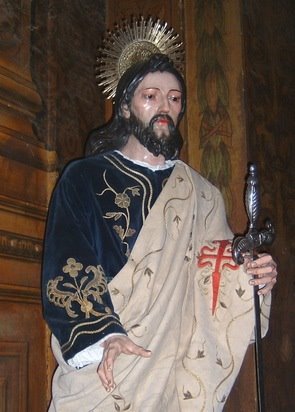
¡Santiago
y cierra, España!


If you have announcements to make, please post them as comments to this post.

Solemn Pontifical Mass in St. Peter's Basilica, October 18, 2009

Rinascimento Sacro has announced that, as the culminating activity of the Second Convention on Summorum Pontificum organized by Giovani e Tradizione, a Solemn Pontifical Mass according to the classical Roman Rite will be celebrated in the Chapel of Eucharistic Adoration in St. Peter's Basilica on Sunday, October 18, 2009 at 10:00 a.m. The Mass will be offered by His Excellency, Archbishop Raymond Leo Burke, Prefect of the Supreme Tribunal of the Apostolic Signatura. Music will be provided by a mixed choir of Franciscans of the Immaculate.
Deo Gratias!

Spiritual Exercises for Women in Colombia

Una Voce Georgia (United States) sends us an announcement of Ignatian Spiritual Exercises for women which will be offered by the Priestly Fraternity of Saint Peter (FSSP) in a retreat center near Bogotá, Colombia, in October:

LA FRATERNIDAD SACERDOTAL SAN PEDRO ANUNCIA

Ejercicios espirituales de San Ignacio
del 10 al 12 de octubre
en La Casa de Retiros La Isabelita
(Anolaima - Cundinamarca)

Los ejercicios serán predicados por los sacerdotes de la Fraternidad Sacerdotal San Pedro, y en esta ocasión se dirigen a mujeres

Se ruega a las personas interesadas nos contacten en la siguiente dirección:

amartindeporres@hotmail.com

More Traditional Latin Masses in Chile

There seem to be two new regular Sunday celebrations of the TLM in Chile.
1. The TLM in the San Juan de Dios parish in Santiago de Chile, which used to be offered only on First Saturdays (and is still listed as such in WikiMissa), is now offered every Sunday at 8:00 P.M. It is regularly offered by Fr. Milan Tisma Diaz


2. According to the blog of the parish of Santa Barbara de la Reina de Casablanca, a twice-monthly Traditional Latin Mass (every second and third Sunday of the month at 5:00 P.M) has been established in the main church of that parish. The first Mass was offered last July 19 by Msgr. Jaime Astorga Paulsen, who will also be the regular celebrant of this Mass.
According to Una Voce Malaga it was the first celebration of the TLM in the Chilean city of Casablanca in 40 years.
I would like to take this opportunity to repeat the call of my fellow Rorate Caeli contributor, Mornac, for our readers to take the initiative in updating the Mass listings on WikiMissa.
(Thanks to Una Voce Malaga for all the info)

"...there is no text of the Tradition which supports it"

The Italian website Pontifex.Roma has published a short interview with Msgr. Nicola Bux on the topic of Holy Communion. Here is the full text of the interview in English translation. Emphases mine.

Given Msgr. Bux's closeness to the Pope and his liturgical thought, it seems that we have here a clear exposition of the "Benedictine" stance regarding the proper way to receive communion: clearly favorable towards communion kneeling and on the tongue coupled with a clear disapproval of communion in the hand (clearer than in the previous three Pontificates), without as yet proposing strict measures to abolish anything not already condemned in documents like Redemptionis Sacramentum, and definitely without opposing communion standing up. -- CAP.

***

How to administer communion in a dignified manner

Communion on one’s knees guarantees devotion and the sense of the sacred. Certain flippant ways to administer this sacrament show a loss of the sense of the sacred. The faithful must not take for themselves the Chalice and the Host, this being a serious abuse.

Monday, July 20th, 2009
From Pontifex Roma

How should one administer communion in a dignified manner? We asked the theologian and esteemed liturgist Monsignor Nicola Bux. It may be a random case but the modernism and the slovenliness of certain post-conciliar interpretations have lead to such a debasement of this Sacrament , that there are all kind of ways in which people approach it…

Don Bux, which is the most correct way to communicate?

“I would say there are two ways. There is the position where one stands up, taking the Host in the mouth, or else on one’s knees. I do not see any third way.”

There is the standing-up position.

“OK, I have nothing against it. The important thing is that the faithful are intimately conscious of what they are about to receive, that is that they do not approach the communion with a lightheartedness that shows immaturity and being at a complete distance from God.”

Communion standing up, but what is the best way to do it?

“Well, look here, even the receiving of the communion standing up may be full of devotion, of compunction…... and a sense of the Sacred is good to have. It would be very good and convenient, no doubt about it, to let a formal sign of reverence precede communion (even if it is received standing up), which means the head is covered for the women, sign of the cross or a slight bow in a sign of one’s love.

But for what reason do people often approach the communion as if it is a kind of buffet?

I like this expression and in part it is correct. Many persons rise mechanically (from their seats - CAP) and they do not know and are not even able to imagine what they are about to receive. They think that participation in Mass something that automatically includes communion and that they have to go up and receive it, although the fact is that only those who are really in the grace of God should do so”.

In his latest Masses pope Benedict XVI has administered communion only to those who were kneeling.

"Yes, he was very right to do so. I believe that kneeling when receiving the communion helps one to gather oneself together and to understand the mystery in a more reverential way. To kneel in front of the Body of Christ is an act of gratuitous love and humility before God, and this sense of the sacred is seldom understood. In our days it is mostly adrift and lost or almost muted. “

All in all, communion on one’s knees helps the spirit?

“Yes, certainly so, it favors devotion and spirituality. I believe that the position on one’s knees when receiving the communion is the one which by far responds the most to the Sacred.

And receiving in one’s hand?

“I am sorry to say, but there is no text of the Tradition which supports it. Not even if everybody takes it and eats it in this way. There is no text concerning this, and if we wish we could say that the Apostles were priests and thus had the right to take it by the hand. The Oriental Church does not permit it.”

In a church in Rome, the so called Caravita, usually very crowded, particularly by the Catholic Mexican community, a Jesuit priest (the Jesuits consent to dancing with women and even to drinking beer in public), personally administers the Host to his faithful in such a way that they dip it in the Chalice, is it not true?

“Yes, this is a most serious and intolerable abuse, which you do well to report to me and which the Bishop must be made aware of, this must come to his knowledge. In paragraphs 88 and 94 (of Redemptionis Sacramentum – CAP) it is firmly said that it is not permitted for the faithful to take the Host themselves, or to pass the Chalice from one person to the other. I think that such a communion is not valid (non sia valida). I will analyze the problem, but we have here to do with an inadmissible abuse which we must repress the sooner the better.

Bruno Volpe

Cardinal Zen clarifies misinterpretations of the Pope's letter to Chinese Catholics and its compendium

Although Cardinal Zen has retired from the See of Hong Kong, he has not remained silent and has now issued a letter defending the letter of Pope Benedict XVI to Chinese Catholics (and its Compendium) from misinterpretations, especially those emanating from the Chinese government and its minions in those elements of the "Patriotic Church" that favor the schismatic mentality. We reproduce the full letter here due to its importance; the original can be accessed on the website of the Catholic Diocese of Hong Kong. Emphases mine.
Cardinal Zen's stance in favor of the underground Catholic Church is clear. Unfortunately, in many parts of the universal Church, there is a tendency to see the "Patriotic Church" as if it is THE Catholic Church in China, even to the exclusion of the suffering faithful of the underground Church. Cardinal Zen's letter exposes this for what it is: a monstrous lie.
Cardinal Zen's coat of arms alludes to the famous dream of St. John Bosco -- the barque of Peter, the barque of the Church, anchored between the two great pillars of the Holy Eucharist and the Blessed Virgin, standing fast against the enemies of the Catholic faith. A true reflection of the spirit of this great man, and of his struggle for the unity of the Chinese Church under Rome!
Two years ago we received a letter from the Pope
Joseph Cardinal Zen Ze-kiun SDB
In these days, from the Holy See you have received a compendium of the Letter of the Pope which helps you to understand more easily the essentials of the Pope’s teachings and also to dispel a wrong interpretation of a particular point of the Letter.

Allow me to underline few things in it.
1. Question 7 of the Compendium

First of all, to my brothers in the underground community, I like to point out the Compendium’s Question Number 7 which brought into evidence many quotations from the Letter where the Holy Father shows his appreciation for and encouragement to all those who have suffered and are still suffering for the Catholic faith.

Often we hear complaints from our brothers in the underground community that they feel abandoned, neglected, even considered a nuisance. We understand this impression and these feelings of theirs. But the rich quotations, from the Letter of the Pope, contained in Number 7 of the compendium should reassure them that the Holy Father is with them. From the bottom of my heart I wish to encourage my brothers in the clandestine community to persevere in their fidelity without compromise.
Footnotes 2 and 5 of the Compendium

I like also to bring to your particular attention the Footnotes Number 2 and Number 5 of the Compendium.

The Footnote Number 2 makes an important distinction between “a spiritual reconciliation of hearts and a structural merger into one system”. The Pope encourages the former which should be pursued with the almost commitment and urgency, while the realization of the latter may be beyond our unilateral good will.

Footnote Number 5 says clearly that the Pope “neither excludes the possibility of accepting or seeking Government recognition, nor encourages doing so”. Every body would like to act in the open freely, but unfortunately very often, “indeed almost always”, it is impossible to do so since conditions are imposed on us which are not compatible with our Catholic conscience. (For the phrase “indeed almost always” in the Chinese translation, please see the revised Chinese text which appeared on the Vatican website since the October 24th, 2008, when this phrase was re-inserted because it was missing from the first official Chinese edition of the Letter).

It is true that the Holy Father leaves the final decision to the single bishops on whether to accept / request the recognition by the Government. But the Holy Father also said that this decision is a very difficult one to make, because, most of the times, the conditions imposed by the Government render a positive decision impossible.

It is no secret that this delicate point of the Letter of the Pope, shortly after its publication, had received a tendentious interpretation that went beyond what the Holy Father had said. The interpretation stated that, according to the Holy Father, there was no longer any reason to remain in the situation of clandestinity and that the Holy Father wanted that all underground communities request the recognition of the Government. This interpretation also favoured an indiscriminate participation in Eucharistic concelebrations. (THIS IS A NECESSARY POINT. Indiscriminate concelebration with Patriotic clergy can't be considered as permitted. - CAP)

The error of such a view consists in that it chooses to overlook the long steps that it is necessary to make and thinks that one can reach immediately the goal. We may call it a sin of impatient optimism. People are easily tempted by optimism, so this erroneous interpretation has had an enormously wide diffusion in China and has been believed by many, as if this were the true will of the Holy Father.

However, since such an interpretation not only does not represent the mind of the Holy Father, but also goes against the cruel reality of the facts described by the Holy Father in his Letter, in the last two years this interpretation has had disastrous consequences all over the Church in China.

The fundamental reality is that the Government has kept its policy substantially unchanged, a policy that aims at enslaving the whole Church. That is why we have to witness such a painful spectacle: bishops and priests who, thinking they are obeying the Holy Father, make enormous efforts to come to terms with the Government; many of these, faced by the unacceptable conditions imposed by the Government, draw back, but in the process the clergy is no longer as united as before; others, thinking that to draw back would be to disobey the will of the Holy Father, have tried to remain in that situation of compromise, while striving hard to keep their peace of conscience, a contradictory state that makes deeply suffer not only the bishops directly involved, but also their priests who are no longer able to understand their bishop.

The Government, on its part, has presented itself as an enthusiastic executor of the will of the Pope, declaring itself the promoter of unity, evidently a unity under the total control of the Government inside the iron-tight structure of an independent Church.

Let us thank the Lord that finally in the Footnotes 2 and 5 of the Compendium the Holy See has given its own authoritative interpretation on this point. We hope that the Compendium may be able to resolve the painful contradiction in so many faithful hearts and to make it possible for the clandestine community to rebuild its faithful unity in suffering.

Obviously, on the level of reconciliation and communion of hearts between the two Church communities, there is much to be attempted and to be done as soon as possible, overcoming every negative feeling caused by historical situations not willed by us, but imposed on us from the outside.
3. Self-examination


In His letter the Pope has presented in unambiguous terms the apostolic nature of the Church, which is always to be led by the bishops, the successors of the Apostles, in communion with the Pope, the successor of Peter, the head of the Apostles. The Holy Father, in all his fatherly kindness, has put his finger on the abnormal present situation of our Church in China, controlled and led by bodies other than the Hierarchy established by Jesus Christ.

The enormous challenge now before us is to bring our Church back to normality, to be a truly catholic Church.

Two years have passed, since the Pope has written his Letter to us. Are we closer to the ideal of Christian fidelity portrayed in the Letter? If yes, let us thank God. If not, let us reflect seriously on why we have wasted such a precious gift from heaven. What we must meditate seriously upon is how much we have taken upon ourselves our small or big part of obligation in achieving this wonderful and arduous goal. How have we spent these two years? How many times have we asked ourselves: What should I do to make the Pope’s dream become a reality?

On the Day of Prayer for the Church in China this year, the Holy Father, while visiting the Montecassino Abbey, exhorted us “to renew our communion of faith in Christ and of fidelity to the successor of Peter”. He also expressed his hope that “the unity of all Christians, the catholicity and universality of the Church always will be deeper and more visible”. Those brothers and sisters in the clandestine community, do they still believe that it is worthwhile to suffer for the faith and that the sufferings would bring victory even though at the moment everything seems to be a failure? Those brothers and sisters in the open community, do they believe that their effort to come out of the canonically abnormal situation is important and that coherence with their status of being in communion with the Holy Father requires them to be courageous?

We all live in a particular moment of history. This gives us particular duties. Our very special duty today in the Church in China is to show to the Chinese people the true nature of the Catholic Church, the home of all peoples and nations. Its unity and universality fit so well into the globalizing desire of humankind. The Church is a community that welcomes all peoples without distinction and for that reason must not be dominated by any particular civil power.

The Church, who cares for our wellbeing on earth, brings us also towards an eternal goal: our homecoming to heavenly Father’s embrace. The rich inheritance which belongs to us has been gained through the suffering and death of our Saviour and has been entrusted to the Apostles, so that it may be faithfully transmitted through the ages. It is our greatest fortune to be called into this great family and it is now our noble duty to live out our faith with coherence, handing it down intact to future generations.

There are people who would like to establish an opposition between our fidelity to the Church and our patriotic duty to our Country. You know that this is a sophism. We all know that, precisely by being loyal to our Church, we are being truly patriotic, because the building up of a truly Catholic Church in China is our specific contribution to the greatness of our Motherland.

We must pray that the leaders of our Nation come to understand that a free Catholic Church is no threat to our country. On the contrary, if we are allowed to live happily our faith, we can contribute more to the welfare and all-round progress of our people.

Dear brother and sisters, look higher up, unto “the mountains from which my help comes” (Ps 120[121]). On this journey of faith, we have been promised both tribulations and consolations. Our companions and models are the Saints and especially the glorious Martyrs.

Mary, Help of Christians, our heavenly mother and the Star of Hope, to whom the Pope has entrusted our Church, will lead us to peaceful victory.

Cardinal Joseph Zen 29 June 2009