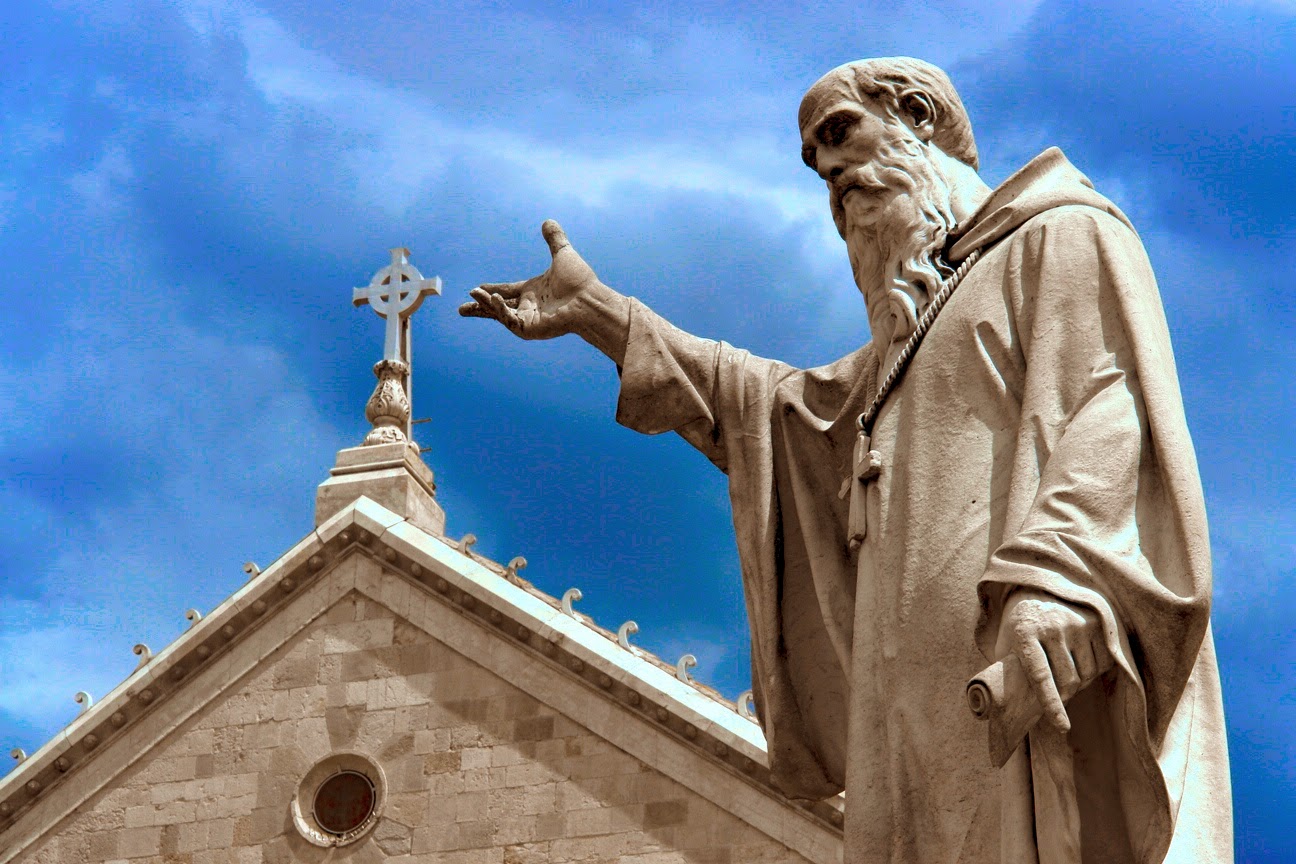
[I - Saint Benedict was above all a man of Tradition]
The Rule of St. Benedict is, as its name indicates, a law, a code of laws - but not any kind of code. Beauty and kindness flow from the heart of the Patriarch as he talks directly to his children.
In his 1913 Commentary, Dom Paul Delatte spends, in the style of his venerable predecessor Dom Prosper Guéranger, what seems like a disproportionate amount of time and energy on every word of the rule's Prologue. That is not the case at all: the only way to explain how this ancient Roman, filled with the best common sense of Antiquity, is about to establish the mode of life that will enable Christian faith to survive, hidden at first, and then flourish in Europe in the long period following the collapse of the Empire in the West is to show how Benedict's words are that of a true Paterfamilias. But not any Paterfamilias, a Christian Father.
And what is the concern of this Christian Father? To make us aware of our true concern, the only true business of our lifetimes. "Our business," says Dom Delatte, "is not to live many years, and to become learned, or to make a name in the world, but to walk to God, to get near to Him, to unite ourselves to Him." This is one of the most profound sentences of the whole book, and a firm rule of life for every Christian - because these beautiful words are not for monks only, but for all Catholics of good will.
"Ausculta, o fili... " [Hearken, o son... ]
Other Rules[, begins Dom Delatte,] have a more impersonal character, a more concise and formal legislative air: St. Benedict in his first words puts himself in intimate contact with his followers, commencing the code of our monastic life with a loving address. He who speaks is a master; for we cannot dispense with a master in the supernatural life, which is at once a science and an art. He gives precepts - that is to say, doctrinal and practical instruction.
St. Benedict here speaks of himself, though many commentators have thought differently. It is no folly to call himself master, since he teaches not in his own name, nor things of his own devising. He wrote near the end of his life and in the fulness of his experience. Why should he not be a loving father, pius pater, as he expresses it?
Dom Paul Delatte
Third Abbot of
St. Peter's Abbey, Solesmes
...He does not dream of imposing them on you, but appeals to your good will, to your delicacy of perception; there is no question of constraint, but of a loving and glad acceptance, of supernatural docility.
This docility St. Benedict requires of every beginner; this same docility, under the forms of humility and obedience, gives our monastic life its authentic character; and, finally, by it is sanctity won: "Who so are led by the spirit of God, they are the sons of God" (Rom. viii. 14) The sovereign importance of this simple, unaffected disposition comes from the fact that it comprises in itself all virtue. To begin with, docility means prudence, and in prudence are united all the moral virtues. We cannot in our own persons have all experiences; but others have had them, and we reap the benefit of these by our docility.
We make our own the wisdom of humanity supernaturalized, the wisdom of St. Benedict, and faith makes us share the very wisdom of God. Docility, and docility alone, establishes us in that state whence all self-seeking has been driven, a state which is the condition and the prelude of a living union with Our Lord. Its name then is charity.
We should note how St. Benedict analyzes and details the successive stages of supernatural docility. "Hearken": for we must listen; if there be too much noise in the soul and the attention be scattered over a multitude of objects, the voice of God which is generally quiet as " the whistling of a gentle air " (3 Kings xix. 12) is not heard. That silence which of itself is perfect praise, "To thee silence is praise," is rare among beings so fickle and impressionable as we are.
But to hearken is not enough, and St. Benedict invites us in the pretty phrase of the Book of Proverbs 2 and Psalm xliv to, "incline the ear of our heart." We must have a receptive understanding, a trustful attitude towards the truth that is proposed to us. If we begin by putting obstacles, by establishing at the entry of our souls a strict barrier, or still more, if we be filled with our own views to the point of saying, "He cannot teach me anything new; I know all that and better than he does!" then we are in the worst possible mental state, not only for supernatural teaching, but even for purely human instruction....
"Et efficaciter comple" And faithfully fulfill. It is the property of truth to move us to action. We cannot "hold it captive in injustice" (Rom. i, 18). We shall have to answer to God for all the good we have seen and have not done. But therein too lies the difficulty; for sin has upset the balance of our being: seeing, willing, loving, performing, these are far from being one single operation.
So lest the work should frighten us, and to make clear at once its character and plan, our Holy Father, with the insight of genius, yet in the quiet classical style, sets down that which is the prize of our life, that which should be its single object, that which gives it its dignity, charm, and power, its merit and simplicity, that in which is contained the whole Rule: "that you may return to Him by the labour of obedience."
For our business is not to live many years, and to become learned, or to make a name in the world, but to walk to God, to get near to Him, to unite ourselves to Him. This manner of conceiving the spiritual life as a fearless walking to God is a favourite one with St. Benedict; we shall meet it many times in the Rule. Our life is on an inclined plane: we may ascend or descend, and the latter is very easy.
Since the Fall, man has only one way in which to separate himself from God, and that is the way of the old Adam, disobedience; and he has, too, but one way to return and that is by obedience, with the new Adam.


