Rorate Caeli
Showing posts with label Reformation. Show all posts

“If the officials do not give sound advice, and if priests live without fear of the Lord, it is no wonder that the entire community can become immoderate and coarse”: Counter-Reformation preaching

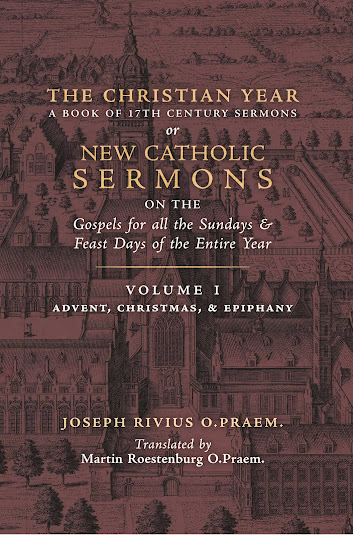
In keeping with recent developments in the ongoing attack on the Traditional Latin Mass and its adherents, it seems fitting to mention a new book just released by the admirable Arouca Press: The Christian Year, volume 1: Sermons for Advent, Christmas, & Epiphany, by Joseph Rivius, O.Praem., in a translation by Fr. Martin Roestenburg, O.Praem.

Who is Fr. Joseph Rivius? Well might you ask! Not a household name, Fr. Rivius was an admirable priest and a compelling preacher whose work deserves renewed attention in our day, for reasons that will become apparent. Born in 1607 during the final years of the Reformation, he entered the Norbertine abbey of Tongerlo abbey in Flanders. After his death in 1660, his bundle of sermons came to be published posthumously in 1668.

The Jesuit Pimpernel: A book review by Fr Konrad Loewenstein, FSSP

Dowry
FSSP Quarterly
 Summer 2019, Issue N˚42


Fr John Gerard: The Jesuit Pimpernel Fr Gerard S.J. (1564 –1637) could have been the inspiration for Baroness Orczy’s celebrated novel The Scarlet Pimpernel (1905) where in 1793 a chivalrous baronet masquerades as a fop to better delude French revolutionaries and save aristocrats from the guillotine. It was English Catholics though, whom Fr Gerard rescued from Elizabethan gaols, and many Anglicans whom he saved from the spiritual dungeon of schism and heresy, reconciling them with the Church of Christ at his life’s peril. Fr Konrad Loewenstein, FSSP reviews a too little-known classic autobiography of this heroic and humorous Englishman.

The book is a memorandum of the exploits of the Jesuit priest, Fr. John Gerard, on the English Mission in 1588, translated from the Latin by Fr. Caraman and first published by him with the title ‘John Gerard, portrait of an Elizabethan’ (perhaps a more felicitous title).

He arrives at night by boat, accompanied by three other priests, all destined for martyrdom. Posing as a falconer in search of a lost falcon, he is soon directed by Divine Providence into the arms of the most outspoken opponent of Anglicanism and the Elizabethan Reform in the county. The latter, an influential member of the local gentry, welcomes him into his home and helps him initiate an apostolate amongst friends and their servants in the other great houses in the area.
Socci: Luther and Melanchthon at the foot of the Cross

Antonio Socci:“The Vatican in a complete mess with its celebration of Luther the Heretic in the place of Our Lady.  Never-ending shame in the dark age of Bergoglio.

November 1, 2017


Now there stood by the cross of Jesus, his mother, and his mother's sister, Mary of Cleophas, and Mary Magdalen. When Jesus therefore had seen his mother and the disciple standing whom he loved, he saith to his mother: Woman, behold thy son. After that, he saith to the disciple: Behold thy mother. And from that hour, the disciple took her to his own”. (John 19,25-27).

This is one of the most fundamental moments in the Life of Jesus, the very apex of His redeeming mission. Mary is there and right next to Her is John. From that moment on Mary is the Mother of all those who are to come into the Church: Mater Ecclesiæ, as Paul VI called Her at the closure of the Second Vatican Council.

BREXIT: A Great Defeat for the Atheist Moneyed Elites that Humiliate Europe

CONTINENT CUT OFF

Juan Manuel de Prada
ABC (Madrid)
June 25, 2016

Battle of Salamanca (1812): Under Wellington, British, Portuguese, and Spanish
Forces defeat Napoleonic troops and free the Iberian peninsula
What happens with democracy is the same as what happens with the stars of modern bullfighting: the fights only end well for them when they contend with bulls with cut horns; if it falls to them to fight a bull with full horns, they forget their posture, start to tremble, and end up being gored.

So it happened with the British referendum, which was a great bull thrown into the arena of democracy -- this charade that Money control at will while they provide it with bulls with cut horns, which they can fight with a stock-market panic here and a media distortion campaign there. But this referendum unearthed the inner ghosts of a Deep England which identified in the disgraceful European Union the humiliations suffered in its old age; and the old Englishman, fed up with being trampled upon, and with the most debasing derision being inflicted upon him (including a Mohammedan mayor in London!), decided to gore, in a dying gesture of bravery.

Should Any Catholic Praise Luther? (A cross-post)

Blogger Dr. Christopher Malloy has written an eloquent piece on why we absolutely should not praise Luther as we draw near to the 500th anniversary of his initial public act of rebellion. Rorate thanks Dr. Malloy for his permission to cross-post this timely collection of quotations here.


We praise someone who fundamentally deserves praise. No one is without fault, and no one without some merit. But only those are worthy of praise who fundamentally deserve praise, whose pith and marrow is good.