In response to the frequent questions posed in recent days regarding the priestly ordinations of the Fraternity of Saint Pius X, scheduled for the end of June, there is nothing to add to what was affirmed by the Holy Father in his Letter to the Bishops of the Catholic Church of past March 10: "As long as the Society (of Saint Pius X) does not have a canonical status in the Church, its ministers do not exercise legitimate ministries in the Church (...) until the doctrinal questions are clarified, the Society has no canonical status in the Church, and its ministers (...) do not legitimately exercise any ministry in the Church". The ordinations are, thus, still to be considered illegitimate.In the same letter, the Pope announced his intention to provide a new status for the Commission "Ecclesia Dei", joined to the Congregation for the Doctrine of the Faith. There are reasons to believe that the definition of this new status is close. This constitutes the premise for the beginning of the dialogue with those responsible for the Fraternity of Saint Pius X in view of the desired clarification of the doctrinal, and, in consequence, of the disciplinary questions which still remain open. [Source: Bollettino]
COMMUNIQUÉ OF THE HOLY SEE PRESS OFFICE
REGARDING THE ORDINATIONS ANNOUNCED BY THE FRATERNITY OF SAINT PIUS X

Press Release regarding the Priestly Ordinations
The Seminary of the Sacred Heart of Jesus of the Priestly Fraternity of St. Pius X, regarding the Ordinations to the priesthood planned for 27 June, 2009, declares the following:1. These ordinations are bestowed with the intention of serving the Catholic Church. We bestow these priestly ordinations because we wish to express our unity with the Church of Rome. This unity consists of the same doctrine, the same sacraments, and the holy sacrifice of the Mass of all times. The newly ordained priests, as well as all of the members of the Priestly Fraternity of St. Pius X, recognize the office of the Pope and the authority of the Church. Just as all other clergy of the Fraternity, the candidates for ordination will pray by name for the reigning Pope as well as the local Ordinary - an expression of solidarity, which theFraternity has practiced since its founding more than 30 years ago. We do not want a parallel Church, but instead wish to preserve the incalculable treasure of Catholic Tradition within the one true Catholic Church.2. When Rome, on January 21, 2009, repealed the decree of excommunication that had been declared against the 4 bishops of the fraternity, the Holy Father surely intended it as a provision of life, and not of death. The generous gesture was primarily intended to be a confidence-building measure for the coming theological discussions with representatives of the Holy See, in which, through difficult negotiations, the difficulties which still remain will presumably be eliminated.3. An emergency requires and justifies corresponding emergency measures. Is there an emergency in the Church today? We refer to an appendix attached to this declaration, in which representative statements from popes, cardinals, bishops, and theologians are documented. Pope Paul VI, for example, speaks of the "self-destruction of the Church", Pope John Paul II speaks of "silent apostasy". Additionally we give two numerical examples: In 1950 in Germany, 13 million Catholics regularly attended Sunday Mass. Today it is less than 2 million - a reduction of more than 85 percent. The number of priestly ordinations in German dioceses in 2008 reached a record low of less than 100.It is a question of the existence or the dissolution of Christianity in Europe. Should the ordination of these new priests, who have been formed on the solid foundations of Catholic tradition and who are so necessary for the survival of the Church, be postponed? Instead, as true vocations become more and more uncommon, should we not with great devotion thank God for the grace of such vocations? There can be no talk of an insult to the unity of the Church and most certainly not of a rebuff of the outstretched hand of the Holy Father, for whom we pray daily.4. The bishops, in their fury, continuously invoke canon law. But consider an analogy: a valuable building is burning down, a group of courageous young men rushes to the blaze to extinguish the fire, or at least to contain it and then afterwards to begin with the rebuilding. But they are detained by law enforcement for having exceeded the speed limit. Isn't the last canon of the 1983 code of canon law still valid today, according to which the highest law of the Church is the salvation of souls?5. Since the current problems are not of a disciplinary nature, the discussion has to be conducted at an entirely different level; in particular, at the level of faith. When Pope Benedict XVI, in his letter to the bishops of March 10, 2009, made the dramatic declaration that the faith is in danger of being extinguished in many parts of the world, is it not urgent that we together make every effort to ascertain the causes of this crisis of faith and to utilize the means at our disposal to remedy this crisis? In this spirit we renew our readiness to engage in dialogue with the German bishops in an atmosphere of peace and intellectual honesty, far removed from all polemics and unhelpful accusations.Zaitzkofen, June 13, 2009Father Stefan Frey, Rector of the Seminary
The unstoppable Cardinal of Vienna
During his visit to the Vatican with a delegation of Austrian Bishops in the past two days, the Cardinal Archbishop of Vienna delivered a message from his flock, as Italian news agency ASCA reports:
In the Vatican, Card. Schönborn also presented the so-called "Initiative of the lay faithful" (Laieninitiative), a petition by relevant Austrian Catholics launched earlier this year, which asks for the abolition of compulsory celibacy, the return to activity of married priests, the opening of the diaconate to women, and the ordination of [married] 'viri probati'.
________________
Tip: Papa Ratzinger blog
Declaration
On June 15 and 16, a meeting was held in the Vatican between the Holy Father and heads of Dicasteries of the Roman Curia, and the following Austrian Bishops: Cardinal Christoph Schönborn, Archbishop of Vienna, President of the Austrian Episcopal Conference; Archbishop Alois Kothgasser, Archbishop of Salzburg; Bishop Egon Kapellari, Bishop of Graz-Seckau, Vice-President of the Austrian Episcopal Conference; Bishop Ludwig Schwarz, Bishop of Linz. Also attending was: Archbishop Peter Stephan Zurbriggen, Apostolic Nuncio to Austria.From the Roman Curia, the following were in attendance: Cardinal Giovanni Battista Re, Prefect of the Congregation for Bishops; Cardinal William Joseph Levada, Prefect of the Congregation for the Doctrine of the Faith; Cardinal Claudio Hummes, Prefect of the Congregation for the Clergy; Cardinal Zenon Grocholewski, Prefect of the Congregation for Catholic Education; Cardinal Stanisław Ryłko, President of the Pontifical Council for the Laity.At the meeting, genuine collegiality was acknowledged and, in fraternal dialogue and constructive spirit, some topics related to the situation of the Diocese of Linz and the Church in Austria were discussed, and solutions for current problems were addressed.The Holy Father recalled the urgency of deepening the faith, of full fidelity to the Second Vatican Council and to the post-conciliar Magisterium of the Church [nachkonziliaren Lehramt der Kirche], and the renewal of catechesis in light of the Catechism of the Catholic Church.Moreover, doctrinal and pastoral issues and issues pertaining to the situation of the clergy, the laity, the seminaries, and the theological schools in Linz and in other dioceses in Austria were discussed.The Austrian Bishops thanked the Holy Father for his paternal care and for this meeting, as a sign of his solidarity with the Church in Austria, and expressed to him their full communion and loyalty. The Austrian Bishops also thanked the Roman Curia for the fruitful cooperation and for their readiness to assist in the matter.
[Source: Kath.net - Stephanscom]
Pictures from the Consecration of Archbishop Cyril Vasil S.J.
As already reported by our friends in the New Liturgical Movement, the new Secretary of the Congregation for the Oriental Churches, Cyril Vasil SJ, was consecrated bishop in the Papal Basilica of St. Mary Major last June 14, 2009. The consecrating hierarchs were His Excellency Rev. Slavomir Miklovš, Emeritus Bishop of Križevci,together with His Excellency Rev. Jan Babjak, SJ, Metropolitan Archbishop of the Byzantines of Prešov and His Excellency Rev. Milan Chautur, C.ss.R. of the Byzantines of Košice. The ceremonies were according to the Byzantine Rite.
The website of the Slovakian Jesuits now has a rich selection of pictures from the ceremonies:
Biskupská vysviacka Cyrila Vasiľa SJ
The website of the Slovakian Jesuits now has a rich selection of pictures from the ceremonies:
Biskupská vysviacka Cyrila Vasiľa SJ
UPDATE: More pictures can be found here:
UCAN on the Ranjith Appointment
 Bishop Ranjith in 1999
UCAN's article on Archbishop Ranjith's move back to Sri Lanka might be of help in understanding the reasons why his presence there is seen as necessary.
The more relevant passages:
A strong leader, he returns as head of the Sri Lankan Church in what many observers see as a particularly difficult moment. A bloody 25-year civil war has just ended with the military defeat of the Tamil Tigers rebels but which has raised many questions about the conduct of the final phase of the war and, more importantly, has not resolved the root causes of that conflict.
***
Pope Paul VI ordained him priest in St. Peter's Basilica on June 29, 1975.
He then went for higher studies and gained a licentiate in Sacred Scripture from the Pontifical Biblical Institute in Rome and a special certificate in Biblical studies from the Hebrew University in Jerusalem.
After various pastoral and academic appointments in Colombo archdiocese, and having served in various roles at national level, Pope John Paul II named him auxiliary bishop of Colombo in 1991 and appointed him bishop of Ratnapura in 1995.
From 1995-2001, he served as secretary-general of the Catholic Bishops' Conference of Sri Lanka and chairman of the National Commission for Justice, Peace and Human Development. In the latter role, he became heavily involved in the search for a solution to the country's civil conflict. The government appointed him as its emissary on peace negotiations with the Liberation Tigers of Tamil Eelam in Sri Lanka
***
The archbishop speaks English, French, German, Italian, Sinhalese and Tamil fluently, and has a fair knowledge of Indonesian and Spanish. He has also studied Hebrew, Greek, Latin and Arabic.
Many in Rome believe his new appointment puts him in line for a red hat. Sources expect Pope Benedict to make him a cardinal either in the forthcoming consistory, probably in 2010, or in the next one, about two years later.
Source: http://www.ucanews.org/
***
It should be noted that even as Secretary of the CDW, Archbishop Ranjith continued to be involved in the peace process in his country. (See this.)
For the Record
Fellay: "We have no problem with the Church recognizing us"
In this report from Toronto, Zenit confirms several news of the past few weeks: the meeting of Bishop Fellay, Superior General of the Priestly Fraternity of Saint Pius X (FSSPX/ SSPX), with Cardinal Levada, Prefect of the Congregation for the Doctrine of the Faith; the upcoming motu proprio on the new structure of the Pontifical Commission "Ecclesia Dei"; the fact that the priestly ordinations of the following weeks will proceed.
Fellay's words:
On the motu proprio: "According to what we have heard, most probably, one of the monsignors of the congregation [of the Doctrine of the Faith] will be the executive head of Ecclesia Dei. So it will be very tightly united with the congregation."
On future relations with the CDF: "I don’t know [Cardinal Levada] enough to really answer the question. […] When we were received it was very courteous. He was gentle. […] I don’t frankly know what and if there will be a real change."
On the ordinations: "We cannot just now say, 'stop breathing,'" he argues in defense of the society's continued administration of the sacraments. "We need to breathe. And, definitely, if the Pope was so good to take away the excommunications, that mean he doesn’t want us now to die."
And his most important words, on whether the SSPX would accept a provisional canonical position recognized by the Holy See: "If Rome gives us enough guarantee, so to say, of survival, I think probably we would certainly consider it. We have no problem with the Church recognizing us, of course."
NYC Mass According to the Rite of Braga
A Votive Mass to the Sacred Heart of Jesus according to the Rite of Braga will be offered by Fr. Joseph Santos on June 20, 2009, 12:15 - 1:00 P.M., in the Church of our Saviour, 59 Park Avenue (Park Avenue & 38th Street), NYC. This Mass will be part of a Conference on Renewing Devotion to the Sacred Heart.
Ranjith, Archbishop of Colombo
DiNoia, Secretary of CDW
As predicted for over a year, Archbishop Malcolm Ranjith, the embattled Secretary of the Congregation for Divine Worship and the Discipline of the Sacraments, was named today Archbishop of Colombo, the main diocese of his native Sri Lanka.
His substitute had been mentioned for almost a month: American theologian Fr. Joseph Augustine DiNoia, O. P., up to now undersecretary of the Congregation for the Doctrine of the Faith.
[Source: Bollettino; also in today's Bollettino, news that the Holy Father held his second meeting with a delegation of Austrian Bishops this Tuesday.]
Events
1. Bishop Fernando Rifan, Apostolic Administrator of the Apostolic Administration of St. John Mary Vianney (Campos, Brazil) will offer a Pontifical Low Mass at Our lady of Fatima Chapel, First Street and W. Franklin Ave., Pequannock, New Jersey, on Sunday, June 21, 2009, at 11:00 a.m.
Note: First things first
Quite an eventful month for the German-speaking bishops.
In Germany, several bishops are afflicted by what can only be described as "mass hysteria" regarding an absolutely normal act of the life of the Priestly Fraternity of Saint Pius X (FSSPX / SSPX) - and it cannot be denied that the great act (very merciful, very just, or both) of Pope Benedict XVI, lifting the excommunication of the Bishops of the SSPX, did not entail the complete paralysis of the regular life of that society. It may still be in an irregular situation, but there has been no sign from the Vatican that the Sacraments ordinarily ministered by its Bishops and priests must be suspended while negotiations go on.
Meanwhile, in Austria, the local Bishops are heading off to Rome for emergency meetings in the Vatican, which include a rendezvous with the Pontiff himself. The topic? The unbearable "autonomy" of the "Church of Austria", particularly after the Linz scandal.
[Rorate note: It is not a regular "ad limina" visit of the Austrian bishops, which should take place no earlier than late 2010 or early 2011.]
---
Update (June 15): "The Holy Father received this morning in audience: Bishops of Austria." (Bollettino)
Third encyclical of Pope Benedict XVI to be "published soon"
Caritas in Veritate, the third encyclical letter of Pope Benedict XVI, will be published soon, according to the words of the Pontiff himself today:
As you know, my Encyclical dedicated precisely to the vast issue of the economy and of labor will be published soon ... .
Most sources indicate that the letter will be signed and will be made public on the Feast of Saints Peter and Paul.
It is this that the faithful expect in a priest!

The solemnity of Corpus Domini ... leads us to the Upper Room, helping us live the spiritual climate of that night, celebrating Passover with his disciples; the Lord through the mystery anticipated the sacrifice that would be consumed the next day on the cross. The institution of the Eucharist thus opens up to us as a Christ’s acceptance of his death....Jesus moreover, showed that through his death God’s close alliance with his people finally became effective. The ancient covenant sanctioned on Sinai by animal sacrifice with the chosen people, who had been freed from slavery in Egypt, and had promised to follow all the commandments given them by the Lord (Ex 24, 3). In reality, Israel from the very outset through its creating the golden calf, proved itself incapable of keeping faithful with the divine pact, what’s more it would often transgress, adapting the tablets of the Law that was to teach them of life to their own hearts desires. The Lord however, is never found wanting in his promise....I speak to you in particular, my dear priests, who Christ chose so that together with him you can live your live in sacrifice and praise for the salvation of the world. Only through union with Christ will you be able to draw on a spiritual wealth that generates hope for your pastoral ministry. St. Leo the Great reminds us that our participation in the Body and Blood of Christ only aims to become what we receive’ (Sermo 12, De Passione 3,7, PL 54). If this is true for every Christian, it is to an even greater degree for us priests.Being Eucharist! This must be our constant desire and duty so that the sacrifice of our existence accompanies our offering of the Body and Blood of Christ at the altar. Every day, from the Body and Blood of the Lord we find that free and pure love that renders us worthy ministers of the Christ and witnesses of its joy. It is this that the faithful expect in a priest: the example of an authentic devotion for the Eucharist; they love to see him spend long moments of silence and adoration in front of Jesus as did the Holy Curé of Ars, whom we will particularly remember during the imminent Year for Priests. ...
With the acknowledgment of being unworthy, due to our sins, but in need of receiving the love that the Lord offers us in the eucharistic sacrament, we renew this night our faith in the real presence of Christ in the Eucharist. We cannot take this faith for granted! Today there arises, even within the Church, the risk of a creeping secularization, which can turn into formal and empty Eucharistic worship, in celebrations lacking this participation from the heart that is expressed in veneration and respect for the liturgy.
Benedict XVI
June 11, 2009
"The just path for a correct reading of sacred Scripture"
 Erigena writes in the "Expositions": "Man was not created for Scripture, of which he would not have had necessity if he wouldn't have sinned, but rather Scripture -- interwoven with doctrine and symbols -- has been given to man. Thanks to it, in fact, our rational nature can introduce itself into the secrets of the authentic pure contemplation of God (II, PL 122, col 146C). The word of sacred Scripture purifies our rather blind reason and helps us to return to the memory of what we, as image of God, carry in our hearts, unfortunately violated by sin.
From here, some hermeneutical consequences are derived regarding the way to interpret Scripture, which can indicate still today the just path for a correct reading of sacred Scripture. It is a matter, in fact, of discovering the meaning hidden in the sacred text and this supposes a particular interior exercise thanks to which reason opens itself to the sure path leading to truth. This exercise consists in cultivating a constant readiness for conversion. To arrive deeply to the vision of the text, it is necessary to advance simultaneously in the conversion of the heart and in the conceptual analysis of the biblical page, whether it be of cosmic, historical or doctrinal character. Only thanks to the constant purification, as much of the eyes of the heart as of the eyes of the mind, can the exact understanding be achieved.
This arduous path, demanding and exciting, made up of continuous conquests and relativations of human knowledge, brings the intelligent creature toward the threshold of the divine Mystery, where all notions verify their own weakness and incapableness and lead, therefore, to going beyond -- with the simple, free and sweet force of the truth -- all that is continuously reached. The adoring and silent recognition of the Mystery, which flows into unifying communion, is revealed therefore as the only path for a relationship with the truth that is at the same time the most intimate possible and the most scrupulously respectful of the otherness.
Benedict XVI
"On John Scotus Erigena"
Light from the East III: Melkite Catholic Benediction of the Blessed Sacrament

The Pantocrator of the Melkite Catholic Basilica of St. Paul in Harissa, Lebanon
From the Western Orthodoxy blog:
The priest, standing before the holy table, begins aloud:
BLESSED + is our God, at all times now and always and for ever and ever.
R. Amen.
While the priest incenses the Blessed Sacrament, the people say:
Let the Armies of heaven be present, and all the hosts of the holy angels. Let them stand with fear before their Creator and God, deeply worshiping Him who is most good, Jesus. He who is feared by the Cherubim is present now, in an invisible manner, hidden under the sensible species. We see Him, and we see Him not, for He is the visible and invisible God.
-Alleluia! Alleluia! Alleluia! Glory to You, O Lord!
The priest: Alleluia! Alleluia! Alleluia! Glory to You, O Lord!
R. Alleluia! Alleluia! Alleluia! Glory to You, O Lord!
Together: O our God and our Hope, glory to You!
While the people are chanting the last Alleluia, the priest incenses. At the end of the chanting, the priest blesses with the covered holy Host saying:
R. Amen.
- May God the Son bless you, + He who gave us the admirable Sacrament of his love.
R. Amen.
- May God the Holy Spirit bless you, + He who sanctified us by his awe-inspiring descent.
R. Amen.
- Glory be to the holy, consubstantial, life-giving and indivisible Trinity, now and always and for ever and ever.
R. Amen.
The priest places the covered Host on the holy table and incenses it while the people say:
IT IS INDEED a tremendous miracle to see God taking flesh and becoming man, and a greater miracle still to see Him suspended on the cross. But the highest of all miracles, O Christ our God, is your ineffable presence under the mystic species. Truly You did institute, through this great Sacrament, a remembrance of all your marvels. How merciful of You, O God, to give Yourself as food to those who fear You! To recall your covenant forever, and to remember your passion and your death until the day of your glorious coming! Let us, O faithful, receive our food and our life, our King and our Saviour, and cry out: "Save, O Lord, those who worship your glorious and venerable presence."
The priest replaces the Host in the tabernacle, while the people recite the
HYMN TO CHRIST IN THE HOLY EUCHARIST
CHRIST, having loved his own, loved them until the end, and gave them his body and blood as food and drink. Therefore let us adore them with veneration and say with fear: "Glory to your presence, O Christ! Glory to your compassion, glory to your condescension, O You who alone are the Lover of Mankind!"
The priest: Glory to You, our God! Glory to You!
- O Christ, our true God, O You who gave us your body and your blood as food and drink for our salvation, through the intercession of your Mother all-pure and of all the saints, have mercy on us and save us! Amen.
Together: Through the prayers of our holy fathers, O Lord, Jesus Christ, our God have mercy on us and save us. Amen.
From Byzantine Daily Worship, ed. Joseph Raya and Jose de Vinck. (Allendale, New Jersey: Alleluia Press, 1969), pp. 402-404.
***
COMMENTARY BY C.A.P: Those astonished by the brevity of this service would do well to be aware that the Divine Liturgy in the Byzantine Rite already features many acts, prayers and ceremonies that testify to a firm belief in the Real Presence of our Lord in the Blessed Sacrament, such as the blessing by the priest of the people with the veiled chalice and its contents, the long prayers of preparation for Holy Communion, and the prostration after the Epiclesis that is done by many Greek Catholic (and Eastern Orthodox) priests. Furthermore, the Great Entrance of the Divine Liturgy, by its magnificent ceremonies that render honor to the sanctified bread that is to be transformed into the Body and Blood of Our Lord, witnesses to the faith of Byzantine Christians in the Eucharist.
In addition to the Melkite ritual, the Ukrainians have their own version of Benediction.
In the wake of the process of de-Latinization undertaken by many Eastern Catholic Churches since the 1960's, the rite of Benediction of the Blessed Sacrament and Corpus Christi processions have largely disappeared from their liturgical lives, even though many great champions of pure Byzantine use such as Andrei Sheptytsky and Joseph Slipyj supported the retention of these acts of worship to the Blessed Sacrament. However, some Melkite and Ukrainian churches continue to have these rites. Keep in mind that many Greek Catholic parishes that set aside the rite of Benediction did so not so much out of any "anti-Latin" prejudice as out of a preference to make use of other Eastern services (Hours, etc.) and devotions (Akathists, for instance).
Posted in honor of Corpus Christi
Divine Body

Christ, having loved his own and loved them until the end, gave them his Body and Blood as food and drink. Therefore, let us offer Them our adoration and say with fear: Glory to your Presence, O Christ, Glory to your compassion, glory to your condescension, for You alone are the Lover of mankind.
Patriarch Maximos II Hakim
Troparion for the Feast of the Divine Body
New motu proprio merging Ecclesia Dei into CDF

The papal plan to transform the Pontifical Commission "Ecclesia Dei" in an internal office of the Congregation for the Doctrine of the Faith - first announced by the Pope himself in his letter to the Bishops - is about to become a reality. According to Vaticanist Andrea Tornielli, a motu proprio on the new structure of "Ecclesia Dei" will be made public in the next few days.
The commission under its new organization will be presided by the Prefect of CDF - currently, Cardinal Levada - while Monsignor Camille Perl will remain its vice-president, and a new secretary will be named (the post has been vacant since the death of Monsignor Mario Marini a few weeks ago).
The change comes as the doctrinal talks between the Holy See and the Priestly Fraternity of Saint Pius X (FSSPX / SSPX) begin in earnest.
Roadmap for Holy See - SSPX doctrinal talks established
According to French Rome-based religious news agency I.Media, as reported by Italian news agency ASCA (translation by Father Zuhlsdorf):
This morning the Vatican Congregation for the Doctrine of the Faith discussed how to begin the doctrinal dialogue with the Lefebvrite Preiestly Fraternity of St. Pius X, for whom four bishops – among whom is the negationist [Bp.] Richard Williamson – Pope Benedict XVI in February revoked an excommunication.According to the French agency I.Media, the cardinals of the ex-Holy Office – to whom Pope Ratzinger entrusted the dialogue wiht the Lefebvrites in view of their eventual reinstatement, in the future, in the structure of the Church – discussed a text "drawn up to clarify the parameter of the doctrinal dialogue with the Fraternity". This dialogue should start with the necessity "of accepting the Second Vatican Council and the Magisterium of the Pope" subsequent to the Council.According to I.Media, the Superior of the Lefebvrites, [Bp.] Bernard Fellay, was received at the Congregation for the Doctrine of the Faith on 5 June last and, even if there hasn’t been identified the "team" which on the two sides will effectively conduct the dialogue, it is probable that there will take part the Swiss Domincan Fr. Charles Morerod, the new Secretary for the International Theological Commission and, on the part of the Lefebvrites, Fr. [l’abbate] Gregoire Celier, co-author of a recent book on Benedict XVI.Meanwhile, as the "doctrinal" dialogue with the Vatican moves along its first steps, the Lefebvrites have decided to challenge again the authority of the of the Pope, announcin the ordination of at least 21 new priests in three parts of the world
Peruvian Bishops to Canadian Bishops: Stop Funding Pro-Abortion Groups in Our Country
By John-Henry Westen
LIMA, June 9, 2009 (LifeSiteNews.com) - In a May 28 letter, the Bishops Conference of Peru has “formally” requested that the bishops of Canada cease funding pro-abortion groups in Peru via the Canadian Catholic Organization of Development & Peace (D&P). “It is very disturbing to have groups which work against the Bishops of Peru by attempting to undermine legal protection for the right to life of unborn children, be funded by our brother bishops in Canada,” says the letter...
Bravo to the Bishops of Peru!
"The human genome is profoundly imprinted with the Trinity"

Following Eastertide, which culminates with the feast of Pentecost, the liturgy foresees these three solemnities of the Lord: today, the Most Holy Trinity; on Thursday, that of Corpus Domini, which, in many countries, Italy among them, is celebrated next Sunday; finally, on Friday in two weeks, the feast of the Sacred Heart of Jesus. Each one of these liturgical observances manifests a perspective from which the whole mystery of the Christian faith is embraced: respectively, the reality of God one and three, the sacrament of the Eucharist and the divine-human center of the Person of Christ. They are in truth aspects of the one mystery of salvation, which, in a certain sense, summarize the whole path of the revelation of Jesus, from the incarnation to the death and resurrection to the ascension and the gift of the Holy Spirit...
***
The Trinity does not live in a splendid solitude, but is rather inexhaustible font of life that unceasingly gives itself and communicates itself.
We can in some way intuit this, whether we observe the macro-universe: our earth, the planets, the stars, the galaxies; or the micro-universe: cells, atoms, elementary particles. The “name” of the Most Holy Trinity is in a certain way impressed upon everything that exists, because everything that exists, down to the least particle, is a being in relation, and thus God-relation shines forth, ultimately creative Love shines forth. All comes from love, tends toward love, and is moved by love, naturally, according to different grades of consciousness and freedom. “O Lord, our Lord, / how wondrous is your name over all the earth!” (Psalm 8:2) -- the Psalmist exclaims. In speaking of the “name” the Bible indicates God himself, his truest identity; an identity that shines forth in the whole of creation, where every being, by the very fact of existing and by the “fabric” of which it is made, refers to a transcendent Principle, to eternal and infinite Life that gives itself, in a word: to Love. “In him,” St. Paul says, on the Areopagus in Athens, “we live and move and have our being” (Acts 17:28). The strongest proof that we are made in the image of the Trinity is this: only love makes us happy, because we live in relation, and we live to love and be loved. Using an analogy suggested by biology, we could say the human “genome” is profoundly imprinted with the Trinity, of God-Love.
Benedict XVI
"On the Holy Trinity"
Traditional Holy Week in the Philippines
My friend Gerald Cenir has -- finally! -- put up the pictures from the Holy Week ceremonies in the Parish of the Lord of Divine Mercy in the Diocese of Cubao, Metro Manila. This is one of only two Filipino parishes that are under diocesan auspices where Mass is said daily according to the 1962 Missal.
Holy Week in PLDM
For the second year running, all the main celebrations of Palm Sunday and the Sacred Triduum were held according to the 1962 Missal. Do note the huge reddish purple curtain covering the entire altarpiece. The "un-nailing" of the corpus from the cross was performed during the Good Friday devotions preceding the liturgical action of the afternoon; unfortunately it was not photographed.
Please look carefully at the pictures and see the large, overflow crowds that attended the ceremonies. Many of these people traveled for hours from the provinces or from more distant parts of Metropolitan Manila just to attend the ceremonies. Who said that Filipinos -- and Asians in general -- can't relate to the Traditional Latin Mass?
BREAKING
Fellay received in the Congregation for the Doctrine of the Faith last Friday

Bishop Bernard Fellay received on Friday at [Congregation for the] Doctrine of the Faith...Last Friday, rumors about a possible arrangement between the Vatican and the Fraternity of Saint Pius X [FSSPX / SSPX], founded in 1970 by French Archbishop Marcel Lefebvre (1905-1991) reappeared in Rome. It all began with the news of the presence in the Eternal City of the Superior of the society, Bishop Bernard Fellay, who last Wednesday had an appointment in the Congregation for the Doctrine of the Faith.
The remainder of the article merely describes the events of the past few years, including the letter of the Supreme Pontiff which placed the Pontifical Commission 'Ecclesia Dei' under the authority of the Congregation for the Doctrine of the Faith.
____________
Note: Picture from the meeting of August 29, 2005.
The secret agreement
Giacomo Galeazzi reviews for La Stampa the new biography of Paul VI written by Andrea Tornielli, and mentions that what many considered a conspiracy theory was true: there was indeed a secret agreement, led by Cardinal Tisserant, between the Soviet Union and the Holy See (under John XXIII) in 1962 - an agreement which Paul VI also respected. As Galeazzi says:
In a note of November 15, 1965, in fact, Montini explicitly mentions among "the commitments of the Council" also that of "not mentioning Communism (1962)". The indication of the date at the end of the sentence written by Paul VI refers to the secret agreement, related by Tisserant, between Rome and Moscow.
And this would explain why the Second Vatican Council, which dealt with all sorts of issues, relevant and irrelevant alike, ignored the most challenging menace of its time: Communism.
Light from the East II
I've been alerted to this sublime excerpt of Vespers of Great and Holy Friday from the biritual Benedictine Monastery of Chevetogne. The Eastern-rite monks in this monastery observe the Russian (Nikonian) recension of the Byzantine Rite, making it one of the very few places where the Russian Orthodox liturgical tradition is celebrated in all its purity in communion with the Catholic Church. (The Ukrainians and other Greek Catholics observe different recensions or local traditions of the Byzantine Rite)
[Note: I will NOT tolerate snide remarks about how all of this is "modernist" and "ecumenist". The observance by Russian Catholics of the Russian Orthodox liturgical tradition -- nec plus, nec minus, nec aliter, in the famed words of Pope St. Pius X -- was fully approved by the Catholic Church decades before Vatican II]
Excerpt: Vespers of Holy Friday in the Monastery of Chevetogne
UPDATED: Announcements
On the request of readers we are posting the following announcements:
1) A traditional Latin Missa Cantata (Mass in the Extraordinary Form) has been scheduled for 3:00 PM on Sunday, June 28, 2009 in anticipation of the Feast of Sts. Peter and Paul at the Church of St. Paul, on Christian St. between 9th and 10th Sts. in South Philadelphia.
Our Sovereign Pontiff Pope Benedict XVI has made available a Plenary Indulgence for those who celebrate this Jubilee Year of St. Paul by participation in such a solemn celebration in connection with the Feast of Sts. Peter and Paul.
2) A Solemn High Traditional Latin Mass will be offered at the Carmelite Monastery located at 66th Ave. and Old York Road (near Broad St.) Philadelphia, on Thursday, July 16, 2009, the Feast of Our Lady of Mt. Carmel. The solemn Missa Cantata in Forma Extraordinaria will be celebrated by Rev. Kevin McGoldrick. This Holy Mass will culminate the annual novena to Our Lady of Mt. Carmel at the Monastery. The Holy Rosary will be said at 6:45 PM, followed by the sung Litany of Loretto in Latin at 7:00 PM, organ music 7:15 PM and Holy Mass at 7:30 PM.
The sequence Flos Carmeli will be sung during the Mass. In accordance with a privilege of the Carmelite Order in pre-Conciliar times, the Asperges will be sung before this Mass even though it is not a Sunday, because it is the Feast of Our Lady of Mount Carmel.
3) In NYC, Edward Cardinal Egan will preside over the Divine Liturgy of St. John Chrysostom in St. Michael's Russian Greek Catholic Church on Sunday, June 21, 2009, 11 A.M. During this Divine Liturgy, Deacon Christopher Li Greci of the same church will be elevated to the rank of Protodeacon.
St. Michael's is one of only four Russian Greek Catholic communities in the North American continent, and one of only about twenty parishes, centers and monasteries worldwide. The small but fast-shrinking Russian Greek Catholic Church -- whose last bishop, Andrei Katkov, died in 1995 -- is heir to Blessed Leonid Feodorov's dream of reunifying Russian Orthodoxy with the Church of Rome, and is significant as providing a home for the glorious Russian Orthodox tradition of liturgy, monasticism and spirituality within the bosom of the Catholic Church.
4) Solemn Pontifical Mass will be celebrated in Manhattan by Bishop Fernando Areas Rifan of the Apostolic Administration of St. John Mary Vianney on the Feast of the Sacred Heart of Jesus, Friday, June 19, at 7 P.M. The Mass will be offered in St. Jean Baptiste Catholic Church; its massive High Altar is renowned for its six-foot tall monstrance. See the website of the Confraternity of the Sacred Heart for more details.
(Please feel free to add your own announcements in the combox)
You report: First parish TLM in South Korea in 40 years and a conference with Martin Mosebach

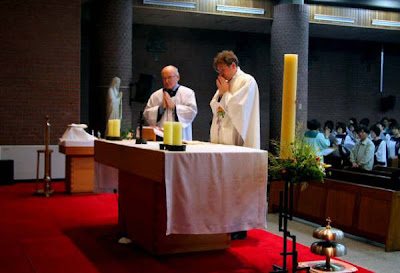


From a Korean Catholic youth (who prefers to remain anonymous) comes the following report about the first-ever TLM in a parish setting in South Korea. The Mass was offered last May 13, 2009, at 7 pm, in the Yongsan church, followed by a conference with famous German Catholic author Martin Mosebach (author of "The Heresy of Formlessness"). Fr. Michael Bauer, parish priest of the German Catholic parish in Shanghai, offered the Mass, with Mr. Mosebach himself as server.
Keep in mind that this is the FIRST TLM under South Korean diocesan auspices in forty years. Please exercise restraint in your comments. In case anyone is wondering, there is a crucifix at the center of the altar (although it is too small and dark to be easily seen in the pictures) and the number of candles (four) is just right for a Missa Cantata.
The report has been edited for this post:
Usus Antiquior Mass was celebrated by Fr. Michael Bauer in Seoul, Korea immediately followed by a conference with Martin Mosebach, the writer of “The Heresy of Formlessness”. The Goethe Institute sponsored this event and Yong-San Catholic Church provided the place for the liturgy. About 200 Catholics attended the first parish-setting EF Mass in South Korea. Most of them have never experienced the Traditional Latin Mass after the liturgical reform, since there has been no indult TLM for almost 40 years.
Most of the people, except Mr. Mosebach, looked new to the liturgy; Fr. Bauer himself is still learning the old liturgy. The choir of Yong-San Catholic Church sang for the Mass. The music setting was Missa de Angelis but Latin hymns were sung instead of chant propers. So it was a mixture of low mass and Missa Cantata. (Very understandable for a first-time TLM – CAP)
Even though the Mass setting was not satisfactory, most of the attendees said they experienced a reverent liturgy. Many of them expressed the wish that the Catholic Church in Korea could provide the EF Mass in at least one parish per diocese. They said the best part of the EF Mass was communion on the tongue whie kneeling – this has become quite rare in Korea, and many TLM attendees were touched by the reverence of this way of receiving communion.
In Seoul Archdiocese, Catholics do not kneel during the consecration, due to the excuse that churches are overcrowded during Sundays. Most of the parishes in Seoul Archdiocese have removed kneelers and it is rare to see people kneeling even during weekday Masses, when there are no crowds. Also, the Catholic Church in Korea has advised Catholics to take communion in the hand, since there have been followers of unapproved apparitions, who adhere only to communion on the tongue or with kneeling. Pastors usually use communion as a litmus test to tell apart those people, which resulted in the practical suppression of communion on the tongue or with kneeling.
After the Mass, there was a conference and Q & A session with Mr. Mosebach. The lack of interest from the Catholic Church in Korea can be seen in the fact that there was not a single Korean Catholic media report or any welcoming statement from Korean bishops or clergy on this first TLM after liturgical reform. Hopefully, the Korean Catholic clergy will listen to the vox populi and the voice of Benedict XVI.
Yours in Christ and our Lady the Coredemptrix,
XXX.
ADDENDUM: Mr. Mosebach's "The Heresy of Formlessness" was translated into Korean in 2007, with the title being translated as "Liberalism of Formlessness".
UPDATE: A clip of the Mass can now be viewed here.
UPDATE: A clip of the Mass can now be viewed here.
Almost certain: Ranjith to Colombo
His replacement? DiNoia

Rumors regarding the removal of Archbishop Malcolm Ranjith as Secretary of the Congregation for Divine Worship and the Discipline of the Sacraments have been intense for over a year. According to Vaticanist Andrea Tornielli, the moment has come for such a move: Ranjith will almost certainly be named Archbishop of Colombo, in his native Sri Lanka, in the next few days - despite all last-minute efforts by interested parties to keep him in his Roman job.
His replacement, according to Tornielli, will be an American: Father J. Augustine DiNoia, O.P., the famous theologian and currently undersecretary of the Congregation for the Doctrine of the Faith.
Southeast Asian Updates
 Our Lady of the Atonement Cathedral, Diocese of Baguio, Philippines
PHILIPPINES
1) The Our Lady of the Atonement Cathedral of the Diocese of Baguio, northern Philippines, now has a regular Mass according to the Missal of 1962. It is offered every Sunday, 7:30 AM, in the cathedral’s baptistery. Should the numbers of attendees grow the Mass will be moved to a larger location. This makes Baguio Cathedral the only cathedral in all of Asia to have a regular Mass according to the 1962 Missal. (UPDATE: There is a second TLM every Sunday, at about 3:30 P.M., also in the baptistery.)
It is my understanding that this Mass was instituted at the initiative of the Bishop of Baguio, Carlito Cenzon CICM, and his Vicar General Msgr. Andrew Cosalan, who is also its regular celebrant.
It is my understanding that this Mass was instituted at the initiative of the Bishop of Baguio, Carlito Cenzon CICM, and his Vicar General Msgr. Andrew Cosalan, who is also its regular celebrant.
Baguio, nestled amidst pines in the Cordillera mountains and located about 250 km north of Manila, is the summer capital of the Philippines. In addition to the every-Sunday TLM in Baguio cathedral, there is a monthly Sunday Mass in La Trinidad, a town located north of Baguio City, under the auspices of the SSPX.
2) In the Archdiocese of Cebu, the FFI's Church of Mary Coredemptrix (San Jose, Talamban, Cebu) now has the TLM thrice a week, every Monday, Wednesday and Saturday at 6:30 A.M. This is in addition to the every-Sunday TLM's offered in two monasteries (one Discalced Augustinian, another belonging to a local monastic congregation) within the same archdiocese.
Unlike Cardinal Rosales of Manila, the Cardinal-Archbishop of Cebu, Ricardo Vidal, has wholeheartedly embraced Summorum Pontificum, and has himself offered Low Mass according to the 1962 Missal on occasion. Pictures of the Mass can be found here. (H/t to our friend from Ecce ego, quia vocasti me)
***
I hope to be able to update last year's listing of TLM's under diocesan auspices in the Philippines very soon. The reason for my difficulty in completing the updating is this: the Church in the Philippines lags far behind the Church in Western and even some other Asian countries when it comes to using the Internet. I often have more difficulty confirming or extracting information from Philippine provinces (or even from my very own diocese!) and from the scattered traditionalist faithful in the Philippines, than from contacts and sources in the USA or Europe. Furthermore, some of the priests and faithful attached to the 1962 Missal are still wary of misunderstandings from the local clergy, and are reluctant to publicize their Masses and other activities.
SINGAPORE
The Singaporean Traditionalist blog Extraordinary from Singapore is reporting that there will be a Missa Cantata according to the 1962 Missal on Trinity Sunday, June 7, 2009, 4:00 - 5:30 P.M. at St. Patrick's School Chapel. There is currently no regular TLM under diocesan auspices in Singapore; let us pray and hope that the traditional faithful in the city-state will soon taste the full benefits of Summorum Pontificum.
(ADDENDUM: It should be noted that there is an SSPX priory in Singapore, with two Masses every Sunday and daily Mass for the rest of the week.)
"Only in this way is our life made great"

"...Rabanus Maurus had an extraordinary awareness of the need to involve in the experience of faith, not only the mind and the heart, but also the sentiments through these other elements of aesthetic taste and the human sensitivity that brings man to enjoy truth with all of his being, "spirit, soul and body." This is important: The faith is not only thought; it touches the whole being. Given that God made man with flesh and blood and entered into the tangible world, we have to try to encounter God with all the dimensions of our being. In this way, the reality of God, through faith, penetrates in our being and transforms it.
For this reason, Rabanus Maurus concentrated his attention above all on the liturgy, as the synthesis of all the dimension of our perception of reality. This intuition of Rabanus Maurus makes him extraordinarily relevant to our times..."
***
I would like to conclude the presentation of this great "man of the Church" citing some of his words that reflect his deep conviction: "He who neglects contemplation is deprived of the vision of the light of God; he who is carried away with worry and allows his thoughts to be crushed by the tumult of the things of the world is condemned to the absolute impossibility of penetrating the secrets of the invisible God" (Lib. I, PL 112, col. 1263A). I believe that Rabanus Maurus addressed these words to us today: while at work, with its frenetic rhythms, and during vacation, we have to reserve moments for God. [We have to] open our lives up to him, directing a thought to him, a reflection, a brief prayer. And above all, we mustn't forget that Sunday is the day of Our Lord, the day of the liturgy, [the day] to perceive in the beauty of our churches, in the sacred music and in the Word of God, the same beauty of our God, allowing him to enter into our being. Only in this way is our life made great; it is truly made a life.
Benedict XVI
Address for the Wednesday General Audience, June 3, 2009
Address for the Wednesday General Audience, June 3, 2009
The whole address contains extended comments on the unique contributions of Blessed Rabanus Maurus to sacred art and to the liturgy.
Russian Orthodox church in Rome

Last May 24, with two cardinals (Etchegaray and Kasper) present, the Moscow Patriarchate dedicated a new parish in Rome, the Church of St. Catherine the Great Martyr. More pictures here.
I will let the above picture speak for itself.
Pope Benedict XVI at Evening Prayer in the Melkite Cathedral
Pictures of Pope Benedict XVI presiding over Evening Prayer last May 9 at the Melkite Catholic cathedral in Amman, Jordan, have now been posted at the Vatican website along with some other pictures from his recent visit to the Holy Land. (The Evening Prayer celebrated in the Melkite Cathedral was a shortened and modified version of Byzantine Vespers, with a Maronite song and Roman Ordinary-Form style prayers of the faithful and a "prayer of consecration" inserted, apparently at the request of the Vatican. The text of the service can be found in pp. 29 - 55 of the missal for the Pope's visit to the Holy Land. Warning: the English translation is apparently incomplete and faulty.)
Noteworthy are the pictures of the Pope blessing with trikirion and dikirion and carrying the Byzantine episcopal staff (with the upper half covered with a cloth embroidered with the coat of arms of Gregorios III (Laham), Melkite Catholic Patriarch of Antioch, Alexandria and Jerusalem.)
Training for Priests - Archdiocese of Westminster
From our friends at The Latin Mass Society of England and Wales:
LMS Residential Training Conference for Priests Wishing to Learn the Extraordinary Form of the Roman Rite (Traditional Latin Mass) at All Saints Pastoral Centre, London Colney, St Albans, Herts
The Latin Mass Society of England and Wales (LMS), in association with the Archdiocese of Westminster, is organising a residential training conference for priests wishing to learn the Extraordinary Form of the Roman Rite (Traditional Latin Mass) at All Saints Pastoral Centre, London Colney, Herts, the premier conference centre of the Archdiocese of Westminster.
The conference will run from Monday 24 August to Friday 28 August 2009 and will feature Traditional liturgies in London Colney’s magnificent Ninian Comper-designed chapel together with a Gregorian Chant schola and polyphonic choir.
Expert tuition in the celebration of Mass in the Usus Antiquior will be provided on a small group basis. There will be guest lecturers and all participants will receive 1962 Missals.
As well as daily Sung Mass, devotions will include Lauds, Benediction and Rosary.
The subsidised fee to participants is only £115.00 which includes full board and accommodation. Places are limited and priests are urged to register as soon as possible.
Further details and registration forms can be obtained from the LMS office (Tel: 020 7404 7284) or downloaded from the LMS website, www.latin-mass-society.org
Mark Johnson, lead organiser, said, “We are extremely pleased to have the backing of the Archdiocese of Westminster and Archbishop Vincent Nichols. This conference – our first at London Colney – builds on the success of our two previous conferences at Merton College, Oxford. I hope the laity will tell their priests about this wonderful opportunity to learn the Usus Antiquior in a welcoming and recollected environment.”
New Major Penitentiary
A veteran member of the Roman Curia leaves his post today:
The Holy Father has accepted the resignation, presented due to age limit, of the Eminent Card. James Francis Stafford, from the post of Major Penitentiary, and has named to the same post His Excellency Abp. Fortunato Baldelli, Tit. Archbishop of Bevagna, up to now Apostolic Nuncio in France.
The "ordinary way" that God has chosen
 The Holy Spirit, the true fire, was brought to earth by Christ. He did not steal it from the gods -- as Prometheus did according to the Greek myth -- but he became the mediator of the "gift of God," obtaining it for us with the greatest act of love in history: his death on the cross.
God wants to continue to give this "fire" to every human generation, and naturally he is free to do this how and when he wants. He is spirit, and the spirit "blows where he wills" (cf. John 3:8). However, there is an "ordinary way" that God himself has chosen for "casting fire upon the earth": Jesus is this way, the incarnate only begotten Son of God, dead and risen. For his part, Jesus constituted the Church as his mystical body, so that it prolongs his mission in history. "Receive the Holy Spirit" -- the Lord says to the Apostles on the evening of his resurrection, accompanying those words with an expressive gesture: he "breathed" upon them (cf. John 20:22). In this way he showed them that he was transmitting his Spirit to them, the Spirit of the Father and the Son.
***
If we do not want Pentecost to be reduced to a mere ritual or to a suggestive commemoration, but that it be a real event of salvation, through a humble and silent listening to God's Word we must predispose ourselves to God's gift in religious openness. So that Pentecost renew itself in our time, perhaps there is need -- without taking anything away from God's freedom [to do as he pleases] -- for the Church to be less "preoccupied" with activities and more dedicated to prayer. Mary Most Holy, the Mother of the Church and Bride of the Holy Spirit, teaches us this. This year Pentecost occurs on the last day of May, when the Feast of the Visitation is customarily celebrated. This event was also a little "Pentecost," bringing forth joy and praise from the hearts of Elizabeth and Mary -- the one barren and the other a virgin -- who both became mothers by an extraordinary divine intervention (cf. Luke 1:41-45).
The music and singing that is accompanying our liturgy, also help us to united in prayer, and in this regard I express a lively recognition of the choir of the Cologne cathedral and the Cologne Chamber Orchestra. Joseph Haydn's "Harmoniemesse," the last of the Masses composed by this great musician, and a sublime symphony for the glory of God, was chosen for today's Mass. The Haydn Mass was a fitting choice given that it is the bicentennial of the composer's death. I address a cordial greeting to all those who have come for this.
Benedict XVI
May 31, 2009
What Was Sacred Then Is Sacred Now
St. Teresa of Avila once indicated she would willingly die a martyr for the least liturgical rubric of Holy Church.
One of the lesser known rubrics which disappeared in the reforms of Annibale Bugnini, a few prescribed lines of the priest for various categories of adult baptism, was suppressed by the Congregation of Rites on Nov. 27, 1959. In the Roman Ritual, Holy Church had placed the following words on the lips of the priest, to be addressed to the one about to be baptized: If the catechumen had been a pagan, he was told “Horresce idola, respue simulacra” (“Abhor idols, reject images”); if “from the Hebrews,” “Horresce Iudaicam perfidiam, respue Hebraicam superstitionem” (“Abhor Jewish infidelity, reject Hebrew superstition”); if “from the Mohammedans,” “Horresce Mahumeticam perfidiam, respue pravam sectam infidelitatis” (“Abhor Mohammedan infidelity, reject that evil sect of infidelity”); and if “from heretics” among whom baptism was invalid (otherwise the convert would not be receiving baptism), “Horresce haereticam pravitatem, respue nefarias sectas impiorum N.” (“Abhor heretical depravity, reject the evil sects of the impious N.”).
From a notice of the suppression which appeared in Ephemerides Liturgicae, 74 (1960), p. 133-134, and which is signed “ab”, apparently by Annibale Bugnini who was editor of the publication, we can take a significant insight into the mentality of the prime architect of the liturgical changes of that decade, and perhaps that of many reforming officials and bishops of the day. Bugnini links this suppression to the earlier removal of the words “perfidis Judaeis” from the Good Friday liturgy. Bugnini acknowledges that these words of the Good Friday liturgy were perfectly exact (“exactissima”) in their original meaning. But now they have become “aurium offensiva” (quotation marks in the original; “offensive to the ears”), an expression which the liturgical reformer is obviously adapting from one of the theological notes which had been employed for centuries, “offensive to pious ears”. Bugnini does not say that the traditional expression is offensive to pious ears, but rather offensive to contemporary ears thanks to a change in the everyday meaning of “perfidis”.
Bugnini goes on to claim that removing similar lines from the Ritual is a logical consequence of the suppression of “perfidis Judaeis”, for, as he says, “adults who lived for so many years in good faith in their own religion and now embrace the Christian combat” do not easily bear having to hear such raw words (“tam cruda verba”) about the religion of their fathers (“paterna religione”). This is a remarkable justification for suppressing this part of the Ritual, for the only logical connection with the Good Friday prayer is that both texts are “offensive to the ears”. They are not “offensive” for the same reason: the Good Friday prayer had become offensive on account of changed semantics, while the Ritual passage is seen as offensive because of the presumed attitude of converts to the religions they are leaving behind.
One wants to ask, who is “offended” by these words, Bugnini or the converts? Eugenio Zolli, the Chief Rabbi of Rome baptized shortly after World War II and who published his story, would certainly have heard them, since he went directly from the Synagogue to the Church. Did he find them offensive?
Were they offensive to the German Jewish psychologist Karl Stern? The illustrious 20th century convert could have heard them, since he seems to have identified himself to some degree with Judaism in the period before his baptism, although this is not totally clear from the source consulted by this blogger. Various sources, both by and about Edith Stein, do not answer the question whether she heard these words at her baptism, since she had been an atheist for years when she was baptized. However it is likely that she knew them, because one witness remarked the firmness and ease of her Latin pronunciation during the ceremonies of her baptism, so it is probable that this scholarly woman had become familiar with the Ritual, even if she was not received “from the Hebrews”. Was the future Carmelite St. Edith Stein offended by liturgical rubrics of Holy Church which St. Teresa of Avila would have shed her blood for?
If the suppressed lines of the Ritual sounded “offensive to the ears” of those who had followed a pagan religion of their fathers, what was Bugnini’s attitude to I Peter 1:18? “[Y]ou were redeemed from the futile manner of life handed down from your fathers . . .”
Was there something of Bugnini’s attitude in many or most of the bishops at Vatican II who in Nostra Aetate professed to consider other religions with sincere “respect” (or “regard”, another meaning of the term “observantia”)? Presuming most non-Christians’good faith, they primarily wanted to befriend the followers of other religions, and this may have been the motive of many when they expressed the attitude of “respect” they brought with them to the examination of religions, ready to acknowledge elements of goodness and truth which can be found in these religions and which are mentioned in the same paragraph.
But “what was sacred then is sacred now”, even when an earlier liturgical practice is changed, for the faith reflected in the earlier practice is true. As seen, even Bugnini said that what was expressed by “perfidis Judaeis” is perfectly exact. Likewise the Vatican II decree on missions discreetly mentions that elements of goodness and truth in the non-Christian world must be liberated from “contagiis malignis” (Ad Gentes 9). As a logical consequence, since the Church’s sacred liturgy has publically expressed her rejection of religious rivals to her Lord, this rejection cannot be rejected, even when those religions are also seen to contain elements of goodness and truth, and when the liturgical rubric in question is not in current use.
(Note: St. Thomas explains the nature of post-Christian Jewish “infidelitas” and “superstition”: it is to consider the ceremonial and Christ-prefiguring laws as still obligatory in the time when the foretold grace of Christ has arrived and been promulgated by the apostles.)
Subscribe to:
Posts (Atom)