Rorate Caeli

In the nation of the Diocese of Rome


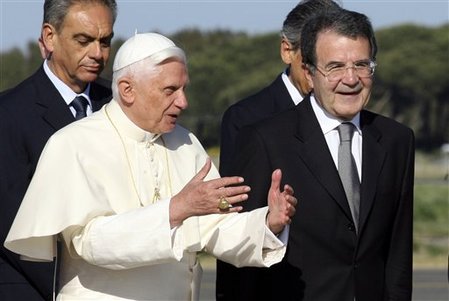
From the Italian Prime Minister's Office, the bill for the new Civil Unions (acronym: DICO):

The Presidency of the Council of Ministers [the Prime Minister's Office] informs:

The Council of Ministers [the Cabinet] met today [Feb. 08] at 1730 at Chigi Palace, under the Presidency of the President of the Council, Romano Prodi.

...

The Council examined and approved, at the proposition of the Minister for Rights and Equal Opportunity, Barbara Pollastrini, and of the Minister for Family Policies, Rosy Bindi, a bill on the subject of rights and duties for stably living couples (DICO). The measure aims to protect the weaker parties of the couple, thus overcoming disparities and inequalities among citizens.

In obedience to articles 2 and 3 of the Constitution [of the Italian Republic, on human rights and equal rights], the bill clarifies and details the rights and duties of persons, including those of the same sex, who have given life to [dato vita: established] stable cohabitations, linked by bonds of affection, solidarity, or mutual assistance; therefore, the sole limitations refer to the existence of marital bonds, kinship (of a direct kind), kinship by marriage, adoptions, and similar [situations].

...

Some rights --such as assistance in case of disease..., possibility of decision making in matters of medical assistance or in case of death... -- are to be immediately enjoyed; other rights -- the possibility of legitimate inheritance... -- are instead linked to a minimal period [of relationship]... .

...
The communiqué also mentions that these civil unions do not violate Article 29 of the Italian Constitution (on marriage) and do not establish a "para-matrimonial" status. The bill now goes to Parliament.

For the record - Castrillón: "The Bishops, Priests, and Faithful of the [SSPX] are not schismatics."

In an interview by Cardinal Castrillón Hoyos, President of the Pontifical Commission "Ecclesia Dei" to the German newspaper Die Tagespost. Translation by Chris Gillibrand, at Catholic Church Conservation:


The old Mass stands for the diversity of Good

8 February 2007

What are the consequences of the liberation of the old Mass?

The Holy Father has an enormous sensitivity to liturgical spirituality and would like to retain a treasure of the Church – not for the museum but as a living inheritance for society so that people who have sensitivity towards tradition will be able to savour this richness.

I am constantly surprised that young people who have not known the Old Rite before discover the peace and mystery of the Old Mass. What is important is that the two Rites do not oppose each other but one should see the beauty and sanctity in both.

Many traditionalists complain that the Bishops hardly take any notice of the Motu Proprio Ecclesia Dei and that they in know way allow generously the Old Mass. Is this Indult a reaction to it?

The Pope, in his capacity as Universal Shepherd, would like in the first instance to accommodate the faithful who have a sensitivity to the traditional liturgy. He is not giving way to external pressure nor to lists of signatures on petitions.

It is rather a holy Rite, which the Church has been celebrating for more than a thousand years. I do not wish to be hard on my Episcopal colleagues who have reacted against the requests of Ecclesia Dei. Some do not even have priests for their Sunday Masses and they find it difficult to allow Masses for small groups. The Motu Proprio does not mention figures. Some people are afraid of a liturgical split. The Holy Father has already as a member of the Ecclesia Dei Commission made clear that the old Mass is neither bad nor divisive and stands for a multitude of good things.

Could the Indult stimulate new experiments and forms of “liturgical creativity”?

What is decisive is how the Church directs the Faithful and Priests. Let’s think of the Ten Commandments. Although they are clearly formulated, Christians do not follow them completely in their lives. But the Ten Commandments are still the same. Each individual is responsible for keeping them.

Cardinal Ratzinger has celebrated the old Mass in public several times. Why has he not done that since the Conclave?

I know that the Holy Father loves the old Rite. I do not know anything about his decisions concerning his personal celebration of this Rite and I do not wish to speculate.

Does the Indult advance an ecumenism “ad intra”?

Please, accept that I reject the term “ecumenism ad intra”. The Bishops, Priests, and Faithful of the Society of St Pius X are not schismatics. It is Archbishop Lefebvre who has undertaken an illicit Episcopal consecration and therefore performed a schismatic act. It is for this reason that the Bishops consecrated by him have been suspended and excommunicated. The priests and faithful of the Society have not been excommunicated. They are not heretics. I do, however, share St Jerome’s fear that heresy leads to schism and vice versa. The danger of a schism is big, such as a systematic disobedience vis-à-vis the Holy Father or by a denial of his authority. It is after all a service of charity, so that the Priestly Society gains full communion with the Holy Father by acknowledging the sanctity of the new Mass.

And the pastoral considerations relating to the Sacraments?

I don’t see any problems there. The Holy Father has made it clear at the consistory that the Bishops can allow baptisms, confirmation and weddings in the old Rite. After all, what applies to the Eucharist also applies to other Sacraments.

Aparecida Notes: the Nueva Cuba in South America


From the new (old-fashioned) "Socialist", "Bolivarian Republic" in Venezuela, the news of the new law which allows President Hugo Chávez to rule by decree. The name of the act: Ley Habilitante (literally, Enabling Act). Now, where have we seen this name before?

In fact, the "Ley Habilitante" is just the first of the five "Constituent Engines" which will drive Venezuela towards its "Revolutionary Socialist" future... The third "engine" looks promising: "Moral and Lights: education in Socialist values"...

Yes, Pius XI will always be right: "no one can be at the same time a good Catholic and a true Socialist" (Quadragesimo Anno).


Interesting new blog

By the Superior-General of the Institute of the Good Shepherd (IBP), Father Laguérie.

In French, naturally.

Indulgence Decree
for the Feast of Our Lady of Lourdes (World Day of the Sick)


...
A Plenary Indulgence is granted to the faithful who, on the usual conditions (sacramental Confession, Eucharistic Communion, prayers for the Holy Father's intentions) and in a spirit of total detachment from any sin, take part devoutly this 11 February in the city of Seoul or in any other place established by the ecclesiastical Authority, in any sacred ceremony celebrated to implore from God the aims of the "15th World Day of the Sick".

The faithful who, in public hospitals or in any private home, charitably care for the sick as "Good Samaritans", especially those in an incurable or terminal state, and, because of their service are unable to take part in the ceremony mentioned above, will obtain the same gift of the Plenary Indulgence if on that Day, at least for a few hours, they generously devote their charitable assistance to the sick as if they were tending Christ the Lord himself (cf. Mt xxv, 40), in a spirit of total detachment from any sin and with the determination to fulfill as soon as possible the conditions required for obtaining the Plenary Indulgence.

The faithful who, due to sickness, advanced age, or other such reasons, are prevented from taking part in the above-mentioned ceremony, will obtain the Plenary Indulgence provided that, in a spirit of total detachment from any sin, with the intention of fulfilling the usual conditions as soon as possible and the desire to take part, in union with the Holy Father on that day, they offer their physical and spiritual suffering to God through the Virgin Mary Mother of God, "Salus Infirmorum".

Lastly, a Partial Indulgence is granted to all the members of the faithful who, from 9 to 11 February 2007, at any time, address fervent prayers to God with a contrite heart, to implore the above-mentioned aims for the benefit of the sick, especially those in an incurable or terminal state.
...

BLOGGER, leave us alone!

I do NOT want to switch to "New Blogger".

Cardinal Ricard on the Motu Proprio: "The Pope takes his time"

The Archdiocese of Bordeaux and the Institute of the Good Shepherd-IBP (that is, Cardinal Ricard and Father Laguérie) have at last reached a settlement on the canonical establishment of a Personal Parish for the Institute in Saint-Éloi. The relevant documents are available in French in the diocesan website (1, 2, 3, 4).

In an interview to the semi-official daily of the Church in France, La Croix, and which was published today, Cardinal Ricard discussed the deal with the IBP and also said the following:

The decision of September 8 [the Roman establishment of the Institute] generated a shock wave within French Catholicism and several questions remain regarding an eventual motu proprio liberalizing the Tridentine Mass. You are a member of the Ecclesia Dei Commission in charge of this matter in Rome; will the Holy See truly pursue this way of reform?

Benedict XVI wishes to pursue a work of reconciliation with these priests and faithful who have left the full communion with the See of Peter (in particular, the Fraternity of Saint Pius X).He also ponders the question of a "liberalization" of the Tridentine Mass. The Pope has in his hands all the elements of the dossier. He takes his time before reaching a decision on a matter of such importance.


Castrillón speaks: "The Holy Father will extend the permission"

In an interview published by the Argentinian periodical Panorama Católico Internacional (the Argentinian edition of the German monthly Kirchliche Umschau), a translation of which is given below. The interview was first published by El Catolicismo, the official newspaper of the Archdiocese of Bogotá, Colombia.


By Victor Ricardo Moreno Holguín, Pbro. [Presbyter]
Rome Correspondent

...

What is the current challenge in "Ecclesia Dei"?

We take care of those who did not wish to follow Archbishop Lefebvre -- which is not exactly a schism [sic]. With our jurisdiction in the name of the Pope, we have established institutes in France and Germany and we have incardinated the returning clergy. We must follow the life of this clergy and of these communities, the fraternities of Saint Peter [sic].


What about those who remain with Lefebvre?

The Saint Pius X associations are in a process of reinsertion [original text is unclear: "Están las asociaciones San Pío X, para su proceso de reinserción"]: with permanent visits and a correspondence which asks for the ancient rite. They are 500 priests and 600 thousand faithful, a growing number, with monasteries and seminaries, some of them full. [sic]

The rite of the Mass today gathers the faithful around the altar, inculturating itself in their reality and language. Will the rite of Saint Pius X, with the priest with his back to the faithful and prayed in Latin, return?


The great love of Christ is the Eucharist, it is not fair that it divide us. The Mass of Saint Pius V was celebrated for more than a thousand years. It was never forbidden. [sic] Even if I do not understand the words, it is not as if I understand much more when I say "This is my Body" and see a piece of bread: only the Faith makes me believe in the present Christ. The Holy Father will extend the permission for this celebration, which is not in opposition to the one of today.

Is it not a step backwards?

I celebrate it nowadays, and, in the first part, in which I make the homily, I am looking at the faithful, who are my brethren, whom I must teach; afterwards, I represent the faithful: let us now [turn] towards God, there is our goal, to give praise to God, and we are all together. It is not a step backwards, it is preserving an asset without opposing it to another.

To make the Mass attractive and joyful to the youth of this culture of the image, there have been initiatives such as the "Disco Mass", and dances of erotic origin were seen in Africa. Is [the Traditional Mass] a solution [original text: "remedio"] to stop these abuses?

It is an element, not "the solution". The new liturgy has not been "the solution". Were our churches fuller or emptier before? They have been emptied! It is true that not only due to this, but the Mass becomes one among several other rites of the world, and to strike what is sacred is a grave matter. The meaning of "Sacrifice" was forgotten. The Eucharist carries [us] to the Resurrection, but through Passion and Death. It is a feast of the spirit, for our redemption. The most important for Jesus was not eating with Him, but eating Him.

...

Share with us...one hope...

... Hope? To keep working to welcome with an embrace these 500 priests of Lefebvre, in the unity of Faith and love which Jesus Christ gave us.


The complete interview was not translated due to copyright reasons. All answers related to the Traditional Latin Mass and with the Traditionalist priests and faithful were duly translated.

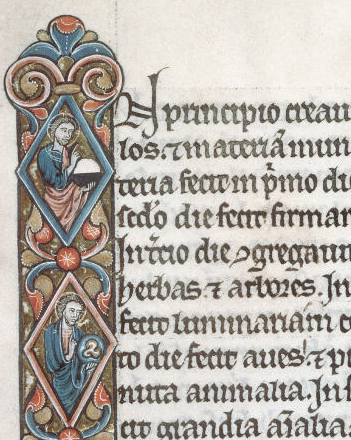
Septuagesima: In the beginning


The lessons for Matins introduce the theme of the penitential pre-lenten season of Septuagesima: Creation, and Fall, and Original Sin; and God's intervention in human History to purify mankind through a remnant in an ark (Sexagesima week) and to choose a People for himself; and the will of the unfathomable Divinity to reveal himself through his chosen people of Israel; and the Mystery of the Incarnation, through which the promise to Abraham ("in thee shall all the kindred of the earth be blessed", First Lesson in the Matins for Quinquagesima Sunday) would be fulfilled by the Divine Son of the Blessed Virgin ("I will put enmity between thee and the woman, and between thy seed and her seed; it shall bruise thy head, and thou shalt bruise his heel", Third Lesson in the Matins for Wednesday in Septuagesima week).

The reality of Original Sin ("I am the Immaculate Conception") and the great need for penitence in our times ("Penance! Penance! Penance!") were also the messages of the memorable events which began on February 11, 1858:

But the world, which today affords so many justifiable reasons for pride and hope, is also undergoing a terrible temptation to materialism ...

This materialism is not confined to that condemned philosophy which dictates the policies and economy of a large segment of mankind. It rages also in a love of money which creates ever greater havoc as modern enterprises expand, and which, unfortunately, determines many of the decisions which weigh heavy on the life of the people. It finds expression in the cult of the body, in excessive desire for comforts, and in flight from all the austerities of life. It encourages scorn for human life, even for life which is destroyed before seeing the light of day. ...

May priests be attentive to [the Blessed Virgin's] appeal and have the courage to preach the great truths of salvation fearlessly. The only lasting renewal, in fact, will be one based on the changeless principles of faith, and it is the duty of priests to form the consciences of Christian people. (Pius XII, Le Pèlerinage de Lourdes)

May we all find good priests to guide us as we "go up to Jerusalem" (Gospel for Quinquagesima Sunday) and help us to be released from the bonds of our sins (peccatorum vinculis: Collect for Quinquagesima Sunday), for the burdensome truth remains unchanged: "many are called, but few chosen" (Gospel for Septuagesima Sunday).

A new member for Ecclesia Dei

The Holy Father named today Cardinal Rodé, Prefect of Religious ("Institutes of Consecrated Life and Societies of Apostolic Life"), member of the Pontifical Commission Ecclesia Dei.

"...on thy way to Mantua"


The beautiful city of Mantua, in Lombardy, was honored to have as its bishop in the late 19th century none other than Monsignor Giuseppe Melchiorre Sarto. As we retrace the steps which led to the struggle against Modernism in this centennial year of Pascendi Dominici Gregis, how much of Saint Pius X's own view of the great war within the Church was shaped by his years in the lacustrine city of the Gonzagas?

As Sarto arrived in Mantua, the diocese was agitated by years of tense relations with the civil government. The state of the diocesan seminary was disastrous, and Bishop Sarto himself filled the most relevant teaching positions in the institution, turning it into (so far as local conditions allowed) a Thomist powerhouse.

It was also in Mantua that Sarto first met Father Gaetano de Lai, then an official in the Roman Curia, whose help would be invaluable in the fight for orthodoxy.

For his efforts in Mantua, Sarto was created Cardinal (and, a few days later, named to the most important ecclesiastical position in his native Veneto). Mantua has had some good bishops since then, as well as some unpleasant ones (and God only knows if it will have fine bishops in the future), but never one so holy and dedicated as the great Sarto.

Feature Article

A Refutation of Fr. Cekada’s “Proof” of the Invalidity of the New Episcopal Ordination Rites

Brother Ansgar Santogrossi, OSB *

Since the beginning of the traditionalist movement, various authors have questioned the validity of certain sacramental rituals revised by the postconciliar reform. For the sacrament of Holy Orders, it has been claimed that the apostolic constitutions Apostolicae Curae of Leo XIII and Sacramentum Ordinis of Pius XII demand certain conditions for validity which are absent from the new rites of ordination promulgated by Paul VI in 1968. One of the strongest claims of invalidity of the ordination of bishops in the 1968 rite is the study published by Fr. Anthony Cekada, who is also a sedevacantist. Despite extensive documentation from theological manuals and recent studies of the history of the liturgy, Cekada’s work nevertheless errs by a manifestly exaggerated approach to language, signification and univocity. It also ignores several elements of the Church’s Tradition which are echoed by Paul VI´s formula and which ensure its validity, independently of whether or not one thinks the Roman ordination texts and rituals needed to have been revised in the first place.

The present study, already published in a less complete form in the French monthly Objections and in The Remnant, responds to Fr. Cekada’s original article and his reply, both of which can be found at www.traditionalmass.org.

As mentioned, Fr. Cekada is a sedevacantist. He would not accept the starting point of the present study, namely that in 1968 it was a Pope, protected by the charism of infallibility in the domain of validity of sacraments, who declared a certain form of words to be efficacious for the ordination of a bishop. (Indeed, on the basis of his approach to language and signification, Cekada claims that the act of Paul VI—promulgation of a manifestly invalid sacramental form--would have been sufficient to manifest his lack of papal authority.) By contrast the present author first receives the formula as valid from the Church, and then presents historical, linguistic and theological considerations which plead in its favor and which at the very least refute Fr. Cekada’s purported demonstration of its invalidity.

I

Fr. Cekada’s position is basically quite simple: the Tradition of the Church recalled by Pius XII in 1947 requires that a sacramental formula signify the sacramental effects in a univocal manner, in this case the power of the order conferred and the grace of the Holy Spirit; the part of the traditional episcopal consecratory prayer which Pius XII defined as essential and required for validity, namely “Complete in your priest the fullness of your ministry, and adorned in the raiment of all glory, sanctify him with the dew of heavenly anointing”, provides this univocal signification. Now the formula prescribed by Paul VI, a prayer for the pouring out of the Spiritum principalem, variously translated as “excellent Spirit” or “governing Spirit”, is obscure and equivocal, and in no way signifies the episcopal order’s priestly-sanctifying power (distinct from the power of jurisdiction bestowed by canonical mission). Even if it does signify the Holy Spirit, which he concedes is probable in the context of the new rite, Fr. Cekada considers it nevertheless invalid since it could at most refer to the grace of the Holy Spirit but not the power of order of the episcopate.

The expression “Spiritum principalem” is present in the consecratory prayer for the ordination of a bishop in the Coptic rite, but Fr. Cekada denies that this provides any basis for accepting it as sacramentally efficacious in Paul VI’s rite, since in his view it cannot be sacramentally efficacious by itself even in the Coptic rite. A declaration of the Coptic Catholic Synod of 1898 designates the long consecratory prayer as the form of sacramental episcopal ordination, without stipulating any particular portion of this prayer as essential and necessary for validity, as was done by Pius XII in 1947 for the traditional Roman consecratory prayer and Paul VI in 1968 for his revised rite. Fr. Cekada concludes that a valid ordination results from the entire Coptic consecratory prayer, or at least the parts of it enumerating distinct powers of bishops such as ordaining priests and establishing churches. Even though “Spiritum principalem” can be understood as the Holy Spirit, and even though pre-Vatican II theology manuals (especially after Pius XII’s apostolic constitution of 1947) were already teaching that the essential form of ordination is certainly invocation of the Holy Spirit (and not the formula expressing the power to offer Masses for the living and the dead), Fr. Cekada maintains the invalidity of the phrase for episcopal ordination, since “principalem” can signify any office of authority at all and is therefore equivocal, not univocal as required by Pius XII. Even if it did univocally signify episcopal authority or power of jurisdiction, which comes from canonical mission and not the sacrament, it would still fail to signify the sacramentally bestowed power of order (the power to confirm and ordain) and thus be invalid. Only the traditional Roman formula canonized by Pius XII, with its mention of the fullness (summa) of the ministry, and not “Spiritum principalem”, signifies the power of the order of episcopacy.

At this point in our exposition, it is necessary to bring together in somewhat shotgun fashion a number of aspects of the issue which are neglected by Fr. Cekada. Once these have been set forth, Fr. Cekada’s questionable presuppositions about sacramental signification will be evident.

First, a comparison of Paul VI´s episcopal formula with the formulas for the other orders as they were fixed by Pius XII. Paul VI’s formula for the bishop: “So now pour out upon this chosen one that power which is from you, the governing Spirit whom you gave to your beloved Son, Jesus Christ, the Spirit given by him to the holy apostles, who founded the Church in every place to be your temple for the unceasing glory and praise of your name.” The part of the formula for the priesthood, defined by Pius XII and retained by Paul VI, which is pertinent here: “Give, we ask, omnipotent Father, . . . the dignity of the priesthood (presbyteratus ).” The traditional formula for the diaconate specified by Pius XII: “Send forth in him, we ask, Lord, the Holy Spirit, that he might be sanctified by Him with the gift of your sevenfold grace for the work of faithfully accomplishing your ministry.” We will shortly examine whether the traditional formulas for the priesthood, diaconate and episcopate reach the degree of univocal signification of their effects which Fr. Cekada finds lacking in Paul VI’s episcopal ordination formula.

In Paul VI’s episcopal formula, the adjective “principalem” qualifies the noun “Spiritum”, and it is the Latin translation of the Greek hegemonikon, a word which normally signifies power, dominion or governing. The complete phrase, pneuma (Spirit) hegemonikon, signifies a divine gift in the Greek Psalm 50 and is therefore used in numerous Oriental consecratory prayers for the conferral of offices and blessings. All of these offices have something do with authority, and one finds that the semantic field naturally associated with the concept—the field containing such terms as prince or head—is clearly in the minds of the Fathers and medieval writers when they characterize bishops as “princes”, “first”, or “heads” in the Church. In fact, the Greek and Latin patristic dictionaries cited by Fr. Cekada himself associate hegemonikon and principalis with the episcopal office. Furthermore, the first thing the Council of Trent teaches about bishops as a distinct order (Decree on the Sacrament of Order, chapter 4) is that it is they who belong principally (praecipue) to the hierarchy, and that they have been established by the Holy Spirit to rule the Church—the episcopal duty of government is mentioned before the power to confirm and ordain. And the Introit of the common of Confessor Bishops refers to the holy bishop commemorated with the words “principem fecit eum”—“[God] made him a prince”.

Let us now apply the data of the two previous paragraphs to the question at hand. If one were to apply the principle of univocity of signification to the traditional Latin formulas with all the rigor Fr. Cekada demands for an episcopal ordination formula, one would be forced to draw an absurd conclusion: that Pius XII specified a sacramental form for priestly ordination which cannot be valid. For if the episcopal formula must signify the plenitude of the power of order or sanctification qua distinct from the power of jurisdiction, as Fr. Cekada requires, then the priestly ordination formula would logically have to mention the power to offer sacrifice, or at least sacerdotium. But such is not the case in the traditional priestly ordination formula. The Greek word “presbyter”, found in its derivative presbyteratus in the essential form of ordination, signifies “elder” and not “one who sacrifices” (hiereus in Greek, sacerdos in Latin). While it is true that in both Christian Greek and Christian Latin “presbyter” refers to an office-holder whose principal duty is the Eucharistic sacrifice, it is not simply a synonym for sacerdos. It only signifies sacerdotal power through the idea of office or rank which stands out in the meaning of the word. The fact that presbyters in the Church of Christ have sacerdotal power, a fact known by liturgical practice and other sources in Tradition, does not imply that the word “presbyter” directly signifies sacerdotal power. (An analogy for this: when I say “victor at Austerlitz” I mean Napoleon, but “victor at Austerlitz” cannot be defined as “vanquished at Waterloo”.) The traditional form thus signifies the sanctifying power of order univocally and implicitly, but not explicitly. Cekada observes that the idea of government present in “Spiritum principalem” does not distinguish a Catholic bishop from even his Mormon counterpart, but that is even more true with regard to the word “presbyterate” defined by Pius XII as an essential substantive in the form of priestly ordination. Again, “presbyter” in the Christian context signifies the one who offers sacrifice, and not only generic office placed over a community, but Fr. Cekada’s own patristic dictionary tells him something similar happens with the words hegemonikon and principalis : although originally very general terms for primacy and power, in the Christian context they are capable of a more specific reference to the power of bishops. If by usage and association “dignity of the presbyterate” signifies sanctifying power of order, then “principalis” can signify the power of the prime order of the hierarchy, the episcopate. Fr. Cekada notes that “second rank” also makes the traditional form signify the power of order, but once again the signification involves a certain amount of implicitness which he rejects when it comes to “Spiritus principalis” for the episcopate: why should “second” signify the sanctifying power of a priest if “principalis” cannot signify the sanctifying power of a bishop, first in the hierarchy as he is?

But that is not all: the traditional Latin formulas for the diaconate and episcopate taken together also fall short of Fr. Cekada’s required degree of univocity in a sacramental formula : the deacon is said to receive the Holy Spirit for “the work of the ministry” while the bishop receives the “fullness (summa ) . . . of your ministry”. Even though a bishop receives the plenitude of the sanctifying power of the priesthood, the formula itself does not say “priesthood”, but rather “ministry”, a generic term also used for the non-sanctifying (non-priestly) power of order a deacon receives. According to his own principles, how does Fr. Cekada know that the formula “plenitude of the ministry” univocally signifies a bishop and not an archdeacon, since diaconate is also, and even etymologically (diakonos—minister), ministry? Traditional writings sometimes use ministerium in a sense which excludes priesthood, as when the famous medieval commentator Amalarius justified a certain detail of ordination ceremonies by the observation that a deacon is consecrated “not for sacerdotium, but for ministerium”. It will not do for Fr. Cekada to reply that the theologian who drafted Pius XII’s apostolic constitution wrote in an article that the formula signifies episcopal order, for Paul VI said the same for his new formula by entitling the rite “episcopal ordination”. Not admitting that his requirements for univocity invalidate the traditional rite as well as Paul VI’s, Fr. Cekada points out that in the old Roman formula the consecrator refers to the ordinand as a priest, so that the phrase “plenitude of your ministry” signifies the fullness of priesthood. But still, “fullness of your ministry” does not in itself indicate that this ministerial fullness is specifically different from the non-priestly ministry the same ordinand had once received when he was ordained deacon. So once again we see that Fr. Cekada’s particular understanding of univocity of sacramental signification logically implies that a formula specified by Pius XII does not signify univocally.

Clearly Fr. Cekada’s understanding of the principle of univocity of sacramental signification—total explicitness--leads to absurdity. By contrast, in ordinary communication in the Church, the meaning of a liturgical phrase is often determined by an entire domain of implicit background knowledge not explicitly stated in the formula itself but nevertheless naturally associated, by everyone, at least potentially, with the public intention of the prelate “to ordain a bishop (or priest or deacon)”. We proceed now to show that it is just such a field of implicit significations which gives an episcopal signification to the phrase “Spiritum principalem” when used in the context of a manifest intention to “confer episcopacy”, in the same way that the traditional formula said with the public intention of “conferring episcopacy” confers episcopacy and not archdiaconate. In other words, we will show that as the traditional formulas are not as explicit as Fr. Cekada would like to think, so the Paul VI formula when actually used is not as ambiguous as he claims it to be.

II

Let us recall that everything which is principalis has something to do with primacy, that is to say being first in some respect, which in turn founds the fact of being a source, origin and principle of direction, at least according to traditional perennial philosophy. A principle or a prince directs by his or by someone’s knowledge of the good and of the ways in or through which the good can be accomplished. In the case at hand, we are dealing with a primacy and a power of direction according to the Holy Spirit, in the Church whose end is the supernatural divine Good and whose efficacious means is the divine Word which instructs, commands and efficaciously accomplishes (when the words are sacramental). Therefore the one who receives a spiritual and Holy Spirit-derived character of the first order, or the character which is principalis, becomes the principal source of the Spirit in the Church—even baptism must be conferred in hierarchical communion with the bishop if it is to be legitimately as well as validly conferred. In other words, he is episkopos, bishop, the one who oversees the flock through the light of the divine Word present to his mind, in order to be the Word´s authentic witness and teacher--power of magisterium; in order to bring out prudential laws necessary for putting the Word into practice—power of jurisdiction; in order to apply the Word efficaciously ex opere operato and completely—power of sanctification in the supreme degree which can confirm and ordain. That does not imply that a bishop receives the power of jurisdiction by his consecration alone, and one must admit that deacons and priests can also receive the power to teach publically—in medio ecclesiae—as well as a share in the power of jurisdiction. Nevertheless one must note a point completely neglected by Fr. Cekada, namely the fact that deacons and priests receive their share in teaching and jurisdiction by virtue of a character which is principalis and which they do not have, since their power depends on the consent of a higher order (the bishop), whereas by contrast the bishop receives his canonical power from another bishop, the bishop of Rome who holds a power over the whole Church which Vatican I called episcopal. Thus the episcopal character given by the Holy Spirit in ordination (“established by the Holy Spirit to rule the Church of God,” said St. Paul to his successors in the Acts of the Apostles) is principalis or hegemonikon par excellence--it is the episcopate as such which governs the Church, by divine right;--the pope cannot confer the government of dioceses habitually to simple priests . . . Thus there should be no grounds for doubt about validity when a prelate who manifestly intends “to ordain a bishop”—he is using an official book which says “ordination of a bishop” about the rite-- utilizes the expressions pneuma hegemonikon, Spiritum principalem, esprit qui fait les chefs (French translation), “guide” (initial German translation), or “governing Spirit” (English translation). (Even the provisional English translation, “the excellent Spirit”, could be understood in this light, because in a healthy metaphysics he who possesses something in the degree of excellence is apt to communicate and direct as a first cause in his own order, which is what a bishop does.)

Pius XII required that the formula signify the “power of order” in order to be valid, but Fr. Cekada has his own rigorist interpretation of this, at odds, as we have seen, with the traditional formulas themselves, when he requires that the formula signify the power of order/sanctification separately and qua distinct from rank and the power of jurisdiction received from canonical mission rather than the sacrament alone. In reality, just as sacerdotal power is indirectly signified through the idea of higher rank in the word presbyter, so the bishop’s plenitude of power of order is indirectly signified through the idea of overseeing in the word episcopus (“overseer”) or the idea of primacy in the word “principalis” in the form of ordination. Fr. Cekada is right to distinguish the sacramentally conferred character and power of order from the power of jurisdiction, but he completely overlooks their intimate relation whereby the character and the power of order constitute an aptitude or predisposition to receive power of jurisdiction from the Holy Spirit through the at least tacit designation by the Supreme Pontiff. Thus Pius XII did not say that episcopal power of sanctification has to be named separately, only signified univocally, and the episcopal character is distinguished from the other degrees of Order not only by the “principal” power to ordain and confirm, but also by the aptitude to receive and possess jurisdiction in a “principal” manner--that is to say not receiving it from a higher order—and thus participate in supreme and ordinary government of the Church. Thus by saying “Spiritum principalem”, the ordaining prelate implicitly but really and univocally signifies the episcopal power of order. If Fr. Cekada’s argument to the contrary is valid, then, as we have seen, he is logically forced to reject the formula Pius XII singled out as efficacious for the simple priesthood, since it doesn’t signify the priestly power of order explicitly.

III

It is true that on a page in a theological or patristic dictionary “principalis” and “Spiritus principalis” show multiple meanings. But words which are equivocal in the dictionary are generally rendered univocal in the moment of actual use, thanks to the manifest context and intention of the speaker. It is speakers, using words, who signify, not words by themselves. Consider the equivocal term “bank”: if my mother picks up her account book and says “I´m going to the bank”, this term at this moment univocally signifies the financial institution and not the shore of a river. Something similar though less obvious happens with the biblical and patristic phrase “Spiritus principalis” spoken by a prelate following a rite labeled “ordination of a bishop”: because of the manifest intention to ordain a bishop, it signifies the grace of the Holy Spirit and the power of episcopacy, even though past usage and dictionary entries refer “principalis” and “Spiritus principalis” not only to episcopacy but to a variety of offices and powers.

To clarify and summarize: the form of ordination must signify the grace of the Holy Spirit and the power of order. In Paul VI’s rite, the “governing Spirit” is invoked on the ordinand. Because of the traditional theology of grace and the patristic usage in which “Spirit” and “grace of the Spirit” can be interchangeable in certain contexts, “Spirit” here signifies the sanctifying grace and gifts bestowed on the ordinand. (Catholic theology goes on to teach that this grace is sacramental insofar as together with the impressed character it constitutes a further disposition to receive the graces of state necessary for fruitful exercise of the ministry received.) As for the power of episcopal order, the prime degree of sacred order, it is signified by “principalem” since as often happens with any potentially equivocal word, it is rendered univocal by the context and manifest intention of the speaker. The traditional theology of appropriation of divine works to distinct persons of the Trinity tells us that the “indwelling” Spirit’s holiness makes the just themselves holy, and so likewise the invoked Spirit’s “governing” or being “principalis” causes the episcopal power whereby the bishop is a “prince” in Holy Church.

Far from being ambiguous in a rite manifestly intended to ordain to episcopacy, the expression “Spiritum principalem” actually finds its primary signification in the bishop. Fr. Cekada gives a list of various ecclesiastical meanings of the word hegemonikon: abbot, patriarch and more. But in all these usages, there is a common element: some office of authority and a petition for the corresponding grace of state. Now every office in the Church is an office for the sake of spreading the Gospel Word which is theoretically, practically and sacramentally true and first of all entrusted to the bishops. They are endowed with all the characters which the Spirit can infuse, characters for performing sanctifying or consecrating actions but which are also so many dispositions to sanctifying grace and thereby to the graces of state for the spread of the Kingdom of Christ. (Note that the diaconal character does not involve a sanctifying power, but a “claim” and disposition to receive graces for more perfect accomplishment of official actions. This proves that when Pius XII said that an ordination formula must signify “potestatem Ordinis” he could not have been referring in a fully exclusive sense, as Fr. Cekada requires for a bishop, to the sanctifying power of order, since none exists in the deacon.) They are also obligated to the highest perfection of charity appropriated to the same Holy Spirit. The episcopal character calls upon God, so to speak, for a maximal effusion of the Holy Spirit—it is not for nothing that the signs and discourse of traditional Catholicism emphasize this maximal association of the bishop with the Holy Spirit (as well as associate the priestly character in general with the Holy Spirit: the lay faithful respond “And with your spirit ” because of the Holy Spirit). When we look at the natural order of things in the economy of revelation and salvation, and not only the dictionary, the bishop is seen to be the primary analogate of signification of the biblical and patristic phrase “Spiritum principalem”, since all other duties and authority in the Church, “principal” as they may be in their own domain, are under the oversight of the bishops. Not only is “Spiritum principalem” not ambiguous on the lips of a consecrating prelate; it even finds there its principal signification.

_______________________________

*Brother Ansgar Santogrossi, OSB, a monk of Mt. Angel Abbey in Oregon (USA) taught for eleven years at Mt. Angel Seminary and is temporarily assigned to Monasterio Benedictino Nuestra Señora de los Angeles in Mexico; he teaches at the diocesan seminary of Cuernavaca, Mexico.

_______________________________

RORATE CÆLI note: this is not an editorial, but a feature article sent by a reader. Please, be gracious in your comments.
Manifesto from the United Kingdom

Mister Leo Darroch who is the Secretary of the International Federation Una Voce has published this manifesto this Monday.

Ad Majorem Dei Gloriam!


Foederatio Internationalis Una Voce.


FOR IMMEDIATE RELEASE.


There has been much speculation in the media in recent months about the expectation from Rome of a document that will grant greater freedom for the celebration of the traditional (‘Tridentine’) Roman rite of Mass. There have been some highly critical comments from certain quarters, especially from the French and German bishops, who do not agree with the prospect of loosening the very tight restrictions imposed by most bishops around the world. It is a fact, for whatever reason, that these bishops oppose greater freedom for the celebration of the traditional Mass and have no interest in the opinions of the laity or even of many of their own priests who long to celebrate this ancient rite; a rite that has never been abolished and is still valid.

In an effort to counter the negative and uninformed attitudes of the bishops a number of public manifestos have been published by lay people in France, Italy, Poland, Germany, and including one from English-speaking people from around the world. A number of people in the UK wish to publicly declare their support for Pope Benedict XVI and his intention to grant greater freedom for the celebration of the ancient classical Roman rite of Mass.


Leo Darroch – Secretary, Foederatio Internationalis Una Voce.

Appeal to His Holiness Pope Benedict XVI.
[From the British Isles]

In 1971 many leading British and international figures, among whose number were Yehudi Menuhin, Agatha Christie, Vladimir Ashkenazy, Nancy Mitford, Graham Greene, Joan Sutherland, and Ralph Richardson, presented a petition to His Holiness Pope Paul VI asking for the survival of the traditional Roman Catholic Mass on the grounds that it would be a serious loss to western culture. The then Archbishop of Westminster, Cardinal Heenan himself appealed to Pope Paul for the continued celebration of the traditional Mass. The full text of this appeal in 1971 was:

"If some senseless decree were to order the total or partial destruction of basilicas or cathedrals, then obviously it would be the educated - whatever their personal beliefs - who would rise up in horror to oppose such a possibility. Now the fact is that basilicas and cathedrals were built so as to celebrate a rite which, until a few months ago, constituted a living tradition. We are referring to the Roman Catholic Mass. Yet, according to the latest information in Rome, there is a plan to obliterate that Mass by the end of the current year. One of the axioms of contemporary publicity, religious as well as secular, is that modern man in general, and intellectuals in particular, have become intolerant of all forms of tradition and are anxious to suppress them and put something else in their place. But, like many other affirmations of our publicity machines, this axiom is false. Today, as in times gone by, educated people are in the vanguard where recognition of the value of tradition in concerned, and are the first to raise the alarm when it is threatened. We are not at this moment considering the religious or spiritual experience of millions of individuals. The rite in question, in its magnificent Latin text, has also inspired a host of priceless achievements in the arts - not only mystical works, but works by poets, philosophers, musicians, architects, painters and sculptors in all countries and epochs.
Thus, it belongs to universal culture as well as to churchmen and formal Christians. In the materialistic and technocratic civilisation that is increasingly threatening the life of mind and spirit in its original creative expression - the word - it seems particularly inhuman to deprive man of word-forms in one of their most grandiose manifestations. The signatories of this appeal, which is entirely ecumenical and non-political, have been drawn from every branch of modern culture in Europe and elsewhere. They wish to call to the attention of the Holy See, the appalling responsibility it would incur in the history of the human spirit were it to refuse to allow the Traditional Mass to survive, even though this survival took place side by side with other liturgical reforms."

This appeal in 1971 came at a crucial time in the history of civilisation when the future of the traditional Latin “Tridentine” Mass was in jeopardy. Pope Paul VI graciously acknowledged this appeal and the traditional Mass was saved, at least in England and Wales. Since this momentous appeal in 1971 the traditional Latin Mass has prospered once again among the faithful worldwide and is now celebrated in almost every country in the world. Now, in 2007, there is great hope and expectation that this treasure of civilisation will be freed from its current restrictions. We, the signatories of this petition, wish to associate ourselves to the sentiments expressed in the petition of 1971 which, perhaps, are even more valid today, and appeal to His Holiness Pope Benedict XVI in 2007 to allow the free celebration of the traditional Roman rite of Mass, the Mass of Ages, the Mass of Antiquity, on the altars of the Church.

Signed:
Rt. Hon. Michael Ancram, QC MP.
Miss Madeleine Beard, M.Litt. (Cantab).
Dr. Mary Berry CBE, Founder of the Schola Gregoriana in Cambridge.
James Bogle, TD, MA, ACIarb, Barrister, Chairman of the Catholic Union of Great Britain.
Count Neri Capponi, Judge of the Tuscan Ecclesiastical Matrimonial Court.
Fr. Antony F.M. Conlon, Chaplain to the Latin Mass Society.
Julian Chadwick, Chairman – The Latin Mass Society of England and Wales.
Rev. Fr. Ronald Creighton-Jobe, The Oratory, London.
Fra’ Fredrik Crichton-Stuart, Chairman CIEL UK.
Leo Darroch, Secretary – International Federation Una Voce.
Adrian Davies, Barrister.
R.P. Davis, B.Phil., M.A., D.Phil (Oxon), retired senior lecturer in Ancient History, Queen’s University of Belfast; translator/commentator on the Liber Pontificalis of the Roman Church.
John Eidinow, Bodley Fellow and Dean, Merton College, Oxford.
Jonathan Evans MEP, Vice Chairman Catholic Union of Great Britain.
Fra’ Matthew Festing, OBE, TD, DL. Grand Prior of England – Sovereign Order of the Knights of Malta.
The Right Honourable Lord Gill, Lord Justice Clerk of Scotland.
Dr. Sheridan Gilley, Emeritus Reader, University of Durham.
Dr. Christopher Gillibrand, MA (Oxon).
Rev. Dr. Laurence Paul Hemming, Heythrop College, University of London.
Stephen Hough, Concert Pianist and Composer.
Neville Kyrke-Smith, National Director, Aid to the Church in Need UK
Prince Rupert zu Loewenstein, President of the British Association of the Sovereign Military Order of Malta. KCSG.
James MacMillan, CBE, Composer and Conductor.
Anthony McCarthy, Research Fellow, Linacre Centre for Healthcare Ethics.
Mrs. Daphne McLeod, Chairman – Pro Ecclesia et Pontifice.
Anthony Ozimic, MA (bioethics).
Dr. Susan Frank Parsons, President, Society for the Study of Christian Ethics (UK) and Co-Founder of the Society of St. Catherine of Siena.
Dr. Catherine Pickstock, Lecturer in Philosophy and Religion; Fellow – Emmanuel College, Cambridge.
Dr. Thomas Pink, Reader in Philosophy and Director of Philosophical Studies, Kings College, London.
Piers Paul Read, Novelist and Playwright; Vice-President of the Catholic Writers’ Guild of England and Wales.
The Rev’d. Dr. Alcuin Reid, Liturgical Scholar and Author.
Nicholas Richardson, Warden of Greyfriars Hall, Oxford.
Prof. Jonathan Riley-Smith, retired Dixie Professor of Ecclesiastical History, Cambridge University.
Fr. John Saward, Lisieux Senior Research Fellow in Theology, Greyfriars, Oxford University.
Dr. Joseph Shaw. Tutorial Fellow in Philosophy, St. Benet’s Hall, Oxford University.
Damien Thompson, Editor-in-Chief, The Catholic Herald.

A novena for life in Portugal


On February 11, millions of Portuguese voters will cast their ballots in the second referendum called for the legalization of abortion in the country. Does this seem like old news to you? Yes, there was a recent referendum on abortion in Portugal in 1998, but the answer from the limited number of voters who cast their ballots at the time was the "wrong" one: NO.

As is well known, there is only one acceptable result in European referenda: that which is determined beforehand by the European political elites. When the people's choice is unexpected, just ask the people again!

Naturally, irrespective of the answer provided by the Portuguese voters who choose to vote in February, the Truth of the matter can never be darkened.* A "yes" vote in favor of the death of babies in the Portuguese Republic will not make it right; yet, why not pray for the best result?

We invite all our readers and their families and friends to pray a novena for life to Our Lady, beginning on Our Lady's Saturday following Candlemas (Feb. 3) and ending on Feb. 11, the day of the referendum and Feast of the Apparition of Our Lady (at Lourdes), so that the right to life shall remain protected in one of its last bastions in Europe. Use the prayer of your choice (though the Most Holy Rosary seems certainly to be the most appropriate). If you are able to ask a community of religious men or women of your acquaintance to pray for life in Portugal, please do. And, if you are a priest and are able to include this intention among those for which you offer the Most Holy Sacrifice of the Mass, please take it into consideration.


_______________________
*As Pope John Paul II affirmed in an important passage of Evangelium Vitæ:

If the promotion of the self is understood in terms of absolute autonomy, people inevitably reach the point of rejecting one another. Everyone else is considered an enemy from whom one has to defend oneself. ... At that point, everything is negotiable, everything is open to bargaining: even the first of the fundamental rights, the right to life.

This is what is happening also at the level of politics and government: the original and inalienable right to life is questioned or denied on the basis of a parliamentary vote or the will of one part of the people-even if it is the majority. This is the sinister result of a relativism which reigns unopposed: the "right" ceases to be such, because it is no longer firmly founded on the inviolable dignity of the person, but is made subject to the will of the stronger part.

In this way democracy, contradicting its own principles, effectively moves towards a form of totalitarianism. The State is no longer the "common home" where all can live together on the basis of principles of fundamental equality, but is transformed into a tyrant State, which arrogates to itself the right to dispose of the life of the weakest and most defenceless members, from the unborn child to the elderly, in the name of a public interest which is really nothing but the interest of one part. The appearance of the strictest respect for legality is maintained, at least when the laws permitting abortion and euthanasia are the result of a ballot in accordance with what are generally seen as the rules of democracy.

Really, what we have here is only the tragic caricature of legality; the democratic ideal, which is only truly such when it acknowledges and safeguards the dignity of every human person, is betrayed in its very foundations: "How is it still possible to speak of the dignity of every human person when the killing of the weakest and most innocent is permitted? In the name of what justice is the most unjust of discriminations practised: some individuals are held to be deserving of defence and others are denied that dignity?" When this happens, the process leading to the breakdown of a genuinely human co-existence and the disintegration of the State itself has already begun.

For the Record: The priests they foster

Sacerdos in Aeternum

About the Holy Father's rumored Motu Proprio:
Father "Reggie"'s opinion of the Traditional Mass:

The Traditional Mass: the Sun of our lives

+
In Reparation for a Public Offense
against the Most Holy Sacrifice of the Mass
+


The legacy of the Lord, the Mass is the Sun of our lives and our treasure.

We love it due to the fact that it is substantially and principally of the Lord's [own] institution. But we love it also as the Church, to which Jesus entrusted its celebration, has transmitted it to us down through the centuries by means of the various liturgical traditions. Because the prayers and rites developed through the centuries in order to explain and manifest before the eyes of the entire Church the unfathomable riches of the essential rite bequeathed by the Lord. ...

We cannot in any way forswear a heritage slowly built by the faith of our fathers, their burning devotion, and the theological reflection around the sacrament of the Passion of the Lord. In contact with the Mass of Saint Pius V -- in which we also contemplate the purest masterpiece of Western Civilisation, hierarchical as well as sacral -- our souls lift up and our hearts expand, while our minds taste the most authentic Eucharistic doctrine. This is why we wish to understand and love, at all times more, the Traditional Mass, our treasure, and we will not cease to defend and advance it.
Father Franck-M. Quoëx (1967-2007 - Requiescat in pace)
Le Baptistère (March 2003)


___________________________


... Excipias, quæsumus, benignissime Iesu, beata Virgine Maria Reparatrice intercedente, voluntarium huius expiationis obsequium nosque in officio tuique servito fidissimos ad mortem usque velis, magno illo perseverantiæ munere, continere, ut ad illam tandem patriam perveniamus omnes, ubi Tu cum Patre et Spiritu Sancto vivis et regnas in sæcula sæculorum. Amen.

Applied Hermeneutics of Continuity

Regarding the intrinsic juridical nature of Holy Matrimony, in the beautiful speech of the Holy Father to the auditors of the Roman Rota (text in Italian).

The entire attitude of the Church and of the faithful in the field of family [affairs] must be based on this truth about marriage and its intrisic juridical dimension. Nonetheless, as I recalled previously, the relativist mentality, in a more or less open or subtle way, may insinuate itself even within the ecclesial community. You are well aware of the currentness of this risk, which manifests itself at times in a distorted interpretation of the canonical norms in force.

It is necessary to react to this trend with courage and confidence, constantly applying the hermeneutics of renewal in continuity and not letting oneself to be attracted by interpretive ways which imply a rupture with the Tradition of the Church. These ways move away from the true essence of matrimony as well as from its intrinsic juridical dimension and, under various more or less attractive names, seek to dissimulate a forgery of conjugal reality.

For the record: "Motu Proprio" News in Radio Vaticana

News provided by Kreuz.net. Link and translation provided by Gillibrand at Catholic Church Conservation:

Father Eberhard von Gemmingen SJ:

Weekly Commentary

In all probability Pope Benedict will give the permission to celebrate again the traditional or Tridentine Rite. It would however be completely wrong if Catholics started to quarrel over this, some of them full of joy about this reversal, the others full of anger. It is to be noted that the Pope will not on any account reintroduce the old liturgy or even make it compulsory. He is only of the opinion that the prohibition of the classical Rite after the Council is in contradiction to Church tradition, because according to his conviction, Rites can be further developed but cannot be abrogated.

The whole thing is not about Latin and the celebration with the back to the people. The new Rite allows both. The exact differences between the old and the new Rite are minimal and are hardly recognizable if the new Rite, as permitted and desired, is celebrated in Latin and with the back to the people.

In my opinion, our actual problem in Europe is that the Faithful find today’s Masses often banal with little mystery and at times also with arbitrary additions to the Rite. Christians with a sense of aesthetics wish for a more classical form and mystery. Behind this is probably also a longing for European language which links all together in a common culture. At that stage, one knew that a Catholic Mass in Lisbon was the same as the one celebrated in St Petersburg. One was spared any surprises. But let’s admit it, at that time millions took part in the Mass diligently and faithfully but have not understood anything and only prayed the Rosary. The German hand Missal, Schott was only known to German intellectuals because in other countries it did not exist (untrue!). The desire to assist at the Mass, actively and with understanding is good and very important. It is my opinion therefore that in todays world we priests should learn again to celebrate the mystery so that Faith, heart and reason are in used to equal measure. If we look at the growing Churches in Africa and Asia, the celebration of the correct Rite is a mere trifle. I can hardly imagine that anyone in these young Churches will want the old Rite.

In Britain, the Church must always submit

It seems to be one of the favorite British sports, equally appreciated in England and in Scotland: forcing Catholics to submit to the almighty State.

Yet, how could an objective assessment of the events surrounding the current "Gay Adoption" Church-State confrontation be any different from this?

Oddly, had the Catholic position been more hardline, it might have stood more of a chance. But once Vincent Nichols, the Archbishop of Birmingham, admitted on Tuesday’s Newsnight that his agencies were happy to place children with single gay people, but not couples, his argument fell apart. Surely two parents are better than one? If single homosexuals are acceptable, why not a couple committed to each other? The widespread view was that he couldn’t have it both ways: either homosexuality was wrong or it wasn’t. Equally, Catholic agencies are prepared to place children with cohabiting heterosexual couples, even though the Church disapproves of sex before marriage. As one Cabinet minister put it: “If there was a religious principle at stake here, they sold the pass several years ago.” (source)

As always in its difficult history in the "Sceptred Isle", the Catholic Church, whose local prelates now rightfully demand a clear exemption from this iniquitous law, would now be in a much better position if its hierarchy had consistently stood for clear, Traditional, Catholic principles.

From the land of Santiago

From Galicia, in northwestern Spain, the land of Santiago de Compostela, pictures (via Le Forum Catholique and La Cigüeña de la Torre) of a Mass in a folk meeting named "Romaxe de Crentes Galegos", celebrated by Father Rubén Aramburu.


More pictures here.

Aparecida Notes: The Pope goes to Latin America


Catholic heritage in an increasingly secularized environment: The abbatial church of Saint Benedict's Monastery (Mosteiro de São Bento), as seen from the entrance to the São Bento Subway Station, in São Paulo, Brazil. Pope Benedict XVI will be the guest of the Benedictines during his visit to São Paulo and Aparecida, Brazil, on May 9-13, 2007. The city of São Paulo was founded by Jesuit missionaries on January 25, Feast of the Conversion of Saint Paul, 1554. (Thanks to the reader who sent us the picture and the information).

In the next few months, as hundreds of bishop-delegates get ready for the largest regional gathering of bishops, the Fifth General Conference of the Latin American Episcopal Council (CELAM), which will be opened by Pope Benedict XVI in the Marian town of Aparecida, Brazil, this weblog will try to provide views on the real challenges facing the Church in the most Catholic region of the planet.

The greatest of these challenges is the seemingly unstoppable growth of Evangelical sects throughout the region since the 1970s, when, in the wake of Vatican II and of the materialistic consequences of the disastrous II General Conference of the CELAM (1968), in Medellín, Colombia, the Church lost its spiritual leadership in the region. As millions of Catholics moved from rural areas to the burgeoning cities, the "new" politicized "Church of Liberation" could not quench the spiritual thirst of the Catholic masses, who became easy targets for the Pentecostal sects.

The current shepherds of Latin American Catholics are men who were indoctrinated with Liberation Theology, which is still taught throughout the region. The efforts of Pope John Paul II in Puebla (1979) and Santo Domingo (1992) could not alter the course of events. Is there any hope that the Catholic hemorrhage will be stopped?

We invite our many Latin American friends and readers to provide us with news and views from their countries. Send us your views and news of the Church crisis in your country (in English, en español, em português) as the Pope goes to Aparecida.

Father Barthe on the Motu Proprio

Father Claude Barthe, author of "Beyond Vatican II: The Church at a new crossroads" and one of the most well-informed clergymen in France, had this to say on the possible Motu Proprio in an online interview given today to the readers of Le Forum Catholique:

As far as it can be known, there have been two successive drafts of the MP. It was the second one -- which should be more complete and which should detail the resolution of problems -- which was examined by the full membership of the Ecclesia Dei Commission in December. A handful of modifications would have been added by the Commission and the text is "ready for signature" on the desk of the Pope. It is notorious that he takes his time for the decisions (that became legendary in Munich, during the short time in which he was Archbishop).

The text is now known to Cardinal Ricard, Cardinal Barbarin, and a certain number of French bishops, at least in its general lines. Their reactions, the precautions which they take, the manner in which they speak to their clergy seem to indicate that there is nothing institutional in the document (it would not refer at all, in theory, to the Ecclesia Dei communities themselves), but that the "needs of the faithful" must be compulsorily satisfied, without their being able to oppose it, except in a justified manner.

I do not believe, but I may be wrong here, that the freedom shall be restrained. I believe that the psychological shock which the freedom will generate will be salutary, even if it creates difficulties, those which we can predict and others which we quite surely cannot predict. ... I insist on the conditional tone which I have constantly used [in this answer].

A tiny Editorial Note

Some readers have questioned our reading of the recent Panorama article by Ignazio Ingrao on several aspects of the Benedictine pontificate. The problem is... we never offered any "interpretation" of the article. Quite the opposite, in fact: as we usually do here, one of our contributors merely translated a small portion of the Panorama article.

So, what is the main theme of the article? Is it the resistance of the Curia? Or is it the acquiescence of the Pontiff?

Is it not evident, in a monarchical system such as that established by the Divine Constitution of the Church, that every resistance which is not caused by an extra-ecclesiastical authority (such as the civil authorities) is a resistance which does not have power in itself except that which is granted to it, willingly, by the acquiescent authority who wields the real power?

Happy Fifth Anniversary

to the Apostolic Administration of Saint John Mary Vianney, in Campos, Brazil.


Bishop Fernando Rifan with Fr. Claudiomar Souza and some members of his flock in a recent pilgrimage to Aparecida, the National Shrine of Brazil, whose main cupolas are being restored in preparation to the CELAM 2007 Conference. All races, all ages, one Tradition, One Church. Animarum bonum suprema est lex ac finis Ecclesiae!

On January 18, 2002, the Decree "Animarum Bonum" of Erection of the Personal Apostolic Administration of Saint John Mary Vianney was signed by the appropriate authority, a few weeks after the autograph letter of Pope John Paul II recognizing full communion with Bishop Licinio Rangel and the Traditionalist priests linked to the heritage of Bishop Antonio de Castro Mayer.


Panorama: Pope not a "Decider"

The Italian Panorama has a new piece about the Holy Father. Of relevance to us, this:
Benedict XVI does not have the temperament of a "decider" and must take his age into consideration (he will be 80 on April 16). Moreover, his initiatives meet great resistance. The French Cardinals, guided by the President of the Episcopal Conference Jean-Pierre Ricard, oppose the liberalization of the Latin Mass of Saint Pius V.

Pitié!

After the persecution of the main community of the Priestly Fraternity of Saint Peter (FSSP) in France, in the Archdiocese of Lyon, by the joint work of some "unsure priests" (i.e. priests who are not sure of what they wish to be: devoted to the Traditional Roman Rite in a stable Society of Apostolic Life or diocesan biritual clergy) and diocesan officials, now is the turn for dire times at the Diocese of Versailles, as new joint effort of "unsure priests" and diocesan "forces" may cause the FSSP to abandon another important location in the French Republic. The FSSP did not completely disappear from Lyon (it retained a foothold at the outskirts of the city), and it will not be wiped out at Versailles -- but at what human and emotional cost?... (More information at Le Forum Catholique).

This while a new wonderful episcopal nomination is announced by the Holy See for the Gauls: the new bishop of Mende, François Jacolin, a well-known "progressive" figure, who had recently been named "national chaplain" for the extremely "progressive" French Catholic Rural Movement, "Chrétiens dans le Monde Rural" (CMR).

It is cold and the wind is blowing,
We need something to keep us going:
Holy Father, have pity on the faithful man!

Saints Berard, Peter, Accursius, Adjutus, and Otho
Pray for us!


Marrochii, in Africa, passio sanctorum quinque Protomartyrum Ordinis Minorum, scilicet Berardi, Petri atque Othonis Sacerdotum, Accursii et Adiuti Laicorum; qui, ob Christianæ fidei prædicationem ac Mahumeticæ reprobationem legis, post varia tormenta et ludibria, a Saracenorum Rege, scissis gladio capitibus, enecati sunt.

(from the Roman Martyrology, Jan. 16: "[A.D. 1220:] In Morocco, in Africa, the martyrdom of the five Protomartyrs of the Order of Friars Minor, Berard, Peter, and Otho, priests, and Accursius and Adjutus, lay brothers; who, for preaching the Catholic Faith and for their condemnation of the Mohammedan Law, after various torments and mockeries by the Saracen king, and with their heads opened by the scimitar, were executed.")
_______________________________

Today is the glorious feast of the Franciscan Protomartyrs, the main patrons of this page.

Collect

Deus, qui sanctorum Martyrum tuorum Berardi, Petri, Accursii, Adiuti atque Othonis glorioso certamine ordinis Minorum initia consecrasti: concede nobis famulis tuis; ut quorum lætamur triumphis, eorum virtutes imitemur. Per Dominum... (God, who has consecrated the beginnings of the Order of Friars Minor with the glorious struggle of your holy Martyrs Berard, Peter, Accursius, Adjutus, and Otho; make us, your servants, imitate the virtues of those in whose triumph we rejoice. Through Our Lord...)


Secret

Pro pretiosa, Domine, tuorum morte Sanctorum sacrificium istud offerimus: quo opem tuam nostris temporibus clementer impendas, et gratiam nobis veræ devotionis exhibeas. Per Dominum... (We offer this Sacrifice, o Lord, for the precious death of your Saints: that you may mercifully give your aid to our time, and that you may show us the grace of true devotion. Through Our Lord...)

Postcommunion

Cælestia, Domine, dona quæ sumpsimus, vitam nobis tribuant sempiternam; quam cum beatorum Martyrum tuorum Berardi, Petri, Accursii, Adiuti atque Othonis gloriosis meritis imploramus. Per Dominum... (Lord, may the heavenly gifts which we have consumed bring us everlasting life; this we implore by the glorious merits of your blessed Martyrs Berard, Peter, Accursius, Adjutus, and Otho. Through Our Lord...)

_______________________________

Holy Franciscan Protomartyrs,
Pray for us!