Rorate Caeli

A word from Moscow


NIZHNY NOVGOROD, September 11 (RIA Novosti) - The Church should be modern but must not be reformed to fall in line with the "transient tastes of the time," the head of the Russian Orthodox Church said Friday.


"The Church retains the apostolic faith that the apostles accepted from the Lord himself," Patriarch Kirill of Moscow and All Russia told an audience of several thousand young people in the Volga town of Sarov who gathered in an indoors sports venue.


He said the Church should "go forward" but avoid being reformed "to please modern tendencies," while simultaneously remaining attentive and considerate toward people's "demands and problems, toward their joys and sorrows."


The patriarch slammed tendencies in some branches of Christianity, which allow ordaining women as priests or blessing homosexual marriages.


"People should realize that falling away from faith under whatever pretexts is sinful and dangerous for man himself," Kirill said

Two important updates on the Remnant website

Traditional Catholicism Rising: The Latin Mass Movement in Hungary

The FSSP in Nigeria.

Swedish TV, part 2: Upcoming attack on the Holy Father scheduled for Wednesday

From a source in Europe:

Next Wednesday, September 23rd, the Swedish public TV channel, SVT, in their program series called ”Uppdrag granskning” will broadcast a follow-up of their program from January this year about the SSPX.

This time the spotlight is directed towards the Vatican: what did the Vatican actually know about SSPX and the private opinions of Bishop Richard Williamson? In the promotion for the program it is said:

Last winter the Catholic Church was shaken by the interview made by Uppdrag granskning with Bishop Richard Williamson. The Pope and the cardinals in charge assured the world that they had not known about the interview, but this is not true.

Swedish Bishop Arborelius: "From our side we passed the information on. That is so to say the usual way of doing it, the local church passes important news about the Church on to the papal representation.”

What did the Vatican know about the Holocaust-denying bishop?

The new program will feature an interview with Cardinal Walter Kasper in connection with his visit to the choral festival Pueri Cantores in Stockholm in July, in which the Cardinal clearly explains that, just before the lifting of the excommunication, he had not received any information internally from within the Vatican, but that he had a general knowledge of the sympathies of Bishop Williamson. He further states in the interview that he thought this was something widely known making it a matter of surprise for him that the Pontifical Comission Ecclesia Dei did not know.

The Catholic Diocese of Stockholm had already warned the local Anglican parish priest, who lent out his church for Bishop Williamson in June 2008, about his supposed extremism. Despite the fact that Bishop Arborelius immediately after the January program said that SSPX is not a part of the Catholic Church, his office has been greatly concerned with the presence of SSPX in Sweden. Even a confidential letter sent to the diocese office was exposed in the now famous TV program from January to prove that measures had been taken by the diocese to stop the SSPX.

The diocese also cooperated with Swedish TV in making the documentary with the Williamson interview. The reporters were even invited to dinner at the bishop’s office, which was noted in the blog of one of the journalists. (See this and this.)

This time Bishop Arborelius will also be interviewed about his actions before the Williamson interview was broadcast. According to him, in an answer to an inquiry made by the Nuncio’s office, well in advance before the program in January, he had sent information regarding the contents of the text of the interview with Richard Williamson to the Vatican.

In the program, the Nuncio to Scandinavian countries, Archbishop Emil Paul Tscherrig, will also be questioned.
We have thus to prepare for another attack, aiming not so much at the SSPX as at the Holy See and the Pope, and we have to prepare for another wave of lies in an effort to put the Catholic Church under suspicion for extremist political views.
Swedish TV has earlier explained that this topic is of little interest for Swedish viewers. However, they choose to spend a lot of time and money on it and this in good timing with the first round of discussions between the representatives of the Holy See and SSPX.

The Situation of the Classical Roman Rite in Ireland, two years after Summorum Pontificum

CUMANN AN AIFRINN LAIDINIGH/LATIN MASS SOCIETY OF IRELAND www.latinmassireland.org
Metropolitan sees are given in block capitals and their suffragan sees follow in alphabetic order. The report follows

ARMAGH: Extraordinary Form Mass has occurred on a few occasions in the primatial see in the past two years - in Cookestown, Co Tyrone; in Clohogue Church outside Newry,Co Armagh; and in St Patrick's Cathedral, Armagh. However, there seems to be little enthusiasm in the archdiocese for anything more regular than occasional Masses at present. There is interest in the traditional Mass among younger clergy and seminarists of the archdiocese. Cardinal Brady has made some positive statements about the older liturgy, but much of administration in the archdiocese is delegated to the Auxilliary, Mgr Gerard Clifford, who seems to favour a strict interpretation of Summorum Pontificum.

Ardagh & Clonmacnois: The Bishop of Ardagh & Clonmacnois, Mgr Colm O'Reilly, offered the extraordinary form Latin Mass himself in in Edgeworthstown, Co Longford to commemorate the bicentenary of the death of Mgr Henry Essex Edgeworth de Firmont in Septmeber 2007. This drew an impressive crowd, particularly from Counties Longford and Westmeath. However, there has been no local effort in the diocese to secure any further Mass, in spite of evidence of interest by at least one of the diocese's younger priests.

Clogher: The traditional Mass took place in Clones, Co Monaghan in May 2009. Clones is a parish in the centre of the diocese, spanning the border between Counties Monaghan and Fermanagh (this is the physically unnatural border between the Irish Republic and Northern Ireland which partitions parishes as well as dioceses). There is enthusiasm for the traditional Mass in this diocese, among laity and a number of both older and younger clergy. The diocesan bishop, Mgr Joseph Duffy, is an ardent Francophile and no lover of the older liturgy, but he is already past retirement age. However, he has not stood in the way of recent initiatives and there have been a couple of extraordinary form nuptial Masses in the diocese since the promulgation of the motu proprio.

Derry: The Bishop of Derry, Mgr Séamus Ó hEigeartaigh, is an ardent Germannophile and the strongest supporter of the extraordinary form among the Irish bishops. This enthusiasm is not shared by a group of influential priests in the diocese. This stalemate is slowly eroding. The bishop paid for several clergy to attend the Latin Mass Society of Ireland's courses for priests wishing to learn to say the traditional Mass in Co Donegal. Mass is now available on Holy Days of Obligation in St Columba's, Long Tower in Derry City since December 2008, but in reality the provision is less restrictive than this. It was possible to attend the extraordinary form Mass almost every day in Derry over the past few months.

Down & Connor: The LMSI was running Mass in St Paul's on the Falls Road (West Belfast) a few times a year since August 2005. Since April 2008, Mass has been available in this church on the First Saturday every month - permission was given by the former bishop, Mgr Patrick Walsh in his last few weeks in office. By way of exception, Solemn High Mass was offered in St Patrick's Church, Donegall St (Belfast's city centre) on the Feast of the Assumption. The Assumption Day Mass drew more impressive crowds than the monthly Mass. A number of extraordinary form Requiem Masses have been permitted since the present bishop, Mgr Noel Traenor took office. There appears to be growing interest among diocesan priests and seminarists.

Dromore
: The first public extraordinary form Latin Mass with diocesan approval took place within a week of the motu proprio in the Dominican Church in Newry, Co Down in September 2007. Since then, there have been a number of Masses in and around Newry varying between the Dromore diocese and Armagh Archdiocese. From June 2009, a Mass has taken place on the first Sunday of every second month in the Poor Clares, High St, Newry. The Bishop of Dromore, Mgr John McAreavey, invited Father David Jones to come from Meath to say this Mass. As this convent will close soon, this provision will have to be revised. Newry has a sizable congregation at an SSPX Mass every Sunday.

Kilmore: Only one extraordinary form Mass has ever taken place in the Kilmore diocese: a nuptial Mass in 1995 in Co Cavan. In the past few years, a native of this diocese became the third Irishman ordained into the SSPX. There has been some activity to seek a Mass in the western deaneries of the diocese, but there has been no sign of success yet.

Meath
: There have been two significant developments in the Meath diocese. First, Father David Jones O Praem is attempting to incardinate into the diocese as a hermit within the Praemonstratentian family at the invitation of the Bishop of Meath, Mgr Michael Smith. He offers either the extraordinary form of the Roman Mass or the old Praemonstratentian liturgy almost daily at the Hermitage in Duleek, Co Meath, while offering confession, spiritual direction and retreats. Since December 2008, there has been a Sunday Mass in the Visitation Convent in Stamullen, Co Meath. When the Bishop of Dromore invited Father Jones to offer the traditional Mass in Newry, this schedule was disturbed. However, the LMSI chaplain, Father Michael Cahill was made parish priest of Kilbeg, Co Meath last year, so from the last Sunday of September, Mass in the Meath diocese will take place every Sunday in St Michael's Church, Stahalmog, Co Meath at 1 pm.

Raphoe: Sunday Mass in the older form continues in Bruckless, Co Donegal every Sunday, as it has since 1999. The status of the First Friday Mass in Golan, Co Donegal is unknown as Father Kevin Driver has returned to England. However, the availability of Mass on an occasional basis at Ards Capuchin Friary is a possibility. Some monks of Flavigny have been conducting an annual Ignatian retreat for men in this friary with the tradtional Mass. This has also been the venue for a course run by the LMSI for priests wishing to say the traditional Mass. Mass is also said every year on the feast of the Assumption in the cathedral in Letterkenny. Several priests and seminarists of this diocese are interested in the extraordinary form Latin Mass.

DUBLIN: The most dramatic development in the Dublin Archdiocese happened when Summorum Pontificum took effect. Some weeks later, the Sunday and Holyday Masses moved from St Audoen's Church, High St to St Kevin's, Harrington St, where the traditional Mass is available every day as a Latin Mass chaplaincy within the archdiocese was created. The Latin Mass chaplain, Father Gerard Deighan, has subsequently been made administrator of the parish, just off Dublin's South Circular Road. Most significantly, since the chaplancy was established, traditional Requiem Masses, Nuptial Masses and baptisms have no longer been an issue in Dublin as before. The Archbishop of Dublin, Mgr Diarmuid Martin, even confirmed children in the extraordinary form on 29 June 2008. In addition, Father Seán Smith initiated a Saturday morning Mass in his church in Newtownmountkennedy, Co Wicklow in 2008. Father Smith also says Mass on Holydays of obligation in Newtownmountkennedy. Mass also occurs on the first Saturday of the month in University Church, St Stephen's Green in Dublin.

Ferns: Old rite Mass continues to take place annually in the private chapel at Edermine House, near Enniscorthy, Co Wexford as it has since June 2001. This is the only Latin Mass which has ecclesiastical sanction in the diocese. An elderly priest has been saying the traditional Mass in Wexford Town for several years who in spite of incessant appeals to his congregation and the diocese remains in a canonical limbo. A petition is underway for a regular extraordinary form Mass in the Ferns Diocese.

Kildare & Leighlin: The annual Mass in Kildare Town continues. From October 2008, the Bishop of Kildare & Leighlin, Mgr James Moriarty, has invited the Priestly Fraternity of St Peter to say a monthly Mass in Newbridge, Co Kildare, usually on the second Sunday of the month. A number of occasional Masses have taken place in other churches in the diocese.

Ossory: The Latin Mass Society of Ireland organised the first Mass with ecclesiastical approval in the Ossory diocese in February 2008. This initiated a series of protracted negotiations between people in the diocese and the Bishop of Ossory, Mgr Séamus Freeman SAC which resulted in a Sunday Mass in Kilkenny City since July 2009.

CASHEL & EMLY: Mass takes place annually in Holycross Abbey, Co Tipperary. Since April 2008, Mass has taken place on the 1st Thursday of the month in Glengoole, Co Tipperary.

Cloyne: The first public traditional Mass in the Cloyne diocese when the Bishop, Mgr John Magee SPS offered Mass in St Colman's Cathedral, Cobh, Co Cork in March 2008. A number of Masses have taken place sporadically in the diocese since then and much publicity was generated by two liturgical conferences in Cobh, but no location for a regular Mass has yet emerged. Mass is offered privately on a regular basis in the parish church of Macroom, Co Cork.

Cork & Ross
: The Extraordinary Form Latin Mass has taken place on the 1st Saturday in Ss Peter's and Paul's, Cork City since December 2005, with an annual Mass in West Cork dating from 2002. Since July 2008, Mass has taken place on the 3rd Sunday in Ss Peter's & Paul's. In July 2009, George Cardinal Pell of Sidney offered Solemn Pontifical Mass in Ss Peter's & Paul's. It was announced that from the first Sunday in October, Mass will take place every Sunday and Holy day in Ss Peter's & Paul's. Cork City has also been a venue of a priests' training course in February 2009, which drew attention from a number of southern-based priests.

Kerry: Once a barren spot, there has been a traditional Mass on the 3rd Sunday of the month in the Dominican Priory in Tralee, Co Kerry since January 2008.

Killaloe: A number of Masses have taken place in the Cathedral in Ennis, Co Clare. The next one will happen in September 2009. The Bishop of Killaloe, Mgr William Walsh, has responded positively to any request put to him for the extraordinary form Mass. The Society for Tradition, the Family and Property have organised an annual father and son camp with the traditional Mass in the Cistercian Abbey in Roscrea, Co Tipperary, in this diocese.

Limerick: The Institute of Christ the King have been sending a priest from Gricigliano to Limerick on a monthly basis since March 2006. Mass takes place on the 3rd Sunday of the month in St Patrick's Church, Dublin Road, Limerick City and on a more sporadic basis elsewhere in the diocese. The Institute of Christ the King is canonically established in the diocese and will send a priest to this apostolate permanently with numbers. A number of diocesan priests have shown an interest in the Mass.

Waterford & Lismore: A retreat takes place almost annually in the Cistercian Abbey of Mount Mellaray, Co Waterford with the traditional Mass available to participants.

TUAM: The daily traditional Mass in the Tuam Archdiocese which dates from 1984 continues in Co Mayo and the Archbishop of Tuam, Mgr Neary, sanctioned the appointment of a new chaplain to St Patrick's Academy, Islandeady, Castlebar, Co Mayo in August 2008. He is Father Jean-Pierre Pilon, a Canadian who is a priest of the Scranton diocese in Pennsylvania. The Archbishop also allows several Masses in other locations in his diocese, such as the annual Mass at the Irish national Marian Shrine in Knock, other pilgrimage Masses and a priests' training course took place in diocesan property in Lettermore, Co Galway - the archdiocese requested the LMSI to use this facility for courses and retreats. Some archdiocesan clergy have shown interest in learning to say the traditional Mass.

Achonry
: The annual extraordinary form Mass still takes place in the diocesan cathedral in Ballaghadereen, Co Roscommon. This is well attended, but there is little evidence of further activity in this diocese.

Clonfert: This is still the only diocese in Ireland where the extraordinary form Mass has never taken place publicly since the liturgical changes. It is reported some priests of the diocese are interested in learning how to say the Mass.

Elphin: The extraordinary form Mass is celebrated annually at a Mass Rock outside Sligo Town. The Bishop of Elphin, Mgr Christopher Jones, has given permission in principle for more frequent celebrations, but no priest of the diocese is available to say the Mass.

Galway, Kilmacduagh & Kilfenora: The LMSI is grateful to the officer commanding, 1st Infantry Battalion of the Irish Army and to the chaplain for making the chapel of Dún Uí Mhaoilíosa, Renmore, Galway, available for a quarterly Mass in November 2008. This may increase in frequency as there is some interest in the extraordinary form Mass among younger clergy of the Galway diocese. Prior to this, there was a less satisfactory arrangement in the parish church of Renmore on the outskirts of Galway City which was less frequent than four times a year.

Killala
: The priests' council sought clarification in relation to Summorum Pontificum from the Roman authorties. The Pontifical Commission Ecclesia Dei provided the Bishop of Killala, Mgr Seán Fleming, with the desired answer and so an extraordinary form Mass was made available on a quarterly basis in Ardagh, Co Mayo beginning in May 2009. This will be subject to review pending attendance at the Mass.

Peadar Laighléis
Uachtarán/President
Cumann an Aifrinn Laidinigh/Latin Mass Society of Ireland.

CONFIRMED

As we had mentioned earlier today, the Holy See Press Office has confirmed that the doctrinal talks between the Holy See and the Priestly Fraternity of Saint Pius X (FSSPX / SSPX) will begin in mid-October.

"The first meeting, which will mark the beginning of the dialogue with the Lefebvrists, will take place in the second half of October," Father Federico Lombardi, spokesman of Pope Benedict XVI, said [today].

(La Croix)

Cardinal Schönborn: Out of the loop?

"Fundamentalists: No discussions with Rome before mid-October"
According to authorized sources both in Rome and Ecône (Switzerland) the discussions between Rome and the Society of Saint Pius X will begin "not before mid-October," rather than in "a few days" as Cardinal Christopher Schönborn, Archbishop of Vienna, suggested this past weekend.
The assembly of two delegations to the dialogue commission – called for by Benedict XVI to end the rupture caused by Archbishop Marcel Lefebvre in 1988 - has not yet been completed.
In any event, the theological discussions which relate to a fundamental disagreement concerning the interpretation of the Second Vatican Council, will be held in a confidential setting.
They are a crucial step in the reconciliation sought by the Pope who, this past January, lifted the excommunications which affected the bishops consecrated by Archbishop Lefebvre, including Bishop Williamson who was marginalized by the Society of Saint Pius X after his revisionist statements.
Jean-Marie Guénois - Le Figaro

"The Church is not 'our' Church, but...God's Church"

We affectionately greet and cordially join in the joy of these five brother presbyters of ours that the Lord has called to be successors of the Apostles... I am certain that, with the same love for Christ and the same zeal for souls, they will carry out the ministry that is being entrusted to them today with episcopal ordination in new fields of pastoral action. According to the Apostolic Tradition, this sacrament is conferred through the imposition of hands and prayer. The imposition of hands happens in silence. The human word is inarticulate. The soul opens in silence to God, whose hand stretches out to man, who takes man for himself and, at the same time, covers him with his hand to protect him, so that consequently man becomes God's total property, belonging entirely to God and bringing others into God's hand. But, as the second fundamental element of the act of consecration, the prayer follows. Episcopal ordination is an event of prayer. No man can make another man a priest or bishop. It is the Lord himself who, through the word of prayer and the gesture of the imposition of hands, brings that man totally into his service, draws him into his own priesthood. He himself consecrates the elect. He himself, the only High Priest, who offered the one sacrifice for all of us, grants him participation in his priesthood, so that his word and his work are simultaneously present at all times.

The Church has developed an eloquent sign of this connection between Christ's prayer and action on man in its liturgy. During the prayer of ordination, the opened Book of the Gospels, the Book of God's Word, is placed upon the candidate. The Gospel must penetrate him, the living Word of God must, so to speak, pervade him. The Gospel, after all, is not just words -- Christ himself is the Gospel. Along with the Word, Christ's life itself must pervade that man, in such a way that he becomes wholly one with him, that Christ lives in him and gives his life form and content.
***
The first characteristic that the Lord requires of the servant is fidelity. He is entrusted with a great good that does not belong to him. The Church is not "our" Church, but his Church, God's Church. The servant must give an account of the way that he has taken care of the goods that have been entrusted to him. We do not bind men to us; we do not seek power, prestige, esteem for ourselves.

We lead men to Jesus Christ and so to the living God. In doing this we introduce them to truth, and freedom, which comes from truth. Fidelity is altruism, and precisely in this way it is liberating for the ministry itself and for those to whom it is given. We know that things in civil society, and often in the Church too, go badly because those upon whom responsibility has been conferred work for themselves and not the community, for the common good. With a few lines the Lord traces an image of the wicked servant, who begins to stuff himself and get drunk and beat his fellow servants, betraying the essence of his duty in this way. In Greek the word that indicates "fidelity" coincides with that which indicates "faith." The fidelity of the servant of Jesus Christ also consists precisely in the fact that he does not seek to adjust the faith to the fashions of the time. Christ alone has words of eternal life, and we must bring these words to people. They are the precious good that we have been given. Such a fidelity has nothing sterile and static about it; it is creative. The master reproaches the servant, who hid the good given to him in the earth to avoid taking any risk. In this apparent fidelity he has put the master's good aside to dedicate himself exclusively to his own affairs. Fidelity is not fear, but it is inspired by love and its dynamism. The master praises the servant who made his goods fruitful. Faith must be shared: it has not been given to us for ourselves alone, for the personal salvation of our soul, but for others, for this world and for our time. We must bring it to this world so that it becomes a living force, to make the presence of God in the world grow.

The second characteristic that Jesus requires of the servant is prudence. Here we must immediately eliminate a misunderstanding. Prudence is something different from cleverness. Prudence, according to the Greek philosophical tradition, it is the first of the cardinal virtues; it indicates the primacy of truth, that becomes the criterion of our conduct through "prudence." Prudence demands humble, disciplined and vigilant reason, [which can be] blinded by prejudices; it does not judge according to desires and passions, but it seeks the truth -- even uncomfortable truth. Prudence means engaging in the pursuit of truth and acting in a way that conforms to it. The prudent servant is above all a man of truth and of sincere reason.

God, through Jesus Christ, has thrown open the window to truth for us that, had it been left to our own powers, would have remained shut tightly and only partly transparent. He shows us in Sacred Scripture and in the faith of the Church the essential truth about man, which gives our action the right direction. Thus, the first cardinal virtue of the priest who is the minister of Jesus Christ consists in letting himself be formed by the truth that Christ shows us. In this way we become truly reasonable men, who judge on the basis of the whole and not according to accidental details. We do not let ourselves be guided by the little window of our personal cleverness, but by the big window, that Christ has opened up to the whole truth for us, we look upon the world and men and [from this truth] see what truly counts in life.

The third characteristic that Jesus speaks about in the parable of the servant is goodness: "Good and faithful servant ...enter into the joy of your master" (Matthew 25:21, 23). What is meant by the characteristic of "goodness" can be made clear to us, if we think about Jesus' encounter with the rich young man. This man turned to Jesus, calling him "Good Master," and received the surprising response: "Why call me good? No one is good but God" (Mark 10:17-18). Only God is good in the full sense. He is the Good, the Good par excellence, Goodness in person. In a creature -- in man -- being good is therefore necessarily based on a deep interior orientation to God. Goodness grows with interior unification with the living God. Goodness presupposes above all a living communion with God, the Good, a growing interior union with him. And in fact: from who else can one learn about true goodness if not from him who loved us to the end, to the extreme (cf. 13:1)? We become good servants through our living relationship with Jesus Christ. Only if our life unfolds in dialogue with him, only if his being, his characteristics penetrate us and form us, can we become truly good.


Pope Benedict XVI
September 12, 2009

"Liturgical paradigms for the whole world..."

"Papal liturgies, broadcast internationally, are a model by which all liturgical celebrations can be measured...papal ceremonies should be liturgical paradigms for the entire world. Those who follow papal ceremonies probably use them as a measure of accord by which the liturgy must be measured. In this way, the liturgy is transformed into a path through which the Pope teaches the Catholic faithful, giving them a proper idea of what they should expect..."
-- Pope Benedict XVI in a recent talk to the Choir of the Pontifical Chapel as quoted in Miles Christi Report, No. 107, September 2009

H/t to Mr. Campbell of Unam Sanctam Catholicam, who has written an interesting post on this topic.

(The picture is that of Pope Benedict XVI celebrating Mass in Viterbo last September 6)

A Message from the Cardinal Archbishop of Vienna


The Cardinal Archbishop of Vienna, the man ultimately responsible for this, and this, and this (and this - and also this; and this, too), has a message for the Priestly Fraternity of Saint Pius X (FSSPX / SSPX) today (EarthTimes - see also Kreuz.net and ORF.at):

Vienna - The Vatican is set to tell a rebel ultra- traditional Catholic group that the Church's core values and its relations with Judaism are not negotiable, Austrian Cardinal Christoph Schoenborn said in an interview published on Saturday. Earlier this year, the Catholic leadership in Rome drew criticism from within and outside the Church for lifting excommunication orders against bishops of the controversial Society of Saint Pius X (SSPX), including British-born Richard Williamson who has denied the scale of the Nazi mass murder of Jews.

In the coming days, a recently restructured church commission would meet the renegades, the cardinal and Vienna archbishop told the Passauer Neue Presse.

Rome would not give the group a "free pass," and Pope Benedict XVI was striving to "get a group of Catholics which has parted from the Church back into the boat," said Schoenborn, who is a member of several Vatican bodies.

The non-negotiable positions to be set out to the Pius Society include the Church's positions towards the Jewish faith, other non- Christian religions as well as Christian faiths, and towards religious freedom as a fundamental human right, according to Schoenborn.

In June, the pope placed the commission under the authority of the Holy See's main disciplinary watchdog body, after it had drawn criticism for its handling of the SSPX.
SSPX members are currently barred from official roles within the church unless they agree to fully abide with its teachings.

Such teachings include the so-called Second Vatican Council reforms of the 1960s, which sought to modernize the Church.

The Cardinal of Vienna: a man who is tough when it counts.

Bishop Brouwet on the pilgrimage of the Society of Saint Peter

The Priestly Fraternity of St. Peter is making a pilgrimage to Ars for the 150th anniversary of the death of the Blessed Curé, Jean-Marie Vianney. Bishop Nicolas Brouwet, Auxiliary of Nanterre and the youngest bishop in France, celebrated Low Mass at noon in the Basilica of Ars where he recalled the role of the priest before approximately 500 people.
Afterwards, he joined the seminarians for lunch along with their families who came to participate in the pilgrimage. The bishop is seen here speaking with Father Berg, Superior General of the Fraternity.
At 2:30, Bishop Brouwet gave a lecture to the forty seminarians who came from Wigratzbad.

Vatican names chosen?

According to French Vaticanista blog Osservatore Vaticano (followed by the website of Le Nouvelliste), the Vatican would have already chosen its team in the doctrinal talks with the Priestly Fraternity of Saint Pius X (FSSPX / SSPX), which would be composed of Fr. Charles Morerod, O.P., Swiss, Secretary of the International Theological Commission, Dean of the Facoltà of Philosophy of the Angelicum; Fr. Karl Becker, S.I., German, a theologian who is close to the Pope and former professor at the Gregoriana; and Mgr. Fernando Ocáriz (Opus Dei), Spaniard, professor at Santa Croce (the Opus Dei university in Rome) and Vicar General of the Prelature.

On the state of the Traditional Roman Rite in Latin America -- a liberal's report

Fr Matias Augé CMF (born in 1936) is a well-known figure in the liberal establishment of liturgical scholars, having being a disciple of the late Abp Bugnini (to whom he even administered the last rites) and a long-time professor at the Pontifical Institute of Liturgical Studies in Rome. On his blog (one of several "progressivist" liturgical blogs that have arisen in response to the dominance of Traditionalist and pro-Reform of the Reform blogs), he champions the superiority of the Novus Ordo and takes issue with Fr Nicola Bux or other exponents of the "reform of the reform" (without directly attacking the Pope).
The following is a translation of the report that he posted yesterday, September 7, on the situation of the Traditional Latin Mass and of the Reform of the Reform in Latin America, based on a survey of his Claretian confreres. The report is informative not so much on the movement (or lack of it) towards liturgical restoration in Latin America, as on the sheer hostility that continues to face it there (perhaps accounting for the lack of progress) and the insistence of liberals that this movement has right-wing political undertones. This vicious accusation is particularly dangerous to tradition-minded Catholics, given Latin America's past with dictatorships and its current swing to the Left.
It is pleasant to note that the Heralds of the Gospel -- better known for their devotion to the solemn celebration of the Novus Ordo -- is also helping to establish the Missal of 1962 in this continent. CAP.
From August 12 to September 6 the Missionary Sons of the Immaculate Heart of Mary (Claretians), to which Institute I belong, celebrated in Rome their XXIVth General Chapter. As our Institute is present in almost all Latin American republics I got the idea of making an "informal" survey of the liturgical situation in Latin America. The following report is the result of my conversations with the heads of the chapters (i capitolari), delegates from the various Geographical areas of the South American continent.

CENTRAL AMERICA (Costa Rica, Guatemala, Honduras, Panama, El Salvador…)
Here there are no special problems regarding the acceptance of the Mass of Pope Paul VI. There are small groups in Panama whose members celebrate using the Missal of 1962. In El Salvador it is the Heralds of the Gospel who celebrate according to this missal, but they are an insignificant group.

ARGENTINA
It is a well-known fact that we have here a Lefebvrist seminary, today led by Mons. Alfonso de Galarreta. For the rest, there are no particular requests in this country for the Missal of 1962. The Cardinal of Buenos Aires has given the permission to celebrate a Sunday mass in the extraordinary form, in which participates a reduced group of around 20 persons. This is the situation in almost all the other dioceses. The eventuality of a Reform of the Reform is viewed by many priests with great concern (con grande preoccupazione). They are of the opinion that this might disturb liturgical peace, which they consider to be well consolidated in their country.
(There have been reports that the Sunday TLM in Buenos Aires is celebrated facing the people. If those reports are true, the small size of the congregation wouldn't be surprising. CAP)

BOLIVIA
The representative from Bolivia gave me the following answer: "Padre, we have other problems. The Missal of Pope Paul VI is not part of these problems". (Perhaps what is meant is that there is little movement in Bolivia to question or critique the Pauline Missal – CAP)

BRAZIL
The two bishops of Lefebvrist tendency, Geraldo Sigaud and Antonio de Castro Mayer, died a long time ago. There exists a pro-Missal 1962 group but as a whole, it does not represent a relevant movement. The Holy See has given the Church in Brazil the permission to introduce into the Mass of Paul VI some elements typical of it, or inculturation. (It should be noted that while Archbishop Geraldo de Proenca Sigaud of Diamantina was one of the most prominent members of the Coetus Internationalis Patrum in Vatican II, he did not actively support the resistance versus the imposition of the new Missal in 1969-1970 – CAP)

COLOMBIA
Here we have liturgical peace, even if we have some groups “promoting” the Missal of 1962, for example the Heralds of the Gospel in Medellin. In the pastoral meetings the priests do not lend much importance to this phenomenon and they consider a reform of the reform to be impractical.

CHILE
The use of the extraordinary form of the Roman Rite is seen as something irrelevant. Unfortunately, here and there we find a liaison between this extraordinary form and extreme right-wing tendencies of political nature. Then there is a certain malaise regarding the translation of the Missal of Pope Paul VI into the special kind of Spanish spoken in Chile.

CUBA, PORTO RICO , DOMINICAN REPUBLIC AND HAITI
In Puerto Rico there are a few individual priests who are for the return of the pre-Vatican II liturgy, but it is certain that groups of this kind are not of any relevance in any of these republics.

MEXICO
As a whole, we have to affirm that the liturgical books of the last Reform have been well received. Here and there we find small groups who adhere to the pre-Vatican II books. However, these are groups that politically stand near the extreme right.

PERU
The celebration according to the extraordinary form of the Roman rite is to be found in small groups that refer themselves to determined ecclesial movements, but who do not constitute a significant pastoral phenomenon.
URUGAY
The situation is similar to the one in Argentina. There are no special tensions in this respect.

VENEZUELA
There is no wish to come back [i.e. to the preconciliar era] and the Reform of Paul VI is not discussed. On the contrary, in some circles there is the wish to have more up-to-date texts, texts nearer to the sensibility of the people. What some people would wish is a Reform of the Reform which goes further than the one that came after Vatican II. (We can only imagine what that will be like -- CAP)

I repeat what I said in the beginning: the facts that I have gathered here are not the result of a survey conducted according to scientific criteria. However, I believe that as a whole they give a correct picture, showing that the Latin American Catholicity (representing almost half of the Catholics of the world) does not concern itself with the problem of a Reform of the Reform. This does not mean that in those countries everything runs smoothly. We know that there are abuses in how the Mass is celebrated, abuses that are to be eliminated with firmness and pastoral sagacity.
H/t to Zoltan Rihmer of Capitulum Laicorum S. Michaelis Archangeli in Budapest for alerting me to this post and for providing the information of Fr. Auge.

Modern world: a desert of God

Dear Brothers, in the decades following the Second Vatican Council, some interpreted the opening to the world not as a demand of the missionary ardor of the Heart of Christ, but as a passage to secularization, ... . ... [C]ertain fundamental truths of the faith, such as sin, grace, theological life, and the last things, were not mentioned anymore.

Many ecclesial communities senselessly fell into self-secularization; attempting to please those who would not come, they witnessed many whom they had leave them, deceived and disillusioned: those of our time, when they come to us, want to see that which they do not see anywhere else, that is, the joy and hope that come forth from the fact that we are together with the risen Lord.

There is today a new generation already born within this secularized ecclesial environment who, instead of noticing an opening or consensus, sees in society a ditch of differences and contradictions to the Magisterium of the Church, above all in ethical matters, which widens itself more and more. In this desert of God, the new generation feels a great thirst for transcendency.
Benedict XVI
September 7, 2009

The Society of Scholastics -- online courses about to start

A reader has alerted us to the online courses about to be offered by the International Society of Scholastics, which describes itself as follows:

We are an intellectual association committed to restoring the philosophic doctrines, didactic principles, and scientific synthesis of the great masters of the classical universities, the Scholastics. We hold Thomas of Aquin to be the paradigm of Scholastic scholars and we apply ourselves to renewing the great scientific tradition forged by his Commentators throughout the centuries.
With a strong emphasis on Logic, the division and subordination of the sciences, and strict methodology, we defend our attention to detail with the axiom: 'A small error in principle is a large error in conclusion.'
The society was founded in 2005 by students studying at the pontifical universities in Rome. Its Board of Advisors is comprised of Msgr. Brunero Gherardini, who has sometimes been called the last of the great theologians of the pre-Conciliar Roman School, and Msgr. Rudolf Michael Schmitz ICRSS, of the Pontifical Academy of Theology. All members are required to uphold the primacy of St. Thomas Aquinas, to adhere to the 24 Theses proposed by Fr. Guido Mattiusi SJ and endorsed by the Holy See in 1914 as embodying authentic Thomism, and to be faithful to the consensus of that Thomistic tradition whose most recent representatives were Reginald Garrigou-Lagrange, Santiago Ramirez and Joseph Gredt.
The website of the Society hosts Sapientis, an online course of studies based entirely on the principles of Aristotelian Thomism. The course will cover Scholastic logic, physics, psychology, ethics and metaphysics. The website also has the Lorenzelli Digital Library, a very rich resource for scholastic material in Latin and English.

The London Colney Conference: A Report


Joseph Shaw has posted on his blog (Oxford Events -- The Weblog of the LMS Chairman) a series of reports on the residential Priest Training course on the Traditional Roman Rite that was held last August 24-28, 2009 in London Colney. This was the fourth such conference organized by the Latin Mass Society of England and Wales in three years, and among the students were two priests from Africa. By the end of the conference, seven priests had managed to say their first-ever Traditional Latin Masses.


Some passages from the post "London Colney in Perspective":


The London Colney conference is the fourth residential Priest Training course the LMS has organised, in three years. The support of this course by the Archdiocese of Westminster led to some pretty dubious coverage from The Tablet, which earned a rebuke in the following issue from Bishop Alan Hopes, an auxiliary of the Archdiocese who coordinates matters with the LMS. In a nutshell The Tablet interpreted Archbishop Nichols' endorsement of the conference as a way of bringing a group of dangerous lunatics under some kind of control, in order to stop them initiating a 'culture war' within the Church. Bishop Hopes pointed out rather percipiently that their uncharitable remarks were themselves an example of the waging of a 'culture war'. It is highly unusual for bishops to respond to The Tablet's barbs, and Bishop Hopes' letter is very significant.

***
The endorsement of the conference by the Archdiocese was real enough, whatever The Tablet might say. Bishop Arnold celebrated Mass (OF) on the Monday the conference started, with his own team of servers and deacons. Among others we had lectures from Colin Mawby, a former Director of Music in Westminster Cathedral, Fr Aidan Nichols OP (who called for the Sarum Use to be used in Westminster Cathedral to enlarge the liturgical pluralism of the Latin Church), and Fr Michale Cullinane, a well-known Westminster priest and academic, who recounted his own long-term attachment to the Traditional Mass and discussed the 'hermeneutic of continuity' applied to the older and newer usages of the Roman Rite. Bishop Hopes, on behalf of the Archdiocese, took a particular interest in the planning of these lectures.

***
The atmosphere at the conference was extremely positive. There was a degree of euphoria at the first priest training conference in 2007, which took place soon after the Motu Proprio was published. The mood has settled down to a serious enthusiasm for the traditions of the Church and a strong sense of common purpose and mutual support among the priests. Several of them remarked that the conference had dispelled their fears about the kind of people they might find there. Pastor Iuventus, the pseudonymous contributor to The Catholic Herald who was a conference participant, puts it this way in the current edition:

I knew from its rather prejudiced leading article what The Tablet expected it to be like. I had some anxieties of my own, but now that the Holy Father has de-politicised the extraordinary form of the Roman Rite, I decided it was time to learn to celebrate it properly and so I have come on the course. I am very pleased I did.

I think it is a tribute to the wisdom of Pope Benedict that this course on the extraordinary form is filled with ordinary priests - I mean priests who clearly have not come here because they are desperate to ally themselves to some faction, but who are working in perfectly average parishes the length and breadth of the country and who find themselves drawn to the reverence of the older form in order to nourish their priestly lives and thereby to foster the devotion of some of their congregations. It is not full of priests plotting to undo the Second Vatican Council, discussing the length of maniple fringes or the claimants to the Bourbon throne, just run-of-the-mill priests who feel that celebrating the extraordinary form once in a while could help them in their particular quest to be good, devout priests, or who are learning it in response to the pastoral needs of their congregations. For these reasons alone, there is nothing marginal or marginalising about the conference.

Irish cathedral to ban the use of secular songs in ceremonies

This may not be much, but it is a start. This cathedral was designed by the great A.W. Pugin himself. CAP.

St. Aidan's Cathedral, Enniscorthy

From ciNews:
Songs that are not religious in nature will no longer be allowed at ceremonies in St. Aidan’s Cathedral in Enniscorthy.


The cathedral’s authorities, who are concerned at an increase in the use of such songs, in particular during wedding and funeral liturgies, have told parishioners that pop music and folk songs will no longer permitted. The authorities feel that although pop or folk songs involved may well be beautiful, they do not respect the sacred character of the liturgy.


Curate Fr. Richard Lawless said he and his colleagues were very mindful in particular that newly-bereaved people were going through a difficult time and would be ‘diplomatic and not dogmatic’ in dealing with requests for the use of various songs. He said the priest involved would explain why a church was, or was not, an appropriate setting for certain music.


“The primary role of a priest is pastoral care, but in the event of a family pointing out the importance of a certain piece of music, that they say must be used for a ceremony, we will look at facilitating and accommodating the request,” he told the congregation. “We are really asking people to respect the sacredness of the building and also the occasion,” he added.


Fr Lawless said certain songs could be used, if so wished, in a funeral home or in a cemetery when the prayers and the Christian part of a funeral service are over. It was the wish of the parish not to upset or offend parishioners in the matter, he went on.


Fr Lawless pointed out that St Aidan’s parish had a beautiful liturgical tradition and was currently served by four choirs and several solo performers. Quoting from the words of St. Paul [...], he told parishioners that churchgoers ‘should sing the words and tunes of the psalm and hymns, and to go out singing and chanting to the Lord in their hearts.’


by Fintan Deere


Picture is from www.irish-architecture.com

You report: the advance of the TLM in the Diocese of San Bernardino, California

Una Voce Report
August 29, 2009
San Bernardino Diocese, CA, USA.
The present officers of Una Voce San Bernardino (UVSB) came together to take on this apostolate for the promotion of the Latin Mass in January of 2009. One of the first things we did was to write our Bishop to introduce ourselves to him and what we were planning to do with this apostolate; after three (3) letters, we have received no response. Much discussion and action has taken place since then, from meetings and contact with numerous priests within the diocese as well as outside the diocese to discuss practical issues concerning the implementation of Pope Benedict XVI’s motu proprio, Summorum Pontificum (SP), to the development of a locally popular website (www.unavocesb.org), as well as other resources made available through the website such as studies and booklets. Shortly before SP, there was only one parish offering the Traditional Latin Mass (TLM) in the diocese, and that was at San Secondo D’Asti in Guasti, CA. It continues to average about 350-375 persons assisting at the TLM.
Shortly after SP, the TLM began in Palm Desert at Sacred Heart Parish. But, we were told that after a few months, the numbers dropped from close to 200 down to 30-50; later I think we found out why. In February of 2009, 3 officers of UVSB assisted at what we had expected to be the “TLM” in Palm Desert, but to our amazement, we found not the TLM, but a sort of hybrid Mass, which I could only describe as a “Novum Tridentum” Mass. Needless to say, it followed neither rubrics of the TLM or the Novus Ordo Mass. The abuses were too many to enumerate here. UVSB drafted a letter addressed to the pastor about our concerns and our willingness to help rectify the issues, but we received no response.
About a year after SP, the TLM began in Adelanto. Here too the numbers are reportedly dropping. But, I do not think it is due to the way it is celebrated. In fact, I have heard good things about the priest who celebrates this Mass. It must be something else then. It is at a parish that is hard to find and “out of the way” so I have been told. They were also told by higher authorities that they had to have at least 50 persons assisting, not including children, to continue in the future. Though this is not a requirement of SP, obviously, I have received confirmation that it is standard diocesan policy that a pastor has the right to abolish any Sunday Mass celebration which has less than 50 persons assisting.
We have also been advised by a person doing this apostolate for many years, that any parish who wants the TLM needs to form a “Latin Mass Committee” at the parish level, to do all the leg work to help the pastor implement the TLM. He advised no more than 4-5 persons. One person is the MC, the other handles the music, then one for altar server training, the other is concerned with contacting priests, and perhaps one for ushering. We have done just that, and contacted persons interested in having the TLM at their parish to form these groups for at least 2 additional parishes, which are about 20 miles apart from each other, and from the other established parishes already in existence. We have compiled a list of priests willing to substitute for any of these regularly scheduled TLM’s, but could not themselves offer it regularly. I was told by one of them, the responsibility for celebrating this Mass for the people who request it, is primarily the pastor. If he cannot learn it, he must provide a priest who can.
This past week, on August 26, Richard Friend and Mike Parish from Temecula organized the celebration of a Missa Cantata at St. James the Less Parish in Perris, CA, inviting Father Carl Gismondi, FSSP from San Diego to celebrate this Missa Cantata. I was contacted by Richard three months prior to this Mass. Many hurdles needed to be jumped over before we were able to make it happen. We scrambled for liturgical items, and even on the evening of, a few hang ups took place, but by the grace of God, the most important thing was a success, the Holy Sacrifice of the Mass was offered in the Extraordinary Form of the Roman Rite, with every bit as much dignity and reverence that is “right and just” due to God. There were close to 200 people asissting at this Mass; we even ran out of consecrated hosts.
The entire Mass may be viewed at the following link: http://unavocesb.org/2009/08/video-missa-cantata-st-james-perris-ca-aug-26-2009/
Also, there is talk of the formation of a young adult group which would have chapters in the Los Angeles, Orange County, and San Bernardino Dioceses.
By the grace of God, this work continues, here and elsewhere.
Instaurare omnia in Christo
Laurence Gonzaga
President
Una Voce San Bernardino
***
Apologies for the delays in posting other news, especially those entailing translations, commentary, and extensive editing. I am tired and under the weather right now. CAP.

Clarification

Regarding the recent report on the role of Bishop Alfonso de Galarreta in the doctrinal talks between the Priestly Fraternity of Saint Pius X (FSSPX / SSPX) and the Holy See, DICI, the SSPX news agency, adds the following:
"In fact, Bishop Alfonso de Galarreta is the president of the commission charged of the preparation of the dossiers that will be studied during the theological talks with the representatives of the Holy See. This commission, [which is] internal to the Fraternity of Saint Pius X, established last April, is not a bilateral commission."

"Reform of the reform": Tornielli reaffirms his report

Italian religious journalist Andrea Tornielli defends himself today from those inside the Vatican who have tried in the past few days to discredit his explosive report on the ongoing bureaucratic steps of the reform of the new Mass of Paul VI. We first mentioned Tornielli's report last week.

In a comment posted in his blog today, Tornielli reaffirms the content of his article (translation by Father T. Finigan, of the great "The hermeneutic of continuity"); excerpts:

The "reform of the reform" and non-denial denials

My dear friends, I return to the subject matter of the post which, on 22 August last, I devoted to the questions discussed by the plenary session of the Congregation for Divine Worship regarding the recovery of a greater sense of sacrality in the liturgy. As you know, and as has already been noted, in the afternoon of Monday 24 August, the vice-director of the Press Office of the Holy See, Fr Ciro Benedittini (whom I greatly esteem) put out by means of Vatican Radio a verbal declaration regarding the subject of my article. These are his carefully measured and considered words: “At the moment, there do not exist institutional proposals regarding a modification of the liturgical books currently in use”.

This supposed denial has made the rounds of the blogs: more than a few have not hidden a tinge of satisfaction for the fact that the undersigned has been caught in the act. ...

First of all, in my article, I never spoke of imminent reforms or of documents already prepared, and at the conclusion I said clearly that it was a matter of the beginning of a work. A long work which does not want to send things down from above by imposition, but to involve the episcopates. I spoke of the voting that had taken place at the plenary session of the Congregation, of the fact that Cardinal Canizares had taken the results to the Pope, of the fact that study had begun, not on “institutional proposals regarding a modification of the liturgical books currently in use” but rather on more precise and rigorous indications regarding the manner of celebration with the existing books and in some cases those just published. All of this is to tell you not to believe those who today write that nothing is happening, that the Pope and the Congregation for Worship are not thinking of anything, that the “reform of the reform” and its recovery of a greater sacrality of the liturgy is a piece of news falsely published by the undersigned.

Since I have been a vaticanista, I have committed many errors – and I will commit many in the future: but the article in question, believe me, is not among these. Moreover, the fact that “at the moment” there are not “institutional proposals” for reform, does not deny that already today there are proposals for study that have not yet become “institutional”. ...
Tornielli has been the great Vaticanist of the Ratzinger pontificate; his record is not flawless, as he himself admits, but he is far more trustworthy than most - even those inside the Vatican.

"I worked under Cardinal Bernardin and he taught me how to collaborate..."

Albuquerque, NM. A majority of U.S. bishops disagree with the loud tactics of some of their peers in opposing President Barack Obama’s May appearance at the University of Notre Dame, but remain silent because they do not want to engage in a public battle over the issue, according to Archbishop Michael J. Sheehan of the Archdiocese of Santa Fe, NM....
(Read the rest in the link)
Lord have mercy.

“Jag skall träda fram till Guds altare”

Sweden recieves a new Missal
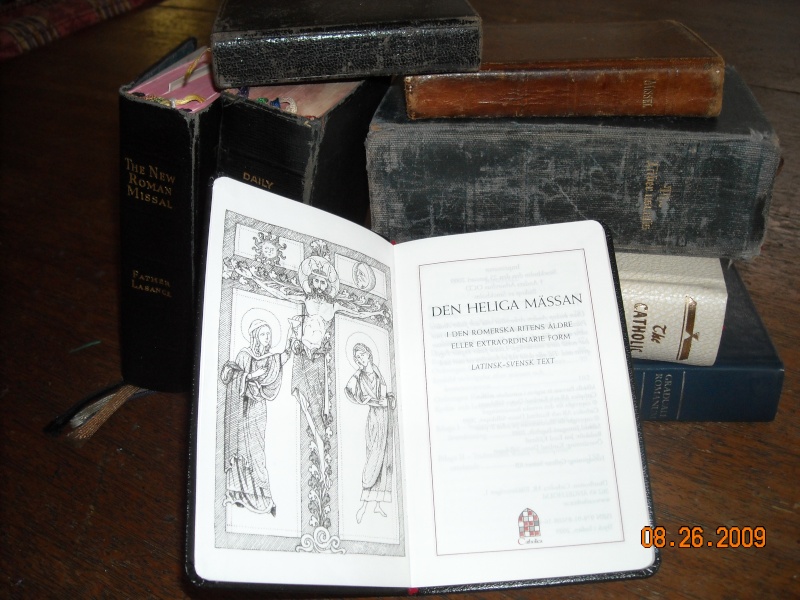
This morning’s mail brought a package from a good friend in Stockholm: The newly published Missale Parvum. Although not as extravagant as some of the new Missals seen in recent years, the appearance of this Latinsk-Svensk Missal is in many ways far more significant as it is the first Swedish language edition of the 1962 Missal to be published in more than forty years and is arguably the first to bear the imprimatur of a Swedish bishop in centuries. Publication of the new Missal was prompted by the growing number of traditional Catholics in the country who were highly instrumental in bringing it about.

The Cathedral of St Erik – Seat of the Diocese of Stockholm
The Church in Sweden has suffered greatly since the 16th century when King Gustav I broke with Rome and established the protestant Church of Sweden, rendering it more or less illegal to be Catholic. Over the years, practice was tolerated among foreigners and there were numerous “closet Catholics” who managed to quietly kindle the Faith as best they could under the threat of expulsion from the country for being identified as Catholic. An Apostolic vicariate was erected in 1783 to serve Catholic immigrants. It was subordinate to the Archdiocese of Paderborn in what is now Germany. As of 1873, native Swedes who had reached their eighteenth year were free to leave the state Church and join other religious societies; however proselytizing was strictly forbidden and such converts found many other official obstacles strategically strewn in their path. The vicariate was only elevated to the status of diocese in 1953 and it wasn’t until the year 2000 that the state Church of Sweden was disestablished and it finally became possible for the Catholic Church to register and be officially recognized by the government. Today, the Diocese of Stockholm encompasses the entire country and consists of 42 parishes. It has been served by five bishops in succession and is presently shepherded by His Excellency Anders Arborelius, OCD. Bishop Arborelius is a convert to the Faith and is the first ethnic Swedish bishop since the kingdom fell to the protestant conquest.

Today Catholics comprise only about 2% of the total Swedish population but they are one of the fastest growing areas of the Church in Europe, attracting increasingly large amounts of converts from the domestic population annually - and it should be noted that traditional Catholicism has been playing an important role. The Swedish Friends of the Institute of Christ the King Sovereign Priest is a lay association which has worked tirelessly for years to propagate the traditional Mass in the country and is largely responsible for bringing the Missal Parvum into reality. Bishop Arborelius, whose imprimatur appears on the new Missal, has proven to be a true friend to tradition and has cooperated with the ICRSP to bring the traditional Mass to four different parishes in the diocese – including the Cathedral! Some Masses are offered by diocesan priests, others by priests of the ICRSP. In addition to these there is a Sunday Mass offered at Gothenburg by the parish priest and another offered by the Friars of the Franciscan Conventual Chapel at Jonsered. The SSPX also offers a Mass in Stockholm.

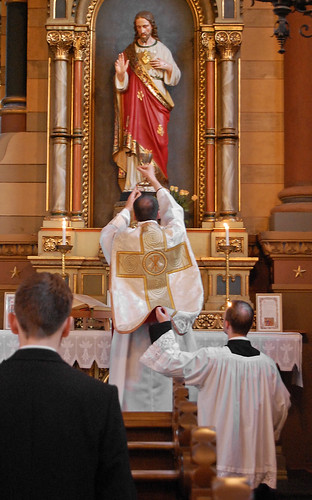
Father Marcus Kunkel ICRSP elevates the Chalice during Low Mass at St Erik’s Cathedral in Stockholm – the seat of Sweden’s sole diocese

The majority of the roughly 200,000 Catholics in present-day Sweden belong to non-Swedish ethnic groups with Poles being the largest of these, followed by Croats and Hispanics. Interestingly it is ethnic Swedes, most of whom are converts from Swedish Protestantism, who form the bulk of the traditional Catholic community. How things will develop from here will be worth keeping an eye on. The Church which had once almost completely disappeared from Sweden is now returning to, what is in some ways, a clean slate. Swedes in general did not suffer from the post-conciliar tumult that ravaged the Catholic world in the late 20th century largely because the Church was only marginally present among, or accessible to the Swedish people during most of that period. Today’s emerging convert population has a choice between two rites of equal footing. What we will be witnessing in the coming years is something never before seen: A test case that will show which liturgical path a historically Catholic European population will choose when given clear options as it re-embraces the Faith. In the unique situation of the Swedes, it is a choice between the rite which was pried from the hands of their Catholic ancestors by protestant rebels, and the rite devised 40 years ago by the post-conciliar Church in exile. Let us remember to pray for the sons and daughters of St. Bridgit as they usher Christ’s Church back into their kingdom – they may very well be constructing the model for the western Church in the 21st century.

Diocesan priest, Fr. Ingvar Fogelquist says the Ecce Agnus Dei at Low Mass in Annunciation church on Stockholm’s east side

The Missale Parvum is a leather bound hardcover volume printed on very fine gilt edged paper. It contains the Ordinary of the Mass, Requiem Mass, a treasury of popular prayers and prayers to particular saints, liturgical calendar, formula for Confession, and numerous other useful items for today’s traditional Swedish Catholic. Perhaps the most relevant feature in the Missal is the complete text of the papal letter, Summorum Pontificum with a commentary by Bishop Arboralius himself. Anyone wishing to own a copy of the Missale Parvum may order it directly from the publisher, Catholica

You report: Promotional Posters for the Traditional Latin Mass

From Una Voce Quad Cities:

Our Una Voce chapter is launching ... an ad campaign, thumbnails attached.
These ads are designed to expose as many as possible to the beauty of the TLM, to inform them about its status in the Church, and to invite them to attend the TLM nearest them. We plan on releasing versions of these ads in local papers, on internet sites, in 16x20 posters, etc. and also making versions (with modified information) available for a nominal fee to other groups promoting the TLM.


Light from the East: The Russian Catholic Parish in Lyons, France

Videos of a few highlights of some liturgical services celebrated earlier this year in the (Russian) Catholic parish of the Byzantine Rite in Lyons, St. Irenee, are now available on the "vincentraveau" channel on Youtube.
The Cherubic Hymn and Great Entrance during the celebration of the Divine Liturgy of Saint Basil for the Sunday of the Triumph of Orthodoxy:


The chanting of litanies during the same Divine Liturgy.
St. Irenee is one of only two remaining parishes of the Russian Greek Catholic Church (Byzantine Rite) in France, and one of only about twenty Russian Greek Catholic parishes, chapels and monasteries throughout the world. In these small places of prayer -- magnificent remnants of the great project of reuniting Russian Orthodoxy to Rome, a project now almost forgotten -- the Russian liturgical tradition is celebrated according to the command of Pope St. Pius X, "nec plus nec minus nec aliter", a tremendous display of the richness and diversity (rightly understood and practiced) of Catholicism.
***
More articles coming up. We request your patience.

URGENT
The "Reform of the Reform" is in motion

In today's edition of Italian daily Il Giornale, religious journalist Andrea Tornielli brings the news that several "propositiones" approved by the plenary of the Congregation for Divine Worship and the Discipline of the Sacraments (reserved session held on March 12, 2009) regarding several reforms of the new Mass of Paul VI. Full translation below:


ROME The document was delivered to the hands of Benedict XVI in the morning of last April 4 by Spanish Cardinal Antonio Cañizares Llovera, Prefect of the Congregation for Divine Worship. It is the result of a reserved vote, which took place on March 12, in the course of a "plenary" session of the dicastery responsible for the liturgy, and it represents the first concrete step towards that "reform of the reform" often desired by Pope Ratzinger. The Cardinals and Bishops members of the Congregation voted almost unanimously in favor of a greater sacrality of the rite, of the recovery of the sense of eucharistic worship, of the recovery of the Latin language in the celebration, and of the remaking of the introductory parts of the Missal in order to put a stop to abuses, wild experimentations, and inappropriate creativity. They have also declared themselves favorable to reaffirm that the usual way of receiving Communion according to the norms is not on the hand, but in the mouth. There is, it is true, and indult which, on request of the [local] episcopates, allows for the distribution of the host [sic] also on the palm of the hand, but this must remain an extraordinary fact. The "Liturgy Minister" of Pope Ratzinger, Cañizares, is also having studies made on the possibility to recover the orientation towards the Orient of the celebrant, at least at the moment of the eucharistic consecration, as it happened in practice before the reform, when both the faithful and the priest faced towards the Cross and the priest therefore turned his back to the assembly.

Those who know Cardinal Cañizares, nicknamed "the small Ratzinger" before his removal to Rome, know that he is disposed to move forward decisively with the project, beginning in fact from what was established by the Second Vatican Council in the liturgical constitution Sacrosanctum Concilium, which was, in reality, exceeded by the post-Conciliar reform which came into forceat the end of the Sixties. The porporato, interviewed by monthly 30Days in recent months, had declared regarding this: "At times change was for the mere sake of changing from a past perceived as negative and outdated. Sometimes the reform was regarded as a break and not as an organic development of Tradition."

For this reason, the "propositiones" voted by the Cardinals and Bishops at the March plenary foresee a return to the sense of sacredness and to adoration, but also a recovery of the celebrations in Latin in the dioceses, at least in the main solemnities, as well as the publication of bilingual Missals - a request made at his time by Paul VI - with the Latin text first.

The proposals of the Congregation, which Cañizares delivered to the Pope, obtaining his approval, are perfectly in line with the idea often expressed by Joseph Ratzinger when he was still a Cardinal, as it is made clear his unpublished words on the liturgy, revealed in advanced by Il Giornale yesterday, and which will be published in the book Davanti al Protagonista (Cantagalli [publisher]), presented beforehand at a congress in Rimini. With a significant nota bene: for the accomplishment of the "reform of the reform", many years will be necessary. The Pope is convinced that hasty steps, as well as to simply drop directives from above, serve no good, with the risk that they may later remain a dead letter. The style of Ratzinger is that of comparison and, above all, of example. As the fact that, for more than a year, whoever approaches the Pope for Communion, have had to kneel down on the kneeler especially placed by the cerimonieri.

RORATE note: The Pope needed, for practical purposes, this first bureaucratic step by the Congregation for Divine Worship. His decisions on this matter will come in the next few months and years. May God grant him many more fruitful years of work as Successor of Peter.