Rorate Caeli
Showing posts with label Laity. Show all posts

Only the Laity Are Able to Present the Traditional World to Pope Leo

Only the Laity Are Able to Present the Traditional World to Pope Leo; and What We Ask Is the Traditional Liturgy in Every Parish

The following two letters (no. 1307 and no. 1354) from Paix Liturgique were published on November 20, 2025 and April 9, 2026. It is well worth giving them wider diffusion, especially in light of the outrageous proposal of the abbot of Solesmes. —PAK

Theological and Canonical Challenges Posed by Appointing Lay Persons to Positions of Governance in the Church — Guest Article

The following article was written for the fourth anniversary of Praedicate Evangelium by the Canon of Shaftesbury, a judicial vicar in a major archdiocese.

The appointment of lay persons, and particularly laywomen, to positions of governance within the Catholic Church traditionally associated with the Sacrament of Holy Orders presents one of the most significant and unresolved theological and canonical tensions of the post-conciliar period. This study examines the classical teaching that the power of governance (potestas regiminis) is intrinsically linked to sacred orders, the canonical framework encoded in the 1983 Code, and the structural rupture introduced by the 2022 Apostolic Constitution Praedicate Evangelium of Pope Francis.

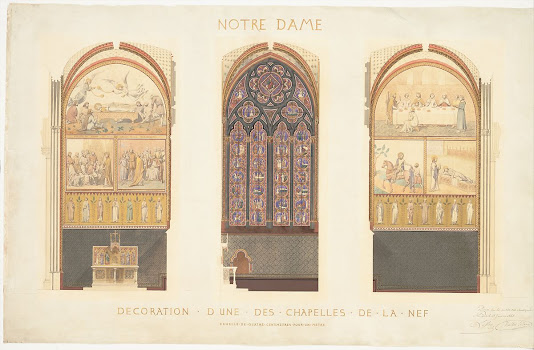
“A New Threat Looms over Notre Dame de Paris: What the Fire Spared, the Diocese Wants to Destroy”: Manifesto Signed by 105 French Cultural Figures

The following manifesto appeared at
La Tribune de l'Art and in the web and print editions of Le Figaro on December 7, in response to revelations that the archdiocese of Paris was pushing for a totally modernized, multi-media, Disney-like renovation of the interior of Notre Dame Cathedral.

On April 15, 2019, the world discovered, stunned and shocked, images of Notre-Dame on fire. While the rubble was still smoking, millions of people, of all nationalities, spontaneously mobilized to collect the money needed to restore the monument. Nearly one billion euros were raised. These donations were declarations of love for Notre-Dame Cathedral. They testified to our confidence in our ability to revive this sublime artistic and spiritual patrimony.

New Book Defends All-Male Liturgical Ministry, Subdiaconate/Minor Orders, and the Proper Roles of Clergy and Laity

I’m pleased to announce the release of my latest book, Ministers of Christ: Recovering the Roles of Clergy and Laity in an Age of Confusion (Crisis Publications).

When this project was first conceived over a year ago, my initial idea was to write a critique of Paul VI’s attempted suppression of the subdiaconate and minor orders, of John Paul II’s permission of altar girls, and of Francis’s innovation of female “acolytes” and “lectors.” During its writing, however, the scope of the book considerably broadened to include a full-scale presentation and defense of the traditional sevenfold manifestation of Orders — priest, deacon, subdeacon, lector, acolyte, exorcist, and porter — together with an explanation of the distinct but mutually supporting roles of clergy and laity. In order to accomplish this, I stepped back further to look at the distinction and complementarity of the sexes in the order of creation and the order of redemption, a perspective that provides the ultimate foundation for the Church’s entire teaching on states of life, roles, and ministries. In this way the book serves as a response to the “gender madness” that has afflicted the world and has increasingly infected the Church.

Analysis: "Querida Amazonia, a Blueprint for a Lay Church" - by Fr. Pio Pace, Roman Curia Insider

It has been a while, but Father Pio Pace, our pseudonymous very influential insider in the Roman Curia, was at last able to send us a special comment on the new post-synodal Apostolic Exhortation of Pope Francis, Querida Amazonia.

***


Querida Amazonia: a document for a kind of "Lay Church"?

Father Pio Pace

Will married viri probati be ordained to the priesthood? This question was the focus of all the attention, before, during, and after the assembly of the Amazon Synod, and the bishops of the German 'Synodal Way' were mounting an ambush, getting ready to seize the issue to force the institutional transformation of the Church.

For all sorts of political and tactical reasons, the long-expected apostolic exhortation does not mention it. It does not reject the possibility (as it has been hastily claimed): it simply does not mention it. In fact, the exhortation goes much further, in the direction of a Laicized Church, in which the common priesthood of the baptized largely absorbs the priestly ministry, being mixed up with it.

Because this text, under a modest appearance, is actually very ambitious. One should read with great attention the beginning of the Exhortation: it is presented as a, "framework of reflection," which is an invitation to read the final document of the Synod (which speaks of priestly ordination of married deacons), but rises up to more fundamental, and certainly more radical, considerations. The central passage deals with the "Inculturation of ministry" (paragraphs 85-90), followed by thoughts on the communities (91-98), then on the role of women (99-103).

The Priest Who Led Believers into the Temple of the Roman Liturgy

The following article was published in German on November 21st for the 50th Anniversary of the death of Father Sylvester Juergens, the ultimate source of the Angelus Missal, still in use today after eight reprints. It is offered here to Rorate readers in an English translation.


Fr. Sylvester Juergens (1894–1969):
The Priest Who Led Believers into the Temple of the Roman Liturgy

By Clemens Victor Oldendorf

2019 was a year in which many golden anniversaries or fiftieth anniversaries lined up for the Catholic Church, bearing on extolling the liturgical reform of Paul VI or defending the preservation of the liturgical tradition.

On April 3, 1969 Paul VI promulgated his Novus Ordo Missae, which came into force in most countries on November 30, the first Sunday of Advent in 1969. June 5, in that year the feast of Corpus Christi, was the date of the Short Critical Investigation of this new Ordo, addressed with a cover letter by the Cardinals Ottaviani and Bacci to Paul VI on September 25, 1969. On October 13, 1969, Archbishop Marcel Lefebvre opened his theological study-centre for priestly formation in Friborg, Switzerland, which was, so to speak, the seed from which the tender plant of the Society of St. Pius X was to spring forth.

New Online Database Tracks Episcopal Fidelity, Including in Liturgy


LifeSiteNews, for which I am a daily columnist, has just launched an initiative called Faithful Shepherds. It is an idea that I have heard people speculate about for years and wish would come true, without having the organizational resources to make it happen. Needless to say, it is welcome at this critical moment in the life of the Church. From the official announcement:

Faithful Shepherds helps hold American bishops accountable by providing years, sometimes decades, of past tweets, public speeches, sermons, actions, pastoral letters, and diocesan guidelines. Faithful Shepherds currently gives evidence of where U.S. bishops stand on ten issues: Archbishop Vigano's testimony, Amoris Laetitia, pro-life leadership, homosexuality, abortion politics, contraception, “LGBT” ideology, liturgy, marriage and family life, and education. More will be added as new evidence is gathered.

The Traditional Latin Mass and the active participation of the laity


by John R. T. Lamont

A standard criticism of the traditional Latin mass is that it leaves little or no place for the active participation of the laity. The Novus Ordo promulgated by Paul VI is held up as being far better suited to such participation; this is presented as a reason for preferring the new ritual to the earlier, and for revising the old ritual to bring it closer to the new one – if not for suppressing the old ritual altogether. I will argue that this is not only false, but the opposite of the truth; and that the greater scope for lay participation in the traditional Latin mass arises from the fact that its design aims at achieving the purpose of a liturgy, while the design of the Novus Ordo is not suited to this purpose.

Schola-Sainte-Cécile during the Traditional Latin Mass for the
Feast of St Cecilia, in the Parish Church of St-Eugène-St-Cécile, Paris (2014) - from their website
'Active participation' in magisterial teaching

The first step in addressing this question is to determine what is meant by 'active participation' in the magisterial documents of the Church that call for such participation on the part of the laity.

The first use of the phrase 'active participation' as a desideratum for lay involvement in the liturgy was in the Italian version of St. Pius X's motu proprio Tra le Sollicitudini in 1903; it did not appear in the official Latin text.