Rorate Caeli

URGENT: The Abolition of Summorum Pontificum could come within days or weeks — declarations from Bishops and Cardinals

 After faithful of the abolished FSSP mission in Dijon came to complain in front of the Archdiocesan office building, on June 26, Abp. Roland Minnerath came to talk to them and had ominous menacing words.


From Paix Liturgique:

"You will have a new motu proprio in the upcoming days or weeks," Abp. Minnerath, Archbishop of Dijon, said on June 26 to the faithful of the Traditional Mass who came to display their discontent before the archdiocesan building. [Rorate: this declaration is on video]


But even before the publication of this text, if it comes to be published, the testimonials on the intentions of the enemies of the previous motu proprio, that of Benedict XVI, grow:

- Cardinal Parolin, the Secretary of State, affirmed thus before a group of Cardinals: "We must put an end to this mass forever!"

- And Abp. Roche, new Prefect of the Congregation for Divine Worship, explained, while laughing, to those responsible for [some] seminaries in Rome and members of the Curia, all English-speaking: "Summorum Pontificum is practically dead! We will give back to the bishops power on this matter, but particularly not to conservative bishops.”


It must be known additionally that Abp. Minnerath, who opened the hostilities against the traditional community of Dijon, is a member of the Congregation for the Doctrine of the Faith [Rorate: curently in charge of the application of Summorum] and due to this is present every month in Rome, surrounded by the Curial milieux that have prepared the offensive against Summorum Pontificum. [Source]


Pontifical High Mass: Washington, D.C.

A pontifical high Mass will be offered at the Basilica of the National Shrine of the Immaculate Conception in Washington, D.C., on Saturday, 14 August 2021 -- the vigil of the Assumption of the Blessed Virgin Mary.  This will be the fourth pontifical high Mass there since 1969:  2010 with Bishop Slattery; 2018 with Archbishop Sample; and 2019 with Archbishop Cordileone.


This year's (rescheduled from last year) celebrant will be His Excellency Thomas E. Gullickson, JCD, an American who recently retired as papal nuncio to Switzerland and Liechtenstein after several years in the Vatican diplomatic service.  Archbishop Gullickson was ordained for the Diocese of Sioux Falls, South Dakota.


The pontifical high Mass, like the other three offered since Summorum Pontificum, will be at the high altar in the great upper church (although the portable table in front of it is not allowed to be removed from the sanctuary, except for concerts).  EWTN will broadcast the 1 p.m. 14 August Mass, like it has done for the other three pontifical Masses.  It will be sponsored by the Paulus Institute for the Propagation of Sacred Liturgy, which sponsored the 2010 and 2018 Masses at the basilica shrine (the 2019 sponsor was the Benedict XVI Institute for Sacred Music and Divine Worship).  Thanks must be given to sponsors, as it is an understatement on just how difficult it is to fund and organize such a liturgy -- and fill the pews in the largest church in North America.  In addition to the above website (through which a donation may be made), the Paulus Institute also has a Facebook page for updates.

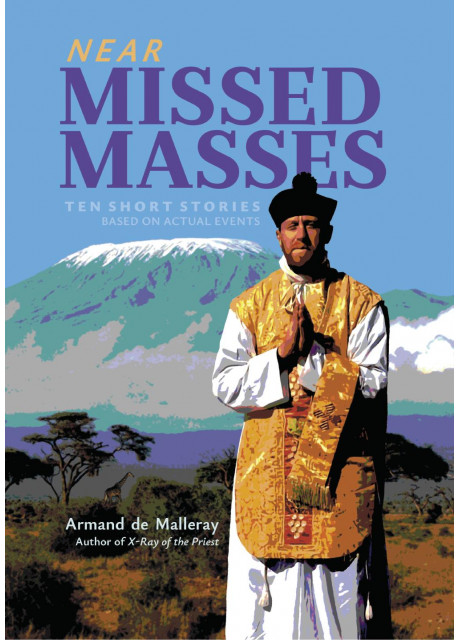
"Near Missed Masses: Ten Short Stories Based on Actual Events" -- a new book by Fr. Armand de Malleray

“Can priests miss Mass? This little book light-heartedly depicts ten Holy Masses nearly missed by priests due to some opposition. From Kilimanjaro to Loch Ness, from Burma to Paris and more, the ten humorous short stories describe obstacles to the celebration of Holy Mass, thankfully overcome. The ten priests persevered, spurred by the conviction that Holy Mass: 1) honours God, whose extrinsic glory increases each time the Holy Sacrifice of the Mass is offered; 2) helps souls through the temporal application of Christ’s saving merits that Holy Mass brings about; 3) fortifies priests, whose ontological raison d’être is to offer the divine Victim on the altar. Leaving aside theological arguments, Near Missed Masses entertainingly illustrates these truths through fiction.”


Praise for Near Missed Masses:

Fontgombault Homily for the Feast of Saints Peter and Paul: "Knowing is not enough. Proclaiming is not enough. We have to offer our own life for Christ."

Sermon of the Right Reverend Dom Jean Pateau
Father Abbot of Our Lady of Fontgombault
Fontgombault, June 29, 2021

Tu es Petrus, et super hanc petram ædificabo Ecclesiam meam. 
 Thou art Peter, and upon this rock I will build My church. (Mt 16:18)


Dear Brothers and Sisters,
My dearly beloved Sons,


Acknowledging Christ, this is the concern for truth that seems to prompt the question the Lord asks of His apostles, and especially of Peter, who answers it in the name of all. The answer is not that obvious, as witnessed by the various opinions several disciples report concerning the Son of man’s identity: John the Baptist, Elijah, Jeremy, or one of the prophets. Acknowledging the Son of man also means appropriating a mission. St. Peter’s confession in Caesarea marks a milestone in the progressive revelation Christ makes of His imminent Passion and resurrection:


From that time, Jesus began to shew to His disciples, that He must go to Jerusalem, and suffer many things from the ancients and scribes and chief priests, and be put to death, and the third day rise again. (Mt 16:21)


Confessing what the Son of man is, is not sufficient, and Peter has yet to understand it. Despite the fact that he proclaims Christ’s divinity, “Thou art Christ, the Son of the living God!” (Mt 16:16), Peter doesn’t seem to be ready to follow the path the Lord is showing him. He doesn’t under-stand the Lord’s mission, and consequently, he won’t be able to accept his own mission, in the Christ’s footsteps. Faced with the scandal of the Cross, Peter rebels, takes Christ aside, and forcefully rebukes Him:

(Somewhat) Good News from the New Archpriest of Saint Peter's Basilica -- Rules limiting Summorum Pontificum and Private Masses modified

Three months ago, a bizarre note from the Secretariat of State prohibited private masses in all altars of the Vatican Basilica and limited the Traditional Mass to one altar in the crypt -- Rorate was the first page to report on it. The note was not published, but posted in the basilica sacristy.


Today, Cardinal Mauro Gambetti, the new Cardinal-Archpriest in charge of Saint Peter's Basilica (who, all sources informed us, was caught completely unaware by the decree) published a clarification note trying to somewhat fix the situation. This time, the note (here in Italian) was signed and published in the Bollettino of the Holy See.


It is a long note, but the main points are the following: while the prohibitions are somewhat held, they are limited to the 7-9 am period, in which there are more masses; even during this time of the day, care should be taken to welcome all kinds of groups of pilgrims, in view of the Basilica being the essential focus of "unity" in the Church; private masses can also be allowed, in specific cases, when a "concelebration" is not going on at the same time, after being "the object of discernment"...


But, most important for the Traditional Latin Mass, the Cardinal states the following:

"-for the celebrations with the 1962 Missale Romanum, all must be made possible to fulfill the wish of the  faithful and priests, as foreseen in the Motu Proprio Summorum Pontificum."


We will see how this clarification note will play out exactly and in practice in the upcoming weeks: we will keep you informed.

Biden, The Eucharist, and the Bishops: WHAT IS AT STAKE


 The possibility that President Biden will be refused Holy Communion as a result of the American bishops’ decision to go ahead with writing a document on “Eucharistic coherence” is making headlines in many newspapers, especially those considered “liberal” in today’s understanding of that term.  The New York Times last Saturday featured a front-page article titled “Bishops on path to refuse Biden holy communion”. It is significant that the article is written using political terminology.  The author frames the division among the bishops in terms of “conservative” and “liberal”. In this framework, those who are “conservative” are out of step with Pope Francis and his understanding of the role of the Catholic Church in today’s world.  Those who are “liberal” are in accord with Francis’ agenda. According to the article, it is the “conservative” bishops who are in the majority, and who by means of this document---which has yet to be written and published—are determined to deny President Biden Holy Communion because of his firm governmental support of abortion.  

Little Latin Readers 'third level' now available for homeschoolers


A couple of years ago we brought our readers a wonderful new tool for children, especially homeschoolers, to learn Latin (see original post with more details below this update). 

The third level of the newly revised Little Latin Readers series, Liber Tertius: Civitates Europae, has just arrived, and it continues and expands the unique Catholic cultural experience of the preceding levels. The stories in this reader focus on the beginnings of Catholic Europe, with selections on the geography, fauna and flora, and history of four key Catholic nations: Ireland, France, Spain and Poland. 

The Sunset of a Papacy. Pope Francis also has his fans against him. By Antonio Socci


Antonio Socci

Libero

June 16, 2021


What is happening in the Catholic Church? Are we on the verge of an earthquake? There are lots of signs that would induce us to think so, and the article by Alberto Melloni from the columns of “La Repubblica” yesterday, is really quite sensational, revealing, as it does, the severe split on the part of some progressive Catholics from Pope Francis, whom they used to support enthusiastically.


Melloni, symbol of the “School of Bologna” and the “progressive wing of the Church – initiates his indictment by highlighting that the German Cardinal Marx, in his recent letter of  resignation, “was in effect asking for the Pope’s resignation”.


Marx is the leader of the powerful and affluent German Episcopate, which, through its Synod, seems to want a revolution. The German bishops are historically the supporters of Bergoglio, but their undue haste is not endorsed by him, and now they are plainly disappointed.


Melloni then cites other recent episodes, like the Papal Decree limiting to ten years “the mandate  of the leaders and bodies of lay ecclesial movements”. A norm – according to Melloni – that “constricts the rights of the faithful” and “establishes  the liquidation of the leaders presently serving, in the name of an ideologically defined good.”


“The Council and the Eclipse of God” Part XI “How the Council jettisoned true Catholic Evangelisation for shallow Ecumenism” by Don Pietro Leone


In the first section on the relations between the Church and the non-Catholic Christians Don Pietro examined Ecumenism in theory; in the second section which we publish to-day, he examines it in practice. He shows how the Council jettisoned Evangelisation and justified indifferentist religious and liturgical assemblies by hetericizing obscurantism, using the terms ‘Ecumenism’ ‘Christian’ and ‘Christian unity’in two different senses, one Catholic and the other not; by historical falsification; and by an appeal to a shallow, sentimental, surrogate Ecumenical love over that one immutable Truth capable of saving man from eternal death, which is our Holy Catholic Faith.                                                                                                            F.R.


Pope Paul VI and Patriarch Athenagoras - December 4, 1965


The Council and The Eclipse of God


by 


Don Pietro Leone 


Part XI


A. Ecumenism in Practice


October 13, 1962  at THE SECOND VATICAN COUNCIL - Cardinal Agostino Bea, standing at right, presents the schismatic and non-Catholic  observers  to  Pope John XXIII.


A.   Ecumenism in Practice


Before the Council, non-Catholic Christians were viewed as mistaken, deprived of graces, in danger of perdition, and thus in need of evangelization and conversion; but with the Council they are treated as equals (or almost as equals) of Catholics, as their friends, and thus no longer in need of evangelization.


In this section we shall examine:


1.     The Practice of Ecumenism in General; 

2.     The Practice of Ecumenism by Communicatio in Sacris;

3.     The Spirit of Ecumenism.


1.     The Practice of Ecumenism in General


i) ‘Without doubt, the differences that exist in varying degrees between them [‘the communities that became separated from full communion with the Catholic Church’] and the Catholic Church – whether in doctrine and sometimes in discipline, or concerning structures of the church – do indeed create many obstacles, sometimes serious ones, to full ecclesiastical communion. The ecumenical movement is striving to overcome these obstacles’ (UR 3);


ii) ‘The term ‘ecumenical movement’ indicates the initiatives and activities… to promote christian unity’… [These consist in] ‘every effort to avoid expressions, judgments and actions which are not truthful or fair’ in regard to non-Catholics; ‘dialogue’ in presenting respective teachings; collaboration in serving ‘the common good of humanity’; and common prayer  (UR 4). Examples of serving ‘the common good of humanity’ are given in Ad Gentes (15) in terms of the ‘social cultural, technical, and religious’ domain on the missions, and in UR 12 in terms of relieving ills such as famine and natural disasters, illiteracy and poverty, and lack of housing. Ecumenical actions aim to ‘promote justice and truth, concord and collaboration, as well as the spirit of love and unity…’ (UR 4);


iii) … as the obstacles to perfect ecclesiastical communion are overcome, all Christians will be gathered, in a common celebration of the Eucharist, into the unity of the one and only church… This unity, we believe, subsists in the Catholic Church… However it is evident that the work of preparing and reconciling those individuals who wish for full catholic communion is of its nature distinct from ecumenical action’ (UR 4).


"George Soros and Alexander Dugin: two sides of the same coin?" (by Roberto de Mattei)

In what sense may George Soros and Alexander Dugin be defined as two sides of a single coin?


In 1945 the Austrian philosopher of science Karl Popper (1902-1994) published a ponderous work in two volumes entitled The Open Society and Its Enemies (Routledge, London, 1945). In this work, Popper maintained that the totalitarian ideologies like communism and Nazism have a common element: claiming to possess absolute truth. The Austrian philosopher contrasted totalitarian societies with a model of social democratic organization that he called an “open society” because it is opposed to any cultural or moral “frontier.” Popper wrote this work in New Zealand, where he had emigrated after the rise of Nazism due to his Jewish origins. Subsequently, the philosopher moved to England, where he taught at the prestigious London School of Economics and obtained British citizenship.

Watch the SSPX ordinations live this Friday

This Friday, June 11, the Society of St. Pius X (SSPX) will live stream their ordinations to the Priesthood and Diaconate. Three priests and six deacons will be ordained this year, and this is the first year they will livestream the ordinations from the Seminary.


We all know what's going on these days. These new priests and future priests may be direly needed in the near future.


A meditation on the Heart of God and the Heart of Man


A meditation on the Heart of God and the Heart of Man


by 


Padre Natanaele Thanner, ORC


St.  Augustine said: “All of us without question want to live happily, and in the whole human race there is no one who does not assent to this proposition.” Where does this desire for happiness in every human heart come from? From God Himself.   “God has placed it in the human heart in order to draw man to the One Who alone  can fulfill it.” (Catechism of the Catholic Church, 1718).


Those who seek happiness, seek God, and those who seek God, seek happiness. “Seeking Thee, My God, I am seeking happiness. I will seek Thee so that my soul may live. My body lives from my soul and my soul lives from Thee.” (Saint Augustine).


Yes, God is the life of our soul, which is the principal of life for our body. A body without a soul is dead.  And what of a soul without God? 


Important Op-Ed by Fr Pio Pace: "Restricting Summorum Pontificum: What the Pope Said, the Credible Information, and the Risk of a War within the Church."

Rorate Note: It has been a while since that great connoisseur of the deepest secrets of ecclesiastical life in Rome, Father Pio Pace, last sent us a report.


The repeated discreet reports on the draft of a papal document restricting the application of the motu proprio Summorum Pontificum (the document by Benedict XVI that recognized the impossibility of the abrogation of the Traditional Roman Liturgy) prompted him to write to us again on this urgent matter:


Restricting Summorum Pontificum: What the Pope Said, the Credible Information, and the Risk of a War within the Church
by Father Pio Pace
Rome

A text weakening the scope of the motu proprio Summorum Pontificum, of Benedict XVI, could be about to be published: that information, that followed the announcement made "confidentially" by the Pope to the Italian bishops of the CEI [Italian Bishops' Conference], assembled at Via Aurelia, in Rome, on May 24, has been largely commented upon, notably by the major Italian press.


 The essential norms of the text, as the Pope informed them, are the following: from now on, the priests of the communities specialized in the Traditional Mass (the "Ecclesia Dei" communities) could continue to celebrate, as well as the diocesan priests that already celebrate it; on the contrary, if additional diocesan priests wish to celebrate it, they must first obtain a permission of the bishop.


Some supplementary information has been added, but this time in the shape of credible off-the-record comments: the Congregation for Divine Worship would now be in charge of the operation of the Traditional Mass and the Ecclesia Dei communities. Within this Congregation, that has just received its new Prefect, Abp. Roche, and a new Secretary, Abp. Viola, a new Under-Secretary of episcopal level, Bp. Aurelio García Macías -- former rector of the seminary of Valladolid, Spain -- would be the direct responsible man for the traditional world, as Abp. Pozzo was in the past. This ensemble of curial personnel being, in principle, hostile to the ancient Mass.

On rumored rollback of Summorum, German website asks: “What’s in store for us?”

A pair of important articles appeared in recent days at the German traditionalist website Motu-proprio: Summorum-Pontificum (www.summorum-pontificum.de), the first on May 31st and the second on June 4. They are provided here in translation for readers of Rorate Caeli. Please note that some of the speculation in the first part is “corrected” in the second part, especially the rumor about Cardinal Braz de Aviz being placed in charge of traditional religious communities, which, for now, seems to be off the table.


What’s in store for us? (Part 1)


May 31, 2021


There is still no reliable information about the “interpretations” of Summorum pontificum announced by Francis, but there are numerous conjectures. Some of them are to be taken quite seriously.


Perhaps the most interesting consideration: Since there is talk of “interpretation,” the text of the motu proprio itself could remain untouched—the planned changes would be realized through a rewrite of the 2011 Universae Ecclesiae implementing regulations. Deeper interventions would thus not be necessary for the time being; yet one would have to accept certain incongruities between the Motu Proprio, which as such has the force of law, and the implementing regulations. This is precisely what one must expect in view of the increasingly demonstrated disregard for formal law and its norms in Rome.


Current practice would be to frame the changes not as generally binding prescriptions, but—under the pretext of decentralization and strengthening episcopal authority—as “extended possibilities,” or “options,” whose implementation would be left wholly or partly to the discretion of the local bishops. It is expected as certain that local ordinaries will be given full authority as to whether and when, and in what form, diocesan clergy may celebrate in the traditional rite. But priests of the old-rite communities could also be subjected to diocesan regulations for celebrating in churches of the diocese. In this context, it could come about that the previously valid prohibition of “mixed forms” would be relativized, so that, if necessary, readings according to the new lectionary and calendar, female altar servers, extraordinary ministers of communion, and other achievements of the Novus Ordo could be expected. Also the administration of the sacraments—above all, baptisms, marriages, and confirmation—are, according to rumors, to be regulated even more strongly than before. Even now, local ordinaries have considerable possibilities of influence over access to the liturgical rites in this regard—up to making (for example) confirmation according to the old liturgy impossible in their area of authority.


Address in Rome March for Life - Bishop Antonio Suetta: "The divine commandment 'Thou shalt not kill' is an irrepressible command that cannot be repealed or suspended."

Antonio Suetta, Bishop of Ventimiglia-Sanremo
Address at March for Life 
Rome, May 22, 2021


A warm and cordial greeting to all present, to those who share this moment from a distance and to all supporters of this initiative. I wish to thank Virginia Coda Nunziante, the President of the March for Life, and all organisers and collaborators of this 2021 event.


I am here first and foremost to share with all of you the joy and celebration of life and to bear witness to the commitment of the Church, of believers and of so many people of sound conscience to promote, serve and protect human life from its beginning to its natural end, in all its variety, and especially when life is most vulnerable and suffering.

Fontgombault Sermon for Corpus Christi 2021: "God’s table is plentiful. God gives Himself as a food. God lives in us, and we live in God. "

CORPUS CHRISTI

Sermon of the Right Reverend Dom Jean Pateau
Abbot of Our Lady of Fontgombault
Fontgombault, June 3, 2021

Dear Brothers and Sisters,
My dearly beloved Sons,

On Maundy Thursday evening, the Church commemorated the institution of the Eucharist, within the broader framework of the Paschal triduum events: institution, death and resurrection of the Lord.

Today, in the wake of the particular revelations made to St. Juliana, an Augustine sister of the convent and leper house of Mont-Cornillon, during the 13th century, the Church invites us more specially to consider this mystery as the place of communion with the Lord and adoration of Him. When she was an adolescent, Juliana used to be strongly drawn by the Eucharistic devotion. She was frequently favored with mystical visions. For instance, she saw the moon blazing with light, but incomplete, crossed diametrically by a dark stripe separating it into two equal parts. 

Benedict XVI commented, during the general audience of November 17th, 2010:

The Lord made her understand the meaning of what had appeared to her. The moon symbolized the life of the Church on earth, the opaque line, on the other hand, represented the absence of a liturgical feast for whose institution Juliana was asked to plead effectively: namely, a feast in which believers would be able to adore the Eucharist so as to increase in faith,  to advance in the practice of the virtues, and to make reparation for offenses to the Most Holy Sacrament.

Juliana accepted this mission, and was helped by Blessed Eva of Liege, a recluse.

New Facebook Group for Preservation of Summorum Pontificum


Shawn Tribe, the founder of two important websites—New Liturgical Movement and Liturgical Arts Journal—has created a Facebook group called “Preservation of Summorum Pontificum & Access to the Ancient Latin Rites.”

The description reads:

The purpose of this group is to factually and non-polemically document what is taking place in regard to the possible or actual diminution / restriction of the liturgical freedoms noted in Summorum Pontificum for the ancient Latin liturgical rites. It also exists as a forum to coordinate efforts to maintain and preserve the free and unfettered access to these more ancient forms, whether the Roman usus antiquior or the liturgical rites of the various religious orders and primatial sees.

The purpose of this group is not to attack individuals, be they popes, prelates, priests, laymen or otherwise. Be firm and strong in your convictions but be courteous.


Please consider joining the group if you are on Facebook.


Reminder: Rorate Caeli Purgatorial Society


This is our monthly reminder to please enroll Souls of the Rorate Caeli Purgatorial Society.  The Society now stands at 110 priests saying weekly or monthly traditional Latin Masses for the Souls. 

** Click here to download a "fillable" PDF Mass Card in English to give to the loved ones of the Souls you enroll (you send these to the family and/or friends of the dead, not to us). It's free for anyone to use. CLICK HERE to download in Latin and CLICK HERE to download in Spanish

Priests: The Souls still need more of you saying Mass for them! Please email me to offer your services. There's nothing special involved -- all you need to do is offer a weekly or monthly TLM with the intention: "For the repose of the Souls enrolled in the Rorate Caeli Purgatorial Society." And we will always keep you completely anonymous unless you request otherwise. 

How to enroll souls: please email me at athanasiuscatholic@yahoo.com and submit as follows: "Name, State, Country." If you want to enroll entire families, simply write in the email: "The Jones family, Ohio, USA". Individual names are preferred. Be greedy -- send in as many as you wish and forward this posting to friends as well.

Draw the living waters of the Sacred Heart - Haurietis Aquas


100 years after Pope Blessed Pius IX had extended the feast of the Sacred Heart of Jesus to the Universal Church, Pope Pius XII, of most glorious memory, decided to celebrate the occasion with one of the brightest lights of his pontificate, the Encyclical Letter Haurietis Aquas, signed on May 15, 1956.

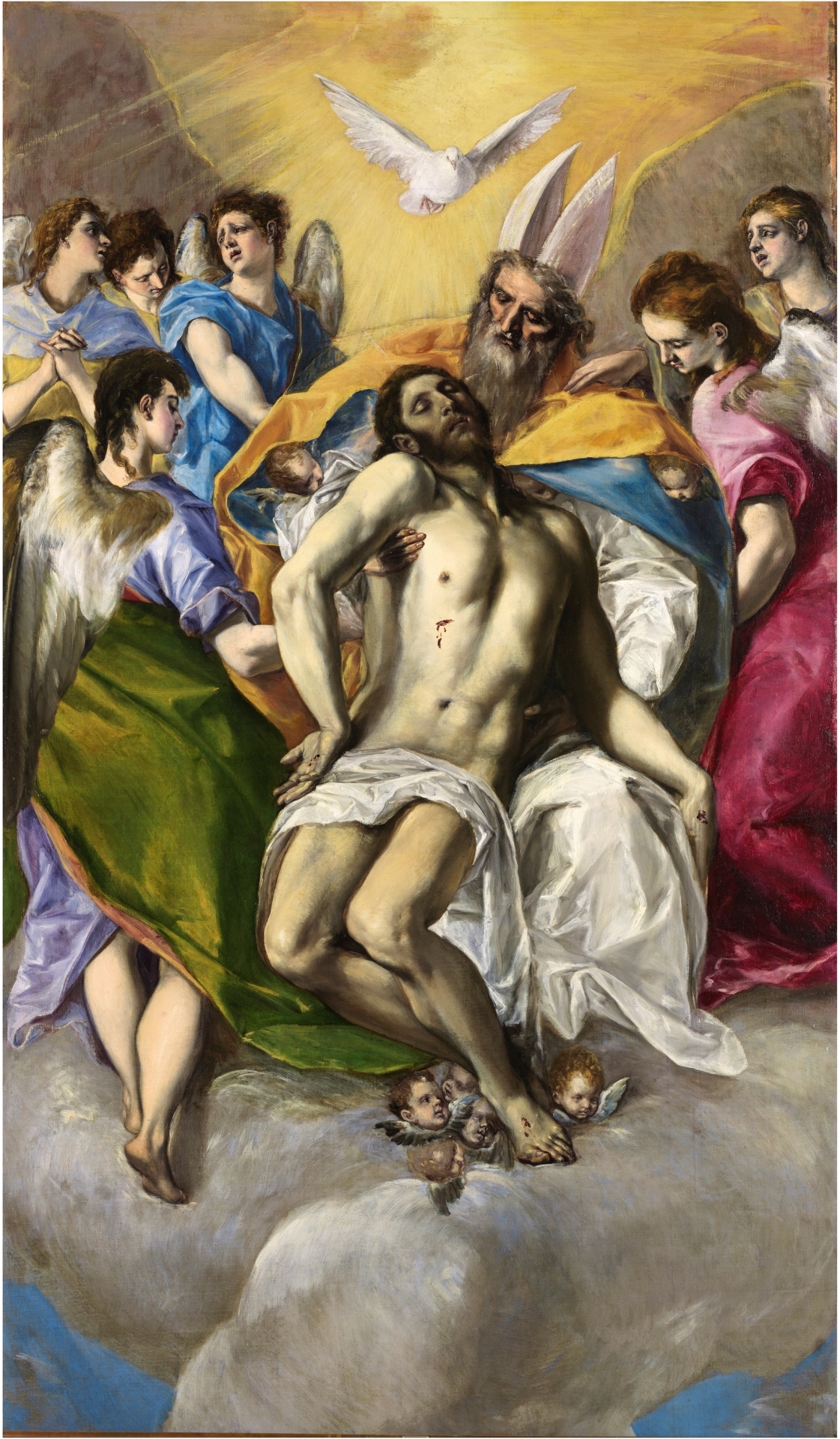
The Christian God: Sermon for Trinity Sunday


What can this Sunday mean, what should we be thinking about, saying. Trinity Sunday. The only Sunday dedicated to a doctrine, a teaching of the Church.  All the other feasts are commemorations of an event: Christmas, Epiphany, Good Friday, Easter, the Ascension, Pentecost.  But this feast is different: this is a celebration of the God we believe in, not in some abstract and idealistic way, but as who God is.  How many times have we said the Gloria Patri, Glory be to the Father and to the Son and to the Holy Spirit?  We say it automatically, without thinking, but this brief prayer of praise contains our understanding of God as Father, Son and Holy Spirit.  This is the doctrine of the Trinity, the teaching about God, but where did this come from?  It did not come from a Council or from a theology book. It came from the early Church’s experience of God.  God as the Father, the one who created all things, the one who made us in the image of God, the Father who tends and loves his children:  this we inherited and affirm with our Jewish brethren.  This is indeed the God of the Old Testament.

New scientific article on the the risk of Covid infection at Mass

Cross-posted from the FIUV.

Sergey Budaev, "Safety and Reverence: How Roman Catholic Liturgy Can Respond to the COVID-19 Pandemic" Journal of Religion and Health (2021), published 24th May 2021.

Among many interesting observations of this article, which cites a great many studies, is that while reception on the tongue does not appear to be more dangerous than reception in the hand, reception kneeling is clearly preferable to reception standing. We reproduce a key passage below; the whole article can be read here (or download the pdf here).

The Holy Species used in the Latin Rite is nearly dry and therefore is likely to have low adhesion of outside particles, further reducing the infectious risk. While receiving the Holy Bread, the communicant normally extends the tongue forward, requiring to hold breath for a while. This reduces possible respiratory output. The traditional manner of receiving Communion on the tongue is therefore unlikely to incur a high risk of infection transmission.

The Wonderful FSSP Community in Phoenix, Arizona (Updated)


In the past few days, some readers have asked us about the spiritual health of the Fraternity of Saint Peter's community in Phoenix, Arizona. 


The FSSP has been in Phoenix since 2004, where they have created with so many local faithful and the support of successive bishops the Mater Misericordiae parish.


Unfortunately, as in all religious communities, there is the occasional disgruntled parishioner -- and if such a parishioner has many followers online, he or she can give the wrong impression about the congregation. That has recently happened with Mater Misericordiae, and we reached to our readers to send their testimonies of life in that community. What we gather from what we received is that this is a spiritually healthy and strong congregation of people deeply devoted to Almighty God, His Church, His Mother, and His Sacraments.


***


From a Catholic couple:


My family and I have been parishioners at Mater Misericordiae in Phoenix for over 3 years. In that time Fr. Passo has been a true spiritual father to our family. 

THE COUNCIL AND THE ECLIPSE OF GOD - PART X - by Don Pietro Leone : THE CHURCH AND THE NON-CATHOLIC CHRISTIANS


If one wishes to understand more fully the Catholic doctrine “Extra Ecclesiam Nulla Salus” and the death of the authentic Catholic missionary spirit in the subsequent decades after the Council,  this installment from Don Pietro Leone’s  The Second Vatican Council and the Eclipse of God” is a must read and well worth the effort of following his painstaking argumentation, which uncovers the insidious false piety, sentimentality and deceit of language found in the documents regarding the Church’s ecumenical association with  non-Catholic Christian denominations, in decrees such as Lumen Gentium and Unitatis Redintegratio.                    F.R.


THE COUNCIL AND THE ECLIPSE OF GOD 


by 


Don Pietro Leone 


PART X


II  THE CHURCH AND THE NON-CATHOLIC CHRISTIANS


     Historical Background [1]


Ecumenism was born in Protestant missionary circles, where the multiplicity of confessions created grave problems for proselytism. In 1919 the Holy Office enforced the prohibition of Bl. Pius IX (of 1864) to participate in ‘public and private talks organized by non-Catholics that propose to promote the union of all groups calling themselves Christian’ [2]. Despite this prohibition, Ecumenism began to infiltrate the Catholic Church through the initiatives of various groups and individuals, the more important of which we shall proceed briefly to sketch.


Lord Halifax 

Between 1921-6, at the instigation of Lord Halifax and one Father Portal, a series of meetings between Catholics and Anglicans known as ‘The Conversations of Malines’ were held in the house of Cardinal Mercier in Belgium. One of the participants in these colloquies was Dom Lambert Bauduin, who, after having promoted the Liturgical Movement, now threw himself into that of Ecumenism, founding the Monastery of Chevetogne in Belgium in 1925. His monks were to ‘de-Romanise’ themselves and open up to ‘dialogue’ with the Anglicans and Orthodox.  One Father Paul Couturier, after visiting the community, introduced into his own community a prayer intention, not for bringing dissident Christians back to the One True Church, as had hitherto been the Catholic practice, but rather for creating a new spiritual ‘unity’ between the different Christian confessions in the name of a ‘convergence towards Christ’. 


URGENT: Pope tells Italian Bishops he plans to abolish the motu proprio Summorum Pontificum (Updated)

Update (May 26): Rorate's additional sources in Rome have confirmed this Wednesday that Francis has indeed a text on Summorum Pontificum lined up, which has been developed for months, but what is not known at this point is if the text is just about a more limited take on the Summorum application questionnaire (first revealed by us in the spring of 2020) or about an overhaul of Summorum Pontificum in general: drafts could be dealing with both matters. It is also not impossible for a text to come out of calculated ambiguity, in the general denial/non-denial terms favored by this pontificate.

 ***


An urgent news item by our friends at Messa in Latino, the Pope spoke on the matter yesterday to the Italian bishops during the portion of the Italian Conference of Bishops' meeting in which the assembly was closed to the media:


It is, for the moment, still fragmentary news, coming from our multiple sources within the CEI [Italian Conference of Bishops] and bishops, but it seems that yesterday (May 24, 2021) the Pope, addressing the Italian bishops at the opening of the annual assembly of the CEI ( and in a subsequent meeting with a group of them), announced the imminent reform for the worse of the Motu proprio Summorum Pontificum.


...

From what is known, it would be a return to the indult -- with a prior authorization of the bishop [as under the motu proprio Ecclesia Dei], or of the Vatican -- with all that it entails, that is, a reintroduction of the prohibition of the celebration according to the Missal of St John XXIII, so many denials of authorizations, and the ghettoization, in practice, of the priests and faithful attached to the old rite. After Moses, the Liberator, Pharaoh returns. [Source]

Fontgombault Sermon for Pentecost: If God rests in a heart, then this heart rests in God, and it is at peace.


Homily of the Right Reverend Dom Jean Pateau
Abbot of Our Lady of Fontgombault
Fontgombault, May 23rd, 2021
Illumina cor hominum.
Illuminate men’s hearts.
(Hymn of Wednesday Vespers)


Dear Brothers and Sisters,

My dearly beloved Sons,


The feast of Pentecost, through the great richness of its texts, and the outstanding beauty of its melodies, evokes with a great liturgical simplicity the coming of the Holy Spirit on the Apostles, gathered in the Cenacle with Mary. A mighty wind fills the whole house. Tongues as of fire appear, part themselves, and sit upon the head of each of the disciples. These begin to speak with different tongues, according to what the Holy Spirit gives them to speak.

Obviously, these phenomena are not limited to the sole room of the Cenacle. A crowd gathers outside, drawn by the noise, and curious to see what is happening. Inhabitants of Jerusalem, devout Jews coming from all the nations, are bewildered because all of them can hear the words of the disciples in their own tongue. They bear witness to what the disciples are proclaiming, “the wonders of God.”

After having meditated on the Lord’s resurrection, the cause of our salvation, the events taking place this morning in the Cenacle should lead us to desire a new Pentecost. The liturgy, for that matter, urges us to call for it, “Veni, Come.”

The Demographic End of Catholic Europe

 Slow, and then sudden, as all great demographic changes in history. The post-war generations' war on morals, marriage, and unborn babies has reached breaking point:


In Capracotta, a small town in southern Italy, a sign in red letters on an 18th-century stone building looking on to the Apennine Mountains reads “Home of School Kindergarten” — but today, the building is a nursing home.

Residents eat their evening broth on waxed tablecloths in the old theater room.

“There were so many families, so many children,” said Concetta D’Andrea, 93, who was a student and a teacher at the school and is now a resident of the nursing home. “Now there is no one.”

The population in Capracotta has dramatically aged and contracted — from about 5,000 people to 800. The town’s carpentry shops have shut down. The organizers of a soccer tournament struggled to form even one team.

About a half-hour away, in the town of Agnone, the maternity ward closed a decade ago because it had fewer than 500 births a year, the national minimum to stay open. This year, six babies were born in Agnone.

“Once you could hear the babies in the nursery cry, and it was like music,” said Enrica Sciullo, a nurse who used to help with births there and now mostly takes care of older patients. “Now there is silence and a feeling of emptiness.”

In a speech last Friday during a conference on Italy’s birthrate crisis, Pope Francis said the “demographic winter” was still “cold and dark.” [Source]


It's over. But a new beginning will rise from the faithful Catholic families we see all around us. Veni, Creator Spiritus!

"On the Marian Nature of the Extraordinary Form" - Guest op-ed by Fr. Matthew MacDonald

Fr. Matthew MacDonald
Archdiocese of New York

As COVID precautions slowly change across the United States, many bishops are beginning to reinstitute the obligation to attend Sunday Mass in their dioceses and encourage the faithful to return. Some are indeed returning with longing to receive Our Lord in the Eucharist. Still, the suppression of Mass accelerated a certain ecclesiastical decay and liturgical distortion that was already happening within the life of the Church. With not only a loss of belief in the Real Presence but also a pre-existing crisis of faith brought about by various liturgical, theological, and ecclesial abuses, as well as a failure to evangelize; many younger people raised Catholic may not indeed return to the Church. Many pastors and bishops wonder where to start in this storm to reach out to the disaffected Catholics and help bring them back to the Church.

The Eastertide Collects in the Post-Vatican II Missal: A Problematic Reform

One obvious difference between the two Eastertides of the usus antiquior and usus recentior is the size of each of them. The 1962 Missal has proper Masses for each Sunday after Easter, as well as each day in the Octave of Easter and for the Ascension. In the 2008 Missal, however, all the Sundays and weekdays within Eastertide have proper Masses assigned to them, with collects unique to each day. [1]

Given this, one might have thought that the corpus of Eastertide orations in the older Missal would have been carried over directly into the newer Missal, and supplemented with other Eastertide prayers from the vast repository of the Church’s liturgical tradition. However, as seems to be the case with so much of the post-Vatican II reforms, this is at best only half-true. Some prayers have been edited in ways completely unknown in their manuscript history; others with a long tradition of use in particular times of the liturgical year have been moved to where they have never been used before; still others have been freely combined with one or more other prayers to create novel and original texts.

REPOST: For the Feast of Our Lady of Fatima May 13, 2021: Don Pietro Leone: The Council and the Eclipse of God – PART IX: how the Minimalists sought to ‘minimize’ Our Lady’s role in the Church and the outcome of the battle that ensued to consecrate the world to Her Immaculate Heart.


N.B. This is a repost of the article published May 13  which ‘disappeared’   from the site by some strange technological act, unknown to us at RC, which I modified by taking out some images and the Italian Medieval hymn to Our Lady.    F.R.


Detail of a mosaic on the façade of Il Duomo in Siena


D.    Our Blessed Lady


Our Blessed Lady is, as we have noted above, at the same time the most glorious member of the Church, and Her model.


i) ‘To Us it seems that we should resolutely dissent from those prophets of doom (profeti di sventura), who always announce the worst, as though the end of the world was coming. In the present state of human events, in which humanity appears to be entering into a new order of things, there are to be seen rather the mysterious plans of Divine Providence’ (Gaudet Mater Ecclesia, opening speech of the Council by Pope John XXIII).