Well, not really.
However, much to our surprise, our blog was mentioned this weekend in the paper of record in America's capital, the Washington Post.
Well, not really.

Rumors have emerged that Archbishop Pietro Parolin, apostolic nuncio to Venezuela, will shortly be appointed as the Vatican's Secretary of State.
***
A skilled diplomat, Archbishop Parolin, 58, served as Vatican undersecretary for relations with States from 2002 to 2009.
Suggestions of a possible “important appointment” for the feast of Saints Peter and Paul emerged from a couple of different Vatican sources who spoke to CNA at the beginning of this week on the condition of anonymity.
“The Pope knows that he cannot have an outgoing secretary of state for so long,” one of them said June 26.

After the first 100 days of his pontificate, the source maintained, “Pope Francis is now in a hurry to have his own staff carry out the reform of the Curia.”
***
Following the appointment of the new Secretary of State, sources say that Pope Francis would also change several of the top-ranking officials of the Curia.
Cardinal Oscar Rodriguez Maradiaga, Archbishop of Tegucigalpa, Honduras could be appointed prefect for the Congregation for the Evangelization of Peoples (the so-called “Propaganda Fide”).
Cardinal Maradiaga is also the coordinator of the Pope-appointed Commission of Cardinals now studying a reform of the Roman Curia.
At the same time, the current prefect, Cardinal Fernando Filoni, would be appointed Archbishop of Palermo, in Southern Italy.
A new prefect for the Congregation of Divine Worship and the Sacraments should soon be appointed, as well.
The current prefect, Cardinal Antonio Canizares Llovera, would be appointed as the successor to Cardinal Antonio Maria Rouco Varela as the Archbishop of Madrid, Spain.
 |
| Abp. Piero Marini with Benedict XVI in Mariazell, Austria |
To cover his post, Pope Francis would call Archbishop Piero Marini, who was Pontifical Master of Ceremonies during Bl. John Paul II’s Pontificate and now heads the Vatican’s commission for Eucharistic Congresses.
A source from Spain who works in the archdiocesan curia in Madrid confirmed to CNA on June 28 that Cardinal Rouco Varela has left for Rome [Rorate note: Cardinal Rouco Varela was received in audience by the Pope this week.]. He also said that “the usual reception” held in the nunciature in Madrid for the feast of Saints Peter and Paul has been canceled.
 |
| Patriarch Louis Raphael celebrating Mass at the Chaldean church of the Queen of the Holy Rosary in Baghdad, 2014. (Source) |
In the old liturgy, in use before the Second Vatican Council, the role of the master of ceremonies consisted in applying a series of rigid norms which could not be changed. Today one cannot organize a celebration without first having thought: who is celebrating, what is being celebrated, where is it being celebrated. The celebration is the point toward which converge diverse and reciprocally coordinated elements under the guide of that spirit of adaptation that is the soul of post-conciliar reform. Thus it´s a matter of foreseeing and planning the celebration with a view toward the result one wishes to obtain. For example, one cannot think of a liturgical action without taking account of the spaces in which it will take place, the chants which will be performed. All that is thought out and planned in view of a celebration may be considered real and proper direction. One finds oneself acting, in a certain way, upon a theatrical stage [palcoscenico]. Liturgy is also a show [spetacollo]. (Virgilio Fantuzzi SJ, in: La Civiltà Cattolica 1999 III, pag. 168-180, "Celebrazioni liturgiche pontificie, radio e tv"; sources here and here).
The liturgical reform, in its concrete realisation, has certainly distanced itself from its origin. The result has not been a reanimation, but a devastation. On one hand, there is a degenerate show-style liturgy, in which religion is rendered interesting with the aide of fashionable stupidities and seductive moral rules, with temporary success in the gang of liturgical fabricators and with an attitude of very pronounced rejection by those who search in the liturgy not the spiritual "showmaster", but an encounter with the living God for whom all 'making' becomes insignificant, an encounter itself capable of allowing us to climb the true riches of the being. (J. Card. Ratzinger, Preface to the French Edition of Klaus Gamber's "The Reform of the Roman Rite").
Rorate is pleased to present a translation of the Paix Liturgique Letter 837, with permission of Christian Marquant.


Luigi Accattoli
CITTÀ DEL VATICANO— ... [T]he nomination of the new "Master of Ceremonies" is expected for the next few days, in substitution of Archbishop Piero Marini. After the arrival of the new cerimoniere, it is "probable" that the Pope will celebrate a Mass in the old rite, in Saint Peter's, obviously entirely in Latin: it could take place on December 2, First Sunday in Advent.
If that celebration truly happens, the passage of power between the current and the future "Master of Ceremonies" will have a generational and symbolical significance, for a Pope has not celebrated with the old Missal for over forty years: for a traditional "Papal Mass", it is necessary to move back to before 1965, the closing year of the Second Vatican Council, when Paul VI introduced the first changes.
It is said that the new "Master" is another Marini, in his last name, his first name being Guido, a Genoese priest up to now unknown in Rome. It is said that he was presented to the Pope by Cardinal Bertone, who esteems him [after] having had him as cerimoniere in Genoa. Nothing is known about his position regarding the old Missal, but it is supposed that he would be more favorable to it than the Marini currently in charge, who is a passionate supporter of the liturgical reform.
Nothing precise is known of the intention of the Pope to give to the bishops an "example" of spontaneous use of the old rite - other than through granting of the demands of the faithful (as the motu proprio [Summorum Pontificum] which he published in July foresees). The rumor comes from the lips of those who hope that gesture and who say that it would definitively "disencumber" the old Missal, which still faces resistances, despite the recent "liberalization", as well as from those who fear that the Pope may accomplish this gesture, because it would be "another step away from the Council".
"It is only a rumor for the moment - says a monsignore who is neither favorable nor opposed to it -, but everyone talks about it here [in the Vatican], and I believe that he will do it even if he risks raising controversy, because Catholics who are under fifty have never seen a Pope celebrate with his back turned to the people and pronouncing the 'Eucharistic prayer' sottovoce. In the meantime, the 'court' that accompanied the Pontiff in the celebrations has been abolished and I would really like to see how the old Papal Mass would be carried out today!"
...
The new Marini and Vian [new director of L'Osservatore Romano] will assume their offices after October 21: on that day, the Pope will be visiting Naples, and that will be the last public occasion for Mario Agnes ... and Marini senior.
[Cardinal Siri,] A prelate careful to all that the Tradition of the Church has handed over, even and especially in liturgical matters. So careful that there are those who say today that, if he were still alive, he would be, more than anyone else, glad with the liberalization of the ancient rite promoted by Ratzinger thanks to the motu proprio Summorum Pontificum. A liberalization which monsignor Guido certainly sees with benevolence, if it be true - as it is true - that also thanks to his work as cerimoniere of Archbishops Tettamanzi and Bertone, and Bagnasco up to yesterday, the ancient Genoese liturgical school has shone again and has shown its beauty in the cathedral of San Lorenzo.
A splendor which originates from the work of monsignor Moglia, a man for whom the vision of the Bugninist school (to which belongs the now former papal cerimoniere Piero Marini), according to which Vatican II broke with the past also in liturgical matters, was something to be rejected because of its falsehood.
...
In the Vatican, there is a small office expecting [don Guido]: three monsignors (Enrico Viganò, Giulio Viviani e Konrad Krajewski) and two addetti to the Papal Sacristy (Mario Mattei e Giuseppe Viscardi) who propably expected anything, except the nomination of a head of ceremonies from outside of their office.
Yet, Ratzinger has decided so. His will is to have a cerimoniere who is not a protagonist (never before as in the age of Piero Marini was a Papal cerimoniere so much spoken of) and who knows how to give to his ceremonies that sumptuosity mixed with sobriety which has not always been seen recently inside the Vatican walls.
...
 |
| [Rumor has it... or a trial balloon?] |
Marini new Prefect of the Congregation for Divine Worship? For some, there are no more doubts about it...Il Timone [September 22, 2014]

Monsignor, first of all, welcome and good work...
"Thank you for the wishes, I truly need them. You know, I have been in Rome for a very short time, and I look around, I study, I reflect: there is so much to do and to toil, believe me."
So it goes from one Marini...to another: what do you say to Piero, your predecessor?
"I thank him from my heart. He gave so much to the Church, he served two Popes, and I find myself only at the beginning of my path."
You have been called to a difficult job...
"Certainly. The life of every head of liturgical ceremonies of the Holy Father is filled with problems. We are under the limelights, we cannot allow ourselves the luxury of making great mistakes."
Many have claimed that you were called because [you are] liturgically more traditionalist and sober than Archbishop Piero Marini. But what is your conception of the liturgy?
"[It is] as the Church wishes and teaches, not more and not less. I am not the kind of person who looks for inventions and oddities. I may even seem banal, but the liturgy is respect to the rules laid down by the Church, and I see no reason for which I should disobey it."
It is said precisely that in Genoa, where you worked up to now, the liturgy was well cared for, sober and elegant, without bizarre adornments...
"But liturgy is naturally thus. I repeat: no one can act against the liturgical laws of the Church. The Mass is a gift, a grace, not a show. Therefore, no invention, but absolute respect for liturgical rules."
Pope Benedict XVI, other than a great theologian, is also a fine liturgist. He attributes to the liturgy, [when] correctly executed, a notable relevance...
"Working together with the Holy Father will be a grace for me. The popularity of the Pontiff, his preaching of truth and courage, are before the eyes of all. Regarding the liturgy, I completely share the thesis of the Pope: the Mass is Sacrifice."
In your opinion, have there been liturgical abuses recently?
"You know, the Church is large. But, as the Pontiff himself recognized in the accompanying letter to the Motu Proprio 'Summorum Pontificum', there have been abuses and extravagant interpretations. What I can say is that certainly I will not be the author of any fabrication, I will limit myself to scrupulously apply the existing rules."
By the way, what do you think of the Motu Proprio which has liberalized the Mass in the Tridentine Rite?
I agree with the Motu Proprio 100%; [it is] an act of good sense, of justice, of freedom, and of foresight.

The origin of the ailments of today's Church is in the rupture which was effected, after the Council, with the previous liturgical tradition.*
Liberto: "I have not read Ratzinger's latest book**"
Journalist: "Not even those pages which have caused great impact?"
Liberto: "No, not even those."Journalist: "Not even his thoughts on Sacred Music and the liturgy collected in 'Cantate al Signore un canto nuovo'*** , edited by Jaca Book?"Liberto: "No, I have not had the time."
"Who will be the new cerimoniere? Marini's substitute - who will not be consecrated a Bishop - should be his number two at the Office of Liturgical Celebrations, ... Enrico Viganò."
"The new 'Princes of the Church', in the Roman Curia, should be Leonardo Sandri, new Prefect of the Congregation for Oriental Churches, Giovanni Lajolo, president of the Governatorate, Angelo Comastri, Archpriest of Saint Peter's, Raffaele Farina, Librarian of Holy Roman Church, John Patrick Foley, pro-Grand Master of the Order of the Holy Sepulchre. The residential Italians who will receive the red biretta will be two: the Archbishop of Genoa, Angelo Bagnasco, President of Cei [Italian Episcopal Conference], and the Archbishop of Palermo, Paolo Romeo. Among the great residential sees expecting the porpora in the world, there are: Paris, São Paulo in Brazil, Washington, Warsaw."
“I can tell you that the document is ready,” he said. “The person who is responsible for it does not want to discuss it any longer,” Schmitz added.
Msgr. Schmitz’s revelation corresponds with the February 7 Mexican daily Milenio article, although citing no sources, which reported the PCED had delivered the document to the Pope in January for his review, consideration and eventual promulgation.
Another notable newsworthy item that Msgr. Schmitz delivered at his February 19, hour-long presentation during the question-and-answer period was that Archbishop Piero Marini, whom many had speculated would have been removed long ago, has finally accepted another assignment.
“The Pope is before all else, a gentlemen,” ... Msgr. Schmitz did not give any details as to the nature of Archbishop Marini’s new assignment.
...the popularly called “reform of the reform” of the Novus Ordo missal is distinct from, and “does not concern the old missal,”
“The missal we use will be left unchanged”...
...two specific encouragements — offering Mass ad orientem and using a Latin canon and Gregorian chant during the ordinaries of the Novus Ordo liturgy — may indeed be part of the post-Synod on the Eucharist document...
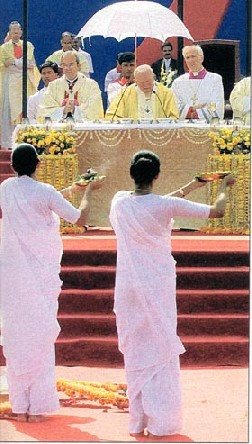 "To remember is to live," as the Spanish say, and what better day than today to remember the words of Archbishop Piero Marini, President of the Pontifical Committee for International Eucharistic Congresses and former Master of Pontifical Liturgical Ceremonies, in his famous 2006 interview to Italian website Affari Italiani. At the time, Marini was promoting his new book, "Liturgy and Beauty", in the Catholic University of the Sacred Heart in Milan (the famous "Cattolica"). We published this translation, with pictures*, on March 21, 2006.
...
Archbishop Marini, after the Council, the liturgical reform cost a schism, that of Archbishop Marcel Lefebvre. What do you make of it?
"After every Council, there has always been a period of tension. There is always someone who does not agree or who does not approve that which has been done. Well, the fact is that we do not have policemen to order the faithful to accept that which the Second Vatican Council has decided [laughter]."
And then?
"And then we must, first of all, understand that the liturgy is a sign of unity and that, as Pope Paul VI said: 'The Church is not that of the past or of the future, but of the present, for which we must accept the Church living today. That is not a question of liberalizing the Missal or something else, it is just a question of accepting the Church of today, period. To be clear, I refer to the history of the Tridentine rite".
Yes...
"The Tridentine rite or that of Saint Pius V, which in reality is the Missale Romanum aggiornato according to the last dispositions of 1962 by the work of John XXIII, was left in place under certain conditions to avoid a traumatic passage from the old rite to the new for the older faithful. Afterwards, pope Wojtyla allowed that, in certain churches, the rite of Saint Pius V could be celebrated. But to walk beyond this is to walk beyond the Church, and that cannot be done. If the liturgy is a sign of unity for the Church, I cannot establish groups of faithful who at a certain day and at a certain time pray in one way, then another group who in another time pray otherwise. And then we come to the Lefebvrists"
Yes, we come to them. What do you think of them?
"It must be clear once and for all: they must accept what the Second Vatican Council has decided, otherwise no reconciliation will be possible. And then, what do these people want? The majority of the faithful has adapted itself; without the new rite, which was not a child of the Curia but a work of international inspiration, the celebrations and foreign trips of pope Wojtyla would have been impossible to make. Now, because they cannot adapt, what is the difference? I wish to tell you a story"
Please...
"Some years ago, they came to greet me and I received them. One of them spoke and said: 'Your Excelency, the new rite is a heresy.' 'Why?,' I asked: 'because -- that Lefebvrist told me -- 'in the old rite the celebrant kneeled, worship the Host, lifted himself, showed it to the faithful and then kneeled again to worship it.' 'Ah -- said I -- and now?' 'And now this is a heresy because the celebrant only kneels after the ostension, in reality asking first for the consentment of the community before proceeding to the consecration.'"
And then what did you do?
"What did I do? Well, we simply wished to abolish a duplicate and he talks to me about heresy? 'Here, this is my phone number,' I told him, 'when you have a need, call me'."
In your words, while you presented the book, I felt a certain nostalgia for the past. [Nostalgia] for what?
"Yes, at times I feel so nostalgic. Because at the time in which the liturgical reform was effected I was only 23, for which I saw the last three months of the Council, but this is part of my feelings. However, in a historical point of view, we had at the time a distant objective, the complete reform of the liturgy, which we wished to accomplish. We have worked through the perspective of the renewal and of the return to the Church of the Holy Fathers, eliminating every crust of time from the Roman liturgy. However, the enthusiasm has had some degenerations..."
Of what kind?
"I think that in Belgium and in the Netherlands, on the wave of experimentalism, more than 300 eucharistic prayers were created, then it slowly returned to normality. But I fear this, the return of neoritualism, that is, of the priest who celebrates Mass thinking: 'Well, I have said my Mass following the rite by the book, I am done.' And that is not good, the celebration is not only a passive respect for the liturgical rules, there is always some space for the celebrant."Antonino D'Anna

 The current Chancellor of the Archdiocese of Genoa, Monsignor Guido Marini - who also is the Prefect of the ancient Cathedral of San Lorenzo and Archdiocesan Master of Ceremonies (Cerimoniere), as well as spiritual director of the Archdiocesan seminary and professor of Canon Law in several institutions -, has been named by several Italian journalists as the man who will replace Archbishop Piero Marini (no relation) as Master of Pontifical Liturgical Ceremonies.
 Earlier today, we remembered the Holy Father's plea to his flock: "Pray for me, that I may not flee for fear of the wolves."
...
Archbishop Marini, after the Council, the liturgical reform cost a schism, that of Archbishop Marcel Lefebvre. What do you make of it?
"After every Council, there has always been a period of tension. There is always someone who does not agree or who does not approve that which has been done. Well, the fact is that we do not have policemen to order the faithful to accept that which the Second Vatican Council has decided (laughter).*"
And then?
"And then we must, first of all, understand that the liturgy is a sign of unity** and that, as Pope Paul VI said: 'The Church is not that of the past or of the future, but of the present, for which we must accept the Church living today. That is not a question of liberalizing the Missal or something else, it is just a question of accepting the Church of today, period. To be clear, I refer to the history of the Tridentine rite".
Yes...
"The Tridentine rite or that of Saint Pius V, which in reality is the Missale Romanum aggiornato according to the last dispositions of 1962 by the work of John XXIII, was left in place under certain conditions to avoid a traumatic passage from the old rite to the new for the older faithful. Afterwards, pope Wojtyla allowed that, in certain churches, the rite of Saint Pius V could be celebrated. But to walk beyond this is to walk beyond the Church, and that cannot be done. If the liturgy is a sign of unity for the Church, I cannot establish groups of faithful who at a certain day and at a certain time pray in one way, then another group who in another time pray otherwise. And then we come to the Lefebvrists"
Yes, we come to them. What do you think of them?
"It must be clear once and for all: they must accept what the Second Vatican Council has decided, otherwise no reconciliation will be possible. And then, what do these people want? The majority of the faithful has adapted itself; without the new rite, which was not a child of the Curia but a work of international inspiration, the celebrations and foreign trips of pope Wojtyla would have been impossible to make. Now, because they cannot adapt, what is the difference? I wish to tell you a story"
Please...
"Some years ago, they came to greet me and I received them. One of them spoke and said: 'Your Excelency, the new rite is a heresy.' 'Why?,' I asked: 'because -- that Lefebvrist told me -- 'in the old rite the celebrant kneeled, worship the Host, lifted himself, showed it to the faithful and then kneeled again to worship it.' 'Ah -- said I -- and now?' 'And now this is a heresy because the celebrant only kneels after the ostension, in reality asking first for the consentment of the community before proceeding to the consecration.'"
And then what did you do?
"What did I do? Well, we simply wished to abolish a duplicate and he talks to me about heresy? 'Here, this is my phone number,' I told him, 'when you have a need, call me'."
In your words, while you presented the book, I felt a certain nostalgia for the past. What for?
"Yes, at times I feel so nostalgic. Because at the time in which the liturgical reform was effected I was only 23, for which I saw the last three months of the Council, but this is part of my feelings. However, in a historical point of view, we had at the time a distant objective, the complete reform of the liturgy, which we wished to accomplish. We have worked through the perspective of the renewal and of the return to the Church of the Holy Fathers, eliminating every crust of time from the Roman liturgy. However, the enthusiasm has had some degenerations..."
Of what kind?
"I think that in Belgium and in the Netherlands, on the wave of experimentalism, more than 300 eucharistic prayers were created, then it slowly returned to normality. But I fear this, the return of neoritualism, that is, of the priest who celebrates Mass thinking: 'Well, I have said my Mass following the rite by the book, I am done.' And that is not good, the celebration is not only a passive respect for the liturgical rules, there is always some space for the celebrant."
Antonino D'Anna


...
In the recent visit to Santa Maria di Leuca and Brindisi, the Pope has distributed communion to the kneeling faithful in the mouth. Is it a practice destined to become usual in papal celebrations?
I think so. Regarding it, it should not be forgotten that the distribution of communion in the hand still remains, from a juridical viewpoint, an indult from the universal law, granted by the Holy See to those Episcopal Conferences which have made a request for it. The mode adopted by Benedict XVI tends to underline the force of the norm valid for the entire Church. In addition, a preference could perhaps be seen for the use of this mode of distribution, which, without eliminating anything from the other, puts into light better the truth of the real presence in the Eucharist, aids the devotion of the faithful, introduces with greater ease the sense of mystery. Aspects which, in our age, pastorally speaking, it is urgent to underline and recover.
...
Still today the motu proprio Summorum Pontificum, on the use of the Roman Liturgy from before the reform effected in 1970, seems to give rise to contrasting interpretations. Celebrations presided by the Pope according to the extraordinary form, that is, the ancient one, are predictable?
It is a question which I do not know how to answer. Regarding the mentioned motu proprio, considering it with serene attention and without ideological views, together with the letter addressed by the Pope to the Bishops of the whole world to present it, a double precise understanding is brought forth. First of all, that of favoring the accomplishment of "a reconciliation in the interior of the Church"; and, in this sense, as it has been said, the motu proprio is a most beautiful act of love for the unity of the Church. In second place - and that is a datum not to be forgotten - its purpose is to favor a reciprocal enrichment between both forms of the Roman Rite: in such a way, for example, that in the celebrations according to the Missal of Paul VI (which is the ordinary form of the Roman Rite) "will be able to demonstrate more powerfully than has been the case hitherto, the sacrality which attracts many people to the former usage".
The new Prefect of the Doctrine of the Faith was named soon after the election of Pope Benedict XVI. Two and a half years have passed since April 2005, and several heads of dicasteries have been replaced: delicate positions such as that of Secretary of State, Prefect of Propaganda Fide, Prefect of Clergy... The head Bugninist in the Congregations (Domenico Sorrentino, former Secretary of the Congregation for Divine Worship) was replaced in November 2005... Even the motu proprio on the liberalization of the Traditional Mass, which many deemed impossible, has been published. Yet, Archbishop Piero Marini, Master of Pontifical Liturgical Ceremonies, has remained in his place.