Rorate Caeli

Place your all in Him who lacks nothing


You must guard your understanding from daydreams and thoughts of earthly things. You must completely free the inclination of your will from worldly cares and cling with all your being to the supreme true good with fervent love. You must keep your memory always lifted up and firmly anchored in that same true supreme good and only uncreated reality. In just this way your whole mind gathered up with all its powers and faculties in God, may become one spirit with him, in whom the supreme perfection of life is known to consist. This is the true union of spirit and love by which a man is made compliant to all the impulses of the supreme and eternal will, so that he becomes by grace what God is by nature.

At the same time it should be noted that in the very moment in which one is able, by God’s help, to overcome one’s own will, that is to cast away from oneself inordinate love or strong feeling, in other words so as to dare simply to trust God completely in all one’s needs, by this very fact one becomes so pleasing to God that his grace is imparted to one, and through that very grace one experiences that true love and devotion which drives out all uncertainty and fear and has full confidence in God. What is more, there can be no greater happiness than to place one’s all in him who lacks nothing.

So why do you still remain in yourself, where you cannot stay? Cast yourself, all of yourself, with confidence into God and he will sustain you, heal you and make you safe. If you dwell on these things faithfully within, they will do more to confer a happy life on you than all riches, pleasures and honors, and above all the wisdom and knowledge of this present deceitful world and its life, even if you were to excel in them all that ever lived.
Saint Albert the Great
De Adhaerendo Deo

The “Dark Ecumenism”

Episcopal Bishop moves to undermine Catholic teaching in the dark of night

The Southern Voice has reported that Episcopal Bishop Gene Robinson, the first openly “gay” bishop in the Episcopal Church and world Anglican Communion admitted to leading a clandestine retreat a few years ago for “gay” Roman Catholic priests at their invitation. The retreat which was held at an undisclosed location was attended by about 75 Catholic clergy from around the U.S. who participated without notifying their bishops or provincial leaders according to Robinson. Apparently Robinson used the occasion to torpedo the Church hierarchy. He was quoted as saying, “I had said to them, ‘It’s too dangerous for you to come out as gay to your superiors, but I believe that if you work for the ordination of women in your church, you will go a long way toward opening the door for the acceptance of gay priests.”

As the world Anglican Communion continues to collapse under the weight of the folly of relativism, let us pray for those of our priests who may be in danger of being lured from the Truth of Christ’s One Holy Church.


* Traditional Mass Can be Celebrated on Traditional Feast Days, Says Rome

Important news from our friends at The Latin Mass Society of England and Wales:
10 November 2008
Transferred Holydays of Obligation: an Important Clarification From the Pontifical Commission Ecclesia Dei
In April 2008, the Bishops’ Conference of England and Wales sought a ruling from the Pontifical Commission Ecclesia Dei aimed at harmonising the celebration of certain Holy Days of Obligation in the Extraordinary and Ordinary Forms of the Roman Rite. The bishops had, in the case of the Epiphany, the Ascension and Corpus Christi, transferred these to specific Sundays and in the case of all other Holy Days of Obligation that are kept in England and Wales, with the exception of Christmas, transferred them also to specific Sundays, whenever they fall on a Saturday or a Monday. They wished to ensure that these Holy Days were also kept on Sundays by those attached to the Extraordinary Form.
Consequently, the Bishops’ Conference submitted a dubium to Rome but declined to release the full text or of Ecclesia Dei’s reply. The LMS therefore submitted its own dubium to Rome in July and a reply, dated 20 October, has now been received.
The reply from the Ecclesia Dei Commission confirms that the Mass and Office of Holy Days can continue to be said on the days prescribed in the calendar for the Extraordinary Form and that the right to use this calendar is intrinsic to the right to use the Extraordinary Form.
The LMS’s letter requested confirmation that:
I. the legitimate use of the liturgical books in use in 1962 decreed by the Sovereign Pontiff in Summorum Pontificum includes the right to the use of the calendar intrinsic to those liturgical books.
II. That, whilst in accordance with Canon 1246 the Episcopal Conference with the approbation of the Holy See legitimately transfers Holydays of Obligation or suppresses the obligation of Holydays, it is legitimate to celebrate the Mass and Office of those feasts on the days prescribed in the calendar of the liturgical books in use in 1962 with the clear understanding that, in accordance with the legitimate decision of the Episcopal Conference, there is no obligation to attend Mass on those days.
III. That, in accordance with nn. 356-361 of the Rubricae generales Missalis romani of 1962, it is appropriate to celebrate the external solemnity of Holy Days on the Sunday to which they have been transferred by the Episcopal Conference as has been customary in many other countries hitherto.
Ecclesia Dei’s reply stated:
“1. The legitimate use of the liturgical books in use in 1962 includes the right to the use of the calendar intrinsic to those liturgical books.
2. While in accordance with Canon 1246 §2 of the Code of Canon Law the Episcopal Conference can legitimately transfer Holydays of obligation with the approbation of the Holy See, it is also legitimate to celebrate the Mass and Office of those feasts on the days prescribed in the calendar of the liturgical books in use in 1962 with the clear understanding that, in accordance with the legitimate decision of the Episcopal Conference, there is no obligation to attend Mass on those days.
3. Thus, in accordance with nn. 356-361 of the Rubricae Generales Missalis Romani of 1962, it is appropriate to celebrate the external solemnity of Holy Days on the Sunday to which they have been transferred by the Episcopal Conference, as has been customary in many other countries hitherto.”
Ecclesia Dei’s reply is signed by its Vice-President, Mgr Camille Perl.
As a consequence of the Ecclesia Dei ruling, the Latin Mass Society will continue to organise Masses on the days prescribed in the 1962 calendar for Holy Days but will also, where appropriate, organise feast day Masses as External Solemnities on the Sundays prescribed by the English and Welsh bishops so that obedience and communion are maintained whilst respecting the sensibilities of those who wish to celebrate the feasts on the traditional days.
Mr Julian Chadwick, Chairman of the LMS, said: ‘This ruling is very important. It confirms that the calendar for the Extraordinary Form is integral to the rite and cannot be suppressed or altered by bishops’ conferences. It also confirms the right of those attached to the Extraordinary Form to continue to celebrate the traditional feast days. Of course, when we organise Masses on the Sundays prescribed by the bishops to celebrate transferred Holy Days we will organise external solemnities of the Holy Days to fulfill the bishops’ requirement that feast days in both Forms of the Roman Rite be celebrated in common’.
____________________
Documents:

Letter to the President of the Pontifical Commission Ecclesia Dei from the Chairman of the Latin Mass Society
HE Darío Cardinal Castrillón Hoyos,
President, Pontifical Commission Ecclesia Dei,
Palazzo del Sant’ Uffizio 11,
00120 Vatican City State.
3 July 2008
Your Eminence,

Holydays of Obligation


The recent announcement by the Bishops of England and Wales that your dicastery has clarified to them “that in the Roman Rite, whichever Form of the liturgy is being celebrated, the Holydays of Obligation are held in common” has given rise to a good deal of confusion and some disquiet amongst our membership.
Whilst we most certainly wish to maintain and to manifest hierarchical communion with our bishops and through them our unity of faith with our brothers and sisters in the faith, there are a number of pastoral reasons - not the least the hope of reconciliation with those not in a regular relationship with the Church - that suggest that this question not be interpreted with a rigour that confuses or scandalises our weaker brethren.
It also seems that the statement of the Bishops of England and Wales does not sufficiently take into account the liturgical laws intrinsic to the liturgical books in use in 1962. Therefore, for the good of souls and the preservation of charity, on behalf of the Latin Mass Society of England and Wales, I request your authoritative clarification on the following points:
I. That the legitimate use of the liturgical books in use in 1962 decreed by the Sovereign Pontiff in Summorum Pontificum includes the right to the use of the calendar intrinsic to those liturgical books.
II. That, whilst in accordance with Canon 1246 the Episcopal Conference with the approbation of the Holy See legitimately transfers Holydays of Obligation or suppresses the obligation of Holydays, it is legitimate to celebrate the Mass and Office of those feasts on the days prescribed in the calendar of the liturgical books in use in 1962 with the clear understanding that, in accordance with the legitimate decision of the Episcopal Conference, there is no obligation to attend Mass on those days.
III. That, in accordance with nn. 356-361 of the Rubricae generales Missalis romani of 1962, it is appropriate to celebrate the external solemnity of Holy Days on the Sunday to which they have been transferred by the Episcopal Conference as has been customary in many other countries hitherto.

As the task of compiling the Ordo for 2009 is upon us, I would be most grateful for Your Eminence’s clarification of these questions as soon as is possible.
Your servant in Christ,
Julian Chadwick
Chairman
Latin Mass Society
____________________________________________________
Letter from the Vice-President of the Pontifical Commission Ecclesia Dei to the Chairman of the Latin Mass Society
PONTIFICIA COMMISSIO « ECCLESIA DEI »
N. 107/97
Rome, 20 October 2008
Dear Mr. Chadwick,
I wish to acknowledge receipt of your letter of 3 July 2008 in which you raise certain questions pertaining to Holydays of obligation.
In the first instance I wish to point out that the question of the liturgical calendar to be followed for the use of the liturgical books of the extraordinary form of the Roman Rite is one that will continue to be studied by this Pontifical Commission. Hence present responses should be understood without prejudice to any subsequent clarifications which may be eventually made by this Pontifical Commission.
With regard to your queries we may state that:
1. The legitimate use of the liturgical books in use in 1962 includes the right to the use of the calendar intrinsic to those liturgical books.
2. While in accordance with Canon 1246 §2 of the Code of Canon Law the Episcopal Conference can legitimately transfer Holydays of obligation with the approbation of the Holy See, it is also legitimate to celebrate the Mass and Office of those feasts on the days prescribed in the calendar of the liturgical books in use in 1962 with the clear understanding that, in accordance with the legitimate decision of the Episcopal Conference, there is no obligation to attend Mass on those days.
3. Thus, in accordance with nn. 356-361 of the Rubricae Generales Missalis Romani of 1962, it is appropriate to celebrate the external solemnity of Holy Days on the Sunday to which they have been transferred by the Episcopal Conference, as has been customary in many other countries hitherto.
With prayerful best wishes I remain,
Sincerely yours in Christ,
Rev. Msgr Camille Perl

Vice President

Editorial note: Pro-death from day one

The reversal of the "Mexico City Policy" will be among the first measures of the future President of the United States. This was fully expected, of course, and it will mean that American taxpayers' money will be used to fund abortions worldwide, as well as to promote abortion throughout the world, particularly in Catholic nations in Latin America.

It is true that the power of the President of the United States is actually more limited than it seems. Yet, while judicial appointments are complex decisions and involve individuals who are ultimately beyond the control of any politician, the reversal of the Mexico City Policy is a clear example of an act of raw presidential power.

Public funding will be restored. Taxpayers' revenue will be spent. Babies will be killed around the world with the help of funding provided by all American taxpayers. Elections do have consequences.

"Quia adulteratæ sunt,
et sanguis in manibus earum,
et cum idolis suis fornicatæ sunt:
insuper et filios suos quos genuerunt mihi,
obtulerunt eis ad devorandum.
" (Ezechiel xxiii, 37)

The inspiration of Pope Pius XII

All recognize in Pius XII an intelligence out of the ordinary, a memory of iron, a singular aptitude for foreign languages, and a notable sensibility. It has been said that he was an accomplished diplomat, an eminent jurist, a great theologian. This is all true, but it does not explain it all. There was also within him a continuous effort and a firm will to give himself to God, selflessly and with no concern for his own poor health.

The true motivation for his behavior was this: all originated out of love for his Lord Jesus Christ, an out of love for the Church and for mankind. He was in fact, above all, the priest in constant and intimate union with God, the priest who found the strength for his incalculable labor in long periods of prayer before the Most Holy Sacrament, in silent conversation with his Creator and Redeemer. Whence his Magisterium, as well as all his other activities, derive their source and impulse.
Benedict XVI
November 8, 2008

For the Record: the influence of the "Extraordinary Form"

This excerpt of Archbishop Burke's interview to Inside the Vatican has been posted elsewhere, but we post it here for our ongoing record on the influence of the Extraordinary Form on the Ordinary Form of the Roman Rite, an influence which Burke believes will take place in an actual reform of the Sacred Liturgy:

[Inside the Vatican:] You were also very supportive of groups in St Louis, wishing to make use of Summorum Pontificum. With the looser restrictions in the celebration of the Old Mass, is the movement for tradition likely to grow, and what effect is this likely to have on the liturgical reform?

[Burke:] Pope Benedict XVI has made clear his reasons for the promulgation of Summorum Pontificum, among which is the enrichment of the Ordinary Form of the Latin Rite through the celebration of the Extraordinary Form. Such enrichment will be natural, since the Ordinary Form developed organically from what is now the Extraordinary Form. The more that the faithful come to appreciate the Extraordinary Form, the more they will also come to understand the profound reality of every celebration of the Holy Mass, whether in the Extraordinary or Ordinary Form. If I understand the Holy Father correctly, with time, a further reform of the Sacred Liturgy may take place, which more fully draws upon the richness of the Extraordinary Form. The legislation given in Summorum Pontificum, I am convinced, will foster greatly the liturgical reform which was the goal of the Second Vatican Ecumenical Council.

IMPORTANT
Decree for the removal of excommunications on the Pope's desk?

From Spanish blog La Cigüeña de la Torre:

On the Holy Father's bureau stands a prepared decree which will lift that of excommunion, of 1988, which applied to the consecrating [Archbishop Marcel Lefebvre and Bishop Antonio de Castro Mayer] and consecrated bishops [Bishops Bernard Fellay, Bernard Tissier de Mallerais, Alfonso de Galarreta, and Richard Williamson]. I mean removing the decree, and not absolving of the excommunication.

The thesis of the subjective element, extenuating or mitigating of fault, and, therefore, of the penalty, according to Canons 1323, 4 and 7, and 1324, 1, 8, and 3, has prevailed.


The information sounds highly credible, it matches recent events (including the Rosary Crusade), and Spanish conservative Catholic lawyer Francisco José Fernández de la Cigoña usually only posts on future events (such as the nomination of Bishops) when he is truly certain of the matter. Nonetheless, even if the information is accurate, there is no way of knowing when the Holy Father will sign the document, or when it will be made public.

The referenced canons of the Code of Canon Law (CIC) are the following:

Can. 1323 The following are not subject to a penalty when they have violated a law or precept:
...
4/ a person who acted coerced by grave fear, even if only relatively grave, or due to necessity or grave inconvenience unless the act is intrinsically evil or tends to the harm of souls;
...
7/ a person who without negligence thought that one of the circumstances mentioned in nn. 4 or 5 was present.

Can. 1324 §1. The perpetrator of a violation is not exempt from a penalty, but the penalty established by law or precept must be tempered or a penance employed in its place if the delict was committed:
...
8/ by a person who thought in culpable error that one of the circumstances mentioned in can. 1323, nn. 4 or 5 was present;
...
§3. In the circumstances mentioned in §1, the accused is not bound by a latae sententiae penalty.

______________________
Thanks to a dear contributor.

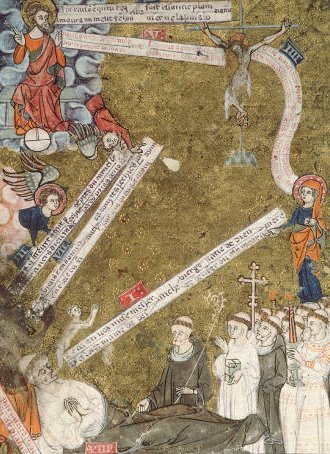
Blessed are those who die in the Lord


Nolite mirari, hoc, quia venit hora, in qua omnes, qui in monumentis sunt, audient vocem Filii Dei: et procedent, qui bona fecerunt, in resurrectionem vitæ; qui vero mala egerunt, in resurrectionem judicii. (From the Gospel for the first Mass for the Commemoration of All the Faithful Departed, transferred to the following Monday in 2008: John v, 28-29: "Wonder not at this, for the hour cometh wherein all that are in the grave shall hear the voice of the Son of God; and they that have done good things shall come forth unto the resurrection of life, but they that have done evil, unto the resurrection of judgment.")

In the ... book of Ecclesiasticus we read that God hears the prayer of the poor man, especially at the time when this man has to die, and that He punishes hearts that are without pity. "The Lord is judge, and there is not with Him respect of person; the Lord will not accept any person against a poor man; He will hear the prayer of him that is wronged . . . [and of] the widow.... The prayer of him that humbleth himself shall pierce the clouds, and he will not depart till the most High beholds."

This doctrine is verified particularly at the hour of death. God will be with him in that last hour. These high thoughts occur repeatedly in the Old Testament, and still more in the New, which sees clearly in the death of the just man the prelude of eternal life.

It was this writer's privilege to see the death of a just man, a poo
r man, Giuseppe d'Estengo, who lived with his family in the eighth story of a house near the Campo Santo in Rome.

He was gangrened in his four limbs, suffered much from the cold, especially when his nerves began to writhe before death. Nevertheless, he never complained. He offered all his sufferings to the Lord for the salvation of his soul, for his own people, for the conversion of sinners. Then he was struck by rapid consumption, and had to be carried to the other extremity of Rome, to the hospital of the Littorio, where three weeks later he died, in a perfect state of abandonment to God in the middle of the night.

At the precise instant when he died, his elderly father, a very good Christian, who was at the other extremity of the city, heard the voice of his son saying: "Father, I am going to heaven." And his excellent mother dreamed that her son mounted up to heaven with healed hands and feet, just as he will be in fact after the resurrection of the dead.

I count it one of the great graces of my life that I knew this poor man, who was pointed out to me by a Vincentian helper who said: "You will be happy to know him." She spoke truly. He was a friend of God. His death confirmed this. Blessed are they who die in the Lord. He was one of those "who taste death" as the prelude of eternal life.
Réginald Garrigou-Lagrange
L’éternelle vie et la profondeur de l’âme

A new altar for the Cathedra of Saint Peter?

A new altar, with a traditional format, has been photographed in the place of the anvil-like iron structure which had been used as an altar under the Cathedra of Saint Peter, in Saint Peter's Basilica, since the time of the destruction of the Traditional altar (cf. our post "Liturgical Renewal at Saint Peter's: How does an altar disappear?").

The new altar is still a freestanding structure, but it is an improvement. However, when will the Traditional altar be put back in its place? Its destruction remains one of the most symbolic acts of the entire "liturgical renewal" and is a stain in the record of the Wojtyla pontificate.


SSPX: pilgrimage and a new Crusade of the Rosary


Pictures of the Solemn Mass, of the public recitation of the Holy Rosary, and of the Adoration of the Most Holy Sacrament, as the Sanctuary of Lourdes once again opens its doors and buildings to the Priestly Fraternity of Saint Pius X (FSSPX / SSPX) during the weekend of Christ the King. The four bishops of the SSPX, who were consecrated by Archbishop Marcel Lefebvre in 1988, were present in the pilgrimage.

Regarding developments in the ongoing conversation between the leadership of the Fraternity and Cardinal Castrillón Hoyos, President of the Pontifical Commission "Ecclesia Dei", the SSPX will start this Saturday a "Crusade of the Rosary" to "obtain from Our Lady the removal of the Decree of Excommunication", a "crusade" which will last from November 1 to Christmas Day.

This is a most auspicious development, considering that the last time a Crusade of the Rosary was proposed by the SSPX (in July 2006), its main intention was to "obtain from Heaven for Pope Benedict XVI the strength required to completely free up the Mass of all time, called the Tridentine Mass". All eyes to Heaven, and to Rome, in the next few months.

My kingdom is not of this world


Dixit Pilatus ad Iesum: "Tu es rex Iudæorum?" Respondit Iesus: "A temetipso hoc dicis, an alii dixerunt tibi de me?" Respondit Pilatus: "Numquid ego Iudæus sum? Gens tua et pontifices tradiderunt te mihi: quid fecisti?" Respondit Iesus: "Regnum meum non est de hoc mundo. Si ex hoc mundo esset regnum meum, ministri mei utique decertarent ut non traderer Iudæis: nunc autem regnum meum non est hinc."
(From the Gospel for the Feast of Our Lord Jesus Christ the King, John xviii, 33-36: " Pilate said to Jesus: Art Thou the King of the Jews? Jesus answered: Sayest thou this thing of thyself, or have others told it thee of Me? Pilate answered: Am I a Jew? Thine own nation and the chief priests have delivered Thee up to me: what hast Thou done? Jesus answered: My kingdom is not of this world. If My kingdom were of this world, my servants would certainly strive that I should not be delivered to the Jews: by now my Kingdom is not from hence.")

_____________________________________________________
Hear then, ye Jews and Gentiles! Hear, O circumcision! Hear, O uncircumcision! Hear, all ye kingdoms of the earth: I interfere not with your government in this world, "My kingdom is not of this world."

Cherish ye not the utterly vain terror that threw Herod the Elder into consternation when the birth of Christ was announced, and led him to the murder of so many infants in the hope of including Christ in the fatal number, made more cruel by his fear than by his anger: "My kingdom," He said, "is not of this world."

What would you more? Come to the kingdom that is not of this world! Come, believing, and fall not into the madness of anger through fear!

He says, indeed, prophetically, of God the Father, "Yet have I been appointed king by Him upon His holy hill of Zion;" but that hill of Zion is not of this world. For what is His kingdom, save those who believe in Him, to whom He says, "Ye are not of the world, even as I am not of the world"? And yet He wished them to be in the world: on that very account saying of them to the Father, "I pray not that Thou shouldest take them out of the world, but that Thou shouldest keep them from the evil." Hence also He says not here, "My kingdom is not" in this world; but, "is not of this world." And when He proved this by saying, "If my kingdom were of this world, then would my servants fight, that I should not be delivered to the Jews," He saith not, "But now is my kingdom not" here, but, "is not from hence."

For His kingdom is here until the end of the world [hic est enim regnum eius usque in finem sæculi...], having tares intermingled therewith until the harvest; for the harvest is the end of the world, when the reapers, that is to say, the angels, shall come and gather out of His kingdom everything that offendeth; which certainly would not be done, were it not that His kingdom is here! [...quod utique non fieret, si regnum eius non esset hic.]

But still it is not from hence; for it only sojourns as a stranger in the world: because He says to His kingdom, "Ye are not of the world, but I have chosen you out of the world." They were therefore of the world, so long as they were not His kingdom, but belonged to the prince of this world.

Of the world therefore are all mankind, created indeed by the true God, but generated from Adam as a vitiated and condemned stock; and there are made into a kingdom no longer of the world, all from thence that have been regenerated in Christ. For so did God rescue us from the power of darkness, and translate us into the kingdom of the Son of His love: and of this kingdom it is that He saith, "My kingdom is not of this world;" or, "My kingdom is not from hence."
Saint Augustine
In Evangelium Ioannis - Tractatus CXV


____________________________
  • Recess continues for a few days.
  • News: Proposition 17 of the Synod of Bishops: "It is wished that the ministry of the lectorate be opened also to women, so that their role of announcers of the Word may also be recognized in the Christian Community." (Original text in Italian.)
  • Other relevant news may be posted at any moment.

New age for episcopal resignation?

Our friends at Spanish-language blog La Buhardilla de Jerónimo notice the increasing buzz in the Italian press (including La Repubblica - external reference) regarding an imminent measure by Pope Benedict XVI, which could be released before the end of the year, and which would alter the pertinent canons and extend by three years (to 78) the age in which bishops would be required to present their resignations to the Pope. The measure would apparently not apply to prelates in Vatican dicasteries.

War is Peace - Freedom is Slavery - Ignorance is Strength


The great Vatican controversy in the last few days of the Synod of Bishops on Holy Scripture is linked to a text written months ago for an introduction to a new edition of the Pope's book "Jesus of Nazareth". The matter is linked, though, to the deepest discussions in the Synod.

Italian daily "Il Resto del Carlino" explains:

A banal "adjective" is agitating the secret Vatican offices. It is an adjective used by the lord of the manor (the Pope) and by his, let us say thus, "minister for Culture", Gianfranco Ravasi. The little word of contention is: "reale" [real].

You might ask: but is it possible that five little words (r-e-a-l-e) are capable of putting the Church in turmoil? Yes, in the sense that ths adjective was used with opposite meanings by Benedict XVI and by the president of the Pontifical Council for Culture. And if it is taken into consideration that this "real" is linked to a certain gentleman called Jesus Christ, you will understand well how the controversy may grow in tone.

The reason for the contention is the [new] illustrated edition of the book of Benedict XVI on Jesus of Nazareth, released in the past few days. The Pope wrote: "I have made the effort to present the Jesus of the Gospels and a real Jesus, as the historical Jesus in the true and proper sense." And also: "I consider that this Jesus, the one of the Gospels, is a historically sensible and convincing figure."

Ravasi signed the introduction to this volume, and, in a certain point, mentioned Benedict's words. This way: "It is to be noted that this adjective 'real' is not automatically synonymous with historical, because we know well that so many events are not recorded, or historically documentable and verifiable, yet nevertheless are deeply real."

In short: to the Pope, "real" is synonymous with "historical", for his minister for culture, it is not.

Naturally, all proper justifications will be made, in an effort to deny the obvious contradiction and to please the reigning Pontiff. But this is not surprising coming from Ravasi.

___________________
Transcript and tip: Papa Ratzinger Blog.
Recess for a few days.

The Crucified Christ


For the Apostle, the Resurrection is not an event which stands by itself, separated from death: the Risen one is always the one who was, first, crucified. Even Risen, he bears his wounds: the Passion is present in Him, and it may be said with Pascal that He is suffering even unto the end of the world, even though he is the Risen one, and lives with us, and for us.

Paul had understood this identity of the Risen one with the Crucified Christ in the encounter on the Road to Damascus: in that moment, it was clearly revealed to him that the Crucified is the Risen one, and that the Risen one is the Crucified, who asks Paul, “Why do you persecute me?” (Acts ix, 4). Paul is persecuting Christ in the Church, and now understands that the Cross is a “curse from God” (Deuteronomy xxi, 23), but a sacrifice for our Redemption.
Benedict XVI
General Audience
October 22, 2008

To Honor the King of Kings

The Faithful venerate relics of St. John Cantius and Blessed Karl of Austria

For the closing of their annual Forty Hours Devotion, the people of St. John Cantius parish in Chicago were graced with the presence of Her Imperial and Royal Highness, Maria Anna, Princess of Galitzine, granddaughter of Blessed Karl of Austria, and her husband Prince Piotr D. Galitzine along with members of the Royal Family. The Royal Family was in assistance at the 12:30 Solemn High Mass which was celebrated by parish pastor Rev. C. Frank Phillips C.R. The Mass was that of the feast of St. John Cantius (October 20). Franz Schubert’s Mass in G was sung by the Resurrection Choir and Orchestra and propers were chanted by the Schola Cantorum of St. Gregory the Great. Relics of St. John Cantius and of Blessed Karl were exposed for public veneration on the church’s Lady Altar. Vespers at 4:00 were the First Vespers of the Solemnity of St. John Cantius, Confessor and included a procession. Mozart's Vesperae de Confessore was sung by the Sine Nomine Choir and Orchestra. The great care with which the traditional liturgy and sacred music were treated is a hallmark of the priests and people St. John Cantius and was a befitting tribute to their Royal visitors who came to pay homage to their beatified predecessor whose feast day is October 21.

See more photos at the SJC website

Alternatives to "Ite, missa est" approved by Rome

From Zenit:

Mass Could End With More Than "Go in Peace"
Holy See Approves 3 Alternative Closing Messages

VATICAN CITY, OCT. 14, 2008 (Zenit.org).- The Holy See has approved three alternatives to "Ite, missa est," the final words said by the priest at Mass.Cardinal Francis Arinze, prefect of the Congregation for Divine Worship and the Sacraments, today notified the participants in the synod of bishops on the word of God about the new alternatives. The final message is currently rendered in English: "The Mass is ended, go in peace."

Benedict XVI has approved the alternatives, which were requested at the 2005 synod on the Eucharist to express the missionary spirit that should follow from the celebration of Mass.

According to Cardinal Arinze, the Pope had asked for suggestions to be presented. The congregation received 72, from which they prepared nine proposals. The Holy Father has chosen three.

The alternatives are in the revised third "editio typica" of the Roman Missal, which was printed last week, the cardinal said.

The alternatives are:

--"Ite ad Evangelium Domini nuntiandum"
--"Ite in pace, glorificando vita vestra Dominum"
--"Ite in pace" with "alleluia, alleluia" added during Easter season.
In English, these could be rendered along the lines of "go to announce the Gospel of the Lord"; "go in peace, glorifying the Lord with your lives"; and simply, "go in peace (alleluia, alleluia)."

The original Latin final message, "Ite, missa est," has not been modified.

Eucharistic compendium

Cardinal Arinze also announced that a Eucharistic compendium, also suggested by the '05 synod on the Eucharist, is nearly finished.

The book will define Eucharistic doctrine, benediction, Eucharistic holy hours, adoration, and prayers before and after Mass, he explained.

The cardinal further said that the Holy See, at the request of the Pope and the 2005 synod, is studying the most adequate moment during the Mass for the sign of peace.

The Holy Father indicated that episcopal conferences should consider two options: either before the "Agnus Dei" or after the Prayers of the Faithful. Each bishops' conference is to respond by the end of October, though there is a three-week grace period for late responses. The proposals will then be presented to the Holy Father, who will make a decision on the matter.

Finally, Cardinal Arinze announced that his congregation is preparing a volume with thematic materials for homily, with the aim of assisting and supporting priests throughout the world with their preaching.

Summorum Pontificum clarification document

We acknowledge the ongoing rumor about a possible publication of the clarification document of the motu proprio Summorum Pontificum in January 2009. Gregor Kollmorgen, of The New Liturgical Movement, offers a translation of the text published in the Italian religious news website Pontifex (Bruno Volpe):

The Instruction on the Motu Proprio Summorum Pontificum of 7 July 2007 which liberalized Holy Mass according to the ancient Roman rite, has been ready for some time already and is now being examined by Pope Benedict XVI. This Pontifex has learned from authoritative sources. The text, signed by Cardinal Darío Castrillón Hoyos, President of the Pontifical Commission Ecclesia Dei, will be signed most likely by the Pope in late December and published in the first days of January 2009. In its most important parts the document, which had become indispensable after the many problems in the application of the Motu Proprio and forms of outright recalcitrance on the part of not a few bishops (incidentally appropriately denounced in September by the Vice President of the Commission Ecclesia Dei, Monsignor Camille Perl), addresses two crucial topics: the interpretation of the term "stable group of faithful" within an ordinary parish and the problem of personal parishes. It was even considered to list and to indicate a minimum number of faithful, but this solution has been discarded.

According to the document, the traditionalist faithful present in a parish will have the full protection of the law to ask for the old Mass, and if the bishop refuses (here is the news), saying that there are no priests capable of celebrating according to the ancient rite in that place, the Commission Ecclesia Dei will authoritatively ("di imperio") send a priest able to do so to that diocese. In short, the bishops will no longer be able to refuse a priori to have the old Mass celebrated, because in such cases, the Commission Ecclesia Dei will send a delegated priest of its own.

The document then analyzes the case of personal parishes in which the traditionalists want to celebrate the Christmas Mass or the Easter Triduum according to the ancient rite, also in cases of an absence of priests, or a prohibition by the bishop. The possibility of a shortage of priests could be envisaged, and also in this case, Ecclesia Dei will take care. The Holy See, therefore, wants to establish definitive clarity regarding the application of the Motu Proprio, and for this reason also the powers and prerogatives of the Pontifical Commission Ecclesia Dei will be better defined and strengthened.

We also recall that several rumors indicated that this instruction should have been published in January 2008(!) - so take all rumors with a grain of salt. The only certainties are that the document exists, and that it awaits the final signature of the Holy Father.

[Tip: La Buhardilla]

A new book on the Benedictine Reform

Two great names come together to present to a wider audience the Benedictine liturgical reform. Father Nicola Bux is the author of La Riforma di Benedetto XVI - La Liturgia tra Innovazione e Tradizione (The Reform of Benedict XVI - Liturgy between Innovation and Tradition) - the book is published by Piemme, and the preface is written by the most famous religious journalist in the world, Vittorio Messori.

The reform of Benedict XVI
(by Nicola Bux)

[Presentation of the publisher:]

When, in July 2007, the motu proprio of Benedict XVI restored the celebration of the Latin Mass, loud voices of protest rose from several places.

The widespread fear was - and is - that Pope Ratzinger had at last thrown away his mask, revealing that reactionary defender of Tradition that many accused him of being since the days in which he was Prefect of the Congregation for the Doctrine of the Faith, that is, the former Holy Office. Benedict XVI replied by showing how the recovery of the Latin Rite was not a "step backwards", a return to days prior to the Second Vatican Council, but rather forward-looking, retaining from past Tradition all that it may offer of what is most beautiful and significant to the current life of the Church.

What Pope Ratzinger wishes to do in his patient work of reform is to renew the life of the Christian faithful - the gestures, the words, the time of everyday- restoring to the liturgy a wise balance between innovation and Tradition. Thus arises the image of Church always on her path, capable of reflecting upon itself and to value the riches of which its millennial treasury is full.


Update (October 12): With a review of Father Bux's book, Vaticanist Andrea Tornielli also reports on the probable indication of Cardinal Cañizares, of Toledo, as new Prefect of Divine Worship, before Christmas or early next January - and a possible indication, several months afterwards, of Archbishop Ranjith (current secretary of Divine Worship) as the new Archbishop of Colombo, Sri Lanka. [We reported on this matter last April.]

Announcements

Readers send us the following notes.

1. From England (Oxfordshire):
Masses for the quarter are now confirmed ... .

Please note the celebration of All Saints on Sat 1st November and All Souls (Sung) on Mon 3rd, both at 12.15 in the Oxford Oratory.

I'd particularly draw attention to the three special events:

Sat 25th October, the LMS Pilgrimage to Oxford: Solemn High Mass at 11 in Blackfriars, Procession at 2pm with the unveiling of a plaque, and Benediction at 3.30 back in Blackfriars. All in honour of the four beatified martyrs of 1589. Bishop Kenny, an auxiliary of the Archdiocese, will preach at the Mass and unveil the plaque. Please support this important event.

Mon 17th Nov: Sung Requiem for 450th Anniversary of Cardinal Pole, 7pm in Magdalen College chapel, followed by a drinks reception.

Fri 5th December: Solemn High Mass in St Birinus, Dorchester, for the patronal feast of this church, at 7pm.

As always we are eager to increase the pool of singers and servers so please get in touch with me if you are interested.
At the invitation of Bishop Moriarty and in response to Pope Benedict's Apostolic Letter Summorum Pontificum, priests from the Priestly Fraternity of St. Peter will celebrate a Latin Mass for the faithful of the Diocese attached to the older ("extraordinary") form of the Roman Rite (liturgical books of 1962). This Mass will be celebrated on the 2nd Sunday of every month in Cill Mhuire Church, Newbridge, Co. Kildare, beginning on Sunday, 12th October, at 1.00 p.m.

From St. Conleth's Parish Newsletter for Sunday, 5th October, 2008.

We acknowledge the ongoing rumor regarding a possible appointment of Archbishop M. Ranjith, the current Secretary of the Congregation for Divine Worship and the Discipline of the Sacraments, to a major diocese in his native Sri Lanka. Nonetheless, we also notice that it is an ancient and recurring rumor - we first reported it last April ("Motu Proprio wars in the Roman Curia: Ranjith off to Sri Lanka?").

Christ, the one true certainty


"He who heareth my word, and believeth ...hath life everlasting." (John, 5, 24) This affirmation by Jesus, which we heard in the Gospel, makes us think of the hardest moments of the pontificate of Pius XII, when, perceiving the collapse of every human certainty, he strongly felt the need, even through a constant ascetic effort, to adhere to Christ, the only certainty that never passes.

The Word of God became thus a light in his path, a path on which Pope Pacelli consoled the downtrodden and the persecuted, on which he dad to wipe away the tears of pain and weep for the countless victims of the war. Only Christ is the true hope of man; only trusting in Him is the human heart able to open itself to the love which conquers hate.

I have fought a good fight,
I have finished my course,
I have kept the Faith.

We, as a newly ordained priest, then just empowered to recite "Introibo ad altare Dei" (Psalm xiii. 4), hailed the Encyclical Annum Sacrum [on the consecration of the world to the Sacred Heart] with genuine approval, enthusiasm and delight as a message from heaven. ... It is only natural, then, that We should today feel profoundly grateful to Providence for having designed that the first year of Our Pontificate should be associated with a memory so precious and so dear of Our first year of priesthood, and that We should take the opportunity of paying homage to the King of kings and Lord of lords (I Timothy vi. 15; Apocalypse xix. 6) as a kind of Introit prayer to Our Pontificate, in the spirit of Our renowned predecessor and in the faithful accomplishment of his designs, and that, in fine, We should make of it the alpha and omega of Our aims, of Our hopes, of Our teaching, of Our activity, of Our patience and of Our sufferings, by consecrating them all to the spread of the Kingdom of Christ. ...
As Vicar of Him Who in a decisive hour pronounced before the highest earthly authority of that day, the great words: "For this was I born, and for this came I into the world; that I should give testimony to the truth. Every one that is of the truth, hearest My voice" (Saint John xviii. 37), We feel We owe no greater debt to Our office and to Our time than to testify to the truth with Apostolic firmness: "to give testimony to the truth." This duty necessarily entails the exposition and confutation of errors and human faults; for these must be made known before it is possible to tend and to heal them. "You shall know the truth and the truth shall make you free" (Saint John viii. 32).

In the fulfillment of this, Our duty, we shall not let Ourselves be influenced by earthly considerations nor be held back by mistrust or opposition, by rebuffs or lack of appreciation of Our words, nor yet by fear of misconceptions and misinterpretations. We shall fulfill Our duty, animated ever with that paternal charity which, while it suffers from the evils which afflict Our children, at the same time points out to them the remedy; We shall strive to imitate the Divine Model of shepherds, Jesus, the Good Shepherd, Who is light as well as love: "Doing the truth in charity" (Ephesians iv. 15).

Pius XII
Summi Pontificatus (1939)
______________________

Pius XII kept his promise, doing the Truth in Charity.

The Word of God and Unbelief of Jews

“But the testimony which I have is greater than that of John, for the works which the Father has granted me to accomplish, these very works which I am doing, bear me witness that the Father has sent me. . . . . You search the scriptures, because you think that in them you have eternal life, and it is they that bear witness to me; yet you refuse to come to me that you may have life. . . . . If you believed Moses, you would believe me, for he wrote of me.” Gospel of John, Chapter 5.

“And he expounded the matter to them from morning till evening, testifying to the kingdom of God and trying to convince them about Jesus both from the law of Moses and from the prophets. And some were convinced by what he said, while others disbelieved. So, as they disagreed among themselves, they departed, after Paul had made one statement: ‘The Holy Spirit was right in saying to your fathers through Isaiah the prophet: “Go to this people, and say, You shall indeed hear but never understand, and you shall indeed see but never perceive. For this people’s heart has grown dull, and their ears are heavy of hearing, and their eyes have closed . . .”’ Acts of the Apostles, Chapter 28.

“It [the Passion] is a grave and sad page which evokes the clash between Jesus and the Jewish people. This people predestined for receiving the Messiah, which was awaiting him for thousands of years and was entirely absorbed by this hope and certitude; at the crucial moment, that is when Christ comes, speaks and manifests himself, not only does not recognize him, but combats him, slanders him and finally will kill him.” Pope Paul VI, Homily, Passion Sunday, April 4, 1965, in Osservatore Romano, April 7, 1965, and in Documentation catholique 1448, May 16, 1965, columns 887-888.

“Let us pray for the unfaithful Jews, that our God and Lord will remove the veil from their hearts, that they themselves may acknowledge Jesus Christ, our Lord. Almighty and everlasting God, who does not reject even the unfaithfulness of the Jews from your mercy, hear our prayers which we bring on account of the blindness of that people, so that, having acknowledged the light of your truth which is Christ, they may be rescued from their darkness.” Translated from the Roman Missal for the liturgy of Good Friday as approved by Pope Pius XII and the immemorial custom of the Church.

Notes


"As you know, the absolute innovation of this Synod [of Bishops] is the presence of a rabbi, who yesterday afternoon spoke in congregation: it is the Chief Rabbi of Haifa, Shear-Yashuv Cohen. The latter, in an intervention dedicated to the interpretation of Scripture according to the Jewish faith, attacked Iranian president Ahmadinejad. And, in the evening, interviewed by Phil Pullella, a Vaticanist for Reuters, said that the Church should not beatify Pius XII and that, had he known that Benedict XVI was about to celebrate the fiftieth anniversary of the death of Pope Pacelli (with the Mass he will celebrate tomorrow at Saint Peter's), he would not even have come to the Synod. Apart from the fact that the date of the death of Pius XII is not exactly a Mossad secret, being found in every encyclopedia, apart from the fact that the fiftieth [anniversary] represents an important date, I find completely out of place that a Jewish exponent, invited to speak to the Catholic bishops, makes use of it to embarrass the Pope, most of all based on black legends."


2. The Institute of Christ the King Sovereign Priest (ICRSS) is no longer a mere diocesan institute, but has been recognized by Pope Benedict XVI as a Society of Apostolic Life of Pontifical Right.

With deepest gratitude to the Blessed Trinity, to Christ Our King, and His Immaculate Mother, to St. Joseph, to St. Michael the Archangel, to our patron saints, to the entire court of heaven, and with filial thankfulness to our Holy Father Pope Benedict XVI and his faithful collaborators, we have the joy to announce a very important event:

His Holiness Pope Benedict XVI

On the feast day of Our Lady, Queen of the Holy Rosary, the Vice-President of the Commission Ecclesia Dei, Very Reverend Monsignor Camille Perl, has read in our Seminary chapel the official decree by which, in the name of the Holy Father, the Institute of Christ the King Sovereign Priest was erected to the status of a Society of Apostolic Life of Pontifical Right. Also our Sisters Adorers of the Royal Heart of Jesus received the status of Pontifical Right. The Decree was signed by His Eminence Dario Cardinal Castrillon Hoyos. A Solemn Te Deum followed the reading of the Decree.

Born out of a profound union with the Holy Father in Rome and the Institute's founder and members having always lived in a continuous and unwavering spirit of faithful Romanitas, the Institute was granted the Pontifical Right after the formal time of experience and interrogation which is a traditional custom for the Holy See. Various positive Apostolic Visitations conducted by the Roman Curia and a very favorable consultation of all the Most Reverend Bishops in whose Dioceses we are invited to serve have finalized this canonical process.

After this affirmative evaluation of our spirituality and our international presence and work, the Pontifical Right is an expression of the appreciation of the service of the Institute of Christ the King by the Roman Pontiff and his collaborators to whom we are deeply obliged. The Pontifical Right will make it even easier for the Institute to conduct its service for the Church according to its constitutions and gives to Monsignor the Prior General rights and duties that are in unison with our canonical lifestyle.

BENEDICTO XVI SUMMO PONTIFICI PAX, VITA ET SALUS PERPETUA!
_________________
Tip: Saint Louis Catholic

The Word of God, the foundation that remains forever


The word of God is the foundation of everything, it is true reality. And in order to be realists, we must count on this reality. We must change our ideas that the material, solid things, that which can be touched, is the more solid and more secure reality.

At the end of the Sermon on the Mount, the Lord speaks to us of two possibilities for building the house of one's life: on the sand, or on the rock. Those who build on the sand to build upon the visible and tangible things, on success, on career, on money. Apparently, these are the true realities. But all of this will pass away one day. We see this today in the collapse of the major banks: this money is disappearing, it is nothing.

And like all of these things, which seem to be the true reality on which to rely, our realities of a second order. Those who build their lives on these realities, on the material, on success, on all that which is visible, build on the sand. Only the word of God is the foundation of all reality, enduring like the sky, and even more than the sky, is reality. We must therefore change our concept of realism.

The realist is the one who recognizes in the Word of God, in this apparently feeble reality, the foundation of everything. The realist is the one who builds his life on this foundation that remains forever.

Pope Benedict at Saint Paul's Without-the-Walls

On Sunday morning, 5th October Pope Benedict celebrated the opening Mass for the XIIth General Ordinary Assembly of the Synod of Bishops. The Mass was offered in the Basilica of Saint Paul's Without-the-Walls.

This post is a continuation of two previous posts on Rorate Caeli about the form of the 16th century chasuble. Please re-read these posts here and here.

On the occasion of the Opening Mass, Pope Benedict wore a green chasuble almost identical in shape and dimensions with the famous statue of Saint Philip Neri by the sculptor Algardi. A digitally-enhanced photograph of that statue is adjacent.


This green Papal chasuble conforms very closely with the dimensions set down by Saint Charles Borromeo at the end of the 16th century governing the size of the chasuble. Note that this chasuble differs significantly in its length and shape from another style of chasuble from the 16th century, which is sometimes referred to as the "Philip Neri" style. A purple and a red chasuble in this "Philip Neri" style were made for the use of Pope Benedict earlier this year (see adjacent photographs).


Photographs of the green chasuble at the beginning of this post from the Papa Ratzinger Forum: with thanks. Click on each of the images below for an enlarged view.

Defending the readings in the Traditional Mass


As the Synod on Holy Scripture is opened by Pope Benedict XVI in the Basilica of Saint Paul Outside the Walls, a good article on the forms of the Roman Rite and the Scripture readings.

WORDS OF DOCTRINE
Two theories born of Biblicism
Fr. Nicola Bux and Fr. Salvatore Vitiello

Some say that the post-Conciliar Mass is richer in Readings and Eucharistic Prayers, while the Missal said of Pius V would be poorer and less accurate. The theory is anachronistic since it fails to consider four centuries of distance; it is as if we were to say the same about "Sacramentaries" some centuries earlier than that of Pius V. What is more, it is forgotten that the pericopes of the Pius V Missal were formed on the basis of old capitularies with epistles, such as St Jerome's Liber comitis– dated 471 - or with Gospel pericopes ; a tradition in common with the Church of the East, as the Byzantine liturgy still shows today.

Secondly, the brief readings help memorize the essential and express the sobriety of the Roman Rite. Some even go as far as to say that the Extraordinary Form of the only Latin Rite gives too little emphasis to the presence of Christ in the Word, when the latter is proclaimed in the assembly; in this cas,e the liturgy loses its very essence, the 'two tables' - in Dei Verbum, n. 21, there would appear to be only “one” - forming one act of worship!

It is said that the Missal of the Council of Trent moves in a vision far from the tradition of the Church Fathers; that the Missal was planned for the priest only, not for the participation of the assembly because the congregation is merely irrelevant. In fact, it is said that the priest celebrates on his own and so does the congregation; they say the Mass of Paul VI is quite different because it is not the priest who celebrates but the Church, sacramentally present in the assembly, of which the priest, by reason of order, is the natural president.

This position is considerably problematic because it reduces everything to Word and Assembly. However “Jesus is not just the teacher, but also the redeemer of the whole person. The Jesus who teaches is, at the same time, the One who saves ” (J.Ratzinger-Benedict XVI, Gesù di Nazaret, p. 65) and this comes about effectively only through the Eucharistic Sacrament.

Another theory, widespread due to the customary phenomenon of substitution and exchanging one thing with another, is to equal the presence of Jesus Christ in the Blessed Sacrament with the presence of the Word in the Book of the Scriptures: the latter presence takes place only “when the Holy Scriptures are read in the Church” (Sacrosanctum Concilium n. 7). It is necessary to reaffirm that Christ's presence in the Word exists on two conditions: when it is read out “in the Church assembly ”, not privately, and when Sacred Scripture is 'read'. Therefore the holy book placed on the lectern or the altar is not sufficient for this presence.

To conclude, it is more than ever urgent for preaching and catechesis to return to making the proper distinction between Revelation, Word of God and Sacred Scripture which, although closely connected, are not equivalent. At times in fact, not without surprise, we see in this regard considerable confusion and not only among the lay faithful. Some even think that the Bible is to be interpreted with the Bible and not, as the Catholic Church has always held, with Tradition and by faithful listening to the Magisterium.

_________________________
FIDES translation, adapted according to the Italian original.

Note: Back from recess, we acknowledge the e-mail messages referring us to the new website of the Pontifical Commission "Ecclesia Dei", first acknowledged by the Spanish Traditional Catholic blog "Hoc Signo". Unfortunately, the website is still very much incomplete, but it may hopefully be a work in progress.

LMS announcement

Announcement of the Latin Mass Society of England and Wales:


Last Chance to Register for Confirmations:

Now is your last chance to register for Confirmations in the Traditional Latin Rite at St James’ Church, Spanish Place, London W1 on Saturday 15th November at 11.30 am with Bishop George Stack.

Confirmations will be followed by Benediction of the Blessed Sacrament.

If you are thinking of Confirmation for your child/ren this year, you need to register their details urgently with the Latin Mass Society. Please telephone or email to request a registration form and return it no later than 31 Oct 2008 to the LMS office.

Tel: 020 7404
7284.
Email:
thelatinmasssociety@snmail.co.uk

Recess continues for three days.

Ecce ego mittam Angelum meum qui præcedat te


"Angelis suis Deus mandavit de te, ut custodiant te in omnibus viis tuis." (From the Gradual for the Feast of the Holy Guardian Angels, Psalm xc, 11: "God hath given His angels charge over thee, to keep thee in all thy ways.")

Saint Bernard says there are three ways by which we ought to honor our guardian angels: "by reverence, by devotion, and by confidence."

By reverence, because these holy spirits and princes of heaven are always present with us, and assist us in all our actions. And on this account, out of regard to our guardian angels, we ought carefully to refrain from every action which can displease them. Saint Frances of Rome, widow, saw that the angel who attended her in a human form, every time that he observed any improper action or word in any one in conversation, covered his face with his hands.

[Prayer:] O my holy guardian angel, how many times have I by my sins obliged you to cover your face! I ask your forgiveness, and I beseech you to implore forgiveness for me from God, for I am resolved to offend neither God nor you any more by my negligences.

In the second place, we ought to honor our good angels by devotion to them, on account of the respect which they deserve, and the love which they have for us.

No love of father, brother or friend, can equal the love which our good angels have for each one of us. Our worldly friends often love us from motives of interest, and on this account very easily forget us when we are in adversity, and much more when we offend them. Our angel guardians love us solely from motives of charity, and hence when we are in difficulties they assist us more particularly, and cease not to help us after we have rebelled against God. Then will they endeavor to enlighten us, in order that we may soon return to God by repentance.

[Prayer:] O, how much do I thank you, my holy guardian, for the lights which you have communicated to me. Oh that I had always obeyed you! Continue to enlighten me, rebuke me when I fail, and do not forsake me unto the last moment of my life.

In the third place, we ought to have great confidence in the assistance of our good angels.

God's love for us was not satisfied with giving us his Son Jesus for our Redeemer, and Mary for our Advocate; he has been pleased to give us also his angels to be our guardians, and has commanded them to assist us during the course of our lives: "He hath given his angels charge over thee: to keep thee in all thy ways" [Psalm xc, 11].

[Prayer:] O God of infinite mercy, what more canst thou do for me that I may be saved? I thank thee, O my Lord; and I thank you also, O prince of paradise, my good angel, who for so many years have assisted and protected me. I have been unmindful of you, but you have not forgotten me. Who knows how much farther I may have to go before I enter eternity? O my good angel, guide me in the way to heaven, and cease not to assist me, until you behold me become your eternal companion in the kingdom of heaven!
Saint Alphonsus Liguori
Via della salute

_______________________
Recess for four days.
Relevant news may be posted at any time.
Angele Dei, qui custos es mei, me, tibi commissum pietate superna, illumina, custodi, rege et guberna. Amen.

Graduale on the web

Congratulations to the Church Music Association of America for another mighty addition to its list of online liturgical works: the Graduale Romanum (1908), one of the greatest liturgical accomplishments of the pontificate of Saint Pius X.

_________________________
Tip: The New Liturgical Movement.